


35,99 €
Mehr erfahren.
- Herausgeber: John Wiley & Sons
- Kategorie: Geisteswissenschaft
- Serie: A History of Spain
- Sprache: Englisch
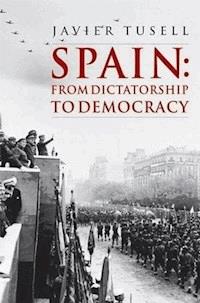
This comprehensive survey of Spain’s history looks at the major political, social, and economic changes that took place from the end of the Civil War to the beginning of the twenty-first century.
- A thorough introduction to post-Civil War Spain, from its development under Franco and subsequent transition to democracy up to the present day
- Tusell was a celebrated public figure and historian. During his lifetime he negotiated the return to Spain of Picasso’s Guernica, was elected UCD councillor for Madrid, and became a respected media commentator before his untimely death in 2005
- Includes a biography and political assessment of Francisco Franco
- Covers a number of pertinent topics, including fascism, isolationism, political opposition, economic development, decolonization, terrorism, foreign policy, and democracy
- Provides a context for understanding the continuing tensions between democracy and terrorism, including the effects of the 2004 Madrid Bombings
Sie lesen das E-Book in den Legimi-Apps auf:
Seitenzahl: 1075
Veröffentlichungsjahr: 2011
Ähnliche



















Contents
Cover
Half Title Page
Title Page
Copyright
Note on the Author
Introduction
Franco: Biography and Political Practice
Francoism: A Form of Dictatorship
Victors and Vanquished: The Disasters of the Civil War and Repression
Exile and the Start of the Postwar Period in Spain
Bibliography
Notes
Chapter 1: The Temptation of Fascism and the Will to Survive (1939–51)
A Failed Attempt to Make Spain Fascist
The Temptation to Intervene and Internal Conflict (1940–2)
Stumbling Progress towards Neutrality (1942–5)
Cosmetic Change: Regime Politics between 1945 and 1951
Opposition from Survivors: The Spanish Left from 1939 to 1951
The Monarchist Alternative
Franco in Isolation
The “Dark Night”: Autarchy and Rationing in the 1940s
Culture: Penance and Survival
Bibliography
Notes
Chapter 2: The Years of Consensus: The High Point of the Regime (1951–65)
The End of International Isolation: The Concordat and Pacts with the United States
Spain and Europe: Colonization of Morocco Ends
The Regime and the Opposition up to 1956
A New Political Opposition
For or against Falange: Political Life under the Regime between 1956 and 1965
The Easing of Autarchy and the Change in Economic Policy
From Political Opposition to Social Opposition
Culture in the Francoist Middle Period: The End of the Penitential Years
Daily Life and Leisure Activities
Bibliography
Notes
Chapter 3: Economic Development, Apertura, and the Late Franco Years (1966–75)
Economic Development in the 1960s and 1970s
The Modernization of Spanish Society
The Change in Spanish Catholicism
Apertura (1965–9)
The Succession. Matesa and Internal Splits in the Regime
Worker Protest. Terrorism
Late Francoism: Carrero Blanco as President
Late Francoism: Arias Navarro’s Government
Opposition Activity: The Road to Unity
Spain and the Western World
Late Decolonization: Guinea and the Sahara
A Politically Committed Culture?
Spain at the Time of Franco’s Death
Bibliography
Chapter 4: The Transition to Democracy (1975–82)
The Monarchy: King Juan Carlos I
The Death-throes of the Past
Adolfo Suárez: The Road from Liberalization to Democracy
Facing Difficulties: Terrorism and the Military Coup
Parties and Elections
The Long Road towards a Constitution
An Unresolved Issue: Nationalism and Terrorism
The Triumph and Fall of Adolfo Suárez
The Army and the Transition: February 23
Calvo Sotelo’s Government and the Crisis in Center Politics
Foreign Policy
Economic Policy and Social Change
October 1982: The End of the Transition
Bibliography
Chapter 5: Consolidating Democracy: The Socialist Government (1982–96)
Felipe González and the Two Souls of Spanish Socialism
The Socialists’ First Term in Office. Reform of the Armed Services, an Economic Update and Foreign Policy
A Means of Consolidating Democracy. The GAL
Elections and Public Opinion in the Second Half of the 1980s
The Second Term in Office: Social Policies and Union Protests. Spain and the World
Policy on the Autonomous Communities: A New Vertebrate Structure for the Spanish State
The Loss of an Absolute Majority
A Tense Term of Office (1993–6)
The 1996 General Election. Drawing up the Balance on the Socialists’ Time in Government
Culture in the Post-Franco Period
From of Rediscovery to a State Culture
Fields of Creativity
Bibliography
Chapter 6: The Turn of the Right (1996–2004)
The Popular Party in Power: José María Aznar
Success in Economic and Social Policies
The Dark Side of the Right
A Pluralistic Spain: Nationalities and Terrorism
Government and Opposition. The Elections in March 2000
The Style of Government with an Absolute Majority
The Limits of PSOE Renewal
Dramatic Basque Elections
The Policy of Making Pacts and Breaking with Consensus
The PP: Idyllic Peace and Neo-conservatism
From More to Less: Government Policy in the Second Four-year Term
The Final Straight
Bibliography
Notes
Index
Spain, from Dictatorship to Democracy: 1939 to the Present
A HISTORY OF SPAIN
Published
Iberia in Prehistory*
María Cruz Fernández Castro
The Romans in Spain†
John S. Richardson
Visigothic Spain 409–711 Roger Collins
The Arab Conquest of Spain, 710–797 Roger Collins
The Contest of Christian and Muslim Spain 1031–1157†
Bernard F. Reilly
Spain’s Centuries of Crisis: 1300–1474 Teofilo Ruiz
The Spain of the Catholic Monarchs 1474–1520 John Edwards
Spain 1516–1598: From Nation State to World Empire*John Lynch
The Hispanic World in Crisis and Change, 1598–1700*
John Lynch
Bourbon Spain, 1700–1808*John Lynch
Spain in the Liberal Age: From Constitution to Civil War, 1808–1939 Charles J. Esdaile
Spain: From Dictatorship to Democracy. 1939 to the Present
Javier Tusell
Forthcoming
Caliphs and Kings 798–1033 Roger Collins
Spain 1157–1312
Peter Linehan
* Out of print
† Print on demand
This paperback edition first published 2011© 2011 Javier TusellTranslation © 2011 by Rosemary Clark
Edition history: Blackwell Publishing Ltd (hardback, 2007)
First published in Spanish as Dictadura franquista y democracia, 1939–2004 by Crítica, 2005
Blackwell Publishing was acquired by John Wiley & Sons in February 2007. Blackwell’s publishing program has been merged with Wiley’s global Scientific, Technical, and Medical business to form Wiley-Blackwell.
Registered OfficeJohn Wiley & Sons Ltd, The Atrium, Southern Gate, Chichester, West Sussex,PO19 8SQ, United Kingdom
Editorial Offices350 Main Street, Malden, MA 02148-5020, USA9600 Garsington Road, Oxford, OX4 2DQ, UKThe Atrium, Southern Gate, Chichester, West Sussex, PO19 8SQ, UK
For details of our global editorial offices, for customer services, and for information about how to apply for permission to reuse the copyright material in this book please see our website at www.wiley.com/wiley-blackwell.
The right of Javier Tusell to be identified as the author of this work has been asserted in accordance with the UK Copyright, Designs and Patents Act 1988.
All rights reserved. No part of this publication may be reproduced, stored in a retrieval system, or transmitted, in any form or by any means, electronic, mechanical, photocopying, recording or otherwise, except as permitted by the UK Copyright, Designs and Patents Act 1988, without the prior permission of the publisher.
Wiley also publishes its books in a variety of electronic formats. Some content that appears in print may not be available in electronic books.
Designations used by companies to distinguish their products are often claimed as trademarks.
All brand names and product names used in this book are trade names, service marks, trademarks or registered trademarks of their respective owners. The publisher is not associated with any product or vendor mentioned in this book. This publication is designed to provide accurate and authoritative information in regard to the subject matter covered. It is sold on the understanding that the publisher is not engaged in rendering professional services. If professional advice or other expert assistance is required, the services of a competent professional should be sought.
Library of Congress Cataloging-in-Publication DataTusell, Javier, 1945–2005[Dictadura franquista y democracia, 1939–2004. English]Spain, from dictatorship to democracy : 1939 to the present /Javier Tusell; translated by Rosemary Clark.p. cm. – (History of Spain)Includes bibliographical references and index.ISBN 978-0-631-20615-6 (hardcover : alk. paper)ISBN 978-1-444-33974-1 (paperback : alk. paper)1. Spain–Politics and government–1939–1975. 2. Spain–Politics andgovernment-1975– 3. Francoism. I. Title.DP270.T835 2007946.08–dc222006036157
A catalogue record for this book is available from the British Library.
This book is published in the following electronic formats: ePDFs [ISBN 9780470766484];Wiley Online Library [ISBN 9780470690031]
Note on the Author
Javier Tusell (1945–2005) was Professor of Contemporary History in the Universidad Nacional de Educación a Distancia (Spain’s Open University) and a leading figure among the intellectuals of post-Franco Spain. The author of many books on the history of modern Spain, he was held in high esteem for his scholarship and judgment and recognized as supreme in his access to contemporary sources. By the time he came to write the present work he had reached his prime, but was then cruelly cut down by terminal illness which afflicted him for the last years of his life. He completed the research and writing, and bequeathed the results in this masterly account of a people in transition from dictatorship to democracy, a book which is evidence too of his personal triumph over adversity.
John Lynch, Series Editor
Introduction
On May 19, 1939, a hundred and twenty thousand soldiers paraded before Franco in Madrid. The press hailed the ceremony as the victory following a second reconquest of Spain’s enemies. During the march-past, the general was awarded Spain’s highest military honor, the Grand Cross Laureate of San Fernando. Although the public was not informed, Alfonso XIII himself had written to Franco pledging his support. The king was unaware that the general was no longer a monarchist and indeed was now playing absolute monarch himself.
The celebrations continued with a religious ceremony the following day. Franco entered the Church of Santa Barbara beneath a palium – a treatment reserved for the Blessed Sacrament and for ruling monarchs. Awaiting him in the church was a selection of artifacts that evoked Spain’s past struggle against the Infidel. Every detail in the appearance of those present alluded to past tradition, not only the military uniforms and ecclesiastical robes but also the “Spanish mantillas worn with pride on tall combs” by the not very numerous women present. The climax of the religious ceremony was the moment at which Franco laid down his sword of victory before the Christ of Lepanto, brought all the way from Barcelona for the occasion. Everything combined to glorify the great leading figure of the entire ceremony. The Primate of Spain, Cardinal Gomá, prayed that God “in His mercy and in praise might look kindly upon you, forever protect you and protect the nation whose governance He has entrusted to your care.”
The entire ceremonial, which more properly belonged to a medieval warrior society in which military, political, and religious life were bound together, largely explains what happened after 1939. If ever there has been a crucial break in continuity in Spanish history it was at that moment, at the end of the Civil War. If the war had never happened, if it had not lasted so long, or if there had been less bloodshed, continuity between the 1930s and 1940s would have been conceivable. Yet although there was a clear intention to make such a break, it was altogether less clear exactly what form it should take. The repression already exercised during the war years was a foretaste of the treatment that would be meted out to the vanquished, while friendship with Germany and Italy defined Spain’s foreign policy; yet decisions still needed to be taken to determine whether Spain’s dictatorship would be personal or fascist, how long it would last, and, above all, how it would function.
So far, circumstances and expediency rather than a political program had decided matters. If anything characterizes the victors of the Civil War it is that while the conflict lasted, instead of attempting experiments in new kinds of social structures as their enemies had done, they left that for later. If we consider Francoism in total, from the perspective of its earliest days, its end, and its duration, it is evident that a fundamental change did occur in Spanish society, but not in the way that those who exercised power had in mind. An observer able to compare the Spain of 1939 with the Spain of 1968 would have judged them to be two entirely different worlds. Yet, although there were evident changes, there were also undeniable examples of continuity, especially obvious in anything relating to the exercise of political power. There is, therefore, no better way of approaching the history of Francoism than by taking these factors as a starting-point.
Franco: Biography and Political Practice
The traits of Franco’s character, particularly his apparent impenetrability, may tempt historians to try to play amateur psychologist with a person who in actual fact was more straightforward than he appeared. When this happens, discussion remains superficial; yet a dictatorship which was by nature personal demands careful consideration of the one who held the monopoly of power.
Born in 1892 in El Ferrol into a family with a history of two centuries of service in the Spanish Navy, Franco’s childhood was not a happy one, though this factor alone does not explain his life as a whole. His father lived apart from his mother and was not officially acknowledged until his death. This explains the boy’s strong emotional attachment to his mother, which contributed to forging a cautious, withdrawn character but one that was, at the same time, susceptible to the wildest flights of ambition. An even stronger influence in the molding of his character must surely have been his early entry to the Military Academy at Toledo as the youngest cadet in his year. The sinking of the fleet denied him the possibility of joining the Navy: that is why he summed up 1898 in the three words “injustice, betrayal, desertion by Europe.” At the Military Academy, his progress was not brilliant. In contrast, after a quick transfer to the Army in Africa, he gained a series of brilliant promotions and was mentioned in dispatches, always at the head of crack troops, first in the Regular Forces and then the Foreign Legion. On five occasions, he was rewarded for conduct on the battlefield. Although Franco’s family had suffered no economic difficulties, it is possible that his marriage to Carmen Polo in 1923 was a step forward for him personally. In the 1920s he led an intense social life that, in his own words, allowed him to “make contact with men who were prepared.” The general himself at 33 now felt “ready for great responsibilities.”
He no doubt meant political responsibilities and it is important to remember in that respect that early on his opinion swung against what he considered dominant “myths.” His Diary of a Footsoldier reveals the mistrust he felt towards liberal politics, in his view unable to achieve anything other than “years of stumbling steps and tentative truces.” But it was the divergence in opinion on military policy in Morocco that brought about confrontation with Primo de Rivera, though it did not last for long. In the draft of his memoirs Franco acknowledges that he welcomed the Republic “enthusiastically.” Disappointment followed swiftly, however, and he blamed all the ills of that regime on “ambitious failed politicians” and on Freemasonry. He soon adopted an attitude of “cold detachment” towards the regime, though not too obviously. From the end of the 1920s onwards he received anti-communist propaganda, and the revolution of October 1934, which he took an active part in putting down, was a turning-point in his life. His tardy commitment to the conspiracy against the Republic can be explained to an extent by his mixture of prudence and opportunism, but also by the fact that he had never been a “politicized” soldier to the same extent as many of his comrades-in-arms.
Lesen Sie weiter in der vollständigen Ausgabe!
Lesen Sie weiter in der vollständigen Ausgabe!
Lesen Sie weiter in der vollständigen Ausgabe!
Lesen Sie weiter in der vollständigen Ausgabe!
Lesen Sie weiter in der vollständigen Ausgabe!
Lesen Sie weiter in der vollständigen Ausgabe!
Lesen Sie weiter in der vollständigen Ausgabe!




