


Erhalten Sie Zugang zu diesem und mehr als 300000 Büchern ab EUR 5,99 monatlich.
- Herausgeber: Wilton Square
- Kategorie: Sachliteratur, Reportagen, Biografien
- Sprache: Englisch
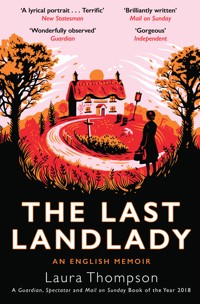
'An eclectic mix of social history and elegy, ironic comedy and indelible Englishness. It is about the pub as theatre' The Spectator Laura Thompson's grandmother Violet was one of the great landladies. Born in a London pub, she became the first woman to be given a publican's licence in her own name. Just as pubs defined her life, she seemed in many ways to embody their essence. Laura spent part of her childhood in Violet's Home Counties establishment, mesmerised by her gift for cultivating the mix of cosiness and glamour that defined the pub's atmosphere, making it a unique reflection of the national character. Her memories of this time are just as intoxicating: beer and ash on the carpets in the morning, the deepening rhythms of mirth at night, the magical brightness of glass behind the bar… Through them Laura traces the story of the English pub, asking why it has occupied such a treasured position in our culture. But even Violet, as she grew older, recognised that places like hers were a dying breed, and Laura also considers the precarious future they face. Part memoir, part social history, part elegy, The Last Landlady pays tribute to an extraordinary woman and the world she epitomised. It was selected as a Spectator book of the year in 2018.
Sie lesen das E-Book in den Legimi-Apps auf:
Seitenzahl: 351
Veröffentlichungsjahr: 2026
Das E-Book (TTS) können Sie hören im Abo „Legimi Premium” in Legimi-Apps auf:
Ähnliche


















Laura Thompson read English at Oxford. Her first book, The Dogs, won the Somerset Maugham Award. While living in Newmarket she wrote two books about horse racing, followed by a biography of Nancy Mitford and a major study of Agatha Christie, reissued in 2018 in the US. Her book about Lord Lucan, A Different Class of Murder, was also reissued in 2018.
Take Six Girls, a group biography of the Mitford sisters, published in the US in 2016, was a New York Times bestseller. Her most recent book, Rex v Edith Thompson, about the Thompson-Bywaters murder case of the early 1920s, has been longlisted for a CWA Gold Dagger award.
By the Same Author
Life in a Cold Climate: Nancy Mitford theBiography
Agatha Christie: An EnglishMystery
A Different Class of Murder: The Story of LordLucan
Take Six Girls: The Lives of the MitfordSisters
Rex v Edith Thompson: A Tale of TwoMurders
‘It was astonishing how significant, coherent and understandable it all became after a glass of wine on an empty stomach … One realized all sorts of things. The value of an illusion, for instance, and that the shadow can be more important than thesubstance.’
From Quartet by Jean Rhys
‘There is nothing which has yet been contrived by man, by which so much happiness is produced as by a good tavern orinn.’
From Boswell’s Life ofJohnson
CONTENTS
By the Same Author
Chapter I
Chapter II
Chapter III
Acknowledgements
Copyright
I
W hen I think of my grandmother, it is thus: seated on a high stool, her stool, in the negligent but alert position of a nightclub singer. Behind her, a cool brick wall, whose edges made little snags in the satin shirts that she wore loose over trousers. One of her hands rested on her thigh, not quite relaxed, holding a glass.
Her hair was white but not a grandmotherly white. She went regularly to the salon on the top floor at Harrods, a fairyland pink parlour in those days, its air dense and shimmering with little starbursts of Elnett. She would come home with tales of her hairdresser’s love life (somewhat pitiable) and green and gold bags full of Estée Lauder cosmetics. From middle age onwards she disdained most products that were not by Estée Lauder, and there was never any arguing with her. The collars of her shirts were impregnated with Alliage scent, and the Re-Nutriv cold cream on her dressing table bore the marks of her fingers dragged across its surface, like little furrows in snow. She wore dark foundation and a deep red lipstick. Even now I feel that I am letting her down if I do not paint my lips.
So here she is: a casual empress on her stool, a woman in late middle age with a brightness, an intensity of being, that still flares in my head. Mysteriously moving, to feel memory shaping her as I write … which reminds me quite suddenly of a camera that she owned, a huge thing with a blue flashlight on top. After the blinding click the photo would ooze slowly out of the camera, a hot square with a white frame around indeterminate dark blobs. My grandmother would clamp it beneath her arm, waiting for it to develop against the warmth of her body. If it didn’t flatter her, she would simply throw it away, ripped quickly in two, before anybody else could see it.
Because of her instant culls, many snapped moments are lost, which I suppose is a pity, but I rather like it that way. Photos are finite and unarguable. I prefer the images that are stored in the mind, the precious surprises that they spring (which of course you are springing upon yourself), their magical areas of occlusion and sharpness. Quite unexpectedly I can see, for instance, the slightly pigeon-toed angle of my grandmother’s feet, looking older than the rest of her, placed upon the bar of her stool. I can see how she was framed, by the open wooden door to her left, and the counter on which she would lean her right forearm. I can see the texture of the counter, although I have no idea what it was made of (I might know now; these are childhood memories). It was shiny, orange-coppery in colour, hammered with tiny dents, wet where one least expected it to be. And it was covered with the evening’s ecstatic confusion: beer mats, glasses, a sturdy blue-green ice bucket, a couple of siphons, the large square ashtray into which my grandmother stubbed her Player’s untipped.
Her glass, which was her own thick tumbler, contained whisky and soda. She loved alcohol with a respectful, tender passion, and nursed the glass rather as she did her little dogs (she owned chihuahuas, years before they became fashionable), although she drank from it only occasionally. Just a deep sip, now and again, to maintain her dégagée buoyancy. She had learned to phrase her personality, as a singer phrases a lyric; she knew the power of withholding, and of brief conspiratorial bursts of charm. People bought her drinks all the time, seeking to please, and she usually accepted them. She would raise her glass in thanks (‘Cheers, darling!’), put it to her mouth, and then throw the contents on the floor. A strip of carpet beside her stool was permanently damp with whisky. Although she did her drink-chucking surreptitiously, as she believed, everybody knew that she did it. It was part of her legend, like her stage whispers and her London childhood.
Around her shining silvered head – the beacon of the pub – the picture is vaguer. She was the person who conjured and orchestrated everything, so naturally the spotlight of memory follows her around. For example, I see again how, when the evenings were busy, she would slide unobtrusively from her stool in the public bar to the other side of the counter, and instantly take up the role of barmaid-in-chief. As she did so, the way in which drinks were served changed, became theatrical. She tugged at beer handles and shoved glasses under optics, hacked at lemons and ripped off bottle tops, all with an untidy, efficient grandeur that invested every drink with a particular potency. People would sip reverentially, eyes briefly closed. ‘Oh, that’s lovely, Vi.’ This may not have been illusory; the strength of her drinks was also legendary (her gin and French was akin to a knockout punch). Her horror of smallness, exactitude, led her to throw in extra measures of spirits, ice, whatever was going. Meanwhile the round would grow, it sometimes seemed exponentially, or possibly eternally, if the buyer was generous: people who had been served first would be finishing their drink while the round was still in play, so in theory this was a situation that could go on for ever. ‘You’d better have another one, boy, while I’m in the mood.’ ‘Go on then, boy, if you say so.’
Oh yes, they’re good drinkers, my grandmother would say the next day, in a tone of the utmost seriousness.
‘Have you got one?’ ‘Yes, I’ve got one!’ ‘What about you, have you got one, girl?’ ‘Oh, I’m all right.’ ‘I know you’re all right, but have you got one?’
The till behind the counter was a hefty chunk of Bakelite, grey and immovable, with a drawer that regularly jammed but could flatten your breasts when it deigned to spring open, and powerful keys that bore the symbols of numbers but did nothing so recherché as adding them up. Therefore alongside the lemons and cherries behind the bar were dank little notepads, on which the cost of a round might be calculated.
This was not really my grandmother’s style. She had never gone to school, or so she said (in fact she spent several terms at a London convent, perhaps the only girl named Solomon ever to have done so), and she never got to grips with decimalisation. She could have done, but she could not be bothered. ‘55p’ for a shot of gin meant ten bob, sort of; thus the niminy-piminy increases demanded with every Budget were absorbed into her large-scale nature. Thus, too, the giant rounds that formed the climax of so many evenings were totted up and rounded down to a sum that she thought acceptable. ‘Call it a tenner, darling.’ ‘How do you make that out, Violet?’ my father would say, in a droll tone that added to the general delight at seeing her legend in action. God knows how many Estée Lauder lipsticks she missed out on with these habitual underestimates. Often people would remonstrate with her, demanding that she take more money, forcing pound notes into her recalcitrant hands. These were the right sort of people, her sort, the kind who fought to pay more while she fought to take less. If the wrong sort came in to the pub, she could become surprisingly mean. In the early evenings she would lay out free food on the counter: the centrepiece was a huge wedge of Cheddar, stabbed in the heart with a cheese knife, surrounded by an overlapping necklace of Ritz crackers. Tacitly, it was understood that this was for regulars. Passing trade might take a sliver of cheese, a gherkin or two, not more. Every now and again some hapless person, who did not know the code of the pub, would order something like a lemonade shandy and hack away happily at the Cheddar. At such times my grandmother became concentrated and dangerous. She would scythe through the saloon bar into the public, seize the plate of cheese and take it into the kitchen. ‘Hungry sod,’ she would mutter furiously. ‘I’m not taking it out again till he’s gorn.’
It was things like this that I didn’t understand, as a child. I simply absorbed it all.
I spent much of my early life at the pub. My grandmother was a babysitter, of sorts. This was a time when adults led their own lives, rather than fretting around those of their offspring, and my parents went out a great deal. My father was a racing man, which meant thrice-weekly nights at the dogs (to which I was sometimes taken); also, not infrequently, the horses. In those days of the 1970s, big races like the Derby were run during the week. My grandmother would pick me up from school in her dark blue MG, which she drove dashingly and badly, with much angry wobbling of the gearstick. Her face would be half-done for the evening, her hair in curlers under a Jacqmar headscarf. If I found her waiting for me, she would be peering in the car mirror, quite possibly with tweezers in her hand. She looked superbly incongruous, sitting there among the neat spillages of uniformed pupils. She would have watched the racing on television, and had her bets, and remembered the Derbies she had seen ‘before the war’, watching from a bus in the centre of the course; and that, elliptically, is what we talked about on the drive to the pub. ‘What did you do at school today?’ was not in her repertoire of remarks. Unlike her daughter, my mother, she had no interest in even simulating an interest in the world of childhood, and I completely accepted this.
I felt a sweet apprehension as the MG rounded the bend in the long village road and I saw the inn sign, swinging high in the air on its gallows. Even then, I realised something about pubs: that they were home but not quite home. They were as dear and familiar to people as home, but they were also the place where people escaped from home.
The pub, situated in the rural Home Counties, was very small, very old and extremely pretty. To me it seemed enchanted. It had a trimly thatched roof, shuttered windows, white walls with a wobbly grid of black beams – the works – and its classic English chiaroscuro was splashed, in summer, with profusions of colour from hanging baskets that dripped with water (the principle of ‘a good drink’ extending to the flowers). It looked like an artist’s sketch upon the landscape, framed by hills that hovered calmly in the distance. Across the narrow road, seeming at times to overspill its bounds, was a towering tangle of ancient woodland. The village was set on a steep incline, and so too therefore was the pub. Everything sloped, giving a tumbledown feeling to the stone-paved courtyard outside the front doors, which was set with a couple of tables. The large garden, always called ‘the orchard’, rolled sharply away towards fields that my memory sees as infinite.
So: a near-perfect specimen of the country pub. Like all the best pubs, however, it was completely un-twee. Held within its quaint exterior was a red-lit world of sophistication, sentiment, vulgarity and warmth. This came partly from its communion with my grandmother, who was not quaint in any way, and not good with the kind of person who asked jovial, pedantic questions about her ‘ales’ or was liable to use the word ‘hostelry’. It was easier to imagine her serving Reg Kray than, say, a group of map-clutching ramblers (although these did occasionally come in, fresh from the ancient woodland in which I once had a close escape from a pervert. I was shaken but not shocked: my pub training).
Indeed she was, on the face of it, an unlikely landlady for this dear little place, which looked like the home of a traditional blacksmith, or of a countrywoman with geese and a herb garden. With her Harrods hair and gold ankle chain, my grandmother should have been as out of place as a showgirl running a WI cake stall. Yet somehow this was not the case. For a start she was never out of place, in the sense that she never worried about such things (she would have remained entirely herself if transported to Holloway jail or Buckingham Palace). And then, she imprinted her own personality upon the pub: such was her power as a landlady. She bestrode the bars, she infused them with her style. At the same time, again like a great landlady, she knew what not to do. She respected the pub, rather as she would have respected a man. She allowed it its natural vigour. For all that it looked so picturesque, it had a kind of steel in its soul: it too rejected the implications of its appearance. Georgie Pillson might have turned up to paint it, but he would soon have fled in terror. It was rooted in a village of farmers and butchers, it was a mere couple of miles from a town of committed gin-drinkers and adulterers; in sum, it was robust and real and belonged to life, not to an image of what a pub should be. It had stood for almost 550 years, and age had given it complete assurance. It had the almost sunken air of a place that knew exactly why it was there; and never more so, I am fairly sure, than in the years of its alliance with my grandmother.
As was obvious from its roadside position, it had originally been an inn. An old photograph shows a sign offering ‘stabling’. Such was its antiquity (it had listed status) that treasures had been unearthed from it – a painting was removed to the National Gallery. Typically, my grandmother’s recollection of this was vague. So too when historical societies visited the pub. The members would enter in a polite, bright-eyed, expectant mass of tweed jackets and dirndl skirts, smiling blindly into the dour faces of farmers, then gather in front of a plaque in the saloon bar. They would repeat in obedient whispers the words that I knew by heart, that the inn was an ‘ancient monument’ built during the Wars of the Roses, that some of its beams were original, etc., etc. If my grandmother chanced to float through the bar, they would pounce, asking pleasant, historian-type questions that she could not answer (she would have breezed over this, ‘ah well, ma’am/sir, nobody really knows …’ but she never liked being at a loss). Not that she was indifferent to the provenance of the pub. She was fiercely proud of everything about it. She simply saw things, including the past, in her own way.
Her history was enough for her, and the past, to her, meant pubs. She was born, a century ago now, in Paddington Green. Her father, who always worked in pubs, later ran his own establishment. So too did some of her relations and most of her friends, ‘old Jim and Hilda at the Star and Garter’, or ‘old Bernard at the White Horse’, or whoever it might be. She spoke as if everybody, me aged six included, should know who they were: as if publicans were a famed species. On a drive she would always peer at any pubs she passed, rather as if they were her personal responsibility. She even gravitated to a pub inside Harrods, the Green Man, a delightful little anomalous dark hole in the basement beside the men’s hairdresser, where she would sit at her observational post, feet covered in green and gold bags, and drink a schooner of dry sherry. Long gone, of course.
Yes, she saw the whole of life through that particular prism, which was in fact a large and enlightened one. Pubs, to her, were not just a job. They were more like a calling. A way of being. A touchstone, a symbol. There was nothing mystical or delusional about her love of them; she knew perfectly well that they could be tawdry or nasty or criminally dull. But her greatness as a landlady came from the fact that she believed, with a true faith, that a proper pub was a beautiful thing.
At the time I am describing she had run her own pub for some twenty-five years. It was her remarkable creation, her life’s work. Yet she defined herself, or so it seemed to me, by her father’s pub: the ‘old pub’. This was the place that had shaped her, to the point where she and pubs became as one, and the rhythms of pub life as instinctive to her as breathing. The landlady was not merely a persona that she assumed. From an early age it had become indivisible from her nature.
Had her formative years not been spent in a pub, had she been the daughter of a solicitor (for instance), she would obviously have grown up different. How, it is impossible to say. It is also absolutely impossible to imagine. A housewife? An office worker? How would those lives have encompassed her? Without the demanding refuge of the bar, what would have happened to that bohemian soul of hers? I think that she would always, somehow, have displayed the true pub qualities: the toughness, the bonhomie, the spaciousness of spirit, the commonplace daily courage, the refusal to judge alongside the implicit steadfast standards. But because of her environment, these qualities were set free and writ large.
I have no idea if she herself thought this way. She was wonderfully free of introspection. This was key to her character. She did not analyse, and she did not dwell on things. Her memories of the ‘old pub’ were not nostalgic, exactly; rather they helped her to keep the past fused with the present.
Above all – and again this was what pubs required – she had a tireless ability to push her personality outwards. She did this willingly, with an effort that was also an instinct, even after her life at the pub was over. It was extraordinary, really. Nobody who met her was resistant to her. What a force she was! Aged ninety she would prowl through our local Morrisons, a small, powerful figure in her loose leopard-print coat (bought in Beauchamp Place in the late 1970s), slow but full of restless energy, fingers twitching with the old irritable urges to shape her surroundings, bestowing herself upon the boys who sullenly stacked apples and peaches (‘find us a few nice ones’), cascading a glamour through the aisles that was utterly indestructible. One of the reasons why I am bored to death by the modern obsession with female ageing is that I grew up watching my grandmother, not so much defying her years as completely untroubled by them, apparently believing that whatever age she was at the time was the right age to be. Actually she is the reason why I am bored by all modern female hang-ups, including the fact of being female itself. ‘Always thought I was slightly better than a man,’ was one of her throwaway remarks. She was the most confident woman I have ever known, Lawrence’s Anna Brangwen transported to a faintly louche and gleaming saloon bar. And she could cut away at self-importance with one good-natured sweep. My mother and I once took her to a London restaurant, much cooed over in magazines, run by a deeply silly ‘legend’ of whom most customers professed to be in awe. ‘Got a nice lobster, duck?’ asked my grandmother amiably, one host to another, as the famed maître d’ loomed over our table.
She never needed to self-mythologise in that way. Her own legend had arisen quite naturally and she let the customers bolster it, rather than doing so herself. Nor, despite her flamboyance, did she display vulgarity or gaudiness, in the manner of the cliché landlady (if such a person actually exists). She always held something in reserve. In style and demeanour she most resembled an old-style theatrical performer, a semi-retired Coral Browne or Hermione Gingold. ‘She should have been on the stage,’ my father used to say. In fact that wasn’t quite right. She had her stage already.
For a pub is a theatre in which people are playing themselves. It is a public house, after all. This is a deceptively simple title, a perfect definition of the paradox that one is at home, but also escaping from home. One is relaxed, but bracingly relaxed. The proper pub is a place where people become their public selves, rather than their private; the division of personality that makes life a business worth engaging with, and that has all but disappeared into the deadly vortex of the smartphone.
My grandmother, who had a lot of self to play, played herself better than most. She learned to do so at such a young age that it became innate; but she also saw it as a duty, and in her staunch, frivolous way she believed in duty. Put on a show, be fun, drown your sorrows, don’t be a bloody bore. Even as a child I understood, and sought to keep up a show in her presence. ‘Chin up,’ she would say, to a tale of playground perfidy; it was the pub code, which she embodied and I revered.
Of course there were dead times in her pub: it wasn’t the Algonquin (although imagine how boring that must sometimes have been! – all that relentless wit). And of course there were lots of bores in her pub. If they clearly couldn’t help it, then that was acceptable, one had compassion, but she once actually barred a cocky, creepy man for being, as she put it, ‘a nuisance to people’ – in other words a bore. He didn’t mind at all, and was back within the week, striving and failing to be bearable; even he subscribed to the code. For my grandmother, meanwhile, the notion that one would go into a public arena and behave as one did in private – slumping, subsiding, staring at a screen – was as inconceivable to her as showing the world a face untouched by the sainted Lauder.
In those days there were licensing hours, which placed a limit upon pleasure in a very English way. The twice-daily closing and opening was again, of course, exactly like theatre: lights up and down, make-up on and off, matinée and evening. Also theatrical was the separation between the bars, ‘out front’, and the living quarters: backstage. I was beguiled by this division between two worlds, this mystery, marked so simply by the discreet wooden door in the far corner of the saloon bar, which opened on to my grandmother’s sitting room. The tiny dark space in front of that door was the dead zone of the pub. It puts me in mind now of one of those music hall Sickerts, in which both performer and audience are visible. In one direction were bursts of vital, indiscriminate sound; in the other, an occluded humming near-silence.
I lived mostly backstage, during opening hours at least. My grandmother, supremely broadminded but at the same time absolutist in her diktats, was very much against children in pubs. If it was cold then they sat in the car and their parents took them a bottle of R. White’s with a straw in it (some people, much despised, would stipulate the colour of the straw). If it was warm then they had the vast ‘orchard’ at their disposal, separated from the car park by a small stone wall, a downward-sloping expanse of lawn with a swing and climbing frame at the bottom. At the top of the hill was a flat plain, laid out with tables and chairs made of white wrought iron (regularly painted, like tennis shoes). This sunlit outpost was for people who were not really of the pub: healthful types like cyclists, wholesome types who liked views, couples for whom the view formed a third party, and families. If parents tried to bring their children into the bar my grandmother was quite capable of requesting that they put them out, like dogs – although dogs were very welcome. A complaint about the child-ejection policy was once made by an aggrieved father, but she was unrepentant. She was nice to children, but always in that vague, smiling, drifting way of hers, which signified an essential lack of interest. She could not accept the pub as anything but a place for adults, preferably men, although not the kind of man who wanted to drink with a three-year-old.
I loved the orchard, not when customers were cluttering up the tables with their splayed bags of crisps and fingerprint-smeared bottles, but when it belonged to me alone. Oh, the three o’clock summer light of that garden. Running at speed from the flat plain at the top; I can still feel the sudden sharp dip in the earth, the ‘look no hands’ sense of the hill taking me down with it. Of course I remember it as bigger than it was. In later years I was honestly amazed to see that the space, though very large, was a visibly contained rectangle. Not that this changes at all the memories of hurtling towards the apple trees that gave the orchard its name, and then into the beginning of wildness, where the grass was not mowed and the early summer cow parsley reached my waist. It was a dreamscape, in which the pub became a magical house (my house) and the sloping lawn an unchanging, buttercup-studded paradise; I stood on the swing and pushed higher and higher to face the ancient woodland, lay in the grass and searched passionately for four-leaf clovers, told the time with dandelion clocks, absorbed myself in the present-tense eternity of childhood. This was when I was happiest at the pub, which is odd because I was doing things that I could do at home, so what made them so memorable? It was because afternoons in the orchard were not like ordinary afternoons. They were a parenthesis. Time was suspended but stolen; precious in a way that did not touch me, but that I recognised. Waiting at the top of the hill was the smoky palais that only masqueraded as an English country cottage, that winked slyly at the brilliance of its own disguise, that compelled me equally, and that made the orchard seem peculiarly prelapsarian: even then, I knew this.
When the stage was empty, I got to know almost every corner of it. In the early mornings – before school, or during holidays – I would go, as one entering a secret chamber, through the door into the saloon. Straight ahead, down a shallow step, insultingly adept at tripping up drunkards, was the door into the public bar. All was dark brick, fretted with heavy wood, humming with silence.
The saloon and public bars were almost identical, except in atmosphere, although at that hour atmosphere was in hibernation. One knew that it had been there, and that it would be there again, but for the moment it was holding itself in abeyance. The air was grey and uncertain, ghostly with dust, streaked with lines of smoke. A thin trail of day eased its way between the curtains; the dust motes danced where it fell, and a crazy solar system of circles gleamed on the tabletops. A brisk clearing-up would have taken place the night before but a few things lingered, like clues in a bad detective story: a couple of sodden beer mats (one perhaps with a phone number on it, never to be rung), a last defiant Embassy stubbed into the ashtrays lined up for cleaning, a shifty glass oiled with whisky dregs.
The bars were tiny. One was more aware of this, oddly, when they were empty. It seemed quite impossible that so much life could fit into them. The ceilings were low – the heads of tall men always seemed to be negotiating with them – and the spaces between the beams were dirty-mellow with nicotine. Seats were pushed up hard against the walls: black settles from the ‘old pub’, with backs curved like shields and smooth slippery seats. A pub is never truly light inside – there is always that interplay of glint and dusk – but on sunny days, with the old sash windows behind them, the settles shone like the coats of young Labradors.
The shimmering look of those early pub mornings, poised between hush and promise … only memory can reproduce their nuances of shadow and clarity, infinite in their imprecision. And memory also holds the hovering quiet, broken by the tentative creaks of the floor, the drip of tap or optic. It holds textures: the beams solid and splintery to the touch, and the stone surrounds of the giant fireplaces rough and cold. Hidden behind these surrounds were shallow seats, ledges built into the stone. These were a great delight to me, although (and despite my obsession with kings and queens) I never pondered the fact that people must have sat on those ledges since the time of Henry VI. The history of the pub was a feather in its cap, no question, but the historical-society view was somehow irrelevant. The plaque in the saloon bar described the pub as an ancient monument. For sure it never behaved like one. Like my grandmother, it revered its past but absorbed it into the present; in a good pub, the accretions of memory are palpable, but all time is the same.
At the heart of the pub was the bar itself. The coppery counter, which formed an L-shape, faced the public bar and looked sideways on to the saloon. Behind it, in the pungent little space that would barely hold three people, I would serve pretend rounds and put my nose – later my appalled tongue – to the different drinks. Here, I knew, was the alchemist’s headquarters. I can remember every detail: to my right hand were two beer pumps – Tankard and (far less popular) Trophy – plus a pump of Heineken, with plastic trays beneath that constantly overflowed. When the barrel was changed the pump was as lively and spiteful as a tiger cub, the first pint an explosion of what looked like whisked egg white. Beside the pumps was a wrench for removing bottle tops, above a rusty tin box into which they theoretically fell; there was also a pedal bin, but that too was a hit-and-miss receptacle. When the pub got busy, and the banknotes were waved and waggled by a towering criss-cross of hands (always male hands), nothing mattered except getting people served: rubbish could pile up at one’s feet, cigarettes could shrivel to grey tubes, the sink could block, the very world could end, but old Mick would get his large Bell’s, ‘When you’re ready, duck …’ The sink was at the front of the bar, beneath the counter. In the course of an evening it became murky with slops, and the water level rose to dark and alarming levels. The square of dark red carpet was soaked with spills and scored with ash: everybody smoked behind the bar. Occasionally a customer would hold up a glass to show a drink flecked with grey-black. ‘Cheeky sod,’ my grandmother would say, meaning that she disliked having been caught out. On the lower shelves were rows of bottles: mixers – R. White’s, Britvic, Schweppes (you know who); Guinness (is good for you), Double Diamond (works wonders), Mackeson, Bass; Cherry B, Babycham, Moussec; and at the bottom, dusty and terrible as bottles of strychnine, the fearsomely strong White Shield and barley wine.
The shelf beside the till was always damp and slimy. Here were the lemons, oozing pips on their little chopping board; the sticky cherries speared with cocktail sticks; the pads and pens; the silver drink measures, which my grandmother thought embarrassingly inadequate and basically ignored – also more arcane items, Angostura, Lea & Perrin’s – and what would now be item-in-chief, a sole bottle of white wine, which then held almost no interest at all. Wine was what one drank, possibly, with dinner. One female customer, splendid as a shire horse, would ask for what she called a ‘double wine’, meaning two glasses poured into another, much larger glass; otherwise the scented Liebfraumilch in its flowery bottle took its humble place beside the Stone’s Ginger Wine (for a whisky mac) and the Bols Advocaat (for a monstrous concoction known as a ‘snowball’, in which the thick yellow stuff was puffed up with lemonade like a soufflé). There was also Rose’s lime juice, which might be dashed into lager for a cost of 5p, although one customer found this a bridge too far. ‘A pint of lager,’ he would say, and pause. ‘With some lime,’ meaning as an afterthought, an adjunct, for which payment was unnecessary.
At eye level were the bottles of spirits, hanging upside-down in front of a mirror. The prices stuck untidily on the optics – 50p, 65p – were changed after every Budget: always a black day, on which the plate of cheese was temporarily withdrawn (‘can’t afford to do that now’). On the glass shelf above was another level of bottles, rarely opened although even more gorgeous and glittering, their contents the colours of jewels: curaçao, grenadine, Drambuie, Green Goddess, Parfait Amour, and crème de menthe (‘tart’s drink’), for which ice had to be crushed in a little mincer. Cigarettes were stacked in rows, and the cellophane-shiny colours of Dunhill, Benson & Hedges and St Moritz gleamed beneath the golden bell for calling time. On the high shelves around the front of the bar were the inverted tumblers and goblets (so demure in size compared with those of today), which my grandmother polished every morning in her carelessly capable way. Pint glasses swung from hooks in the shelves, catching stray diamonds of light. A couple of white drying-up cloths flopped across the counter in an attitude of exhaustion. In the dark sink below, a gathering of what had once been lemon slices lay around the plughole in a shallow pool of spume.
At this hour, the bar was drained of colour, its sheen dimmed, tired and unlovely like the morning bodies of the people it had served the night before. Yet throughout the day it would take on warmth and light, to the point when – to those who could not see the overflowing beer trays, the sink full of foaming water, the litter of bottle tops and fag ends – it became luminous, configurative, the gleam of glass and mirror and electricity so much refracted as to fuse into an absolute of light. It was a shining cave of plenitude, a lucent vision that a child might dream, that offered a promise and haven of the most adult kind.
In the public bar was the door to the cellar. From the outside this looked like a thatched wooden barn attached to the pub, sloping downwards along with everything else. The giveaway was the low double-door, opened when the barrels were changed (a sadistically noisy business, like an industrial blood transfusion). The ‘barn’ stood above the cellar proper. It had been built by the brewery in the 1950s, when my grandmother was not long at the pub, and its chilly interior was like a large cell. It contained my grandmother’s accounts, one of the few things that could make her panic; stacked boxes of Walker’s crisps, behind which I once surprised a semi-dressed couple; and the ice machine. Ice: what a tyrant. Perfectly nice people became touchy if they felt that their drink did not contain its full quota (there were also those who, fearing any weakening of the drink, would sternly forbid its presence). Busy evenings meant the frequent crowd-surfing passage of empty ice buckets to whoever was willing to fill them – sometimes a good-natured customer – and every night held the unspoken prayer that nothing should go wrong with the ice machine. I remember its arrival, the wonder of all those cubes. Before that there had been a constant filling and disgorging of ice trays. As a girl, my grandmother had wheeled a pram every day containing a miniature glacier (from the local tannery) back to her father’s pub, where it would be chipped at like a sculpture.
The cellar at the old pub – paradoxically, a much newer establishment – had run underneath the whole ground floor, and served as an air-raid shelter during the war. At my grandmother’s pub, the cellar proper was a true medieval oubliette, big enough for nothing but barrels, a grey hollow reached by a twisting staircase of rock-like steps. Before the barn was built, one opened the cellar door and was launched straight at the staircase; enormously dangerous, although nobody thought that way. In the early years of the twentieth century, jugs of beer were filled straight from the barrels. Down and up went the bartender, down and up the treacherous grey steps.
What with the wildly thrumming barrels and the juddering whirr of the ice machine, the cellar always seemed to shake, and it smelled fiercely of beer and cold stone. Smell, of course … the pub in the mornings had an acid, weary smell that I can still conjure, bred from the coupling of booze and smoke: a smell of aftermath. Cleaning was not the answer, what was needed was more of the same – a fresh new pint pulled, a pristine cigarette sparked up, the hair of the dog principle as a guide to life; nevertheless, by 8.30 a.m. the beer-fag miasma was penetrated by a powerful stream of disinfectant from a tin bucket propped against the door of the Gents’ in the public bar. Within I could hear Mrs Brennan, the cleaner, banging around with her mop, singing wheezily, ‘yew were meant, for me … and ay was meant, for yew!’ She had hair permed to a crisp and an Embassy glued to her bright pink lower lip. From the open door came another smell, unspeakable, winding its way through the Jeyes fluid. I was nervous of the Gents’, and never once went inside it. The Ladies’ I loved: a lush Camay-scented cave.
Later Mrs Brennan would polish the dark red tiles around the edge of the floors, then tackle the carpets. Every morning they were newly dank, swiped with commas of ash – some of it Mrs Brennan’s own – and posing the intractable problem of the sodden strip beside my grandmother’s stool, where whisky and cleaning fluid fought for supremacy, and an unhappy mingling of the two ensued. It was not until the evening, when my grandmother was re-established in her pitch, that her rich cosmetic scent took possession of the air; although she would then recreate the original problem by throwing yet more whisky onto the floor.
The kind, industrious Mrs Brennan (who in the 1980s would become the only worker in a family of five) lived in one of the council houses along the road, beyond the woodland and towards the town, by which point the village was no longer picturesque but instead one of those hard, flat, transitional areas – neither country nor urban – in which England abounds although no notice is paid to them. The houses brandished TV aerials like antlers, and their pale lawns were decorated with ornamental lions and the like. A couple of men from these houses got a bus to the pub in the early evenings (there was a stop directly opposite, carved bathetically into the ancient woodland). In the public bar they would commune with other customers, a sparse assortment at this time, in the sidelong, semaphore way of men who would normally have nothing to say to each other: ‘all right, boy?’; ‘what you having then, mate?’; the brusque, courteous democracy of the true pub. Now this would be called ‘community’. Then, again, nobody thought that way. They simply did things.
By around nine in the morning, the day had lurched further forwards away from me, into normality, as an erratic timpani of rattling and clinking struck up to punctuate Mrs Brennan’s banging and singing. This was ‘bottling up’: the boy who did the garden – silent of person, rampantly noisy in his work – hurling the empties into crates, tipping rubbish into sacks. Soon the boy would be seated in the saloon, still silent beneath his abundance of sulky dark hair, eating the enormous savoury breakfast provided by my grandmother (she adored hungry young men) while Mrs Brennan smiled indulgently (‘bless him’) from her stool at the bar, blowing on her coffee cup in between puffs on her fag. The pair were positioned like customers, but they were a facsimile only, understudies on a stage that had lost its half-lit mystery but was not yet transfigured by performance. I had no interest in the pub at that point. As was my privilege, of which even then I was aware, I retreated backstage into the squashy warm embrace of my grandmother's sitting room.
In this other world, all was comfort and plenitude. There was nothing ‘cosy’ about it, in the peculiarly English sense of the word; it was not a room in which to ‘curl up’ and read detective stories or listen to Book at Bedtime




