


18,49 €
Mehr erfahren.
- Herausgeber: THP Ireland
- Kategorie: Sachliteratur, Reportagen, Biografien
- Sprache: Englisch
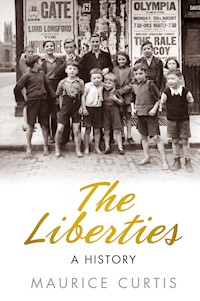
Following the murder of Thomas á Becket, King Henry II came to Ireland. He decreed that an abbey be founded close to the present-day St Catherine's church, Thomas Street, Dublin, in Becket's memory, and the monks that founded it were to be free from city taxes and rates. This 'Liberty' expanded and took in the part of Dublin which today is known as the Liberties, one of Dublin's oldest and most interesting parts of the capital, occupying a unique place in Ireland's social and cultural history. In this book, author Maurice Curtis explores this fascinating history and its significance to the people of Dublin.
Das E-Book können Sie in Legimi-Apps oder einer beliebigen App lesen, die das folgende Format unterstützen:
Veröffentlichungsjahr: 2013
Ähnliche














ACKNOWLEDGEMENTS
Many organisations made this work possible including the Office of Public Works, the Dublin Civic Trust and in particular its study, ‘Thomas Street – Proposed Architectural Conservation Area’ and other studies on The Liberties. The Dublin City Council’s Heritage Office (Dr Howard Clarke/Dublinia, Charles Duggan and Seamus Donohoe) has undertaken significant studies of the area and these were of help. The Irish Architectural Archive, An Taisce (National Trust for Ireland) and in particular John Ducie for detailed information on the significance of Tailors’ Hall; the Architecture Foundation, the Irish Georgian Society, the National Library of Ireland, the National Gallery, the Gorry Art Gallery, the National Archives, the National Museum, Dublin City Council, and the Dublin City Public Libraries (Hugh Comerford in the Gilbert Library/Archives) were all of assistance. Dublin.ie forums were indispensable for chats on The Liberties. Thanks to Archiseek (and in particular Paul Clerkin) for its many contributions on Thomas Street and Wood Quay. Excavations.ie is excellent for archaeological information. Thanks also to the Heritage Council, Friends of Medieval Dublin, and Irish Architecture for its many examinations and reflections on the area. The Royal Society of Antiquaries of Ireland was a great source for articles and old images. Dr Christopher Morash and the Smock Alley Theatre provided help on the history of the theatre. Thanks to Emmeline Henderson for her landmark Thomas Street study and likewise to Graham Hickey for his outstanding work on Meath and Francis Streets. Their studies are a must for a greater understanding of this historic and unique area of Dublin.
Particular thanks to John Gallagher of the Coombe, who combines being a local community leader, social worker, historian, campaigner and much more. He is based in Carman’s Hall and is the founder of The Liberties Heritage Association (LHA) (with Bernard Warfield who has an encyclopaedic knowledge of The Liberties, and is ably assisted by John Brogan, Wayne Deane and the team in the LHA project), and director of St Nicholas of Myra Parish Centre. The Liberties Association and St Nicholas of Myra Heritage Projects, based in Carman’s Hall Community Centre (and Gerry Graham and his busy staff), are inspiring. Additional biographical details on John Gallagher were compiled from interviews he had with Michael O’Flanagan in 2008, and author and historian Kevin C. Kearns in 1994 – particular thanks to all involved. The Liberties Living Heritage Project is proof of his energy and the vibrancy of this fascinating historic neighbourhood of Dublin.
Thanks also to Liberties poet, Christine Broe, for her inspiring poem on John Gallagher and her biographical compilation. Her poem does indeed encapsulate profound respect for all the work John has done for the people of The Liberties over a lifetime.
Much praise to the SICCDA (South Inner City Community Development Association), organisers of the annual Liberties Festival. Founded in 1982, this is a committee of local residents from The Liberties who are committed, on a voluntary basis, to tackling the social, educational, health, economic and environmental problems facing the local community. In particular their annual Festival, still going strong after more than forty years, is an inspiration. The sterling work of Liam Fenlon (Snr), Chairman of the SICCDA and The Liberties Festival for many years, and ably helped by an outstanding committee, will never be forgotten. Liam, speaking on the twenty-fifty anniversary of the festival, noted that it is not simply a concentration on the past, but signifies an act of concern for the future of The Liberties. As Maurice Stewart, former Dean of St Patrick’s Cathedral, put it – it has always been a festival of The Liberties, for The Liberties, by The Liberties.
Tessa Fleming was helpful on the Royal visit to The Liberties in 1911. For local writer Liam O’Meara’s books The Bayno and Zozimus, many thanks. Other local writers were inspiring, including Deirdre McMahon, Isobel Smyth, Mairín Johnston and Liz Gillis. That great Liberties poet, Gerard Smyth, has captured the essence of the life of the people and places that is The Liberties in his many poems, and is well worth reading. Another poet, Padraig J. Daly, with a fresh perspective and in a different era, portrays the customs and story of The Liberties. Artist and writer Chris Reid deserves fulsome praise for his imaginative and inspiring plaques on the Iveagh Trust buildings. Of course Eamon MacThomáis and his Liberty memories, both in print and on film, are the stuff of legend. Kenneth Milne of Christ Church Cathedral undertook an indispensable landmark study on the four Liberties which was most useful. Muriel McCarthy of Marsh’s Library opened the cage doors in her splendid library and has also written on The Liberties.
To the Deans of St Patrick’s Cathedral and Christ Church Cathedral, the deans/rectors/priests and staff of St Audoen’s church (both C of I and RC), John’s Lane, St Catherine’s, Thomas Street (CORE) and St Catherine’s, Meath Street, St Nicholas of Myra, and the various other churches – a special thanks. Charles Reed and Sinead Hernon of St Patrick’s Cathedral were of particular help. I found the studies of Kenneth Milne and Stuart Kinsella on Christ Church Cathedral to be of great assistance. Tony Dolan of the OPW has an encyclopaedic knowledge on St Audoen’s (C of I). The Holy Faith Sisters of the Coombe, the Presentation Sisters of Warrenmount (in particular, Sister Pauline) and the Mercy Sisters on Cork Street were also helpful. The Augustinians of John’s Lane church and Brother Giles O’Halloran in particular, were of immeasurable help.
Thanks to Eddie Rice for buttoning me on Robert Emmet and the Liberty Rangers. Mícheál D. Roe of the famous Roe’s Distillery and St Patrick’s Tower, Thomas Street, was helpful with the family history. Eugene Coyne of the Digital Hub was a fountain of information on the distillery and St James’s Cemetery. Some of the staff of The Irish Times have written on The Liberties from time to time and I am particularly grateful for this: Gerry Smyth for pointers on The Liberties in literature and Áine Kerr for her article on architect George Boyle who set up the Fumbally Exchange when the Celtic Tiger disappeared. Thanks also to former Blackpitts resident and Irish Times journalist Karl Whitney, for his articles and blogs on the River Poddle, Newmarket Square, and Charles Dickens in Dublin. Alison Walsh of the Sunday Independent/Evening Herald helped set the compass. To the Irish Independent for information on the renowned Irish music player John Potts of the Coombe, grateful thanks also. And thanks to Miriam Lord, formerly with the Irish Independent, for her coverage of President Mikhael Gorbachev’s visit to The Liberties in 2002.
That renowned teacher, music historian, flute player and much else, Mick O’Connor, originally from The Liberties, was of immense help with regard to the musical heritage of The Liberties and in particular the huge influence of the Dublin Pipers’ Club on Irish traditional music. James Ferris advised me on O’Donovan Road in The Tenters and Sharon Fitpatrick was a source of much useful information on the old Fever Hospital on Cork Street (BrúCaoimhín).
Thanks to Isobel Smyth for her ‘A Southside Childhood’ memories. Likewise to IrishArchaeology for notes on the archaeological roots of Dublin in The Liberties. I found the Heritage Council helpful for notes on archaeological excavations in the Back Lane/Lamb Alley area. Ken Finlay’s Chapters of Dublin History resource and out-of-print books about locations in Dublin, many of which no longer exist or have changed beyond recognition, was very helpful. Douglas Bennett’s excellent resource on local history, the Encyclopaedia of Dublin, is indispensable. Turlough O’Riordan of the Dictionary of Irish Biography was helpful with Pue’s Occurrences. To Millie Lawler for her thesis, ‘St Nicholas of Myra and its Two Architects, An Historical and Architectural Survey’, a big thank you. Emmet Scanlon of Tom De Paor Architects was helpful with the ‘Double House’ on John Dillon Street.
Thanks also to Eleanor Fitzsimons of the Evening Herald/The Dubliner for information on Darkey Kelly and The Dolocher. Cathy Hayes of the Irish Central Irish American magazine also provided information on Darkey Kelly. Eamon McLoughlin and Phil O’Grady of 93FM undertook revealing research on the legend of Darkey Kelly, which added to the story. Thanks to RTÉ Library and Archives for information on Wood Quay. Professor Howard Clarke and Professor Mary Daly of UCD have produced landmark research on different facets of Dublin social history. My research brought back fond memories of the late and great Professor FX Martin of UCD and the Friends of Medieval Dublin. He greatly encouraged his students of medieval history (myself included) to get up and march to preserve our history and heritage even if that involved missing lectures. Sincere thanks to Ronan Colgan and Beth Amphlett for their patience and encouragement, as well as professionalism. June O’Reilly of the Business Depot of course can still walk on water!
William O. Frazer and his study on the Newmarket and Weavers’ Sqaures (and to Dr Ruth Johnson, Dr Paddy Ryan, Katrina Bouchier, Jill Siddall, Peter Walsh, Dr Clodagh Tait, Chris Corlett, Antoine Giacometti, Kevin Lohan, Franc Myles and Claire Walsh for their contribution to that work) were of immense help. In this respect, the Dublin City Council has made tremendous strides in raising awareness of the architectural, archaeological and environmental heritage of The Liberties. I found a number of their publications to be of particular assistance in this regard. Peter Pearson provided interesting interpretations of the paintings of Alexander Williams. Noel Haughton of the St Vincent De Paul Back Lane Shelter and the Dublin Bird Market is a great story teller and was of invaluable help. Sam Smith of Plant Life of Cork Street gave me useful leads on the area.
Thanks to Damtheweather and Bernard Warfield of Dublin.ie Forums for the history of the Mushatts and much else on local history. Tony O’Rourke of Oh Rourke’s on Bridgefoot Street, besides being very welcoming, is a mine of information on the old traditions and customs of The Liberties, some of which are very much alive. Thanks also to Kevin C. Kearns for his book Dublin Tenement Life: An Oral History, and for the interviews he undertook with Liberties residents. Author and long-time Tenters resident, Anto Howard, gave an enjoyable description ‘Ode to the Smell That Lingers’ from his memorable book Slow Dublin. Thanks to author Joseph O’Connor for his memories of his father’s influence on him from his home in Francis Street. The Ark Children’s Centre in Temple Bar was also of help. Jonathan Hynes, manager of the Harding Hotel at Copper Alley, provided access to Dublin’s oldest alleyway. Rory Delaney of the Dublin Unitarian church was helpful with street names in The Liberties. Son of The Liberties, Jimmy Dent of Viking Splashworld, was a fountain of information on The Liberties. Young Calum McPartland of Fallons Capstan Bar helped on legendary boxer Dan Donnelly’s association with the old pub. Declan Larkin of Larkin’s Butchers on Meath Street was of immeasurable help also. Likewise, Foley’s Chemists and Noel Fleming of Londis Supermarket on Meath Street were of particular help. Jack Roche of the Roche’s Green Grocers on Meath Street was an inspiration for his reminiscences on meeting President Mikhael Gorbachev in The Liberties in 2002. The residents of The Liberties are often the best for a clear appreciation of the character of the area. In this respect my grateful thanks to Mona Farrell and her son Rory Farrell of James’s Street for their hospitality, memories, reflections and fascinating insights into the essence of The Liberties. Similarly, Liberties stalwarts Christy Lawlor and Paddy Nealey, for their help and humour. Finally, thanks to all the people of The Liberties who helped make this work such an enjoyable undertaking.
Mary Makebelieve lived with her mother in a small room at the very top of a big, dingy house in a Dublin back street. She knew every crack in the ceiling, every spot of mildew on the ancient wallpaper was familiar, at night-time the cockroaches came rattling, the grime of many years had encrusted the glass of the window, the chimney pots of next door continually hurled jays of soot against her window, and water had to be carried from the very bottom of the five-storey house up hundreds and hundreds of stairs to her room ... she disliked having to use too much water …
(James Stephens, The Charwoman’s Daughter, 1912)
With the passage of time the tenements were depleted and demolished, the families banished to the outskirts of the city to housing estates... but their relations, friends and neighbours weren’t there. The shops, schools, churches, dealers, pawnshops, hustle, bustle, atmosphere, bumping into people they knew all their lives. The security of the community was gone …
(Former Resident of The Liberties)
CONTENTS
Title
Acknowledgements
Quote
Introduction
1. The Gaelic, Viking and Norman Origins of Dublin
2. Henry II: Liberties or Franchises?
3.The Middle Ages: Barbers, Blackpitts and the Black Death
4.From the Tudors to the Georgians
5.The Huguenots: Weavers and Dutch Billies
6.The United Irishmen: The Wearing of the Green
7.From Daniel O’Connell to the Irish Tricolour
8.Forged in the Smithy: Poverty and Tenements
9.The 1916 Rising and The Liberties
10.The Wood Quay Campaign and the Knight
11.Boots, Brews, Biscuits and the Golden Triangle
12.Stairways to Heaven: Landscape of Spires
13.A Tour of The Liberties: By the Sign of the Leather Bottle
14.Celebrating The Liberties
Bibliography
Copyright
INTRODUCTION
James Malton in his work, A Picturesque and Descriptive View of the City of Dublin, gives a glimpse of Dublin at the close of the eighteenth century. Malton was ‘struck with admiration at the beauty of the Capital of Ireland and was anxious to make a display of it to the world’. His comment and many of his illustrations included the oldest neighbourhood of Dublin – The Liberties. And the ‘beauty’ of this part of Dublin has not been lost, and in fact has been enhanced since Malton’s visit to Dublin, and is there for all to see.1
John Gallagher, long-time Liberties resident, activist, campaigner and stalwart advised me that any history of The Liberties would run to ten volumes. And he is quite correct. This book therefore is a mere introduction to an ancient area and neighbourhood in the city of Dublin.
The area known as The Liberties is the south-west part of Dublin’s inner city, approximately west of Dublin Castle, Werburgh Street and Bride Street and stretching to James’s Street and Cork Street, including Pimlico, the Coombe, Newmarket and The Tenters; south of the River Liffey from Wood Quay, Merchant’s Quay and Ussher’s Quay, extending to the Coombe Hospital, New Street and Kevin Street – predominately in the Dublin 8 postal district.
The story of The Liberties begins shortly after the murder in 1170 of Thomas à Becket, the Archbishop of Canterbury. King Henry II came to Ireland and visited the ancient church of St Catherine at what is now the western end of Thomas Street. The king declared that an abbey be founded in memory of Thomas à Becket. The founders of the monastery, the Augustinian monks, were given complete freedom of city laws, i.e. they did not have to pay rates or taxes. This first ‘Liberty’ spread out to take in the lands of Donore. This area became known as the Liberty of Thomas Court and Donore (later the Earl of Meath’s Liberty), and had its own palace, prison, courts and hospital.
In return for supporting the ruler, the Liberty of St Sepulchre (under the Archbishop of Dublin) also received privileges such as freedom from various taxes. These were the two most important Liberties in Dublin. Today the term ‘The Liberties’ comes from these two ancient areas and jurisdictions.2 Over time, however, The Liberties included different parts and places of the south inner city, and have meant different things to different people.
The Liberties was always regarded as being an intrinsic part of the real old Dublin. It is one of the oldest and most interesting areas of the city, and played a vital role in Irish medieval and revolutionary history. It occupies a unique place in Irish political, social, economic, religious, cultural and literary history. Some of the most pivotal events of Irish history took place in and were inspired in or by The Liberties.
It is of particular significance that the last official function of former President of Ireland, Mary McAleese, was to The Liberties. In the course of her tour, she visited Back Lane and the St Vincent de Paul night shelter. The locals, adults and children alike, gave her a huge welcome. This was not her first visit to The Liberties as she had previously visited the historic Liberty Crèche on Meath Street for its centenary celebrations. And she was not the first head of state or leader to visit the area. British royalty had visited The Liberties in the early years of the twentieth century and in early 2011 Queen Elizabeth II visited the area when she toured Guinness’s Brewery. Former Taoiseach Bertie Ahern was a frequent visitor particularly during election times and Pope John Paul II made it his business to visit the area in September 1979. In addition, Ireland’s first Taoiseach (or President of the Executive Council as he was called in the 1920s), William T. Cosgrave, was born in The Liberties (174 James’s Street in 1880) and was educated at Francis Street Christian Brothers School.
Unique Spirit of The Liberties
There is no doubt that The Liberties holds a special place in the heart of Dublin people and in fact of people from all over Ireland. But why the fascination? Why the aura, magic and mystery that seems to surround the area? According to some of the residents themselves the reason is that the people of The Liberties are the ‘real Dubs’: this location is the area of Dublin where the city started and evolved more than a thousand years ago. Secondly, they say that over time, the area developed a great community spirit which gives a unique stamp and character to the people and place. The Liberties was also where some of the most pivotal events in Irish history occurred, ranging from the coming of Henry II, the Reformation, the United Irishmen and 1798, the 1916 Rising and the Wood Quay marches of the late 1970s.
Some of the finest and most historically significant churches in Dublin are to be found here, along with some of the city’s most important industries and businesses. Weaving, tanning, brewing and distilling started and developed in The Liberties and some of these industries are still located here; Guinness’s Brewery, in the heart of The Liberties, is one of Ireland’s foremost tourist attractions.
W.T. Cosgrave, 1922. He was the first Taoiseach of the Irish Free State 1922–1932 and was born at 174 James’s Street, Dublin. (Courtesy of UCC Multitext Cultural Project)
As far back as the 1950s conservationists were particularly aware of the historical significance of The Liberties. Attempts were then made to preserve Chamber Street with its terrace of Huguenot ‘Dutch Billy’ houses. In the 1960s, the Irish Georgian Society took the Tailors’ Hall under its wing and subsequently An Taisce (National Trust for Ireland) took it over as its headquarters. Most significantly the campaign by the Friends of Medieval Dublin for Wood Quay, which included Coombe resident and activist, John Gallagher, did a huge amount to focus national and international attention on the major historical, cultural and archaeological significance of the area. As recently as April 2012 the Dublin Civic Trust launched a plan that aims to reverse the ‘blight, dereliction and vacancy of Thomas Street, one of Dublin’s most historic streets, through the restoration of its historic buildings, the promotion of indigenous businesses and the development of visitor attractions.3
The indomitable spirit and sense of place that characterises The Liberties can be seen in many contrasting things: the South Inner City Community Development Association (SICCDA); The Liberties Festival committee (and Larry Dillon its first Chairman who spearheaded change); Mrs Ryan of Meath Street Public House; the inspiring Liberties singer Imelda May; footballer Kevin Moran; The Liberties and Wood Quay campaigners and local activists John Gallagher and Fr F.X. Martin (the local Augustinian priest); and the many active and committed residents’ groups, heritage associations, parish groups and businesses. Think of Declan Larkin’s butcher’s shop going strong for more than sixty years, or Hanlon’s of Cork Street still longer, or Tony Byrne’s enterprising spirit, or Jimmy Dent’s Viking forays, or Gerard Smyth’s memorable Liberties poems, or Sean Foley’s Mushatt cures! These encapsulate The Liberties today.
Notes
1. James Malton A Picturesque and Descriptive View of the City of Dublin (1799)
2. South Inner City Community Development Association Heritage Centre Talking Liberties (1995); Dublin Civic Trust Thomas Street: Improving the Public Face of an Historic City Centre Street (2012); Bernadette Flanagan The Spirit of the City: Voices from Dublin’s Liberties (1999)
3. Dublin City Council ‘The Liberties Local Area Plan, September 2008’
1
THE GAELIC, VIKING AND NORMAN ORIGINS OF DUBLIN
As The Liberties are an intrinsic part of the history of Dublin, let us first look at the history of the wider city.
Settlement in the area can be traced back to the Early Christian period. One of the most significant settlements was the church of St Patrick, sited beside the River Poddle and very close to the present-day St Patrick’s Cathedral.
Baile Átha Cliath is the ancient Irish name for Dublin and it means literally ‘the town of the ford of the hurdles’. The Vikings built the town they called Dubhlinn, named after the Black Pool, which was formed by the meeting of the rivers Poddle and Liffey. Viking Dublin stretched roughly between Wood Quay, Winetavern Street, Christ Church and Fishamble Street.
A network of ancient routes (slighe) linked the early settlements with other locations in the country and familiar streets such as Augustine Street, Francis Street, Thomas Street and New Street in The Liberties are all descendants of these Gaelic routes. The city walls were constructed around the hill of Christ Church. This established it as the heart of the medieval city on high ground above the river, and drew the populace into the impressive cathedral. Further routes were developed, building on the slighe to develop an early urban network of streets. John Speed’s map of Dublin, 1610, showed the city centred on Dublin Castle, with Thomas Street and Patrick Street being significant routes to the west and south.1
Map of Dublin by John Speed, 1610. (Courtesy of NLI/Dublin City Libraries)
From the Battle of Clontarf to the Normans
Following the Viking settlement, Dublin evolved into the Kingdom of Dublin. Despite a number of rebellions by the native Irish, it remained largely under Viking control until 1014, when Brian Boru, High King of Ireland, defeated them at the famous Battle of Clontarf. After this remaining Vikings were assimilated into the Irish way of life.
The Norman invasion of Ireland was launched from Wales in 1169. The King of Leinster, Dermot Mac Murrough, enlisted the help of Strongbow, the Earl of Pembroke, to help him conquer Dublin. Following Mac Murrough’s death, Strongbow declared himself King of Leinster after gaining control of the city. In response to his successful invasion, and fearing that Strongbow would form a rival kingdom, King Henry II of England reaffirmed his sovereignty by mounting a larger invasion in 1171 and pronouncing himself Lord of Ireland. Henry’s show of force was aimed as much at his own Anglo-Norman vassals as it was at the native Irish.2
King Henry II.
On arrival in Dublin, King Henry II then granted the city of Dublin to his faithful men of Bristol following its capture and on 15 May 1172, Dublin’s first written Charter of Liberties was granted by Henry, Lord of Ireland, addressed to all his ‘French, English, Irish and Welsh subjects and friends’.3
In 1177 Strongbow died in Dublin and was buried with great solemnity in Christ Church, where a monument to his memory is still on view. The same year Vivian, the Pope’s legate, held a synod in Dublin, and therein published King Henry’s title to Ireland, ratified by Pope Adrian (the first and only English pope). He announced that all who should withdraw their allegiance from Henry would be excommunicated. (Recent historians, however, have questioned the authenticity of the Pope’s Laudabiliter as one of the justifications for Henry’s invasion of Ireland).4
Notes
1. John Gilbert A History of the City of Dublin (1854)
2. Christine Casey Dublin: The city within the Grand and Royal Canals and the Circular Road with the Phoenix Park (2005)
3. J.C. Beckett The Making of Modern Ireland 1603–1923 (1966)
4. James Collin Life in Old Dublin (1913)
2
HENRY II: LIBERTIES OR FRANCHISES?
The term ‘The Liberties’ is a very familiar feature in Dublin, but what exactly does it mean? The Liberties are not so called because they were ever free – in fact they had several masters – but because they lay outside the medieval city walls and so were not under the city’s jurisdiction or control. The Archbishop of Dublin executed justice and levied dues in one part, the monks of St Thomas’s Abbey another, and there were some lesser overlords. Those in control of The Liberties were granted certain privileges; the Archbishop, for instance, was entitled to have a boat on the River Liffey and to take salmon and other fish. He was also entitled to all the fines imposed on jurors for non-attendance at the King’s Bench. The court of his Liberty was held in the Palace of St Sepulchre’s (now Kevin Street Garda station) and the Archbishop himself tried and sentenced persons for offences committed within his Liberty.1
The ancient Liberties remained independent of the Lord Mayor and Corporation up to 1840. They were town lands united to the city, but still preserving their own system of local government.
How did these semi-independent royal government-mandated entities come into being, and to what extent did they retain their privileges and immunities that they enjoyed until well into the nineteenth century? Kenneth Milne in his excellent in-depth study, DublinLiberties 1660–1850, shows that the four main Dublin Liberties were rooted in charters granted to ecclesiastics, the Archbishop of Dublin (St Sepulchre’s), the prior of the Augustinian monastery of Thomas Court, and the two cathedral chapters.2
Liberty of Thomas Court and Donore
The origin of this liberty goes back to the founding of the Abbey of St Thomas in what is now Thomas Street, near St Catherine’s church, in 1177. The founder was William FitzAldelm, deputy and kinsman of King Henry II. The church was dedicated to Thomas à Beckett (St Thomas the Martyr), who had recently been murdered in his cathedral at Canterbury by followers of the King. The church, which became a rich and powerful monastery, was for the use of the Canons of the Congregation of St Victor. In return for the support of the prior of the abbey, or to alleviate certain hardships suffered by Englishmen or the Church in Ireland, privileges were granted to the abbey. These allowed the abbey to have its own courts of justice, where it was allowed to try a limited number of crimes, mainly dealing with bad debts. The court-house was located in Thomas Court Bawn, off Thomas Street, while the jail was in Marrowbone Lane.3
In 1538, Henry VIII dissolved the monasteries. At this time the Abbey of St Thomas Court held 56 rectories, 2,197 acres of land, 67 houses, 47 messuages (houses and attached lands) and 19 gardens. Most of the land was in Meath and Kildare. These possessions were confiscated and distributed among several people, of whom Sir William Brabazon (ancestor of the Earl of Meath) and Richard St Leger were the major beneficiaries.
On 31 March 1545, Sir William Brabazon was granted the lands of the abbey, with all jurisdictions, liberties, privileges, and so on. This grant was confirmed in 1609 to Sir Edward, his son. In 1579 the city of Dublin claimed the abbey to be within the jurisdiction and liberty of the city, but they lost their case. From then on the head of the liberty was the Earl of Meath.
Liberty of St Sepulchre
The Liberty of St Sepulchre (also known as the Archbishop’s Liberty) was under the jurisdiction of the Archbishop of Dublin. The headquarters of the Liberty was the Palace of St Sepulchre, located now where Kevin Street Garda station stands. This was originally constructed by John Comyn, the first Anglo-Norman Archbishop of Dublin, appointed in 1180. The name was suggested by the campaigns being waged by the Crusaders for the recovery of the Holy Sepulchre from the Muslims. Comyn was shortly after granted land by the monarchy for the See of Dublin, which provided the basis for the Liberty. The importance of the Liberty of St Sepulchre was enhanced by the fact that it consisted of a number of smaller Liberties, many of which lay outside the city or even county of Dublin. The Liberty of St Sepulchre in the city was, however, the principal Liberty.
As with the Abbey of St Thomas Liberty, privileges were granted to the Liberty (that is, to the archbishop and his successors) at various times and by various kings of England in return for his support. These rights and privileges were ended by the Manor Court of St Sepulchre Abolition Act 1856, the last such jurisdiction remaining in Ireland.
A courthouse and jail for the use of the Liberty were built in the early nineteenth century at the corner of Long Lane and Bride Street. Most of the prisoners were insolvent debtors. Much of the business of the court related to trading, fairs, and weights and measures.4
Milne points out that:
Until modern times the lords of the larger Liberties, that of St Sepulchre and that of Thomas Court and Donore, exercised legal jurisdictions comparable to those of the Lord Mayor, and in all four Liberties they controlled the economic life of their territories (including the two smaller Liberties of St Patrick’s Cathedral and Christ Church Cathedral) through their market juries and by administering the assize of bread, the provision of public lighting and fire-engines. The Liberties tenaciously maintained their privileges until the demands of an increasingly complex urban society became too much for them.5
Milne also notes:
The Liberty and Ormond Boys frequently clashed (weavers versus butchers). This then led to the development of a law and order system to regulate crime, the dispensing of justice, courts, disputed jurisdictions, a legal system to oversee local government services, such as paving, sanitation, lighting, the right to hold markets and fairs and their supervision (the Kevin Street Market in the Liberty of St Sepulchre was the largest market south of the Liffey), the size, standard and quality of bread, water supply issues and problems of flooding, hazards of fire, payment for services through various taxes, e.g. hearth taxes, paving tax, foundling tax and many more.6
The main two Liberties are mentioned in Allen’s Register of 1529, but without describing their exact location. In 1728 Charles Brooking published a detailed ‘Map of the City and Suburbs of Dublin’, which contained a description: the Liberty of St Sepulchre boundaries stretched from Bishop Street to St Stephen’s Green, along Harcourt Street to Donnybrook, across Rathgar to Harold’s Cross and back along Clanbrassil Street to Patrick Street. The Earl of Meath’s Liberty ran west along the Coombe to Ardee Street, turning north towards Echlin Street, then along James’s Street and Thomas Street to Meath Street, then through various smaller streets to Ash Street and back to the Coombe.7
In 1754 Roger Kendrick produced a map of the Liberty of St Patrick’s and Thomas Reading followed ten years later in 1764 when he made a map showing the Liberty of Christ Church. In 1837 the Ordnance Survey started developing their maps, and that of Dublin published in 1840 showed all The Liberties, from the smallest (Christ Church Liberty, one acre two roods) to the largest (Earl of Meath’s Liberty, 380 acres).
Riding the Franchises
There were those who quibbled at using the term ‘Liberties’ – according to a late nineteenth-century visitor to Dublin, the ‘Franchises’ and not ‘Liberties’ was the correct term. In fact the National Library of Ireland has a manuscript and map called: Survey of The Liberties and franchises of Dublin City as ridden and perambulated every third year, published in 1815, which seems to corroborate this view.8
‘Riding the franchises’ was a tradition that began in the Middle Ages and continued until the early nineteenth century. It involved the Lord Mayor of Dublin and his entourage, including representatives of the various guilds and other important citizens, parading in their regalia and finery around the boundaries that marked the city from The Liberties. Every so often they would stop and the Lord Mayor would bang his mace on a wall, signifying the boundary of his rule. This had the function of asserting his authority, protecting his territory and pointing to the authorities in the adjacent Liberties, the extent of the latter’s rule: thus far and no further.9
But the use of the word ‘franchises’ to describe the local government system of royal administration is quite interesting. The Liberties need to be seen and understood in the context of the Anglo-Norman invasion of Ireland. The granting of so-called ‘Liberties’ by Henry II to the native Irish was in reality a contradiction. In fact the original lands they had enjoyed were sequestered by the invaders and handed back with stipulations that were called ‘Liberties’ with privileges. But these ‘Liberties’ and privileges were a step back from the freedoms and rights they previously owned and enjoyed before the invasion. The native Irish in these ‘Liberties’ were henceforth tenants of the English king and the ‘Liberties’ their rent books. In later years this policy was extended to other parts of Gaelic Ireland under the guise of ‘surrender and re-grant’. The story of The Liberties area of Dublin then is also the story of Irish history and the overthrowing of that confiscation of the lands of Ireland. And some of the pivotal events in Irish history in this process took place in The Liberties.
Notes
1. Kenneth Milne (ed.) Christ Church Cathedral, Dublin: A History (2000)
2. Kenneth Milne The Four Liberties 1660–1850 (2009) ‘Introduction’, pp.46–7
3. Elgy Gillespie (ed.) The Liberties of Dublin (1973)
4. Herbert Wood (ed.) Court Book of the Liberty of St Sepulchre Within the Jurisdiction of the Archbishop of Dublin ‘Introduction’ (1930)
5. Milne The Four Liberties, ‘introduction’, pp.37–45 and ‘conclusion’
6.ibid., pp.18–20, pp.21–30 and pp.37–45
7. Charles Brooking Map of the City and Suburbs of Dublin (1728)
8. National Library of Ireland Survey of The Liberties and franchises of Dublin City as ridden and perambulated every third year (1815)
9. ‘Riding the Franchises’, leaflet in Dublin City Council Archives
3
THE MIDDLE AGES: BARBERS, BLACKPITTS AND THE BLACK DEATH
Dublin Castle, which became the centre of English power in Ireland, was founded in 1204 as a major defensive work on the orders of King John of England. Following the appointment of the first Lord Mayor of Dublin in 1229, the city expanded and had a population of 8,000 by the end of the thirteenth century. Dublin prospered as a trade centre, despite an attempt by King Robert I of Scotland to capture the city in 1317, though it remained a relatively small walled medieval town during the fourteenth century and was under constant threat from the surrounding Irish clans.
By 1400, however, many of the Anglo-Norman conquerors were absorbed into the Irish culture, adopting the Irish language and customs, leaving only a small area of Leinster around Dublin, known as The Pale, under direct English control.
Candles and Guilds
Medieval Dublin was a busy place. Many of the people who lived within the city walls worked at a trade or a craft and serviced the needs of the castle which was the centre of the city. They also paid taxes to the castle for the privilege of living within the city walls. Amongst the craftspeople who lived in the town, or just outside its walls in The Liberties, were goldsmiths, carpenters, smiths, butchers and fishmongers. There were also tanners, weavers, coopers, shoemakers, tailors, and bakers.
These craftsmen were organised into Guilds that were modelled on the self-help principles of the trade and craft guilds. A large number of such guilds came into existence throughout Europe in the Middle Ages. Most of the guilds were based around the High Street and St Audoen’s church. One of most important was the Guild of Tallow Chandlers, Soap Boilers and Wax Light Makers that was founded in 1538 by a civic charter. Guild meetings were held at St Audoen’s Arch. In medieval times candles were made by the simple process of repeatedly dipping a series of wicks on pieces of wood into melted wax until the desired thickness had been achieved. Candles would have been of great importance in the Middle Ages as a main source of light in churches, businesses and elsewhere. The old Dublin firm of Rathbornes Candle Makers were producing candles in Winetavern Street in 1488 and, now located in East Wall Road, Dublin, is still producing candles today.
Other important guilds included the Glovers and Skinners; the Weavers; the Brewers and Malters; the Felt Makers; the Smiths; the Tanners; the Tailors (who had their own Guild Hall on Winetavern Street and later at Back Lane); the Barber Surgeons (hence the red and white barber’s pole signifying blood and bandages); the Coopers; the Cooks; the Bakers; the Carpenters; the Goldsmiths; and the Millers.
The Black Death
Like all medieval towns, Dublin was a dirty place. There were no sewers and rubbish was thrown into the streets. People did not have baths or showers regularly or even wash their clothes. There were rats and mice everywhere. Medieval towns were a perfect breeding ground for diseases and in 1348 the Bubonic Plague or ‘Black Death’ reached Dublin. The crowded conditions of the city allowed the deadly disease to spread like wild fire and it is estimated that around one third of the population was wiped out.1 This was a common occurrence across Ireland and England and the Black Death led to the complete disappearance of some villages and towns as the population either died or moved away. Dublin, like the majority of other European cities, was large enough to survive the Black Death as it had a population of about 35,000 when the plague hit.
The victims of the Black Death inside Dublin were buried in mass graves, something that is reflected across many of the major cities in Europe. The graves were located in an area still known as the ‘Blackpitts’, but there has been some debate recently as to whether this refers directly to the graves of plague victims. It cannot be underestimated how much this set back the development of cities throughout Europe, including Dublin.2
The Black Death altered the balance of power in the city, which just before the disease was firmly in the hands of the Anglo-Normans, back in favour of the native Irish. The Black Death continued to return for most of the fourteenth century, and it meant that effective rule by the Anglo-Norman leaders was almost impossible. It was not until the sixteenth century that the English regained the full control of the city.3 Consequently Dublin was seen as a potential hotbed of rebellion for many years to come.
Notes
1. Friends of Medieval Dublin
2. Howard B. Clarke (Dublin City Council) The Four Parts of Dublin: High Life and Low Life in Medieval Dublin (2002)
3. Howard B. Clarke Dublin c. 840 to c. 1540: The Medieval Town in the Modern City 2nd ed. (2002)
4
FROM THE TUDORS TO THE GEORGIANS
Silken Thomas and William Brabazon
Just off Werburgh Street in The Liberties at Ship Street Little, there is a series of wall panels (created by Grace Weir) depicting scenes from a very important event in Irish history – the attack by Silken Thomas on Dublin Castle in 1534. The plaque on the wall tells the story:
In 1534, at the age of 21 years, ‘Silken Thomas’ of the Fitzgeralds of Kildare, laid siege to Dublin Castle from this vicinity. The rebellion failed and he was executed in London, together with all of his uncles (five), by order of Henry VIII. The fall of the House of Kildare was a major factor leading to the Tudor conquest of Ireland, which shaped the country we know today.
The Dissolution of the monasteries by King Henry VIII in the mid-sixteenth century and the accompanying Reformation had an enormous impact on The Liberties due to the concentration of cathedrals, churches, monastic houses and lands in the area.1 In 1520 King Henry VIII abolished all religious orders in Ireland and in the 1530s gave the monastery of St Thomas’s Abbey, and the land around it, one of the two major Liberties, to his vice-treasurer in Ireland at the time, William Brabazon, who had been sent to Ireland in 1533. Furthermore, the monastery came with a large parcel of land in County Wicklow, known as Kilrotheric, on which the monks had built a retreat, farm and burial ground. This land, today the home of the Brabazons and Ardees who reside at Kilruddery House, extended to more than 22,000 acres and encompassed Bray Head and the Little Sugar Loaf. Over the years it contracted in size, but today it still comprises around 850 acres.2
In 1627 Brabazon’s grandson, William, was made Earl of Meath. From then on the area was known as the Earl of Meath Liberties.
Reginald Brabazon, 12th Earl of Meath. The family fortunes blossomed when Henry VIII dispatched the Machiavellian Sir William Brabazon to Ireland as Vice-Treasurer. He established the family at Kilruddery in County Wicklow and his grandson was created 1st Earl of Meath in 1627. In 1539, Sir William Brabazon secured ownership of the Abbey of St Thomas, which stood between present day Thomas Street and the River Liffey. He converted the Abbey into ‘Thomas Court’, his home.
William Brabazon was buried in St Catherine’s church on Thomas Street and is remembered in the naming of Brabazon Street, Brabazon Square, Brabazon Place and Brabazon Row and also Ardee and Meath Streets. Earl Street is named after the first Earl of Meath, Edward Brabazon, who was also the Baron of Ardee. The name is still being used to adorn dwellings even more recently with the Brabazon Hall and Brabazon Court blocks of apartments.
The Brabazon family, the Earls of Meath, have lived at Killruddery, near Bray, County Wicklow, since the early seventeenth century. The Brabazon pedigree commenced with Jacques le Brabançon, said to have lived about the eleventh century but almost certainly a legendary figure. The first of the family to settle in Ireland was Sir William Brabazon in the time of Henry VIII, who rose to the positions of Vice-Treasurer and Lord Justice.3
The Brabazon family had a huge impact on the development of The Liberties over the generations, in spheres ranging from water control, weaving, mills, the location of many business enterprises, health and housing, to name but a few. The 12th Earl of Meath (1841–1929) and his Countess were renowned for their philanthropic work. In 1876 the Earl of Meath owned 14,700 acres of land in County Wicklow and 28 acres in Dublin City. They are remembered in many place names in The Liberties to this day.4
William Brabazon’s influence and control over government finances at the time of the Reformation had an enormous impact on the subsequent history of The Liberties (and that of Ireland). Vice-treasurer and three times Lord Justice, he was described by historian Hiram Morgan as the prototype New Englishman – ‘a hard man with sticky fingers’. He began the conquest of Gaelic Ireland by attacking the O’Moore and the O’Connor clans while St Leger (the Lord Deputy) was away in 1546. The Dissolution of the Monasteries, over which he had a major influence, presented an opportunity to overhaul government finances. However, Brabazon, St Leger, and other officials profited themselves by renting out confiscated land (dissolved monastic and confiscated rebel lands) at rates far below market values and leaving thousands of pounds of rent arrears uncollected. This massive fraud was not uncovered until three years after his death. When the widespread corruption was brought to light in 1556 St Leger was dismissed, tried and fined £5,000.5
The Exchequer itself gained very little extra revenue from the Dissolution of the Monasteries; the main beneficiaries were Lord Deputies Grey and St Leger, and treasurer Brabazon. However, 60 per cent of Irish monasteries and friaries remained undisturbed in the Gaelic and Gaelicised parts of Ireland. The Liberties, being in the Pale, and under direct English influence and control, was not so lucky, with the lands of the Abbey of St Thomas confiscated, as were the lands of the Franciscans on Francis Street, the Augustinians on Thomas Street, and both cathedrals. They all suffered hugely, and the legacy of this upheaval weighed enormously not only on The Liberties, but on Dublin and Irish life up until the present day.
On a broader scale, the Reformation itself was part of the conquest of Ireland that was gathering apace in the sixteenth century and would be legally and militarily complete with the surrender of Hugh O’Neill at Mellifont in 1603.
Gunpowder Plot?
The Tudor conquest of Ireland in the sixteenth century spelt a new era for Dublin, with the city enjoying a renewed prominence as the centre of administrative rule in Ireland. Determined to make Dublin a Protestant city, Queen Elizabeth I of England established Trinity College in 1592 as a solely Protestant university and ordered that the Catholic St Patrick’s and Christ Church cathedrals be converted into Protestant cathedrals.
However, this move to turn Dublin Protestant and extend the conquest was also precipitated by the great gunpowder explosion in Dublin in 1597. The background to the explosion was the English war against the Irish chieftains, the O’Neills and the O’Donnells, who were successfully waging a campaign during the Nine Years War. English soldiers and supplies were arriving in Dublin port and whether by accident or design, a number of barrels of gunpowder dramatically exploded in the heart of the old city, near Dublin Castle, killing over 100 people and destroying half the small city. Most damage was incurred to buildings in Cook Street, Fishamble Street, Bridge Street, High Street and St Michael’s Lane.
The English government was particularly suspicious of the Catholic tendencies of the City Fathers despite their recognised loyalty to the Crown and the huge gunpowder explosion brought matters to a head. Consequently, moves were made to undermine not only the power of the Dublin aldermen, but also the privileges and independence of The Liberties, that had been guaranteed by charter for the previous 400 years. This move toward royal absolutism, however, was strongly and successfully resisted both within and without the city, particularly by The Liberties.6
The city had a population of 21,000 in 1640 before a plague in 1649–51 wiped out almost half of the city’s inhabitants. However, the city prospered again soon after as a result of the wool and linen trade with England (much of it centred in The Liberties), reaching a population of over 50,000 in 1700.
As the city continued to prosper during the seventeenth century, Georgian Dublin became, for a short period, the second largest city of the British Empire and the fifth largest city in Europe, with the population exceeding 130,000. The vast majority of Dublin’s most notable architecture dates from this period, such as the Four Courts and the Custom House. Temple Bar and Grafton Street are two of the few remaining areas that were not affected by the wave of Georgian reconstruction and maintained their medieval character.7
Notes
1. R.D. Edwards (ed.) Reformation to Restoration: Ireland 1534–1660 (1987)
2. R.D. Edwards Church and State in Tudor Ireland (1935); Gillian Nells/Sunday Business Post ‘The Business Post Interview: Anthony and Fionnuala Ardee’, 1 July 2012
3. Turtle Bunbury The Landed Gentry & Aristocracy of Co. Wicklow (2005)
4. Henry Boylan Dictionary of National Biography (1998)
5. S.J. Connolly (ed.) The Oxford Companion to Irish History (1998); Brabazons information according to UCC History Lecturer Hiram Morgan/HM
6. Colm Lennon ‘The Great Explosion in Dublin, 1597’ Dublin Historical Record, pp. 7–20 (1988)
7. Mary Daly The Deposed Capital: A Social and Economic History, 1860–1914 (1984)
5
THE HUGUENOTS: WEAVERS AND DUTCH BILLIES
The expansion of Dublin ran parallel with the new brewing, distilling, textile and banking enterprises and by flourishing writing, publishing, and music endeavours in The Liberties. In the eighteenth century Francis Street and Skinners Row (Christ Church Place) were centres for Dublin’s publishing and book auctions. The building of the Weavers’ Hall in the Coombe, the construction of Marsh’s Library at St Patrick’s Close and Jonathan Swift’s time as Dean of St Patrick’s Cathedral, also illustrate a new confidence and growing prosperity.




