


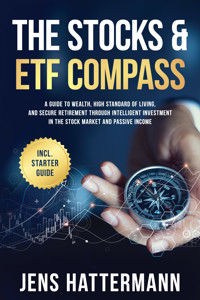
The Stocks & ETF Compass: A Guide to Wealth, High Standard of Living, and Secure Retirement through Intelligent Investment in the Stock Market and Passive Income – Including Starter Guide E-Book
Jens Hattermann
Erhalten Sie Zugang zu diesem und mehr als 300000 Büchern ab EUR 5,99 monatlich.
- Herausgeber: Edition Lunerion
- Kategorie: Fachliteratur
- Sprache: Englisch
Stocks & ETFs: Make Your First Steps on the Stock Market as Easy as Possible and Uncomplicate the Foundation of Solid Wealth Building Inflation, declining real estate values, political uncertainties – is money slipping through your fingers? The traditional savings account is becoming a money pit, and you know it's time to rethink your financial strategy? Unfortunately, the stock market is unfamiliar territory for you? Then you've taken the crucial step with this guide, as here you'll quickly find everything you need to know for successful wealth building! Whether it's inflation, an uncertain pension, or costly property renovations – this year, most savers have realized: old financial securities are no longer reliable. Fortunately, you don't have to accept that, because with stocks or ETFs (Exchange-Traded Funds), reliable, efficient, and long-term wealth building is easy even for beginners. In this book, you'll first find everything you need to know about these beginner-friendly investment options in a compact and approachable way, and you'll systematically familiarize yourself with the most important stock market basics. Then, you'll discover a variety of simple investment and portfolio strategies and find out how to develop the perfect investment plan for your personal situation. Are you completely clueless about finance? No problem! Contrary to common fears, ETFs are perfectly suitable for stock market beginners, and with the straightforward methods explained in this book, wealth building will no longer be a mystery. Stock Market Basics: Stocks, indices, share prices, smart investments – with concise, easy-to-understand information, you'll become a stock market expert in no time. Future Investment ETFs: Gain full insight into the promising and beginner-friendly investment form, find out how ETFs work, and learn how to identify the perfect ETFs for your situation. Optimal Strategy: Whether it's thematic investments around commodities, sustainability, and cryptocurrencies, or the right portfolio strategy between trend-following models, Core Satellite, and more – learn the pros and cons of various strategies. Focus on Retirement Planning: With six simple rules, you'll successfully and sustainably build solid wealth for a relaxing retirement. With this book, you take your financial future into your own hands and effectively counter wealth erosion and uncertainties. Thanks to the bonus coaching program "Successful ETF Investments in 7 Steps," starting is a breeze, and a motivating mindset manual will give you the confidence to confidently start your investment journey. So, what are you waiting for? Click on "Buy Now with 1-Click" and look forward to finally making your money work for you!
Sie lesen das E-Book in den Legimi-Apps auf:
Seitenzahl: 189
Veröffentlichungsjahr: 2025
Das E-Book (TTS) können Sie hören im Abo „Legimi Premium” in Legimi-Apps auf:
Ähnliche

















All advice in this book has been carefully considered and checked by the author and the publisher. However, no guarantee can be given. The author and publisher therefore accept no liability for any personal injury, property damage or financial loss.
Copyright © 2023 www.edition-lunerion.de
All rights reserved, in particular the right to reproduce and distribute the translation. No part of this work may be reproduced in any form (by photocopy, microfilm or any other process) or stored, processed, duplicated or distributed using electronic systems without the written permission of the publisher.
For questions and suggestions:
Edition 2023
Contents
Foreword1
Exchange-traded funds and shares2
The path to financial freedom6
The income situation6
Personal savings behavior10
Social security14
Intelligent investment14
Here we go: Stock market knowledge compact19
Fundamentals19
Types of exchanges24
What is an index?27
Share prices31
What is the best way to profit from rising and falling prices?32
Trading hours at a glance33
ETFs - The investment opportunity of the future35
ETFs - brief overview35
Why ETFs are ideal for getting started45
How does it actually work? Trading with ETFs49
Excursus: Modern portfolio theory according to Markowitz52
The ETF lexicon: Basic terms in the ETF area53
Invest successfully58
The theory behind ETF investing58
Requirements for getting started with ETF investing62
How to: How do I find the best ETFs?65
Theme-centered investing71
Raw materials71
Sustainability72
Cryptocurrencies75
Dividends76
The right portfolio strategy79
Buy & Hold79
Core Satellite81
Trend-following models83
Combination of portfolio strategies86
The advantages and disadvantages of portfolio strategies at a glance87
Building a successful pension plan89
Rule 1: Leave nothing to chance when it comes to retirement provision89
Rule 2: Clarify needs and set goals90
Rule 3: Careful inventory92
Rule 4: Insure against existential risks93
Rule 5: Recognize the gap and observe inflation93
Rule 6: Implement planning and close the supply gap94
Nothing will change if you don't change! - The mindset manual95
Detect & release negative beliefs96
Personal responsibility and honesty97
Visualize your success!99
Generate multiple income streams100
Have the courage to let your money work for you!100
Bonus coaching: Investing ETFs successfully in 7 steps102
Step 1: Select savings amount102
Step 2: Choose the right equity fund102
Step 3: Find the right broker102
Step 4: Open the online custody account103
Step 5: Create a sensible savings plan103
Step 6: Select a suitable index103
Step 7: Select ETF104
Step 8: Intelligent risk management104
On the best way into the world of finance105
Foreword
What is money? Money is the generally recognized means of payment that a society has agreed upon. Money enables, simplifies and accelerates the execution of barter transactions. It is therefore a commodity that is generally recognized as consideration for a good and makes these goods comparable. It is the defining element of our modern, capitalist social order. Money in itself is immoral, it is purely a means to an end. The history of money goes back to prehistoric times; even in early agrarian societies in Mesopotamia or Egypt, a primitive type of money was used in the form of commodity money. Shells or precious metals were considered to have value, which is why they were accepted as a means of payment in exchange for food or building materials.
The first coins were minted in Asia Minor (roughly the area of modern-day Anatolia in Turkey) as early as the 7th century BC. This form of money subsequently became established and was perfected in the 19th century by the gold standard, whereby the currency in force consisted either of gold coins or banknotes, which in turn represented a claim to gold. Our modern monetary system developed from this basic idea of a currency regime backed by gold.
Today, everyone is part of a social and monetary system that is based on money. Money rules the world and undoubtedly has a psychosocial component as well as an economic one. It influences our lives, our thoughts and our actions in many different ways. Having money does not necessarily lead to satisfaction and happiness in life, but it is a decisive factor in creating the conditions for this. So is it reprehensible to strive for it and try to increase it? Certainly not. So don't let yourself be held hostage by the moral negativity sometimes attached to money. You work hard to earn it. So work accordingly to keep and increase it. There is nothing wrong with this, because a certain degree of wealth is a basic prerequisite for a carefree life. This book will help you to gradually increase your wealth. The vision of a comfortable life can become a reality if you make the right decisions. Good luck with that!
Exchange-traded funds and shares
If you are actively looking into investing in these volatile times, this is good news for your finances and sets you apart from a significant proportion of your peers. The variety and complexity of financial products overwhelm many people, which is why they prefer to leave their hard-earned money in their current account and ultimately "impoverish" themselves due to high inflation. Unfortunately, financial education is extremely underdeveloped in Germany, although today's world offers many opportunities to educate oneself in this area. The fact is that anyone who does not deal with their finances and invest sensibly in the face of current inflation will lose money in the long term. However, there is no need to shy away from entering high-yield investment opportunities on the stock market.
With so-called ETFs, it is child's play to generate a more than decent return with little effort and very manageable risk. This book offers you a holistic view of your finances so that you can take a structured approach to planning your investments. It begins with a check of your current financial situation and your savings behavior. This is followed by the basics of stock market knowledge and ETFs as an investment option for the future. After you have been brought up to the necessary level of knowledge for an investment in the stock market, the following chapters deal specifically with the development of your successful investment strategy. Concrete instructions and tips will make it easier for you to build up your own personal, high-yield investment. Comprehensive financial planning also includes the topic of retirement provision, which is why a separate chapter is dedicated to this area. Towards the end of the book, a mindset manual will familiarize you with the subjective side of successful investing. After all, your personal attitude and approach determine to a large extent the success of your financial ventures. Finally, a bonus coaching session summarizes the seven steps to successful ETF investing and gets to the heart of the matter.
You will ultimately realize that successful investing is not rocket science. The knowledge you acquire will substantially improve your financial literacy and put you in a position to participate in the performance of the stock market and beat inflation.
Have fun and enjoy reading this book!
Financial challenges of our time
"When I was young, I believed that money was the most important thing in life. Now I am old and I know it." (Oscar Wilde)
The glass is either half full or half empty - it always depends on how you take things. You have probably heard this classic from everyday psychology many times. As hackneyed as this saying may be, it is still true at its core. In the changeable times we live in, we might be inclined to see the glass as half empty. Starting with the real estate crisis in the USA in 2007, which subsequently grew into a global financial crisis and brought entire countries such as Greece to the brink of bankruptcy, followed by years of massive uncertainty and upheaval at a social and political level, rising national debt, the UK's exit from the European Union, the rise of populist forces worldwide and the war in Ukraine. In recent years, the global community has seen that stability and peace cannot be taken for granted. To make matters worse, the coronavirus crisis ruthlessly exposed the disadvantages of global supply chains and exacerbated the situation in a global economy that was already in a state of flux. As a result of all this, we are currently experiencing a sharp rise in inflation, which is having a significant impact on our wallets.
Inflation (also known as the rate of price increases or inflation) means that your assets are constantly being affected and are subject to constant devaluation. If the general price level rises, you will be able to buy less for the same amount of money after a while.
Example:
In 2004, a scoop of ice cream cost €0.80 on average. Due to the price increase, a scoop of ice cream will cost €1.80 in 2023.
However, inflation is not an unusual process in normal times - on the contrary: the general aim in an economy is to achieve inflation of around 2%. This means that prices and wages rise at roughly the same rate, but the general standard of living remains the same or develops positively. The problem arises when wages can no longer keep pace with inflation. In April 2023, inflation in Germany amounted to an impressive 7.2%. Persistently high inflation therefore leads to a loss of real wages, which means you can afford less and less with your income and slowly but surely become "impoverished".
The term "real wage" refers to the earnings that employees can actually dispose of after inflation has been taken into account (Federal Statistical Office).
In addition, the pension level in Germany is falling continuously.
The pension level describes the relationship between the amount of a pension (assuming 45 years of contributions based on an average income) and the current average income of an employee.
In the 2021 pension insurance report, the German government forecast the development of the pension level for the years 2021 to 2035. According to this, the pension level in 2035 will be 5 percent lower than it is currently. In view of the fact that pensions are a pay-as-you-go system, i.e. current pension expenditure is largely financed by employee contributions, it is not surprising that the pension level cannot be maintained in this way given the demographic trend in our country. The state pension alone will therefore no longer be sufficient to provide for old age. You will have to make private provision for your old age if you want to maintain your standard of living in your well-earned retirement.
The good news for you is that you don't have to be part of the population that simply accepts the loss of real wages or a falling pension level. You can do something about it, and it's relatively easy. The glass quoted above is not half empty, but half full! You can even fill it up yourself. However, this requires a change in your savings behavior.
According to a survey by the Association of Private Building Societies, the most frequently used form of investment in Germany in 2023 will still be the current account. 38% of Germans prefer a current account as an investment. This is followed by the good old savings account with 33 percent. Real estate (25 percent), pension and endowment insurance (24 percent), home loan and savings contracts (23 percent) and investment funds (22 percent) are next in line. This is followed by shares, which are only used as an investment by 20 percent of respondents. The next places are occupied by call money, Riester pensions and fixed-interest securities.
To put it briefly: 38 percent of respondents use their current account as an investment - the account for which you have to pay account management fees and receive no interest whatsoever. On the contrary, some banks have even charged you a deposit fee in the past if your account balance is too high. The same applies to savings accounts. As a rule, your money does not earn interest there either.
With the constant devaluation of money due to inflation mentioned above, it must be clear that the money parked in a current account or savings account will become less and less in the long term. Traditional savings behavior is clearly outdated.
This can be illustrated with an example:
For example, if you had invested in the German DAX share index over the last 50 years, you would have generated an average annual return of around 8 percent. Even adjusted for tax and inflation, this would still have left a net return of 5 percent per year. An investment in the globally diversified MSCI World index, which comprises shares in over 1600 companies from 23 industrialized countries, would have generated a net return of 8.7 percent. In effect, your assets would have increased, while Team Giro would have decreased.
It is therefore clear that you will not get very far with conventional savings methods. To stop the devaluation of your money, keep your purchasing power stable and build up your assets, you need to save and invest your money wisely. You can only improve your financial situation if you invest your money cleverly and thus generate returns. This is particularly possible if you spread your assets across selected asset classes, such as shares. With the right investment in this area, you will be able to stabilize your financial situation and provide for your old age. You don't need to be a stock market expert or mathematician to do this. The path to financial freedom is easier than you think.
The path to financial freedom
Achieving financial freedom is a goal that many people would certainly like to reach. Most people would therefore probably agree with you if you asked them whether they would like to have more money at their disposal. However, very few people are prepared to do anything about it.
Unfortunately, financial literacy is still a topic that is dealt with far too rarely and extremely inadequately in Germany. As the result of a Europe-wide study in 2018, ING Bank found that a certain degree of financial illiteracy is prevalent among the German population. At the time, 51% of respondents stated that they had not received any financial education. However, in order to have your finances under control and increase your wealth, it is essential to take a serious look at this topic. Nowadays in particular, it is easier than ever to educate yourself in this area and adopt or develop strategies yourself.
There is a wealth of information on this subject. It will be easy for you to develop your financial intelligence with little effort. Just reading this book will take you a big step forward.
In order to embark on the path to financial freedom, you need a specific strategy tailored to your needs. To do this, however, you should first take a thorough and honest inventory of your finances. The first step is to take a look at your income situation. The next step is to put your personal savings behavior to the test. A look at your social security and the right investment strategy for you rounds off the path to financial freedom.
The income situation
This point is intended to provide clarity about your income and expenditure. It is a sober inventory of your current situation. How much money do you take in each month? How much do you spend on what? Which loans are open and where can you optimize or cancel contracts and insurance policies ? These are all questions that you need to address in order to successfully embark on the path to financial freedom.
Budget calculator: Income and expenditure
A budget calculator or budget book compares all of a household's income with its expenditure. This enables clear budgeting. You can use a traditional pad and pen to record everything. Alternatively, you can also use an Excel spreadsheet. Of course, nowadays there are also a few apps that make the process easier for you. One good app is "Monefy", albeit for a fee. A less comprehensive, but free and easy-to-use app is the app "mein Budget - Ausgaben im Griff" (my budget - spending under control) from the "Deutschland im Plus" foundation.
No matter what you use, the procedure is the same: make a note of your regular income. It makes sense to do this on a monthly basis. Regular income includes all income that is really always available: Wages, child benefit and the like. What you should not record here are things such as gifts of money or out-of-sequence payments, such as all (state) special bonuses.
Regular income
Irregular income
Regular income must
always
be
noted
and included in the
invoice.
These include:
Wages
Pension
Unemployment benefit
Child benefit
State subsidies (e.g. housing benefit)
Rental income
Irregular income is
not recorded
and is not included in the calculation.
These include:
Christmas and vacation bonus
Gifts of money
Payments that take place outside the series (e.g. bonuses)
Income from the sale of items (books, clothing, car, etc.)
Now calculate the expenses against this. This includes all monthly expenses such as rent, insurance, any loan installments for the car, electricity, internet, cell phone contract, subscriptions, etc. Calculate annual or quarterly costs down to the month.
Then try to use your bank statements to work out roughly what you spend each month on living expenses, i.e. fuel, shopping and so on. Leave out irregular costs such as car repairs. Finally, deduct the expenses from the income. The result is the budget that is freely available to you each month, including for your investments.
Monthly costs
Annual/Quarterly Costs
Livingliving costs
Irregular costs
Z. B.:
Warm rent
Insurances
Electricity
Internet
Contracts
Subscriptions
Possible loan installments
Z. B.:
Property tax
Vehicle tax
Car insurance
Annual contribution clubs
Z. B.:
Grocery shopping
Clothing
Household articles
Hygiene articles
Gasoline costs
Z. B.:
Repairs
Vacations
Leisure activities
Gifts for family, friends etc.
You now have a structured overview of your income and expenditure and know how much money you have at your disposal each month. This should remain the case. Therefore, carry out this calculation at regular intervals or update the values in the app. This way, you will always have an overview of your financial options.
The credit situation
The next step is to assess the situation of your loans. You may not have an exact overview of which loans you currently have and on what terms. Get some clarity:
What loans do you currently have?
How much interest do you pay on the individual loans?
What other terms do they have?
Having a precise overview of this makes it easier to plan for the future. Many households will probably have a real estate loan, sometimes a car loan. Perhaps the new bedroom was also financed at the furniture store. It is therefore essential that you know when, for example, the follow-up financing for your home is due so that you are prepared.
The interest rate conditions for real estate loans and consumer loans are currently undergoing massive changes. The interest rate environment is significantly influenced by the key interest rates set by the European Central Bank (ECB).
Key interest rates are the interest rates at which commercial banks can borrow or deposit money with a central bank or central bank. The primary aim of central banks is to create a stable price level with an appropriate inflation rate of around 2 percent.
The ECB can therefore influence and control interest rates in the eurozone by setting its key interest rates. Interest rate cuts boost the economy as loans become cheaper. Companies can thus invest more easily and private consumers can afford more thanks to low-interest loans.
Interest rate hikes have exactly the opposite effect. More expensive loans inhibit economic growth and price increases, i.e. inflation.
After years of a policy of cheap interest rates to stimulate the economy and private consumption, interest rates have been rising again since 2021. This makes loans enormously more expensive for you. Interest rates for property loans have risen from around 1.00 percent in summer 2021 to currently (as of 2023) around 3.50 to 4.00 percent.
Coming back to the example of follow-up financing, it is of course important for your financial planning to know what additional burden you could face as a result of higher interest rates on follow-up financing. Conversely, you can also use the capital released by a paid-off car loan to build up your assets. Therefore, keep an eye on your loans so that you are always up to date.
Contracts and insurance
As with loans, you should have an overview of the contracts and insurance policies you have taken out. This may give you potential for optimization. In the case of contracts or subscriptions (such as for all streaming services), you can save a lot of money by switching to a family subscription, for example. In addition, some services may be significantly cheaper with other providers. It is worth regularly checking the conditions of your contracts. With the help of comparison portals, you can get an overview of a wide range of available measures.
The same applies to your insurance policies. Some types of insurance, such as buildings, liability or travel health insurance, are of course essential. Household contents or occupational disability insurance can also be useful. Ultimately, when it comes to insurance, it is always a question of individual risk tolerance. You can insure yourself against any eventuality, no question about it. However, this also costs a lot. You should therefore check from time to time which insurance policies still suit your current life situation. Term life insurance with a payout of €100,000 in the event of death may still have suited your life situation when you were single without a family in your early 20s. In your late 30s, with two children and a current real estate loan with a residual debt of €350,000, your family would hardly be sufficiently protected with this life insurance in the event of death.
Some insurance policies are also hardly worthwhile from a financial point of view.




