


5,99 €
Mehr erfahren.
- Herausgeber: Lozzi Roma
- Kategorie: Religion und Spiritualität
- Sprache: Englisch
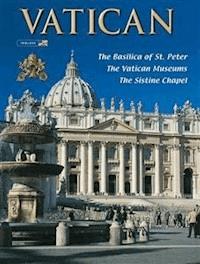
A book rich with images, in carefully designed colour, with up-to-date descriptions of Saint Peter’s, the Sistine Chapel and Vatican Museums, as well as stories and anecdotes about the Vatican City.
Das E-Book können Sie in Legimi-Apps oder einer beliebigen App lesen, die das folgende Format unterstützen:
Veröffentlichungsjahr: 2014
Ähnliche
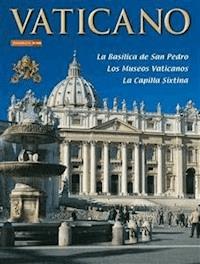




“VATICAN”
© LOZZI ROMA S.A.S.
All rights reserved. No part of this book may be reproduced in whole or part or by any means in printed or electronic form without the express permission from the Publisher.
Publisher:
LOZZI ROMA s.a.s.
Via Filippo Nicolai, 91
00136 Roma
Tel. (+39) 0635497051 - 0697841668
Fax (+39) 0635497074
Web site: www.gruppolozzi.it
E-mail: [email protected]
Photographies:
Archivio fotografico Lozzi Roma s.a.s.
Archivio fotografico Fabbrica di San Pietro
Archivio fotografico Millenium
Archivio fotografico Musei e Gallerie Pontificie
Archivio fotografico Osservatore Romano
Archivio fotografico Scala
Made in Italy
Edizione digitale: luglio 2014
ISBN: 9788868380939
Edizione digitale realizzata da Simplicissimus Book Farm srl
INDEX
Introduction
St. Peter’s Basilica
Sacristy and Treasury of St. Peter’s
The Sacred Grottoes
The visit to the dome
The Apostolic Palace
The Vatican Museums
Egyptian Gregorian Museum
Chiaramonti Museum
Pio-Clementine Museum
Gregorian Etruscan Museum
Raphael Rooms and Loggias
Borgia Apartment
The Sistine Chapel
The Vatican Apostolic Library
The Vatican Picture Gallery
The Gregorian Museum of Profane Art
Inside the Vatican City
The Swiss Guards
A short history of the Papacy
Chronological list of the Popes
Map of Sacred Vatican Grottoes
Map of St. Peter
INTRODUCTION
When in 67 AD an unknown centurion led the squad that was to crucify Simon Peter up the Vatican Hill, he could certainly not have imagined that he was laying the foundations of the smallest State in the world with regard to size, and the largest with regard to spiritual power.
The body of the first Successor of Christ was buried in that very place and about three centuries later, on this spot, the Emperor Constantine built a grandiose basilica, with five naves and a façade adorned with rich mosaics preceded by a broad atrium, which served as the model for the oldest Christian basilicas.
St Peter’s Square thronged with the faithful visiting Rome from all over the world for the Pope’s traditional Easter Blessing.
The Constantinian Basilica stood for more than a millennium, periodically reinforced by large-scale restorations. At the end of the 15th century, despite constant care, the ancient edifice seemed to be on the point of collapsing. There were plans to substantially rebuild it but nothing was done until the energetic and determined Julius II became Pope in 1503. The old church was then demolished and soon after (1506) work begun on the building of the new basilica which became the pride of Renaissance and Baroque Rome. It was a dreadful and fascinating spectacle: as if in the grip of a mania for destruction, Donato Bramante, the architect commissioned by Julius II to undertake this huge project, left not a stone of the old building standing. However Bramante was unable to do more than lay the foundations of the new building: he died in 1514, when the work was partly begun. The most important artists in Rome in the 15th and 16th centuries succeeded him: Raphael, Giuliano and Antonio da Sangallo, Michelangelo, Della Porta, Maderno, Fontana and Bernini. The work was only completed in 1665, with the building of Gianlorenzo Bernini’s famous colonnade.
In the centuries to come, the Basilica, architecturally complete, was constantly enriched by numerous works of art. But the frenzy for construction in the Vatican was far from being over: indeed, the popes of the 16th and 17th centuries continued to add new wings and enlarge the Vatican palaces, both because of the increasing demands of the Papal Court and the desire to display the priceless art collections as they deserved.
Vatican City became an independent state through the signing of the Lateran Treaty between the Church and the Italian State on 11 February 1929. Important work was then carried out to make this small state, encircled by the powerful walls built between the 15th and 16th centuries by Julius II, Paul II and Pius IV, completely selfsufficient, and the span of the walls erected by St. Leo IV as a defense against the Saracens’ raids in the 9th century was increased.
For more than six centuries (since 1377) the Vatican has been the papal residence; the Quirinal was added in the 17th century. Before the papal court moved to Avignon (1309-1377), the Lateran was the seat of the papacy. There have been 266 pontiffs on the Throne of St. Peter in uninterrupted succession. For 20 centuries the Catholic Church, whose temporal power the Vatican State embodies, has played a vital role in the world’s history through different vicissitudes down the ages.
The diagram shows:
- In yellow, the ground plan of Nero’s Circus (67 A.D.) on Vatican hill;
- In blue, the Constantinian Basilica (321 A.D.);
- In brown, the first part of St. Peter’s Basilica built by Bramante and Michelangelo between 1506 and 1564. In the center, the tomb of St. Peter, next to the necropolis;
- In orange, the extension of the Basilica completed by Carlo Maderno in 1614;
- In green the Bernini’s colonnade completed in 1667.
ST. PETER’S BASILICA
(The italic numerals in brackets, refer to the plan of the Basilica on the last page)
Very few nations in the world can boast a vestibule like St. Peter’s Square. This extraordinary entrance gives visitors a sense of serenely profound balance, which may indeed be described as incomparable. The perfect harmony of the square with its colonnade and the basilica crowned by the famous dome makes it all seem like the work of one talented artist. Instead, the (1656-65) and its two curved arms were built by Gianlorenzo Bernini, one of the greatest architects of sixteenth-century Europe, about 50 years after the façade was finished by Carlo Maderno in 1614 and more than 70 years after the completion of the dome (1590). The pink granite standing at the centre of the square was made in Egypt during ancient Roman times. The fountain on the right was designed in 1613 by Carlo Maderno and the one on the left was designed in 1677 by Carlo Fontana. Though they were erected at different times, Bernini succeeded in perfectly harmonizing these many different elements. The artist worked on it from 1657 to 1665, declaring to have designed the colonnade as an architectural game of human body proportion. The colonnade’s relationship to the basilica buildings is similar to the relationship of the arm and the head. Statistical facts: the colonnade has an ellipsoidal shape and it is made up of 284 columns arranged in four rows, interposed with 88 pilasters and crowned by a balustrade that holds 140 aligned statues of different saints created by Bernini’s students.
Lesen Sie weiter in der vollständigen Ausgabe!
Lesen Sie weiter in der vollständigen Ausgabe!
Lesen Sie weiter in der vollständigen Ausgabe!
Lesen Sie weiter in der vollständigen Ausgabe!
Lesen Sie weiter in der vollständigen Ausgabe!
Lesen Sie weiter in der vollständigen Ausgabe!
Lesen Sie weiter in der vollständigen Ausgabe!
Lesen Sie weiter in der vollständigen Ausgabe!




