


Erhalten Sie Zugang zu diesem und mehr als 300000 Büchern ab EUR 5,99 monatlich.
- Herausgeber: Allen & Unwin
- Kategorie: Lebensstil
- Sprache: Englisch
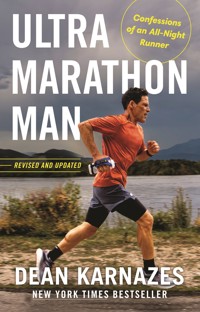
Ultrarunning legend Dean Karnazes has run 262 miles - the equivalent of ten marathons - without rest. He has run over mountains, across Death Valley, to the South Pole, and is probably the first person to eat an entire pizza while running. With an insight, candour and humour rarely seen in sports memoirs, Ultramarathon Man has inspired tens of thousands of people - nonrunners and runners alike - to push themselves beyond their comfort zones and simply get out there and run. Ultramarathon Man answers the questions Karnazes is continually asked: - Why do you do it? - How do you do it? - Are you insane? and the follow-up queries: - What, exactly, do you eat? - How do you train to stay in such good shape?
Sie lesen das E-Book in den Legimi-Apps auf:
Seitenzahl: 322
Veröffentlichungsjahr: 2017
Das E-Book (TTS) können Sie hören im Abo „Legimi Premium” in Legimi-Apps auf:
Ähnliche













Acclaim for Dean Karnazes and Ultramarathon Man
‘Full of euphoric highs...a journey into distance running that is much less about sweat than about the emotional terrain that unfolds at the frontier of endurance’
New York Times
‘An exhibition of unadulterated courage and mental and physical stamina [for] anyone who likes to read about ordinary people doing extraordinary things’
Boston Globe
‘[Karnazes’] spirited memoir...can help mere mortals who want to push past their perceived limits or simply jump-start their sedentary lives’
Chicago Tribune
‘[Dean is] like a comic-book superhero who remains undercover by day, every bit the unremarkable family man’
Telegraph
‘A real-life Forrest Gump…[Karnazes] has pushed his body to limits that are beyond masochistic. They’re inhuman’
Newsday
‘Heart-stopping stuff ’
Economist
‘Karnazes is revolutionizing [ultrarunning], inspiring many weekend warriors to take it up a notch…. Money and fame aside, Karnazes [is] motivated by primal need more than anything else’
Outside
‘The undisputed king of the ultras, who has not only pushed the envelope but blasted it to bits’
Philadelphia Inquirer
‘The perfect escapist fantasy for couch potatoes and weekend warriors alike’
Kirkus Reviews
‘Dean’s masochism is a reader’s pleasure’
Publishers Weekly
‘There is clearly something Nietzschean in Karnazes’ makeup … that whatever doesn’t kill you makes you strong’
Los Angeles Times
Published by arrangement with Jeremy P. Tarcher, an imprint of Penguin Random House LLC
First published in Great Britain in 2017 by Allen & Unwin
This updated paperback edition published in Great Britain in 2023 by Allen & Unwin
Copyright © Dean Karnazes, 2005, 2023
The moral right of Dean Karnazes to be identified as the author of this work has been asserted by him in accordance with the Copyright, Designs and Patents Act of 1988.
All rights reserved. No part of this book may be reproduced or transmitted in any form or by any means, electronic or mechanical, including photocopying, recording or by any information storage and retrieval system, without prior permission in writing from the publisher.
Every effort has been made to trace or contact all copyright holders. The publishers will be pleased to make good any omissions or rectify any mistakes brought to their attention at the earliest opportunity.
Allen & Unwin
Atlantic Books
Ormond House
26–27 Boswell Street
London WC1N 3JZ
Phone: 020 7269 1610
Email: [email protected]
Web: www.allenandunwin.com/uk
A CIP catalogue record for this book is available from the British Library.
Book design by Lovedog Studio
Paperback ISBN 978 1 80546 011 4
E-book ISBN 978 1 92557 530 9
This book is dedicatedto my beloved sister,Pary, who alwaysencouraged me tofollow my heart.
Contents
Part One
Chapter 1 The Long Road to Santa Cruz
Chapter 2 The Formative Years
Chapter 3 Run with Your Heart
Chapter 4 Run for Your Life
Chapter 5 Soiling of the Lexus
Chapter 6 Leaving Normal
Chapter 7 Over the Mountains and Through the Woods
Chapter 8 King of Pain
Chapter 9 Into Darkness
Chapter 10 Forever Changed
Part Two
Chapter 11 Badwater
Chapter 12 Frozen Stiff
Chapter 13 The Ultra-Endurance World
Chapter 14 The Relay
Chapter 15 Crossing Over
Chapter 16 Team Dean
Chapter 17 Run for the Future
Chapter 18 The Gift of Life
The Aftermath
Acknowledgments
Part One
Chapter 1
The Long Road to Santa Cruz
Sleep is for wimps.
—Christopher Gaylord
Napa Valley, Cal i forniaFriday evening, September 29, 2000
It was approaching midnight as I wove up the deserted road, wearing nothing more than a pair of shorts and a sleeveless vest, a cell phone tucked in a pocket of my pack. It had been hours since I’d last had contact with humanity, and the night air was still and warm. By the light of the full moon I could see the hillsides covered in grapevines, their leaves glistening in the milky light. But I wasn’t fully appreciating the view; I kept thinking about food. I was famished. Earlier tonight I’d eaten a bowl of macaroni and cheese, a large bag of pretzels, two bananas, a PowerBar, and a chocolate éclair. But that was more than three hours ago. On big occasions like this one, I needed more food. And I needed it now.
My body fat is less than 5 percent, so there’s not much reserve to draw upon. My diet is strict—high protein, good fats, no refined sugar, only slowly metabolized carbs—but tonight I had to be reckless. Without massive caloric binges—burritos, potato chips, pudding and chocolate—my metabolism would come to a screeching halt and I’d be unable to accomplish my mission.
Right now, it craved a big, cheesy pizza.
The problem was, I hadn’t had access to food in the past few hours. I was heading west through the remote outskirts of Sonoma County, well off the beaten path, no food outlets nearby. Proceeding farther from civilization, I’d watched the signal indicator on my cell phone diminish to the point of no reception, severing my contact with the outside world. Midnight was nearing, and I was ravaged.
The night air was dry and fresh, and, despite my hunger, I was able to enjoy the tranquillity of the surroundings. It was a rare moment of serenity in an otherwise frenetic life. At times my mind quieted and I slipped into a spell, mesmerized by the full moon illuminating the hillsides.
At others all I could think about was finding the next convenience store.
When I left the office early today, I received backslaps and hoots of encouragement from several co-workers, most of whom are aware of my other life. One minute I was all business, discussing revenue forecasts and corporate strategy in my neatly pressed Friday casuals. The next I was jamming out the door like a wired teenager, psyched about the upcoming weekend festivities. I’d learned to switch from work mode to play mode in the span of several paces. I liked my job plenty, but I loved what I was about to do.
At 5:00 P.M., I pushed a button on my stopwatch and the mission was afoot, so to speak. It started in the bucolic outpost of Calistoga at the northern reaches of the Napa Valley. The afternoon was exceptionally cloudless as the townsfolk milled about stoically. One guy tipped his hat and said “Howdy” as I passed, and a lady sweeping the sidewalk with a reed broom looked up and smiled. They were friendly enough, though judging from the peculiar looks I received it was clear I was being sized up: We know he’s not here to cause trouble, but what, exactly, is he doing? Alongside me in our VW campervan (aka the Mother Ship) was my family: my parents, my wife, Julie, and our two kids, Alexandria and Nicholas. The Mother Ship would be our operational headquarters for the next three days. That, however, implies a level of sleekness that didn’t exist. The Mother Ship was more like a roaming funhouse, cluttered with maps, toys, travel magazines, binoculars, and homemade bug-catching jars. Between the seats were pieces of Fig Newtons and stale Goldfish with a dusting of beach sand. It was the perfect anti–feng shui environment, and we loved it. Macaroni and cheese from a box was easy to cook on the Mother Ship’s small stove, and that’s what we’d had for dinner tonight. Because of my two lives, we didn’t eat together as a family as often as I liked, so I treasured this meal—dehydrated cheese and all.
We were like any other happy family having dinner together, only we were sitting on the guardrail on the side of a highway. The kids didn’t seem to find it strange—they didn’t know any different, really—and my parents had grown accustomed to sipping wine from a paper cup while balancing on the narrow railing as cars rumbled past. There wasn’t too much traffic on the road tonight, so we engaged in pleasant dinner conversation.
I had seconds, and then I finished the rest of my wife’s meal. Dessert followed: two bananas and a chocolate éclair.
“I hate to dine and ditch,” I said, “but I’ve got to be moving along.”
“Daddy, are you going to be gone all night again?” my daughter Alexandria asked. Her big brown eyes filled with enthusiastic curiosity, as if trying to understand why her daddy had this odd yearning to roam that wasn’t shared by many other daddies.
“Yes, sweetie, I am. But we’ll have breakfast together tomorrow morning.”
Although that conversation was earlier today, it seemed like a lifetime ago. Nearing midnight, they would now all be happily asleep inside the Mother Ship as I made my way through Sonoma and continued west toward the town of Petaluma.
Known for its thrift stores and bowling alleys, Petaluma isn’t a bustling metropolis. But to its credit, the town does have a Round Table Pizza, one of the greatest franchises on the planet.
You see, other pizza companies are not as flexible as Round Table. Most of them have complicated delivery rules and policies—picky little things like requiring you to provide a street address in order to have a pizza delivered. Imagine that—you actually have to tell them exactly where you are! Round Table, on the other hand, will deliver a pizza to just about anywhere.
Over the years I’ve pushed the envelope with Round Table, and they’ve consistently outperformed all other pizza chains. I was so confident in their pizza-delivering prowess that I once even had them bring one to my house. Cresting the peak and seeing that my cell phone now had service, I dialed. The signal was weak.
“Round Table,” a young voice answered. Loud rock music blared in the background.
“I need to order a pizza.”
“What’s that? You need a pizza?”
Why else would anybody be calling the Round Table delivery line? “YES, I NEED TO ORDER A PIZZA! I NEED PIZZA!”
“Okay, dude, no need to scream.”
“Sorry.”
“That’s all right. I know how edgy people get about their pizza.”
“I’m not edgy, I’m just hungry,” I said in a very edgy tone.
“Whatever, dude. Just be assured that we’re going to get you the tastiest grinds imaginable. We toss ’em, they’re awesome! Now what’s it gonna be?”
“I’ll take the Hawaiian style, with extra cheese. Extra olives. Extra ham. Oh yeah . . . extra pineapple, too.”
“Extra everything! I’ll throw it all on there. What size you after?”
This was a tricky question. I didn’t have the means to carry any uneaten portions, but if I ordered too little, I’d run out of fuel and never reach Marin County before sunrise.
“How many does a large feed?”
“Three or four, with all those extras. How many in your party?”
“It’s just me. I’ll take the large.”
“Cannonball, dude! You must be operating on some kind of hunger.”
If you only knew, I thought. “Do you have dessert?”
“Cherry cheesecake. It’s killer—I tested some earlier tonight.”
“Okay, I’ll have one.”
“One slice?”
“No, one whole damn thing.”
“Dude, this is epic!”
“How long do you think it’ll take?”
“Thirty, forty minutes. You in some kind of rush?”
“No rush, really, I’ll be out here a while. I just need to know how long it’ll take so I can tell you where to meet me.”
“Okay . . . I guess. Let’s say thirty-five minutes.”
“Then I’ll meet you at the corner of Highway 116 and Arnold Drive.”
“What, right on the corner?” he asked. “That’s a pretty lonely stretch of highway. What color’s your car?”
“I’m not in a car,” I said. “But I’ll be easy to spot. I’m the only one out here running.”
“Running?” There was a brief moment of silence. “Is someone chasing you?”
“No.” I laughed.
“But it’s midnight!” he said.
“Yes, it’s late. And that’s why I need pizza. I’m starving.”
“Got it.” [Long pause.] “Makes perfect sense. Is there anything else I can bring you?”
“Is there a Starbucks in town?”
“Yeah, but I’m sure they’re closed by now. But I’ve got my own stash of beans right here. I’ll brew some up while the pizza’s cooking. You just keep running straight on Highway 116 and we’ll track you down.”
After giving him my cell number and hanging up, I put my head back down and kept plowing into the darkness, one step after the next. If they were going to locate me along the route, there was no need to wait on the corner, which was good. Standing idle in the evening air was a surefire way to invite a debilitating leg cramp.
Replacing my cell phone in the back pocket of my pack, I pulled out the picture of a little girl. Even with tubes and needles stuck all over her body, her face looked vibrant. But she was sick; in fact, she was near death, and I was running to help save her. I took one final look at the picture and tucked it carefully away.
Forty minutes later, a dusty pickup truck with oversized tires came barreling down the road. My pizza had arrived. To my surprise, the young manager was behind the wheel.
“Dude!” he hailed out the window. “You’re mad. This is awesome!”
He pulled alongside me.
“How do you want to do this?” he asked.
“Can you hold the box out the window?”
His eyes lit up with a bemused look of excitement. Then he reached over to the passenger seat and lifted the pizza box, steering with his knees, as I maneuvered closer to accept the bounty. As he attempted to hold the box out the window, the car swerved and nearly hit me.
“Whoa, captain. Steady she goes,” I yelped.
“Sorry, dude. Sorry.”
We tried again and this time he successfully got the box out the window. I pulled back the cover and got my first glance at the masterpiece. It was artfully crafted, almost as high as it was wide, with lots of pineapple and olives piled on top. It looked like something you’d feed a rhinoceros.
“Just the way you wanted,” he said, “and with a thin crust and unsliced.”
He scratched the side of his head. “You know, no one’s ever asked us not to slice a pizza before.”
“Watch this,” I said.
With the box held out the window and the cover pulled back, I began rolling the pizza into a giant “pizzarito.” I kept slowly jogging next to the moving vehicle, focused on the task at hand and hoping I wouldn’t trip. Once it was tightly rolled, I pulled it out with both hands and took a big bite. It was steaming hot and messy, cheese and sauce dripping all over me, but soooo good!
“How is it?” he asked.
“Unn . . .” I opened my mouth to let out some steam. “Friggin’ . . .” I let out more steam. “Believable!”
“EPIC!” he bellowed, banging his hand on the steering wheel. “This is epic!”
I was amused by his antics, but still kept eating.
When I got to a point where I could hold the pizza with one hand, we stopped and he helped me cram the cheesecake into my pack.
“Let me get my credit card.”
“No way, dude, this one’s on us.”
“What? You sure?”
“Absolutely! I can’t wait to tell the boys back at the shop.” And off he sped.
Chuckling to myself, I kept moseying along. Just as I was finishing the pizza, I heard the manager’s truck reapproaching (the loose muffler was a dead giveaway). He’d forgotten to give me the coffee! We filled one of my water bottles with the dark brew and I drank the rest. I tried to pay him again, but he would have none of it. He sped off once more.
Not two hundred feet down the road, I heard him slam on the brakes and flip a U-turn. He pulled alongside me.
“I didn’t think to ask, do you need a lift?”
I laughed. “Thanks, man, but I’m gonna keep going.”
“But how far are you gonna go?”
“I’m headed to the beach,” I said.
“To the beach!” he cried. “Dude, Stinson Beach is like thirty miles from here!”
Actually, I was heading to the beach in Santa Cruz— over 150 miles from here—but I didn’t think either of us was prepared to face up to that reality.
“I can’t believe it’s humanly possible to run that far,” he gasped. “Are you like Carl Lewis or something?”
“Ah . . . yeah,” I replied. “I’m like Carl Lewis, only slower.”
“Where will you sleep?”
“I won’t.”
“You’re running straight through the night? This is insane. I love it!” He kept driving next to me, in a ponderous state. Then he spoke again.
“Dude, I don’t wanna pry or anything, but do you mind me asking why you’re dong this?”
Where to begin? “Oh man,” I replied, “I’ll have to get back to you on that one.”
And now is the time to ponder his question. Millions of Americans run. They run for the exercise, for their cardiovascular health, for the endorphin high. In 2003, a record-setting 460,000 people completed one of the country’s many marathons. They pushed the outer limits of their endurance to complete the 26.2 miles.
Then there’s the small hardcore group of runners, a kind of runners’ underground, who are called ultra-marathoners. For us, a marathon is just a warm-up. We run 50-mile races, 100-mile races. We’ll run twenty-four hours and more without sleep, barely pausing for food and water, or even to use the bathroom. We run up and down mountains; through Death Valley in the dead of summer; at the South Pole. We push our bodies, minds, and spirits well past what most humans would consider the limits of pain and exertion.
I’m one of the few who’s run beyond 100 miles without resting, which I guess makes me an extra-ultramarathoner. Or just nuts. Whenever people hear that I’ve run 100 miles at a clip, they inevitably ask two questions. The first is “How can you do that?” The second, and much harder question to answer, is the same the pizza guy asked: “Why?”
It’s an excellent question, though compulsions are never easily defined. When asked why he was attempting to be the first to climb Mount Everest, George Mallory offered the famously laconic, “Because it’s there.” That seems to satisfy people enough for it to have become a famous adage. But it’s really not much of an answer. Still, I can understand Mallory’s clipped response. When people ask me why I run such improbable distances for nights on end, I’m often tempted to answer with something like, “Because I can.” It’s true as far as it goes, and athletes aren’t always the most introspective souls. But it’s not a complete answer. It’s not even satisfying to me. I’ve got questions of my own.
What am I running from?
Who am I running for?
Where am I running to?
Every runner has a story. Here’s mine.
Chapter 2
The Formative Years
Of all the animals, the boy is the most unmanageable.
—Plato
Los Angeles1969–1976
I’ve been running much of my life. I grew up the oldest of three kids. My brother, Kraig, is a year younger than I am, and my sister, Pary, came along two years after him.
Some of my earliest memories are of running home from kindergarten. We were a working-class family living in Los Angeles, and my father worked two jobs to make ends meet. I didn’t want to burden my mother with getting me home from school every day, so I started running.
At first, my route was the most direct path from the school back to our house. In time, however, I began to invent diversionary routes that would extend the run and take me through uncharted territory and new neighborhoods. Running home from school became more enjoyable than attending it. Running gave me a sense of freedom and exploration that school never did. School was about sitting still and trying to behave as someone explained what the world was like. Running was about going out and experiencing it firsthand. I watched buildings go up, witnessed the birds migrating south, saw the leaves falling and the days shortening as the seasons changed. No textbook could compare to this real-life lesson.
By the third grade I was participating in organized running events (some of which I organized myself). The distances were short, often only the length of a football field. Sometimes it was hard finding other kids to run with, and I found myself constantly campaigning for classmates to join me. My relatives from the Old Country frequently reminded me that the Greeks were great runners. The marathon, after all, was conceived in Greece.
“Constantine,” they would say, using my given name, “you will be a great Greek runner, just like your ancestors.” Then they would down another round of ouzo and seal my fate with a collective “Oppa!”
Never mind that Pheidippides, the Greek runner who ran from the Plain of Marathon to Athens with the news that the Athenians had defeated the Persians, dropped dead from exhaustion after delivering his message. That part of the story never got mentioned.
As I grew older, I became more passionate about pushing my small body to extremes. Advancing the limits of personal endurance seemed part of my hardwiring; I found it difficult to do anything physical in moderation. By age eleven I had already trekked rimto-rim-to-rim across the Grand Canyon, a weeklong journey carrying all my supplies on my back, and had climbed to the top of Mount Whitney, the highest mountain in the contiguous United States.
For my twelfth birthday, I wanted to celebrate with my grandparents, but they lived more than forty miles away. Not wanting to burden my folks to drive me there, I decided to ride my bike. I had no idea how to get to my grandparents’ house. But I didn’t let that dampen my sense of adventure. I tried to talk Kraig into joining me, but there was absolutely no way. Even a bribe with allowance money didn’t work. So I stuffed the money in my pocket, told my mother I was going to the local mall, and set a course for Pasadena.
I got a lot of confused and worried looks when I asked for directions.
“That’s gotta be over forty miles from here,” one gas station attendant told me.
“Which way do I go?” I asked.
“You can get on this freeway and go to the 210 North, I think,” he replied doubtfully.
Of course, I couldn’t ride my bicycle on the freeway. I’d need to take surface streets.
“Are you sure you don’t want to call your parents?” he asked.
“That’s okay,” I said nonchalantly, pointing at the freeway. “So you think Pasadena is that way?”
He nodded, though not with a great deal of conviction.
“Thanks.” I smiled and set a course for the closest surface street in the direction he had indicated. This was what adventure was all about. Getting lost, on purpose.
Ten hours later, I arrived in Pasadena. The course I’d followed meandered haphazardly through the Los Angeles basin, and there was no telling how many miles I’d covered along the way. I stopped a couple times at other service stations to ask for directions, and also to buy a soda and use the restroom. My money was entirely depleted, but that didn’t matter. What mattered was that I made it to Pasadena. Now what?
I didn’t know the name of my grandparents’ street, or their phone number. In fact, they didn’t even live in Pasadena, but in nearby San Marino. But after some wandering around, I recognized a familiar landmark— The Galley, a large ship on the corner of an intersection that had been converted into a fish-and-chips joint. We had eaten there many times, and I knew the way to my grandparents’ house from there. It was about five miles from The Galley to San Marino.
Riding up their driveway, covered in black road grime, I felt a grand sense of accomplishment. I just as well could have been standing atop Mount Everest, or the moon. It was my best birthday ever.
Luckily they were home, and were both delighted, and mortified, to see me. We called my mom and dad, who were relieved to know I was safe. They weren’t upset, just thankful that I was okay. Nobody ever explained to me that what I had done was dangerous. I think they were too shocked to reprimand me. And, I hoped, they were actually proud of me. My grandparents put my bicycle in the trunk of their car and drove me home. We were greeted by the entire family—a birthday party with cousins, aunts, uncles, and many neighbors. There was music and dancing, plenty of food, and ample drink for the older folks.
The conversation at the party kept coming back to my adventure. For a kid my age to do what I had just done was almost unthinkable, and I could feel the power in it, the ability to inspire. All I needed to do was get on a bike or start running for some extraordinary distance, and the family would join together and rally around me in celebration. Naive as that may seem, it’s the lesson I took away on that day.
As we grew older, Kraig became convinced that my behavior was excessive. Being the middle child, he was prone to cynicism, and, in my case—given that the centerpiece of my weekend usually revolved around some extreme adventure—his feelings were probably justified. Pary, on the other hand, seemed to appreciate my peculiarities and always encouraged me to follow my passion, regardless of how strange it seemed.
“If running makes you happy, keep going,” she once said to me. She was like that—even as a kid, she was heartening.
Running did make me happy, so I kept going, right into junior high, where I met my first mentor and learned more about the odd appeal of long-distance running.
Rumor was that as a young enlisted man, Jack Mc-Tavish could do more push-ups, sit-ups, and pull-ups than anyone in his platoon, officers included. And he could do them faster. Other recruits feared being paired with him; his strength and focus left them shamed. His approach to life was straightforward: he would rise earlier, train harder, and stay longer than anyone else. On those days when he didn’t feel like giving 100 percent, he’d give 120.
This bullheaded drive and discipline served him well as a military man. But as my junior high school track coach, I found his approach intimidating. I don’t think many of the other students, or faculty members for that matter, really knew what to make of him. It was Southern California in the seventies, and he was slightly out of place. The other teachers wore puka shells, tie-dyed shirts, and had long, scraggly hair. McTavish kept his hair in a tight crew cut. He wore the same outfit every day, regardless of the season or the setting: gray gym shorts, a perfectly pressed white V-neck T-shirt, and black midtop gym shoes. He always looked freshly shaven and neatly groomed. At five-feet-seven, one hundred fifty-five pounds, he was built as solidly as a tree trunk. There wasn’t an ounce of fat on the man. He was cut like an inverted pear.
Coach McTavish didn’t speak much, and when he did it was direct and to the point. Idle chatter was out of the question.
I met Coach for the first time outside the men’s locker room, where he was doing sit-ups on the concrete floor. He stood, gave me a crushing handshake, introduced himself while looking me squarely in the eyes, then got right back into the sit-ups, hardly missing a beat.
All of us on the track team were seventh- and eighth-grade boys, but Coach always referred to us as men. There were two kinds of people in his view of the world: those he took orders from, and those he gave orders to. We were in the latter group.
Coach’s approach to running didn’t come out of any textbook; he simply instructed us to run as fast as we could until we crossed the finish line. Words of advice and encouragement were few asnd far between. His most frequent instruction to me was, “Go out harder.”
Once I tried to explain that if I started faster, I would have less kick left at the end.
“Nonsense,” he replied. “Go out harder and finish harder.”
That was one of the few complete sentences Coach ever spoke to me. In two years, we probably exchanged fewer than fifty words. And of all the runners on the team, he spoke to me the most, as though I held some promise and could do right by him.
He always had my full attention. There was something strangely appealing about his balls-to-the-wall training technique, and I came to respect, even enjoy, the practice of pushing my body to the brink of collapse. The theory was simple: Whoever was willing to run the hardest, train the longest, and suffer the most would earn the spoils of victory.
At the season-end California State Long-Distance Championship, a prestigious affair held on the legendary Mount Sac track, Coach issued his dictum: “Go out harder than those other chumps,” he said. And then he walked away.
All the other schools seemed to know what they were doing. Their runners wore matching, neatly tailored tracksuits that shimmered in the morning sun. They were doing wind sprints and stretches, then quietly consulting with their coaches as though they were in complete control of the situation. Our school wore the same thing as Coach: gray gym shorts and white V-neck T-shirts.
I stood on that starting line, shivering with anxiety. I thought the other runners around me knew things I didn’t about how to train better and go faster. I was scared. But the mile was my event. It was the longest race in junior high, and the most physically punishing. Even without a formal running strategy, I could endure more pain than anybody. That much I was sure of. No one, I was certain, had worked as hard as I had, or was willing to push as hard as I was about to push.
The gun went off and I did exactly as Coach had instructed: I went out as hard as I possibly could. I ran as though I were in a sprint rather than a one-mile race. The aggressive start put me immediately in the lead, and I maintained a blistering pace that broadened the distance between me and the rest of the pack as the race progressed. I ran faster and faster, and my lead increased. When I broke the finish tape in first place I was so focused that I kept right on running until I noticed that people were waving at me to stop.
As I stood doubled over, trying to catch my breath, runners and coaches kept coming over to congratulate me. They said things like, “I’ve never seen anyone go out like that.” Clearly they were taken aback by my raw determination. It was more like complete tunnel vision.
Eventually, after everyone else had walked away, Coach casually strolled up.
“Good work, son,” he said. “How’d it feel?”
I was shocked. Coach had never asked me a question before.
“Well,” I answered slowly, “going out hard was the right thing to do. It felt pretty good.”
Coach kicked some dirt around with his foot. “If it felt good,” he said, squinting like Clint Eastwood, “you didn’t push hard enough. It’s supposed to hurt like hell.”
My dad got transferred and my family moved to another city a week after that race. Those were the last words Coach ever said to me, and I live by them to this day: If it comes easy, if it doesn’t require extraordinary effort, you’re not pushing hard enough: It’s supposed to hurt like hell.
Chapter 3
Run with Your Heart
He who suffers remembers.
—Fortune cookie
Southern California1976–1977
My family relocated from the Los Angeles area to San Clemente, a lovely little beach town at the far reaches of Southern California, infamously known as the home of Richard Nixon’s Western White House. My friend’s dad headed Nixon’s Secret Service detail and let us walk through the compound to get to the best surf spots. Occasionally, the ex-president would drive by in his Rolls-Royce golf cart. “How’s the water today, boys?” he’d ask. “Good, Mr. President,” we’d answer and, surf-boards under our arms, leave it at that. No need to shoot the shit with Nixon when the surfing was so great.
High school freshman
As much as I surfed, I still loved to run. So when tryouts for the cross-country team rolled around, I was raring to go. What I quickly discovered is that high school running was divided into two camps: those who ran cross-country, and those who ran track. There was a clear distinction. The kind of runner you were largely mirrored your approach to life. The cross-country guys thought the track runners were high-strung and prissy, while the track guys viewed the cross-country guys as a bunch of athletic misfits.
It’s true that the guys on the cross-country team were a motley bunch. Solidly built with long, unkempt hair and rarely shaven faces, they looked more like a bunch of lumberjacks than runners. They wore baggy shorts, bushy wool socks, and furry beanie caps, even when it was roasting hot outside. Clothing rarely matched.
Track runners were tall and lanky; they were sprinters with skinny long legs and narrow shoulders. They wore long white socks, matching jerseys, and shorts that were so high their butt-cheeks were exposed. They always appeared neatly groomed, even after running.
The cross-country guys hung out in late-night coffee shops and read books by Kafka and Kerouac. They rarely talked about running; it was just something they did. The track guys, on the other hand, were obsessed. Speed was all they ever talked about. “Think we’re doing tempo work today?” they would ask each other in the hall. “Did you clock your splits on Monday?” Track members seldom stayed out past 8:00 P.M., even on weekends. They spent an inordinate amount of time shaking their limbs and loosening up. They stretched before, during, and after practice, not to mention during lunch break and assembly, and before and after using the head. The cross-country guys, on the other hand, never stretched.
The track guys ran intervals and kept logbooks detailing their mileage. They wore fancy watches that counted laps and recorded each lap-time. The mile was divided into four quarters, each quarter-mile split being logged and compared to previous benchmarks. Everything was measured, dissected, and evaluated.
Cross-country guys didn’t keep track of anything. They just found a trail, and ran. Sometimes the runs would last for an hour, sometimes three. It all depended on how they felt that day. After the run they would move on to the next thing, which was usually surfing.
I gravitated toward the cross-country team, partly because I loved to surf, but mostly because the culture suited me. During my interviews with the coaches and captains of both teams, the differences were obvious. The track team was cliquish and hierarchical. I felt like I was being interrogated and examined. The cross-country team, on the other hand, seemed to be about working together. They ran for the good of the team rather than for personal gain. One runner might cover for another’s weakness, so both would hang together through the low points of a run rather than trying to “drop” each other.
The track coach, Mr. Bilderback, was abrasive and domineering. During my interview, he made several offhand remarks about the cross-country team that seemed to cross the line from a healthy rivalry to outright jealousy. The cross-country coach, Benner Cummings, insisted that I call him Benner, unlike the track coach, who didn’t seem satisfied with me calling him anything short of God. Benner talked with me instead of down to me.
He was short, maybe five-feet-six, and energetic for a man in his sixties. He had an infectious smile and a full head of naturally dark hair. His skin was radiant and smooth, and he had large, fluffy eyebrows that moved as he talked.
For high school kids to respect anyone, let alone a teacher, is unusual, but every single member of our team respected Benner. He functioned more as a guru than a coach, using training methods that were unorthodox but indisputably effective. Year after year, his cross-country team placed at or near the top of the league.
Benner himself was a terrific runner who liked nothing more than to work out with his team. He frequently had us run the mile from the high school to the beach, where we’d stash our shoes in the bushes and run barefoot along the seashore. Growing up in Southern California has its advantages. Sometimes we’d run single-file in the soft sand, following each other’s footsteps and rotating the front-runner at every lifeguard tower. Other times we’d mix it up, running side by side in groups of two and three.
My favorite beach training run was “chasing the tide.” This was Benner’s answer to wind sprints, which the track runners did obsessively with a stopwatch on hundred-meter straightaways. Our routine consisted of running along the waterline and chasing the water down as it receded, and then running away from the water as the waves washed back in, staying just inches from the tide line. We would do this for miles and miles, hardly noticing how physically demanding it was because we were so caught up in the natural rhythm of the game.
Most of the cross-country guys ran in baggy surf trunks. This was a marked departure from the traditional running shorts with their tight internal jockstrap. One of my teammates told me that he preferred wearing loose-fitting surf trunks because, as he put it, “the boys appreciate the fresh air.” This made sense, so I adopted the practice.
Cross-country was, in many ways, a paradox. Though our approach to running may have seemed nonchalant, we still took winning seriously. If we won, our unconventional methods and beach escapades would be viewed as brilliant training tactics. If we lost, we’d be considered a bunch of freaks.
After the workout, we’d always go for a swim. Benner loved to swim. Actually, he loved to float. He would swim out past the breakers, roll onto his back, close his eyes, and hang out for an eternity. Some of us thought that he napped while floating.




