


13,99 €
Mehr erfahren.
- Herausgeber: Parkstone International
- Kategorie: Geisteswissenschaft
- Sprache: Englisch
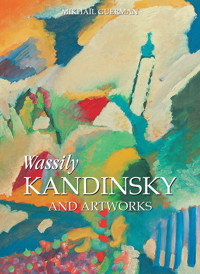
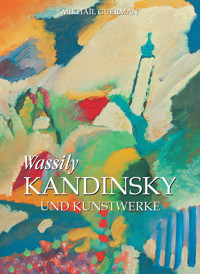
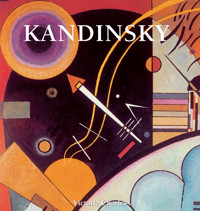
Wassily Kandinsky (1866-1944) was a Russian painter credited as being among the first to truly venture into abstract art. He persisted in expressing his internal world of abstraction despite negative criticism from his peers. He veered away from painting that could be viewed as representational in order to express his emotions, leading to his unique use of colour and form. Although his works received heavy censure at the time, in later years they would become greatly influential.
Das E-Book können Sie in Legimi-Apps oder einer beliebigen App lesen, die das folgende Format unterstützen:
Seitenzahl: 69
Veröffentlichungsjahr: 2023
Ähnliche
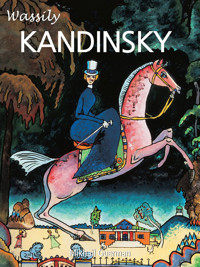
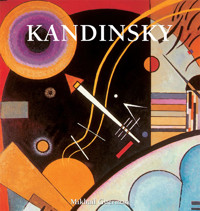







Mikhaïl Guerman
© 2023, Confidential Concepts, Worldwide, USA
© 2023, Parkstone Press USA, New York
© Image-Barwww.image-bar.com
All rights reserved. No part of this may be reproduced or adapted without the permission of the copyright holder, throughout the world.
Unless otherwise specified, copyright on the works reproduced lies with the respective photographers. Despite intensive research, it has not always been possible to establish copyright ownership. Where this is the case, we would appreciate notification.
ISBN: 978-1-78525-063-7
Contents
Biography
Concentration
The Miracle at Murnau
Between East and West
The Return
“The Blue Rider”: A Look Back
List of Illustrations
Kandinsky in Berlin, January 1922
Photograph. Musée national d’Art moderne, Centre Georges-Pompidou, Paris.
Biography
16 December 1866:
Wassily Wassilyevich Kandinsky is born in Moscow. His parents are Lidia Ticheeva and Wassily Silvestrovich Kandinsky.
1871:
The Kandinsky family moves to Odessa where Wassily attends a classical grammar school and takes cello and piano lessons as well as drawing classes.
1886:
He begins to study Law and Economics at the University of Moscow.
1892:
He receives his Ph.D. and works as a teacher at the law faculty. He marries his cousin Anna Chimyakina. At this time he starts turning increasingly towards painting.
1896:
He moves to Munich, at the time one of Europe’s art centres, to devote himself completely to art.
1897-1899:
In Munich he attends the school of Anton Ažbe.
1900:
Studies at the Munich Academy of Fine Arts. His teacher is Franz Stuck, then considered the best draughtsman in Germany.
1901:
Kandinsky and his colleagues found the Phalanx artists’ group, which soon opens its own drawing school. Kandinsky later becomes the group’s president. During the following four years he organises exhibitions.
1902:
He meets young artist Gabriele Münter, for whom he will divorce his wife in 1910. The same year he exhibits in the Berlin Secession for the first time.
1903:
First solo exhibition in Moscow.
1903-1908:
He and Münter undertake several journeys: Holland, Tunisia (Kairouan), France (Paris), Russia, Italy (Rapallo), Germany (Dresden and Berlin). They move into a house in Murnau, Bavaria in 1908.
1904:
Two solo exhibitions in Poland. His work is shown at the Salon d’Automne in Paris.
1909-1910:
Kandinsky founds the Munich New Artists’ Association (Die Neue Künstlervereinigung München). Kandinsky spends autumn and winter of 1909 in Russia, where he exhibits fifty-two works at the “International” Salon in Odessa and participates in an exhibition of the Knave of Diamonds group.
1911:
Together with Franz Marc, Kandinsky founds The Blue Rider (Der Blaue Reiter).
Piper Verlag publishes Kandinsky’s first important written work, Über das Geistige in der Kunst (Concerning the Spiritual in Art), the first theoretical base for abstract art.
1914:
At the outbreak of the First World War, he separates from Münter and goes back to Russia through Switzerland, Italy, and the Balkans. The couple’s last meeting, in Stockholm during the winter of 1915-1916, marks the end of their relationship.
1917:
Kandinsky marries Nina Andreewskaya, aged 17. His political environment is shaped by the Russian Revolution. The Soviets are looking for Russian avant-garde artists. After the October Revolution, Kandinsky holds a number of different positions in the newly created Soviet cultural institutions. He is among the founders of INKhUK (Institute of Artistic Culture) and heads its monumental painting studio.
1918:
He becomes a professor at the Russian Academy of Arts and writes his autobiography which is translated into Russian.
1920:
He starts a professorship at Moscow University. The Soviets reorient towards Socialist Realism.
1921:
Kandinsky and his wife leave Moscow for Berlin. He joins the Bauhaus in Weimar as a professor.
1923:
Kandinsky has his first one-man exhibition in New York. The following year, together with his Bauhaus colleagues, Paul Klee, Lyonel Feininger, and Alexei Jawlensky, he organises the Blue Four group whose lectures and exhibitions reach the United States.
1925:
The Bauhaus is moved to Dessau where he teaches mural painting.
1926:
His essay Point and Line to Plane is published.
1928:
His production of Mussorgsky’s Pictures at an Exhibition is performed at the Friedrich Theatre in Dessau.
1933:
The National Socialists close the Bauhaus. Kandinsky immigrates to Paris.
1937:
Kandinsky works are defamed at the “Degenerate Art” propaganda exhibition. The National Socialists confiscate 57 pieces of his work.
1940:
After the German invasion of France, Kandinsky flees to the Pyrenees.
13 December 1944:
Kandinsky dies in Neuilly-sur-Seine, France.
Mountain Lake, 1899
Oil on canvas, 50 x 70 cm. Manukhina Collection, Moscow
Concentration
Not long ago it seemed that the 20th century had not only begun with Kandinsky, but ended with him as well. But no matter how often his name is cited by the zealots of new and fashionable interpretations, the artist has passed into history and belongs to the past and to the future, perhaps to a greater degree than to the present. So much has been written and said about Kandinsky. His works, including his theoretical ones, are so well-known that this abundance of knowledge and commonplace opinions often hinders our seeing the artist in his individuality, in his real – not mythologised – significance. With a fresh gaze. From the threshold of the third millennium.
Weary of arch postmodernist games, the experienced and serious viewer today seeks in Kandinsky that which no one had seen in him earlier – and had not attempted to see: a buttress in an unstable world of artistic phantoms and fashionable shams. What just less than a hundred years ago was born as a bold revelation has now passed over into the category of eternal values. Among the titans of modernist art, Kandinsky was a patriarch. Matisse was born in 1869; Proust, in 1871; Malevich, in 1879; Klee, in 1879; Picasso, in 1881; Kafka, in 1883; Chagall, in 1887. Kandinsky himself was born in 1866, a year that also witnessed the birth of Romain Rolland and the publication of Dostoevsky’s Crime and Punishment. Anna Karenina had yet to be written and no one had yet pronounced the term “Impressionism”. Kandinsky, in a word, was born in “the very depths” of the 19th century.
Kandinsky was twenty when the last exhibition of the Impressionists opened; he was thirty-four when Ambroise Vollard held the young Picasso’s first one-man show in his gallery. At the turn of the century, Kandinsky was only just beginning to become a professional, his name was still unknown – and he did not yet know himself.
Kandinsky’s intellectualism and that of his art have constantly been noted by scholars and essayists. This situation is not typical: the young paladins of the avant-garde attracted their adepts not so much with knowledge and logic as with the radicalism and the spiritedness of their opinions; and, more often, with a meaningful incomprehensibility interspersed with brilliant revelations. The destiny of a master who linked his art with Russia, Germany, and France; his work as a teacher in the celebrated Bauhaus; his prose, verse, and theoretical writings; his unbending and determined path towards individuality – all of these things have made Kandinsky more than just another of the great artists of the 20th




