


4,99 €
Mehr erfahren.
- Herausgeber: Samuel Shepherd
- Kategorie: Geisteswissenschaft
- Sprache: Englisch
📚 Unveil the Secrets of the Maya Civilization! 🌿
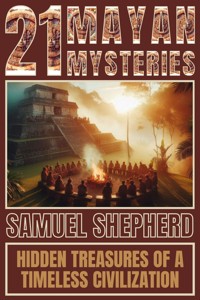
Title: 21 Mayan Mysteries: Hidden Treasures of a Timeless Civilization
Unlock the Mysteries, Discover the Magic
Journey into the heart of one of history’s most fascinating and enigmatic cultures with "21 Mayan Mysteries: Hidden Treasures of a Timeless Civilization." This captivating book takes you on an unforgettable adventure, revealing the incredible achievements and enduring mysteries of the ancient Maya. 🌄✨
Why You’ll Love This Book:
🔍
Explore Intriguing Mysteries
From the celestial alignments of their grand pyramids to the intricate details of their undeciphered codices, this book dives deep into the Maya’s sophisticated world. Each chapter unveils a specific mystery, providing a comprehensive look at their advanced knowledge in astronomy, mathematics, and architecture. 🌟📐
🏛️
Marvel at Architectural Wonders
Discover the genius behind the towering temples of Tikal, the sacred cenotes of Yucatán, and the awe-inspiring palaces of Palenque. The Maya’s architectural prowess will leave you spellbound, offering insights into their spiritual devotion and unparalleled craftsmanship. 🏺🛕✨
📜
Decipher Ancient Texts
Immerse yourself in the labyrinth of Maya glyphs and codices that tell tales of gods, kings, and cosmic events. Learn about their sophisticated writing system and the rich tapestry of history and mythology it conveys. 📖🔑
🌱
Connect with Modern Descendants
Meet the living descendants of the Maya who continue to inhabit Central America, preserving their languages, traditions, and cultural identity. Their resilience and vibrant cultural heritage provide a powerful connection to the past and a living testament to their ancestors’ greatness. 🌎💬
🌟
Perfect for Scholars and Enthusiasts
Whether you’re a seasoned historian, a curious traveler, or a lover of ancient cultures, "21 Mayan Mysteries" is designed to ignite your imagination and deepen your understanding of the Maya. Richly illustrated and meticulously researched, this book is both an educational resource and a captivating read. 🎓📚
🎁
The Perfect Gift
Delight your friends and family with a gift that offers endless hours of discovery and inspiration. "21 Mayan Mysteries" makes a wonderful addition to any bookshelf, providing a treasure trove of knowledge and beauty. 🎁📘
What Readers Are Saying:
"An enthralling exploration of one of the world’s greatest civilizations. A must-read for anyone interested in the mysteries of the ancient world!" 🌟🌟🌟🌟🌟
"Beautifully written and richly detailed, this book brings the Maya’s hidden treasures to life. Highly recommend!" 🌟🌟🌟🌟🌟
Don’t Miss Out!
Step into the world of the Maya and uncover the secrets that have fascinated scholars and adventurers for centuries. "21 Mayan Mysteries: Hidden Treasures of a Timeless Civilization" is more than a book – it’s a journey through time. Order your copy today and embark on an adventure that will captivate your mind and spirit. 🌠📖
Order Now and Discover the Wonders of the Maya Civilization!
🛒
[Add to Cart]
Explore. Wonder. Discover.
Das E-Book können Sie in Legimi-Apps oder einer beliebigen App lesen, die das folgende Format unterstützen:
Veröffentlichungsjahr: 2024
Ähnliche





21
MAYAN MYSTERIES
HIDDEN TREASURES OF A TIMELESS CIVILIZATION
SAMUEL SHEPHERD
Copyright © 2024 by Samuel Shepherd
All rights reserved. No part of this book may be reproduced or transmitted in any form or by any means, electronic or mechanical, including photocopying, recording, or by any information storage and retrieval system, without permission in writing from the publisher.
Published by Samuel Shepherd
Library of Congress Cataloging-in-Publication Data
ISBN 978-1-83938-817-0
Cover design by Rizzo
Disclaimer
The contents of this book are based on extensive research and the best available historical sources. However, the author and publisher make no claims, promises, or guarantees about the accuracy, completeness, or adequacy of the information contained herein. The information in this book is provided on an "as is" basis, and the author and publisher disclaim any and all liability for any errors, omissions, or inaccuracies in the information or for any actions taken in reliance on such information.
The opinions and views expressed in this book are those of the author and do not necessarily reflect the official policy or position of any organization or individual mentioned in this book. Any reference to specific people, places, or events is intended only to provide historical context and is not intended to defame or malign any group, individual, or entity.
The information in this book is intended for educational and entertainment purposes only. It is not intended to be a substitute for professional advice or judgment. Readers are encouraged to conduct their own research and to seek professional advice where appropriate.
Every effort has been made to obtain necessary permissions and acknowledgments for all images and other copyrighted material used in this book. Any errors or omissions in this regard are unintentional, and the author and publisher will correct them in future editions.
TABLE OF CONTENTS – 21 MAYAN MYSTERIES
Introduction
Chapter 1: The Lost City of Uxmal
Chapter 2: The Enigma of the Maya Calendar
Chapter 3: Secrets of Chichen Itza
Chapter 4: The Astronomical Marvels of Copán
Chapter 5: The Sacred Cenotes of Yucatán
Chapter 6: The Mystery of the Maya Codices
Chapter 7: The Rise and Fall of Tikal
Chapter 8: Decoding the Glyphs of Palenque
Chapter 9: The Ball Game Rituals
Chapter 10: The Mayan Underworld: Xibalba
Chapter 11: The Construction of the Pyramids
Chapter 12: The Role of the Jaguar in Maya Culture
Chapter 13: The Legend of the Hero Twins
Chapter 14: The Secrets of Maya Agriculture
Chapter 15: The Hidden Temples of Belize
Chapter 16: The Mayan Trade Routes
Chapter 17: The Mystery of the Red Queen
Chapter 18: The Power of the Priests
Chapter 19: The Astronomy of the Maya
Chapter 20: The Legacy of the Maya Civilization
Chapter 21: The Mayan Prophecies and the Modern World
Conclusion
Introduction
The ancient Maya civilization, flourishing for over three millennia in the dense jungles and rugged highlands of Mesoamerica, remains one of the most enigmatic and captivating cultures in human history. The Maya were pioneers in astronomy, mathematics, and architecture, leaving behind a legacy of knowledge and achievements that continue to astound modern scholars and enthusiasts. Yet, despite extensive research and archaeological discoveries, much about the Maya remains shrouded in mystery, beckoning us to explore their hidden treasures and unravel their secrets.
"21 Mayan Mysteries: Hidden Treasures of a Timeless Civilization" invites you on a journey through the heart of Maya culture, delving into the intriguing enigmas that have puzzled historians for centuries. Each chapter of this book is dedicated to a specific mystery, offering a glimpse into the complexity and depth of Maya society. From the celestial alignments of their pyramids to the undeciphered codices, from the sacred rituals of their priests to the unexplained collapse of their grand cities, this book seeks to shed light on the profound and often perplexing aspects of Maya civilization.
Our journey begins with the exploration of the Maya's sophisticated writing system, a labyrinth of glyphs that convey a rich tapestry of history, mythology, and knowledge. We then traverse their intricate calendar systems, marveling at their precise astronomical observations and mathematical prowess. The grandeur of Maya architecture, with its towering temples and palatial complexes, reveals their architectural genius and spiritual devotion. As we delve deeper, we uncover the rituals and ceremonies that connected the Maya to their gods and the cosmos, offering a glimpse into their deeply spiritual worldview.
But this book is not just about uncovering ancient secrets; it is also a tribute to the living descendants of the Maya. Today, millions of Maya people continue to inhabit Central America, preserving their languages, traditions, and cultural identity. Their resilience and adaptability in the face of historical challenges underscore the enduring spirit of this remarkable civilization.
"21 Mayan Mysteries: Hidden Treasures of a Timeless Civilization" is an invitation to explore, wonder, and reflect. It is a journey through time, an adventure into the unknown, and a celebration of human ingenuity and cultural richness. Whether you are a seasoned scholar or a curious reader, this book promises to ignite your imagination and deepen your appreciation for one of the world's greatest civilizations. Welcome to the world of the Maya, where mysteries abound and treasures await.
Chapter 1: The Lost City of Uxmal
The Lost City of Uxmal, nestled in the Puuc region of Yucatán, Mexico, has long captivated the imaginations of archaeologists, historians, and adventurers alike. Its discovery and exploration represent a fascinating chapter in the annals of Mesoamerican archaeology, a tale marked by intrigue, perseverance, and the relentless pursuit of knowledge. Uxmal, which means "thrice-built" in the Maya language, stands as a testament to the architectural prowess and cultural sophistication of the ancient Maya civilization.
The story of Uxmal's discovery is intertwined with the broader narrative of European exploration in the New World. In the early 19th century, as curiosity about the pre-Columbian civilizations of the Americas grew, explorers and scholars set out to uncover the secrets of the Maya. Among the first Europeans to lay eyes on Uxmal was Jean-Frédéric Waldeck, a French artist and explorer who visited the site in the 1830s. Waldeck's detailed drawings and descriptions, though sometimes embellished, provided an initial glimpse into the grandeur of Uxmal and sparked further interest in the site.
The real breakthrough in the exploration of Uxmal came with the arrival of John Lloyd Stephens and Frederick Catherwood in the 1840s. Stephens, an American writer and diplomat, and Catherwood, a British artist and architect, embarked on a series of expeditions to the Yucatán Peninsula, documenting their findings in richly illustrated books that captured the public's imagination. Their work, particularly the publication of "Incidents of Travel in Yucatán," brought Uxmal to the attention of the wider world and established it as one of the most important archaeological sites in the Maya world.
Stephens and Catherwood's exploration of Uxmal was marked by meticulous observation and a deep appreciation for the artistry and engineering of the ancient Maya. They marveled at the intricate carvings, the grandeur of the pyramids, and the sheer scale of the city. The Pyramid of the Magician, with its steep, elliptical shape and towering height, stood out as a particularly impressive structure. The Nunnery Quadrangle, with its ornate facades and complex layout, further exemplified the sophistication of Maya architecture. Through their detailed accounts and vivid illustrations, Stephens and Catherwood conveyed the splendor of Uxmal to an eager audience back home.
The late 19th and early 20th centuries saw continued exploration and excavation at Uxmal, as archaeologists sought to uncover the mysteries of this ancient city. Among the key figures in this era was Sylvanus G. Morley, an American archaeologist whose work in the early 20th century laid the groundwork for much of what is known about Uxmal today. Morley's excavations focused on the major architectural complexes, including the Pyramid of the Magician, the Nunnery Quadrangle, and the Governor's Palace. His meticulous documentation and analysis of these structures provided invaluable insights into the construction techniques, artistic styles, and cultural practices of the ancient Maya.
One of the most striking features of Uxmal is its unique architectural style, known as Puuc, characterized by its elaborate facades, stone mosaics, and decorative elements. The Puuc style is exemplified in the Nunnery Quadrangle, a complex of four buildings surrounding a central courtyard. Each building is adorned with intricate carvings and masks, many of which depict the rain god Chaac, a deity of great importance in the arid Puuc region. The Governor's Palace, another architectural masterpiece, stretches over 300 feet and features a façade richly decorated with stone mosaics and sculptures, including a prominent serpent motif.
As exploration at Uxmal progressed, archaeologists uncovered not only the architectural marvels but also the everyday artifacts that provided glimpses into the lives of the ancient inhabitants. Pottery, tools, and other domestic items revealed aspects of daily life, trade, and religious practices. These discoveries helped to paint a more comprehensive picture of Uxmal as a vibrant urban center, bustling with activity and deeply interconnected with other Maya cities through networks of trade and cultural exchange.
The exploration of Uxmal also shed light on the city's political and religious significance within the Maya world. The presence of large ceremonial complexes, such as the Pyramid of the Magician and the Nunnery Quadrangle, indicated that Uxmal was a major center of religious and political power. The city's strategic location along important trade routes further underscored its role as a key player in the economic and political landscape of the region. Through the study of inscriptions and iconography, archaeologists were able to piece together the dynastic history of Uxmal's rulers and their interactions with neighboring city-states.
The discovery and exploration of Uxmal have not been without challenges. The dense jungle that once enveloped the city posed significant obstacles to early explorers, who had to contend with harsh weather, disease, and logistical difficulties. The preservation of the site has also been a constant concern, as the ravages of time and the elements threaten to erode the intricate carvings and structures. Efforts to protect and conserve Uxmal have included initiatives to stabilize the buildings, prevent further deterioration, and promote sustainable tourism practices that minimize the impact on the site.
In recent years, technological advancements have opened new avenues for the exploration of Uxmal. Aerial surveys, ground-penetrating radar, and 3D imaging have allowed archaeologists to gain deeper insights into the layout and construction of the city. These tools have revealed previously unknown structures and provided a more nuanced understanding of the spatial organization and architectural evolution of Uxmal. Collaborative efforts between international research teams and local communities have further enriched the study of Uxmal, fostering a more holistic approach to its exploration and conservation.
The discovery and exploration of the Lost City of Uxmal continue to inspire awe and wonder, as each new finding adds to our understanding of the ancient Maya civilization. From the early accounts of explorers like Stephens and Catherwood to the meticulous excavations of modern archaeologists, the journey to uncover the secrets of Uxmal has been a testament to human curiosity and perseverance. The architectural splendor, cultural richness, and historical significance of Uxmal ensure that it remains a focal point for ongoing research and a source of fascination for generations to come.
The Lost City of Uxmal stands as one of the most stunning exemplars of Maya architecture, renowned for its elaborate and highly refined Puuc style. Located in the Puuc region of the Yucatán Peninsula, Uxmal's architectural wonders reflect the ingenuity and artistry of the ancient Maya civilization. The city’s name, meaning "thrice-built," hints at the layers of construction and reconstruction that contribute to its complex and majestic structures.
One of the most iconic and awe-inspiring structures in Uxmal is the Pyramid of the Magician, also known as the Pyramid of the Dwarf. This pyramid stands out due to its unique elliptical base and steep, almost imposing, ascent. Unlike the typical squared or rectangular base of most Mesoamerican pyramids, the Pyramid of the Magician's elliptical shape sets it apart, showcasing a distinctive approach to architectural design. Rising to a height of about 115 feet, the pyramid comprises five distinct levels, each representing different phases of construction. The legend associated with this pyramid tells of a dwarf magician who built it in a single night, adding to the mystique and allure of the structure.
The Pyramid of the Magician is not only a marvel of engineering but also a masterpiece of decorative art. The upper temple, known as the Temple of the Birds, is adorned with intricate carvings and friezes that depict various animals and geometric patterns. These embellishments are not merely decorative; they hold significant symbolic meanings and reflect the cosmological beliefs of the Maya. The serpent motifs, often associated with the feathered serpent deity Kukulcán, symbolize renewal and the cyclical nature of time, central themes in Maya cosmology.
Another architectural gem in Uxmal is the Nunnery Quadrangle, a large complex comprising four elongated buildings that enclose a central courtyard. Despite its name, there is no evidence to suggest that it functioned as a nunnery. The structure's name originates from the Spanish explorers who thought the many small rooms resembled a European convent. The Nunnery Quadrangle exemplifies the Puuc architectural style with its highly decorated facades. Each building is adorned with detailed stone mosaics, latticework, and masks, most notably the Chaac masks, representing the rain god. These masks, with their long, hook-like noses, dominate the decorative scheme, emphasizing the importance of Chaac in the rain-scarce Puuc region.
The intricacies of the Nunnery Quadrangle's design are evident in the east building, which features a grand staircase leading to a richly decorated façade. The use of stacked stone mosaics to create intricate patterns and images is a hallmark of Puuc architecture, showcasing the Maya's advanced stonemasonry skills. The courtyard, surrounded by these ornate buildings, served as a central space for ceremonies and gatherings, further underscoring the complex's sociopolitical significance.
Adjacent to the Nunnery Quadrangle lies the Governor's Palace, another testament to the architectural prowess of the ancient Maya. This massive structure, stretching over 300 feet, is considered one of the longest single buildings in pre-Columbian Mesoamerica. The Governor's Palace sits atop a large platform, enhancing its prominence within the cityscape. Its façade is a masterpiece of Maya artistry, featuring over 20,000 meticulously cut stones arranged into intricate mosaics. The central motif is a double-headed jaguar throne, symbolizing power and authority, flanked by serpent motifs and celestial symbols.
The Governor's Palace also highlights the Maya's advanced understanding of astronomy and cosmology. The building is aligned with celestial events, particularly the movements of Venus, which played a crucial role in Maya calendrical systems and rituals. This alignment is a testament to the Maya's sophisticated knowledge of astronomy and their ability to incorporate this knowledge into their architectural designs.
Another remarkable structure within Uxmal is the House of the Turtles, named for the turtle sculptures that adorn its cornice. Turtles, associated with water and fertility, were significant in Maya mythology, and their presence on this building emphasizes the symbolic integration of nature and architecture. The House of the Turtles is part of a larger complex known as the Great Pyramid, which includes a stepped pyramid similar in style to the Pyramid of the Magician but on a smaller scale. The Great Pyramid's summit offers a panoramic view of Uxmal, highlighting the city's strategic layout and the harmonious integration of its structures with the surrounding landscape.
Uxmal's architectural wonders extend beyond these major structures to include numerous other buildings, terraces, and ball courts, each contributing to the city's grandeur. The House of the Doves, with its peculiar roof comb featuring dovecote-like openings, and the ball court, where ritualistic ball games were played, are integral parts of the city's architectural ensemble. These structures, though not as grand as the Pyramid of the Magician or the Governor's Palace, showcase the diversity and richness of Maya architectural design.
The decorative elements found throughout Uxmal's architecture are not merely ornamental; they serve as a narrative medium, conveying the Maya's religious beliefs, social structure, and cosmological views. The recurring Chaac masks, serpent motifs, and geometric patterns are laden with symbolic meanings, reflecting the interconnectedness of the natural and supernatural worlds in Maya thought. The attention to detail in these carvings is remarkable, with artisans employing various techniques to create depth and texture, resulting in visually stunning and symbolically rich façades.
The construction techniques used in Uxmal further illustrate the ingenuity of the Maya builders. The use of cut stones fitted together without mortar, a technique known as dry-stone masonry, is prevalent throughout the site. This method not only provided stability and durability but also allowed for the intricate decorative work that characterizes Puuc architecture. The precision with which the stones were cut and assembled speaks to the high level of craftsmanship and engineering knowledge possessed by the Maya.
In addition to their architectural and artistic achievements, the builders of Uxmal also demonstrated advanced knowledge of urban planning and hydrology. The city was designed to maximize the limited water resources of the Puuc region, with a network of cisterns, known as chultuns, to collect and store rainwater. These chultuns were strategically placed throughout the city, ensuring a reliable water supply for its inhabitants. This innovative approach to water management was crucial for sustaining a large urban center in an area with few natural water sources.
The architectural wonders of Uxmal are a testament to the creativity, skill, and ingenuity of the ancient Maya civilization. Each structure, from the towering Pyramid of the Magician to the intricately decorated Nunnery Quadrangle and the majestic Governor's Palace, embodies the cultural and artistic achievements of the Maya. The city's harmonious integration of architecture, art, and nature reflects a deep understanding of the environment and a sophisticated cosmological worldview. As archaeologists continue to study and preserve Uxmal, the site remains a source of inspiration and awe, offering a glimpse into the extraordinary legacy of the Maya.
Chapter 2: The Enigma of the Maya Calendar
The enigma of the Maya calendar, particularly the Long Count system, continues to fascinate scholars and enthusiasts alike. The ancient Maya civilization, known for its impressive achievements in architecture, astronomy, and mathematics, developed a highly sophisticated calendrical system that has intrigued researchers for centuries. The Long Count calendar is a cornerstone of Maya chronology, serving as a linear count of days from a mythological starting point, providing insights into the Maya’s perception of time, history, and the cosmos.
The Long Count system differs fundamentally from the more familiar cyclical calendars used in many ancient cultures. While the Maya also used the Tzolk'in, a 260-day ritual calendar, and the Haab', a 365-day solar calendar, the Long Count provided a way to track longer periods of time with remarkable precision. The Long Count is a vigesimal (base-20) system, structured to mark the passage of time in intervals that could span thousands of years, a feature that reflects the Maya’s advanced understanding of mathematics and astronomy.
The origin of the Long Count calendar is traditionally set at a mythological date corresponding to August 11, 3114 BCE in the Gregorian calendar. This date, referred to as the “Creation Date,” marks the beginning of the current cycle of the Maya cosmological timeline. The choice of this specific starting point remains a subject of speculation, but it underscores the Maya’s deep-seated belief in cyclical creation and destruction. By establishing this zero date, the Maya created a framework for recording historical and astronomical events, embedding their cultural and religious significance within the very fabric of their calendrical system.
The structure of the Long Count calendar is based on units of time that include the k'in (1 day), winal (20 days), tun (360 days), k'atun (7,200 days), and b'ak'tun (144,000 days). Each unit is multiplied by the next highest to form larger cycles, allowing the Maya to express dates spanning millions of days. This meticulous system enabled the Maya to document and predict celestial events with extraordinary accuracy. For example, inscriptions found on stelae and monuments often record important historical events, alignments of celestial bodies, and prophecies tied to specific dates in the Long Count.
One of the most famous aspects of the Long Count calendar is its role in the so-called “2012 phenomenon.” The end of the 13th b'ak'tun, which fell on December 21, 2012, sparked widespread speculation and sensationalism, with many interpreting it as a prediction of the world’s end. However, this interpretation misrepresented the Maya's actual beliefs. For the Maya, the completion of a b'ak'tun cycle was a time of renewal and transformation rather than apocalypse. The transition marked a significant, yet natural, point in the ongoing cycle of time, akin to the turning of a new century in the Gregorian calendar.
In addition to its chronological function, the Long Count calendar played a crucial role in the Maya's astronomical observations. The Maya were keen astronomers, and their calendar reflected their sophisticated understanding of celestial cycles. The Long Count was used to predict solar and lunar eclipses, track the movements of planets, and align important ceremonial events with astronomical phenomena. This connection between the calendar and the heavens underscores the integral role that astronomy played in Maya culture, influencing everything from agriculture to religion.
The Long Count calendar’s inscriptions provide a wealth of information about Maya society, politics, and religion. Monuments and stelae across the Maya region bear dates recorded in the Long Count, often accompanied by glyphic texts that describe significant historical events, the reigns of kings, and religious ceremonies. These inscriptions offer a glimpse into the complex and hierarchical nature of Maya society, where rulers were often portrayed as intermediaries between the earthly and divine realms. The calendar thus served not only as a tool for timekeeping but also as a means of legitimizing political power and reinforcing religious beliefs.
The accuracy of the Long Count calendar is particularly remarkable when considering its age and the resources available to the Maya. Their ability to synchronize their calendar with astronomical events, such as the solar year and the synodic cycles of Venus, demonstrates a level of precision that rivals modern calculations. This precision was achieved through careful observation and recording of celestial events over centuries, highlighting the Maya’s dedication to understanding the cosmos and their place within it.




