


Erhalten Sie Zugang zu diesem und mehr als 300000 Büchern ab EUR 5,99 monatlich.
- Herausgeber: The History Press
- Kategorie: Sachliteratur, Reportagen, Biografien
- Sprache: Englisch
Bognor Regis is situated on the south coast of Britain, overlooking the English Channel. On 18 January 1787 the resort's founder, Sir Richard Hotham, laid the first stone marking the town as a 'public bathing place', a description that Bognor Regis has enjoyed ever since. The lure of the sea and the town's regular appearance at the top of the national sunshine league continues to draw people from towns and cities. Throughout the decades, seaside holidays have changed to reflect current fashions. Bognor Regis has been no different; rather like the ebb and flow of the tide, visitor numbers have risen, fallen and risen again according to the various fashions of the day. Accessibility by train from London was a major contributor to the number of visitors in the resort's early years. Coaches and Sunday school outings then came into prominence, followed eventually by the arrival of the car. As leisure time and money became more plentiful, a Sunday outing was replaced by a week at the seaside, then a fortnight's break. Recalling Macari's delicious ice cream, the divers leaping off the pier, and children building sandcastles as their parents sat in deckchairs in suits and summer dresses, this book relives the glory days of 1950s Bognor Regis. With many pictures published here for the first time, this book is sure to bring back happy memories for both visitors and residents of this popular seaside town.
Sie lesen das E-Book in den Legimi-Apps auf:
Seitenzahl: 134
Veröffentlichungsjahr: 2014
Das E-Book (TTS) können Sie hören im Abo „Legimi Premium” in Legimi-Apps auf:
Ähnliche



















To our parents, Lewis & Elsie Endacott and Winifred & Norman Lewis, who always enjoyed their holidays in Bognor Regis, our adopted home town.
ACKNOWLEDGEMENTS
We would like to thank the following organisations: Bognor Regis University of the Third Age (U3A) and the Shared Learning Project (SLP); West Sussex Record Office; Bognor Regis Local History Museum; also members from numerous U3A’s.
Shared Learning Project members: Anne Barrow, Tim Eade, Richard Jeffery, Helen Krarup, Josie Landolt, Rodney Lees, Jill Wellman.
We also acknowledge the help given to us by Jane Barnes, Chris Burstow, Peggy Carrott, David Jennings, Sue Millard, Alan Readman and the late Sheila Smith.
We have received contributions and photographs (P) from: David Allam (P), Les Allatt, Eileen Anderson, Lyn Baily (P), Alan Binns (P), Paul Bignall, Margaret Bryant, Peter Burrell (P), Maureen Carter (P), Jill Chapman, Hugh Coster, Adrian Collyns, Mrs Cowell, Sheena Cribb, Sheila Dixon, Pauline Edwards, Barbara Eldridge (P), Kay Fall (P), Angela Ford, Tom Gillespie (P), Fiona Huntley, Anne Jeffery, Jenny Jennings (P), Clifford Jones (P), Ruby Knight, Josie Landolt, Roy Laing (P), Doug Law (P), Maureen Lord (P), Colin Manning, Anne Manville (P), Felicity Mills (P), Les Norman, Sylvia Olliver (P), Marilyn Paton (P), Charles Powell, Paul Rapley, Sue Reeves (P), Margaret Richards, Janet Rufey, Julie Scott, Ken Scutt (P), Jean Shearley (P), Paula Smith (P), Mary Streeter, Carol Tickner, Daphne Thomas, Gwen Twaites (P), Peter Tompkins (P), Liz Tribe (P), Val Warlow (P), Peter Williams, Brian Willis (P), Anthony Wills.
We have used images from our own archives, the Bognor Regis Local History Museum, the Gerard Young Collection, and the West Sussex District Council archives situated in the West Sussex Record Office. A number of photographs were also loaned from the Colin L.M. Bell collection, with associate information and assistance from Aidan and Hazel Bell.
Finally we acknowledge Anne Barrow, Jeni Pinel, Marjorie Spooner and Alan Warwick for proofreading and contents comments, and Ron Iden for his historical checks as well as general comments.
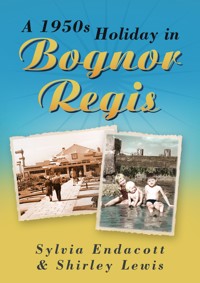
Cover images:
Left – Esplanade Theatre postcard.
Right – Helen Scutt (centre) with her cousins, Hilary and Robin.
Back cover (left to right):
Hazel Macaulife, Malcolm Roberts, Roy Becker and his fiancée Kathy Richardson.
CONTENTS
Title
Dedication
Acknowledgements
Introduction
Travel
Accommodation
Memories
Entertainment
East and West
Copyright
INTRODUCTION
Shirley and I have been involved in a number of publications over the years, dealing with specific subjects such as airfields, companies, people and the seaside, and relating to various times in the past. When considering local history it is understandable to think of it as ‘days gone by’, but when those days are part of one’s own lifetime it takes on another significance altogether.
This book looks at our present home town, Bognor Regis, in the 1950s, although we did not move here permanently until the 1970s. The 1950s were an interesting decade; after the austerity of war, people welcomed the end of rationing. It was a period of change for everyone. As the decade progressed, people started thinking of holidays again, and in this publication we will look at how they travelled to their destination, whom they went with and where they stayed. On arrival what did they do, where did they eat and drink and who did they meet? In 2014 these may seem somewhat strange questions, but we think you may be surprised by the answers!
For the journey within this book we have taken the opportunity to speak with people who remember this decade, whether as holidaymakers or residents. We have read local and national newspapers and magazines of the 1950s and the annual Bognor Regis Urban District Council Holiday Guides. We teamed up with the Bognor Regis Branch of the U3A on a National Shared Learning Project and formed a team to look in depth at the subject. We have worked with the Bognor Regis Local History Museum, using their archives and research rooms; we have also worked with the West Sussex Record Office.
What were holidays like in the 1950s? People had, perhaps, a break of a week, or maybe two, at a favourite location. For many people, especially those with large families, there would be the opportunity of renting a caravan for a period, or staying at a bed and breakfast. In very popular holiday destinations, local people advertised that they would provide a bed and breakfast in their own home for a weekly rate; Sylvia’s mother did this for a time in the 1950s in Plymouth. There were, of course, those who were only able to go to the seaside for the day, thus the day tripper became important to any resort.
When one looks around Bognor Regis in 2014, there is a Butlin’s Holiday Resort, also some smaller caravan parks, and a number of hotels and guest houses, but it is a far cry from the profusion of hotels, caravan and camping sites and bed and breakfast accommodation that existed in the 1950s. Our expectations and needs have changed considerably over the last sixty years. We have moved from a time when only rich people had cars to one where it is not uncommon for several members in one household to each have a car. Many rented their homes in the 1950s, today home ownership is more prevalent. For many more people, holidays at home have changed to holidays abroad, weekend breaks and cruises.
In post-war Bognor Regis, the authorities and business owners realised that the holidaymakers and day trippers were returning, and so had to ensure there were services, activities and entertainment available to ensure a good holiday experience for everyone.
It is important to remember that the aftermath of the Second World War was still affecting daily life in the UK. Rationing was still in operation: petrol and soap rationing had only ended in 1950, identity cards were abolished in 1952 and in the same year the Utility Furniture and Clothing Schemes ended. Sweet rationing remained until 1953, when sugar rationing also finally ended after fourteen years. Not until 1954 did all rationing end.
In this book we have looked at a seaside resort in the 1950s through the eyes of holidaymakers, and also residents who spent their childhood in Bognor Regis. In a 1953 Kelly’s Directory the Bognor Regis Urban District Council area is recorded as consisting of 2,695 acres of land with 352 acres of foreshore. By 1955 the population was recorded as 25,647 people. Much of the advertising for the town featured the phrase ‘The Heart of the Sussex Riviera’.
People speak of this time with such a depth of feeling that one gets carried along with their memories. We have added some historical facts and background information as necessary to complete these memories. It has not always been possible to place the very interesting pictures that we have been given into the text of the person who kindly supplied them; nor have we been able to use all the words and pictures you supplied and we hope you will understand our difficulty in deciding on the final content.
Sylvia Endacott & Shirley Lewis
2014
It has been interesting to read the newspapers of this era and to realise how similar the reports were. It is good to see how the press reported on our town.
The Times, 21 February 1951 – Popular Notions corrected:
‘Taking the average for the whole year, the warmest places are the Scillies, The Channel Isles and Penzance. The Channel Isles enjoys the most sunshine, but Eastbourne, Worthing and Bognor Regis are not far behind.’
Early Days
I was born in 1952 and experienced my first Bognor Regis holiday in 1954. My grandmother used to rent both Valetta Cottages in Nyewood Lane for the month of July every year until 1962. She and her companion of the time took one cottage, and my parents and I, and sometimes my parents’ guests, the other. The cottages then belonged to Mrs Newton and her daughter Iris, both teachers, who lived in London. The late Mr Newton had been a political journalist with the News Chronicle.
The cottages were very old fashioned with kitchen ranges, chenille cloths on the table and a noisy geyser in each downstairs bathroom. They both smelt slightly damp, but I loved them. They were my passport to the joys of the beach at Aldwick Road and visits to Pets Corner in Hotham Park and, until Butlin’s came, the thrill of model railway trips on the flat lands at East Bognor.
My grandmother always hired two beach huts from the Grays who regaled me with stories of smugglers who had, they assured me, once lived at Valetta Cottages. They told me that there was a passage under the back garden in which contraband had been stored and a large number of ghosts lurked. Certainly the cottages had once housed a pig-farmer called Greenwood and my parents and grandmother often commented that they could smell bacon curing. So a culinary rather than a smuggling spirit was abroad in Nyewood Lane in the 1950s.
Beach life involved fishing for shrimps and crabs in the broken wreckage of the Mulberry harbour*, sandcastles and swimming. The hot summer of 1959 had the best swimming and beach life, although my grandmother always insisted that we return to the cottages for lunch and a rest before returning to the beach or more likely a drive in the countryside, which she preferred.
*Authors’ Note – the wreck of a concrete Mulberry Harbour section which broke loose in a storm prior to being towed across the Channel on D-Day 1944.
David Allam aged 6 years.
For special occasions, there were ice creams on offer at the Marine Café and the odd, very English lunch at the Green Lounge in Aldwick Road, which I recall was a very 1950s menu of soup, meat and two vegetables, and ice cream or cabinet pudding.
The pier was about slot machines and didn’t excite me, but Bognor in the immediate post-war period had various backyard poultry-keepers and I was fascinated by them, particularly a large flock of chickens in Wood Street and geese behind Valetta Cottage. Grants, the greengrocers in Nyewood Lane, stocked fantastic summer fruit and strawberries and cream were a regular, totally seasonal treat. Prawns could be acquired from contacts of the Grays and cream teas were on offer in a garden in Bosham, which to my delight hosted an aviary of budgies.
It was simple stuff but Bognor Regis was crowded with young families in the 1950s, forming a moving crocodile to the beach. Those without beach huts went regardless of weather, emerging from a host of guest houses, small hotels and lodgings, dragging buckets and spades behind them. I felt proud that we had a cottage with the freedom of a small garden full of roses, honeysuckle and wild strawberries. To me, a London boy, Bognor Regis was not just seaside in the 1950s it was a country town.
David Allam
1st Chairman of the Bognor Regis Local History Society
High Sheriff of East Sussex, 2013
The Season
Bognor Regis – the holiday resort – was always absolutely full during ‘The Season’, which usually stretched from just after Whitsun until the end of the summer school holidays.
The 1950s followed the war and I remember summer after summer, that the part of the beautiful sandy beach between the end of Gloucester road and the end of Nyewood Lane, was absolutely packed with happy holidaymakers – in fact when the tide was coming in it was difficult to find a place on the beach to place a deckchair. The most popular part was between The Rex Entertainment Centre and the Royal Norfolk Hotel. On the corner of York Road, opposite the Rex, there was a wonderful toy shop called Goodacres that sold all the wonderful toys imaginable and also, of course, all the paraphernalia necessary to enjoy the seaside: buckets and spades, beach balls, kites, and bathing costumes and footwear for paddling in the sea.
Next to the toy shop was the Florida restaurant, a delightful seaside restaurant with a glass-covered canopy beneath which one could dine in all weathers. This restaurant was owned by the Kalli brothers who also ran the amusement arcade on the pier. Their sister ran the ice-cream stall next to the restaurant. She quite fascinated me because, where she was in the sun all day with her sunglasses on, she got very brown apart from her sunglasses-covered eyes. She looked like a panda. She was very beautiful.
By the ice-cream kiosk was the first set of amusements: ghost train, roundabouts, bingo stalls. This set of amusements was run by the Romain family. The Romain twins, Pauline and Johnny, were wonderful ‘show people’ who performed amazing jitterbug sessions at the Rex Ballroom that had all the other dancers spellbound (dances were held every night during the summer, apart from Sunday of course). Although in those heady 1950s the sun appeared to be shining continually, Johnny told me that he preferred a bit of rain because then the holidaymakers would come up off the beach to shelter and spend their money in the amusement arcades. I worked in the amusement arcade on the pier occasionally, when I was on leave from the Navy, so I knew that this was true – there was no custom on the Greyhound Racing at all when the sun was shining!
Next to the amusement arcade was the zoo with its imitation rock-faced cliff on which monkeys would clamber. It was from this zoo that a lion was said to have escaped in the 1930s when the news was broadcast nationally that the lion had been seen in Pagham. It all turned out to be a publicity stunt arranged, I believe, by Billy Butlin, the owner of the site.
Going west from the zoo there were sunken gardens with a small café, and several hotels including the famous Shoreline, which later became very popular as a club for young people where they could go and let their hair down.
Opposite the pier was a bowling green at Waterloo Square and a small crazy golf course, which was a favourite with elderly holidaymakers. This area and the pier itself were extremely popular. The pier had two theatres and an amusement arcade and there was also a very good café that was managed by my wife Pat. A train ran along the pier to the end where there was a small dance hall and diving boards from where divers – hooded, shackled and sometimes on bikes – would amaze large audiences as they plunged into the sea. There was a jetty at the very end of the pier from which paddle steamers, loaded with passengers, would sail down the Channel. The pier was a great centre of fun, on the top, at the end and even underneath.
Leaving the pier and travelling westwards, this part of the beach was the most popular for organised games on the sands, competitions, keep fit, small car races, Punch and Judy, and beauty competitions. The lower promenade had long rows of concrete steps leading down to the sands. These made an ideal ‘grandstand’ for watching the games and Punch and Judy.
At this upper level of the promenade, opposite the Royal Norfolk Hotel, the delightful Esplanade Theatre was situated. Each summer the same show Dazzle was performed and the show became very much part of the summer scene of Bognor Regis. The cast made many friends locally and some of them eventually settled in the town.
Adjoining the theatre was a proper seaside café, run by Mr Macari, where one could get a welcome cup of tea and snack. Teas were often delivered on a tray down to the sands – this happened at several of the cafés along the seafront.
There were floodlights fitted next to the café which shone onto a large raft situated a few yards out to sea when the tide was in. At night the area was lit up, and on a warm summer’s evening midnight bathing took place; with the dance music drifting across the water from the dance hall at the end of the pier, what a wonderful, romantic time it was.
I’ve tried to convey what an exciting and joyous place Bognor was in the summer. Visitors streaming from the train station to one of the 123 hotels and guest houses advertised in the local guide, a look on their faces of happy anticipation, a fulfilled anticipation that brought those visitors back to Bognor year after year.




