


9,99 €
Mehr erfahren.
- Herausgeber: The History Press
- Kategorie: Sachliteratur, Reportagen, Biografien
- Sprache: Englisch
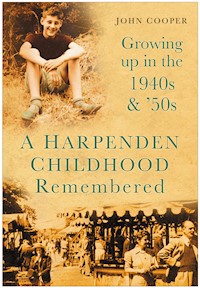
John Cooper vividly recalls the dark days of the Second World War - air raids, rationing, Home Guard manoeuvres, prisoners of war on the doorstep and the excitement of VE Day - and the long, carefree days of post-war childhood that followed, when the pace of life was much gentler than today. The author recalls local shops, now long gone, such as Harriden's grocery store and Mr Lines the blacksmith, as well as Harpenden's two cinemas, in one of which he was briefly employed as a projectionist. Memories of the glittering Festival of Britain and Queen Elizabeth II's Coronation celebrations, together with a nostalgic journey back to Harpenden, round off this trip down memory lane, which will surely appeal to anyone interested in the history of Hertfordshire within living memory.
Das E-Book können Sie in Legimi-Apps oder einer beliebigen App lesen, die das folgende Format unterstützen:
Veröffentlichungsjahr: 2012
Ähnliche



















A HARPENDEN CHILDHOOD
Remembered
A HARPENDEN CHILDHOOD
Remembered
Growing up in the 1940s & ’50s
JOHN COOPER
To my darling wife Bet, in appreciation of her constant support and encouragement
First published in 2007 by Sutton Publishing
The History Press
The Mill, Brimscombe Port
Stroud, Gloucestershire, GL5 2QG
www.thehistorypress.co.uk
This ebook edition first published in 2012
All rights reserved
© John Cooper, 2007, 2012
The right of John Cooper, to be identified as the Author of this work has been asserted in accordance with the Copyrights, Designs and Patents Act 1988.
This ebook is copyright material and must not be copied, reproduced, transferred, distributed, leased, licensed or publicly performed or used in any way except as specifically permitted in writing by the publishers, as allowed under the terms and conditions under which it was purchased or as strictly permitted by applicable copyright law. Any unauthorised distribution or use of this text may be a direct infringement of the author’s and publisher’s rights, and those responsible may be liable in law accordingly.
EPUB ISBN 978 0 7524 8687 1
MOBI ISBN 978 0 7524 8686 4
Original typesetting by The History Press
CONTENTS
About the Author
Introduction
1 The War Years
2 School Days
3 Childhood Memories
4 Where Did It All Begin?
5 Reflections of Harpenden
6 The Last Film Show
7 Village Celebrations
8 Return To My Roots
Acknowledgements
ABOUT THE AUTHOR
John Cooper was born in Harpenden in 1938 and lived in the Village until 1969 when, following his marriage to Betty, he moved to Watford where they still live. They have two children, Mark and Sarah and a two-year-old grandson, Liam.
A retired quantity surveyor and office manager, most of John’s spare time has been taken up by researching and writing this book, a project that he has found to be not only challenging and stimulating but extremely enjoyable too. His other interests include genealogical research (which at one stage he did professionally), working at his computer, collecting classic movies and reading, especially local history and the Second World War. He also collects old photographs and postcards of Harpenden.
INTRODUCTION
This narrative recounts the author’s early years growing up in the village of Harpenden in Hertfordshire during the 1940s and early 1950s. Memories of the Second World War are vividly recalled when air raids, rationing and shortages were part of everyday life, as was the constant fear and dread of the siren, rising and falling in a crescendo, the nightly incarceration in the air-raid shelter and then the overwhelming relief of the ‘All Clear’. Remembered also are the manoeuvres carried out by the local Home Guard, the day that the enemy turned up on the doorstep and then the palpable buzz of excitement and happiness as at long last VE Day dawned.
The start of school brought its own fears, not only from the disruption caused by the sound of the air-raid siren but also from the ever-present threat of a caning or detention due to some misdemeanour or other. Although discipline was strict, the teachers were fair with old-fashioned values. The author recalls the epitome of every boyhood dream – the exhilarating experience of travelling on the footplate of a steam locomotive with a school friend.
During those drab, austere post-war years, the long, carefree days of childhood are nostalgically captured in an age when the pace of life was gentler and slower than it is today. With the country struggling to get back on its feet after nearly six years of hostilities, what youngsters lacked in material diversions, they certainly made up for with inventiveness, make-believe and a keen sense of adventure. Pleasures were simple and many happy hours were spent on innocent pursuits such as trainspotting or a bike ride to the Silver Cup Pond to sail a toy yacht.
The author takes the reader on a fascinating journey – how he, a young schoolboy, came to be living in the peace and tranquillity of Harpenden. He recalls how members of his family originally travelled from the furnaces and forges of the South Wales ironworks to the thread mills of Russia and Poland, the outbreak of the Russian Revolution and the constant fear and deprivation of living under the scourge of the swastika in Germany during the Second World War.
The author in the 1940s.
The local shops, both in north Harpenden and in the Village are fondly remembered where service and courtesy were bywords. The author recalls the heady aroma of roasting coffee beans as one passed Harriden’s grocery store and the smell of the horses and the red hot metal as a shoe was fitted by Mr Lines, the local blacksmith.
The Village at that time proudly boasted two cinemas – the Austral (later the Embassy) and the Regent. Both were popular venues. At one stage the Austral used to serve afternoon tea in the interval to any patron who placed an order at the time that they paid for their ticket. An amusing anecdote of the author’s somewhat brief employment as an assistant projectionist is also recounted.
Post-war recovery was slow and rationing was still very much in evidence when Harpenden surpassed itself with a glittering and spectacular programme of festivities to celebrate two key events in the early 1950s that were to bring some much-needed colour and excitement to an otherwise cheerless and lack-lustre country. These were the Festival of Britain and the Coronation, following the death of the King in February, 1952.
More than fifty years later, the author returns to the place of his birth and childhood. Many changes have taken place, shops have altered or disappeared forever and no longer is there the peace and tranquillity that he used to know so well. Yet despite all this, Harpenden still retains the same ‘village’ atmosphere and old-world character that always existed in a childhood remembered.
John Cooper
November 2007
Chapter One
THE WAR YEARS
As the ear-splitting sound of the ‘All Clear’ from the siren gradually faded away, my father pulled open the double blast-proof doors of the air-raid shelter. Another night spent underground was over. The grim news bulletins on the wireless recounted the utter devastation in London where they had just experienced the worst raid of the blitz, when over 500 enemy bombers had dropped their deadly loads killing in excess of 1,400 people and injuring hundreds more.
After six long hours in the stale, dank atmosphere of the shelter, it was good to greedily gulp in the cool, fresh air. The dew lay heavy on the lawn while the sun, just starting to rise, gave the promise of another beautiful day on that May morning in 1941 in the Hertfordshire village of Harpenden.
My father went back down the concrete stairs of the shelter, extinguished the flame of the hurricane lamp hanging just inside the doorway and picked me up onto his shoulders, while my mother and elder sister Pat followed behind as we made our way back to the house.
This was my first recollection of the dark days of the Second World War that were to follow.
With the war now into its second year, these nocturnal visits to our shelter, coupled with rationing and severe shortages, formed a regular uninterrupted pattern in our daily lives. The sound of the siren in the Village, rising and falling in a crescendo that put fear and dread into your whole body, being plucked from my bed and taken by my parents to our bunker in the garden, the deep throb of the turbo engines from the bombers passing overhead and then eventually the relief of the ‘All Clear’. These are all indelibly etched in my memory.
Map of Harpenden, c. 1946. (Reproduced from the 1950 Ordnance Survey map)
At just under three though, and in common with many other youngsters of my age at the time, this was the norm. We hadn’t known anything different. Names such as Churchill and Hitler meant nothing to us. I was content with the few toys that I had which were either second-hand or made by my father and although food was scarce, I never seemed to go hungry.
Just over two and a half years earlier, on Monday 29 August 1938 to be exact, the day dawned like any other – nothing very spectacular. The weather forecast promised cloud and rain at first, fairer periods later. The newspapers gave full accounts of Captain George Eyston breaking the world land speed record on Bonneville Salt Flats in Utah, USA, the previous day, and, oh yes – I was born. This important event took place at the Nursing Centre or to give it its full title, the Harpenden Memorial Nursing Centre in Luton Road, just opposite the Austral Cinema.
At the time of my birth we were living in Fairmead Avenue but shortly after the outbreak of war, we moved to Bloomfield Road at the northern end of Harpenden. It was a lovely detached property with clear, uninterrupted views across open fields. Our road was the very last one on the right-hand side as you left the Village travelling towards Luton. It stretched uphill from Luton Road to Ambrose Lane at the top. In those days, as with so many others in Harpenden, the road was not made up which I think made it more interesting than the bland tarmacadam surface that was eventually laid many years later.
Churchill RHF tanks with a Soviet delegation at Vauxhall Motors.
Bedford lorries with a Soviet delegation at Vauxhall Motors.
Business card of a Soviet tank expert of the trade delegation.
An invitation from the Embassy of the USSR to the first screening of two documentary films entitled Berlin and The Victory Parade in Moscow.
Quiet Please!




