


4,99 €
Mehr erfahren.
- Herausgeber: tredition
- Kategorie: Sachliteratur, Reportagen, Biografien
- Sprache: Englisch
At the age of 95, Gray K. Madyenkuku has seen it all. As a boy he was one of the first to receive an education by the missionaries who came to the hot and remote Gwembe Valley in Southern Province of Zambia. He and his family lived through the resettlement of 57 000 BaTonga people after for construction of the Kariba dam, the largest man-made lake at that time and he saw the struggle for Zambia´s independence. As critical observer of development and a longtime member of local committees and projects, he is also heading a large family. This is the view of a local man of the changes and developments from colonial times to today. Smartphone users can access the original recordings via QR Codes in the book. More photos and information on the author at www.vielfalt-landwirtschaft.jimdo.com
Das E-Book können Sie in Legimi-Apps oder einer beliebigen App lesen, die das folgende Format unterstützen:
Seitenzahl: 42
Veröffentlichungsjahr: 2017
Ähnliche

















To Elizabeth Colson who knew all of them
Ursula Gröhn-Wittern
A Large Dam, Small Fish and the BaTonga
95 years of Zambian History observed by Gray K. Madyenkuku
© 2017 Ursula Gröhn-Wittern
Verlag: tredition GmbH, Hamburg
ISBN
Paperback:
978-3-7345-5523-7
Hardcover:
978-3-7345-5524-4
e-Book:
978-3-7345-5525-1
Das Werk, einschließlich seiner Teile, ist urheberrechtlich geschützt. Jede Verwertung ist ohne Zustimmung des Verlages und des Autors unzulässig. Dies gilt insbesondere für die elektronische oder sonstige Vervielfältigung, Übersetzung, Verbreitung und öffentliche Zugänglichmachung.
I tell you, whenever you did this for one of the least important of these brothers of mine, you did it for me.
Matthew 25, 40
Photos:
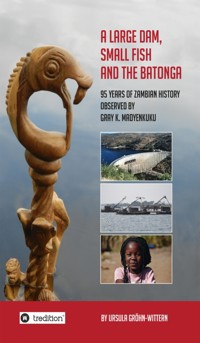
Front cover: The river god Nyaminyami i, Kariba ii Dam, Kapenta Fishing rigs, Tonga Girl
Back cover: Gray Madyenkuku and author 2016
All rights by the author.
Map on page is by Gossner Mission
Layout cover: Druckerei St. Pauli, Hamburg
Introduction
In 1984 I started to work on a three- year contract as an agricultural adviser for a seed multiplication and distribution programme in the former Gwembe South Development Project (GSDP) in Southern Province of Zambia. BaGray, as he is called by his friends, became my source of knowledge and advice in many ways.
This book is the tribute I pay to his patience, knowledge and friendship. I feel a great need to preserve the voices of people who have seen such a long time of social, economic and political change in a country like Zambia as he has.
BaGray was 95 years old when my husband and I spent a week together with him at his home near Sinazongwe in 2016, recording his memories but also discussing many topics ranging from the Brexit (happening at that time), to birth control and the problems of an ageing population in Germany, to the upcoming elections in Zambia or the pollution of rivers and air by the mining industry.
I do not agree with all of his views but respect his conclusions as a result of the observations he made and his deep belief in the words of the Bible. I have tried to keep to his wording as close as possible. Some things though, need explanations for the reader who is not familiar with certain events and terms. This is done in the footnotes I added.
Father of 33 living children and numerous grandchildren and greatgrandchildren he is spending his days at home, keenly interested in the world and at the same time humbly thanking God for every day He gives and the food on his table.
The people of Zambia are close to me and my husband. We hope this can be a small contribution and a sign of the love and respect we feel for all those who really try to contribute to a peaceful and just development without pursuing their personal advantage.
I would like to thank Gossner Mission for the support in Lusaka and the work done by the staff of the Kaluli Development Foundation especially Mr. Milupi Silumesii at Nkandabbwe, Sinazongwe district.
Ursula Gröhn-Wittern
August, 2016
Some of the original recordings can be accessed through the QR Codes in the book.
Gray Kanini Madyenkuku
Gray Kanini Madyenkuku
My name is Gray Kanini Madyenkuku. I was born in Siameja in the Gwembe District, Zambia on the March 3 in 1921.
My father was a teacher-evangelist. He was a class teacher running an elementary school. He first opened a new school in Sinakasikili in 1923. There we stayed up to 1927 when we shifted to open another school in Mweemba´s area. We stayed there for three years and were transferred to go across from Northern Rhodesia to Southern Rhodesia to open a school in the village of Binga.
That is where I started learning and grew up. In 1926, my brother, the son of my aunt, took me to Kabanga Mission where I had to go into Tonga primary part two. Within the same year, I went into English reader one. When I came back for holidays, the missionary at Kanchindu blamed my father for sending me to another people´s denomination to get my education. So I didn't go back to Kabanga Mission which was catholic. I remained at Kanchindu Methodist Mission where I had to start with standard one.
In 1926 the provincial education officer, Mr. Bell from Livingstone came and after testing class standard one, I was one of three boys who were transferred straight away into standard three.
The point made by him was, that one should not waste people’s time when they already know everything.
I went on with Kanchindu Mission. That same year we transferred the whole mission to go to Masuku Mission because the white missionaries did not like the heat of the Gwembe Valley. So they had to go to a cooler place. Masuku Mission at that time was built in the land of the senior headman Siasikabole in Singani chiefdom.
While there, I was put into standard four and at the end of 1928 I went to Kafue Mission for standard five and six.




