


Erhalten Sie Zugang zu diesem und mehr als 300000 Büchern ab EUR 5,99 monatlich.
- Herausgeber: The History Press
- Kategorie: Sachliteratur, Reportagen, Biografien
- Sprache: Englisch
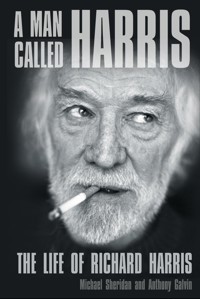
Richard Harris was a giant who oozed charisma on screen. But off screen he was troubled and addicted to every pleasure life could offer. Coming from a repressed Irish Catholic background, he was forced by a teenage illness to abandon his beloved rugby, but not his macho appetites. Discovering theatre saved him. He had found his calling. Despite marrying the daughter of a peer, he never tried to fit in. He was always a hell-raiser to the core, along with legendary buddies Richard Burton and Peter O'Toole. But he was more; he was a gifted poet and singer. He was an intelligent family man who took great interest in his craft, a Renaissance man of the film world. Every time his excesses threatened to kill his career – and himself – he rose magnificently from the ashes, first with an Oscar-winning performance as Bull McCabe in The Field, then in the Harry Potter franchise.
Sie lesen das E-Book in den Legimi-Apps auf:
Seitenzahl: 475
Veröffentlichungsjahr: 2013
Das E-Book (TTS) können Sie hören im Abo „Legimi Premium” in Legimi-Apps auf:
Ähnliche


















2013 is the 50th anniversary of This Sporting Life in which Richard Harris arguably played his greatest role. His portrayal of rugby league player Frank Machin got a BAFTA nomination for Best Actor, won the Cannes Film Festival Award for Best Actor and got an Academy Award nomination for Best Actor.
But thy eternal summer shall not fade,
Nor lose possession of that fair thou ow’st,
Nor shall death brag thou wander’st in his shade
When in eternal lines to time thou grow’st:
So long as men can breathe or eyes can see,
So long lives this, and this gives life to thee.
Shakespeare, Sonnet 18
Cover illustration © Getty Images.
ACKNOWLEDGEMENTS
A number of people were very generous with their time and expertise during the preparation of this book. In no particular order we would like to thank the following people.
Richard Harris’s only surviving sibling, Noel Harris. Lifelong friend Manuel Di Lucia and Dickie’s other friends who spoke to us, including Vincent Finucane and Kevin O’Connor. Editor Alan English and news editor Eugene Phelan of the Limerick Leader. The patrons of Quinlan’s Bar and Charlie St George’s in Limerick. Tommy Monahan of Young Munster Rugby Club. Illusionist Peter Blackthorn and magician Tony Baloney. Ronan O’Leary for his time and invaluable expertise. And all the Limerick people who shared their stories of the great man.
We thank them, but the opinions in the book are our own. Any errors that may have crept in are entirely our fault!
CONTENTS
Title
Dedication
Acknowledgements
Prologue
1 The Man/Artist
2 Origins
3 Childhood
4 Secondary School
5 A Romantic Interlude
6 A Sporting Life
7 The Actor is Born
8 London Calling
9 Mutiny on the Bounty [1962]
10 Raging Rugby Bull
11 Major Dundee (1965)
12 Camelot (1967)
13 ‘MacArthur Park’ (1968)
14 Burning Up the Screen
15 A Man Called Horse (1970)
16 The Molly Maguires [1970]
17 Bloomfield and Beyond [1970]
18 The Field [1990]
19 Indian Summer
20 Limerick Giants Come to Blows
21 Gladiator (2000)
22 The Ongoing Passion
Epilogue
Appendix
Filmography
Bibliography
Plates
Copyright
PROLOGUE
As the years passed, Richard Harris looked back on his childhood with a special fondness. Nowhere was as special for him as Kilkee, County Clare, where he had passed so many happy summer days. It was his Mecca, his Eden, and the place from where he set out on his journey to conquer Hollywood. It was no surprise that he kept returning there.
He came back most summers in his early days, and when he began to do well, he decided to buy a house in the resort. He purchased a place on his beloved West End, a big old Victorian terraced house called The Billows. It was a spectacular end-of-terrace two-storey building, one of the most elegant on the seafront. The house had an unusual side-by-side pair of double bay windows, with spectacular beach and bay views. It retained many of its period features, including high ceilings, and had six rooms.
Harris made the purchase in 1969, at the peak of his fame. Money was rolling in and he could afford to splash out on his new indulgence. He refurbished the house to the highest specifications, making it one of the most desirable residences in Kilkee.
His friend Manuel Di Lucia, an auctioneer and restaurateur, remembers the purchase well: ‘He bought the house for £7,000, then spent £22,000 on doing it up.’ That was a staggering amount in the late 1960s, the equivalent today of spending perhaps half a million on renovations alone. Although Harris was in the process of divorcing his first wife, Elizabeth, she had a big say in the design of the new home. He also consulted his sister, Harmay. Little did he suspect that she would be dead within a year, and would never see the project to completion.
Much of the furniture and fittings were brought over to Ireland from London, and only the best was considered. ‘It was done up by his wife Elizabeth and his sister Harmay,’ recalled Di Lucia. ‘It was a mansion. It was the first house I ever saw with gold taps and bathroom fittings.’
Limerick man Vincent Finucane, who had played rugby with Harris at Crescent College, got the job of doing the electrical refitting of the old house. ‘I got a contract below in Kilkee to do up his house for him. He had electric storage heating before anyone else. He had all the fancy things.’ Finucane also remembers something else Harris had back then: ‘He had this fancy piece there with him.’
This would have been in 1970, as his marriage with Elizabeth finally imploded, leaving Harris a free agent. He began dating a 17-year-old actress, Linda Hayden. She was with him for the première of Bloomfield in Limerick late that year, and also visited Kilkee, where the renovation work was nearing completion.
The house was eventually finished to a very high standard, and should have proved a haven for Harris from the shallowness and falsity of Hollywood, which he rebelled against. But it didn’t turn out that way. The idea of buying the getaway had come to him near the end of his marriage. Perhaps he thought of it as a way of saving his family from the looming divorce. It would allow him and his wife and three sons to get away from everything and spend time together. But when the divorce papers were served, that dream was gone. And the other woman in his life, his beloved sister Harmay, fell ill in 1970. She underwent emergency surgery but never recovered.
It was a triple blow – his wife and family had left him, his only remaining sister had died, and his directorial début, Bloomfield, had flopped. Harris had dreamed of filming Hamlet, with himself in the title role. For a while that looked possible. Then it was unlikely. After Bloomfield, it was impossible. As blow followed blow, it was enough to throw Harris into a deep depression. He hit the bottle hard, and moved from shallow relationship to shallow relationship. Life was one long party; it was a vain attempt to block out the pain.
Perhaps this is the reason why Harris never actually occupied the house in Kilkee. The house was part of a dream, and once the dream died his interest in the house died with it. He only ever spent a single night under its roof. He continued to visit Kilkee, but chose to stay in the Hydro Hotel.
‘He actually only slept one night in the house,’ Di Lucia said. ‘That’s all. He used to give the house to a children’s orphanage in Limerick, a charity, for them to come on holidays to Kilkee.’
Harris had gone off the house. But he had not abandoned the seaside resort. He spent a few weeks in Kilkee in the summer of 1970, staying in the Hydro Hotel. This was a few months before Harmay’s death, and before Bloomfield opened, so he was still in remarkably good spirits, despite his divorce. He threw himself into life in the small town, as he had in his teens.
‘The Tivoli Cup [for racquetball] was playing at that time,’ said Di Lucia. ‘Dickie was 40 then, and I was 30. He was here for that week. I said that we wanted a bit of an attraction for the tournament, and would he enter? “Ah Jesus,” he said, “I’d never be fit enough for that.” So we worked it that he wouldn’t meet anyone too strong at the beginning. It was manipulated so that he would meet me in the quarter finals.’
That was a clash that would draw out the crowds. Di Lucia was a very popular local man, involved in everything in the small town. Harris was Hollywood royalty – and a four-time previous winner of the racquetball competition.
‘We set it up as a personality type of game,’ recalls Di Lucia who, being a bit larger than life himself, decided he would upstage Harris.
There was a pony and trap down on the beach and I got on that with a big towel around me, and a helmet with horns, and I had my racquet up in the air. Here I was, driving across the beach like a warrior coming to battle. Harris was standing by the alleys waiting for me, and he was bursting his sides laughing. He said: ‘You would make a grand entrance and upstage me.’ I said it wasn’t often people managed to do it!
The grand entrance proved to be the best part of Di Lucia’s game. Harris was paired with Mary O’Connor, while Di Lucia’s partner was a Limerick woman, Ms Kennedy. The beach was thronged for the encounter, and the crowd got what they wanted. It was a very close game, with both sides going point for point and neither managing to dominate. But eventually Hollywood won out.
‘He beat me by one point,’ grinned Di Lucia. ‘He genuinely beat me. Even at that age he was very good. But then he was beaten in the next round, the semi-final.’
It was a great run for a man of 40, who had lived such a hard life.
Victory in the bag, Harris continued to delight the crowd. He had a few A-listers with him on the holiday, but decided to celebrate with the townspeople instead of retiring to his ivory tower.
When that game was over that day he took us all up to the Hydro. He took us all there, because all these film stars who were with him were there. He had us all on the lawn in front, and he ordered tea, coffees, cakes, biscuits, minerals for the kids, drinks for the adults. There must have been two or three hundred people there. It all went on his bill.
It was typical of Harris’s generosity, the sort of big gesture he enjoyed. Only a few years previously, he had done something similar for a crowd outside the town’s cinema. ‘He came back to Kilkee a few months after he made This Sporting Life, and the film was showing in the cinema here,’ said Di Lucia. ‘There was a big crowd going to it, because it came in the summertime. I was with Dickie, walking down the street, and he saw all the people standing outside the cinema. And he shouted: “I wouldn’t go and see that film, it’s rubbish, rubbish.”
‘But what did he do then? He went into the box office and he hired out the entire cinema. He said: “Go in now everybody. It’s all on me.”’
When there was a crowd, Harris loved to play it up. But on his own, the slings and arrows of outrageous fortune were constantly buffeting him down.
When Harris gave up on his Kilkee home, he asked his lifelong friend Di Lucia to look after the building, as a sort of live-in caretaker.
Dickie came over with a whole lot of people, like Lulu, Maurice Gibb and Honor Blackman. There were a load of other people whom I can’t remember. He came to my apartment. Myself and my wife had one kid at the time. And he just walked straight in, opened the door, and sat down and had a cup of tea. We were having breakfast at the time. He asked what we were doing there. I said I had bought a site outside Kilkee, up the hill, and I intended building a house on it. I was waiting for planning permission.
‘I’ll show you my house and you can move in there while you’re waiting,’ he said. ‘You look after my house, and when I come over you can look after me.’
Harris paid all the bills, and Di Lucia made sure the house was well maintained. Two years later, their arrangement changed.
‘Dickie just walked in as usual. We were sitting in the kitchen having lunch, with a fellow diver from the North. We had a load of crawfish and lobsters and crab on the table that we had caught that morning. We were having a feast. “Oh Jesus,” he said, “that’s fantastic.”’
Harris was not on his own that afternoon. Di Lucia invited him and his companion to draw up chairs and dig in.
I said ‘sit down there and grab yourself a plate’. He was with a very nice lady – he was separated from Elizabeth at this stage. He was with a woman called Barbara Lord. She was a dancer with Pan’s People in London. She since married Robert Powell, the actor, and they have a couple of kids and are very happy.
What Harris said that afternoon changed Di Lucia’s life.
‘He turned around to me and he said I should open a restaurant.’
He suggested that Di Lucia should take over the bills for the house, and open his restaurant in the beautiful terraced property. For the next few years, that is exactly what Di Lucia did. Eventually, in 1975, Harris sold the house to an Englishman. Di Lucia moved his restaurant to the house he had been building and it remained a Kilkee institution for the next three decades.
Di Lucia is now an auctioneer, and he handled the subsequent sale of Harris’s Kilkee dream home. He remained close to the actor, teaching his kids how to swim and snorkel in the Pollock Holes in Kilkee. He also sponsored a trophy for an annual swimming race across the big bay, the swim he had done so often as a teenager. The race is still held every August.
Di Lucia said:
I had great times with him, and enjoyed his company. I loved when he came to Kilkee. With most film stars like that they would walk past you on the street. But if he knew you, he wouldn’t. Anybody, it didn’t matter who you were. He would stop and talk to you. That’s the kind of man he was. He had a lot of fans in Kilkee. But people never bothered him in Kilkee.
Near the end of his life, Harris made one final visit.
‘He wasn’t in great form because of the Hodgkin’s Disease. But he was never tetchy. He was over with his personal assistant, a Danish woman called Danke,’ said Di Lucia.
We were drinking down in Scott’s Bar. Then he beckoned us out and we jumped into his limousine. He said he wanted to show Danke his Kilkee. We drove around the seafront, and back to the Pollock Holes. We got out of the car there, and he looked out and said: ‘This is my favourite place in the world.’ And that is why I put up a statue to him back at the Pollock Holes.
The statue commemorating Dickie Harris in his native Limerick is an uninspired image of the actor in the robes of King Arthur. The statue in Kilkee captures the man in the fullness of his physical energy, stretching for the ball during the annual racquets tournament. To unveil it, they managed to get an actor who has inherited Harris’s hellraising mantle, his friend and fellow troublemaker Russell Crowe.
Dickie would have appreciated that.
1
THE MAN/ARTIST
Richard Harris was a giant in stature, personality and presence both on and off the screen. The contradictions of his nature served only to increase his allure. A man who was pursued by the demons of drink, carousing and brawling in public in his early years, he was also an artist of great sensitivity, highly intelligent, a voracious reader and with breathtaking talents that spanned the disciplines of sport, theatre, music, film and writing. In the broad sense he was a warrior capable of plumbing the depths of human behaviour and yet he had an ability to reinvent himself all through his life and career.
Whatever the extent of his human fallibility, through the medium of hard work and vision he was capable of rising above it and defeating his demons. In spite of his achievements and the dubious mantle of fame, he possessed the common touch that endeared him not only to his peers but to ordinary people. There are few whom the authors encountered on this journey that had a bad word to say about Richard Harris.
He had a fierce sense of self-belief and ambition, but with a facility to view success and failure with equal disdain. He never forgot his roots and never neglected them. The same could be said of his family.
All his life, from an early age, he was imbued with a passion for anything he chose to do and a gargantuan appetite for the more dangerous temptations. He possessed a classic Irish artistic temperament - nothing was worth doing in small shovels, only in spades. Quite apart from his acting career, his myriad talents included singer, poet, theatre director and producer. The sport of rugby was an abiding passion all through his life. And at one time he stared a financial abyss in the face and emerged a multi-millionaire.
In any culture he would be considered a Renaissance man, the true depth of his intellect masked by the public face of a carousing clown. Doubtless he had an inclination for reaching the lower depths of behaviour, but that was a curse in his formative acting years that was shared by his contemporaries, among them Richard Burton, Peter O’Toole and Oliver Reed. For some, the impulse to success is accompanied by the urge to self-destruct - a phenomenon not exclusive to any generation of the creative world.
His early career coincided with a period in both theatre and film that saw the changing of the old guard: the onset of the Swinging Sixties and the less heady but nonetheless indulgent 1970s, in which the icons of the entertainment business were almost expected to indulge in excess of all kinds - sex, drugs, and rock and roll. A hedonistic lifestyle, in fact, may well have been a convention of the times.
Yet it is not exclusive to those times, nor is such a dubious lifestyle exclusive to the theatre and film world. Scott Fitzgerald and Ernest Hemingway were spectacular drunks, as was, on occasion, the genius James Joyce. History proves it is universal.
It was, however, an aspect of Harris’s character that inspired neither apologies nor regrets: ‘I had the happiest days of my life as a drinker. If I had my life again I’d make all the same mistakes. I would sleep with as many women and drink as much vodka. My regrets would make me seem ungrateful.’
Be that as it may, this statement likely contains disingenuous sentiment, as there are few, if any, great people in any walk of life who could stand over their worst failures. Richard Harris is possibly no different in that regard. What he was able to do with apparent ease, however, was not to dwell on the past or allow negative episodes to get him down.
‘The trick is to keep moving. Don’t let them get you and don’t let them get you down,’ he said in relation to the vicissitudes of life. He put it in more metaphorical and philosophical terms during an interview for Profile magazine in 1968:
Keep switching the lights on and off in all the rooms until you find the one where you belong. But for God’s sake shake the shackles from your feet and find your pride and dignity. The world owes no one anything and all we owe it is a death.
If this view was rendered meaningless by the offering of a theory, as opposed to practice, it would amount to just another ephemeral quotation, but the evidence of the rollercoaster nature of Harris’s career proves that on more than one occasion the actor and the man actually took his own advice.
The question remains to this day: who was he? What formative influences combined to make him who he was? Are the answers provided by his many statements on the subject, or the assessments by others who claimed to have known him well during his life, or by the many people who have encountered him on his relatively long journey?
The one thing that can be said of him is that in the hundreds of interviews that he gave in print and on television he was generally open and honest. He rarely tried to hide anything that would reflect badly on him in terms of behaviour or artistic shortcomings. That in itself is unusual in a profession that has traditionally - and to this day - been firmly rooted in public-relations spin: the snake-like practice of saying something that means nothing. Harris consistently outed himself without any sense of inhibition or apology, even if his memory of his excesses could at times be faulty.
To a great degree he could have been accused of underestimating, in a public sense at least, the true sum of his achievements. In the tradition of his countryman W.B. Yeats, he cast a cold eye on life, and on death. Even his large ego did not demand such obvious supplication. He was too honest at times, but then he could afford to take that position. In his youth he had been his own man, and time and success would not change him.
Harris was the quintessential Limerickman, always an icon and in death a legend. There is a story about the actor in the folklore of the town for every location, street and pub. He is as identifiable with his native place as Joyce was with Dublin. He played with his reputation. He told local reporter Gerry Hannan that he didn’t want to go back to Limerick, ‘because they hate me there’. When he was assured this was far from the case he went on: ‘Okay, they don’t hate me. They don’t know what to make of me.’ This was, of course, a disingenuous statement and somewhat typical of the man. He wanted to be told that he was liked, even though this was beyond argument. He could also be ambivalent about his birthplace, as was many an Irish artist who ended up in exile with a love-hate relationship with their native town and country. Long before James Joyce experienced the cosmopolitan culture of Paris, Rome and Trieste, he found Dublin suffocating and inducing a form of paralysis to a person of artistic temperament.
He had an uneasy but constant relationship with his native city, veering from love to hate and back again. This adversarial relationship with Limerick probably stemmed in part from his lifestyle. Limerick was one of the most conservative cities in Europe. Home for years of the arch-confraternity, a worldwide Catholic organisation run along almost military lines, the religion was deeply rooted in the city. Drink might be tolerated, but little else. Sexual urges were to be (preferably) sublimated in sport, or drowned in alcohol. No wonder rugby was so popular. When the Jesuit order told interviewers that they would rather not be mentioned in connection with the actor, this was what motivated them. Nonetheless, Harris had a personal charm that won over the people of Limerick. During the mid to late 1960s, as his fame grew, he threw himself heavily into a few selected public affairs, including a campaign to get a university for the city.
In 1970 Harris brought Bloomfield to Limerick for a charity première in aid of disabled children, which raised £3,500, a very big sum for the time. For some strange reason he got the impression that his home town was not satisfied with the result. In an interview he vented his ire:
I will never again appear in Ireland. The local newspaper wouldn’t cover it, didn’t even mention my world premiere - simply because I hadn’t got down on my knees and knelt at the institutional shrine. My sin was simple: I refused to give the newspaper’s proprietor the four free seats she wanted. In my book, for charity, nobody gets free seats. That is the mind-set of Limerick. It’s either go the way of the pack, or no way at all. I am not and never will be, a pack animal.
Despite his disappointment, it was around this time that he told Hannan he would lecture or fundraise in Limerick if anyone asked him:
There is no understanding and no forgiveness. Ireland is changing all the time. It is merging itself with Europe and reversing from cowed emigration to proud immigration. The theocratic bullying is over. The people are becoming Europeans. There is education, money, freedom. But Limerick still wants to dwell in the nineteenth century. It is stubborn and that’s its problem. It can’t welcome me, it can’t understand me - because it won’t give in.
Shortly after this it was proposed in the city council that Harris should be made a Freeman of Limerick. Unfortunately, the proposal was narrowly defeated. One of the chief opponents was from the Fine Gael Party. Seen as the party of the farmers and the wealthy merchants, Fine Gael were staunch conservatives. In spite of Harris’s great artistic achievements, he was paying the price for his hellraising image. Ironically, the councillor who spoke so vehemently in the 1970s against Harris being honoured proclaimed himself a great friend of the actor on his death, and heaped glowing praises on him!
When Harris’s brother and manager Dermot died in 1986, he complained to Len Dineen about the poor funeral turnout and the absence of the Old Crescent and Garryowen players in particular. Dineen rightly put him in his place, ‘Look around you. All the old faces are here. They respect and admire you. It is you who forgets them, not the other way around.’
Despite the strained relationship, Harris overcame his falling out with his native city. He returned regularly, both to see family and old friends, and to catch up with his favourite rugby team. When he was home he was never slow to lend a hand to good causes.
In October 1979, aged almost 50, he was willing to put his life in danger for a good cause, when the Limerick Variety Club persuaded him to take part in a charity horse race. This was the Madhatters Race, and each rider had to pay £100 to compete, with the proceeds going to charity. Many celebrities had been invited, including Angela Rippon, Eamonn Andrews and Terry Wogan. Harris had the guts to take up the challenge and, at a large race meeting in Greenpark, the traditional home of the sport in the county, he saddled up for the final race of the card. He finished well down the field of twenty riders, but thoroughly enjoyed the adulation of the crowd.
Whenever Limerick felt it needed to trot out a famous son, only two men were considered: Harris or Terry Wogan. Wogan was the BBC’s top chat-show host and their most popular radio presenter. Like Harris, he had been educated at Crescent College. Unlike Harris, he was a clean-living man, unlikely to provoke controversy. But Harris was always considered the more quintessentially Limerick man, and he lived up to the image abroad of the hard-drinking, fighting Irish.
During the late 1980s a brief trend emerged within the tourism industry of celebrating anniversaries of dubious significance. It began in 1988, when Dublin declared itself 1,000 years old. The Dublin Millennium was a huge commercial success, and encouraged other towns to cash in on the idea. Ennis was next, with a celebration of 800 years in 1990. In 1991 Limerick jumped on the bandwagon. In 1691 the forces of William of Orange had laid siege to the city, bringing to an end the Williamite War in Ireland. The Jacobite supporters were vanquished and the war ended with a treaty, signed in Limerick. The stone on which the treaty was signed is still on prominent display on the riverbank. Limerick decided to celebrate the 300th anniversary of the treaty. The year was called Treaty 300, and everyone who was anyone was pressed to get involved. Richard Harris was an obvious target, but at that time his relationship with Limerick was rocky. Nevertheless, an approach was made.
Gerry Lowe worked for Shannon Development, a government agency tasked with promoting the mid-west region of Ireland, which included Limerick. He was put in charge of the Treaty 300 project. One of his most difficult tasks would be to bring back the irascible actor to the city. He did his best – he fired off faxes, made phone calls, left messages – but soon realised he was getting nowhere.
‘It was almost impossible to track him down because he had four home bases – the Regent in New York, the Savoy in London, his residence in the Bahamas, and the Berkeley Court when he was in Ireland,’ Lowe told the Limerick Leader.
After weeks of failure, Lowe decided to ambush Harris in London, where he was performing in (and directing) Pirandello’s Henry IV. He waited in the Savoy Hotel for Harris to return there late in the evening. During the subsequent chat, Harris admitted that the great ambition of his life was to become a member of Young Munster Rugby Club. This gave Lowe an idea, and he persuaded the club to offer life membership to Harris in return for his involvement in the Treaty 300 project. ‘Getting life membership of Young Munster was the carrot that lured him back,’ Lowe confessed.
A date was fixed for the ceremony, but Lowe was taking no chances. He didn’t want Harris to go off on one of his legendary skites, so he drove to Dublin and picked the actor up at the Berkeley Court Hotel. His own car was not good enough for such an important mission, so he got a top-of-the-range Toyota from local dealer Tony O’Mara. He arrived at 9 a.m.
When I arrived at the suite, Harris was with his brother-in-law Jackie Donnelly and I was invited to have breakfast while Richard had a shower. But after the shower, he told Jackie that he had no toilet bag for his toiletries. So Jackie suggested that they ring down to the hotel shop for a toilet bag. Up came a young porter with a carrier bag from the shop and in it a selection of toilet bags. Harris picked out each one and asked the prices. The porter listed off £45, £60 and £70 for the range of Gucci bags. Winking over at me and Jackie, Harris stunned the porter by taking the carrier bag and sending back the expensive toilet bags.
On the road to Limerick, conversation was stilted. But as they drove through Portlaoise, about halfway there, they spotted a young woman with her thumb out, hitchhiking.
‘Pull over,’ said Harris.
The woman was from Castleconnell, just outside Limerick, and once she joined the two men, the conversation flowed. They stopped in Nenagh, about 20 miles from Limerick, and Harris got out of the car. He went into a local chipper and bought three fish and chips, chicken and three Coca-Colas.
They made it to the Young Munster grounds at Greenfields with an hour to spare, and Harris was in his element. He was lionised as Young Munster welcomed him into their fold and their inner sanctums. He was presented with life membership and a club tie. Then it was on to important business – the senior team were playing Greystones, a County Wicklow club.
Harris was given a special seat for the day, a chair in the box honouring legendary player Tom Clifford. It gave him a perfect view of the game, but Harris needed the roar of the crowd and was not happy to be boxed in with the elite. He stepped out among the rugby crowd and was immediately mobbed. He emerged with a big grin on his face.
‘Everything went just right, except the result of the game,’ Lowe said. Young Munster suffered a shock defeat by Greystones.
In earlier years Harris would have remained until closing time at the clubhouse, drowning his sorrows. But by 1990 he was off the drink; he wasn’t even taking an occasional pint. His discipline did not waver. He gave Lowe the nod, and Lowe brought the car around: it was time to retire for the evening. But instead of taking Harris back to Jurys Hotel by Sarsfield Bridge, Harris decided to take a nostalgic tour of the city. Lowe told the Limerick Leader:
He first asked to be taken to Cruise’s Hotel, which was in its final year before being replaced by the Cruise’s Street development. He even peeked into the hotel, where he was recognised immediately by one of the staff. It turned out that Harris knew her mother. Then he asked to go up past his old Crescent College school and when we reached there he decided to go into the Jesuit church. The church was empty, so we knelt in the front pews to say a prayer and Harris looked around the names over the confession boxes and saw the name of a priest who was his boyhood confessor.
Lowe thought they were on the last leg of the journey into the past when they headed for the Ennis Road and Jurys Hotel, but Harris again asked for a detour, this time to his old family home.
When we got there he had a look and then got out and walked up to the door and rang the bell. A woman answered the door and was stunned to see Richard Harris on her doorstep. He explained to the woman and her husband that it had been his home and was invited in. He recognised the changes that had been made, but also familiar things like the fireplace, which was still there. The hosts asked if he would like to look over the rest of the house and it was upstairs that he showed us the back bedroom where he used to sleep. He also showed us the galvanised roof that he used to climb onto from his bedroom window and the tree he would shimmy down for clandestine night-time dates.
There was one final stop: The Field was playing in the Savoy, and the two men slipped into the back row. Inevitably the actor was recognised. Local politician Alderman Frank Prendergast was there with his wife. An old friend of Harris’s, they spent some time reminiscing. All in all, it had been a very successful day.
The following day Harris had one task left. The organisers had persuaded him to film a brief television commercial for the Treaty 300 celebration. He delivered his piece to camera by the Treaty Stone, then looked at the camera and grinned.
‘Tell them Richard Harris sent you,’ he told viewers.
Age had softened old enmities, and past grievances were laid to rest. For the remainder of his life – despite not getting the freedom of the city – Harris was a staunch defender of Limerick. However, as the years progressed his visits became less frequent, as his old cronies died off. Only one brother – Ivan – had remained in the city, so family ties no longer drew him home. He did visit Dromoland Castle occasionally, especially around Christmas time, and he came home occasionally for the bigger rugby games.
But he was staunch in his defence of his native place, even becoming embroiled in a very public spat with best-selling Limerick author Frank McCourt, whose book Angela’s Ashes was seen to be an attack on the city.
The city did eventually try to honour Harris, when the University of Limerick offered him an honorary doctorate. He considered it carefully but decided not to go ahead with the ceremony. He didn’t want his name linked to lesser lights, such as McCourt.
He even overcame the antipathy he had always felt towards the Limerick Leader, giving an interview to the newspaper in 2001, a year before his death. The reporter, Iain Dempsey, met him at the Curraghower Bar, overlooking the falls on the river near the centre of town. It was not far from where Harris had first trod the boards in front of actor-manager Anew McMaster in the house of his friend Mick English, and a two-minute walk from where he had lost his virginity.
‘The actor, notorious for his hellraising days, was wearing a long, black overcoat, a pair of dirty runners, and ill-fitting baggy trousers, his wild, white mane blowing in the breeze,’ Dempsey reported. ‘He looked like a dishevelled tramp, sitting on the wall downing a pint of Guinness.’
News editor Eugene Phelan - who had found that Harris could be difficult - had warned Dempsey to be prepared for the worst: ‘He’ll either invite you to go drinking with him, or he’ll tell you to get lost.’
That day, however, Harris was open and affable. He was in town for two days to shoot a documentary for the high-profile American 60 Minutes. When the topic turned to rugby he became animated, giving out about a recent result. Munster had lost to Stade Français in the semi-final of the Heineken Cup, and he felt they had been robbed by English officials. He also complained about the lack of Munster men on the Lions team. After venting his spleen, he smiled, and invited the reporter and the photographer who was with him to join him for lunch. The monster had been tamed.
Harris was obsessed and driven, both in a personal and professional sense. He had a notoriously short fuse and valued his independence, especially in the film industry, whose controlling moguls demanded obedience from the artists they employed - on the simple basis of paying top dollar. He despised cant, hated poor workmanship and possessed an overwhelming competitive spirit. He did not like the cult of celebrity: ‘Actors are not important. Not like Beethoven, or Van Gogh or Francis Bacon.’
At 6ft 2in, broad chested, manly and extremely handsome, Harris was attractive to the opposite sex. His machismo was combined with the sensitivity of a poet, which added to his allure. He was hugely intelligent and oozed charisma.
In his teens Harris was already over 6ft and weighed 14st. He was completely bewitched by rugby, a passion that would last a lifetime. His great ambition was to play for and captain the national team. In 1947, Crescent College, Limerick, met Presentation Cork in the final of the Munster Schools Senior Cup. Harris was on the subs bench for the game, which ended in a draw. Before the replay, one of the pack left school to start a job, and Harris, still only 16, was called in as a replacement. His brother Ivan was also on the side.
The Cork side had a talented fly-half, and Harris and his back-row teammates practised ways to put the lynchpin of that side out of action. When the coach, Fr Guinane, spotted what was going on he called Harris to the sideline. Puffing on a cigarette he said: ‘I am utterly appalled; we will win this game by fair means or not at all.’ On match day when Presentation Cork came on the pitch the coach had a quiet word with Harris: ‘You may continue with your plan,’ he said.
For the first time, Crescent won the Munster Schools Senior Cup. Already Harris had made his mark, even in a modest manner, on Irish rugby history.
It is certain that he could have attained great success as a rugby player had he not contracted tuberculosis as a teenager. The ambition to play for his country as expressed in his childhood fantasy, combined with his talent for the game, would have translated dream to reality. But it is equally certain that had that happened then he would not have reached the heights he did in the acting profession.
There is some debate as to just how good a rugby player he was, but it is also true that other players of indifferent talent managed to play for their country. What is not at issue is his passion for the game, which is obvious from his poetry from a very early age. He entered the acting profession relatively late, at 24, and had it been delayed further by an international rugby career it is likely that it would have been beyond his reach.
The young aspiring rugby international’s great-grandfather, James Harris, was an entrepreneur whose business empire had grown by 1864 to include Limerick’s largest flour mill, a company dock and warehouse at Steamboat Quay and a bakery in Henry Street. James was the tenth child of Richard Harris and his wife Eleanor, born in Wexford. He moved to Limerick and broke the Protestant family tradition by marrying a Catholic, Anne Meehan. The couple had six children, one of them Richard, the grandfather of the actor.
The family home, Hartstonge House, was rambling and richly furnished with its own chapel. James Harris, a fiercely loyal man, remained a lifelong friend with colourful Scots-born textile magnate and ship owner Sir Peter Tait, who was Limerick mayor three times, and in three decades went from rags to riches and back again.
James Harris was a political liberal and, since his marriage, a staunch and devoted Catholic. During the last quarter of the nineteenth century he was elected secretary of the Harbour Board and became a markets trustee and a shareholder of the Limerick Race Company. He was a stakeholder in the Catholic-funded citizens’ tugboat Commodore, which was in competition with Privateer, owned by the Protestant families of Bannatyne, Spaight and Russell. He died in 1895 at 70 years of age.
By the time he died, James had built up a booming business and the family was one of the wealthiest in the town, yet retained the respect of the citizens because of their warmth and decency, which did not set them apart from the less well-off people of the community. When James’s son Richard retired in his eighties, his sons Ivan and Billy took over, the former the mills and bakery and the latter the property assets.
But the considerable family inheritance was put under pressure in the late 1920s with the economic effects of the post-war depression and increased competition. Ivan worked very hard, and was involved in the sports of hockey and tennis. He met and fell in love with Mildred Harty, a local beauty from a distinctly unmonied background, or so it appeared. Her fortunes changed when her mother inherited a substantial sum from an aunt.
The couple got married and set up home in a large house with extensive grounds, on the North Circular Road. They had four children, but by the time the fifth, Richard, was born on 1 October 1930, cracks had appeared in the foundation of the business. Up to that point, there were servants in the household, nannies for the children and gardeners. Ivan had extended the empire zealously and there was a chain of flour mills in addition to more than twenty town bakeries.
Ivan could have been accused of over-expansion, but he could not have known that the biggest British flour merchant, Rank, was planning an all-out assault on its competitors - and, in Ireland, the Harris business was a prime target. The deadly weapon to be used was simple cost undercutting. It was a time long before competition and monopoly regulation and there was nothing to stop big businesses destroying weaker competitors, by whatever means.
Prices charged by the Harris business were severely undercut by Rank and the suppliers were enticed away by under-the-counter incentives and higher prices for their produce. Rank could take the hit over the long term but Ivan Harris could not. The threat was somewhat reduced by Ivan’s easy-going and unflappable personality and the fact that the Limerick mill and wholesale business continued to thrive for quite a while. While the commercial storm clouds were thickening, the somewhat privileged and idyllic life at Overdale continued apace. But by the end of his life, Ivan Harris had seen his business empire decimated.
It was clear that the Harris clan, whose origins stretched back to Norman times, were not without ambition. Richard Harris would later develop an interest in his genealogy and claim that his behaviour was genetic and his future had been cast five centuries before his birth.
His achievements as an artist on stage, in film, in song and in poem are quite extraordinary and have long been overshadowed by his fondness for social activity, often to extremes, of which he was not always proud but accepted as part of his persona. The latter have been long and boringly documented and the former somewhat consigned to the shadows of his life. It is one of the objectives of this book to redress that balance and take a more detailed look at the formative years of his life in his beloved Limerick and Kilkee.
His personal life has also been minutely documented in print and is only of concern to this book as a thread in the narrative. It is to a large extent a celebration as opposed to a denigration. There have been a host of contributors to the latter position, one that they are quite entitled to adopt in some cases but not all with a degree of justification.
Richard Harris, despite the faults attributed to him - which he was the first to recognise – was a loving and generous man. He loved the family he was born into and the family he had and the women he married. He took his responsibilities in that regard very seriously and strived to maintain good relations with them during his lifetime.
His driven nature was not conducive to a rooted family ethos and he recognised his own failures in this. By his own admission he had great difficulty in his relationships with women, most graphically expressed in his two marriages.
In a superb, wide-ranging interview conducted by Dublin journalist Joe Jackson and published by music magazine Hot Press in 1987, Harris talked openly about his two marriages, first to Elizabeth Rees-Williams, with whom he had three children, and later to actress Ann Turkel. (See Appendix.)
I broke up my first marriage because I was totally selfish. The second broke up because I was totally selfless. I did everything, I was like a nurse-maid. I was father, uncle, lover, doctor, psychiatrist, occasional husband, father-confessor in her eyes. It broke up because I couldn’t take that any more. I gave too much because the first one was an absolute catastrophic fuck-up because of my behaviour and I tried to overcompensate in the second.
He admitted that there was a dark, potentially unpleasant and violent side to his nature that did not only manifest itself in bar-room brawling but also during his first marriage: ‘Elizabeth writes about it in her book. I think she says I beat her once or twice. I probably did give her a smack across the face. I remember once I did. It was horrendous.’ He believed that it was better to end a poisonous relationship and create a healthier one at a distance, especially when there were children involved.
He subsequently established friendly relations with Elizabeth: ‘You couldn’t get a stronger family than me and my divorced wife. We are not married, don’t live together but by Christ we are a family. We are unlike most divorced families because we were not torn apart by the law. You could think Elizabeth and I were still married.’
The failure of his marriages, he said, did not make him bitter and angry; he was a romantic at heart but the practicalities of love were too prohibitive. He did not agree with the French assessment of the difference between men and women, and his views on the subject were quite cynical: ‘They use us, we use them and having used them we put them aside and they do the very same.’ Such a glib statement from a man of such intelligence does not fit, and is a total contradiction to his lifetime of respect for the mother of his children. It was clearly given for effect.
Nor did this statement reflect the example of his own parents, which he said was a truly devoted union, apart from the usual tiffs, but then theirs was an arranged marriage. It may have resulted from a family introduction but did not take place in the usual sense of arranged marriages.
Perhaps Harris’s relationships with women resonated more with his inability to control his passion, a force that, given the nature of relationships, fades in the face of more pragmatic considerations. After all, he would find no difficulty in such investment and commitment to the fleeting exigencies of film and theatre, consigned with equal brevity to history.
One thing Harris was adept at was wearing a mask. After all, it was the essence of his profession. He could present an attitude or an opinion that was consistent with his feeling at the time but not necessarily definitive - and often contradictory. Like any good actor he would appreciate the value of the subtext. He would say that he didn’t get on with people on a permanent basis. Well, then, who does? Of his claim that he wasn’t gregarious, there is a host of evidence to disprove that, just as there is to his contention that he did not have any friends. He posited the theory that with friendship came responsibility for maintenance and expectations, which was too much to bear.
Gregarious and forthright in his opinions, he was wild and unpredictable, with a large and charismatic presence but nevertheless sensitive, emotional and deeply attached to his origins and family. His collection of poems, I, In the Membership of My Days, is deeply redolent of the latter aspect of his nature.
In spite of his love of male camaraderie and drinking, he was a highly intelligent man with a breathtaking range of talent in acting and singing and, as his poetry proves, a facility for writing that could have blossomed, had his life path been different.
Without obviously drawing any gratuitous or unjustified comparison, and bearing in mind that times were different, James Joyce could often be a destructive drinker as well, as chronicled by his brother Stanislaus, and W.B. Yeats was an inveterate womaniser. Yet unlike Harris, they were lucky not to have the dubious attentions of star-obsessed media.
As for Harris’s drinking, he did not fit easily into the category of the ‘till death do us part’ brigade of drunkards and party animals such as the playwright Brendan Behan, the poet Dylan Thomas or indeed Harris’s later contemporaries Richard Burton and Oliver Reed. Harris was able to pull back when the stark consequences of his drinking were put to him. He gave up his two-bottles-of-vodka-a-day habit after being diagnosed with hyperglycaemia (abnormally large sugar content in the blood) and told that if he continued he would have but months to live. He said: ‘There must be other things in life besides drinking, though I haven’t discovered what they are. Drinking is really a man’s occupation. What I loved was the male camaraderie of it.’
Stopping drinking was no easy task: ‘I knew it had to or it would kill me. It was only when I crossed the line from sanity to madness that I realised it was all over.’ While playing the role of Cromwell he saw a picture of Alec Guinness in the role of Charles I and informed his secretary that the execution should be stopped. She was aghast and immediately rang a doctor.
To strengthen his resolve, he placed alcohol in every room of the house to provide a temptation that he would not give in to, an interesting psychological exercise as opposed to the ‘out of sight, out of mind’ tactic. He also dabbled in drugs and once flushed a load of cocaine down the toilet after nearly expiring from its effects: ‘For a one-month period in the 1970s I was into the drug and nearly died. I was anointed twice. I had no idea how dangerous it was and ended up in the intensive care unit of Cedars-Sinai.’
He won $75,000 from a small syndicate who laid bets that he would not reach his fortieth birthday.
In dealing with his drink and drug problem he eschewed both the established twelve-step route and the popular road of psychotherapy to discover the why as opposed to the what. If he was going to do it, then it would involve a simple stop decision on his own part, as he told Joe Jackson:
I studied pyschotherapy in America for years. I became part of a school and found that one of the most fantastically damaging things about modern thinking is: ‘Let us discover why, why, why.’ America is saturated with psychoanalysts. It is good for people who are damaged, seriously mentally deranged. It can be useful medical therapy, but in America it is just a fad. Self-analysis is dangerous to unravel - to be so self-interested that you need to know why you do this and that and why you are here.
I loved my mother, hated my father, hated my mother, loved my father, boom, boom. It goes on forever. Ah - that’s why, you say, I am that way - but that doesn’t change what you are. So Americans start feeling it’s wrong to get out of bed on the left side. ‘Why do I do that?’ Then they spend $150 an hour in therapy five days a week and finally work out why they get out on the left side - and are told to try the right side.
Tennessee Williams was a wreck, I knew him and all the therapy he did was of no help to him, not one bit. He should have accepted what he was and made the best of it. He stopped writing those wonderful plays after he went into therapy. The same with Brando as an actor. I said to him: ‘It’s a real tragedy all your great performances are lying in a psychotherapist’s file in New York.’
Harris was avoiding the basic problem of why the playwright was such a wreck, which had to do with his excessive drinking, which, like Truman Capote, had a huge impact on his personal and professional life. To say that Williams should have accepted such a state was as stark a judgement as Harris would have to make when he himself would face it: to live or die. People in extremity usually, but not always, hang on to anything to survive. Or they will experience a life-changing episode that will prompt a different form of thinking.
It could be viewed as a less appealing aspect of the actor’s character - the hard-man stance that belies the sensitivity that lurked beneath. Whatever the provenance of Tennessee Williams’s problems, Brando’s were much chronicled - an absent father and an alcoholic mother who neglected him to such an extent that when he arrived home from school there was nothing in the fridge, and then there would be a phone call from the local bartender to take the drunken woman home.
There was nothing in Harris’s childhood that could match that - nothing near it. He would later come to reflect on a loss that would affect him deeply, as all family losses do. He told Joe Jackson:
My brother Dermot died last year (1986), there is no doubt from excessive drinking - a heart attack. I walked around saying, ‘If I’d only known he had a pain in his chest I could have got him into hospital and he could have had a quadruple bypass.’ All his friends laughed at me and said that if you told Dermot he was going to die on 15 November 1986 if he didn’t stop drinking, smoking and sitting around in bars - he would have replied, ‘Ok I’ll go then.’ He probably had more guts than me. I don’t want to go. I am enjoying my life. But then I don’t need to drink any more. I can find the excess in theatre or film.
When someone said to me, ‘You’ll be dead in six months, if you don’t stop drinking’, I stopped drinking overnight. Same with regards to the four packs of cigarettes I smoked every day. I stopped because I found myself out of breath onstage.
I didn’t finally stop drinking until 1981.
He was nonetheless a much-loved man. His so-called elevation to stardom never allowed him to lose the common touch. Ordinary people who met him still speak fondly of their encounters with a man of wit, humour, sentiment, impressive intellect and passion for any subject, most particularly in the arenas of sport and creative pursuit. All recall a powerful presence and seductive charisma.
That is not to say that Richard Harris did not alienate some people along his dramatic journey, but that is something that could be said of all humans, particularly those who inhabit the perfidious world of the entertainment business and the world of Hollywood. That cauldron of ambition, monetary imperative, betrayal and manufactured fame and fantasy has always had, and will always have, a negative impact on some of its most accomplished participants.
His movie career was that of a jobbing actor, and there was naturally going to be celluloid wheat and chaff. That other fabulous actor, Michael Caine, who like Harris experienced an Indian summer in his career, was just as lax in his acceptance of screen roles. When confronted on the subject on the Michael Parkinson show, Caine replied: ‘My art is on my walls. I have made so much money out of terrible films, that the only way I can justify them is by putting the money to good use. I have discovered that there is more to life than driving a Rolls-Royce.’
In Harris’s home on Paradise Island in the Bahamas he sometimes spent days writing poetry and reading. While he never had to work again, he retained his Hollywood agent and continued to read scripts. He said that he tried to avoid going to Limerick:
Limerick is a dangerous place, going there and not having a drink is like going into a church and not saying a prayer […]
I remember sitting down in the dust with Richard Burton when we were making The Wild Geese




