


3,99 €
Mehr erfahren.
- Herausgeber: Pappus OÜ
- Kategorie: Sachliteratur, Reportagen, Biografien
- Sprache: Englisch
Have you seen the Hollywood movie
Green Book
? If you have, you know
Donald Shirley only from his driver Tony Vallelongaʼs point of view.
This book contains true stories from two men who witnessed the brilliant and complicated mind of pianist Donald Shirley: cellist Juri Taht, a long-time colleague, and the maestroʼs apprentice, double bass player Atro Mikkola.
A glimpse
backstage and a deep dive into the
secrets behind the creation of Donald Shirley’s music.
Would you like to know more
about the forgotten piano virtuoso?
Das E-Book können Sie in Legimi-Apps oder einer beliebigen App lesen, die das folgende Format unterstützen:
Veröffentlichungsjahr: 2022
Ähnliche



















Table of Contents
Title Page
This book contains true stories from two men who witnessed the brilliant and complicated mind of piano virtuoso Donald Shirley: cellist Juri Taht, a long-time colleague, and the maestro’s apprentice, double bass player Atro Mikkola.
Juri and Atro knew Donald at completely different points of his life—they only met each other in 2019, after the Hollywood movie Green Book was released. In 1957, when Juri’s path first crossed with Don’s, the men were nearly in their thirties and they enjoyed a long and quite casual relationship as colleagues. Juri witnessed the loneliness that was a part of Donald’s life before he met Michiel Kappeyne or John Scoulios, who were his friends and played a big part in his later years. In 1983, after Juri’s new job took him away from New York, he soon lost touch with Don.
Atro knew the mature and sophisticated version of Dr. Shirley, as his music student. Atro met Donald in 1995 and, after moving back to his native Finland in 1997, he stayed in touch with the maestro—by yearly visits to New York and regular long phone calls—for the last seventeen years of Shirley’s life.
In April 2013, when Donald Shirley died, Michiel (Donald’s heir and protégé) wrote a bio-obituary, included in this book. Michiel’s writing has never before been published completely in its original state because, at the time of his passing, Donald wasn’t considered to be famous enough. He did something so unique that his work was not understood; as it was not commercial, it was almost forgotten. His complex persona did not contribute to his fame either. “He was a complicated man, who would switch his personality from one minute to the next, even his vocabulary and tone of voice, depending on what the situation needed,”wrote Michiel, as he tried to sum up the man’s nature.
By coincidence, Kenneth Fricker (longtime trio bassist), passed away in the same year, without much fanfare, with the fame of the Don Shirley Trio having come to an end long before that.
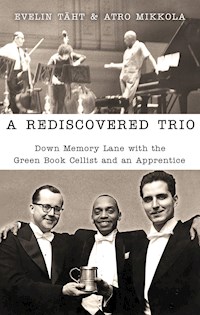
After seeing the movie Green Book in Finland, Atro Mikkola heard from a Canadian-Estonian friend that Juri Taht, the cellist depicted in the film as Oleg, was alive and well and had moved back to Estonia, the land where he was born. Like Mikkola, he too had been interviewed by the local newspaper about his experiences with Donald Shirley when the film premiered in their respective countries. Mikkola regretted that he never had a chance to meet members of the Don Shirley Trio, so he immediately asked another Estonian musician friend, Aivar Vassiljev, if he could help him to contact Mr. Taht. He did, and in March 2019 Mikkola took a boat from Helsinki to Tallinn and drove to Tartu, Estonia to meet the cellist. He joined Juri and his wife Carmen at their home, with everybody exchanging their memories of Shirley, of course accompanied by an endless wellspring of anecdotes. Juri’s daughter-in-law, Evelin Taht, had started to write Juri’s biography and encouraged Mikkola to write about his stories with the maestro. When this fascinating biography was published in Estonian in February 2020, Evelin contacted Mikkola again and told him that she was working on an English translation and wanted to add Mikkola’s viewpoint and his analysis of Shirley’s musical concept to this book. Juri’s life outside the Don Shirley Trio is a completely different story and can be found in the pages of another book – Stargazing: An Extraordinary Life.
_______________________________________________________________________
Here are some excerpts from the e-book about the cellist and bass player mentioned above.
Juri Taht:
Jüri Täht was born on 26 May 1930, in the city of Tartu, in Estonia. (As the English alphabet does not contain the letters ü and ä, after emigrating to the United States his name was changed to Juri Taht.)
At the age of six when he began his cello lessons, Juri already knew he wanted to become a professional cellist when he grew up. He was considered a musical prodigy with perfect pitch but his dreams were interrupted by the outbreak of World War II. No matter the difficult life circumstances, he still pursued his dream and, after the war, he studied at the State University for Music Stuttgart, though he left for America and his studies were not completed. He graduated from Dana College, in Nebraska, in 1952, with a Bachelor of Arts degree and received his Master of Music degree from the Manhattan School of Music, in New York City, in 1958. His dream had finally come true.
Though he was a long-time member of the Don Shirley Trio, he was also engaged elsewhere—a highly regarded substitute in various Broadway musical orchestras, he played with the Radio City Music Hall orchestra, with the accompanying orchestras for Marlene Dietrich, Frank Sinatra, Tom Jones, and Paul Anka. He lived an incredible life during complicated times, and this is only a small summary of it.
Although luck was on his side (many of his friends said he was born under a lucky star), a big role in his success was played by his unwavering and decisive personality—once he made up his mind, nobody could make him change it—and a profound love for the instrument: his willingness to practice, learn and grow as a cellist. It was a combination that brought him success in his professional career.
...and Atro Mikkola:
I am a double bassist from Finland performing mostly music within the jazz idiom. In addition to the musical aspects of this art form, I have always been interested in its aesthetics, history and social function, especially concerning its Afro-American heritage. Finnish pianist-composer Lauri Kivikataja was an essential force in getting me started, and to learn more about these elements I traveled to the USA, first in 1977–78, and then in 1984–97. During those times I performed widely in the New England area and in New York City with various groups and musicians.
In 1985 I started my studies at the University of Massachusetts in Amherst, graduating in 1989 with a Bachelor of Music in Afro-American Music and Jazz. I was offered an assistantship there to continue my studies at the graduate level in Jazz Arranging and Composition. I received my master’s degree in 1991. In addition to my schoolwork, I had many encounters with musicians who I had long admired: Max Roach, Archie Shepp, Billy Taylor, and Yusef Lateef, who were all in the faculty at the University, plus numerous visiting artists including Oscar Peterson, Clark Terry, and Norman Simmons. Finding Emery Smith, a pianist from Hartford, Connecticut (now 89 years young), was a treasure for me. We met in 1984 when we worked together in Archie Shepp’s quartet, and this led to my working with Mr. Smith for ten years. Through working with him, the essential aspects of repertoire, possibilities of harmony and especially the aesthetics of jazz tradition, became clear.
Looking back at the road I have travelled, I realize how fortunate I have been to encounter people who have so wholeheartedly been willing to share their experience and knowledge to provide answers and direction to my endless and honest curiosity about the art-form they espouse. When I left New England in 1992 to move to New York, I felt I had been able to gather a wide knowledge of the elements of jazz music and its tradition, but then I became fortunate once more …




