


Erhalten Sie Zugang zu diesem und mehr als 300000 Büchern ab EUR 5,99 monatlich.
- Herausgeber: Editora Dialética
- Kategorie: Sachliteratur, Reportagen, Biografien
- Sprache: Englisch
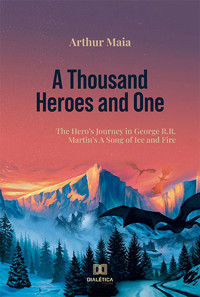
This master's thesis approaches the heroes in George R. R. Martin's "A Song of Ice and Fire", analyzing the journeys of Eddard Stark, Quentyn Martell, Jon Snow, and Daenerys Targaryen. The application of Campbell's famous Monomyth, or Hero's Journey, did not prove particularly successful when it comes to this series, which leads to a series of ponderations about its universality and the role point of view plays in this debate. "A Song of Ice and Fire" is a masterpiece of fantasy literature that helps scholars to rethink axioms they have been taking for granted for decades, and there is still much more to be said about it.
Sie lesen das E-Book in den Legimi-Apps auf:
Seitenzahl: 197
Veröffentlichungsjahr: 2023
Das E-Book (TTS) können Sie hören im Abo „Legimi Premium” in Legimi-Apps auf:
Ähnliche


















ACKNOWLEDGMENTS
A work of this length is never a product of individual efforts only, it is a result of an entire life of learning from others, professors, friends, family, and many people we do not even rationalize about their contributions. The people who follow are only some of those who brought their knowledge, inputs, and opinions to me. There is more than a bit of each of you in here.
Thanks to my closest friends, first and foremost, Amanda, without whose support, both intellectual and emotional, this thesis might not have been finished. As well as Mariana, Buss, Leandra, Vitória, and Isabela, for listening to so much about this during the process, always with interest and smart and comforting things to say. The same amount of gratitude goes to my family, for the unconditional support always, not only respecting my career choices but actively encouraging me to always do my best.
Speaking of career, it is safe to say that my change to literary studies was the rightest choice I could have taken. And this work is proof of that. So I would like to thank the many wonderful professors, classmates, researchers, and friends I got to know in these last few years, to whom I own most of the intellectual aspect of it. To professors Claudio, Elaine, and Sandra for introducing me properly to the fields of studies that resulted here, and for making themselves always available and comprehensive. To Eduarda, Fernanda, Gabriela, Rafael, and Rosana, for being amazing classmates and becoming great friends. And to Fabian, who embraced the challenge of sharing a course, which proved to be a success even with all the difficulties posed, thanks to our team effort. I also thank CNPq (Conselho Nacional de Desenvolvimento Científico e Tecnológico) for the 24-months scholarship they granted me.
My continuous enthusiasm with A Song of Ice and Fire has been renewed every day, due to the people I met through loving these books. Reading the novels in detail demand frequent debate and I have been lucky to be among the best. My eternal gratitude to my partners in Gelo& Fogo, Rayane, Bini, and Ana, and to my Worldcon mates, Matteo Barbagallo and Javi Marcos. And, of course, to George R. R. Martin, for granting the world the novels that led me this way.
“The Horned Lord once said that sorcery is a sword without a
hilt. There is no safe way to grasp it.”
(George R. R. Martin, A Storm of Swords)
O presente trabalho foi realizado com apoio do CNPq – Conselho
Nacional de Desenvolvimento Científico e Tecnológico – Brasil.
This thesis was financed in part by the Conselho Nacional de
Desenvolvimento Científico e Tecnológico – Brazil (CNPq).
TABLE OF CONTENTS
Capa
Folha de Rosto
Créditos
ACKNOWLEDGMENTS
INTRODUCTION
1. HEROES AND FANTASY: AN OVERVIEW
1.1 JOSEPH CAMPBELL’S HERO’S JOURNEY
1.1.1 Heroes
1.1.1.1 Antiheroes
1.1.1.2 Female Heroes
1.2 GEORGE R. R. MARTIN AND A SONG OF ICE AND FIRE
1.2.1 George R. R. Martin and the new wave of science fiction
1.3 IMMERSIVE FANTASY AND TOLKIENIAN TRADITION
1.3.1 A Song of Ice and Fire and the challenges to the Tolkienian Tradition
2. THE FATE OF CAMPBELLIAN HEROES: EDDARD STARK AND QUENTYN MARTELL
2.1 EDDARD STARK, THE CLASSICAL HERO
2.1.1 Eddard’s journey
2.2 QUENTYN MARTELL, THE UNLIKELY HERO
2.2.1 Quentyn’s journey
2.3 FINAL THOUGHTS
3. THE MANY FACES OF A HERO: JON SNOW AND DAENERYS TARGARYEN
3.1 JON SNOW AND THE BILDUNGSROMAN
3.1.1 Jon’s Journey
3.2 DAENERYS TARGARYEN, THE PRINCESS THAT WAS PROMISED
3.2.1 Daenerys’ journey
3.3 FINAL THOUGHTS
CONCLUSION
REFERENCES
APPENDIX
Landmarks
cover
titlepage
copyright-page
Table of Contents
bibliography
INTRODUCTION
I started reading the book series A Song of Ice and Fire, by George R. R. Martin (1996 onwards) when I was in high school. That signaled not only my return to fantasy literature – I had read some in my childhood, although it was not a major interest –, but also a return to reading after some teenage years in which I had other priorities. Later, as I watched some episodes of the TV show adaptation of the novels, Game of Thrones (BENIOFF; WEISS, 2011), I was so engrossed by that fictional universe that I decided I needed more of it. And the author George R.R. Martin granted it to me.
In the coming years, the TV series and the book series followed in different directions, and I took the path of the books. In 2017, when I was finishing my History course at UFRGS, I wrote my first piece on Martin’s work, a paper about his vampire historical novel, Fevre Dream (MARTIN, 2012f). In 2018, in my undergraduate monograph, I investigated the impact of A Song of Ice and Fire and Game of Thrones in high school students’ views of the Middle Ages (GOMES, 2018). In the same year, I entered the graduate program in Literature so that I could keep studying Martin’s work. Soon after that, I was invited to join Gelo & Fogo, a Brazilian website dedicated to the fan community of the series, and related material. And in 2019 I had the opportunity to attend the world’s biggest science fiction and fantasy literary convention, Worldcon, representing the website, where I met many other fans from all over the world.
A Song of Ice and Fire led me to many other authors, which now figure among my favorites. More than that, it made me aware of the power that science fiction and fantasy narratives have in contributing to our readings of the world. I concluded that they are possible and necessary fields of study, which reflect society’s fears, desires, paradigms, and relationships in a very particular way, appealing to a specific group of onlookers who usually take them as more than mere entertainment. Literature becomes actively a part of their lives, and they are very vocal about it.
Halfway through the 2010s, since the stupendous success and repercussion of Game of Thrones as a cultural phenomenon, medieval based fantasy experienced increasing popularity, a revival that has its precedents in the movies based on J.R.R. Tolkien’s The Lord of the Rings (TOLKIEN, 1999) some ten years prior. This is easily observed in pop culture conventions, such as the Comic-Con Experience held in São Paulo, Brazil, every year since 2014. Game of Thrones has a panel in every edition of the event, which is held in the largest auditory, and has always been overcrowded. In 2016, A Song of Ice and Fire reportedly sold 70 million copies and had nearly 18 million readers (WHITEHEAD, 2018), becoming the most successful fantasy saga after Tolkien’s trilogy.
This phenomenon is not limited to the influence of A Song of Ice and Fire and its adaptations. Instead, the whole medieval themed fantasy field rose in the past few years due to its success. In Brazil, many medieval fairs are emerging, and the number of participants increases every year. Since Martin’s novels were translated into Brazilian Portuguese, many other relevant works so far neglected by local publishing companies were published, such as Robert Jordan’s The Wheel of Time (2002), Robin Hobb’s Farseer Trilogy (2014), Brandon Sanderson’s Mistborn (2008), or Steven Eriksson’s Malazan Book of the Fallen (2005). National authors writing in the immersive fantasy standards, a subgenre of fantasy in which the story takes place entirely in a secondary world1, have also obtained acknowledgment, as well as higher sales and raised academic interest in a slow but ongoing process. Instances of this are the works of Felipe Castilho, Rafael Draccon, and Eduardo Spohr (MATANGRANO; TAVARES, 2018).
I refer to the state of affairs in Brazil because it is where I live, and where I can feel the impact of the referred facts, but they certainly take place in different parts of the world. Game of Thrones is the most illegally downloaded TV show in history (HOOTON, 2017). The production won 59 Emmy Awards, the most prestigious prize when it comes to television, and one Golden Globe, which also figures among the main awards. It also won the Hugo Awards, a prize granted to science fiction and fantasy fiction, thrice in a row. The current president of the United States of America even referenced the TV show in his Twitter account, as a reference to his conservative politics. Martin, a very vocal Democrat voter, was quick to protest against this use of his creation (MORAES, 2019).
The success of the TV series brings new readers to Martin’s books. And this presence of Martin’s creation in pop culture makes it influence beliefs and behaviors; hence, studying and debating the values and world visions endorsed is something that has its social significance. Writing a thesis about this subject is a means of investigating the phenomenon while presenting a critical reading. I believe that the role of the literary critic is to promote debates about what people take for granted when consuming pieces of art and to stimulate critical reading. There is no way something as huge as the impact A Song of Ice and Fire and Game of Thrones has in the consumption of fiction nowadays should not be analyzed. The point I choose to investigate relates to comprehending the notions of heroism presented in A Song of Ice and Fire. What do we think about the place of heroes in our society? What do we look up to in others and seek to become as individuals? How do we comprehend the possibilities of changing the world? These questions are some of the motivators for this work.
The discussion about models of heroism has always been present in the field of fantasy studies, in which the tradition of literary criticism relies predominantly on Carl Jung’s model of the Collective Unconscious (JUNG, 1981). It is from this source that Joseph Campbell extracts the Hero Journey, nowadays so widespread and popular in literary criticism (CAMPBELL, 2008). Jung theorizes about human archetypes. Campbell analyses the hero’s journey according to archetypes and presents his model. Despite that, when I read Martin, the juxtaposition between the heroic archetype in its more fundamental definition and the completion of its journey is not there. This makes me wonder how much it is possible to define fundamental characteristics of the human mind, and therefore, the universal applicability of such theories.
My work, thus, seeks a case that might evidence some limitations in the Campbellian model. Considering A Song of Ice and Fire’s insertion in the literary field, it tends to belong to a heavy materialist tradition, which might make the applicability of Jung’s system harder, since its philosophical affiliation is idealistic in contrast2. This might lead to a more clear perception of the limitations of its applicability, since the idealist theories rely upon belief; while it might have been perfectly suitable to the cases studied to create it, this system might not work in different contexts. Being aware that Campbell’s proposition was not intended to be applied to 20th Century literature, I aim at formulating some hypothesis on why that is, and what makes my object of studies different from the myths analyzed by him when formulating the Monomyth.
In order to carry out the investigation, this thesis contrasts Campbell’s model of the Hero’s Journey and the journeys of four characters selected from A Song of Ice and Fire, chosen for their similarities and their differences concerning the Monomyth. As a result, it is expected that we comprehend different notions of heroism present in contemporary fiction, especially in the Fantasy genre. The characters chosen for this exercise are Eddard Stark, Quentyn Martell, Daenerys Targaryen, and Jon Snow3. They are paired in accordance with the elements in Campbell’s model they defy.
The thesis is divided into three chapters. Chapter One brings the contextual material considered important for the development of the research, informing the reader about Campbell’s model, the author and the work, and the literary genre in question. It begins by providing a synthesis of Campbell’s model of the Hero’s Journey and contextualizing the position the Monomyth occupied in the intellectual framework of the 20th Century. Secondly, I will follow the development of Martin’s career and the way he constructs his heroes to identify the recurrent themes that are involved in the process and that lead to the choices made in A Song of Ice and Fire. This track becomes clear as we follow the writing from his early years, when Martin rises as a writer in a movement called the New Wave of Science Fiction, later evolving into his Fantasy series. Chapter One also presents some concepts related to Fantasy as a genre and the Tolkienian tradition, commenting on terms such as “Fantasy”, and “Immersive Fantasy”, and a set of features that are heavily connected to the genre. By contrasting the traditional comments with what is found in Martin’s A Song of Ice and Fire, I open the way to verify in what ways this work corroborates the traditions of the genre, and in what ways it subverts these traditions.
After the historical and theoretical information provided in Chapter One, I come into the critical part of the thesis, which consists of two chapters, each containing the analysis of a pair of characters that can be said to play the role of the hero. The two chapters share the same structure: each starts with the presentation of the first hero in the pair, followed by a comment on his/her journey; then, they are compared and contrasted, and a conclusion about the analysis is presented.
Chapter Two examines the cases of Eddard and Quentyn. They are the closest to a classical hero the series presents. It starts with a discussion on the notion of the classical hero, followed by an analysis of Eddard and his journey. Then, Quentyn Martell is discussed in light of the concept of an unlikely hero, followed by the analysis of his journey. The main question in this chapter will be to identify what is A Song of Ice and Fire’s approach to the more traditional heroes, those that Campbell took as universals.
In the third chapter, the analysis will be about those whose journeys will likely lead down a heroic path, but who are yet to play a larger role as heroes, Daenerys and Jon Snow, questioning whether they are on an ascendant path to salve the world. Starting with Jon Snow and his journey, I will follow what I consider a “first hero’s journey”, his ascension from an inexperienced recruit of the Night’s Watch to becoming Lord Commander of the organization, after defending the military order from an enemy army. In Daenerys’ case, it will be necessary to debate the theory of Maureen Murdock (1990), who adapted the classical journey Campbell conceived to female heroes, as she does not see the original approach as fit to the analysis of women characters. By the end of the chapter, the discussion will focus on both the characters’ plots in the fifth novel, A Dance with Dragons (MARTIN, 2012). This is when the final step of the Monomyth, “Freedom to Live”, is represented, so the study will center on the results of their journeys.
At the end of the work, in the Conclusion, I expect to comprehend how the heroes analyzed in the series fit, or not, in Campbell’s model, and why. I will also discuss if Martin is proposing significant innovations to the field of Immersive fantasy. If so, corroborating this point will be my thesis’ contribution to the critical fortune of George R. R. Martin. I also mean to point to some possible courses of development for future research related to this thesis. Finally, I will comment on the fact that A Song of Ice and Fire can tell a lot about our relationship with heroes and contemporary morals.
Martin’s series is widely known for its massive cast of characters, and this can make this thesis hard to follow without some support for those still unfamiliar with the plots. For that reason, Appendix I was composed, containing a list of all characters, with a brief description of who they are. For further information about the characters, the website Westeros.com maintains a wiki with entries for all the characters in the series, besides places, historical events, families, botanical and animal species, etc. It is called The Wiki of Ice and Fire.
Yet, a relevant point to raise concerning the plan of studying the characters’ trajectories in A Song of Ice and Fire is the fact that the series of books is still to be completed. Thus, the material considered for the sake of this thesis closes in the first trimester of 2020. Two of the four characters analyzed are still active in the story. Eddard and Quentyn, being already dead, are the ones whose journeys have been completed. In spite of that, the stories of the two remaining heroes present significant deviations and challenges from Campbell’s model, which are worth being analyzed. I hope work contributes to our better comprehension of Campbell’s Monomyth in studies directed to fantasy literature as well as to the studies in Martin’s A Song of Ice and Fire.
1 In J. R. R. Tolkien’s (2008) definition: “He makes a Secondary World which your mind can enter. Inside it, what he relates is ‘true’: it accords with the laws of that world. You therefore believe it, while you are, as it were, inside” (p. 52).
2 The debate over materialism (sometimes called realism) and idealism in philosophy respects the existence beyond physical phenomena (BAKUNIN, 1964).
3 Although the book series is still unfinished, the TV show Game of Thrones came to an end by mid-2019. Even if all parts involved guarantee that books and the show are different ways to tell a story, they also reinforced that the main points by the end would be similar, even if the paths that led to them went down differently. A major aspect of the TV show ending was the character Bran Stark becoming the king of the Seven Kingdoms in the very last episode, The Iron Throne (2019). Bran Stark is not one of the six heroes analyzed in this thesis, but it seems that his role will be major in the outcome of things when Martin finishes his collection. He has indeed a journey into the unknown in the novels already published, but little could be said of him as a hero and the development of his character.
1. HEROES AND FANTASY: AN OVERVIEW
“Just as if I was one of those true knights you love so well, yes. What do you think a knight is for, girl? You think it’s all taking favors from ladies and looking fine in gold plate? Knights are for killing”.
(Martin, A Dance with Dragons)
This first chapter aims to discuss the necessary theory before going into the analysis of the selected cases. It is divided into three sub-chapters. Each one is meant to give background to one element pursued in this thesis. The first focuses on the theory; within this section, I present and discuss Joseph Campbell’s model of the Monomyth, or the Hero’s Journey, in a detailed description of its structure. Its second session is dedicated to the definition of a hero and its derivatives, in order to better evidence the reasons which led to the choice to analyze the four selected characters.
The following sub-chapter focuses on my object: A Song of Ice and Fire. So, in order to provide some background about the author George R. R. Martin and how he is inserted in the literary tradition, I will discuss his relationship with the movement called The New Wave of Science Fiction. Then, the third sub-chapter moves to fantasy literature, with its first section regarding the Tolkienian tradition, followed its last section, which comments on studies that have already shown how A Song of Ice and Fire challenges some concepts of the mentioned tradition, reinforcing the main question of this thesis, which is if the heroes presented in A Song of Ice and Fire challenge the traditional models present in other immersive fantasy works.
1.1 JOSEPH CAMPBELL’S HERO’S JOURNEY
The North-American professor Joseph Campbell was born in 1904, passed away in 1987, and is considered one of the great researchers in the field of Mythological Studies in the 20th Century. Campbell concentrated his studies on mythology and religion, deriving from Carl Jung’s theory of the collective unconscious and archetypes. In the book The Hero with a Thousand Faces (2008), he develops the concept of Monomyth or The Hero’s Journey, a study on the heroes portrayed in several myths in recurrent patterns all over the world. Before I undertake the proposed analysis of the characters, I will survey Campbell’s model of the Monomyth. Starting with a definition provided by Tutta Kesti,
Campbell used the ideas of Jung’s theory of archetypes to find “the common underlying structure behind all religion and myth” (apud Brennan 2001). In the theory that he calls the “Hero’s Journey” or the “Monomyth”, he argues that all stories, or rather, all heroes, are fundamentally the same, hence the name of the book The Hero with a Thousand Faces, where he introduced the idea providing examples of myths from cultures all over the world and history (apud Campbell, 1966). (KESTI, 2007, p. 27).
Campbell refers to Jung’s concept of the collective unconscious, which substantiates his concept of the Monomyth. For Jung, as developed in the essays “The Significance of Constitution and Heredity in Psychology” (2014) and “The Concept of the Collective Unconscious” (1981), there is a layer beyond personal experiences in humans’ unconscious, in which the basis for our comprehension of society is shared by every human being. The methodology of Campbell (2008) consists, as pointed out by Kesti (2007), in mixing many examples to create the common structure. That structure (the Monomyth) is a sequence of steps that are followed by most of the studied cases. These are seventeen steps divided into three broader categories, which I will refer to as “levels”.
The first level, the one of Departure, concerns all the steps related to the transition from the initial stage of the hero – his stable life, in which some moral values go unquestioned – to the point when he truly gets into the adventure. The Departure level is usually associated either with the passing of the first act of a narrative to the second one or with the first act itself, in which the first dilemmas are presented, leading the narrative into the development arc (TROTTIER, 2014). Therefore, the whole setup of the hero’s story ends when the first step of the Monomyth comes, and that is, the Call to Adventure.
The Call to Adventure consists of the moment in which some conflict is introduced to the hero. That conflict will lead him into a zone unknown. Campbell uses, among others, the example of Buddha’s myth (2008), mentioning the moment in which Gautama Śākyamuni becomes aware of the poverty outside his royal life. The reaction of the hero to that call might be controversial. Prince Kamar al-Zaman refuses his father’s request in the Arabian Nights (CAMPBELL, 2008). This is the step called Refusal of the Call, which symbolically means the difficulty one may face to leave behind his selfish interests and to sacrifice themselves in favor of others. But as heroes are no ordinary people – their definition being the refusal of the ego – they will eventually wake up to the call and begin their adventure.




