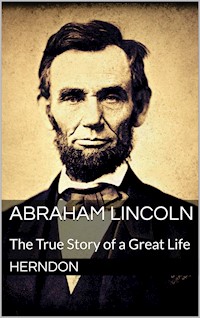
INTRODUCTION.
CHAPTER I.
CHAPTER II.
CHAPTER III.
CHAPTER IV.
CHAPTER V.
CHAPTER VI.
CHAPTER VII.
CHAPTER VIII.
CHAPTER IX.
CHAPTER X.
CHAPTER XI.
PREFACE
A
quarter of a century has well-nigh rolled by since the tragic death
of Abraham Lincoln. The prejudice and bitterness with which he was
assailed have disappeared from the minds of men, and the world is
now
beginning to view him as a great historical character. Those who
knew
and walked with him are gradually passing away, and ere long the
last
man who ever heard his voice or grasped his hand will have gone
from
earth. With a view to throwing a light on some attributes of
Lincoln's character heretofore obscure, and thus contributing to
the
great fund of history which goes down to posterity, these volumes
are
given to the world.If
Mr. Lincoln is destined to fill that exalted station in history or
attain that high rank in the estimation of the coming generations
which has been predicted of him, it is alike just to his memory and
the proper legacy of mankind that the whole truth concerning him
should be known. If the story of his life is truthfully and
courageously told-nothing colored or suppressed; nothing false
either
written or suggested-the reader will see and feel the presence of
the
living man. He will, in fact, live with him and be moved to think
and
act with him. If, on the other hand, the story is colored or the
facts in any degree suppressed, the reader will be not only misled,
but imposed upon as well. At last the truth will come, and no man
need hope to evade it."There
is but one true history in the world," said one of Lincoln's
closest friends to whom I confided the project of writing a history
of his life several years ago, "and that is the Bible. It is
often said of the old characters portrayed there that they were bad
men. They are contrasted with other characters in history, and much
to the detriment of the old worthies. The reason is, that the
Biblical historian told the whole truth-the inner life. The heart
and
secret acts are brought to light and faithfully photographed. In
other histories virtues are perpetuated and vices concealed. If the
life of King David had been written by an ordinary historian the
affair of Uriah would at most have been a quashed indictment with a
denial of all the substantial facts. You should not forget there is
a
skeleton in every house. The finest character dug out thoroughly,
photographed honestly, and judged by that standard of morality or
excellence which we exact for other men is never perfect. Some men
are cold, some lewd, some dishonest, some cruel, and many a
combination of all. The trail of the serpent is over them all!
Excellence consists, not in the absence of these attributes, but in
the degree in which they are redeemed by the virtues and graces of
life. Lincoln's character will, I am certain, bear close scrutiny.
I
am not afraid of you in this direction. Don't let anything deter
you
from digging to the bottom; yet don't forget that if Lincoln had
some
faults, Washington had more—few men have less. In drawing the
portrait tell the world what the skeleton was with Lincoln. What
gave
him that peculiar melancholy? What cancer had he inside?"Some
persons will doubtless object to the narration of certain facts
which
appear here for the first time, and which they contend should have
been consigned to the tomb. Their pretense is that no good can come
from such ghastly exposures. To such over-sensitive souls, if any
such exist, my answer is that these facts are indispensable to a
full
knowledge of Mr. Lincoln in all the walks of life. In order
properly
to comprehend him and the stirring, bloody times in which he lived,
and in which he played such an important part, we must have all the
facts—we must be prepared to take him as he was.In
determining Lincoln's title to greatness we must not only keep in
mind the times in which he lived, but we must, to a certain extent,
measure him with other men. Many of our great men and our
statesmen,
it is true, have been self-made, rising gradually through struggles
to the topmost round of the ladder; but Lincoln rose from a lower
depth than any of them. His origin was in that unknown and sunless
bog in which history never made a foot-print. I should be remiss in
my duty if I did not throw the light on this part of the picture,
so
that the world may realize what marvellous contrast one phase of
his
life presents to another.The
purpose of these volumes is to narrate facts, avoiding as much as
possible any expression of opinion, and leaving the reader to form
his own conclusions. Use has been made of the views and
recollections
of other persons, but only those known to be truthful and
trustworthy. A thread of the narrative of Lincoln's life runs
through
the work, but an especial feature is an analysis of the man and a
portrayal of his attributes and characteristics. The attempt to
delineate his qualities, his nature and its manifestations, may
occasion frequent repetitions of fact, but if truthfully done this
can only augment the store of matter from which posterity is to
learn
what manner of man he was.The
object of this work is to deal with Mr. Lincoln individually and
domestically; as lawyer, as citizen, as statesman. Especial
attention
is given to the history of his youth and early manhood; and while
dwelling on this portion of his life the liberty is taken to insert
many things which would be omitted or suppressed in other places,
where the cast-iron rules that govern magazine-writing are allowed
to
prevail. Thus much is stated in advance, so that no one need be
disappointed in the scope and extent of the work. The endeavor is
to
keep Lincoln in sight all the time; to cling close to his side all
the way through—leaving to others the more comprehensive task of
writing a history of his times. I have no theory of his life to
establish or destroy. Mr. Lincoln was my warm, devoted
friend.I
always loved him, and I revere his name to this day. My purpose to
tell the truth about him need occasion no apprehension; for I know
that "God's naked truth," as Carlyle puts it, can never
injure the fame of Abraham Lincoln. It will stand that or any other
test, and at last untarnished will reach the loftiest niche in
American history.My
long personal association with Mr. Lincoln gave me special
facilities
in the direction of obtaining materials for these volumes. Such
were
our relations during all that portion of his life when he was
rising
to distinction, that I had only to exercise a moderate vigilance in
order to gather and preserve the real data of his personal career.
Being strongly drawn to the man, and believing in his destiny, I
was
not unobservant or careless in this respect. It thus happened that
I
became the personal depositary of the larger part of the most
valuable Lincolniana
in existence. Out of this store the major portion of the materials
of
the following volumes has been drawn. I take this, my first general
opportunity, to return thanks to the scores of friends in Kentucky,
Indiana, Illinois, and elsewhere for the information they have so
generously furnished and the favors they have so kindly extended
me.
Their names are too numerous for separate mention, but the
recompense
of each one will be the consciousness of having contributed a share
towards a true history of the "first American."Over
twenty years ago I began this book; but an active life at the bar
has
caused me to postpone the work of composition, until, now, being
somewhat advanced in years, I find myself unable to carry out the
undertaking. Within the past three years I have been assisted in
the
preparation of the book by Mr. Jesse W. Weik, of Greencastle, Ind.,
whose industry, patience, and literary zeal have not only lessened
my
labors, but have secured for him the approbation of Lincoln's
friends
and admirers. Mr. Weik has by his personal investigation greatly
enlarged our common treasure of facts and information. He has for
several years been indefatigable in exploring the course of
Lincoln's
life. In no particular has he been satisfied with anything taken at
second hand. He has visited—as I also did in 1865—Lincoln's
birthplace in Kentucky, his early homes in Indiana and Illinois,
and
together, so to speak, he and I have followed our hero continuously
and attentively till he left Springfield in 1861 to be inaugurated
President. We have retained the original MSS. in all cases, and
they
have never been out of our hands. In relating facts therefore, we
refer to them in most cases, rather than to the statements of other
biographers.This
brief preliminary statement is made so that posterity, in so far as
posterity may be interested in the subject, may know that the vital
matter of this narrative has been deduced directly from the
consciousness, reminiscences, and collected data ofWilliam
H. Herndon.
INTRODUCTION.
I
was called upon during the lifetime of Mr. Herndon to write for the
second edition of this work a chapter on the Lincoln-Douglas
campaign
of 1858. After this had been done and the book had been revised for
the press, I was requested by the publishers to add something in
the
nature of a character sketch of Mr. Lincoln as I knew him before
his
fame had spread much beyond the confines of Illinois, and to tell
what were those qualities that made him so attractive then. Of
course, they were the same qualities which made him attractive
afterward on a wider scale. The popular judgment of him is, in the
main, correct and unshakable. I say in the main, because there is
in
this judgment a tendency to apotheosis which, while pardonable, is
not historical, and will not last.At
the time when he was preparing himself unconsciously to be the
nation's leader in a great crisis the only means of gaining public
attention was by public speech. The press did not exist for him, or
for the people among whom he lived. The ambitious young men of the
day must make their mark by oratory, or not at all. There was no
division of labor between the speaker and the editor. If a man was
to
gain any popularity he must gain it by talking into the faces of
the
people. He must have a ready tongue, and must be prepared to meet
all
comers and to accept all challenges. Stump-speaking, wrestling,
story-telling, and horse-racing were the only amusements of the
people. In the first three of these Mr. Lincoln excelled. He grew
up
in this atmosphere, as did all his rivals. It was a school to
develop
all the debating powers that the community possessed, and to bring
them to a high degree of perfection. Polish was not necessary to
success, but plainness of diction was. The successful speaker was
he
who could make himself best understood by the common people, and in
turn could best understand them.Among
the earliest accounts that we get of Mr. Lincoln we find him
talking
to other boys from some kind of a platform. He had a natural gift,
and he exercised it as opportunity came to him. When he arrived at
man's estate these opportunities came as often as could be desired.
Other young men gifted in the same way were growing up around him.
Douglas, Baker, Trumbull, Hardin, Browning, Yates, Archibald
Williams, Josiah Lamborn, and Lisle Smith were among them. All
these
had the same kind of training for public preferment that Lincoln
had;
some of them had more book learning, but not much more. We have his
own word for it that he was as ambitious of such preferment as
Douglas was; and this was putting it in the superlative
degree.The
popular conception of Mr. Lincoln as one not seeking public honors,
but not avoiding public duties, is a
post bellum growth,
very wide of the mark. He was entirely human in this regard, but
his
desire for political preferment was hedged about by a sense of
obligation to the truth which nothing could shake. This fidelity to
truth was ingrained and unchangeable. In all the speeches I ever
heard him make—and they were many—he never even insinuated an
untruth, nor did he ever fail when stating his opponent's positions
to state them fully and fairly. He often stated his opponent's
position better than his opponent did or could. To say what was
false, or even to leave his hearers under a wrong impression, was
impossible to him. Within this high inclosure he was as ambitious
of
earthly honors as any man of his time. Furthermore, he was an adept
at log-rolling or any political game that did not involve falsity.
I
was Secretary of the Republican State Committee of Illinois during
some years when he was in active campaign work. He was often
present
at meetings of the committee, although not a member, and took part
in
the committee work. His judgment was very much deferred to in such
matters. He was one of the shrewdest politicians of the State.
Nobody
had had more experience in that way, nobody knew better than he
what
was passing in the minds of the people. Nobody knew better how to
turn things to advantage politically, and nobody was readier to
take
such advantage, provided it did not involve dishonorable means. He
could not cheat people out of their votes any more than out of
their
money. The Abraham Lincoln that some people have pictured to
themselves, sitting in his dingy law office, working over his cases
till the voice of duty roused him, never existed. If this had been
his type he never would have been called at all. It was precisely
because he was up and stirring, and in hot, incessant competition
with his fellows for earthly honors, that the public eye became
fixed
upon him and the public ear attuned to his words. Fortunate was it
for all of us that he was no shrinking patriot, that he was moved
as
other men are moved, so that his fellows might take heed of him and
know him as one of themselves, and as fit to be their leader in a
crisis.Let
me repeat and emphasize what I have here said. Mr. Lincoln never
gave
his assent, so far as my knowledge goes, to any plan or project for
getting votes that would not have borne the full light of day. At
the
same time, he had no objection to the getting of votes by the
pledge
of offices, nor was he too particular what kind of men got the
offices. His preference was always for good men; but he could not
resist pressure where persons were concerned, even though his
conscience told him that he was doing wrong.We
have seen what kind of debating school Mr. Lincoln grew up in. It
was
the best possible school for him, and it was an advantage to him
that
he had able men for his competitors. Among them was Stephen A.
Douglas, the most versatile, indomitable, and unscrupulous of all
of
them. He was Lincoln's rival, as is shown in these pages, for
almost
everything, from the hand of Mary Todd to the presidency of the
United States. He had the strength and presence of a lion, with all
the cunning of a fox. He possessed every quality which wins popular
favor and high station except veracity, and I know of nothing in
the
pages of history more cheering to pious souls than the eventual
triumph of Honest Abe over the Little Giant.It
was by restless competition and rough-and-tumble with Douglas and
others that Mr. Lincoln acquired that rare power of expression, by
mouth and pen, which drew to himself the attention of the State and
afterward of the nation and the world. He rarely used ornament in
his
speeches. Although gifted with the power of humor to an
extraordinary
degree, he seldom employed it in his later years except in private
circles. Thus it came about that this growing master of logic, this
profound and earnest debater of the most serious questions of the
day, was the most popular of tavern loungers, and could draw more
people together and hold them longer by mere drollery and
cameraderie than
any other man I ever knew. Mr. Lincoln's nature was one of almost
child-like sweetness. He did not "put you at your ease"
when you came into his presence. You felt at your ease without
being
put there. He never assumed superiority over anybody in the
ordinary
intercourse of life.A
good test of this trait in his character was furnished in my own
experience. When I was first thrown into his society I was just out
of college, and was as callow and as self-confident as boys usually
are at that time of life. Mr. Lincoln was at the maturity of his
powers. I was often with him when he had no other companion. In our
intercourse he always paid marked deference to my opinions, and if
we
differed he would argue the point with me as earnestly as though I
had been the opposing counsel in a lawsuit. And this he would do
with
anybody, young or old, ignorant or learned. I never heard him
express
contempt for any man's honest errors, although he would sometimes
make a droll remark or tell a funny story about them. Deference to
other people's opinions was habitual to him. There was no
calculation, no politics in it. It was part and parcel of his sense
of equal rights. His democracy was of the unconscious kind—he did
not know anything different from it. Coupled with this was a habit
of
unselfishness and kindly temper most engaging to all who knew him
or
had any dealings with him. At the same time he knew when he was
imposed upon, and it was unsafe for anybody to presume upon his
good
nature or to take him for a flat.But
more than intellectual gifts, more than good-fellowship, did the
sense of justice give him his hold on others. That was a magnetic
field whose influences could not be escaped. He carried it as
unconsciously as he carried his hair. The Athenians would never
have
ostracized him—indeed, they would never have called him the Just.
They would have taken him as they took the bees on Hymettus—as one
naturally searching after sweet things.To
say that Mr. Lincoln was a man who had the courage of his
convictions
would be rather an under-statement. This was part and parcel of his
sense of justice. He wore it as he wore his clothes, except that it
fitted him much better than his garments usually did. At the time I
first knew him it was irksome to very many of his friends to be
told
that there ought to be an efficient fugitive slave law. But it was
his conviction as a lawyer that there ought to be one, and he never
failed to say so when interrogated, or when occasion required that
that subject should be touched upon. And it is a fact that
abolitionists like Lovejoy and Codding would take this from Lincoln
without murmuring, when they would not take it from anybody else.
He
never would echo the popular cry, "No more slave States!"
Whenever this subject was discussed he would say that if a
Territory
having the requisite population and belonging to us should apply
for
admission to the Union without fraud or constraint, yet with
slavery,
he could not see any other disposition to be made of her than to
admit her. And when he had said this, even to an audience of
radical
antislavery men, there would be no protestations. Those who were
not
convinced would observe a respectful silence.Mr.
Lincoln's facial expression when in repose and when animated
presented most remarkable contrasts. I have before me a photograph
of
him taken at Pittsfield, Illinois, during the campaign of 1858. It
looks as I have seen him a hundred times, his lantern jaws and
large
mouth and solid nose firmly set, his sunken eyes looking at nothing
yet not unexpressive, his wrinkled and retreating forehead cut off
by
a mass of tousled hair, with a shade of melancholy drawn like a
veil
over his whole face. Nothing more unlike this can be imagined than
the same Lincoln when taking part in a conversation, or addressing
an
audience, or telling a story. The dull, listless features dropped
like a mask. The melancholy shadow disappeared in a twinkling. The
eye began to sparkle, the mouth to smile, the whole countenance was
wreathed with animation, so that a stranger would have said: "Why,
this man, so angular and somber a moment ago, is really
handsome."What
more can be said of the qualities that first made Mr. Lincoln
attractive to his contemporaries? These were debating power,
honesty
of purpose, a child-like temper, purity of life, and courage of
conviction. All these traits will be seen in the following pages,
rising, unfolding, expanding in a regular, orderly, human way as
the
young Lincoln grew to mature years.What
Mr. Lincoln was after he became President can be best understood by
knowing what he was before. The world owes more to William H.
Herndon
for this particular knowledge than to all other persons taken
together. It is no exaggeration to say that his death, which took
place at his farm near Springfield, Illinois, March 18, 1891,
removed
from earth the person who, of all others, had most thoroughly
searched the sources of Mr. Lincoln's biography and had most
attentively, intelligently, and also lovingly studied his
character.
He was generous in imparting his information to others. Almost
every
life of Lincoln published since the tragedy at Ford's Theatre has
been enriched by his labors. He was nine years the junior of Mr.
Lincoln. Their partnership began in 1843, and it continued until it
was dissolved by the death of the senior member. Between them there
was never an unkind word or thought. When Mr. Lincoln became
President, Mr. Herndon could have had his fortunes materially
advanced under the new Administration by saying a word. He was a
poor
man then and always, but he chose to remain in his more humble
station and to earn his bread by his daily labor.Some
six years ago Mr. Herndon conceived the project of writing a series
of magazine articles intended to portray the youth and early
manhood
of Lincoln. Being somewhat infirm, he called Mr. Weik to his
assistance, as he has explained in his preface. The magazine
articles
expanded insensibly to the present volumes. Lincolniana is
increasing
and is destined to increase. It has been enriched within recent
years
by the indispensable but too massive work of Nicolay and Hay, by
the
masterly essay of Schurz, and by the posthumous lecture of Greeley,
which latter, being in reality if not in terms a hearty, ungrudging
confession that he had underestimated Lincoln in his lifetime, is
doubly welcome. As a portraiture of the man Lincoln—and this is
what we look for above all things in a biography—I venture to think
that Mr. Herndon's work will never be surpassed.Horace
White.
CHAPTER I.
BEYOND
the fact that he was born on the 12th day of February, 1809, in
Hardin county, Kentucky, Mr. Lincoln usually had but little to say
of
himself, the lives of his parents, or the history of the family
before their removal to Indiana. If he mentioned the subject at
all,
it was with great reluctance and significant reserve. There was
something about his origin he never cared to dwell upon. His
nomination for the Presidency in 1860, however, made the
publication
of his life a necessity, and attracted to Springfield an army of
campaign biographers and newspaper men. They met him in his office,
stopped him in his walks, and followed him to his house. Artists
came
to paint his picture, and sculptors to make his bust. His
autographs
were in demand, and people came long distances to shake him by the
hand. This sudden elevation to national prominence found Mr.
Lincoln
unprepared in a great measure for the unaccustomed demonstrations
that awaited him. While he was easy of approach and equally
courteous
to all, yet, as he said to me one evening after a long day of
hand-shaking, he could not understand why people should make so
much
over him.Among
the earliest newspaper men to arrive in Springfield after the
Chicago
convention was the late J. L. Scripps of the Chicago
Tribune, who
proposed to prepare a history of his life. Mr. Lincoln deprecated
the
idea of writing even a campaign biography. "Why, Scripps,"
said he, "it is a great piece of folly to attempt to make
anything out of me or my early life. It can all be condensed into a
single sentence, and that sentence you will find in Gray's
Elegy,'The
short and simple annals of the poor.'That's
my life, and that's all you or anyone else can make out of
it."He
did, however, communicate some facts and meagre incidents of his
early days, and, with the matter thus obtained, Mr. Scripps
prepared
his book. Soon after the death of Lincoln I received a letter from
Scripps, in which, among other things, he recalled the meeting with
Lincoln, and the view he took of the biography matter."Lincoln
seemed to be painfully impressed," he wrote, "with the
extreme poverty of his early surroundings, and the utter absence of
all romantic and heroic elements. He communicated some facts to me
concerning his ancestry, which he did not wish to have published
then, and which I have never spoken of or alluded to
before."What
the facts referred to by Mr. Scripps were we do not know; for he
died
several years ago without, so far as is known revealing them to
anyone.On
the subject of his ancestry and origin I only remember one time
when
Mr. Lincoln ever referred to it. It was about 1850, when he and I
were driving in his one-horse buggy to the court in Menard county,
Illinois. The suit we were going to try was one in which we were
likely, either directly or collaterally, to touch upon the subject
of
hereditary traits. During the ride he spoke, for the first time in
my
hearing, of his mother, dwelling on her characteristics, and
mentioning or enumerating what qualities he inherited from her. He
said, among other things, that she was the daughter of Lucy Hanks
and
a well-bred but obscure Virginia farmer or planter; and he argued
that from this last source came his power of analysis, his logic,
his
mental activity, his ambition, and all the qualities that
distinguished him from the other members and descendants of the
Hanks
family.In
only two instances did Mr. Lincoln over his own hand leave any
record
of his history or family descent. One of these was the modest bit
of
autobiography furnished to Jesse W. Fell, in 1859, in which, after
stating that his parents were born in Virginia of "undistinguished
or second families," he makes the brief mention of his mother,
saying that she came "of a family of the name of Hanks."*
The other record was the register of marriages, births, and deaths
which he made in his father's Bible. The latter now lies before me.
That portion of the page which probably contained the record of the
marriage of his parents, Thomas Lincoln and Nancy Hanks, has been
lost; but fortunately the records of Washington county, Kentucky,
and
the certificate of the minister who performed the marriage
ceremony—the Rev. Jesse Head—fix the fact and date of the latter
on the 12th day of June, 1806.*
If anyone will take the pains to read the Fell autobiography they
will be struck with Lincoln's meagre reference to his mother. He
even
fails to give her maiden or Christian name, and devotes but three
lines to her family. A history of the Lincolns occupies almost an
entire page.On
the 10th day of February in the following year a daughter Sarah*
was
born, and two years later, on the 12th of February, the subject of
these memoirs came into the world. After him came the last child, a
boy—named Thomas after his father—who lived but a few days. No
mention of his existence is found in the Bible record.*
Most biographers of Lincoln, in speaking of Mr. Lincoln's sister,
call her Nancy, some—notably Nicolay and Hay— insisting that she
was known by that name among her family and friends. In this they
are
in error. I have interviewed the different members of the Hanks and
Lincoln families who survived the President, and her name was
invariably given as Sarah. The mistake, I think, arises from the
fact
that, in the Bible record referred to, all that portion relating to
the birth of "Sarah, daughter of Thomas and Nancy Lincoln,"
down to the word Nancy has been torn away, and the latter name has
therefore been taken erroneously for that of the daughter. Reading
the entry of Abraham's birth below satisfies one that it must refer
to the mother.Abraham
Lincoln, the grandfather of the President, emigrated to Jefferson
county, Kentucky, from Virginia, about 1780, and from that time
forward the former State became an important one in the history of
the family, for in it was destined to be born its most illustrious
member. About five years before this, a handful of Virginians had
started across the mountains for Kentucky, and in the company,
besides their historian, William Calk,—whose diary recently came to
light,—was one Abraham Hanks. They were evidently a crowd of jolly
young men bent on adventure and fun, but their sport was attended
with frequent disasters. Their journey began at "Mr. Priges'
tavern on the Rapidan." When only a few days out "Hanks'
Dog's leg got broke." Later in the course of the journey, Hanks
and another companion became separated from the rest of the party
and
were lost in the mountains for two days; in crossing a stream
"Abraham's saddle turned over and his load all fell in Indian
creek"; finally they meet their brethren from whom they have
been separated and then pursue their way without further
interruption. Returning emigrants whom they meet, according to the
journal of Calk, tell such "news of the indians" that
certain members of the company are "afrade to go aney further."
The following day more or less demoralization takes place among the
members of this pioneer party when the announcement is made, as
their
chronicler so faithfully records it, that "Philip Drake Bakes
bread without washing his hands." This was an unpardonable sin,
and at it they revolted. A day later the record shows that "Abram
turns Back." Beyond this we shall never know what became of
Abraham Hanks, for no further mention of him is made in this or any
other history. He may have returned to Virginia and become, for
aught
we know, one of the President's ancestors on the maternal side of
the
house; but if so his illustrious descendant was never able to
establish the fact or trace his lineage satisfactorily beyond the
first generation which preceded him. He never mentioned who his
maternal grandfather was, if indeed he knew.His
paternal grandfather, Abraham Lincoln,* the pioneer from Virginia,
met his death within two years after his settlement in Kentucky at
the hands of the Indians; "not in battle," as his
distinguished grandson tells us, "but by stealth, when he was
laboring to open a farm in the forest." The story of his death
in sight of his youngest son Thomas, then only six years old, is by
no means a new one to the world. In fact I have often heard the
President describe the tragedy as he had inherited the story from
his
father. The dead pioneer had three sons, Mordecai, Josiah, and
Thomas, in the order named. When the father fell, Mordecai, having
hastily sent Josiah to the neighboring fort after assistance, ran
into the cabin, and pointing his rifle through a crack between the
logs, prepared for defense. Presently an Indian came stealing up to
the dead father's body. Beside the latter sat the little boy
Thomas.
Mordecai took deliberate aim at a silver crescent which hung
suspended from the Indian's breast, and brought him to the ground.
Josiah returned from the fort with the desired relief, and the
savages were easily dispersed, leaving behind one dead and one
wounded.*
"They [the Lincolns] were also called Linkhorns. The old
settlers had a way of pronouncing names not as they were spelled,
but
rather, it seemed, as they pleased. Thus they called Medcalf
'Medcap,' and Kaster they pronounced 'Custard.'"—MS. letter,
Charles Friend, March 19,1866.The
tragic death of his father filled Mordecai with an intense hatred
of
the Indians—a feeling from which he never recovered. It was ever
with him like an avenging spirit. From Jefferson county he removed
to
Grayson, where he spent the remainder of his days. A correspondent*
from there wrote me in 1865: "Old Mordecai was easily stirred up
by the sight of an Indian. One time, hearing of a few Indians
passing
through the county, he mounted his horse, and taking his rifle on
his
shoulder, followed on after them and was gone two days. When he
returned he said he left one lying in a sink hole. The Indians, he
said, had killed his father, and he was determined before he died
to
have satisfaction." The youngest boy, Thomas, retained a vivid
recollection of his father's death, which, together with other
reminiscences of his boyhood, he was fond of relating later in life
to his children to relieve the tedium of long winter evenings.
Mordecai and Josiah,** both remaining in Kentucky, became the heads
of good-sized families, and although never known or heard of
outside
the limits of the neighborhoods in which they lived, were
intelligent, well-to-do men.*
W. T. Claggett, unpublished MS. ** "I knew Mordecai and Josiah
Lincoln intimately. They were excellent men, plain, moderately
educated, candid in their manners and intercourse, and looked upon
as
honorable as any men I have ever heard of. Mordecai was the oldest
son, and his father having been killed by the Indians before the
law
of primogeniture was repealed, he inherited a very competent
estate.
The others were poor. Mordecai was celebrated for his bravery, and
had been in the early campaigns of the West"-Henry Pirtle,
letter, June 17,1865, MS.In
Thomas, roving and shiftless, to whom was "reserved the honor of
an illustrious paternity," are we alone interested. He was, we
are told, five feet ten inches high, weighed one hundred and
ninety-five pounds, had a well-rounded face, dark hazel eyes,
coarse
black hair, and was slightly stoop-shouldered. His build was so
compact that Dennis Hanks used to say he could not find the point
of
separation between his ribs. He was proverbially slow of movement,
mentally and physically; was careless, inert, and dull; was sinewy,
and gifted with great strength; was inoffensively quiet and
peaceable, but when roused to resistance a dangerous antagonist. He
had a liking for jokes and stories, which was one of the few traits
he transmitted to his illustrious son; was fond of the chase, and
had
no marked aversion for the bottle, though in the latter case he
indulged no more freely than the average Kentuckian of his day. At
the time of his marriage to Nancy Hanks he could neither read nor
write; but his wife, who was gifted with more education, and was
otherwise his mental superior, taught him, it is said, to write his
name and to read—at least, he was able in later years to spell his
way slowly through the Bible. In his religious belief he first
affiliated with the Free-Will Baptists. After his removal to
Indiana
he changed his adherence to the Presbyterians—or Predestinarians,
as they were then called—and later united with the
Christian—vulgarly called Campbellite Church, in which latter faith
he is supposed to have died. He was a carpenter by trade, and
essayed
farming too; but in this, as in almost every other undertaking, he
was singularly unsuccessful. He was placed in possession of several
tracts of land at different times in his life, but was never able
to
pay for a single one of them. The farm on which he died was one his
son purchased, providing a life estate therein for him and his
wife.
He never fell in with the routine of labor; was what some people
would call unfortunate or unlucky in all his business ventures—if
in reality he ever made one—and died near the village of Farmington
in Coles county, Illinois, on the 17th day of January, 1851. His
son,
on account of sickness in his own family, was unable to be present
at
his father's bedside, or witness his death. To those who notified
him
of his probable demise he wrote: "I sincerely hope that father
may yet recover his health; but at all events tell him to remember
to
call upon and confide in our great and good and merciful Maker, who
will not turn away from him in any extremity. He notes the fall of
a
sparrow, and numbers the hairs of our heads; and He will not forget
the dying man who puts his trust in him. Say to him that if we
could
meet now it is doubtful whether it would not be more painful than
pleasant; but that if it be his lot to go now he will soon have a
joyous meeting with the many loved ones gone before, and where the
rest of us, through the help of God, hope ere long to join them."
**
MS. letter to John Johnston, Jan. 12, 1851.Nancy
Hanks, the mother of the President, at a very early age was taken
from her mother Lucy—afterwards married to Henry Sparrow—and sent
to live with her aunt and uncle, Thomas and Betsy Sparrow. Under
this
same roof the irrepressible and cheerful waif, Dennis Hanks*—whose
name will be frequently seen in these pages—also found a shelter.
At the time of her marriage to Thomas Lincoln, Nancy was in her
twenty-third year. She was above the ordinary height in stature,
weighed about 130 pounds, was slenderly built, and had much the
appearance of one inclined to consumption. Her skin was dark; hair
dark brown; eyes gray and small; forehead prominent; face sharp and
angular, with a marked expression of melancholy which fixed itself
in
the memory of everyone who ever saw or knew her. Though her life
was
seemingly beclouded by a spirit of sadness, she was in disposition
amiable and generally cheerful. Mr. Lincoln himself said to me in
1851, on receiving the news of his father's death, that whatever
might be said of his parents, and however unpromising the early
surroundings of his mother may have been, she was highly
intellectual
by nature, had a strong memory, acute judgment, and was cool and
heroic. From a mental standpoint she no doubt rose above her
surroundings, and had she lived, the stimulus of her nature would
have accelerated her son's success, and she would have been a much
more ambitious prompter than his father ever was.*
Dennis Hanks, still living at the age of ninety years in Illinois,
was the son of another Nancy Hanks—the aunt of the President's
mother. He furnished Mr. Weik and me with much interesting
information, especially facts and incidents relating to early life
in
Indiana.As
a family the Hankses were peculiar to the civilization of early
Kentucky. Illiterate and superstitious, they corresponded to that
nomadic class still to be met with throughout the South, and known
as
"poor whites." They are happily and vividly depicted in the
description of a camp-meeting held at Elizabethtown, Kentucky, in
1806, which was furnished me in August, 1865, by an
eye-witness.**
J. B. Helm, MS."The
Hanks girls," narrates the latter, "were great at
camp-meetings. I remember one in 1806. I will give you a scene, and
if you will then read the books written on the subject you may find
some apology for the superstition that was said to be in Abe
Lincoln's character. It was at a camp-meeting, as before said, when
a
general shout was about to commence. Preparations were being made;
a
young lady invited me to stand on a bench by her side where we
could
see all over the altar. To the right a strong, athletic young man,
about twenty-five years old, was being put in trim for the
occasion,
which was done by divesting him of all apparel except shirt and
pants. On the left a young lady was being put in trim in much the
same manner, so that her clothes would not be in the way, and so
that, when her combs flew out, her hair would go into graceful
braids. She, too, was young—not more than twenty perhaps. The
performance commenced about the same time by the young man on the
right and the young lady on the left. Slowly and gracefully they
worked their way towards the centre, singing, shouting, hugging and
kissing, generally their own sex, until at last nearer and nearer
they came. The centre of the altar was reached, and the two closed,
with their arms around each other, the man singing and shouting at
the top of his voice,"'I
have my Jesus in my arms Sweet as honey, strong as bacon ham.'"Just
at this moment the young lady holding to my arm whispered, 'They
are
to be married next week; her name is Hanks.' There were very few
who
did not believe this true religion, inspired by the Holy Spirit,
and
the man who could not believe it, did well to keep it to himself.
The
Hankses were the finest singers and shouters in our
country."Here
my informant stops, and on account of his death several years ago I
failed to learn whether the young lady shouter who figured in the
foregoing scene was the President's mother or not. The fact that
Nancy Hanks did marry that year gives color to the belief that it
was
she. As to the probability of the young man being Thomas Lincoln it
is difficult to say; such a performance as the one described must
have required a little more emotion and enthusiasm than the tardy
and
inert carpenter was in the habit of manifesting.
CHAPTER II.
Sarah,
the sister of Abraham Lincoln, though in some respects like her
brother, lacked his stature. She was thick-set, had dark-brown
hair,
deep-gray eyes, and an even disposition. In contact with others she
was kind and considerate. Her nature was one of amiability, and God
had endowed her with that invincible combination—modesty and good
sense. Strange to say, Mr. Lincoln never said much about his sister
in after years, and we are really indebted to the Hankses—Dennis
and John—for the little we have learned about this rather
unfortunate young woman. She was married to Aaron Grigsby, in
Spencer
county, Indiana, in the month of August, 1826, and died January 20,
1828. Her brother accompanied her to school while they lived in
Kentucky, but as he was only seven, and as she had not yet finished
her ninth year when their father removed with them to Indiana, it
is
to be presumed that neither made much progress in the matter of
school education. Still it is authoritatively stated that they
attended two schools during this short period. One of these was
kept
by Zachariah Riney, the other by Caleb Hazel. It is difficult at
this
late day to learn much of the boy Abraham's life during those seven
years of residence in Kentucky. One man, * who was a clerk in the
principal store in the village where the Lincolns purchased their
family supplies, remembers him as a "small boy who came
sometimes to the store with his mother. He would take his seat on a
keg of nails, and I would give him a lump of sugar. He would sit
there and eat it like any other boy; but these little acts of
kindness," observes my informant, in an enthusiastic statement
made in 1865, "so impressed his mind that I made a steadfast
friend in a man whose power and influence have since been felt
throughout the world." A school-mate** of Lincoln's at Hazel's
school, speaking of the master, says: "He perhaps could teach
spelling and reading and indifferent writing, and possibly could
cipher to the rule of three; but he had no other qualification of a
teacher, unless we accept large size and bodily strength. Abe was a
mere spindle of a boy, had his due proportion of harmless mischief,
but as we lived in a country abounding in hazel switches, in the
virtue of which the master had great faith, Abe of course received
his due allowance."
This
part of the boy's history is painfully vague and dim, and even
after
arriving at man's estate Mr. Lincoln was significantly reserved
when
reference was made to it. It is barely mentioned in the
autobiography
furnished to Fell in 1859. John Duncan,*** afterwards a preacher of
some prominence in Kentucky, relates how he and Abe on one occasion
ran a ground-hog into a crevice between two rocks, and after
working
vainly almost two hours to get him out, "Abe ran off about a
quarter of a mile to a blacksmith shop, and returned with an iron
hook fastened to the end of a pole," and with this rude
contrivance they virtually "hooked" the animal out of his
retreat. Austin Gollaher of Hodgensville, claims to have saved
Lincoln from drowning one day as they were trying to "coon it"
across Knob creek on a log. The boys were in pursuit of birds, when
young Lincoln fell into the water, and his vigilant companion, who
still survives to narrate the thrilling story, fished him out with
a
sycamore branch.
*
John B. Helm, June 20,1865. ** Samuel Haycraft, December 6,1866.
***
Letter, February 21, 1867.
Meanwhile
Thomas Lincoln was becoming daily more dissatisfied with his
situation and surroundings. He had purchased, since his marriage,
on
the easy terms then prevalent, two farms or tracts of land in
succession; no terms were easy enough for him, and the land, when
the
time for the payment of the purchase-money rolled around, reverted
to
its former owner. Kentucky, at that day, afforded few if any
privileges, and possessed fewer advantages to allure the poor man;
and no doubt so it seemed to Thomas Lincoln. The land he occupied
was
sterile and broken. A mere barren glade, and destitute of timber,
it
required a persistent effort to coax a living out of it; and to one
of his easy-going disposition, life there was a never-ending
struggle. Stories of vast stretches of rich and unoccupied lands in
Indiana reaching his ears, and despairing of the prospect of any
betterment in his condition so long as he remained in Kentucky, he
resolved, at last, to leave the State and seek a more inviting
lodgment beyond the Ohio. The assertion made by some of Mr.
Lincoln's
biographers, and so often repeated by sentimental writers, that his
father left Kentucky to avoid the sight of or contact with slavery,
lacks confirmation. In all Hardin county—at that time a large area
of territory—there were not over fifty slaves; and it is doubtful
if he saw enough of slavery to fill him with the righteous
opposition
to the institution with which he has so frequently been credited.
Moreover, he never in later years manifested any especial aversion
to
it.
Having
determined on emigrating to Indiana, he began preparations for
removal in the fall of 1816 by building for his use a flat-boat.
Loading it with his tools and other personal effects, including in
the invoice, as we are told, four hundred gallons of whiskey, he
launched his "crazy craft" on a tributary of Salt creek
known as the Rolling Fork. Along with the current he floated down
to
the Ohio river, but his rudely-made vessel, either from the want of
experience in its navigator, or because of its ill adaptation to
withstand the force and caprices of the currents in the great
river,
capsized one day, and boat and cargo went to the bottom. The
luckless
boatman set to work however, and by dint of great patience and
labor
succeeded in recovering the tools and the bulk of the whiskey.
Righting his boat, he continued down the river, landing at a point
called Thompson's Ferry, in Perry county, on the Indiana side. Here
he disposed of his vessel, and placing his goods in the care of a
settler named Posey, he struck out through the interior in search
of
a location for his new home. Sixteen miles back from the river he
found one that pleased his fancy, and he marked it off for himself.
His next move in the order of business was a journey to Vincennes
to
purchase the tract at the Land Office—under the "two-dollar-an-acre
law," as Dennis Hanks puts it—and a return to the land to
identify it by blazing the trees and piling up brush on the corners
to establish the proper boundary lines. Having secured a place for
his home he trudged back to Kentucky—walking all the way—for his
family. Two horses brought them and all their household effects to
the Indiana shore. Posey kindly gave or hired them the use of a
wagon, into which they packed not only their furniture and
carpenter
tools, but the liquor, which it is presumed had lain undisturbed in
the former's cellar. Slowly and carefully picking their way through
the dense woods, they at last reached their destination on the
banks
of Little Pigeon creek. There were some detentions on the way, but
no
serious mishaps.
The
head of the household now set resolutely to work to build a shelter
for his family.
The
structure, when completed, was fourteen feet square, and was built
of
small unhewn logs. In the language of the day, it was called a
"half-faced camp," being enclosed on all sides but one. It
had neither floor, door, nor windows. In this forbidding hovel
these
doughty emigrants braved the exposure of the varying seasons for an
entire year. At the end of that time Thomas and Betsy Sparrow
followed, bringing with them Dennis Hanks; and to them Thomas
Lincoln
surrendered the "half-faced camp," while he moved into a
more pretentious structure—a cabin enclosed on all sides. The
country was thickly covered with forests of walnut, beech, oak,
elm,
maple, and an undergrowth of dog-wood, sumac, and wild grape-vine.
In
places where the growth was not so thick grass came up abundantly,
and hogs found plenty of food in the unlimited quantity of mast the
woods afforded. The country abounded in bear, deer, turkey, and
other
wild game, which not only satisfied the pioneer's love for sport,
but
furnished his table with its supply of meat.
Thomas
Lincoln, with the aid of the Hankses and Sparrows, was for a time
an
attentive farmer. The implements of agriculture then in use were as
rude as they were rare, and yet there is nothing to show that in
spite of the slow methods then in vogue he did not make commendable
speed. "We raised corn mostly"—relates Dennis—"and
some wheat—enough for a cake Sunday morning. Hog and venison hams
were a legal tender, and coon skins also. We raised sheep and
cattle,
but they did not bring much. Cows and calves were only worth six to
eight dollars; corn ten cents, and wheat twenty-five cents, a
bushel." So with all his application and frugality the head of
this ill-assorted household made but little headway in the
accumulation of the world's goods. We are told that he was indeed a
poor man, and that during his entire stay in Indiana his land
barely
yielded him sufficient return to keep his larder supplied with the
commonest necessaries of life. His skill as a hunter—though never
brought into play unless at the angered demand of a stomach hungry
for meat—in no slight degree made up for the lack of good
management in the cultivation of his land. His son Abraham* never
evinced the same fondness for hunting, although his cousin Dennis
with much pride tells us how he could kill a wild turkey on the
wing.
"At that time," relates one of the latter's playmates**
descanting on the abundance of wild game, "there were a great
many deer-licks; and Abe and myself would go to these licks
sometimes
and watch of nights to kill deer, though Abe was not so fond of a
gun
or the sport as I was."***
*
"Abe was a good boy—an affectionate one—a boy who loved his
parents well and was obedient to their every wish. Although
anything
but an impudent or rude boy he was sometimes uncomfortably
inquisitive. When strangers would ride along or pass by his
father's
fence he always—either through boyish pride or to tease his
father—would be sure to ask the first question. His father would
sometimes knock him over. When thus punished he never bellowed, but
dropped a kind of silent, unwelcome tear as evidence of his
sensitiveness or other feelings."—Dennis Hanks, MS., June
13,1865. ** David Turnham, MS. letter, June 10, 1866. *** Mr.
Lincoln
used to relate the following "coon" story: His father had
at home a little yellow house-dog, which invariably gave the alarm
if
the boys undertook to slip away unobserved after night had set
in—as
they oftentimes did— to go coon hunting. One evening Abe and his
step-brother, John Johnston, with the usual complement of boys
required in a successful coon hunt, took the insignificant little
cur
with them. They located the coveted coon, killed him, and then in a
sportive vein sewed the hide on the diminutive yellow dog. The
latter
struggled vigorously during the operation of sewing on, and being
released from the hands of his captors made a bee-line for home.
Other large and more important canines, on the way, scenting coon,
tracked the little animal home, and possibly mistaking him for real
coon, speedily demolished him. The next morning old Thomas Lincoln
discovered lying in his yard the lifeless remains of yellow "Joe,"
with strong proof of coon-skin accompaniment. "Father was much
incensed at his death," observed Mr. Lincoln, in relating the
story, "but as John and I, scantily protected from the morning
wind, stood shivering in the doorway, we felt assured little yellow
Joe would never be able again to sound the call for another coon
hunt."