


1,99 €
Mehr erfahren.
- Herausgeber: Publisher s13381
- Kategorie: Geisteswissenschaft
- Sprache: Englisch
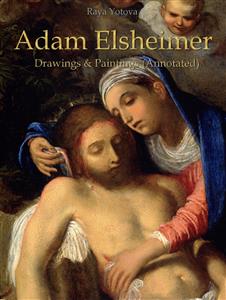
Adam Elsheimer was born in Germany, Frankfurt am Main, one of ten children, in a family of master-tailor. Artist Philipp Uffenbach apprenticed him. He probably visited Strasbourg in 1596. Twenty years old he traveled to Italy via Munich, where he was documented in 1598. His stay in Venice has not been documented, but the impact on Venetian style is visible. Elsheimerprobably worked as an assistant to Johann Rottenhammer. Rottenhammer was a German who lived in Italy for several years and was the first German artist to specialize in cabinet paintings. Although the earliest small paintings by Elsheimer on copper seem to date from before his arrival in Italy, the influence of Rottenhammer is noticeable in his mature work. It is believed that Elsheimer produced some significant works in Venice, such as the Baptism of Christ and the Holy Family, which show the influence of the Venetian artists Tintoretto and Paolo Veronese, as well as of Rottenhammer. His perfectionism and apparent propensity for depression were the reason for a small total volume of his work. In total, all his paintings have so far been forty. He also painted several etchings, but not very successful.
Das E-Book können Sie in Legimi-Apps oder einer beliebigen App lesen, die das folgende Format unterstützen:
Veröffentlichungsjahr: 2019
Ähnliche




Adam Elsheimer
Drawings & Paintings (Annotated)
Annotated by Raya Yotova
––––––––
First Edition
*****
Copyright © 2019 Annotated by Raya Yotova
Table of Contents
Title Page
Copyright Page
Foreword
Paintings and Drawings
Foreword
Adam Elsheimer was born in Germany, Frankfurt am Main, one of ten children, in a family of master-tailor. Artist Philipp Uffenbach apprenticed him. He probably visited Strasbourg in 1596. Twenty years old he traveled to Italy via Munich, where he was documented in 1598.
His stay in Venice has not been documented, but the impact on Venetian style is visible. Elsheimerprobably worked as an assistant to Johann Rottenhammer. Rottenhammer was a German who lived in Italy for several years and was the first German artist to specialize in cabinet paintings. Although the earliest small paintings by Elsheimer on copper seem to date from before his arrival in Italy, the influence of Rottenhammer is noticeable in his mature work.
It is believed that Elsheimer produced some significant works in Venice, such as the Baptism of Christ and the Holy Family, which show the influence of the Venetian artists Tintoretto and Paolo Veronese, as well as of Rottenhammer.
His perfectionism and apparent propensity for depression were the reason for a small total volume of his work. In total, all his paintings have so far been forty. He also painted several etchings, but not very successful.
However, his work has been highly appreciated by other artists and several essential collectors. He had a great and direct influence on other North painters who were in Rome. Even the first dating of Rembrandt appears to be a replica of Elsheimer's painting on the same theme.
Some works by Italian artists also show an evident influence of Elsheimer. Rubens owned at least four of his works, met Elsheimer in Rome and praised him in a letter after his death.
In a broader sense, he is influential because his night scenes are incredibly original. Its light effects are generally outstanding and very different from those of Caravaggio. He often used five different sources of light and relatively gently illuminated the objects, the less lighted parts of the composition usually containing essential elements of it.
Besides, its combination of a poetic landscape with significant figures in the foreground gives the scene a flourish that is rarely seen during the early Renaissance. Its landscapes do not always have a broad view; they are more realistic but no less poetic than those of Bril or Jan Brueghel and play an essential role in the formation of landscape artists such as Poussin and Claude.
His attitude to the significant figures with a landscape background is also used by Rubens and van Dick, as well as in the English portrait in the eighteenth century. Shortly after his death, he became very popular among English collectors and more than half of his paintings were in English collections.
Also, integrating it in Italian style with the German tradition in which it was trained is perhaps more effective than any Nordic artist. His compositions tend to underestimate the drama of the events they depict, but very often indicate the beginning of moments of transformation. His figures are relatively short and stubborn and reflect little of the classic ideals. Their poses and gestures are hot, and the expression on their faces resembles those in Early Netherlandish painting, but not so many the figures in the classical Italian Renaissance.




