


1,99 €
Mehr erfahren.
- Herausgeber: Publisher s13381
- Kategorie: Geisteswissenschaft
- Sprache: Englisch
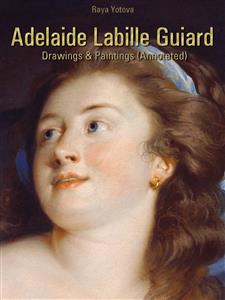
The paintings of Labille-Guiard and Vigée-Le Brun are often compared by critics, with Vigée-Le Brun usually receiving more favorable reviews. Labille-Guard's early masterpiece "Self-Portrait with Two Students" is influenced by the style of Vigée-Le Brun. Labille-Guiard's works of art are now considered at least equivalent to or higher than those of Vigée-Le Brun. Under the Patronage of Princess Marie Adélaïde, Labille-Guiard acquired a government pension of 1,000 francs and commissions for drawing the Royal family. These royalties made Labille-Guiard politically unreliable after the French Revolution of 1789, and in 1793 he was ordered to destroy some of his royalist works. However, it was far from conservative and did not resign from the status quo. At the beginning of 1790, Labille-Guiard conducted a campaign to reopen the Academy for Women. At Salon in 1791, she presented portraits of members of the National Assembly, including Maximilien Robespierre and Armand, Duc d'Aiguillon. Labille-Guiard was the first woman to be allowed to create a studio for herself and her students in the Louvre. She continued to exhibit her works in the Salon until 1800. She died on April 24, 1803.
Das E-Book können Sie in Legimi-Apps oder einer beliebigen App lesen, die das folgende Format unterstützen:
Veröffentlichungsjahr: 2019
Ähnliche

Adelaide Labille Guiard
Drawings & Paintings (Annotated)
Annotated by Raya Yotova
––––––––
First Edition
*****
Copyright © 2019 by Raya Yotova
Table of Contents
Title Page
Copyright Page
Foreword
Paintings and Drawings
Foreword
Adélaïde Labille-Guiard was feom Paris, the youngest of eight children, in a bourgeois family. Her father owned a store. Her older sister, Félicité, married Jean-Antoine Gros, a remarkable collector of paintings.
During the adolescence, Labille-Guiard studied how to paint miniature paintings with François-Elie Vincent's family friend. His connections made it possible for her early works to be exhibited at the Academy. In 1769 she trained with Quentin de la Tour who was famous pastel master. After the apprenticeship, she presented one of her pastels at the Academy. She continued to show her works at the Academy until 1776.
At her twenty years, Labille-Guiard married Nicolas Guiard, a senior French official. The marriage contract testifies that at that time Labille-Guiard was recognized as a professional artist in the Academy. The couple separated in 1779. They both retained the property they had before the marriage, as the division of ownership already existed under the laws of the Old Regime.
She retains the name Guiard after divorce and remains known in the art world as Labille-Guiard. After the separation, she had earned her living as a taught painting.
Labille-Guiard re-married the painter François-André Vincent, who won the Rome Prize in 1768 and was a member of the Royal Academy. There were 130 women in the Académie de Saint-Luc at that time, and Labille-Guiard could practice professional art.
Meanwhile, she began to study oil painting on her husband so that she could apply at the Royal Academy, which required her to present at least one oil painting for admission. For her first exhibition, Labille-Guiard chose to show some of her pastels, including her portraits, which were well received by critics.
On May 31, 1783, Labille-Guiard was admitted to the French Academy of Royale de Peinture et de Sculpture. Three other women, including Élisabeth-Louise Vigée-Lebrun, were accepted as members on the same day.
The paintings of Labille-Guiard and Vigée-Le Brun are often compared by critics, with Vigée-Le Brun usually receiving more favorable reviews. Labille-Guard's early masterpiece "Self-Portrait with Two Students" is influenced by the style of Vigée-Le Brun. Labille-Guiard's works of art are now considered at least equivalent to or higher than those of Vigée-Le Brun.
Under the Patronage of Princess Marie Adélaïde, Labille-Guiard acquired a government pension of 1,000 francs and commissions for drawing the Royal family. These royalties made Labille-Guiard politically unreliable after the French Revolution of 1789, and in 1793 he was ordered to destroy some of his royalist works.
However, it was far from conservative and did not resign from the status quo. At the beginning of 1790, Labille-Guiard conducted a campaign to reopen the Academy for Women. At Salon in 1791, she presented portraits of members of the National Assembly, including Maximilien Robespierre and Armand, Duc d'Aiguillon.
Labille-Guiard was the first woman to be allowed to create a studio for herself and her students in the Louvre. She continued to exhibit her works in the Salon until 1800. She died on April 24, 1803.




