


1,99 €
Mehr erfahren.
- Herausgeber: Publisher s13381
- Kategorie: Geisteswissenschaft
- Sprache: Englisch
His work did not belong to either the Romantic nor Neoclassical schools. The historical painting that Paris Salon appreciated as the artist's highest calling did not interest him. Instead, he claimed that the only possible source of live art was the artist's own experience. He and Jean-Francois Millet found inspiration for painting by peasants and workers. Courbet drew figurative compositions, landscapes, seascapes, and still-lifes. He loved contrasts by dealing with social issues in his work and bringing subjects and objects that were considered some kind of vulgar, such as the rural bourgeoisie, the peasants, and the working life of the poor peoples. His art, along with that of Honoré Daumier and Jean-François Millet, became known as a trend in pictorial art called Realism. For Courbet, realism was not limited to the imitating of the line and the form, but to spontaneous and rough handling of paint and color, which implied direct observation by the artist while depicting nature. He portrayed rudeness in life and thus challenged modern academic ideas about art.
Das E-Book können Sie in Legimi-Apps oder einer beliebigen App lesen, die das folgende Format unterstützen:
Veröffentlichungsjahr: 2019
Ähnliche

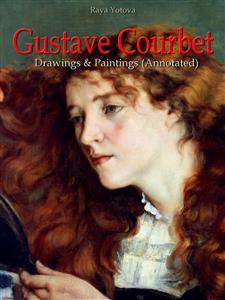
Gustave Courbet
Drawings & Paintings (Annotated)
Annotated by Raya Yotova
––––––––
First Edition
*****
Copyright © 2019 Annotated by Raya Yotova
Table of Contents
Title Page
Copyright Page
Foreword
Paintings and Drawings
Foreword
Gustave Courbet was born in 1819 in Ornans, France. Since he was from a prosperous agricultural family, his household was dominated by anti-monarchical feelings. His maternal grandfather was a participant in the French Revolution.
Courbet's sisters were his first models of drawings. After he moving to Paris, Courbet often returned home to hunting, fishing, and find inspiration.
Courbet left for Paris in 1839 and worked at the Steuben and Hesse Studios. An independent spirit, he soon left the studio, preferring to develop his style by studying the paintings of the Spanish, Flemish and French masters in the Louvre and painting copies of their works.
Courbet's first work was Odalisque, inspired by the writing of Victor Hugo and George Sand, but he soon abandoned literary influences instead of basing his paintings on the observed reality.
Among his early paintings are several self-portraits, romantic in concept, in which the artist presented himself in different roles.
His voyages in the Netherlands and Belgium have strengthened Courbet's belief that artists should portray life around them, as Rembrandt and other Dutch grwat masters did. By 1848, he already had supporters among the younger critics - neo-romantics and realists.
Courbet achieved his first big success at Salon in 1849 with his painting After Dinner in Ornans. This painting won the Courbet gold medal and was bought by the state. The gold medal from Salon meant that his works would no longer require approval from the jury for the Salon exhibition - a privilege that Courbet had until 1857 when the rule changed.
In 1849-50 Courbet painted Stone, which Proudhon admired as an icon of rural life; called it "the first of his great works." The painting was inspired by a scene where Courbet had witnessed the road.
His work did not belong to either the Romantic nor Neoclassical schools. The historical painting that Paris Salon appreciated as the artist's highest calling did not interest him.
Instead, he claimed that the only possible source of live art was the artist's own experience. He and Jean-Francois Millet found inspiration for painting by peasants and workers.
Courbet drew figurative compositions, landscapes, seascapes, and still-lifes. He loved contrasts by dealing with social issues in his work and bringing subjects and objects that were considered some kind of vulgar, such as the rural bourgeoisie, the peasants, and the working life of the poor peoples. His art, along with that of Honoré Daumier and Jean-François Millet, became known as a trend in pictorial art called Realism.
For Courbet, realism was not limited to the imitating of the line and the form, but to spontaneous and rough handling of paint and color, which implied direct observation by the artist while depicting nature. He portrayed rudeness in life and thus challenged modern academic ideas about art.
Paintings and Drawings
Flowers and Fruits, 1810, Oil on canvas, 107 x 87 cm
Episode of the Russian Retreat, 1836, Oil on canvas, 293.5 x 194.4 cm




