


1,99 €
Mehr erfahren.
- Herausgeber: Publisher s13381
- Kategorie: Geisteswissenschaft
- Sprache: Englisch
Gonzalès's work, according to some art historians, cannot be considered innovative but has charm and a sense of sincere personal expression, which gives her considerable value. Salon reviewers appreciated Gonzalès' paintings for their natural intuition with which she had expressed her art, as well as her extraordinarily brilliant technical skills. Salon's artistic reviews characterize much of her creative work by discussing her "female technique" and her "seductive harmony." Also, art critic Maria Deraismes encourages Gonzalès that her art has overturned all prejudices against female artists who had previously existed in Paris. Like Édouard Manet, Gonzalez never took part with her paintings at the Impressionist's exhibitions in Paris but was considered part of their group because of their style of art. By 1872, she was strongly influenced by Manet's style, but later developed her own, more intimate manner. She has used her family members, especially her husband and sister Jeanne Gonzales, as models in her work. In 1879 Eva married Henri Guérard, a graphic artist and engraver of her teacher Manet. In 1883, Gonzalez died at the age of thirty-four, five days after the death of her teacher, Édouard Manet.
Das E-Book können Sie in Legimi-Apps oder einer beliebigen App lesen, die das folgende Format unterstützen:
Veröffentlichungsjahr: 2019
Ähnliche

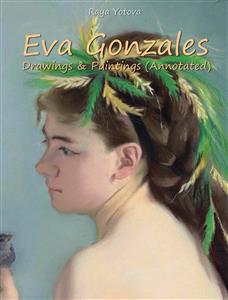
Eva Gonzales
Drawings & Paintings (Annotated)
Annotated by Raya Yotova
––––––––
First Edition
*****
Copyright © 2019 by Raya Yotova
Table of Contents
Title Page
Copyright Page
Foreword
Paintings and Drawings
Foreword
Eva Gonzalès was born in Paris, france, and, from an early age, has entered the sophisticated literary and artistic circles in Paris where her father, Emmanuel Gonzalès, was moving.
In 1865, at the age of sixteen, Eva began her professional training under portraitist Charles Chaplin.
Through her father's relationships, she met with various members of the Parisian cultural elite, and from an early age, Eva was exposed to the new ideas of art and literature at that time.
She is most popular with the fact that she started as a pupil of the painter Édouard Manet in February 1869. She was the only official student of Manet and also a model for several members of the Impressionist School.
The painting style of Gonzalès is very similar to that of the Spanish period of Manet; over the years she has made only minor changes in this style. The themes she chose to use are a presentation of everyday life, partly due to the profound influence of her first teacher, Chaplin.
In 1871 Édouard Manet pursued the inclusion of the brighter colors and active surfaces of Impressionists in his work. Meanwhile, Gonzalès decided to keep neutral color schemes and the exact contours of her works, leaving her pastels in softer colors that created a lighter palette to work with.
Gonzalès's work, according to some art historians, cannot be considered innovative but has charm and a sense of sincere personal expression, which gives her considerable value. Salon reviewers appreciated Gonzalès' paintings for their natural intuition with which she had expressed her art, as well as her extraordinarily brilliant technical skills. Salon's artistic reviews characterize much of her creative work by discussing her "female technique" and her "seductive harmony." Also, art critic Maria Deraismes encourages Gonzalès that her art has overturned all prejudices against female artists who had previously existed in Paris.
Like Édouard Manet, Gonzalez never took part with her paintings at the Impressionist's exhibitions in Paris but was considered part of their group because of their style of art.
By 1872, she was strongly influenced by Manet's style, but later developed her own, more intimate manner. She has used her family members, especially her husband and sister Jeanne Gonzales, as models in her work.
In 1879 Eva married Henri Guérard, a graphic artist and engraver of her teacher Manet.
In 1883, Gonzalez died at the age of thirty-four, five days after the death of her teacher, Édouard Manet.
Paintings and Drawings
The Window, 1865-1870, Oil on canvas, 55.6 x 46.2 cm




