


1,99 €
Mehr erfahren.
- Herausgeber: Publisher s13381
- Kategorie: Geisteswissenschaft
- Sprache: Englisch
After the death of her sister Giovanna in 1738, Rosalba Carriera fell into deep depression. She suffered two failed cataract surgery, but eventually, she completely lost her sight. She survived all her family, spending her last years in a small house in Dorsoduro in Venice. She died at the age of 84. At the time of her death, Rococo's style was no longer as popular as before. However, she still had a strong influence on many of the artists who started working after her syle, such as Catherine Read, Adélaïde Labille-Guiard and Élisabeth Vigée Le Brun. Rosalba Carriera was the first female artist to start a new style in the artistic community. Rococo's style emphasizes the use of pastel colors; spontaneous brushes, dancing lights, subtle surface tonality and a soft, elegant and charming approach to the subject. She was known for pulling white chalk in combination with darker tones to capture the shiny texture of lace and satin. She also had the talent to highlight facial features and soft stunts of fluffy hair. Nearly a century after her, many different artists were working with the pastel media in her style.
Das E-Book können Sie in Legimi-Apps oder einer beliebigen App lesen, die das folgende Format unterstützen:
Veröffentlichungsjahr: 2019
Ähnliche

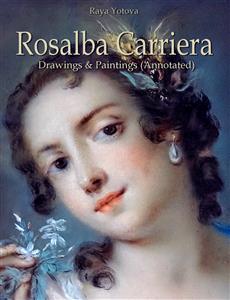
Rosalba Carriera
Drawings & Paintings (Annotated)
Annotated by Raya Yotova
––––––––
First Edition
*****
Copyright © 2019 by Raya Yotova
Table of Contents
Title Page
Copyright Page
Foreword
Paintings and Drawings
Foreword
Rosalba Carriera was born in Venice. Her family is from the lower middle class in Venice, and as a child, she began her artistic career by making lacy patterns for her mother who was engaged in this trade. However, when the interests of lace fell, and the industry began to decline, Carriera had to find a new means of securing itself and her family.
The popularity of snuff-taking enabled her to do just that. Carriera began painting miniatures for cigarette-boxes and was the first artist to use ivory instead of parchment for this purpose.
Gradually this work turned into a portrait painting on which she was a pioneer, and with the extraordinary use of Pastel media. Famous foreign visitors to Venice, young sons of nobles and diplomats wanted to be painted by her. The portraits of her early period included those of the 12 most beautiful Venetian ladies.
By 1700, she had made mostly miniatures and from 1703 completed her first pastel portraits. In 1704, she was proclaimed the "Accademico di Merito" of the Roman Academy of San Luca, which was a preserved title for non-Roman artists.
By 1721 Rosalba Carriera left Venice and went to Paris because portraits of her were much demanded there. While in Paris, she was a guest of the great lover of art and art collector, Pierre Crozat.
She painted Watteau, the whole inner circle of the King and the regent, and was elected a member of the Academy by acclamation.
In the short time spent in Paris, her work contributed to the formation of the new aristocratic tastes of the Court and later to the art tastes of the Parisians.
But her art did not serve only the needs of the monarchy. Her freedom, color, and charm were injected in the Rococo style, which has recently dominated the arts.
Despite her great triumph in Paris, she returned to her home in the Grand Canal, Venice in 1721. Carriera, along with her sister Giovanna, visited Modena, Parma, and Vienna and was enthusiastically received by the rulers and the monarchic Courts.
In her later life, Carriera traveled for a long time to the Royal Court in Vienna, Austria. While there, Holy Emperor Carl VI became her benefactor and was fully committed to supporting her work. The Emperor had an extensive collection of more than 150 her pastels.
After the death of her sister Giovanna in 1738, Carriera fell into deep depression. She suffered two failed cataract surgery, but eventually, she completely lost her sight. She survived all her family, spending her last years in a small house in Dorsoduro in Venice. She died at the age of 84.
At the time of her death, Rococo's style was no longer as popular as before. However, she still had a strong influence on many of the artists who started working after her syle, such as Catherine Read, Adélaïde Labille-Guiard and Élisabeth Vigée Le Brun.
Rosalba Carriera was the first female artist to start a new style in the artistic community. Rococo's style emphasizes the use of pastel colors; spontaneous brushes, dancing lights, subtle surface tonality and a soft, elegant and charming approach to the subject. She was known for pulling white chalk in combination with darker tones to capture the shiny texture of lace and satin. She also had the talent to highlight facial features and soft stunts of fluffy hair. Nearly a century after her, many different artists were working with the pastel media in her style.




