


1,99 €
Mehr erfahren.
- Herausgeber: Publisher s13381
- Kategorie: Geisteswissenschaft
- Sprache: Englisch
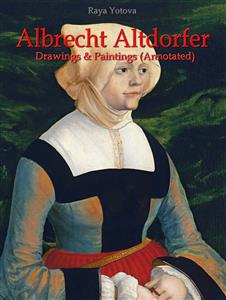
The legacy of Altdorffer's surviving work consists of 55 panels painted with oil, over 120 drawings, and hundreds of etchings and engravings, as well as frescoes. He signed and dated each of his works. Altdorfer is a pioneer artist of the pure landscape, turning it into a standalone subject, as well as landscaped compositions; most of his works are such landscape compositions. Altdorfer believed that the human figure should not destroy nature but instead participate in it or imitate its natural processes. Taking as a base and developing the landscape style of Lucas Cranach, the Elder, Altdorfer pictured the beautiful landscape of the Danube valley with dense forests of hanging branches of pine and pine mosses, and often dramatic coloring from rising or setting sun. His Landscape with Footbridge from 1518-1520 is considered the first pure landscape made with oil paint. In this painting, he placed a large tree that formed a central axis and focuses on his picture. Some viewers perceive this landscape as anthropomorphic stylization - a tree that is supposed to display human qualities. Altdorfer has also made many excellent drawings, mostly feather, ink, and watercolor landscapes. Altdorfer often distorted the prospect of a beautiful effect. His donor figures are often painted in the scale of real figures, as has been the tradition of paintings of previous centuries. He also portrayed some portraits. In later works, Altdorfer moves more into mannerism and begins to depict the human form following the Italian model, as well as to dominate the picture with bold colors. Altdorfer was a significant engraver, with numerous wood engravings and about ninety-three etchings. Most of his best prints are landscapes; in them, Altdorfer most easily manages to show his style of drawing. He often combined etching and engraving with one single plate and produced an average of about 122 prints of a deep printing with it.
Das E-Book können Sie in Legimi-Apps oder einer beliebigen App lesen, die das folgende Format unterstützen:
Veröffentlichungsjahr: 2019
Ähnliche



Albrecht Altdorfer
Drawings & Paintings (Annotated)
Annotated by Raya Yotova
––––––––
First Edition
*****
Copyright © 2019 Annotated by Raya Yotova
Table of Contents
Title Page
Copyright Page
Foreword
Paintings and Drawings
Foreword
Albrecht Altdorfer was born in Regensburg, Germany. He gained an interest in art from his father, who was a painter and miniature artist. Already at the beginning of his career, Altdorfer gained public attention by creating small, intimate modest works with unconventional media and eccentric themes.
He settled in his native Regensburg, a town located on the Danube River, eventually becoming a city architect and city councilor. His first signed works were dated by 1506 when he start painted engravings and drawings. His model patterns were engravings from the workshop of Albrecht Dürer.
Around 1511 he traveled along the river and to the south to the Alps, where the landscape impressed him so deeply that he became the first landscaper in the modern meaning, making Altdorfer the leader of the Danube School, a circle of painters that pioneered the landscape as an independent genre in painting in South Germany.
From 1513, Altdorfer entered the service of Emperor Maximilian I in Innsbruck, where he received several orders from the Imperial Court. During the unrest of the Protestant Reformation, he devoted himself primarily to architecture; his paintings from this period show his growing attention to architecture.
In 1529 he painted his famous picture named The Battle of Alexander at Issus for the ruler of Bavaria.
After he returned to Regensburg as a wealthy man, Altdorfer became a member of the city council where he was also responsible for the fortifications of Regensburg.
During this period his works were influenced by artists such as Giorgione and Lucas Cranach. In 1535 he moved to Vienna.
Altdorfer died in Regensburg in 1538.
The legacy of Altdorffer's surviving work consists of 55 panels painted with oil, over 120 drawings, and hundreds of etchings and engravings, as well as frescoes. He signed and dated each of his works.
Altdorfer is a pioneer artist of the pure landscape, turning it into a standalone subject, as well as landscaped compositions; most of his works are such landscape compositions. Altdorfer believed that the human figure should not destroy nature but instead participate in it or imitate its natural processes.
Taking as a base and developing the landscape style of Lucas Cranach, the Elder, Altdorfer pictured the beautiful landscape of the Danube valley with dense forests of hanging branches of pine and pine mosses, and often dramatic coloring from rising or setting sun.
His Landscape with Footbridge from 1518-1520 is considered the first pure landscape made with oil paint. In this painting, he placed a large tree that formed a central axis and focuses on his picture. Some viewers perceive this landscape as anthropomorphic stylization - a tree that is supposed to display human qualities.
Altdorfer has also made many excellent drawings, mostly feather, ink, and watercolor landscapes.
Altdorfer often distorted the prospect of a beautiful effect. His donor figures are often painted in the scale of real figures, as has been the tradition of paintings of previous centuries.
He also portrayed some portraits. In later works, Altdorfer moves more into mannerism and begins to depict the human form following the Italian model, as well as to dominate the picture with bold colors.
Altdorfer was a significant engraver, with numerous wood engravings and about ninety-three etchings. Most of his best prints are landscapes; in them, Altdorfer most easily manages to show his style of drawing. He often combined etching and engraving with one single plate and produced an average of about 122 prints of a deep printing with it.
Paintings and Drawings
The Emperor Maxentius Ordering the Burning of the Fifty Wise Men
1500-38, Pen and brown ink, and wash over black chalk, 16.9 x 16 cm




