


Erhalten Sie Zugang zu diesem und mehr als 300000 Büchern ab EUR 5,99 monatlich.
- Herausgeber: Allen & Unwin
- Kategorie: Sachliteratur, Reportagen, Biografien
- Sprache: Englisch
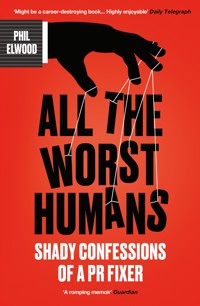
A New York Times Notable Book A New York Times Editors' Choice A New York Post Best Book of the Year An Amazon Best Biography/Memoir 'Hilarious and harrowing, and hard to put down' Christopher Buckley, author of Thank You for Smoking 'Might be a career-destroying book... highly enjoyable' Daily Telegraph 'A spin doctor to the rich and corrupt spills his secrets... starts with the crack of a Jack Reacher thriller' The New York Times The man who used to pull the strings of the global media is now pulling back the curtain: a bridge-burning, riotous confession by a top PR operative who exposes the secrets of the $129-billion industry that controls so much of what we see and hear in the media. After nearly two decades in the PR business, Phil Elwood wants to come clean, by exposing the dark underbelly of the very industry that's made him so successful. The first step is revealing exactly what he's been up to for the past twenty years - and it isn't pretty. From helping win the Qatar World Cup bid, to a four-day Las Vegas bacchanal with a dictator's son, and helping to land a Middle Eastern dictator's wife a glowing profile in Vogue at the same time the Arab Spring broke out, Elwood reveals all his slippery tricks for seducing journalists in order to create chaos and cover for politicians, dictators and spies. But as Phil moved up the ranks, he felt worse and worse about the sleaziness of it all - and his role in it - until he received a shocking wake-up call from the FBI. This risky game nearly cost Phil his life and his freedom. Seeing the light, he has decided to tell the full truth about who is the worst human. _____ 'A rollicking, unexpectedly affecting story. . . It's going to be one of the big, buzzy Beltway books of the year.' Politico 'Phil Elwood has written a book about his Washington life that's part therapy, part cautionary tale ? and quite funny . . . What makes Elwood's story stand out from the typical Washington read is that his personal demons are so intertwined with his professional choices . . . Elwood's prose is zippy, even Sorkin-esque, and he relishes dark humor.' The Washington Post 'If Hunter S. Thompson billed clients by the hour, it would look like All The Worst Humans by Phil Elwood. The pacing and storytelling propel the book's epic sweep across the darkside of DC and global hotspots. Even the most experienced in PR will learn things they did not know, and Elwood's gripping personal story is an unexpected and wild ride.' Bill McCarren, former Executive Director, National Press Club 'A lively, often hilarious, blood-chilling tale.' Sam Kashner, Air Mail 'A redemption story about becoming a better human, a story Elwood tells with vulnerability, heart, and brutal honesty.' James Kirchick, New York Times bestselling author of Secret City: The Hidden History of Gay Washington 'An exhilarating ride through the underbelly of global power structures.' Ben Smith, author of Traffic and editor in chief of Semafor 'I raced through this book and was gripped by every page.' Sophie Heawood
Sie lesen das E-Book in den Legimi-Apps auf:
Seitenzahl: 311
Veröffentlichungsjahr: 2024
Das E-Book (TTS) können Sie hören im Abo „Legimi Premium” in Legimi-Apps auf:
Ähnliche



















First published in Great Britain in 2024 by Allen & Unwin, an imprint of Atlantic Books Ltd.
First published in the United States in 2024 by
Henry Holt and Company
This paperback edition published in Great Britain in 2025 by Allen & Unwin.
Copyright © Phil Elwood, 2024
The moral right of Phil Elwood to be identified as the author of this work has been asserted by her in accordance with the Copyright, Designs and Patents Act of 1988.
All rights reserved. No part of this book may be reproduced or transmitted in any form or by any means, electronic or mechanical, including photocopying, recording or by any information storage and retrieval system, without prior permission in writing from the publisher.
No part of this book may be used in any manner in the learning, training or development of generative artificial intelligence technologies (including but not limited to machine learning models and large language models (LLMs)), whether by data scraping, data mining or use in any way to create or form a part of data sets or in any other way.
Every effort has been made to trace or contact all copyright holders. The publishers will be pleased to make good any omissions or rectify any mistakes brought to their attention at the earliest opportunity.
A CIP catalogue record for this book is available from the British Library.
E-book ISBN 9781805462248
Allen & Unwin
An imprint of Atlantic Books Ltd
Ormond House
26–27 Boswell Street
London WC1N 3JZ
www.atlantic-books.co.uk
For Lindsay, who really took the“for better or worse” thing seriously
The single biggest problem in communication is the illusion that it has taken place.
— GEORGE BERNARD SHAW
AUTHOR’S NOTE
This is my story, as I remember it. Some names and a few details have been changed to protect the many guilty and the few innocents.
PROLOGUE
FEBRUARY 8, 2018
When the FBI knocks, you are going to lose. It’s just a question of what. And how much of it. Money. Love. Freedom. Friends. Jobs. If they knock, you have been gambling. And you do not have the high card in this hand.
At 6:30 a.m., my phone rings. I mute CNN’s Chris Cuomo discussing the latest in Robert Mueller’s election interference inquiry and answer to make the ringing stop.
“Phil Elwood?” a woman’s voice says. “This is Special Agent Logan with the FBI.”
“Good morning?”
“Do you still live at apartment one-zero-zero-eight?”
“Not anymore,” I say, struggling to process. “We’ve moved within the building.”
“What apartment are you in right now?”
I look at my wife, Lindsay. She is still in her pajamas, answering emails from a higher education reporter. Fighting the good fight. “Can you give me an hour?” I ask Agent Logan.
Fight-or-flight kicks in. Protect what matters. “Lindsay, the FBI is downstairs,” I say. “They will be up in one hour. You need to leave.”
My wife speaks with the lyrical precision, and efficiency, of a machine gun. When her adrenaline spikes, the words get really fast. So, I can’t repeat with any accuracy the chain of concern, profanity, and fear that comes out of her. She is out the door in record time.
I have thirty minutes before the agents are due to knock. Normally, the FBI doesn’t call ahead, so I believe I am unique in my ability to describe how one waits for them. How would you spend your time? I read their Wikipedia entry. Thirty-five thousand employees, $9.8 billion annual budget, thirteen thousand Special Agents, many of whom carry the Glock 19 Gen5, a 9mm with a fifteen-round magazine. A top priority of today’s Federal Bureau of Investigation: “Protect the United States against foreign intelligence operations, espionage, and cyber operations.”
At this moment, there is a bag in my closet full of promotional material for an Israel-based organization that advertises that it is a “foreign intelligence operation” that engages in “online operations.” The word espionage is not in the brochure, but it is strongly implied.
Ten minutes to go. I think about the million dollars the Israelis have moved through my bank account. The wire transfers to the Seychelles, Cyprus, Switzerland, the Caribbean, Palestine, and who knows where else. About the laptop whirring away under the desk in my office, which the Israelis told me never to touch. Five minutes. I worry about the reach of the Wire Fraud Act, and of the Espionage Act of 1917. My pajama bottoms peek out from under the legs of my cargo pants.
Then comes the knock.
I open the door to a man and a woman wearing pistols on their hips. The woman steps forward and hands me her business card: “Special Agent Logan, Counterproliferation.” It is my understanding that this division works to stop the proliferation of nuclear weapons. I also understand that my life is about to change. Until this morning, I’ve been a ghost. My name has never even appeared in a Politico “Spotted” blurb. Google “Phil Elwood,” and you’ll find a dead jazz reviewer for the San Francisco Chronicle.
I offer the agents coffee. They decline. I walk them to my dining room table. They sit down across from me. Their body language telegraphs: the government versus you.
“Mr. Elwood,” Agent Logan begins. “Do you know why we’re here?”
Several things come to mind. It could be the Israelis. Or Muammar Gaddafi. Or Bashar al-Assad. Or the Iranians. Or because of what I pulled in Antigua. Or the bank transfers to accounts in tax havens all over the world. Or Project Rome. Probably not the ounce of cannabis in my kitchen drawer.
They could be knocking on my door about so many things I’ve done over the last two decades in public relations.
CHAPTER 1
Of Marble and Giants
EIGHTEEN YEARS EARLIER, JULY 2000
The halls of the Capitol Building are empty this morning. The clinks of the liquor bottles in the hand truck I’m pushing are the only sound. I love being alone here, marveling at marble columns propping up carved ceilings. Under the massive dome of the Rotunda, paintings tell the mythology of early America. In Statuary Hall, I nod to a bronze statue of Huey Long, an assassinated senator who some consider a hero, others a criminal, and then enter a wood-paneled corridor. Spiral staircases of iron and marble materialize out of dark corners.
I maneuver the bottles past unmarked doors that lead to the hideaway offices of Senators Trent Lott, Mitch McConnell, and Ted Kennedy. Senators steal away to these coveted havens to host meetings they’d rather not have eyeballed by reporters or to nap after marathon debates. The booze is heavy, and I’m out of breath when I reach Sen. Daniel Patrick Moynihan’s hideaway. Vodka soda sweat leaks through my cheap, white collared shirt. We interns were out late at Politiki bar last night.
I let myself in and head for the brass bar cart. Fifths of whiskey, gin, scotch, and Tio Pepe sherry, Moynihan’s favorite, get loaded in and lined up. When I’m finished, I sit on a leather couch dyed the same dark mahogany as the regal desk and spark up a Camel. Moynihan is a fellow smoker. His hideaway reeks of tobacco.
The hundred or so hideaways in the Capitol are passed down through handshake deals. Seniority rules, and sitting on the Finance Committee doesn’t hurt. Junior senators fight over windowless basement rooms the size of utility closets and furnished with cots. Moynihan has earned a view of Pennsylvania Avenue and space for ten people to sip cocktails. Standing under an oil painting, I pull back the cream-colored curtains and take it all in. I imagine the senator from New York in here, lighting up, pouring a tumbler of Tio Pepe, and telling stories about the presidents he has advised.
Sitting in the private office of a Senate demigod still doesn’t feel real. I’m a twenty-year-old college dropout whose only credentials are a job at a Mexican restaurant and a cocaine problem. The rest of my intern class are the kids of campaign donors and New York City’s financial glitterati. My dad is a pastor in the other Washington. He preaches to a congregation in Olympia.
Six months ago, I was a sophomore at the University of Pittsburgh on a debate scholarship. Debate is about speed. Being able to talk fast was the prerequisite for entry. On weekends, I traveled to universities around the nation to argue about what policies would lead to nuclear war. Rapid-fire reading of news clippings scored points in a round. So did biting insults lodged at your opponent in an attempt to trap them in a rhetorical mishap. You won by manipulating the news and calling it “evidence” to advance your argument. I won a lot.
My grades were nearly perfect until I started working nights as a cook at Mad Mex. The waiters survived on a diet of wings and cocaine. One night, one of them noticed that I seemed a bit down and he offered me a pick-me-up from his bag. It worked. For fifteen minutes. Three months later, I was failing five out of five courses. I don’t believe I attended one.
The week before finals, I called my older brother in a panic. He jumped on a plane to Pittsburgh. We debated my options. I tried to advance the argument for my brother taking my finals. It was raining when we went to the registrar’s office and filled out the forms. The first Elwood to drop out of college.
My parents collected me at SeaTac airport. I deplaned drunk on whiskey and clutching a plush toy of Opus the Penguin, from Berkeley Breathed’s comic strip. My father shook his head and made me see a shrink. I snowballed my way through the sessions. Left out the cocaine use. The shrink informed me that I was suffering from “situational depression.”
“Since you are removed from the situation,” she explained. “The problem must be resolved.”
“Makes sense,” I said.
It didn’t. And the depression didn’t lift. A childhood friend, who I’ll call Preston, worried that I had no prospects after dropping out of school, threw me a lifeline. His college classmate Eric, a trust fund kid, worked in Washington, DC, as Senator Moynihan’s aide. If he liked me, Eric could get me an internship on the Hill.
I called Eric, and he told me to meet him the next Tuesday, at 10 p.m., at 1823 M Street. “Northwest M Street, the one near the White House,” he said. “Do you have a fake ID?”
“Indeed I do.”
“Bring it. You’ll need it in DC,” Eric said. “Your official interview will be on the Hill the next day. But this one is more important. I vet the interns for the staff.”
My parents bought me a suit at the mall, and I flew to Washington. Résumé in hand, I cabbed it to a redbrick building with blacked-out windows on M Street. My fake ID fooled the bouncer. Inside, Ice Cube’s “You Can Do It” played as a dancer sprayed Windex on the pole before taking off her underwear. A topless woman asked if I wanted some singles.
Eric wasn’t hard to spot. He was the only other guy wearing a suit in the strip club on a Tuesday night. He chugged a Bud Light at a table with a clear view of the stage. I handed him my résumé. He gave it to a dancer in a neon-yellow G-string.
“Relax,” he said, sliding me a beer. “You met me at Camelot on a Tuesday night. You passed the test.”
In Moynihan’s hideaway, I kill my cigarette and flush it down the toilet. I lock up, push the empty hand truck past Minority Leader Tom Daschle’s office, and ride an elevator down to the basement. I flash my badge to a guard, cut through the crypt under the Rotunda, and head into the Capitol Hill Tunnels. I love these underground passageways, that feeling of special access.
I walk the pedestrian pathway alongside a miniature subway trolley modeled after the Disney World Monorail. A group of congressional aides are taking the two-minute ride, briefcases on their laps. To my right, I spot Sen. Fred Thompson.
“Good afternoon, Senator,” I say. “Die Hard Two was on TNT last night.”
“Was it really?” he replies in the deep southern drawl that was so out of place when he played a New York district attorney on NBC’s Law & Order. “Walk me back to my office.”
On the twenty-minute trip to the Hart Building, Thompson asks whether I think DC or Hollywood is the more terrifying place. I argue in favor of Hollywood. The Capitol doesn’t frighten me. Just the opposite. From the moment I set foot in DC, I knew I was home. The Hill is a real-world version of debate team. Everyone talks fast, and there are winners, losers, and nukes. Last week, I had a drink with Sen. Russ Feingold, who told me stories of working with John McCain and Carl Levin on trying to pass campaign finance reform. I’ve gone from bussing tables at a Mexican restaurant in Pittsburgh to rubbing elbows with senators. I never want to leave.
I weave through redbrick-walled tunnels back toward Moynihan’s staff office in the Russell Building. Discarded and broken office furniture lines the bowels of the Capitol Hill office buildings. I pass the Senate barbershop, where I recently got a bad haircut sitting next to Majority Leader Lott. A quick elevator ride up from the basement takes me to Russell’s fourth floor, where I drop off the hand truck and head down a flight of stairs to a private parking lot.
Two interns are already out here smoking. The senior senator from Michigan Carl Levin’s beaten-up blue Oldsmobile sticks out among the rows of luxury sedans. I smoke another Camel and watch Kit Bond of Missouri climb out of a black town car. Kay Bailey Hutchison struts by, followed by her “purse boys,” two young, attractive male aides who carry her luxury bags around Capitol Hill. When senators bum a smoke before hustling to their next meeting, I feel like a young Henry Hill parking cars for Paulie’s crew in Good-fellas.
It’s almost four o’clock. In this town, the most important hour is happy hour. I head back out into the muggy city, down First Street, passing the Supreme Court and the Library of Congress, where 3,700 boxes of Moynihan’s personal papers have been kept for posterity. It’s the largest one-man collection in the library, Moynihan’s legislative director recently told me over whiskey and Cokes at the Capitol Lounge.
At Pennsylvania Avenue, a helicopter buzzes across the sky. The pilot shadows a motorcade of black SUVs careening downtown, lights flashing and sirens blaring. When the street clears, I duck into the Hawk ’n’ Dove. I nurse a vodka soda, holding a good table with a view of the TVs, tuned to CNN. Just like the hideaway office system, this place runs on dibs. Soon the bar will be teaming with staffers from both sides of the aisle. They will drink, party, date, and sometimes put together bipartisan legislation. Tables are valuable currency. As an intern, I take it as my sacred duty to make sure the staff doesn’t have to stand at the bar.
At five o’clock, Moynihan’s staff trickles into Hawk ’n’ Dove in ascending order of the food chain. Legislative correspondents arrive first, along with the rest of the interns. An hour later, the legislative assistants claim their seats. Then come the legislative director and, finally, around seven, Moynihan’s chief of staff. His blue suit is rumpled, and he looks exhausted. In his hand is today’s “clip sheet,” a binder compiling daily press filings that mention our boss. The interns create it each morning by cutting apart the Washington Post, the New York Times, and the hyper-local weeklies and meticulously underlining Moynihan’s name.
“Thanks for holding down the fort, Phil,” the chief of staff says. “Look at this. Hillary Clinton is going to walk into Moynihan’s seat. Rick Lazio doesn’t stand a chance.”
I’ve landed in Moynihan’s office just in time. He’s about to retire after twenty-four years in the Senate. The alumni list from his office reads like a who’s who of Washington, DC—and they help each other out. I spent the rest of the summer helping them out by following the legislative director’s instructions: “Do anything we ask. And do it with a smile. Even if it’s not part of your job. Even if it’s weird.” I take his words to heart. Moynihan’s staff takes a shine to me because I volunteer to huff cartloads of Tio Pepe and get menial intern tasks done at my restaurant pace.
There are two ways to go about a career here: get in deeper or get out. I know one thing: I’m never leaving Washington. But a college dropout’s trajectory is limited; I need a degree. Before my internship ends, I apply to George Washington University. I draft my own letter of recommendation, and Moynihan’s chief of staff, for whom I’ve held tables all summer at half the bars in town, signs it. “Motivated and gifted with his words, Phil Elwood will make a valuable addition to your storied university.”
I wake up in a holding cell. Two cops yank me into an interrogation room and slam me with the accusation that I drunkenly crashed through a window at GWU’s Gelman Library. I can’t remember last night, but my throbbing head and the cuts on my body indicate that the police are telling the truth. I’m frog-marched into a sheriff’s van and handcuffed to the floor.
I stand in front of a judge, who tells me he knows I’m very sorry for what I’ve done and that I will never do it again. He slaps me on the wrist with twenty hours of community service. Later, I hear that Moynihan’s office made a call. A few days after I get home from central booking, a thin letter arrives from George Washington. I am no longer welcome on campus.
I’m certain I’ll be excommunicated from DC. I’ll have to return to Olympia. My parents will once again watch their son emerge at the Arrivals gate holding his plush toy Opus the Penguin, like a deadbeat Sisyphus. Instead, I’m promoted. Moynihan’s office makes one call, and I’m hired as a legislative correspondent for the senior senator from Michigan, Carl Levin. The happy hours continue. It’s amazing I get anything done with all the booze. Toward the end of my first year, the chief of staff hauls me into his office.
“I strongly suggest you get a college degree,” he says. “George Washington is off the table, clearly. What about Georgetown?”
Given my high school C average, Georgetown should be off the table, too. But it turns out Levin has considerable influence with the university. One letter from the senator and I’m accepted as a transfer student. I realize this is how the world works, or at least how this world does. It is not a meritocracy.
In the basement office of the Permanent Subcommittee on Investigations, staffers drop off crates of documents. “Go through these. Look for anything suspicious,” they instruct. They leave to fetch more boxes. Levin is leading an inquiry into the malfeasance of Enron’s board of directors. Enron’s spectacular implosion has been a lead story on CNN for months. Now Levin is making it his mission to codify the company’s wrongdoing into the national record.
I drink coffee with a team of lawyers who haven’t seen the light of day in weeks and sift through thousands of pages of emails with a highlighter. Most of the material is banal talk about steakhouse lunches and corporate retreats. Every few pages, I notice the obscene dollar amounts of Enron’s transactions. Villains get paid in numbers with extra zeros.
On the day of the Enron hearings, I go watch the fireworks at the Hart Building. A homeless man stands at the front of a long line stretching down Constitution Avenue. I watch a sharky-looking guy in a jet-black suit hand the homeless man a ten-dollar bill and slide into his place. Lobbyists have probably been pulling this trick since the Grant administration. I flash my staff ID and follow the lobbyist past security and into the Senate hearing room, where I stand against the back wall.
Levin strides up to the dais in a baggy suit, the last of his hair combed over a sun-spotted scalp. In 2013, BuzzFeed News will publish a list of the “23 Most Important Comb-overs of Congress.” Levin will come in second place. A man of the people. He’s the hardest-working member of his staff. I watch, rapt, as he rakes Herbert Winokur Jr., Enron’s Finance Committee chair, over the coals about a half-billion-dollar loan.
“Now, when you met with my staff, did you also tell my staff you did not have much recollection of that transaction?” Levin asks, peering down his glasses, pushed far down the bridge of his nose.
“Yes, sir.”
“Now that you have refreshed your recollections. Enron was borrowing a half a billion dollars from Citibank, but it did not show up on the balance sheet of Enron as debt but rather as preferred shares, which looked more like equity than debt. It was a loan disguised as equity in order to avoid showing debt on the books.”
“Sir, I believe it was accounted for as a consolidated subsidiary with a—”
Levin cuts him off. “Was it shown as a loan?”
“It was shown as—the entity was consolidated and the $500 million of Citibank was a minority interest.”
“But was it shown as a loan?”
Levin’s got him dead to rights. I watch Winokur break. “No, sir.”
An exchange worthy of a headline. I spot a gaggle of reporters taking notes at the side of the chamber. As in a debate, they’ve got their evidence. Now they’ll print it in tomorrow’s paper. And some college debater will use the article as evidence in a round where the topic is “fiscal regulation.” It’s codified into the record. The truth, as far as anyone is concerned.
I’m fascinated by this bloodbath, particularly by the criminals on the witness stand. Who helps them? Who prepped them for this massacre? Whoever it was, they aren’t good enough at their job. Where’s the consistent messaging? Why weren’t they expecting these questions? Why aren’t they repeating the same five lines over and over and over? Why are they just giving easy sound bites to the senator and the media?
I realize I’m probably the only person in the world who has this reaction to the Enron scandal.
I lean out into K Street, hailing a cab. It’s the first week of summer. School is out. I’ve been barhopping with Hill staffers. A yellow cab pulls up, and I attempt to hop over a Jersey barrier. My foot catches the edge. I spin as I fall to the curb.
I can’t walk. I crawl into the cab’s backseat and tell the driver to take me to the nearest trauma center. When we arrive at George Washington University’s ER, nurses put me in a wheelchair. Three hours later, a tech looks at my X-ray, says, “Oh shit,” and starts to run out of the room. I grab his arm. Make him show me the image. The ball of my hip is floating, completely separated from my femur.
I wake up sucking oxygen from a tube. My mother is sitting in a chair next to the bed. My mother lives on the other side of the country, so I figure something is probably wrong. I don’t remember anything after looking at the X-ray.
I’m on crutches for a month. Then I graduate to a cane. For the rest of my life, I’ll walk with a slight limp. And the three titanium screws in my hip will ache when the temperature dips below forty degrees. A few months later, I skydive out of an airplane for the first time. At a checkup, I inform my surgeon that he must have done some good work. He is not pleased.
My parents fly in for Georgetown’s graduation ceremony. They seem relieved that I made it to the finish line. Levin writes yet another letter, and I’m accepted into the London School of Economics. I live in a flat in Notting Hill, attending lectures on trade wars with the kids of prime ministers and international diplomats.
One day, I’m walking on campus when I pass a balding young man with hard eyes flanked by massive bodyguards. I’ve heard about Saif Gaddafi. The students whisper that he’s a dictator’s son.
In a few years, he’ll be one of my clients. Long after I’ve been on his family’s payroll, he’s forced to show he didn’t buy his PhD in philosophy with millions of pounds donated to LSE. Howard Davies, the distinguished institution’s director, whose signature is on my diploma, will resign, disgraced.
But I’m getting ahead of myself.
I walk through the doors of Venture, which feels like the smallest public relations shop in DC. I’ve been back in town for a few weeks, applying for any job that will keep me close to the action on the Hill. I’ve missed this city. Missed working on projects that I’d read about in the newspapers the next day. Missed the happy hours spent trading gossip about senators and feeling like a master of the universe.
Venture’s office isn’t much more than a few desks scattered in the basement of a lobbying firm. A young woman shakes my hand and tells me to sit down. She scans my résumé, catching an item that makes her pause.
“Mr. Elwood,” she says, smiling. “I see you’ve worked on the Hill.”
I’m riding in a black SUV heading down First Street toward CNN Studios. Beside me sits Jon Powers, an army officer fresh off a tour in Iraq, and Michael Tucker, a filmmaker. “When you get on set, remember to emphasize that young audiences need to watch this film,” I coach them. “Putting an R-rating on it is limiting the exact people who should see what war is like firsthand. The kids who might enlist.”
Powers nods, mouthing my words to himself. I walk him through his talking points one more time as the SUV pulls up to the tan-and-glass building housing CNN’s DC bureau.
“If this film gets rated R, it hurts the youth of America,” I repeat when we step into the lobby and receive our security badges.
Powers is a subject of the documentary Gunner Palace, directed by Tucker, about soldiers living in Saddam Hussein’s son Uday’s pleasure palace during the second Iraq War. Venture has been tasked with keeping a PG-13 rating on a film in which the word fuck is uttered more than forty-two times. MPAA rules state if the word fuck is said in a movie more than once, the film receives an automatic R. And an R means fewer ticket sales.
It’s my first PR campaign. My strategy has been to flood the zone. Make as much noise as we could. I’ve called television bookers and producers from a landline in Venture’s basement office. “The Iraq War is a killing field right now,” I spitballed. “Teenagers being recruited by the army need to see this film.”
“I don’t have time for this,” beleaguered bookers said before hanging up.
“This isn’t my beat,” I heard again and again. “Take me off your list.”
I’m twenty-four years old—my “save the children” pitch was born out of instinct. I didn’t train in a press shop on the Hill. Venture has two other employees and pays me $35,000 a year, but my gut told me I was on to something. After a barrage of calls, I got through to a segment producer at CNN. In passing, I mentioned that Powers was from Buffalo, New York.
“Lucky break,” the producer said. “Wolf Blitzer is from Buffalo. We’ll help your guy out.”
The CNN set is smaller than I imagined. The studio looks like a toy replica of what you see on-screen. The idea that this tiny room is responsible for so much influence seems incongruous, like ants carrying an apple. A line producer walks Powers from the green room to his mark. We have four minutes of camera time. Powers is calm. He has faced down RPG fire in Baghdad; he can handle a few questions from a cable news anchor.
I watch the segment on the TV in the green room, imagining the audience watching at home. Powers and Tucker stick to our script, repeating my talking points about the film educating America’s youth about the harsh realities of war.
As the anchor nods like a concerned parent, I watch as Powers’s words—my words—become legitimate in real time because he’s saying them on cable news. In an instant, ideas I thought up in a windowless office appear to become reality, certified by CNN itself. The audience doesn’t see me building the machine that creates this illusion. They don’t even know I exist. If a PR person appears on TV, it usually means we’ve fucked up.
As CNN broadcasts my message to millions of Americans, I realize my job isn’t to manipulate public opinion. My job is to get gatekeepers like CNN to do it for me. Once you have ink, your story becomes real. A conversation starts that didn’t exist moments before, a conversation nobody would think to have if you hadn’t started it. The public begins to accept something you created out of nothing.
And I have something reporters will always need: access to inside information. Information is the only commodity I control, but in this world it’s valuable currency. The media demand constant fuel. I can feed information to reporters and toggle how much they see. I feel as if I’ve put on a pair of night-vision goggles that reveal the hidden machines powering the world. I begin to see levers I can pull. The adrenaline that spikes feels stronger than any line of cocaine.
The press pick up our message and run with it. We secure a sympathetic review by A. O. Scott in the New York Times. “The raw inconclusiveness of ‘Gunner Palace’ is the truest measure of its authenticity as an artifact of our time and of its value for future attempts to understand what the United States is doing in Iraq,” he writes. Fox News’s Sean Hannity and Alan Colmes bring on Powers for a five-minute segment. MSNBC also does a segment with Powers and the director. My first time out, I secure a cable news “hat trick.”
A few weeks later, I attend the premiere of Gunner Palace. Sen. Ted Kennedy shows face on the red carpet. The house lights go down, and the screen lights up: “This film is rated PG-13.”
I’ve just sunk a body.
Let me explain. I sank my first body when I was twelve. My father was the minister of an East Coast church, an easy walk to the ocean. Our house stood behind the church, and our front yard was the parish graveyard. Heavy metal bands tried to rent the property for record release parties. Aging, failing septic systems upstream yielded fecal counts in the hundreds of thousands in the creek running through the graveyard. A river of shit.
When a parishioner expired, I would get to spend time with my father, and I would be compensated for my time. Fifty dollars per body. All I had to do was hold the cross and look sad for an hour. Workers brought in earth-moving machines to dig the grave. When the casket was in place, we stacked flower pots between the hole and the bereaved.
During one burial, my father and I stood behind the flower pots. I could see down into the hole. “Yea though I walk through the valley of the shadow of death . . .” my father began. Then, over the mourners’ bellowing, crying, and sniffling, I heard clods of earth falling and . . . splashing. Brown liquid was pooling up from the dark earth. I gave my father an elbow and nodded toward the bottom of the grave.
He picked up his pace. “I will fear no evil.”
I watched shit-colored water swirl around the coffin. The coffin broke free from the dirt, floating, rising. I elbowed my father again.
“Steady the casket,” he whispered.
Angling the cross just so, I was able to place one foot on terra firma and the other on today’s Jane Doe.
“For thy rod and thy staff they comfort me.”
By the closing prayer, my shoe was soaked through.
“Handle this. I’ll be back soon,” my father told me and then led the mourners to the parish hall. They were none the wiser. I worried that the coffin was going to float up and out of the hole. I was twelve, so I also worried that the body inside would come back to life. I jumped on the coffin, trying to submerge it. I slipped on its slick surface and fell into the grave.
It was the first time I helped create a false narrative. Cover up the truth when the wheels have fallen completely off the wagon. Remain calm and sink the body. The body is the truth. With Gunner Palace, the truth was that we wanted a PG-13 rating to sell more tickets. So, you sink the body. You make the public believe you want to keep vulnerable teenagers safe from the Iraq War. And with this body, I’ve made much more than fifty bucks.
I need to create this illusion again. All around me, I see power and more power. I’m low in DC’s pecking order. Even Moynihan’s aide Eric has more pull than me. But for the first time in my life, I’ve discovered a trick that makes people clap. A trick that I’m apparently good at. I need to master it. I need to see how far it can take me.
CHAPTER 2
Everyone Deserves Representation
I’m sweating through my best suit at the Garden Terrace at the Four Seasons in Georgetown. My table sits below a trellis of manicured ivy. Peter Brown is due to arrive in five minutes.
Earlier this afternoon, I got a call from a woman who said she was Peter Brown’s assistant. “Can you meet Mr. Brown for a drink this afternoon?” she asked. “He’s thinking about hiring you.”
I agreed. Then I googled “Peter Brown.”
Brown rose from running the record department at a store in Liverpool to managing the Beatles and sitting on the board of Apple Corps. He is mentioned by name in a Beatles song. He helps Robert De Niro promote the Tribeca Film Festival and takes Barbara Walters as his date to events. In the early 1980s, Brown moved to the PR game and now heads up Brown Lloyd James, a boutique firm based in New York.
Brown strides into the Garden Terrace wearing a tailored blue suit accented with a pink silk tie. His silver hair matches his cuff links. When we shake hands, he feels frail but somehow in charge of even this small physical interaction—which is incredibly disarming. A waiter materializes, asking, “Campari and soda, Mr. Brown?” I order a glass of Malbec. Our drinks arrive nearly instantaneously.
“So,” I say, “tell me about the firm.”
“Imagine Brown Lloyd James as a relationship brokerage,” Brown says in an elegant English accent. “We solve ornate problems for extraordinary clients. Used to do it ages ago for John.”
It takes me a moment to realize he’s referring to John Lennon.
“John once called me in a pinch. He needed to get married immediately without the media hounding the ceremony. I found the one place on the bloody globe that fit the ticket. He and Yoko tied the knot in Gibraltar.”
Coming out of a less remarkable man’s mouth, this story would sound like shameless name-dropping. But Brown speaks softly, nonchalantly. He can afford to: Lennon canonized him in “The Ballad of John and Yoko”: “Peter Brown called to say ‘You can make it okay,’” Lennon sang. “‘You can get married in Gibraltar, near Spain.’” A Beatle singing about your cocktail stories is better than being knighted. And Brown will later almost be knighted. The Crown will appoint him a Commander of the Order of the British Empire.
“My uncle Phil is a big Beatles fan,” I say. “I’m named after him.”
“John and Yoko bought an apartment in the building next to mine because they liked my view of Central Park. Yoko still lives there. Mick Jagger once sublet my apartment. When the term was up, he wouldn’t give it back. We got into quite a dustup over it.”
“Happens.”
“We need someone in New York,” Brown says. “To run a couple of accounts.”
“What sort of accounts?”
“BLJ represents exotic clients. Countries. High-net-worth individuals.”




