


13,99 €
Mehr erfahren.
- Herausgeber: Grove Press UK
- Kategorie: Sachliteratur, Reportagen, Biografien
- Sprache: Englisch
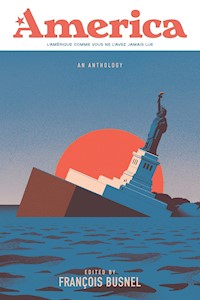
France and the United States have long shared a special relationship, defined both by occasional puzzlement and endless fascination. François Busnel, one of France's most prominent literary critics, seeks to bridge this gap with America, his journal of literature and politics, launched in the wake of the 2016 election and now available to English readers for the first time. In this collection of pieces from the magazine, Alain Mabanckou sketches the outlines of his Los Angeles, where he finds a sense of belonging far from his home country of the Republic of the Congo. Leïla Slimani considers the ways #MeToo is shaping a new discourse of consent on college campuses. Philippe Besson travels through the American heartland, driving from Chicago to New Orleans. Featuring interviews with Chimamanda Ngozi Adichie and Louise Erdrich and original work in English by Richard Powers and Colum McCann, America celebrates the enduring relationship between France and the United States and offers a testament to the essential power of literature to unite in times of division.
Das E-Book können Sie in Legimi-Apps oder einer beliebigen App lesen, die das folgende Format unterstützen:
Veröffentlichungsjahr: 2020
Ähnliche


















AMERICA
First published in the United States of America in 2020 by Grove Atlantic
First published in Great Britain in 2020 by Grove Press UK, an imprint of Grove Atlantic
Introduction copyright © 2020 by François Busnel
All other pieces were originally published in French in the magazine America.
English translations copyright © 2020 by David and Nicole Ball; John Cullen;
Kate Deimling; Penny Hueston; Jessica Moore; Emma Ramadan; Rachael
Small; Sandra Smith; Helen Stevenson; and Sam Taylor.
Excerpt from Letters to a Young Writer: Some Practical and Philosophical Advice by
Colum McCann, copyright © 2017 by Colum McCann. Used by permission of Random House, an imprint and division of Penguin Random House LLC.
All rights reserved. Same excerpt, copyright © 2017 by Colum McCann, used by permission of The Wylie Agency (UK) Limited. Same excerpt, copyright © 2017 by Colum McCann, published in Canada by HarperCollins Publishers Ltd. All rights reserved.
This work received support from the French Ministry of Foreign Affairs and the Cultural Services of the French Embassy in the United States through their publishing assistance program.
The moral right of the authors contained herein to be identified as the authors of this work has been asserted by them in accordance with the Copyright, Designs and Patents Act of 1988.
All rights reserved. No part of this publication may be reproduced, stored in a retrieval system, or transmitted in any form or by any means, electronic, mechanical, photocopying, recording, or otherwise, without the prior permission of both the copyright owner and the above publisher of the book.
1 3 5 7 9 8 6 4 2
A CIP record for this book is available from the British Library.
Grove Press UK
Ormond House
26–27 Boswell Street
London
WC1N 3JZ
www.groveatlantic.com
Trade paperback ISBN 978 1 61185 453 4
Ebook ISBN 978 1 61185 892 1
Printed in Great Britain
TABLE OFCONTENTS
Introduction
François Busnel
Los Angeles
Alain Mabanckou
From Chicago to New Orleans
Philippe Besson
Orange Is the New Black
Richard Powers
The Outskirts of the City
Marie Darrieussecq
The Yellowstone Chronicles
Joël Dicker
Hitchhiking along the Border
Sylvain Prudhomme
Four Letters from America
Laura Kasischke
Chocolate-Colored Washington
Abdourahman Waberi
Trans-America
Alex Marzano-Lesnevich
A Hat in Manhattan
François Busnel
Miss Gulliver in America
Leila Slimani
The Home(less) of the Free and the Brave
Lee Stringer
Will Evangelicals Save Trump?
Philippe Coste
Boulevard of Broken Dreams
Yann Perreau
We Must Fight for Our Memory
An Interview with Louise Erdrich
Among the Amish
Philippe Claudel
Las Vegas
Alice Zeniter
A Call to Young Writers on the Eve of the Trump Presidency
Colum McCann
Contributor Notes
INTRODUCTION
By
François Busnel
Translated by
Kate Deimling
How many times have you heard someone say, “In the Trump era, truth is stranger than fiction”? This is why some friends and I founded a magazine in which specialists in fiction— novelists—can describe the reality of America.
America came about after Donald Trump was elected. The idea was to tell the story of the world’s number one superpower on a quarterly basis, for the length of a presidential term. Trump’s victory didn’t just stun many Americans. It shook the whole world. As a Frenchman, I feel I belong to what is sometimes called, without irony or submissiveness, the fifty-first state. In other words, the rest of the world. Whether we like it or not, we are all deeply affected by what happens in the United States. If we accept the prevailing cynicism and see Donald Trump simply as a clown, we’re just fooling ourselves. The current resident of the White House is much more astute than people think. He shrewdly proves the Mark Twain maxim “All you need in this life is ignorance and confidence; then success is sure.”
Since America is anything but homogeneous, America has sent writers all over the country, to big cities and little towns, to collect impressions and opinions face-to-face in unbiased fashion, so that literature can cast its net to capture the images that are the truest, the strongest, and sometimes the most disturbing.
Novelists’ inspired visions, which are the basis of our approach, seem to be more necessary than ever. We are currently experiencing one of the biggest challenges to democracy: in a puzzling paradox, it seems the more we know about our world—with the Internet, new technologies, and the accessibility of the written word—the less we know what to think about it. There is only one solution: novels. When the authorities preach, novelists take a skeptical stance. When experts try to simplify things, novelists restore complexity. When politicians spin the facts, novelists pull back the curtain on deception. How? By asking questions. By telling stories. How did Trump’s reign happen? How did the populist wave triumph, with its accompanying intolerance, ignorance, racism, and partisanship? How are Americans living today, both those who brought this movement to power and those who are simply enduring it? What does the United States of America look like today, after four years of a reign marked by huge political turmoil, threats of war, a surge in protests fighting for racial justice, and the worst public health crisis the country has faced in the last century? A line from investigative journalist Carole Cadwalladr has inspired my readings and travels for years now: “You may know the facts, but you don’t know the story.” Like many people, I’m a collector of stories.
Novelists don’t affirm anything; they seek. Their job is not to solve problems, but to express them. It’s quite possible that human stupidity comes simply from trying to have an answer for everything. The novel’s wisdom is to have a question for everything. America wants to take up this challenge: to understand rather than to judge.
LOS ANGELES
By
Alain Mabanckou
Translated by
Helen Stevenson
Dear Marc-Antoine,
Thank you for your e-mail, from which I learned that you spent three days in Los Angeles and were disappointed to discover it was actually just a heap of miserable skyscrapers and towers held hostage by giant motorways. To illustrate the full scope of your resentment, you even say that in the center of town some drivers were so concerned to see you walking, they’d slow down, draw up alongside you, and ask with a kindly air:
“Are you okay, sir? How can I help you?”
You also claim that the City of Angels, which features in the dreams of every global tourist, is ultimately no more than a showcase for extravagance and ostentation, its lethargic inhabitants lounging by the ocean with a glass of mint lemonade. I have to tell you I burst out laughing at this point, because I’m always looking for these people, and it’s starting to feel like they only ever appear to lucky travelers like yourself! Also, this caricature of a Californian reminded me of when I lived in France and spent my whole time in the streets trying to find the famous “average Frenchman” with his baguette, Basque beret—and maybe a bottle of red wine and an overripe Camembert . . .
Continuing in the same vein, you tell me that in Venice Beach, where you’ve rented a small studio, you were appalled to find canals and an artificial lagoon—a “hideous” stage set, a feeble imitation of the real Italian city built on wooden stakes, with its four hundred bridges, a far cry from the vulgar reproductions that obsess Americans and expose their lack of taste and culture, further demonstrated by the replicas of European monuments in Las Vegas.
You conclude by wondering how a cultured man like myself can bear to live in such a place, having experienced both the festive clamor of African capitals and the architectural splendors of the old European cities which, unlike Los Angeles, have their own real history, genuine traditions and unique character . . .
To come straight to the point, my dear Marc-Antoine, I have to say I do not share your view, but I’m sure you are not one of those travelers who, after a very brief stay in a place, consider it “done,” and set themselves up as intransigent specialists, to the point of even churning out one of those bestsellers, stuffed with superficial insights and Épinal print–style clichés, that seem to afflict all great American cities. My worry—to be quite frank with you— is that the meager memories you took home with you to Lyons will become your abiding image of Los Angeles and its surrounding area. It’s this concern that has moved me to come up with a loose description of where I live, a few unusual places that I love and that fascinate me, those small treasures, you might say, that contribute to my delight and joy in living in California. Delight can also have its dark side, as I know too well, which is why at the end of this letter I will also share with you some of my concerns as a Californian in the wake of the election of Donald J. Trump as president of the United States.
Santa Monica, outpost of Pointe-Noire
As you know, I have lived in Santa Monica, a coastal city on the west side of the county of Los Angeles, for over ten years. With each passing year I have felt an increased sense of belonging, that the city is stretching out its long arms affectionately toward me, and I am drawn to it as I am to Pointe-Noire and Paris. Santa Monica has not just one soul, but many. I need only close my eyes to sense the breath of its first inhabitants—Native Americans of the Tongva tribe—and to hear the distant tread of the Spaniards who made landfall here in the eighteenth century, occupying the exact neighborhood where I live, close to Wilshire Boulevard.
Not a day passes without my sensing the shadow of the Spanish explorer and colonizer Gaspar de Portolá in the features of an old tree, the dead leaves of which, lying at its feet, embody the suffering of those indigenous people whose descendants today are practically strangers in the land of their ancestors. Santa Monica—such a pretty name, a sweet name, derives from Monica of Hippo, a Berber woman, whose saintliness was recognized by both Roman Catholic and Orthodox churches. She was the mother of Saint Augustine, who himself—if I can say this without trampling on the certainties of historians—was an African, since he was born in what at that time was called “the province of Africa,” which covered present-day Tunisia and a few parts of Libya and Egypt.
As you will have noted, dear Marc-Antoine, when in Santa Monica I almost feel I’m in Africa, which helps attenuate the pangs of nostalgia that commonly assail the long-term migrant. I am deeply affected by the setting, history, and customs of any place where I might decide to settle for an indeterminate length of time. Had you visited Santa Monica while you were here, you would have observed that the town occupies a central position in Los Angeles county, by which I mean that it is bordered by the most beautiful districts, such as Pacific Palisades, Brentwood, Sawtelle, Mar Vista, and Venice. I feel a deep sense of spiritual connection to these places and to their various cultures, and Santa Monica Bay offers me freedom of movement and access to the famous Route 66, which used to connect East and West. But rest assured, my friend, I’m not going to give you a history lesson on this mythical stretch of road, since my plan here is to let you into my little secrets concerning Los Angeles and the surrounding area . . .
Where’s the center? Where’s the periphery?
I will always deeply regret that our paths didn’t cross.
We’d have visited the different parts of Mid-Wilshire, between Hollywood and “Downtown” Los Angeles, where you would have noted that it’s here, out of the whole county, that the population is most diverse, balanced in such a way that none of the communities concerned—Latinos, African Americans, Asians, and Caucasians—could claim to be dominant. There’d have been lots to do and see in Wilshire Vista, which, before it became “ethnically” diverse, was the African American district. Close by we’d have found the historic and very wealthy district of Windsor Square, where the mayor of Los Angeles resides. A third of the population of Windsor Square was born outside of the United States, and over half come from Asia—in fact, the Koreatown district, on the east side, is one of the most densely populated. Also in Mid-Wilshire is Miracle Mile, a sort of subdistrict within Koreatown, between Wilshire Boulevard and Fairfax and La Brea Avenues, where I would have been thrilled to show you LACMA (Los Angeles County Museum of Art), visited by over a million people every year. This cultural center doesn’t just showcase the past: it shows films and regularly holds big concerts, creating monster road blockages, next to which the traffic on Highway 405 would seem like child’s play to you. Just beyond the museum, you come to the “Champs-Élysées of America,” where I sometimes do a bit of shopping to keep myself “up-to-date” in the clothes department, as the SAPEURS, the Congolese Society of Elegant Dressers, would say . . .
Why my insistence on visiting Mid-Wilshire? So you could see Los Angeles as a vast ensemble and realize that the center of town—or “Downtown,” as they say here—is in fact just a space captured in the broad net of a conglomerate of districts, and that it’s wrong to expect, as most tourists do, to find a clear divide between a main town on the one hand and a set of dependent—and therefore less important—suburbs on the other. This is the thing I like most about Los Angeles county: you can’t tell where the center is, you think you’re in and at the center wherever you happen to be. Anyone who lives in Santa Monica or Venice is likely to say “I live in Los Angeles,” not by way of abbreviation, but to indicate that the various different towns, the different districts of the county, are all guardians of the spirit of Los Angeles, so that it isn’t just a single fixed place, with precise geographical coordinates. The defining characteristic of this metropolis is its ability to exist in all its many different cultures, populations, activities, customs, and even obsessions . . .
Ethiopia in Los Angeles
No doubt you would have asked me where to find Africa in Los Angeles. And I’d have replied that Africa can be found even here in Mid-Wilshire, where I’d have invited you to lunch in Little Ethiopia. We’d have gone down Fairfax Avenue to get to the heart of the place, between Olympic and Pico Boulevards, streets all lined, like Miracle Mile, with shops and restaurants, but here heaped all in a great muddle redeemed only by the festive vibe, swarming with people, in an atmosphere that makes you feel you must be somewhere on the Black Continent. Little Ethiopia started expanding in the early 1990s, gradually replacing the Jewish shopkeepers and, in the 2000s, thanks to the Democratic mayor, James K. Hahn, and in recognition of the concentration of people from the Horn of Africa, the area was officially rebaptized Little Ethiopia.
You’d no doubt have objected that most of the restaurants in this district are Ethiopian or Eritrean and don’t represent the cuisine of my continent. You’d not be wrong there, but having said that, Ethiopia is one of the nations we Africans are most proud of. In each of the restaurants in Little Ethiopia—Messob, for example, an Ethiopian restaurant I eat at once a week—you of course encounter the portrait of Haile Selassie I, the last emperor of Ethiopia, considered by the Rastafarian movement to be the leader of the Earth. His heroism is celebrated in the black and white photos and paintings proudly displayed by the owner of Messob. As soon as he sets eyes on me, he’s brimming with kindness, patting his little belly before folding me in his arms and exclaiming for joy:
“My brother from Congo-Brazza! Welcome to your home!”
Then, as usual, he’d have told me how Haile Selassie refused to acknowledge Italian colonization, convinced that he alone, as noble representative of the dynasty of Kings David and Solomon, had dominion over his territory.
In this restaurant, Ethiopian music is constantly playing in the background, and sometimes you hear the voice of Bob Marley, global ambassador of rastas. I’d order my usual dish, kitfo, which I love for its spicy flavors of minced beef and homemade cheese, all served with a kind of very thin pancake, called injera. The boss would have stood there watching over my first mouthfuls, waiting for my verdict on his cooking. I’d have nodded my head and he’d have whispered, delightedly:
“You should thank King Haile Selassie and Bob Marley . . .”
And once again the owner of Messob Ethiopian restaurant would have gone into great detail, describing the mythical journey the king made to Jamaica, where the whole population was in a state of trance because at last, after so many centuries, the long-awaited Messiah had come!
A bridge for suicide?
After a copious lunch at Messob, we’d have crossed to Pasadena, on the east side of Los Angeles, not to contemplate the splendid San Gabriel Mountains but to admire the Colorado Street Bridge, known as Suicide Bridge. I’d have noticed concern on your face at the dark and daunting name of the structure. Especially as I’d have told you that Suicide Bridge is a fount of different beliefs, legends, and superstitions— as in my country of origin, where bridges are inhabited by wicked spirits who, believing the bridge will collapse and they will drown, are unable to cross the water to find peace in the world beyond. Which is why they cling to the pylons and suspension cables, waiting for the day when the Lord will have mercy on them and suggest an alternative means of transport for getting, at long last, to heaven.
No, I wouldn’t have spent too much time scaring you with my African beliefs about bridges. I would simply have informed you that Suicide Bridge, erected at the beginning of the twentieth century, cost the American taxpayer over four million dollars and today is one of the most highly prized of all historic monuments. I’d have gone on at once to tell you that the first time, it was pure chance that brought me face-to-face with this structure.
Chance? Let’s say coincidence, rather, as you will soon realize, if you will permit the following digression . . .
When I moved to Santa Monica in 2005, I often used to hang out on Montana Avenue, making my way down to Ocean Avenue, a stone’s throw from the sea, where the famous Santa Monica Pier Ferris wheel, constructed in 1909, dominates the view, towering over the crowd of tourists farther down, at the far end of the jetty. Montana Avenue is pretty much the chic center of the district, with its luxury boutiques, café terraces, and a profusion of convertible cars of varying degrees of fabulousness. It’s also the refuge of those movie stars who reject the bright lights of Beverly Hills or Hollywood in favor of the more laid-back feel of Santa Monica and its proximity to the sea.
It was during one of these meanderings, shortly after I had arrived, that I discovered the Aero Theatre cinema—established in the 1930s by the Douglas Aircraft Company—which specializes in showing films around the clock, seven days a week. There’s always someone chatty in the box office who’ll tell you Robert Redford used to come here when he was a kid.
Though it closed down in 2003 for financial reasons, Aero Theatre opened its doors again the year I came to live in this neighborhood, after complete refurbishment, and instantly became one of those cultural venues the municipality of Santa Monica loves to show off in television ads or leaflets aimed at every resident. It was in this pleasantly intimate establishment that I rediscovered Charlie Chaplin’s The Kid, and was introduced for the first time to the Suicide Bridge of Pasadena in the scene in which “the Tramp,” played by Chaplin himself, comes to the rescue of a young woman accompanied by her child, who is just about to jump to her death from the bridge. The Kid came out in 1921, and it was proof that cinema sometimes echoes reality: Suicide Bridge was in fact where many Americans ended their lives when faced with the hardships of the economic crisis of the 1930s. Today, as a precaution, there are barriers to stop visitors from following in the footsteps of these unhappy souls, the most famous of which was the British-American actor, presenter, and model Sam Sarpong, who died in 2015 at age forty. Despite the efforts of his family and the Los Angeles fire department to dissuade him from committing the irrevocable, he threw himself off Suicide Bridge and into the void. Followers of certain television series had enjoyed his appearances on Bones and 24, and in the year of his death, he had been cast in American Crime Story. Which is where I bring this digression to a close . . .
A haunted house?
Saddened by our visit to Suicide Bridge, you might have wondered if all our outings would share the same sinister atmosphere. I’d have smiled, thinking you might rather have gone to gaze at the sumptuous buildings of Beverly Hills. Quite understandably—it’s what everyone does when they first set foot in Los Angeles. Personally, I hate that kind of outing: you might as well read celebrity magazines; at least they’re more informative.
No, we wouldn’t have gone looking for such and such an actor’s house. We’d have gone to the “Witch’s House” (or Spadena House), at 516 North Walden Drive, in Beverly Hills. More shivers down the spine? No, let’s just say I’m fascinated by this house, which was originally built in Culver City in 1921 by the film director Harry Oliver, then transferred to Beverly Hills in 1934. Its irregular architecture —the wooden frame with misshapen windows, the gardens stocked with gnarled trees, the bridge (another bridge!) crossing over a ditch—all offer the visitor a unique experience, along with the feeling of being a character in a book of fairy stories, as when the house was still in Culver City and used as a setting for silent movies. Today it is a private residence that can be rented for short leases, and many Californians still believe it was built by one of the seven dwarves from Snow White, or that one of its former occupants reappears at Halloween dressed as a witch, handing out sweets to children . . .
I’d have understood if, after visiting these “scary” locations, you’d felt the need to relax in the evening and immerse yourself in the night scene to see how Californians party. We’d have gone to the Circle Bar on Main Street, in Santa Monica, a short distance from Venice. This bar-cum-discotheque, which dates back to the 1940s, is considered one of the trendiest on the west side of Los Angeles. There you’d have met young people from every corner of the States, hoping to be spotted by people in the business. Customers cluster around the centerpiece of the interior, an oval-shaped bar, discussing ideas for stories or adaptations, or simply hanging out in the hope of glimpsing some celebrity, before launching onto the crowded dance floor. What with the old photos on the walls and glaring lights, you’d have been astonished to learn that Jim Morrison and Truman Capote were regulars here . . .
A real writer?
I mention the Circle Bar because I have special memories of it, and whenever I go back there, I am reminded of an experience I had a few years ago that was rather odd, to say the least. I think it might make you smile—at least I hope it will.
Back then, I had a female novelist friend who was writing a book set in Los Angeles. She was spending ten days or so in town, and I have to tell you she did not stop for one minute; she wanted to see everything, do everything, photograph everything, to gather as much material as possible and get all her facts exactly right. She didn’t have a driver’s license, so she took the bus, walked for miles, got lost, called me for help, and often I’d discover her in districts that were completely new to me. She had, to put it mildly, a loathing of discotheques, because you had to dance, and she was paralyzed at the thought of dancing. I’d had quite a job persuading her to come with me to the Circle Bar, and as soon as we stepped inside she took up her seat at the bar, firmly planted on her high stool, giving off the message to any potential suitor that no way was she cutting through the crowd to go and make a fool of herself on the dance floor.
She had warned me in advance:
“If anyone asks me to dance, I will deliberately tread on their toes, and it will be their own fault!”
I didn’t insist. I was on the dance floor, executing the trickiest steps of the ndombolo, the dance of the two Congos, while some people must have been wondering what planet I was from, with my choreography so out of step with most of the other revelers’.
I was concentrating so hard on what I was doing, I lost sight of my novelist friend. I was starting to get worried, when I caught sight of her, surrounded by four young men with biceps that had clearly been blown way out of proportion in the gym. They wore tight T-shirts and were talking to her about screenplays for feature films and television series she might write, which they’d hand on to the greatest film directors in Hollywood.
I was familiar with this kind of pickup line and had advised my friend to take care, not pay too much attention, and avoid being seduced by empty promises. Alas, she was more than a little receptive, and there was a definite spark between her and the four unknown young men.
By the time I suggested we go on somewhere else in the hope of detaching her from the group, it was one in the morning.
“What? You must be kidding! It’s only one in the morning, the bar shuts at two!”
To my utter amazement, she had dashed onto the dance floor and was cutting some moves to the applause of her four admirers.
By now I was feeling pretty impatient and irritated. I left the Circle Bar and went home. Somewhere around three in the morning, I heard a knock on the door. The four Californians were there, with my friend and another woman. The noise level was close to a nocturnal disturbance of the peace, so I decided to shoo the untimely visitors away.
Though at first they resisted, once I threatened to call the forces of law and order, they cleared off, along with the unknown woman. An hour later, my friend told me that the group had taken her overcoat, which she had bought in Germany.
“You know, I really love that coat,” she said. “It cost me my ass. I mean, I just can’t lose it! I’ve got the phone number of the girl who was with us, I’ll call her, please, can we go and get my coat?”
So the next morning, having received a text from the unknown woman giving the address where the group lived, we set out for Pacific Palisades, a quarter of an hour from Santa Monica. The block was quite high up in the hills, the house itself a very modern building with a glass façade, set in a huge park. The doors were wide open, and the whole place was bathed in silence, which we found quite unsettling, especially as there were signs on the grounds that a struggle had taken place. The trunk of the car was half open, which I didn’t find very reassuring, having seen enough films in which dead bodies were hidden in trunks.
We crept up toward the vehicle. The overcoat was there, hooked over the driver’s seat. We grabbed it quickly, ran back to my car, and shot off, waiting until we were safely away before bursting into peals of laughter. Since that day, I have not heard a whisper of those so-called “producers,” not to mention the young woman they had with them . . .
California, still Democratic . . .
My dear Marc-Antoine, this city of mine, Los Angeles, is a mosaic of little stories like this. I could go on forever. I still haven’t written an “American novel,” though my French publisher would like me to. Maybe I never will. Because the freedom I enjoy here brings me more peace of mind than inspiration. But I also find it increasingly stifling, which comes from the political atmosphere in the country as a whole. I’ve lived through the presidencies of George W. Bush and Barack Obama, each of whom occupied the White House for two successive terms before Donald Trump came to power. I could just have rejoiced in the privilege of living in California, a state that votes overwhelmingly for the Democratic Party in the primaries: over 60 percent for Hillary Clinton in the 2016 election, with a peak of 85 percent in a city like San Francisco . . . So I completely understand that some Californians, recognizing the danger of an America folded in on itself, as envisaged by the current powers that be, favor a veritable “Calexit.” But, my dear friend, I am keeping my head here, because it would be easier to pass an elephant through the eye of a needle than to obtain independence for California. In the absence of such a step, we are witnessing a wave of protests in Los Angeles, but also in most large cities in the country, particularly in Chicago and New York, with the motto “Not My President.” And the presidential decree on immigration is seen here as a backward step and a denial of the tradition of hospitality that is special to Los Angeles, the whole of California, and indeed a nation that rose to greatness thanks to the support of migrants.
For my own part, I need hardly say that my door will always be open to you, and that next time we really must make sure we’re in tune, so we don’t miss one another again.
Till we meet, then, and with good wishes,
A.
FROMCHICAGOTONEW ORLEANS
By
Philippe Besson
Translated by
Sandra Smith
Idon’t exactly know which of us had the idea. But I think that it was S. who first said: “We could travel across America by car.” I believe he was thinking of taking Route 66, which runs from Chicago to Santa Monica. Romantic pipe dreams seem to last forever. I objected at once (I am undoubtedly not romantic enough, or quite simply I’ve gotten too old): “You have no idea how exhausting that would be; let’s find a shorter route.” But I do remember that I liked the idea of starting in Illinois.
Chicago: my first encounter with the United States. That was twenty-five years ago. I’d gone to visit a French friend who had settled down there, doing odd jobs to earn a living and hoping one day to work in the movies (he should have chosen LA, and even in LA, his chances would have been minuscule). He lived in a tiny apartment in the Loop, next to an elevated subway line. His windows shook when the train went by. The screeching of the wheels was shrill to my ears. Those first few days, it took me hours to fall asleep, despite the jet lag. And what’s more, the city was having a horrible heat wave. The temperature was over one hundred degrees every day. On television, they even went so far as asking people not to use their ovens. That shocked me.
In short, I thought it would be good to go back there for the first time in a quarter of a century. Even if it’s always a little strange to confront your memories with reality. Dangerous too.
Suddenly I remember: S. came back with: “In that case, let’s drive from north to south, starting from the Midwest and finishing in the Deep South.” “Agreed,” I said. Without hesitating. Without thinking about it. Here we go.




