


Erhalten Sie Zugang zu diesem und mehr als 300000 Büchern ab EUR 5,99 monatlich.
- Herausgeber: The History Press
- Kategorie: Sachliteratur, Reportagen, Biografien
- Sprache: Englisch
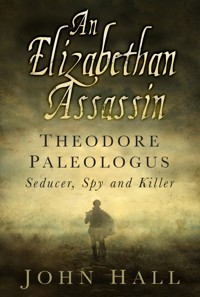
In this first biography of Theodore Paleologus, new documentary evidence exposes him as a hardened mercenary and killer in the pay of the wicked Earl of Lincoln but also supports his imperial pretensions – long dismissed by historians. Yet despite his black record, memorial services are still conducted with imperial honours at Theodore's grave in Cornwall and he now enjoys a new lease of life in fantasy fiction. Award-winning author John Hall traces the extraordinary real lives of Theodore Paleologus and his three sons – from contract killings throughout Europe to fighting one another in the English Civil War, and from buccaneering on the Spanish Main to a pioneering role in the Caribbean slave trade. Their true story is contrasted with parallel lives on the wilder shores of literature which link Theodore to the bloodline of Christ, the biblical End of Days, and a claim to the throne of England. Here, Hall finally separates fact from fable in the patchy history of this legendary but elusive villain.
Sie lesen das E-Book in den Legimi-Apps auf:
Seitenzahl: 430
Veröffentlichungsjahr: 2015
Das E-Book (TTS) können Sie hören im Abo „Legimi Premium” in Legimi-Apps auf:
Ähnliche
















In memoriamJohn Herbert Adams
Author’s note
Except when quoting directly from a source, I have used the spelling Paleologus rather than one of its many variants as this is how it appears on my subject’s memorial. However, I call him Theodore rather than Theodoro because the longer he lived in England, the more frequently this spelling appeared in official records. Similarly, I call his youngest son Ferdinand instead of Ferdinando.
I have kept to the original spelling and punctuation of quoted documents where this gives a flavour of the period without the risk of tiring or puzzling the reader with chunks of archaic language, otherwise I have opted for a modernised form of words.
For the crucial period covered in these pages England lagged behind Europe by observing the Julian calendar rather than the Gregorian, so the English year ran from 25 March instead of 1 January. A document of the affected months would be dated, for example, February 1689/90. Except when quoting directly from such a document, I have adjusted dates to the modern style, in this case February 1690.
Acknowledgements
I am most grateful to the Society of Authors and the Authors’ Foundation for the generous award of the Elizabeth Longford grant which made possible research in Italy and Barbados. A grant from the Cornwall-based ‘Q’ Committee, trustees of the Sir Arthur Quiller-Couch Memorial Fund, helped to fund further researches in England. I must also thank Piers Brendon for his encouragement when few seemed to see the point of a biography of an obscure figure like Paleologus.
Among many distinguished academics who were generous with their time and advice I should mention especially Judith Herrin, Professor of Late Antique and Byzantine Studies at Kings College, London; Robin Law, Professor of African History, University of Stirling; and Professor Jane Stevenson, who combines her educational role at the University of Aberdeen with a successful career as a historical novelist and who kindly tracked down the source of the statement that Ferdinand Paleologus was the inspiration of Magic Realism. Christopher Rowe was an insightful reader of an early draft of sections of this book, and he and Nigel Coulton assisted with the translation of difficult passages of early legal Latin. Two of the country’s leading authorities on early handwriting, Dr David Iredale and John Barrett, most generously analysed the handwriting of Theodore Paleologus, and Chris Scott was similarly unstinting in examining the likely circumstances of the death of Theodore II. These and others with specialised knowledge, sometimes of extremely obscure subjects, were unfailingly helpful.
I thank His Eminence Archbishop Gregorios, Father Gregory-Palamas Carpenter, and the Revd Philip Lamb for their patient assistance with many queries. I thank a luminary of the Church Monuments Society, Dr Julian Litten, for his unrivalled knowledge of seventeenth-century burial customs – it has rightly been said he is the best man in England to take you down into a vault – and I am grateful for his informative comments. Andrew Barrett, historian of Landulph, was a fount of knowledge on the church and parish. The Alabaster Society proved a mine of information on the town of Hadleigh and the Balls family, and I offer special thanks to Laraine Hake and Dr Tony Springall for their generous assistance in searching town records for evidence of the Balls family. John Carras of the Anglo-Hellenic League was most helpful in researching records in Greece.
In Barbados, the collections of the Shilstone Memorial Library proved crucial to my research and I was fortunate to have the assistance of Joan Brathwaite, archivist, and Miguel Pena, the museum’s researcher. At St John’s Church, Angelina Lovell-Johnson was a helpful guide. To Paul Foster, historian of Barbados, serendipitously encountered at the graveside of Ferdinand Paleologus, I am greatly indebted for sharing his encyclopaedic knowledge of the island past and present.
In Italy, the archives of the Oliveriani Library in Pesaro were of central importance and I thank Dr Marcello Di Bella, library director, and his staff, especially Maria Grazia Alberini, for their assistance in identifying documents relating to the Paleologi. Monica Russo was my admirable translator of Italian.
In the United States, I sincerely thank Mr Victor Paleologus for his rewarding and illuminating correspondence composed under the most trying personal circumstances. I always opened his meticulously handwritten letters with keen anticipation. Thanks are also due to Chief Stubbs and Lieutenant Salerno of the Santa Monica Police Department and to Jean Guccione of the Los Angeles District Attorney’s Office.
My thanks also to Dr Christine Faunch, head of Heritage Collections at Exeter University; Angela Broome, librarian archivist at the Courtney Library, Royal Institution of Cornwall; Claire Larkin of the Alumni Office, Oxford University; Steve Edwards of the Foundation for Medieval Genealogy; Sue Kauffman of the Liverpool Record Office; Christine Reynolds, assistant keeper of muniments at Westminster Abbey Library; Enid Davies, assistant archivist at St George’s Chapel, Windsor Castle; Alan Barclay of the Plymouth and West Devon Record Office; Jon Culverhouse, curator of the Burghley House collections; Ray Biggs of the Grimsthorpe and Drummond Castle Trust; Rachel Lacy, editor of Orders of the Daye, the journal of the Society of the Sealed Knot; Mrs Dymoke of Scrivelsby; the Revd Gordon Plumb; Mr Colin Squires of Saltash Heritage.
I am indebted to Dr Garry Tregidga, senior lecturer at Exeter University and assistant director of the Institute of Cornish Studies, and Sarah Jayne of Academic Services, University of Exeter: to Sarah I owe a special word of thanks for unearthing the long-mislaid collection of Canon Adams’s manuscripts and letters from a mass of uncatalogued material at the University’s Tremough campus. That inspired search saved months of labour.
Kind assistance was provided on many occasions by staff at the British Library (in particular the manuscript reference team), National Archives at Kew, Lincolnshire Archives, Lincolnshire County Libraries, Courtney Library in Truro and the Public Library and Morrab Library in Penzance.
At The History Press, my thanks to Mark Beynon and Naomi Reynolds.
To my wife Lilian, thanks and much love.
Finally I formally acknowledge my debt to the late Canon John Herbert Adams. The results of his investigations provided the early framework for this book and will remain the starting point for any future biographer of the English Paleologi. That indispensable body of knowledge was itself based on pioneering research by his distant predecessor as incumbent at Landulph, the Revd Francis Jago Arundell, who began his enquiries into the mysterious Paleologus before even the penny post was at his disposal. It is humbling to reflect how few are my own discoveries despite such present-day advantages as the infinite archives of the internet and cheap jet travel.
I must, of course, add that responsibility for any errors, mistaken conclusions, misreading of ancient documents and wild surmises is entirely my own.
Contents
Title
Dedication
Author’s Note
Acknowledgements
Prologue
An Elizabethan Assassin
Chapter 1
Chapter 2
Chapter 3
Chapter 4
Chapter 5
Chapter 6
Chapter 7
Chapter 8
Chapter 9
Chapter 10
Chapter 11
Chapter 12
Chapter 13
Chapter 14
Chapter 15
Chapter 16
Chapter 17
Chapter 18
Chapter 19
Chapter 20
Chapter 21
Epilogue
Appendix A
Appendix B
Appendix C
Bibliography
Picture Credits
Plates
Copyright
I hear new news every day, and these ordinary rumours of war, plagues, fires, inundations, thefts, murders, massacres, meteors, comets, spectrums, prodigies, apparitions, of towns taken, cities besieged, in France, Germany, Turkey, Persia, Poland, etc., daily musters and preparations and suchlike, which these tempestuous times afford, battles fought, so many men slain, monomachies, shipwrecks, piracies, and sea-fights, peace, leagues, stratagems, and fresh alarms … Now come tidings of weddings, maskings, mummeries, entertainments, jubilees, embassies, tilts and tournaments, trophies, triumphs, revels, sports, plays: then again, as in a new shifted scene, treasons, cheating tricks, robberies, enormous villainies in all kinds, funerals, burials, deaths of Princes, new discoveries, expeditions; now comical, then tragical matters.
Robert Burton, The Anatomy of Melancholy, 1621.
Claimed Descent of the English Paleologi
Prologue
Mighty, indeed, were these Paleologi: mighty in power, dignity, and renown; yet within less than two centuries from the heroic death of the Emperor Constantine, their direct descendant, Theodoro Paleologus, was resident, unnoticed and altogether undistinguished, in a remote parish on the Tamar.
Sir Bernard Burke, Vicissitudes of Families.
Remember that what you are told is really threefold: shaped by the teller, reshaped by the listener, concealed from both by the dead man of the tale.
Vladimir Nabokov, The Real Life of Sebastian Knight.
It has become commonplace to describe any new study of a historical character as a detective story. This investigation of Theodore Paleologus is the first biography of an exotic yet elusive figure who surfaced in mysterious circumstances in Elizabethan England. It is certainly a detective story of sorts, and one that brims with murders, treasons, revels, battles, sieges, tournaments, forgeries, piracies, cheating tricks, burials and much more that we find listed among the Anatomist of Melancholy’s ‘enormous villainies in all kinds’. But proof positive of the crimes of Theodore Paleologus is now beyond mortal grasp and we might as easily call his life a legend, morality tale or horror story.
Let us start with the legend.
At the fall of Constantinople on Tuesday, 29 May 1453, an event which burst like a thunderclap over the Christian world, the last emperor of Byzantium died valiantly sword in hand, defending his capital against the Muslim invader. Constantine XI, of the ancient family of Paleologus, left no direct heir, and his only brother to reach safety in the west was Thomas, known by his resounding Byzantine title of Thomas the Despot. Recognised by the pope as emperor-in-exile, Thomas died in Rome twelve years later, and of his sons – there were two, three or four of them, depending on which authority you believe – only the youngest, John, left heirs male. The single family of the bloodline to survive into the next century made their home in the Adriatic port of Pesaro, but during the 1570s they were embroiled in a disastrous vendetta. The sole survivor was the subject of this history, the then teenaged Theodore Paleologus, last of the legitimate imperial blood.
Banished from Pesaro, Theodore wandered round Europe and after a spell as a soldier of fortune ended up in England. Here he married a gentlewoman who bore him sons, three surviving into adulthood. A revered, white-bearded figure in old age, Theodore Paleologus died in 1636 at a manor house in Cornwall leaving his illustrious pedigree recorded on a small memorial brass in the parish church. The bloodline of Paleologus must have seemed secure, so far as those tempestuous times allowed. But all three sons fought in the English Civil War, one dying in the king’s cause and one in Cromwell’s. The surviving brother fled to the new colony of Barbados, married there and left a son, another Theodore, who returned to England and became a sailor. This Theodore, the third generation to marry an Englishwoman, died in 1693. His only child was a posthumous daughter who died in infancy, the last representative of the imperial line.
There is a poignant postscript to this tale. Over a century later, during the Greek War of Independence, the provisional government in Athens sought vainly in Cornwall and Barbados for a descendant of Theodore who would accept the crown of Greece and chase the infidel from Constantinople.
Thus far the legend, yet it is also essentially a factual account of the English dynasty of Paleologus which was accepted by respected historians until recent times. As late as 1940 Sir Stanley Casson wrote of Theodore as ‘the last recorded heir to the throne of Byzantium’, and similar assertions are scattered through scholarly works dating back two centuries and more.1 Disobligingly, historians of the present day tend to dismiss Theodore’s claim out of hand, though so far as I am aware without benefit of original research. Chief of the iconoclasts is Sir Steven Runciman, in whose famous book on the fall of Constantinople a single reference to the English family occurs in a footnote: ‘The pathetic double eagles carved (sic) on the tomb of Theodore Palaeologus in the church of Landulph in Cornwall have, regrettably, no business to be there.’ The clinching evidence for the modernists is that no son of Thomas the Despot called John is mentioned by the contemporary chronicler George Sphrantzes, a survivor of the Ottoman conquest. Alone among recent writers, the philhellene and arch-romantic Sir Patrick Leigh Fermor sounds a sympathetic note. Although admitting a ‘shadowy’ quality about the youngest son of Thomas, he says that if the authenticity of John is accepted, there are no grounds for doubting our Theodore’s ancestry: ‘Among his compatriots and contemporaries, at any rate, his Imperial descent was never questioned.’ It is an argument that leaves the sceptics unmoved.
The Landulph monument has excited much curiosity over the years. The bold statement that ‘Here lyeth the bodye of Theodoro Paleologus of Pesaro in Italye descended from ye Imperyall lyne of ye last Christian Emperors of Greece’ comes as an unexpected, not to say stirring, sight in a lonely Anglican church. And while no life of Theodore has been published before, his legend has inspired a remarkable number of works of fiction from the early nineteenth century to the present day. The Edwardian author Sir Arthur Quiller Couch penned a novel based on a local tradition that Theodore sired a race of dashing Cornish squires; he also wrote a weird novella with a plot revolving around Theodore’s progeny, occult secrets and rebirth over many centuries. Thomas Hardy visited Landulph Church in the 1880s and carefully copied the tomb inscription into the notebook in which he jotted ideas for novels, stumbling on the germ of the plot for Tess of the D’Urbervilles. Several romantic novels and a murder thriller have appeared in recent times in which Theodore features either as a protagonist or the ancestor of the principal character. I have also traced a lengthy Regency ballad and a First World War play about him. A complex mythology continues to evolve and the Paleologus story has even been identified as the source of the Magic Realism genre in modern literature.
These are some of the many afterlives of Theodore Paleologus, a chain of ever more fantastic reincarnations. Like Dr Who, the same man can be endlessly rearranged in time and space. To a novelist or poet, he can be a once and future king, a swashbuckling adventurer, a demon lover, a son of prophesy awaiting the appointed hour, or a kind of Wandering Jew or Flying Dutchman figure; in one recent book he is revealed as the ancestor of the rightful, black-skinned queen of England. His spirit strays deep into Da Vinci Code territory, wafting in and out of the Priory of Sion and the Rosslyn Chapel, whispering of global conspiracies, hermetic numbers, the bloodline of Christ and the End of Days. He is a kind of all-purpose deus ex machina.
My initial aim in writing this book was to separate fact from fiction. Was the man buried in that quiet spot in Cornwall a genuine heir to the Byzantine emperors or an imposter? As my researches progressed, I grasped that much which seemed fanciful in the legend is firmly rooted in fact. Searches in Italian archives, following the discovery of a long-lost box of Paleologus papers in an English university storeroom, were added excitements to my quest. So far as his imperial lineage goes, a fair body of documentary evidence can now be presented which should help decide the issue in the reader’s mind. Yet the more I unearthed of my subject’s story, the more beguiling his personality appeared and the wider the focus of my investigation. For if the man was an imposter, fraud would be among the lesser offences on the charge sheet against him.
Briefly stated, the Theodore Paleologus I shall portray here is a multiple murderer, mercenary, apostate, seducer and spy – a real-life figure with all the sinister glamour of the fictional characters inspired by his legend. Yet the defence may easily present him in a sympathetic light, stressing his roles as paterfamilias, asylum-seeker, freedom-fighter, expert linguist, acclaimed horseman and classical scholar.
His years in England bridge the late glories of the Elizabethan age and the chronically unsettled times before the Civil War, and among the dramatis personae flitting in and out of his story are some of the most dazzling characters of the times, from Sir Philip Sidney to the Duke of Buckingham, from the poet-diplomat Sir Henry Wotton to Prince Maurice of Nassau. We meet two ill-starred Earls of Essex and assorted Bacons and Cecils; we see Theodore reading Machiavelli with the colonist Captain John Smith; we picture him in the company of the historical Tom Thumb and the leading candidate as Shakespeare’s Dark Lady.
But all his life he felt a magnetic pull towards very bad men, for time and again we find him intimately involved with some of the most notorious, vicious and corrupt figures of the age. And as he disappears from sight on frequent occasions, almost certainly under an alias, it seems perfectly possible that Theodore is also known to history with a completely different identity, with deeds known only to the Recording Angel. As it is, this story must be an epic assembled from scraps.
What we can trace of his wanderings show him as a restless soul. Following the banishment from Pesaro, we have fleeting glimpses of him pursuing a double career throughout Europe as soldier of fortune and contract killer. There is a claimed appearance on the Aegean island of Chios, where he may or may not have married another woman before taking his English wife. Once he emerges in England, he ranges north, east, south and west – popping up in Yorkshire, Lincolnshire, London, Devon and finally Cornwall – though with frequent absences supposedly spent fighting for the Protestant cause in the Low Countries. In between are blank periods when we simply do not know his whereabouts. Now you see him, now you don’t, and all that lingers is a faint whiff of sulphur. Yet even his Cornish burial, in the honoured place next to the altar, is not our final sighting, for there is the macabre touch of the opening of his coffin a century and a half after his death, revealing the body in a perfect state of preservation.
Theodore’s story is still running. On 18 April 2007, a large coach cautiously negotiated the narrow country lanes leading to Landulph, halted outside the ancient granite church and disgorged fifty black-robed Greek Orthodox priests. Inside, the Paleologus monument was draped with silk ribbons of the Greek colours with the Byzantine eagle flag displayed above it. Led by Archbishop Gregorios, head of the Orthodox community in Britain, senior clerics exchanged their sober garb for sumptuous embroidered vestments to celebrate vespers in honour of the heir of the Paleologi. Candlelight flickered on golden icons on the altar, chants rose and fell, and clouds of incense drifted past the massed bushy beards.
This strange evocation of Byzantium in a simple Cornish church was witnessed by a handful of bemused locals squeezed along the rear pews, peering over rows of black stovepipe hats. It was explained to me afterwards that the ceremony was not technically the full Orthodox memorial rite, in deference to the imperial scion’s conversion to the Church of England. I suspected the shade of Theodore was chuckling softly at such scruples, and it was then I knew this book had to be written. For here was a most striking demonstration of how the name Paleologus continues to exert its power over the imagination.
Byzantium has a deep spiritual significance for the Greeks and the Eastern Church, but there is a strong English interest in the vanished empire. Constantine the Great, founder of Constantinople, was proclaimed Caesar by the Roman army at York, and in the deep layers of ancient British myth Constantine’s mother was an Englishwoman, daughter of the King Coel immortalised in the nursery rhyme. King Arthur was the claimed grandson of Constantine and was himself the claimed ancestor of the Tudors.
There is no lack of present-day pretenders to the imperial bloodline. Anyone with access to the internet is free to roam their airy realms. Paleologus is a brain-turning name, and as claimants in cyberspace range from the mildly delusional to the barking mad it is a dreamlike experience to wander through their mazy pedigrees, only to find each and every claim of descent ridiculed by some spoilsport genealogist on a rival website. There is also a recurring element of the criminal. Now and then a self-declared imperial heir will materialise to offer you a Byzantine coat of arms or title for a financial consideration, only to exit fast when the police or press come knocking.
Others have at least a half-respectable claim to Paleologus blood and some of these will be examined later. The Constantine link with the British royal family may be risible, but the future King Charles III inherits Paleologus blood twice over, from his mother’s forebears and his father’s. My chapter on Victor Paleologus, the only living, breathing bearer of the name to feature in this book, does not yet present a formal claim, as Mr Paleologus is currently researching his imperial descent from a cell in Chino State Prison in California, where he is serving a term of twenty-five years to life for murder. Mr Paleologus tells me of a strong family tradition of ‘intricate connections’ with the dynasty, though he accepts that establishing ‘the constructive link’ will demand further investigation.
With the single exception of Victor Paleologus, claims of imperial descent are traceable through female lines. The pedigrees of all other pretenders twist and turn and shift sideways in the ingenious manner of the Windsor descent from William the Conqueror. If we seek the last heirs of the imperial Paleologi in direct male line, it is Theodore’s English family or nothing.
This book examines the strange and sometimes shocking history of Theodore Paleologus, his pedigree from the mysterious John and of his own descendants up to their extinction – or supposed extinction – a century after his arrival in England. Before tracing these generations in detail, however, we must begin with an overview of Byzantium’s last ruling line, a dynasty founded on assassination, heresy and treason. A chronicle of cruel deeds and dark secrets, it seems a fittingly lurid backcloth to the tale of Paleologus of Landulph.
1
Talk to me, my lords,
Of sepulchres and mighty emperors’ bones.
Thomas Middleton, The Revenger’s Tragedy.
For most of us Byzantium is a hazy concept. Anyone of my own post-war generation might easily envisage an Egyptian or Roman of ancient times, if only by courtesy of Cecil B. De Mille, but the Byzantine was a figure shrouded in mystery. Many must have heard the name of his empire’s great capital for the first time when taxed with the simple playground riddle:
Constantinople is a very long word – if you can’t spell it you’re the biggest dunce in the world.
The Byzantines were absent from history lessons at my grammar school; John Julius Norwich, best-known of the modern historians of Byzantium, has made the same point about his schooling at Eton. For a teenager, a next fleeting brush with the civilisation might have come on reading Sailing to Byzantium, with Yeats’s sensuous lines offering an illusory moment of empathy where history had failed, in images of hammered gold and gold enamelling, a drowsing emperor, and an artificial bird singing on a golden bough:
To lords and ladies of Byzantium
Of what is past, or passing, or to come.
Our present use of the word byzantine as a synonym for the excessively complex, tortuous or duplicitous serves to distance us further from a proud Christian empire that lasted over 1,000 years. It may not be too fanciful to discern the origin of this detachment in a collective Western guilt over the conquest of Constantinople by Islam.
Constantinople was founded in the year 330 by Constantine the Great, the first Roman emperor to convert to Christianity. For the site of his New Rome he chose an established Greek settlement called Byzantion, located on the Bosphorus where east meets west. Like Old Rome, his city was built on seven hills. Drawing on legacies of the classical world, it became the centre of an empire which at its zenith was by far the greatest power on earth, ruling over present-day Greece, North Africa, Egypt, the Holy Land, the islands of the Mediterranean, much of Italy, the Balkans and Asia Minor – in all, the empire encompassed the territories of thirty-four of today’s nation states. Constantinople was renowned for its fabulous wealth, sublime art and unrivalled tradition of learning; above all, from the seventh century to the fifteenth, it was Christendom’s bulwark against an ever-expanding Islam. The city survived repeated sieges by the Arabs and the empire’s most formidable foes of latter centuries, the Ottoman Turks.
Constantine ruled both Old and New Rome, but in 395 the empire was divided between his descendants. Less than a century later, Rome was overrun by barbarians. The emperor in Constantinople was sole ruler of what remained, and during the next golden age, the reign of Justinian the Great, many lost territories of Old Rome were regained. But the empire was constantly assailed by enemies on all fronts – not only Ottomans, but Persians, Slavs, Normans, Huns, Bulgars, Venetians and a host of others – and repeatedly fragmented by civil wars. In the meantime the empire’s character changed from essentially Latin to Greek, though to the end its subjects persisted in calling themselves Romans.
The vast all-powerful Byzantine Empire was a distant memory by the time of Michael Paleologus, founder of the last imperial line and claimed ancestor of the man buried in Landulph Church. In 1204, twenty years before Michael’s birth, Constantinople had been captured and sacked, not by Turks but by so-called crusaders – Latins, as the Byzantines called everyone from Western Europe. Dazzled by the enormous wealth they saw en route to the Holy Land, which like so much of the former empire was now in Muslim hands, they realised that Constantinople offered easier pickings. With the great city in ruins and its treasures plundered, a Latin usurper was proclaimed emperor; much of the Greek mainland was carved up between rapacious followers who proceeded to call themselves counts, dukes and princes.
With their empire on the verge of total collapse, the Byzantine emperors-in-exile retreated to the ancient city of Nicaea across the Straits of the Bosphorus, forty miles from the old imperial capital. The short-lived dynasty of that period, the Lascaris, was soon supplanted by the Paleologi. And it must be said that all our negative and sensational associations with Byzantine history – assassinations, plots, arcane ceremony, unbridled greed, cruelty, treachery, hypocrisy and love of ostentatious display – may justly be linked with the Paleologan era.
Though a usurper, Michael Paleologus was no upstart. The Paleologi were among the empire’s great aristocratic families, counting among their ancestors no fewer than eleven emperors of earlier times. The theoretical succession from the Caesars was maintained. Paleologus – the Greek name means ancient word – was the most talented general serving the Lascaris, but their relationship was always fragile.
Emperor John III, an epileptic, managed to recapture considerable territory from the Latins, but grew jealous of Michael’s prowess as a soldier. John’s son and successor, Theodore II, was even more suspicious of the general. At one time Paleologus was so convinced he was in mortal danger from the emperor that he defected to the Turks, then busily mopping up yet more sorry remnants of the empire. But again the quarrel between emperor and general was patched up.
When Theodore II died leaving an eight-year-old successor, John IV, the looming thundercloud burst. During a memorial service for the dead ruler, the child emperor’s appointed regent was hacked to pieces at the high altar. The outrage was almost certainly on the orders of Michael Paleologus, who soon afterwards proclaimed himself co-emperor. The fate of a child monarch was rarely a happy one and on Christmas Day 1261 the wretched boy’s eyes were put out – along with castration, blinding was a favourite Byzantine method of dealing with rivals – and he was locked up for the rest of his life. As Michael VIII, the first Paleologus ruler assumed the sonorous title of his predecessors, Basileus Basileon Basilieuon Basileonton, King of Kings ruling over Kings, and signed his name in royal red ink: ‘in Christ, true Emperor and Autocrat of the Romans, Vice-Gerent of God on earth, Equal of the Apostles’. He is known to history as Michael the Crafty. The first emperor to adopt the emblem of the double-headed eagle which looks east and west, he was by far the ablest of his line and is best remembered for recapturing Constantinople.
In 1261, following a series of victories against the Latins, Michael entered the Queen of Cities by the Golden Gate. With a display of piety calculated to impress the citizens, he is recorded as appearing humbly on foot behind Byzantium’s holiest icon. However, it is axiomatic that any Byzantine source is contradicted by the next, and another account has him entering in triumph on a magnificent white horse. Either way, Michael’s popularity was short-lived. Taxes rose steeply to finance a lavish rebuilding of the city and an imperial navy. Disgusted by the fate of the boy emperor, the patriarch of Constantinople excommunicated Michael, who responded by deposing the patriarch. But it was a more radical act which turned the majority of Byzantines against their ruler.
The schism between Orthodoxy and the Roman Catholic Church dated back to 1054. The mutual hatred between the Eastern and Western traditions intensified during the Latin reign in Constantinople, where many of the emperor’s subjects regarded the rival Christian faith as a worse enemy than Islam. Once in power, Michael schemed for a reunion of the two churches – not through religious conviction, but as the means of winning papal support against his Catholic foes. Michael’s promised submission to Rome enraged the powerful Orthodox clergy, but protest in Constantinople was crushed without mercy. Michael was not a man to cross and opponents escaping death faced exile, imprisonment, torture or mutilation. The simmering resentment of the Orthodox hierarchy was to dog the emperor for the rest of his reign, and in the end all his machinations came to nothing. Negotiations with Rome dragged on for twenty years with one pope after another until a newly elected pontiff, Martin IV, finally lost patience. He pronounced a sentence of excommunication on Michael, to add to that issued by the patriarch. ‘The usurper Paleologus’ was now fair game to any Catholic rival who wanted the Byzantine crown for himself.
The most serious challenge came from the French king’s brother, Charles of Anjou. A huge French army was assembled in Sicily, formerly Byzantine territory but now one of the many possessions that Charles ruled with a rod of iron, along with the armada needed to carry it to Constantinople. The army was on the point of sailing when, on the evening of Easter Monday, 1282, outside the church of the Holy Spirit in Palermo, a tipsy French soldier molested a local girl. As the bells tolled for vespers, an infuriated crowd fell upon the soldier and his companions and killed them all. It was a strike of lightning that set the entire island on fire. Soon every Frenchman in Sicily had been slaughtered by the vengeful Sicilians, excepting a handful who managed to scramble on board Charles’s ships. The greatest threat to Michael’s reign was wiped out overnight.
How far Michael was responsible for the extraordinary incident known as the War of Sicilian Vespers is disputed, but he was not slow to claim the credit: ‘If I dare to say that God did it by my own hands,’ he wrote, ‘I would only be telling the truth.’2 For months his secret agents had been diligently at work among dissidents in Sicily, freely dispensing Byzantine gold.
But within a year Michael VIII was dead. Exhausted by a life of campaigning, excoriated as a heretic by both churches, he left a near-bankrupt empire. Doubly damned, denied Christian burial, he was laid in a shallow grave at dead of night by his son and successor, Andronicus II. Only years later did Andronicus dare to give his father a quiet burial in holy ground, and when the body was dug up it was found in a perfect state of preservation. The scene strangely foreshadows the discovery of the body of Theodore Paleologus some 500 years later in Cornwall. In popular belief – though a paradox – it was only the most saintly and most evil whose bodies were incorruptible. After Michael’s exhumation, the legend arose that the earth itself had refused to take back a man so wicked.
The reign of Michael the Crafty set the tone for generations to come and would find echoes in the lives of Theodore Paleologus and his English brood. Recurring motifs in the family’s history are conspiracy, murder, treachery, apostasy, enforced abdication, denied burial, perjury, seduction, forgery and extortion. And, almost constantly, there was war between the generations – father against son, grandfather against grandson, brother against brother.
The strife between Michael’s successor Andronicus II and his grandson serves as an illustration. Andronicus II was the longest-reigning of the Paleologi and perhaps the unhappiest. No soldier like his father, he would have made a better monk, and during his forty-six years as emperor most of Asia Minor was lost forever. But it was the family that proved the curse of his life. When his grandson and heir, the eventual Andronicus III, suspected his mistress of infidelity, he decided to trap his rival by stationing thugs in an unlit passage near her door. Unfortunately the man they pounced on and beat to death in the dark was Andronicus’s younger brother, Prince Manuel, the emperor’s favourite, whereupon Emperor Andronicus disinherited his namesake. Years of costly civil war ensued until the humiliated emperor, at the age of seventy, was forced to abdicate and beg his grandson for his life.
Family hostilities resumed when Andronicus III died in 1341 leaving an eight-year-old heir, John V. A bitter six-year power struggle was waged between the regent, Andronicus’s widow Anne, and the dead ruler’s bosom friend and cousin, John Paleologus Cantacuzenus, who declared himself ‘spiritual successor’ of Andronicus and therefore rightful co-emperor as John VI. Aided by the empire’s wily enemies, the Turks and the Serbs, Cantacuzenus eventually proved victorious. To consolidate his claim he agreed to share the throne with the legitimate heir, now fourteen, who was married off to one of Cantacuzenus’s daughters. In the meantime thousands had died in clashes between the contending Byzantine armies or at the hands of foreign mercenaries. Part of the price Cantacuzenus paid for Turkish aid was the despatch of another daughter to the sultan’s harem.
On entering Constantinople the conqueror discovered the imperial treasury contained ‘nothing but air and dust’. Desperate for funds, Empress Anne had pawned the crown jewels and imperial plate to the Venetians. So at their solemn joint coronation as Johns V and VI in 1347, the co-emperors’ crowns were of gold-painted leather studded with bits of coloured glass. The ceremony could not be held as tradition demanded at the Church of the Divine Wisdom, Haghia Sophia, because the great dome had collapsed during a recent earthquake. That same year, as a crowning misery, the Black Death made its European debut in Constantinople, wiping out half the population.
Inevitably, war broke out again between the two emperors, young John V gaining the upper hand with the aid of the Genoese. There now occurs one of the few uplifting episodes in the Paleologus saga. John V allowed his defeated father-in-law to live on condition he took monastic vows, and the former John VI entered the most enriching period of his life. Finding his true vocation in the cloister, he filled a fruitful retirement with meditation and theological studies, though he was frequently called back to court as elder statesman and counsellor to his former rival. He was to die peacefully in his bed aged eighty-eight.
However, there was one hiccup. The three-decade idyll in the monastery was interrupted when the ex-emperor was seized as a hostage by his own grandson, another Andronicus – son of his daughter Helena and John V – and cast into prison. Andronicus was the latest Paleologus to rebel against his father, and with Turkish and Genoese help he took John V prisoner and locked him up. The hapless John had brought about his own downfall by touring Christendom in a fruitless search for allies against Islam. In Rome, he followed his ancestor Michael the Crafty in announcing his conversion to Catholicism, to the horror of Constantinople.
The next emperor of significance was Andronicus’s brother, the intellectual Manuel II, who has demonstrated that the name Paleologus can invoke fury across the Islamic world to the present day. As Manuel’s reign saw the Turkish conquest of most of his remaining lands, an agonisingly long if unsuccessful siege of Constantinople, and the slaughter, enslavement or forced conversion of countless thousands of his subjects, he might not be expected to take a rosy view of the founder of Islam. ‘Show me what Mohammed brought that was new,’ he wrote to a Persian scholar, ‘and there you will find things only evil and inhuman such as his command to spread by the sword the faith he preached.’3 Quoted by Pope Benedict XVI in 2006 during a university lecture, the fourteenth-century emperor’s musings led to mass street protests and riots, calls for the pope’s assassination and a unanimous condemnation by the Pakistani parliament, along with murders of Christians and the firebombing of churches.
Manuel was the first Byzantine emperor since Constantine the Great to visit England, during his own futile begging tour of Europe. In 1400 he met the new king, Henry IV. The chronicler Adam of Usk recorded the spectacle of the dignified but impoverished emperor at King Henry’s court: ‘I thought within myself, what a grievous thing it was that this great Christian prince from the farther East should perforce be driven by unbelievers to visit the islands of the West, to seek aid against them. My God! What dost thou, ancient glory of Rome? Shorn is the greatness of thine empire this day.’
The scholarly John VIII, Manuel’s son and successor, is the only Paleologus emperor of whom we have reliable portraits. A bronze medal by Pisanello shows him in profile, and in Gozzoli’s famous fresco in the Medici Chapel at Florence he is one of a trio of contemporary grandees represented as the Magi. Here John is the image of a Renaissance prince, though with a dash of the exotic: astride a magnificent white horse in gold trappings, he wears a sumptuous tunic of gold-embroidered green and the traditional red boots of the Byzantine emperors, while on his head is a fantastic crown of gem-studded gold enclosed by waving feathers. Whether his crown was mere paint and glass we do not know. The fresco dates from around twenty years after John’s visit to Italy, but if Gozzoli did not himself set eyes on the emperor he would certainly have cross-examined many who did, and may well have studied portraits then extant. Gozzoli’s John is a strikingly handsome man of kingly bearing, his long face framed by thick curly hair and neatly trimmed beard of auburn. Pisanello’s profile shows an older, careworn man with the kind of long aquiline nose which would be observed at the opening of Theodore Paleologus’s coffin in Cornwall.
Other portraits of Paleologus emperors follow Byzantine tradition, and instead of studies from the life we have icon-like images representing the essence of royalty rather than human beings. One beard may be a little longer or greyer than the next, but otherwise the emperors are a row of solemn look-alikes, each in his stiff bejewelled robes and the elaborate semi-spherical crown which distinguishes a ruler of Byzantium. The late flowering of Byzantine art under the Paleologi did not extend to a new take on portraiture as pioneered in contemporary Italy.
Discussing the physical appearances of these imperial figures brings me to a central challenge in writing a biography of this kind. Readers want to put a face to any character claimed as worthy of their interest. Alas, I have no portrait to offer: bizarrely, the only detailed description of my subject’s appearance dates from long after his death. Nor do I see any prospect of his long-forgotten picture turning up in some dusty corridor of a country house, no Unknown Man circa 1600 whose identity will be revealed as layers of grime are wiped from a coat-of-arms or riddling motto. The mind’s eye must fill the void, taking as a starting point an uncommonly tall soldierly figure and a long-nosed, fine-boned face owing something to the ancestral line.
Despite the glamorous image reflecting his youthful visit to Italy, John VIII was one of the few emperors to inherit none of the obvious characteristics – vaunting ambition, cruelty, martial prowess and cunning statesmanship – of the founder of the dynasty. He was worthy and a little dull. His younger brother and successor Constantine XI, destined to be the last of the ninety emperors of Byzantium, was a man of a very different stamp.
History has not been kind to the name Paleologus. The dynasty is inescapably linked with the empire’s decline and fall, though the die was cast long before its founder’s time. But the tragic and heroic figure of Constantine XI4 redeems the Paleologi, and to the present day his legend is an inspiration to countless Greeks. He is the sacred emperor, not dead but sleeping, the figure of prophecy who will reappear at the appointed hour.
Constantine took pains to avoid the deadly family quarrels which had blighted his forebears. Long before succeeding John VIII, he promised to be the longed-for leader who would reclaim the empire, and in early years had successfully waged war on the petty Latin rulers clinging on in mainland Greece. But the victories ended in 1444 when the Italian duke of Athens allied himself to the Byzantines’ nemesis, the Ottoman sultan. Thereafter Constantine was constantly on the defensive. As well as his outside enemies, he had much to contend with from his two remaining brothers, Demetrius and Thomas, who shared the title of despot of the imperial fiefdom called the Morea, better known today as the Peloponnese. Of Thomas, there is more to be said later.
For eight centuries Muslims dreamt of conquering Constantinople, ‘the bone in the throat of Allah’, yet though they overran virtually every corner of the empire, all their previous twenty-three sieges of the city had ended in failure. They had never equalled the feat of the crusaders. But a ruthless new sultan, Mehmet II, was obsessed with taking Constantinople, and at the age of twenty-one he made his bid.
After a five-week siege the final assault began in the early hours of 23 May 1453. The advantage swung back and forth between attacker and defender as desperate fighting shifted to different points around the city walls, and the moment of crisis came when the leader of the Byzantines’ Genoese allies was grievously injured and carried from the ramparts. His loss caused panic among the defenders and the Genoese rushed for their boats. Byzantines who followed the emperor into the gap tried to hold off the invaders but were quickly overwhelmed.
Estimates of the combatants involved differ wildly though no one has ever doubted that Mehmet’s forces vastly outnumbered Constantine’s. The emperor’s chancellor survived the fall of the city and recorded the total number of defenders – Byzantines and their allies – as less than 8,000. The Muslim host has been calculated as anything up to 400,000, though modern historians trim this down to perhaps 200,000 including camp followers. Whatever the odds, the outcome was inevitable. The fall of the city brought to an end not only the Byzantine world dating from the fourth century but an empire whose origins could be traced to the founding of Rome in 753 BC.
All accounts of Constantine’s death were based on hearsay, though the Greek world has never doubted his end befitted a hero and martyr. Several reports say that when he realised all was lost, the emperor threw off everything that could identify him, hurled himself into the enemy ranks, and was cut down instantly. However, he had forgotten about his red boots embroidered with golden eagles, and these gave him away when the bodies of the dead were looted.
According to one story, the sultan had his head cut off and paraded around the city on a stake, then sent as a present to the sultan of Egypt. One highly suspect source has Mehmet weeping at the sight of his dead adversary and ordering an honourable Christian burial at Haghia Sophia, while another says Constantine hanged himself the moment the Turks broke through the city’s defences. One of the surprisingly few Ottoman accounts claims he was fleeing in terror when felled by a Turkish marine. One or two sources even say he made his escape from the city by boat. But the most persistent theme is that Constantine displayed sublime courage, unhesitatingly choosing to die rather than abandon the imperial city.
No one really knows what happened to his body. The legend quickly arose that an angel snatched him away to sleep in a deep cavern under the Golden Gate until the day he will rise again to free his people. It is a variant of the universal legend of the sleeping hero, a Greek equivalent of Britain’s Arthur, Owen Glendower or Fionn mac Cumhaill. All appear to derive from the ancient tale of the Seven Sleepers of Ephesus, the Christian youths who fell asleep in a cave during the Roman persecution and woke centuries later in the Christian empire.
All surviving tombs of the emperors were destroyed. Their favoured burial place was not Haghia Sophia but the Church of the Holy Apostles where Constantine the Great himself was interred. Crusader knights had smashed and looted their resting place two and a half centuries before, departing with a great haul of gold and jewels. Among the treasures of St Mark’s in Venice is a gold crown torn from one of the bodies cast out like so much rubbish. The Turks evicted the last scraps of imperial dust, determined that no place of pilgrimage would remain; Mehmet demolished the church itself to make way for the mosque which would house his own tomb. All that remain today are a few empty battered sarcophagi carved from the porphyry reserved for imperial use, transported to the environs of Haghia Sophia or the Istanbul Archaeological Museum, inevitably recalling the words of Hamlet:
To what base uses we may return, Horatio! Why may not imagination trace the noble dust of Alexander, till he find it stopping a bung-hole?
More fortunate than the emperors, the English Paleologi have left us three tombs to visit, though none has remained undisturbed. The earliest and historically most important is that of Theodore at Landulph with the ancestral names set out on the monument like an incantation: besides those of the commemorated man, his wife and father-in-law, the others are of six direct ancestors and five descendants.
In full, the inscription reads:
HERE LYETH THE BODY OF THEODORO PALEOLOGVS
OF PESARO IN ITALYE DESCENDED FROM YE IMPERYALL
LYNE OF YE LAST CHRISTIAN EMPERORS OF GREECE
BEING THE SONNE OF CAMILIO YE SONNE OF PROSPER
THE SONNE OF THEODORO THE SONNE OF JOHN YE
SONNE OF THOMAS SECOND BROTHER TO CONSTANTINE
PALEOLOGUS THE 8th OF THAT NAME AND LAST OF
YT LYNE YT RAYGNED IN CONSTANTINOPLE VNTILL SVB-
DEWED BY THE TVRKS, WHO MARRIED WITH MARY
YE DAUGHTER OF WILLIAM BALLS OF HADLYE IN
SOVFFOLKE GENT: & HAD ISSUE 5 CHILDREN THEO-
DORO, JOHN, FERDINANDO, MARIA & DOROTHY, & DE-
PARTED THIS LIFE AT CLYFTON YE 21st OF JANVARY 1636.
Tracing down the generations to the man buried at Landulph, we begin with an account of the last emperor’s brother Thomas, last of the despots.
Notes
1 Casson, Sir Stanley, Greece and Britain, Collins, 1940.
2 Runciman, Steven, The Sicilian Vespers, Cambridge, 1958.
3 The Pope was quoting from Twenty Six Dialogues with a Persian, translated by Professor Theodore Khoury, in an article for Sources Chretiennes, n 115, Paris, 1966.
4 The numbering of the emperors sometimes differs depending on whether an individual was recognised as legitimate or not. Thus Constantine XI may be referred to as VIII, as on the tomb of Landulph.
2
They are the abstract and brief chronicle of the time: after your death, you were better have a bad epitaph than their ill report while you live.
Shakespeare, Hamlet.
Sometime late in the summer of 1460, seven years after the fall of Constantinople, a Venetian galley tied up in the Adriatic seaport of Ancona with a party of weary, seasick and impoverished Byzantine exiles on board. The remnants of the imperial family, they had fled before a Turkish onslaught against the last imperial outposts on the Greek mainland, braving waters infested with enemy warships to reach this place of safety.
The leader of the fugitives was Thomas Paleologus, brother of the slain emperor, and among his companions were his young sons: how many he fathered has long been disputed, but if the John named on the Landulph brass is no fiction there must have been at least three. During his futile defence of the Morea, the last despot had fought not only Turks but his treacherous brother Demetrius. Having thrown in his lot with the sultan, Demetrius forfeited any claim to the succession. Contemporaries who were fond of seeing living characters as the incarnation of figures of antiquity would call Demetrius and Thomas the new Cain and Abel, though the new Abel’s destiny was a living martyrdom.
Thomas was now the sole survivor of five brothers of the emperor. He arrived in Italy, as a sorrowful Pope Pius II observed:
… a prince who was born to the illustrious and ancient family of the Paleologi, the son of an emperor, the brother of an emperor, himself the first in line and so destined to become an emperor … wise, magnanimous and full of courage, a man who has been robbed of his empire, of his every kingdom … a man who is now an immigrant, naked, robbed of everything except his lineage, so poor and so needy.




