


Erhalten Sie Zugang zu diesem und mehr als 300000 Büchern ab EUR 5,99 monatlich.
- Herausgeber: The History Press
- Kategorie: Sachliteratur, Reportagen, Biografien
- Sprache: Englisch
An Oxford Childhood is a personal reminiscence of growing up in Cowley, Oxford in the 1920s. The author's detailed memories describe every aspect of life in the years following the Great War. The clothes she wore, the furnishings of her parents' house and the food they ate are graphically remembered. She describes the fun they had with a newly made rag rug, trying to identify the pieces of old clothing that it was made from and remembers that on bath nights, in front of the fire, mother covered the hearth with newspapers to prevent splashes staining the black leading. She describes schooldays, shopping, street games, the 'cat's whisker' crystal set and the arrival of Welsh miners who walked to Cowley from Wales to find work at the new Morris Motor Works. This charming book is illustrated with drawings by Max Surman and some delightful contemporary photographs.
Sie lesen das E-Book in den Legimi-Apps auf:
Seitenzahl: 240
Veröffentlichungsjahr: 2009
Das E-Book (TTS) können Sie hören im Abo „Legimi Premium” in Legimi-Apps auf:
Ähnliche



















AN OXFORD CHILDHOOD
PRIDE OF THE MORNING
AN OXFORD CHILDHOOD
PRIDE OF THE MORNING
PHYL SURMAN
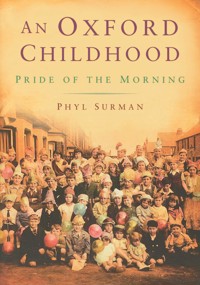
Cover photograph: Children playing ‘ducks and drakes’ in the sheep-washing place, Barracks Lane, Cowley, July 1914.
First published 1992
This edition first published in 2009
The History Press
The Mill, Brimscombe Port
Stroud, Gloucestershire, GL5 2QG
www.thehistorypress.co.uk
This ebook edition first published in 2013
All rights reserved
© The Estate of Phyl Surman, 1992, 1995, 2009, 2013
The right of Phyl Surman, to be identified as the Author of this work has been asserted in accordance with the Copyrights, Designs and Patents Act 1988.
This ebook is copyright material and must not be copied, reproduced, transferred, distributed, leased, licensed or publicly performed or used in any way except as specifically permitted in writing by the publishers, as allowed under the terms and conditions under which it was purchased or as strictly permitted by applicable copyright law. Any unauthorised distribution or use of this text may be a direct infringement of the author’s and publisher’s rights, and those responsible may be liable in law accordingly.
EPUB ISBN 978 0 7524 9464 7
Original typesetting by The History Press
Youth is the morning of life, let it be remembered with pride
.
‘We three children’
CONTENTS
Foreword
Acknowledgements
1 Our House
2 The Neighbourhood
3 Work and the Lack of It
4 Learning and Living
5 May Day
6 The General Strike
7 Holidays and Outings
8 Come Out to Play
9 Superstition and Beliefs
10 Fine Feathers
11 Shops and Traders
12 St Alban the Martyr
13 SS Mary and John
14 The River Thames
15 Fairs and Fireworks
16 Around and About
17 Christmas
18 And We Shall Have Snow
19 The Street Still Lives
Bibliography
FOREWORD
Historians are drawn to Oxford like moths to a flame but their work rarely does much to record the daily lives of ordinary folk. In Pride of the Morning, Phyl Surman does something to redress the balance, bringing us vivid memories of her east Oxford childhood in the 1920s. She broadcast regularly on BBC Radio Oxford in the 1970s and the infectious enthusiasm which she displayed ‘on air’ is also present in her writing, catapulting us straight back into a very different world.
Phyllis (or Phyl), the elder daughter of Harry and Alma Beck, was born in 1917. Her father was a plumber who had married Alma Haynes in 1913 and, at a time when most people still rented property, they were struggling to buy the family home, no. 74 Howard Street, on a mortgage. Phyl had an older brother, Norman, who was born in 1914 and a younger sister, Joyce, born in 1921.
Pride of the Morning recalls a happy and secure childhood centred around a home which served as ‘my refuge, to which, at the losing end of a battle with other children, I could return to continue a shouted argument through the keyhole of its strong front door’. Like many east Oxford families, the Becks were far from prosperous and Phyl was ten years old before her parents could afford to take her on a seaside holiday. Nevertheless, Harry was in regular employment and, if plumbing work was in short supply, he was also a trained metal-worker. He was therefore in a position to subscribe to the Cutler Boulter Provident Dispensary in Marston Street which offered medical treatment to the family in the event of illness; he also contributed to the Independent Order of Oddfellows which would provide financial help if the breadwinner became ill or incapacitated.
The family enjoyed day excursions by river steamer or charabanc and went for long walks in the fields beyond Iffley. In most years, they were able to take cheap summer holidays in leafy Warwickshire where Aunt Eva’s husband was chauffeur to a wealthy lady. All the year round, the children used the traffic-free east Oxford streets as a joyful playground, although they exasperated a near-neighbour on the corner of Catherine Street by their noisy games. They had a recreation ground nearby in Cowley Road and further afield they could explore Shotover and the rural fringes of Cowley.
At the age of four, Phyl went to SS Mary and John Infants’ School in Hertford Street and then, three years later, to the big school next door. This two-storey building was ingeniously designed with the girls entering from Essex Street to the first floor and the boys from Hertford Street to the ground floor. Segregation of the sexes was also practised at the Becks’ local church, St Alban’s, although ‘this did not prevent the exchange of grimaces, some smirking, some threatening, across the central aisle’. St Alban’s was High Church and the children were impressed for a while by the pageantry of the service before settling down to swap ‘treasured pieces of silver paper with our neighbour’.
Gradually, Phyl’s local perspectives widened and, in 1927, she gained a scholarship which enabled her to go to the Central Girls’ School in New Inn Hall Street. The avid observer of local shops in and around the Cowley Road could now gaze in wonder at the delights of the Penny Bazaar in St Ebbe’s or perhaps have tea with her parents in the Cadena Café.
Phyl Surman completed Pride of the Morning in 1978 and a few of her contemporary remarks have inevitably been overtaken by subsequent events. Parsons’ Pleasure, the well-known bathing place for men on the river Cherwell has now been closed; so too has the Long Bridges bathing place where she spent so many happy hours. On the corner of Catherine Street and Howard Street the ‘Slipper Baths’ closed in 1978 after bathrooms had been installed in most local houses. Change goes on, but the east Oxford of Phyl’s childhood will always be found in these memories. Phyl Surman died in 1985 and Pride of the Morning is published by kind permission of her son, David.
Malcolm Graham
ACKNOWLEDGEMENTS
With grateful thanks to all who have assisted in the production of this book, especially:
Mr F. Ackerman; Mr R. Angus; Mr W.E. Arthy; Mr N.G. Beck; Mrs J. Blakeman; Mr R.D. Burnell; Mr C. Clarke; Mr T. Colverson; Mr V. Couling; Revd E.H.W. Crusha; Dr M. Graham; Mr J.R. Hunt; Mr L. Lardner; Revd Arnold Mallinson; Mr W.J. Rose; Mr A.R. Sargent; Society of St John the Evangelist; Mr T.J. Surman; Mr J.M. Surman; Thames Water Authority; Mr M.A. Tredwell; Revd Canon A.G. Whye; Mrs W. Crook; Mrs U. Scrivyer; Mrs M. Knight.
Photographs are reproduced courtesy of David Surman, Jeremy Daniels and Oxfordshire Photographic Archives. The drawings are by Max Surman.
1
OUR HOUSE
In 1920, development along the eastern side of Iffley Road in east Oxford ceased with three long, straight streets: Percy Street, Charles Street and Howard Street. From Howard Street, halfway along its western side, Catherine Street branched out extending to Magdalen Road, cutting through Percy and Charles Streets on its way, so that they were each divided into two unequal lengths, the shorter of which were known as ‘Little Percy Street’ and ‘Little Charles Street’.
Several theories have been put forward as to why these three streets were so named, the most likely of which appears to be that, in the 1860s to 1870s, a William Howard was living with his family on the Iffley Road and, being an estate agent, it is conceivable that he may have been involved in the development of this area. The census of 1871 shows that he had six children, the youngest of whom, then aged five years, was named Percy; none of the other five was called Charles, but there may have been another son of that name who died in infancy. Alternatively, there may have been some other reason why the name Charles should have been chosen. By 1871, Percy, Charles and Howard streets were all laid out and building was in progress. Percy Street had six houses, two of them uninhabited; Charles Street had twenty-six houses, one unoccupied; and Howard Street, nine houses, of which five were empty. At the time of which I write the three streets were completely built up and, beyond, allotments and fields stretched away to Iffley Turn. To locals this area was known as ‘Robin Hood’, and was zealously guarded by the younger element of the community who met any threat of invasion of their territory by rival gangs with cries of ‘Up Robin Hood!’ As to why our neighbourhood was so called, correspondence in the Oxford Mail dated 9 September 1976 suggests that the name resulted from the existence in Magdalen Road of a public house of that title, but earlier correspondence in the newspaper quotes from the parish magazine of July 1915:
At that time [the early fifties] and for years before an encampment of gipsies had settled on the site of what was later ‘Robin Hood Terrace’ and, as is usual, they had great difficulty in removing them. It was from this that the district derived the name of ‘Robin Hood’.
I was also intrigued by the following statement in the Cowley St John parish magazine dated January 1920: ‘Father Jacob has taken charge of “London over the Border”, i.e., the part of the parish the other side of Iffley Road.’ This was the first and only reference I came across to what was presumably a local name for the area lying to the west of the main road to Iffley.
Our house was situated about halfway down Howard Street, which, though straight, displayed no monotony in the buildings lining its footpaths. Some were terraced, a few three storeys high, others, like ours, semi-detached with a side entrance, but all boasted a small front garden about ten feet deep enclosed in most cases by railings and a privet hedge. Entrance to our house was by means of a side door; glass panelled, stained and grained to a high polish it surmounted two steps, one of stone, scrubbed daily, and another of brass, polished daily. This door opened into a small hall, the consequent rush of air causing small rectangles of coloured glass suspended from the ceiling to tinkle a musical welcome. Directly opposite the main entrance lay the door to the front room, to the left, the door to the living room and, far left, the staircase leading to the three bedrooms.
Howard Street in 1906 – home of the author
The front room enlarged by a bay window was used only for parties, visitors, or sometimes on Sundays. The windows were hung with white lace curtains and two heavy green curtains suspended from wooden rings on a pole and looped back to either side of the bay in which stood, the pride of most households, a bamboo stand holding a monster aspidistra plant. The furniture in this room consisted of a horsehair sofa, one end of which curled up high, as a pillow, while along its back ran a small wooden balustrade; there were four matching chairs and the wallpaper was deep red. In this room stood an upright mahogany piano with two brass candlesticks hinged to its satin-backed fretwork facing; this instrument, much used and loved by my brother Norman, held little interest for me; the truth was that I found the practice sessions boring and consequently made laborious progress.
The fireplace was of black marble with red tiles, and the hearth was surrounded by a brass fender on which reposed brass fire-irons. The doors, skirting and other woodwork were painted dark brown, it being then considered that dark colours were more practical.
Most of the woodwork in the living room was painted dark green, the doors panelled and low-handled in brass. The mantelshelf was draped with green material edged with bobbles, and on the shelf stood a large mirror flanked by two tall, narrow mirrors reflecting a framework of small shelves holding ornaments. A plain deal table stood in the centre of the room covered with a bobble-edged cloth to match the mantelshelf, and on the floor lay a rag rug made by my mother from strips of thick material threaded into hessian with a wooden peg. For some weeks before attempting such a task she would ask around our friends and relations for cast-off coats or thick curtains which might be cut up for this purpose, so that when the completed rug finally lay before the hearth, we children would sit on it and, selecting a strip, amuse ourselves by recounting the history of its source:
‘That’s Uncle Ern’s post office coat.’
‘That was mum’s old dressing gown, and look, that piece of red was your old gaiters!’
In the centre of the ceiling was suspended a gas jet with a voracious appetite for mantles; I was constantly being sent round to a nearby shop for replacements for they were easily shattered. The fireplace was an ‘oven and sham’, black-leaded and surrounded by a steel fender and fire-irons which were covered with newspaper on bath nights so that as we dried off before the fire there was no fear of splashing and staining these objects.
Hardly a house in this area had the luxury of a bathroom, but my father, who was a very practical man, had fitted a bath into the kitchen with a wooden cover which served as a table. Water for baths was heated in a corner copper under which a fire was lit, and when the water was hot it was bucketed across the kitchen and poured into the bath. Sheets and linens were all home laundered and boiled in the copper for there were then few organised laundries, though some women had wash-houses built in their gardens and took in washing, either from neighbours or from the Oxford colleges, to augment their income. Later, these brick coppers which took up so much space in the kitchen were removed and replaced by gas or electric boilers, but there were no airing facilities in winter, so that it was common in many homes to find the living-room criss-crossed with string on which washing or airing seemed almost permanently hung, for the weekly wash was a mammoth task. My mother was very much against this practice and our things were aired on a large wooden clothes-horse which she placed in the warm living-room last thing at night.
The oven and sham ranges in the living-room also began to lose favour about this time, being replaced by open coal grates with tiled surrounds and wooden mantelpieces, and cooking was then performed on kitchen ranges, though these too were soon replaced by gas stoves and later still, electric ovens. Despite the obvious advantages of these ovens, being easier to clean and control, my mother still favoured the coal range. Opening its oven door, she would hold her hand inside to test the heat and somehow she knew just when to put in her sandwiches and pies, and baking-day in our house was always warm and golden. On the front of most ranges was a grid iron on which flat irons were heated, usually two; one was heated while the other was in use, so that no time was lost. The iron handles were, of course, hot, and for this purpose, by the side of the range hung a padded iron or kettle-holder. These holders were the first things that we were taught to make in the sewing class at school.
Utensils were made of tinned metal or enamel and kitchen buckets, baths etc. usually of galvanised metal, though enamelled hip-baths were still in use. Saucepans were of iron and very heavy, but when the new stoves came into being, lighter models of enamel or aluminium pans were used. Behind the kitchen door stood a large wooden mangle with cupboards beneath and further cupboard space was provided under the stairs.
The upstairs rooms were lit by gas, but here, no mantle, just a hinged bracket ending with a bare half circle of flame which could be turned down to a small blue glimmer once we were in bed. My bedroom had a brass bedstead with mattress of flock filling, hard and lumpy, but with experience I learned to fit my body quite comfortably into its undulations. There was a dressing-table covered with a lace duchesse set, a wardrobe and a marble-topped wash-hand stand, complete with jug, basin and soap-dish, and on the wall over the fireplace hung a large coloured picture of The Light of the World, by William Holman Hunt. My father, who usually rose first in the morning, would bring warm water upstairs for us but he would get washed and shaved in the kitchen.
This, then, was my home around 1920, kept clean and in good repair by my hardworking parents. They had little money when they married in 1913, but had managed to buy this house for £250, most of which they borrowed and were still repaying. Sublimely unaware of financial problems, I regarded this house as security, my refuge, to which, at the losing end of a battle with other children, I could retire to continue a shouted argument through the keyhole of its strong front door. I also had complete faith in my parents. In my childish estimation there was nothing they could not do or provide and this feeling was obviously shared by my brother, for he recalls taking home six of his school friends one day calmly announcing to my surprised mother that they had ‘come to tea’. Father could be relied upon to repair bicycle punctures and mend broken toys and he knew the best places to fish for minnows or to seek out the yellow king-cup; and oh, the comfort of my mother who was always there and understood how to deal with cut knees and sums which would not add up! To my parents I turned for reassurance when angry or upset, or for practical advice; I accepted their caring presence as a normal part of my existence, never thinking there could come a time when I might be deprived of their support, so that when, in later years, they inevitably became old, ill and uncertain, it was with a feeling of shock that I realized that they too were mortal.
A part of east Oxford
The front gate step of this house was my favourite resting-place where I might sit (despite its coldness to my bottom and the sinister warning from Norman that I should ‘catch the quack’) happily meditating and watching the world go by. It was while so engaged one autumn morning, pensively munching an apple, that I remembered uneasily the unpleasant task I had allocated for that day. In the evening there was to be a ‘pig-killing’, so this morning I must say ‘Good-bye’ to Blackie and Whitey.
In common with many householders my father kept chickens in a wire-netted run and two pigs in a sty at the bottom of our garden. Pig-sties were allowed only in gardens on the eastern side of Howard Street because they were backed by allotments and this meant that the sty was sufficiently far away from human habitation to comply with the law. The pigs were, in fact, the joint property of several neighbours who contributed to their feeding. Acorns, household scraps, small rejected ‘tatties’ were all boiled together in a big, black iron saucepan and greedily enjoyed by the animals, blissfully unaware that, at the end of the year, the donors of this gastronomic mess would come to assist at the killing and apportionment of the carcasses. Nothing was wasted. The pig skin or flare was melted down for lard; the blood drained from the carcass used to make black puddings; the innards boiled down for faggots, and chitterlings and trotters were dishes in their own right. The pig’s head was often made into brawn and the hams and choice portions treated with saltpetre and stored away for winter eating. The necessity for this butchery had been gently explained to me by father: ‘It’s the way of the world I’m afraid, dear. We must kill animals to live.’
But I always hated the killings and so it was with heavy heart that I walked round to the back garden, hoping, perhaps, that a little explanatory chat might be of some consolation to the pigs. Our garden was of useful size and accommodated a pear tree, four apple trees, a damson tree and currant and gooseberry bushes, with a small lawn and flower garden near the house. Honeysuckle threaded itself on a trellis near the back door and the perfume from this on a still summer evening was exquisite. But the glories of the garden were lost upon me as, in this moment of sadness, I walked slowly past the chicken run; even they, I thought dismally, will meet a similar fate, yet they served us well and in addition to our own needs we often sold eggs to neighbours, preserving the surplus in a big crock of water-glass for winter use. These same chickens had been reared from the shell in a large flannel-lined box which was placed in a warm spot in the hearth; a yellow fluff-ruffled, cheeping mass among which one occasionally saw a small amber claw or bright beady eye and there they stayed until strong enough to face the world outside. I decided it would be kinder not to enlighten them and left them clucking and pecking to their hearts’ content.
At the bottom of the garden leaned ‘Dad’s shed’; a construction of planks and corrugated iron held together by long nails which, when hammered home, went right through the planks, so forming a useful hook on the inside of the shed for coils of wire or bunches of keys. My mother always vowed that had it not been for the contents this structure would have collapsed and, indeed, it did appear that walls and roof were kept in place by the many biscuit tins and rows of shelving stacked internally. Tins full of rusty nuts and bolts, nails, odd door furniture, washers, screws, and on the shelves, tools, pieces of piping, tins of putty, bottles of methylated spirits and cans of paraffin were to be seen in glorious disarray. On the bench below the only window, a vice, soldering-irons, flux and miscellaneous tools were always in evidence, and beneath the bench, odd sheets of glass, tin, copper and pieces of lead. Yet this cluttered, crazy workshop housed the remedy for many a crisis of maintenance; whatever was needed was to be found in ‘Dad’s shed’. That is until, in later years, my tidy-minded brother took a hand and put the place in order. Tools were put into racks, tins and boxes neatly labelled, the bench cleared and rubbish thrown away, after which my father complained he could not find a thing!
To the right of the shed was a cycle shed and to the left, the object of my thoughts, the pig-sty. Perched up on the wooden fence around the sty and adopting what I considered to be a soothing tone, I attempted to explain to Blackie and Whitey that their sacrifice was all very necessary because Dad had said so. In my anxiety to get this message across I leaned too far over, lost my footing, and found myself hanging upside down, my face inches away from the bewhiskered, pink, snuffling nostrils of Whitey. The indignity of my position was quite outweighed by the alarming proximity of the pig and I was convinced that far from grieving over the threat of his own demise, Whitey was about to relish the last meal of the condemned! My piercing shrieks brought mother running from the kitchen and she, locating the sound, perceived two short fat legs protruding from navy-blue fleecy- lined boots above the sty door. Laughing, she uprighted me and together we left the pig to ruminate on the peculiarities of humans.
Later that night, when the darkness was pierced by the light of many lanterns and the quietness shattered by men’s voices and the shrill screams of the pigs, I lay with my head under the bedclothes, fingers in ears, and wept for Blackie and Whitey.
2
THE NEIGHBOURHOOD
Soon after this sad incident, I was cheered by the news that there was to be a wedding in the family. My mother’s sister May was to be married to Pat and the whole family was invited to the ceremony at SS Mary and John church on 19 September 1920.
This was to be a great event. I was to have a new fawn coat and brown velvet hat decorated with buttercups made by my mother, as were all my clothes, and Norman was to be resplendent in a new sailor suit. On the appointed day, we assembled with other relatives in the big church and I was allowed to sit at the end of the pew so that I might more easily watch the proceedings, but this did not satisfy my curiosity. I could see my aunt May and my prospective uncle Pat standing before the vicar, but, being unable to hear what was said or see what was happening, I left my seat, avoiding father’s outstretched hand, walked down the aisle and pushing between bride and groom came face to face with the reverend gentleman. Startled though he must have been, he did not falter and the ceremony proceeded with the interloper maintaining her position throughout.
Afterwards there was a wedding breakfast at Granny’s house in Temple Street, to which Norman and I did full justice, and then the newlyweds left to spend their honeymoon with aunt Eva, another of mother’s sisters, at Ashorne in Warwickshire. How I wished there could be weddings every day: I enjoyed the happiness, the flowers, the food and above all, the family atmosphere. This sense of belonging, that my brother and I were the pivot of my parents’ world, must have been instilled since my earliest days and it was, therefore, probably a good thing that in 1921, a new member of the family arrived, Joyce, born during the hot month of August. She, being rather a delicate infant, needed a great deal of attention, particularly when, at the age of a few months, she developed pneumonia and almost died. Her cot was brought downstairs so that mother could watch her constantly, snatching fitful sleep in a chair by the cot side during the long hours of night. Though only four years old, I was conscious of the anxiety and fetched and carried for my mother, who hardly left the baby. Fortunately, this care and devotion was eventually rewarded and Joyce slowly recovered. Infant mortality at this time was very high and month by month church records of burials show the sad entries: aged one hour; aged ten hours; aged five weeks; and register the deaths of many young people.
Neighbours were very kind to us during this crisis, and would undertake shopping or have me to play with their children to relieve my mother. On one such occasion, playing with a neighbour’s child, I followed her indoors and found myself in a dimly lit room wherein several children played and in one corner of which, on a mattress on the floor, lay a young woman, thin and wasted, who even to my inexperienced eyes looked very sick. The truth of this was of course not known to me at that time, but this was another victim of tuberculosis, so prevalent in those days and an illness which then, more often than not, proved fatal.
A view down Cowley Road in 1917. The church of SS Mary and John is in the background on the left and a milk delivery cart is approaching on the right
At other times I would play with my friends on the Green, a plot of wasteland at the street corner. Ownership of this land had been the subject of dispute for many years so that it was now regarded as common land. Here, goats were tethered to graze and we children played cricket or football, dug trenches and fought battles, much to the harassment of the poor lady whose house adjoined the Green. The constant battering of balls up against her wall caused the china on her dresser to fall and shatter and the succession of small children tapping on her front door to ask for balls which had bounced into her back garden must have driven her to distraction. But to children, these things were trivial and, though her threats and warnings were heeded for a while, inevitably, high spirits dimmed memory and before long the games were again in full swing.
‘The Home of Compassion’




