


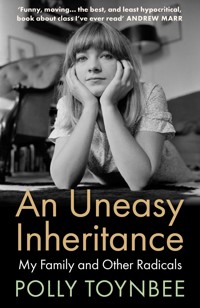
Erhalten Sie Zugang zu diesem und mehr als 300000 Büchern ab EUR 5,99 monatlich.
- Herausgeber: Atlantic Books
- Kategorie: Sachliteratur, Reportagen, Biografien
- Sprache: Englisch
'Fascinating' Spectator 'Entertaining' Sunday Times 'Enthralling' Guardian 'Beautiful, funny and moving' Daily Mail 'Compelling and moving' Observer 'Replete with vivid - often hilarious, often shocking - anecdotes' Financial Times While for generations Polly Toynbee's ancestors have been committed left-wing rabble-rousers railing against injustice, they could never claim to be working class, settling instead for the prosperous life of academia or journalism enjoyed by their own forebears. So where does that leave their ideals of class equality? Through a colourful, entertaining examination of her own family - which in addition to her writer father Philip and her historian grandfather Arnold contains everyone from the Glenconners to Jessica Mitford to Bertrand Russell, and features ancestral home Castle Howard as a backdrop - Toynbee explores the myth of mobility, the guilt of privilege, and asks for a truly honest conversation about class in Britain.
Sie lesen das E-Book in den Legimi-Apps auf:
Seitenzahl: 524
Veröffentlichungsjahr: 2023
Das E-Book (TTS) können Sie hören im Abo „Legimi Premium” in Legimi-Apps auf:
Ähnliche


















‘Part social analysis, part polemic (once a columnist, always a columnist), part compelling family memoir, replete with vivid – often hilarious, often shocking – anecdotes. It is ultimately, however, a work of love, forgiveness and understanding’ Financial Times
‘Fascinating...She has spent a lifetime highlighting the need for social change, and her book fizzes with that continuing purpose’ Spectator
‘Enthralling...laceratingly honest and often funny’ Guardian
‘An irresistible, self-aware British class comedy. It reads rather like an Evelyn Waugh novel’ New Statesman
‘For the many people who have followed Toynbee’s career and felt a connection with her strong, radical voice, this book will delight and educate in equal measure’ Yorkshire Life
‘Marked by its compassion, humour and elegiac tone’ Irish Times
‘An outstanding work: totally absorbing and so well written, packed with interesting events, people and thoughts’ Claire Tomalin
‘An absorbing picture of entwined families managing for generations to lead (mostly) comfortable middle class lives while holding radical liberal or left wing views – uneasy indeed, but where would we be without them and others like them?’ Rt Hon Lady Hale DBE
Also by Polly Toynbee:
Leftovers: a novel
A Working Life
Hospital
The Way We Live Now
Lost Children
Hard Work: Life in Low-Pay Britain
The Verdict: Did Labour Change Britain?(with David Walker)
Unjust Rewards: Ending the Greed That isBankrupting Britain (with David Walker)
The Lost Decade: 2010–2020 (with David Walker)
*
Polly Toynbee is a journalist, author and broadcaster. A Guardian columnist and broadcaster, she was formerly the BBC’s social affairs editor. She has written for the Observer, the Independent and Radio Times and been an editor at the Washington Monthly. She has won numerous awards including a National Press Award and the Orwell Prize for Journalism.
First published in hardback in Great Britain in 2023 by Atlantic Books,an imprint of Atlantic Books Ltd.
This paperback edition first published in Great Britain in 2024 byAtlantic Books, an imprint of Atlantic Books Ltd.
Copyright © Polly Toynbee, 2023
The moral right of Polly Toynbee to be identified as the author of this work has been asserted by her in accordance with the Copyright,Designs and Patents Act of 1988.
All rights reserved. No part of this publication may be reproduced, stored in a retrieval system, or transmitted in any form or by any means, electronic, mechanical, photocopying, recording, or otherwise, without the prior permission of both the copyright owner and theabove publisher of this book.
No part of this book may be used in any manner in the learning, training or development of generative artificial intelligence technologies (including but not limited to machine learning models and large language models (LLMs)), whether by data scraping, data mining or use in any way to create or form a part of data sets or in any other way.
The extract from ‘How to Get on in Society’ by John Betjemanwhich appears on page 234, taken from The Best Loved Poems of JohnBetjeman, is reproduced with the kind permission ofHodder & Stoughton Limited through PLSclear.
Every effort has been made to trace or contact all copyright-holders. The publishers will be pleased to make good any omissions or rectify any mistakes brought to their attention at the earliest opportunity.
10 9 8 7 6 5 4 3 2 1
A CIP catalogue record for this book is available from the British Library.
Paperback ISBN: 978 1 83895 837 4
E-book ISBN: 978 1 83895 836 7
Printed in Great Britain
Atlantic Books
An imprint of Atlantic Books Ltd
Ormond House
26–27 Boswell Street
London WC1N 3JZ
To my family, past, present and future
Contents
Introduction
1 What Children Know
2 Arnold
3 Harry: A Social Reformer’s Tragedy
4 Rosalind
5 Good People, Bad Parents
6 Philip the Child
7 Philip at Oxford and at War
8 My Mother Anne
9 Philip the Father
10 Rhodesia: Many Painful Political Lessons Learned in One Brief Episode
11 Josephine
12 Escaping Oxford, Starting Work
13 Philip – Older But Not Wiser
14 Work, Thirty Years Later
15 An Ending
Acknowledgments
Notes
Bibliography
Picture credits
Index
An Uneasy Inheritance
Josephine and Polly
Introduction
My Class
‘When Adam delved and Eve span, who was then the gentleman?’ That was my father’s riddle as he delved and dug every afternoon in the garden or in the next-door allotment at Cob Cottage. ‘Tell us, tell us!’ Josephine and I pleaded, jumping up and down in irritation, trying every answer we could think of. Was it like ‘Constantinople is a very long word: spell it’? Was it like ‘I saw Esau sitting on a see-saw, how many S’s in that?’ What sort of a riddle was it? My father would smile cryptically as he drove his spade into the heavy Suffolk soil and say that one day we would work it out for ourselves, and when we did, we would understand many things. That made the words magic, a spell to reveal the tree of knowledge.
Those Peasants’ Revolt words are wrapped up in my memory with two ceremonial swords with gilded hilts, the pommels wound round in faded golden threads. My father had plunged them deep into the earth, their tarnished silver blades only just poking above the ground. I have no idea how he came by them, certainly not from his own wartime military career. You can have one each, he said. When you are strong enough to pull them out, then you’ll be old enough to have them. We tugged and pulled but couldn’t loosen them.
Not long afterwards Josephine told me she had the answer to the riddle, but she wasn’t telling me, ever. I was too young and stupid to understand and I probably never would. I begged and offered her anything I could think of, including my pocket money, but she just smirked like a ginger cat. I kicked her and she let fly her fists. I cried as I always did and she sneered ‘Cry-baby!’ as she always did. That same afternoon we wiggled and yanked and pulled and tugged the Arthurian swords out of the ground. Still quarrelling over her refusal to tell me, we lifted those heavy weapons with both hands and clashed them over and again until somehow, suddenly, blood gushed from her ankle, her Achilles heel: I was the one that screamed, not her. She dropped her sword and ran, leaving a trail of bloody drops while I ran after her shouting out that I’d killed her. But she didn’t run for help; that was not her way. She plunged under a huge upturned wooden vat my father used for stamping out his pungent experimental wines, pulling it down on top of her in the middle of the grass. I thumped on the tub, implored her to come out, said I’d never ever annoy her in any way again if she would come out and not die, but she groaned louder and louder. ‘Go away! I’m going to bleed and suffocate and it’s your fault! Let me die in peace!’ she said, and I rushed for help.
The cut wasn’t mortal, not even worth a stitch, and a simple sticking plaster stopped the bleeding, but she always had that small white scar on her ankle just above her heel, my scar, another harm I’d done her. She never told me the answer to the riddle, though I did find out a while later. I asked my philosopher stepfather first, but he never gave a straight answer to any question. ‘It all depends what you mean by…’ When my mother finally explained that it was about social class, about a time long ago when people were equal with no aristocrats, I felt cheated. It wasn’t a proper riddle at all, not one you could tell in the playground. It was a shaggy dog riddle. Neither Adam nor Eve? No one? What kind of an answer was that?
The question of who delved and why was embedded deep in my family’s thoughts, for as many generations as I know about. Liberal ancestors agonized over the excruciating moral embarrassments of social class. My father would wag his finger and say people will look back on us with horror, just as we look back on feudal serfdom and slavery. He was unwavering in his trust in the inevitability of social progress, though so often outraged at its frequent backsliding. People in the future (if there is one, if we are not annihilated by the bomb or environmental catastrophe) will be shocked at how we live now while half the world starves, he said, as he set out to turn his family home into a (would-be) self-sufficient agricultural commune, with (would-be) sharing of wealth and income among all communards. People in the future won’t be able to imagine our moral state of mind, he said. They won’t comprehend the hypocrisy of people like us.
Everyone is class-conscious in their own way, but the liberal and left-wing middle classes writhe in the particular contortions of their own moral inadequacy. Though it is, I suppose, no different to the double-think of generations of comfortably-off occupiers of the front pews in church who were warned that they could no more reach heaven than a camel can squeeze through the eye of a needle. If they genuinely believed only the meek and the poor at the back of the church would inherit the kingdom of God, wouldn’t they have lived differently? There are many ways of accommodating contrary beliefs and the cognitive dissonance of failing to live up to the beliefs we profess.
To the left-wing middle classes, how the charge of hypocrisy cuts to the quick. With great glee, enemies on the right spit at ‘champagne socialists’ – David Cameron hurled that one at Ed Miliband across the floor of the House of Commons. How easy for the right who can bathe in champagne without qualms because life on their moral low ground is easy on the conscience. The hard truth is that those of any politics or faith who claim concern for others are faced with the shaming incompatibility between life and belief, unless they take the Mahatma Gandhi way of loin cloth and self-denial. No political movement can be built on the expectation of a society of saints, but the moral contortions spring from searching for some liveable ground somewhere between Gandhi and hypocrisy.
I started writing this book after making a series for Radio 4 in 2011 called The Class Ceiling, when the producer asked me to include something about my own experience of social class. I clammed up. Of course I would have leapt at self-exposure with pride if I’d had some satisfying pulled-up-by-my-own-bootstraps-from-tough-council-estate story to tell. Lock-jawed, I couldn’t think where to begin. Must I? It was a fair enough question. I set out to make these programmes on social class keen to ask as many people as possible how they felt. Facts, figures and statistics about Britain’s rigid social immobility are revealing, but more powerful still is how people feel about their background and how social divides affect their own lives and attitudes. Richard Sennett and Jonathan Cobb’s fine book written in 1970s America, The Hidden Injuries of Class, says it all: class hurts, deeply and emotionally, not merely economically. So while making the programmes I started a habit of asking everyone I met for stories about their experiences of class: I asked the experts, the academics, pollsters, politicians and sociologists, alongside friends, people in the street and anyone I came across. Could they remember an event when they had bumped up against class barriers, either feeling not classy enough or too embarrassingly posh, put upon, put down or mocked on account of their origins, occupation or status? Everyone, it turned out, has strong stories to tell of themselves or their family. If they rose in the world from humble roots, they are full of guilt about family, neighbourhoods and school friends socially left behind. Those, like myself, born into the middle classes, have their own shame and anxiety too. Social mobility, which every politician advocates, means many people rising up and falling down, which is rarely without emotional cost. But a world more equal would be a world less painful too. Literature is rich with social class agony, none more poignant than in Great Expectations when the newly enriched Pip treats gentle Joe Gargery shamefully on the blacksmith’s visit to his elegant London chambers, leaving the fine old son of toil awkwardly uncertain what to do with his hat. Most writers are absorbed by the pain of social class, its gin traps and its barbed wire boundaries.
The Clapham omnibus was too difficult for radio interviews, so I went instead to Clapham Common, my home for forty years, where I talked to a group of elderly working class men, drinking tea from thermoses by the boating pond. Yes, they had tales to tell of being snubbed, quite often. In the old days it was ‘Use the tradesmen’s entrance’, that kind of insult. These days it was only a little more subtle, people identifying them by class with just a first glance. Or worse, they talked of school opportunities missed and regretted because staying on was not an option, intelligence wasted in jobs that didn’t require their brain. When I asked the chic young mothers drinking lattes at the café by the Clapham Common bandstand they had other mortifications to tell, toe-curling moments of sudden shame at culture clashes over their children across the class divide. At other people’s houses what should they say if their children were exposed to the wrong television programmes, wrong video games, wrong food, and how could you say to a mother of a different/lower social class, I don’t want my child to watch, eat or play with the same things as your children? These women were not suffering any social injuries, just blush-making awkwardnesses.
Outside Asda in the Isle of Dogs, looking up at the great glass palaces of the new world of Canary Wharf finance, so near and yet a planet away from the unrewarded East End where we stood, I interviewed a welder who talked indignantly of sitting with his children in his work clothes in a first class train carriage, when an upper class-sounding man summoned the guard to check his absolutely correct first class tickets. His son later did well and went to Oxford University, he boasted.
Professor John Goldthorpe of Oxford, the distinguished expert on class and social mobility, who keeps his Yorkshire accent despite a lifetime in upper academe, told of the letter he had received from an Oxford college after passing the exam to get in: ‘It said, “We need you to come to interview to check you are appropriate in dress and manners.” I sent a rude reply,’ he recalls. He went elsewhere and keeps the framed letter in his bathroom. Maybe it helped propel him on his life’s research. Deborah Mattinson, a pollster and social researcher into class, recalled arriving at university from a working class background and being stumped by what to do with an avocado. Andy Burnham, Labour politician, Manchester’s first elected mayor, man of impeccable working class origin, talks of the awfulness of arriving for a date with a posh girl at Oxford for ‘dinner’ at lunchtime instead of in the evening.
Writing in 1941 in his great essay on patriotism, ‘The Lion and the Unicorn’, George Orwell thought the war effort was being imperilled by England’s shameful state as ‘the most class-ridden country under the sun’. Five Etonian prime ministers later – Eden, Macmillan, Douglas-Home, Cameron and Johnson – England keeps a firm grip on that undesirable top ranking.
So, said the producer, wasn’t it only reasonable that I should say something or other about my own class background? But what? I have travelled nowhere, not made my own way in the world, staying socially more or less where I was born. As far as I can tell, stretching far back into the past, my father’s family and his father’s and grandfather’s family, and those before them remained remarkably socially static, writers, teachers, professors, civil servants. Certainly, I can find not one drop of working class blood – though the history of wives is usually ignored and lost. Nor do these people come from any particular place, this peripatetic rootless class of professionals who were roundly abused by Theresa May as ‘people from nowhere’. Yes, that’s who we are. In the olden days this was the clerk class, indeterminate, dressed in black, holding a quill, doing quite well in a quiet way, not landed but educated, footloose to follow professions. The peculiar name Toynbee is found in Danelaw lands, invaders and settlers up the Lincolnshire coast, where Norse names end in -by and -bee. ‘Over with Canute, don’cha know?’ my father would mock, trumping the upper class pretensions of those who claimed they came over with William the Conqueror. Nonsense of course, but that was exactly his point. Few of us truly come from anywhere. I talk about the male line, my father and his father and his father’s father – but that’s only half the picture. My great-grandfather, the Australian-born classical scholar Gilbert Murray, unexpectedly married into a branch of the aristocracy, so when I firmly describe us with the portmanteau expression ‘middle class’, sometimes that ought to include the borderlands of ‘upper middle class’ and ‘aristocracy’. But once we plunge into those quicksands of disputed class gradations, we risk losing the main thread.
Idiosyncrasies and oddities invade every family tree, defeating every attempt to shoehorn ancestry into a coherent pattern. My mother’s father George, as we shall see, was a perplexing mystery, origins and birth unknown, propelled into the upper class by some benefactor, but once arrived there, left penniless to sink or marry money. Once you look at the gigantic size of anyone’s family tree within a couple of generations, you can see how absurdly people have to pick a dainty path through thickets of forebears to claim any one particular origin: any selected bloodline of ancestors dilutes in a generation or two to less than a thimbleful, less than a little toe.
I hunted hard for any redeeming twig of a working class branch of my family tree, without success. Not a shadow of a distant root emerges from good working class earth. That’s a ridiculous middle class habit, trying to justify itself by proving working class origins. I enjoy a 2021 piece of research from the London School of Economics (LSE) that shows how many of the indisputably middle class these days lay spurious claim to being working class. An astonishing 47 per cent of all those in professional and managerial jobs actually call themselves working class. Even a full quarter of those who have middle class parents still claim working class authenticity by reaching back to grandparents and even to great-grandparents. I understand the urge, but it’s ludicrous. (My wise daughter interjects here: am I being unfair? If we had working class grandparents, wouldn’t our lives and attitudes and self-confidence be subtly different? She may be right.) The search for these origin stories springs, the LSE researchers suggest, from the need to prove their own merit, to assert that we do really live in a meritocracy, against all the evidence. To show they made it to their present status by their own effort and talent alone, they need to believe they earned it. US political philosopher Michael Sandel’s book The Tyranny of Merit explodes these self-delusions. Most of us acorns don’t fall far from the trees we come from. If I can’t find a shred of working class credibility to boast about, I have to assume, from the way I stayed exactly within my own social class, that had I been born into a family with no advantages, I would probably have stayed there too, equally static.
But I digress, avoiding the question. How do I feel about social class? That’s what this book is about. I can make myself blush all over at embarrassing scenes remembered. All my family, my father, my mother, my sister, my brothers, my stepfather, my late husband, my present partner and my children too, tussle with questions of class. Those who claim to be resolutely immune are either crassly in sensitive to their own privilege or from their own niche, high or lowly, they live in some insulated social zone where they rarely glimpse beyond their own kind, except on television.
The fashionable – and politically convenient – view is that ‘we’re all middle class now’, apart perhaps from the feral underclass of Daily Mail nightmares. Class is old hat. The useful political myth declares class is dead. Downton Abbey deference is no more and look how often vocal differences among the young meld into universal estuary and mockney accents. Classlessness may be modern and hip – yet that affectation is no more than an unsuccessful disguise of the extent to which birth determines destiny more, not less, than it did fifty years ago. Never mind irrelevant Hyacinth Bucket and Nancy Mitford wars over the niceties of napkins versus serviettes; in everything that matters class holds sway more, not less than it did and that needs saying loudly and often. Things are going backwards. That’s why it matters.
The dangerous tendency now is to replace class with other identities – ethnicity in all its variations, gender, transgender, sexual orientation or religion. I realize that, in describing previous eras, this is a very white book about white people. Other identities have other stories, but class still stands out as the overarching determinant of most lives, an identity everyone is born with, and too few escape. Platitudinous politicians talk only of upward mobility: the truth the middle class knows and fears is that for some to rise up the ladder, others must slip down it. But not our children.
Look, I have skated away again from the personal. Pondering the difficulty of describing my liberal family’s intense convolutions about class, I agreed with my producer to give a modest nod to acknowledge my middle class background – not that Radio 4 listeners could have missed the unmistakable inflections of my voice. So I said, ‘I come from a family of writers and academics, we had every advantage – and it was dinned into us how lucky we were compared with some children I played with. But what if I hadn’t grown up surrounded by books and parents who talked to me about everything, how do I know if I’d ever have made it into journalism?’ I don’t – and never will. Secretly, I think how admirable and enviable are those who have risen from hardship, without privileges, through sheer talent and determination into a job like mine. But how rare too. The Guardian also writhes with discomfort at figures showing how private school and Oxbridge educated its staff have been – like so much of broadcasting, the press and the most desirable jobs. It has taken conscious effort to hire a more diverse younger generation.
In the office at the Guardian I discover that the mother of the leader writer I sit next to went to school with me, both at Kensington High School, a private primary school, and together again in the sixth form of Holland Park comprehensive. Where you come from matters a lot less than what you stand for, I hear some say, with some justification. It’s not which side of the tracks you were born on, but whose side you fight for that counts: I hold onto that thought but I also partly doubt it. Collectively, it still looks bad for newspapers, the broadcasters and all the other commanding heights of privileged jobs that are effortlessly occupied by we silver-spooners. When I started writing this book, Alan Milburn’s final report for the Social Mobility Commission reported that the private school educated make up 54 per cent of leading journalists and medics, 55 per cent of partners in top law firms, 68 per cent of barristers and 70 per cent of judges, with a far higher proportion than that drawn from Oxbridge. In the legal profession, the numbers of privately educated are actually on the increase again, a warning that in these tough times, as competition gets harsher for fewer good jobs, the proportion of the sharpest elbowed, the most intensely tutored, crammed and bred for success may well rise, not fall. Progress has gone into reverse in my lifetime.
The story of social class since the Second World War has followed the story of British politics. A reasonably steady progressive consensus secured upward mobility and an expanding white collar middle class. I was taught social history in the 1960s as we lived and perceived it in the post-war decades: it was taught as an ineluctable onward march from factory acts and trade union rights to the universal franchise, the welfare state and universal free education, including expanding universities. From the start of the twentieth century, incomes became more equal while income tax and inheritance tax chipped away at Victorian levels of inequality. In the mid-1970s Britain reached its most equal era with its highest levels of social mobility. Why wouldn’t that social democratic improvement continue forever onward under the flag of Fabian gradualism? But then came the 1980s, when everything went into reverse, when incomes shot off in opposite directions. Accelerating poverty and soaring wealth have stayed relatively unchecked ever since. My father died in 1981 at the age of sixty-five, steaming with anger both at Margaret Thatcher and at me for joining the Social Democratic Party that year, splitting from Labour and, in his view, making her continued victory the more certain. (That historic argument has never been resolved.)
Britain’s social story since the 1980s can be told in numbers and statistics, slice it any way you like. The top 10 per cent gained greatly, the top 1 per cent insanely, while, especially since the turn of the millennium, the middle stagnated and the bottom half fell back. That means the habit of measuring national wealth by GDP as if it were per capita is meaningless for the majority of people who saw very little increase in their own living standards, while hearing that the country was apparently motoring ahead. Almost all of that growth of the last fifteen years was gobbled up by the top tenth, so an ‘average’ figure for growth is useless in a country as unequal as ours. Statisticians may be satisfied with national numbers that express GDP growth as if the spoils were fairly shared, but in such an unequal country, never accept an average. Average out the living standards or the GDP of Good King Wenceslas and the poor man underneath the mountain, and by statistical magic the poor man is doing just fine. The turmoil of the last decade that delivered the great Brexit cultural division and the Red Wall of ‘left behind’ northern towns turning blue in Boris Johnson’s 2019 landslide general election springs in part from the simmering disruptions of Thatcher’s heedless de-industrializations and forty years of those consequences.
In one way or another I have spent most of my working life chronicling social change or, in recent years, social stagnation, reporting and writing about it in newspapers, broadcasting and books. I inherit my parents’ indignation at the wrongness of things, personal guilt over privilege and an obligation never to forget it. But it is not as easy to be good as it is to imagine what a good society might look like. This raw awareness of undeserved good fortune was in my parents’ marrow, though mercifully they didn’t express it with solemn Quakerish puritanism but with a measure of rueful self-mockery at the impossible difference between how we live and how we think society should be. Delight in life’s pleasures was blended with an awkward guilt, a hallmark of my father’s writing. My older sister was more tortured and struggled harder than I to correct the distortions and convolutions of our lives. I was indignant but, if I’m honest, not truly tormented, not tormented enough or I would have lived differently. But I do feel lucky and so do my children, the luck every human has from haphazard randomness of birth. ‘Aren’t we lucky’ is what we keep saying when enjoying life, and I have so enjoyed myself.
* * *
No family story is simple. No family history can be boiled down to class, though class is at the heart of the way everyone describes the history of their antecedents and their origins. But stirred in with social context, in my family as in every other on earth, there is a rich mix of the nuts and raisins of odd characters and illogical passions. Anyone looking at mine through a Freudian lens would ask what might my father have been like had he not had a fiendish mother? Might he have been a happier man, and less wracked by cycles of sin and guilt? He was a romantic by nature who believed that romantic agony is the price to be paid by artists, writers and truth-seekers. If he had not suffered the deep wound inflicted by his mother, a believer in the idea of romantic agony might wonder if he would have had the spur to make him the clever, comic, self-knowing writer and good companion he was. At the end, in the grip of severe clinical depression, the agony overwhelmed everything else. So, inevitably this is a story of inherited anguish and of alcoholism passed through the generations, as well as a tale about the angst of the middle class left.
Spare us from the fate of being remembered only through the eyes of our children. Children are grasping creatures, by nature programmed to require just one thing of their parents – that they devote themselves unstintingly to the wellbeing of their offspring, and nothing much else. Parents’ independent state of being is beside the point to children. It has been the fate of too many interesting people of every kind to be remembered only by their grumbling offspring. Did Edmund Gosse’s recollections of his abominable father begin the child-as-victim autobiography? Or did the fashion start with the misery memoirs by the daughters of Joan Crawford and Bette Davis about their alcoholic mothers? There followed a succession of family revenge sagas, no doubt justified by aggrieved children of the famous with neglectful or abusive childhoods. But being an unsatisfactory parent or a bad spouse is only one aspect of a human life, not enough to blot out every other talent or attribute. I don’t know if, say, Louis Pasteur or Marie Curie were good parents, but it would be the less important or interesting facet of their lives. Sex has overwhelmed the biographies of many, remembered more for their bedrooms than the workrooms that were the reason why we should care about them at all. Ill treatment of their wives is no reason to stop reading Tolstoy or Dickens. Sometimes children’s recorded resentments of their parents overshadow everything else: Philip Larkin gave everyone permission. I bear no grudge against my parents or my upbringing, complicated and disrupted though it was: on the contrary, I always felt fortunate.
My father, however, was entirely justified in his sense of the damage his poisonous mother Rosalind had done him. To a lesser extent he blamed his father Arnold’s inadequacy, for the harm they both did him. But blame is never that simple. Rosalind’s own upbringing may have harmed her, with a domineering and chilly mother in Mary Murray. But was that altogether Mary’s fault? Her mother, the Countess of Carlisle, was far worse, a famously radical but terrifying tyrant, ending up at war with all her eleven children. So where did it all begin? Deuteronomy says the sins of the fathers – and in my father’s family the sins of the mothers – are visited on the children and the grandchildren even unto the third and fourth generation. My family have a long generational habit of writing, so plentiful evidence abounds. They all leave trails of book after book, and what I write here is in part a book about their books.
This is a back-to-front way to tell my family’s story. Everyone has two stories: a personal, psychological, emotional family tale to tell, but also a social setting, tracing histories that travel up and down the social scale. Beyond the personal, this book is a particular history of a liberal heritage, generations of lives lived on the left, mostly struggling to be good but inevitably never being good enough. For as far as I can reach back to uncover, on all sides of the family, of Toynbees and Murrays and Howards, here is an assembly of the old liberal world of social reformers, concerned philanthropists, good internationalists, communists, socialists, liberals and social democrats. In each generation they are always in the minority and forever locked in combat with the perpetual old enemy, the forces of conservatism. To live on the left side is to live with inevitable hypocrisy and painful self-awareness, with good intentions forever destined to fall short of ideals, social concern never enough. And there are, of course, those admirable few who genuinely do live their ideals, and put the rest of us to shame.
Liberal/left idealism doesn’t, it seems, make for contentment. In a conversation with economist and psychologist Daniel Kahneman, he told me research shows how much less happy are those on the left: in the US, Republicans have always far outscored Democrats on the happiness scale. You can see why there is not an abundance of happiness to be had from all that seething outrage at social injustice, anger at governments that protect the interests of the rich and confused despair at the incomprehensible inertia of the masses who inexplicably fail to rise up against their oppressors, despite our indefatigable urgings. Life on the left is a destiny of indignation, illusion and disillusion. As I hunt back through my family’s life and times, from liberal grandees to earnest academics, from passionate communists to my own duller social democratic endeavours, looking back at the liberal/left life of the last 150 years my family has faced a long chain of inherited disappointments. To be sure there has been progress, but the steady two steps forward, one step back has often felt like two steps back. For most of the time covered in these stories, certainly for most of my lifetime, the right has been complacently triumphant, a Conservative Cheshire Cat beaming down on us from the high branches of power. Oh for the contentment of conservatism! The uncomplicated class confidence of the Conservative life, unwracked by who you are, unashamed by birth privilege, certain that merit has propelled them to the top and just as certain their children will merit their inheritances. Life untouched by social guilt must be easeful, while the contradictions of the lives of the middle class left are, of course, excruciating – and often inherently comic.
1
What Children Know
CHILDREN KNOW. THEY breathe it in early, for there’s no unknowing the difference between nannies, cleaners, below stairs people and the family upstairs. Children are the go-betweens, one foot in each world, and yet they know very well from the earliest age where they belong, where their destiny lies or, to put it crudely, who pays whom. From a young age their loyalties are torn, betrayal of both inevitable, colluding in complaints with gossip passing each way, upstairs and down. Every autobiography, every story about middle class childhood is riddled with guilt, complicity and awareness. Love that nanny, au pair, housekeeper or any paid employee – but never forever. Never equally. Tiny hands are steeped young in the essence of class and caste.
In their first view from the pushchair, they know as ineffably as they know about male and female how others compare, who fits, who’s the same, who’s different. No one need speak a word. Good liberal parents will strain every nerve to deny it’s there, to blank it out and protect their offspring from the awkward truth of their lucky lives, but the harder they pretend, the more a child sees and knows. In nursery school, in reception they see the Harry Potter sorting hat at work. They know. And all through school those fine gradations grow clearer, more precise, more consciously knowing, more shaming, more frightening. Good liberal parents teach their children to check their privilege – useful modern phrase – but it swells up like a bubo on the nose. There’s no hiding it.
Maureen
I can summon up the childhood shame at class embarrassments. Aged seven like me, Maureen, with her hair pinned sideways in a pink slide, lived in a pebble-dashed council house in the Lindsey Tye, the small row by the water tower. They lived at the other end of Lindsey, more hamlet than village, half a mile down the road from my father’s pink thatched cottage set in the flat prairie lands of Suffolk. I envied Maureen for what looked to me like a cheerful large family tumbling noisily in and out of their ever-open front door. They never asked me in, so I would hang about the door waiting for Maureen to come out and play.
I thought they were the Family from One End Street, the Ruggleses from Eve Garnett’s children’s book. In that classic 1930s story, Mr Ruggles was a dustman, Mrs Ruggles was a washerwoman, and Lily Rose their eldest looked out for their other six children, including the twins and baby William. It was a groundbreaking book at the time, seen as radical, these stories of everyday working class life, though it was read, I imagine, mostly by children like me envying the daily scrapes and the scraping up of pennies for an annual family treat.
Polly, aged seven
Maureen (whose name wasn’t Ruggles) and I played fairies in the corn fields, crept about scaring each other in St Peter’s churchyard next door, water-divined in the ditches with hazel switches, drew hopscotch squares on the road and threw five-stone pebbles on and off our knuckles. One day we had a cart, an old orange box set on pram wheels. Was it her brother’s? Where did we find it? I don’t think we made it ourselves. We took it in turns pulling along the rope harness and riding in the box, up and down the flat road outside her house, shouting Giddy-up and Goa-on, waving a stick as a mock whip. It was my turn, I was in the box and Maureen was yoked in as my horse, she heaving me along making neighing and whinnying noises while I whooped and thrashed the air with my stick. Suddenly, there came a loud yell, a bark of command. ‘Maureen! Get right back in the house, now! Right now!’ Her mother was standing in the doorway with the baby in her arms. ‘You, who do you think you are, your ladyship, getting my girl to pull you around! What makes you think she should pull you, eh? Off you go home and don’t you ever, never come back round here again!’ Maureen dropped the rope and scuttled back home. I thought she’d explain we were taking turns, but she was scared of her mother. I jumped out of the cart and ran all the way back to my father’s house in tears of indignation. Not fair, unfair! But something else in me knew very well that there was another unfairness that wasn’t about taking turns, that couldn’t be explained away. Somewhere deep inside, I knew it meant Maureen would never have the turns I had. And Maureen’s family knew it well enough. They were plainly nothing like the Ruggleses in the book, who were always cheerful, not overly bothered by their lowly place and not resentful of the better off. Nor were Maureen’s family like another book I loved, about Ameliaranne Stiggins and her five siblings. Of similar disposition to the Ruggleses, the Stigginses were ever grateful to the squire and his tea party for poor children.
Jackie
I was always looking for friends in the lonely weekends and holidays at Cob Cottage, where my sister and I, children of divorce, had our time parcelled out precisely between South Kensington and Suffolk, staying with my father and stepmother. Josephine was rarely companionable: when we were sent out to ‘play’ she always asked me which way I was going, and then walked off in the other direction. When she grew too tall for it, her knees knocking the handlebars, I was passed on her old purple Raleigh bike and I pedalled it all the way to Kersey, the chocolate box village with a steep hill that races down to a ford running across the road at its foot, a zoom and a splash well worth the bike ride.
Beside the ford was the Bell Inn and one day I met Jackie riding her bike in and out of the water too, slow pedalling around the minnows and the pebbles. I went back to play with her often and I looked up at her village school just up the hill with longing as she talked about their playground games there. But most of all I envied Jackie her home above the pub, where her father was landlord. Up the winding back stairs, into a small snug, she had things I wasn’t allowed – a big tin of Quality Street ever open to dip into, bottles of Vimto whenever we wanted and a knee-high pile of comics – Dandy, Beano, Girls’ Crystal, Bunty, School Friend, all the best.
‘Ask her here,’ my father and stepmother kept saying, ‘ask her to lunch,’ so I did, with fearful trepidation. But when I pedalled back to Kersey, she was surrounded by village friends. ‘Here she comes, Miss La-di-da!’ one shouted out at me. ‘Oh I say, I’m just going to check my Rolls-Royce is in the garage!’ mocked another. ‘Oy, posh-pants! Bet you think you’re better than us!’ a boy called out, with more of the same. I thought Jackie would stand up for me, but I was the outsider. And every time I opened my mouth, the noise that jumped out like a box of frogs only drew more mimicry.
When they had gone, I asked Jackie if she’d come to my house for lunch, and she said yes, but with a sort of shrugged diffidence. I was gripped by anxiety: she wouldn’t like our food, it wouldn’t be as good as hers. Nothing I had was as much fun, no sweets, no comics. Did she play board games? She’d be bored. I played country games, camping in the old hay wagon beside the allotment, but she wouldn’t reckon much to that. I lit fires and cooked up soups made of nettles and herbs, playing witches, but she’d think that was disgusting.
Here’s the damned subtlety of class: she had more stuff that children want, but I was posh. My father’s cottage didn’t even have electricity until a few years later, only paraffin lamps with mantels, pumped up and lit at dusk. Her clothes were smart, I only wore baggy jeans too short up the calf and a home-knitted jersey. My plaits were old-fashioned, she had a cool bob like Bunty. What of our cooking would she eat? I begged for sausages and mash, the only thing that seemed safe. And please no cabbage. The next day I stood by the window and waited and waited and waited, but she didn’t come. I cried. My father was perplexed. When I rode back to Kersey the following day I waited and waited by the ford until eventually when I saw her she was with the same group of friends, and she just said, ‘You’re not my type,’ and rode off with them. And that was that. I knew it was true, but not fair. Jackie Bull of the Bell and Maureen of Lindsey Tye, where are you now?
Joe the Milkman
If I couldn’t find friends in the half of my life and the long holidays I spent at Cob Cottage, I did find work, or an early fascination with it. Three mornings a week at exactly 5.45 a.m. Joe came by Cob Cottage on his milk truck and I, aged about nine, would be waiting for him at the gate, alarm set not to miss him. He was a whistler, but not much of a talker. ‘Jump up,’ he’d say and off I’d go with him for the morning, counting out the right bottles for each house in one village after another. I read out the notes tucked into the empties, sometimes orders for cream in glass bottles too, eggs, white sliced loaves, and money in a twist of paper to be noted down in his cash book, tucked into his aged leather pouch slung round his overalls on a strap.
This was the job I wanted when I grew up, real work, useful, practical, pounding up and down pathways, clinking bottles, wary of barking dogs. ‘You’re a useful lass,’ he’d say when the round was done and I glowed with more pride than if a teacher had given me a star and a red tick – which they never did. In my family no one did proper jobs. My father (journalist, poet and critic) and my stepfather (philosophy professor), my grandfather (history professor), my great-grandfather (classics professor) disappeared into their studies dark with books and wrote, wrote, wrote, boring, incomprehensible, inexplicable and not useful. Now that’s all I can do, write, write, write. It took the pandemic of 2020 to remind this labour-despising hyper-civilization that the people we really depend on don’t work from home in their book-lined studies, but they bring in the food from earth to shelf. Or they care for people, or they keep the electricity and the water flowing, they fix things, make things, transport things. That has always transfixed me, real work of tangible value. In the Covid crisis praise and clapping came for the deliverers – but afterwards there followed no reversal of values to say the workers by hand deserve money and respect to match those of us working in thin air producing books or newspapers, our clean hands well rewarded in cash, esteem and status.
The Morley Brothers
The Morleys farmed the great wide fields that stretched in every direction as far as the eye could see all round my father’s cottage. It was desolate country, wide acres with grubbed-up hedges short of coveys, copses or clumps to interrupt the getting of grain in summer or sugar beet in winter. I never knew why my father had chosen this bleak prairie land to bring his new wife from America and plant her here. It’s not as if she came in on a tornado from Dorothy’s Kansas, which this part of East Anglia imitates in its small way. Sally came from Shaker Heights, a well-heeled Cleveland, Ohio suburb when he met her in Tel Aviv where she worked in the secretarial pool of the American embassy. Many days of the week – four at least – he was in London at the Observer’s offices, or off reporting or interviewing, doing journalism or roistering with friends, leaving her, just as he used to leave my mother in the Isle of Wight. Sally was parked there in the middle of nowhere with a thatched roof but not one mod con, not even electric light.
Out there in the fields was the rich and fecund Suffolk earth. I don’t know how I persuaded them, taciturn and silent by nature, but the Morleys let me jump up on their tractors in the ploughing season, perched in the biting cold on those giant mudguards watching clods of earth turn over in the scything silver churn of the ploughshares. Those gigantic ridged tyres threw up divots, followed by birds swooping down for worms. These great wide fields that reached up to the flat horizon came into their own at harvest time, swaying with wheat brushed by the wind into rivers of swirls and streams. The Massey Ferguson combine harvester was a wonder of a machine, its front reapers devouring the corn, its innards flaying the stalks, a monster munching its way across the fields, a Kraken only half-tamed. Cutters, threshers, augurs, belts, screws, reels and rams churned away inside. The chaff blew out of a chimney on top, the straw emerged in bales ready tied with string, dumped down in rows as we trawled up and down those seas of corn. The bounty from these yellow oceans was the unbroken stream of wheat that poured like liquid gold down chutes into sacks. My job was to stand on the platform at the back and fix the new sacks onto the hooks, as each full sack was heaved aside, making sure no corn was lost from sack to sack. I can feel the wheat pouring through my fingers, even as the dust and flecks of straw choked the throat, sneezed the nose, sorely rubbed into the eyes. The roar of the engine was deafening. The sight of rabbits, hares, nesting birds and mice dashing away from the jaws of this beast was heart-stopping: some didn’t make it, mashed up by the great red field-eater.
What pride I felt, as if it was I who was tending this animal, obeying its commands and needs, the glow a child feels at a rare chance to be useful, though no doubt only in a very small way. No child now would be allowed anywhere near such agricultural machinery: it was frightening – easy to imagine falling under those crushing tyres, slipping down in front of the ploughshares or the harrows behind, minced to pieces. But I have always loved machines and admired the engineers who coax and ease them into life, oil their cogs, fix their glitches. Later as I was writing about the drudgery and hardship of life on factory production lines, describing workers as slaves to the greedy unforgiving speed of the conveyor belt, I always found in the machines themselves a captivating fascination. Their hammer-blow precision wrapped and packed, filled and sorted, stamped, mixed and fixed. But nothing matched the magnificence of the mighty combine harvester and the people who worked it.
Only a middle class child would sentimentalize the glory of hard manual work. You soon grow up to understand the penalties of labouring by hand, and the rewards of thin-air product-less work by brain. All other things being equal – the status and the pay – keeping a machine running with spanner and oily rag might have suited me better than tussling with newspaper column-writing. But all other things never are equal, so no one knows how many labouring hands would have been better suited to wordsmithing on a laptop or how many word-warriors would have been happier fixing things. When, interminably and dishonestly, every politician of every hue pledges each child will ‘fulfil their potential’, who ever knows what a child’s natural skills might be when most of our lives are more or less predestined by background, accident and luck – good or bad? In my working lifetime social immobility has grown more rigid, not less.
Servants
For a child, class bites hardest with the people you love. In the other half of my divorced childhood, in my London life, Aurelia arrived with her two sisters in London in 1953 in a wave of Italian immigration, from Fano on the Adriatic coast. Bianca and Maria went to work for neighbours, while Aurelia came to live with us in our tall South Kensington house. Fiery, tempestuous, emotional, superstitious, uproariously funny and frequently obscene, with wild black hair, a hooked nose and coal black eyes, she called herself a ‘strega’, but she was our witch, living in our basement front room, next door to the kitchen. Josephine, myself and my twin younger half-brothers came to speak her blended pidgin Ital-Anglais, but she taught me much more than Italian. She sang Italian songs of every kind with a fine voice, not just ‘Nel blu, dipinto di blu’ but streams of others, some Neapolitan folk tunes too. The twins were toddlers when she came and they too loved her gusts of laughter and storms of fury. She told me rude gossip she got from her sisters about the neighbours, eye-popping tales of the unlikeliest ladies of the house screwing a tradesman on the kitchen table. I never repeated these upstairs.
Hers was a hard life, up early lighting the kitchen boiler: there was no central heating. This grand stuccoed house in Pelham Crescent put on a fine show outside but inside only two rooms kept up appearances, the ice-cold rarely used dining room and the drawing room, with its Pither stove devouring anthracite beans. It was cold everywhere else, especially the shared bathroom with rationed hot water, and the chill attic rooms for children. The house, like many smart London addresses, was all fur coat and no knickers, rented not owned. For years there was no fridge, just an outside pantry with a stone shelf for keeping milk and butter cool. No washing machine, but a copper boiler and a mangle for sheets, nappies and towels we took turns to wring. ‘Dodici camicie!’ Aurelia protested to us at my stepfather’s hyper-fastidious elegance of dress – he wore at least three silk shirts a day for her to wash and iron: he was phobic about many things, including dirt. She complained a lot and I sympathized, sitting at the kitchen table, but it was me and mine she was complaining about.
Pelham Crescent
I listened to her stories from Fano, tales about her lovers and other people’s. She told of her London nights out with GIs. Her friend Pina often brought her GI boyfriend Vito home to us, bringing chewing gum and strange American grape-flavoured sweets. We have a photo of my little brother wearing Vito’s GI uniform. I heard in graphic detail what the Italian girls and their Italian-American GIs got up to in the Chenil Gallery dance hall in the King’s Road and the Hammersmith Palais. ‘Is that a stick you got in your trousers?’ another of Aurelia’s friends, Yolanda, told me she’d asked her GI. I didn’t know what she meant but it was definitely rude. From the earliest age I knew that I inhabited these two lives, two sets of worlds apart, never to be mixed.
Rita
Aurelia’s Fano family was large and dirt poor. She and her sisters had worked at a fruit-packing factory since leaving school at the age of twelve. But there was something no one knew and she never told until she had been with us a few years. One summer she was taking my twin half-brothers back home with her to Fano for a holiday, and so the secret couldn’t be kept any longer. She had a daughter, Rita, born when she was only fourteen, who she’d left behind all these years with an aunt, and not happily. Aurelia had been sending money back for Rita’s upkeep and no one knew. She told me how she’d kept her pregnancy quiet, wearing tight bindings round her stomach, hoping it would just go away. No one knew until she gave birth alone one night in the local graveyard, the same graveyard where she’d been raped frequently on the way back from the factory by someone she feared who used to lie in wait for her. My mother was horrified that she had never known about Rita for all these years: she said she must come at once to live with us too.
Rita was exactly my age, just eleven when she arrived. I waited for her full of excited expectation. She would be the sister I wanted, my own twin to play with me, an ally on my side as my actual sister never was. I thought she would be all mine, like a new doll. I could model her into exactly what I wanted her to be, as if she was newly made of clay.
Of course that wasn’t it at all. By accident I got off to a bad start. Rita unpacked her small suitcase and stood in front of the mirror brushing her long black hair. I thought she was beautiful. Her skin was a deep olive, darker than her mother’s, smooth and glowing, her eyes luminous, her features faultless, I thought. She was wearing big gold hoop earrings I yearned for: no eleven year old was ever going to be allowed pierced ears and gold hoops in my family. ‘You’re so beautiful! Che bella!’ I said. She made a face at herself in the mirror. ‘You look like a gypsy girl, come una zingara!’ She turned on me with double the fury of her mother in a tempest and screamed, ‘Zingara! Putana!’ Hurling her hairbrush at me, she stormed out of the room yelling for her mother, ‘Mi ha chiamato zingara!’ Aurelia was angry with us both. I had no idea that zingara was the rudest thing I could have said, but in Fano there was no lower anyone could sink.
Things didn’t get much better. She’d lived an unloved life and there was no recovering her relationship with her mother. They fought and shouted, and Aurelia just couldn’t love her, nor could Rita love her mother, unforgiving of the miserable years abandoned to a brutal aunt. I couldn’t love Rita and she certainly couldn’t and wouldn’t be moulded into my imaginary twin.
Besides, I was sent off to boarding school soon after she came, and she went to Holland Park, the brand new comprehensive that had just opened. By the time I escaped boarding school and insisted on going to Holland Park too, she was leaving, though she passed on to me some warnings and all the lowdown on gropers, bullies and teachers who she said were trouble. In London she had settled in fast, made friends, took to mod clothes, pleated miniskirts and Peter Pan collars. Even with a helmet of Cilla hair and her skin plastered with bright white panstick to hide her olive tones, she still looked beautiful. When we talked, she was Moody Blues and The Beatles, I was more Stones, The Who and The Kinks. But otherwise our lives diverged almost immediately. She was always out, escaping her mother, in trouble for being late. Beyond friendly hellos as we passed on the stairs, in our lives we just passed each other by.
Her life didn’t turn out happily later. When I thought of her of course I felt guilty, nothing specific I had done or not done, just that same old class guilt, living under the same roof, same age, but each with a destiny more or less etched out at birth, hers in a graveyard.
Aurelia left soon after my stepfather walked out on my mother. To me, her going was the greater shock. To my mother it felt like a double betrayal. How could she? She’d gone off with Denis the decorator who had been painting the outside of our house. She upped and went, never came back, but took a job as a caretaker that came with a basement flat in a mansion block behind Harrods. Well, why not? Wouldn’t anyone, given the chance? It hurt. But this is no misery memoir. Add up all these pains, slights and embarrassments, and frankly, the price of privilege is pretty low. We of the middle classes seem to live comfortably enough within our skin most of the time, despite these social disquiets.




