


Erhalten Sie Zugang zu diesem und mehr als 300000 Büchern ab EUR 5,99 monatlich.
- Herausgeber: The History Press
- Kategorie: Sachliteratur, Reportagen, Biografien
- Sprache: Englisch
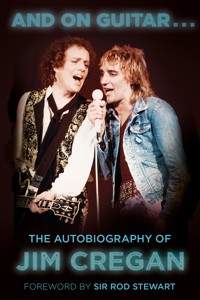
Jim Cregan's career as a rock guitarist, songwriter and producer has spanned over fifty years, touring and recording albums with stars such as Elton John, Cat Stevens, Family, Willie Nelson, Steve Harley and Cockney Rebel, Joe Cocker, The Gypsy Kings, and Katie Melua. However, he is perhaps best known for his forty-year association with Rod Stewart, not only as his guitarist but also being best friends and godfathers to each other's children. In his autobiography Jim Cregan lifts the lid on his extraordinary life, recounting his experiences with music's biggest stars, from his first band at the age of 14 playing in youth clubs in Poole to performing in front of 350,000 people in Rio de Janeiro. In And on Guitar . . . Cregan holds nothing back: from his early life and anecdotes about his family to shenanigans on the road and extraordinary tales of hedonism, love and loss, his stories feature a Who's Who of music's biggest stars.
Sie lesen das E-Book in den Legimi-Apps auf:
Seitenzahl: 360
Veröffentlichungsjahr: 2019
Das E-Book (TTS) können Sie hören im Abo „Legimi Premium” in Legimi-Apps auf:
Ähnliche


















Front cover image © Nick Busco
First published 2019
This paperback edition first published 2022
The History Press
97 St George’s Place, Cheltenham,
Gloucestershire, GL50 3QB
www.thehistorypress.co.uk
© Jim Cregan, 2019, 2022
The right of Jim Cregan to be identified as the Author of this work has been asserted in accordance with the Copyright, Designs and Patents Act 1988.
All rights reserved. No part of this book may be reprinted or reproduced or utilised in any form or by any electronic, mechanical or other means, now known or hereafter invented, including photocopying and recording, or in any information storage or retrieval system, without the permission in writing from the Publishers.
British Library Cataloguing in Publication Data.
A catalogue record for this book is available from the British Library.
ISBN 978 0 75099 185 8
Typesetting and origination by The History Press
Printed and bound in Great Britain by TJ Books Limited, Padstow, Cornwall.
eBook converted by Geethik Technologies
Contents
Foreword by Sir Rod Stewart
Acknowledgements
1 High Kings, Ukuleles and Falcons
2 What’s Our Time, Mr Wolf?
3 Setting the Cat on Fire
4 Far, Far from Ferraris
5 Hollywood and Bust
6 Bun Fight at the OK Kraal
7 A Bird Never Flew on One Wing
8 Nobody Knows Anything
9 Do Ya Think I’m Sixty?
10 Still Making Waves
Foreword by Sir Rod Stewart
How can I possibly write a forward for such a backward-thinking human being as Jim Cregan? I have friends in very high places, thankfully Jim is not one of them.
To be totally frank with you, I’ve always found this man to be somewhat tedious and boring. In fact, I always thought my used razor blades were dull till I met Jim Cregan. Tragically, he lacks any social graces and is devoid of any humour. To be honest, I’ve had better conversations with my kitchen table.
His sense of dress is not even up for discussion because it doesn’t exist. He showed up at my wedding to Penny wearing a pair of bell-bottom trousers and high-heeled boots. The heel fell off one boot so he actually limped through the whole ceremony. It was so embarrassing, I could have killed him.
As far as his musicianship goes, the only word that comes to mind is ‘rubbish’. It’s totally lacking in style and depth and bereft of any soul and, worse still, Jim Cregan can’t play football.
Together we’ve played our music to millions of people all over the world and stayed in more hotel rooms than the Gideon Bible. Touring can be tough and exhausting at times but if ever I felt rough before a show all I had to do was glance across the stage and see what Jim was wearing … and that would always make me roar with laughter.
As you have probably realised, this, so far, is all a wind-up, a ploy to get you to read J.C.’s book. The thing is, it’s been said that if a man can count his true loyal friends on one hand he is truly blessed. Well, I’m blessed to have had Jim as a dear friend for over forty years.
Jim and I have written some wonderful songs together, including ASCAP-award winners ‘Forever Young’, ‘Passion’ and ‘Tonight I’m Yours’. We’ve enjoyed fleeting debauchery, drunken falling down nights, hotel furniture rearranging, and general foolish behaviour as well as some deep, serious discussions about world affairs and relationships. Along the way, we’ve shared everything … but never our women (as far as I know).
We’ve created a million memories and had even more laughs, all of which are contained in this fantastic book.
A man could not have a better friend than you.
Love you mate …
Sir Rod
Acknowledgements
First of all, I’d like to thank everyone for their contributions, especially family members, who were, no doubt, partly hoping for something flattering to read about themselves. Good luck with that …
I’m eternally grateful to my kids, Camille, Mackenzie and Ava, for, well, everything.
To all the musicians I’ve worked with. Thanks for your dedication, skill and miscreant behaviour over the years. It’s been a blast. As with any autobiography, there will be people upset because they’re not in it and others annoyed because they are!
I must also state that in these ‘riffing yarns’ I have included many snippets of conversations that have taken place over the years, and that my memory may have played a few tricks. Some are verbatim, some are flights of fancy or even fictionalised. And while the anecdote about going on safari with Elton John is entirely true, my conversation with the water buffalo is slightly exaggerated.
I am grateful to all of the photographers whose work is reproduced. Some I have been unable to trace. Otherwise, unless credited, images are from my collection.
To all of the staff at The History Press, especially Mark Beynon and Alex Waite.
And finally my co-writer, Andy Merriman, without whom this whole farrago could have been avoided and my life would have been a lot easier.
1
High Kings, Ukuleles and Falcons
There was ‘hot’ music coming from behind the bar.
Captain W.E. Johns
Biggles in the Underworld
‘Jim, you useless bastard, where are you?’
‘Who’s this? The line’s a bit rubbish.’
‘It’s Mike, Mike Batt. Where are you?’
‘I’m in LA, what’s up?’
‘I’m stuck and I need some help.’
‘What have you done now?’
‘I need you to go in the studio and stick a singer on a track I’ve recorded over here in London. There’s a budget.’
‘Of course,’ I agreed, prompted by the promise of several beer vouchers for my trouble. ‘And who’s the artist?’
‘Lemmy,’ said he with a tone of voice I didn’t recognise at first. It contained humour, for which he is renowned, but also a tiny bit of fear. Maybe he was thinking I might forgo the vouchers and just stay home and scratch my bum. ‘It’s a track called the “Eve of Destruction” and it’s part of an album I’m doing on songs from that period with the London Philharmonic Orchestra, so there … Barry McGuire, you know the one?’
‘Yes, I know it,’ I replied, not exactly thrilled with the prospect, and fighting back a tsunami of indifference. ‘What exactly would you like me to do?’ I asked, dreading the reply.
‘Just nip in to Ocean Way Studios, stick the vocal on the back track I’ve recorded and return it to me. I’ll mix it and take it from there. Piece of cake.’
‘OK, I can do that.’
‘You’ll need to bring the track to Lemmy, so he can rehearse. He doesn’t drive so he won’t pick it up.’
‘OK, I can do that.’
I should point out here that Mike’s taste is very conservative and exceptionally musical. He’s classically trained and regularly conducts symphony orchestras. He discovered Katie Melua and has a stack of platinum records even though I’ve played on many of them.
So, armed with a cassette, I went to Lemmy’s apartment, which was located within walking distance of the infamous Rainbow Bar and Grill on Sunset Boulevard. Renowned for its groupies and pizza, it has played host to almost every touring band that there ever was. Back in the day I was there, rubbing shoulders with Joni Mitchell and Elton John while Led Zep monopolised all the best-looking women. Bastards. Later it was eclipsed by other bars, but still remains an old favourite and there’s usually some recognisable face in there.
Lemmy’s home was a one-bedroom flat in a very ordinary block quite like a motel with a walkway all around the second floor giving a view of the unnamed-contagion-ridden pool. I knocked and waited at his door. There were some strange noises.
Slowly the door cracked open and a girl slipped through the gap, all black vinyl miniskirt and smudged mascara. There were no formal introductions.
‘Hello,’ I said to the shadowy figure inside the darkened hallway. ‘I’m Jim. Mike Batt sent me to give you this tape.’
‘Come in,’ he said opening the door wide, revealing himself for the first time. ‘I’m Lemmy.’
And there he was, stark naked, except for a droopy pair of greyish paisley briefs. His pale, white, luminescent torso in vivid contrast to the multiple tattoos that covered his arms. Complete with cigarette and that shit-kicking grin.
‘Wanna beer?’ he asked, ushering me in.
‘Sure,’ I said, wondering if he would get dressed any time soon.
Now, I’ve done a lot of travelling, seen many unusual sights and consider myself somewhat unshockable.
Rubbish.
Lemmy’s flat was crammed with an enormous collection of Nazi memorabilia. There was a mannequin in one dark corner dressed in a Gestapo SS uniform which scared the living daylights out of me. A Luger automatic pistol and a Nazi dagger graced the coffee table amongst the beer cans and overflowing ashtrays. Swastika flags, helmets, guns and uniforms were everywhere you looked. He even had one of those banners they used to hang from balconies after they had taken over the Ritz in Paris.
I was completely shocked.
Unlike his surrounding paraphernalia, Lemmy was, however, very friendly and thankfully took great pains to tell me he definitely wasn’t a Nazi or a Fascist; he just liked collecting this stuff. I was much relieved. Then, still in his underpants, he showed me an old magazine featuring him on the front cover, cranked up the ghetto blaster with his latest album on it and played his Rickenbacker bass along with it, giving me a free concert.
I have to admit there was something very likable about him.
We drank our warm beer and eventually I escaped back out into the sunny LA afternoon.
‘See you Wednesday,’ I called back to him. ‘Maybe with some trousers?’
I duly picked him up for the session and was happy he was wearing his trademark black everything, complete with that hat.
‘Can you just pull over here?’ he asked after a couple of minutes.
‘Sure,’ I replied.
Then I notice we are outside a liquor store and he soon emerges with a bottle of any old whisky. It’s 1.30 in the afternoon and I’m worried …
So, we arrive at Ocean Way Studios in Hollywood and greet the engineer and assistant who are both friendly and courteous. We sit and chat for a while in the control room looking out through the glass to the main recording room. The mic and headphones are waiting for our artist and there’s a semi-circle of 8ft-high acoustic screens behind the mic, which is an absolutely normal set-up.
‘I can’t sing out there like that,’ announces Lemmy.
‘Like what?’
‘Like that, with you all watching.’
‘What do mean, watching?’
‘Y’know, staring at me while I’m singin’.’
‘We won’t be staring at you, we’ll be listening.’
‘I’m not doin’ it.’
This goes on for a while until we agree to put a full circle of screens round the mic and turn down the lights. Lemmy disappears into this grey void. A feeling of dread seeps into the air-conditioned room. We ask him to run through the song, so we can get some levels.
The disembodied voice grunts, ‘Hmm.’
We run the track and in a moment of premonition, I ask the engineer to record everything. The banter in the control room has escalated and we are now supposing that maybe Lemmy can only sing naked. Or he’s snuck somebody into the studio to help him … er … relax … or … the imagination takes wings. Which is more than can be said for the vocal performance. It’s terrible.
‘OK Lemmy, we need to do it a couple of times now we’ve got the levels,’ I lied.
‘No that’s it. I won’t get it any better.’
‘But that was just the run-through.’
‘You took it though, didn’t you?’
‘Yeah … but …’
‘Well, we’re done then.’
DEAR GOD IN HEAVEN.
I’ve got nothing. Nada. Zip.
‘Please, Lemmy,’ I beg. ‘Just one more take.’
‘No man, sorry that’s it.’
So, using every bit of Irish persuasion taught by generations of Paddys down the years, I gave him the full blarney. Both barrels for about fifteen minutes. Not a chance. Nowhere. Complete failure. Batt had paid in the region of $8,000 … to get nothing.
‘Can you give me a lift?’ he inquires, all whisky and pallor.
‘Yes, of course.’
We climb into my black 560 SEL and rip out of the parking lot.
‘Could you drop me round the corner?’
‘You don’t want to go home?’
‘Naah … take me to the strip club.’
So, we said our goodbyes on the corner of Sunset and La Brea outside a very grimy club and that was the last I ever saw of him. Living the Dream. Telling Mike Batt about it was not my favourite moment but it had an interesting postscript.
Lemmy was about to tour the UK so Mike arranged to re-record the vocal in London, producing it himself. I warned him, but to no avail. And exactly the same thing happened! Maybe Lemmy had heard Frank Sinatra supposedly only did one take. Anyway, through the magic of computers it turned out somewhat bearable.
Dear Lemmy. The real thing.
RIP.
***
In an extraordinary and coincidental twist of fate, just a couple of hundred miles away and merely a few months after Lemmy’s birth, I was born, at an early age, to Irish parents, Robert and Evelyn Cregan, in Yeovil in 1946 (hence earning Rod Stewart’s moniker as ‘the Somerset Segovia’). Third in the trio of offspring, Maurice and Joyce had already made their debuts in the Cregan band before I appeared. I never knew any of my grandparents, but that won’t stop me mentioning them. My maternal grandmother was a headmistress in the town of Falcarragh (County Donegal) where my grandfather was the postmaster. My paternal grandparents, the Cregans, were staying in Scotland at the time my dad was born. Grandfather was a stud groom working for the Ponsonby family who had estates in Scotland and Ireland. He was in charge of the stables and responsible for the horses which pulled the carriages. My dad was put up on a horse when he was 2 and promptly fell off. He never got on a horse again.
The family later moved to Limerick, and Dad, one of three siblings, attended the ‘Christian Brothers’ school that was described in Frank McCourt’s book Angela’s Ashes. He left there at the age of 13. He met my mother, Evelyn Finola Boyle, in Dublin and then both travelled to England in search of work.
Dad had a variety of jobs. He worked as a blacksmith and as a rep for the National Cash Register Co. During the war, he worked in a factory, putting tails on Hurricane fighter planes, then as a postman and aircraft fitter at Westlands before being gainfully employed in a company that manufactured refrigerated display units. He was also, and let’s keep this between us … a smuggler. Not of the kind that fought with dragoons and customs men in Cornish coves. No, his job was to smuggle suitcases full of Irish Hospital Sweepstake tickets to Kilburn where they would be sold. It was legal to own the tickets in the UK, but against the law to sell them or bring them over. It was his way of helping the poor, so I like to think of him as a sort of Robin Hood type, although he looked like a gangster. So, in fact, he was more George Raft than Errol Flynn. He was self-educated: his learning came from the radio and books, but he refused to rent a television set until I had finished my O-levels. ‘And put that guitar away,’ was a constant refrain …
My mum was one of five siblings and worked as a hairdresser in Dublin until she married Dad and they moved to London. She eventually became a full-time housewife, looking after the three of us. I was a chronic asthmatic and spent a lot of time off school. When I was 5, it was thought that the sea air might improve my condition and we all uprooted to Parkstone, near Poole in Dorset, where Dad got a job as a travelling salesman.
This was a great and generous gesture on Dad’s behalf, but sadly it made no difference to my health. What the asthma really needed was a massive dose of testosterone and so by 15 or so, I was pretty well over it. I’m not sure that my brother Maurice or my sister Joyce, then aged 13 and 11, were that enamoured with me for instigating the move. Fortunately, they aren’t the types to hold a grudge for something that happened in 1951 and so both forgave me last year.
The move did, however, begin a love affair with the sea, which continues to this day. I was in the 1st Lilliput Sea Scouts at the age of 11 and I was taught to sail in a fixed keel boat by one of the seniors. He got me out on Whitecliff Bay, tied off the jib, then settled himself in the bottom of the boat and said, ‘Right, I’m going to have a sleep. Don’t wake me unless we hit something – and don’t bloody hit anything!’ And that was it. No health and safety; I had to learn to sail.
Ours was a working-class family with aspirations to be successful. The family struggled to make ends meet, but never went hungry. We were taught good manners and to treat everyone equally. I feel comfortable with anyone from any background. This philosophy has formed my intense dislike of injustice and authoritarian regimes, which has stayed with me all my life. One of my heroes is Nelson Mandela. Any man who is locked up for twenty-six years by a vile racist government and, on release, forgives them and embarks on a programme of reconciliation, is a man I choose to admire.
Mine was a happy childhood, growing up in the 1950s in the south of England. I used to read a lot and my heroes were the flying ace, Biggles, and schoolboy William Brown, Richmal Crompton’s eponymous hero of the Just William books. Of course, I wanted to be one of them, but I suppose it was no coincidence that both these fictional characters had friends called ‘Ginger’ (their real names were never divulged) and as I sported a shock of fiery red hair, I was reduced to playing the role of supporting character rather than the lead. I was even called Ginger when I was at Longfleet Infants school in Poole. When I later attended Poole Grammar School, I joined the school boxing team, so people tended to leave me alone. Luckily, they never found out that I wasn’t much good.
There was the occasional use of the slipper by my dad if it was deemed necessary, but in terms of discipline, our mother was more pushy about exams and qualifications. Poor Joyce was sent to a convent school, which she hated because of the bullying nuns. She is seven years older than me and used to look after me when I was a toddler. My brother Maurice and I never got on as kids. He still describes me as ‘a spoiled brat’, which, of course, I am. But as soon as I turned 18, and could buy a round of drinks, we started a friendship which gets closer with each passing year.
Dad always had a car, which was unusual in those days; a Ford V8 and he used to arrange mystery tours on a Sunday afternoon. It wasn’t much of a mystery as we usually went to Lyme Regis or Weymouth. And our picnics in those days weren’t exactly lavish – it was soon after the war and so there was still rationing, but I recall those days with great fondness.
My Uncle Ernie, my dad’s brother, who incidentally looked more like my dad than my dad, always used to recount that our family were descendants of Brian Boru, the greatest of the Irish high kings, famed in saga, legend and public houses. I was once in a pub with my then wife, the singer Linda Lewis, who proudly announced to the Irish landlord, ‘My husband is a descendant of Brian Boru.’ Generously he gave us endless free drinks. ‘This royalty business is great,’ I thought but it was all fantasy, of course, and later my dad sadly had to explain it was all blarney, invented by Ernie.
We had lots of relatives across the Irish Sea and I remember gifts of turkeys and butter sent by an uncle, while we were still under the administration of rationing. I visited the family in Ireland a couple of times – once when I was 12 and more than a decade later. We visited Ballybrittas, County Laois, which I was sure was the village where my Auntie Sally lived. By now I was 22 and went into a shop and asked if Sally O’Donnell still lived nearby and the shopkeeper’s response was, ‘No, she’s moved away, but you wouldn’t be that little Jimmy Cregan, would you? Nice to see you again.’ I hadn’t been there for ten years or more and now had long hair and a beard. Must be pretty quiet round here I thought – either that or the shopkeeper has a photographic memory.
Playing music has dominated my life since I was 9, when a friend of Age’s gave me a ukulele. Oh, I’d better explain that ‘Age’ is my dad. My brother Maurice nicknamed him ‘Age’ – for no apparent reason. Oh, and we call Mum ‘Plum’ – again the Cregan archives offer no explanation. Anyway, I was given this ukulele, which, believe it or not, only had one string, so I couldn’t play chords, but I could pick out melodies and by the time I had learned Bill Haley’s legendary tune ‘Rock Around the Clock’ a few months later, I was totally immersed in music – to the extent that Age would lock the ukulele in the cupboard and not let me have it until he had checked to make sure I had done my homework properly.
When I was 12, as a Christmas present and a reward (not sure whether it was for my ukulele playing or my homework) my parents gave me a guitar and I guess that I haven’t really put the instrument down since. My first public performance was given at Poole’s ‘Central’ (there was only one) library singing Irish rebel songs and I’m convinced I have been under MI5 surveillance ever since.
Now, I remember that our family were staunch Irish Republicans. When Bobby Sands, a member of the Provisional IRA, died in 1981 after sixty-six days on hunger strike at the Maze Prison, there was much political discussion in the house. Dad stated that he admired that Sands starved himself to death for his principles. ‘Very few people would do that,’ he declared. I remember singing Republican songs at home that I had learned from family members. Our house was culturally Irish and our influences were Gaelic.
Listen to my sister and brother on the subject. Firstly, Joyce, ‘I don’t remember that at all. You’re wrong.’ And my brother, ‘Nonsense, where did you get that from? Complete rubbish!’
Now, this is an important stage of the book, because, dear reader, you must decide how much of a reliable narrator I really am. Because if you call into question my memory and my anecdotal material, then we are in trouble. So, I suggest you stick with my stories throughout and certainly at this stage – because I’m not going to tell you where Maurice and Joyce live in case you do try and verify these adolescent memories.
At home, my dad really did sing ‘When Irish Eyes are Smiling’ and ‘Phil the Fluter’s Ball’, but it was my brother, Maurice, who was initially influential in my musical education. He liked Sinatra and Ella Fitzgerald and came home one day with a jazz album by André Previn and Shelly Manne playing My Fair Lady. The sleeve notes said they had no rehearsal and had never worked together before. The passages of improvisation blew me away. We also had Shubert’s Unfinished Symphony. All right, I don’t think there was much vamping going on there, but it shows that I was being influenced in quite different directions, but that seemed normal … and still does.
Our family weren’t particularly religious, but the Catholic Church was a way of life back in the old country. The local Catholic primary school was pretty awful with so few kids passing the eleven-plus exam, so Mum decided to send me to the Protestant school in the hope of a better education. This was such sacrilege that the old Catholic priest refused to confirm me into the faith, so I didn’t have first communion or any of the other rituals. Mum despised his petty mindedness. Eventually Maurice and I, dressed in our Sunday best, would leave the house for eleven o’clock Mass but then go fishing down at Poole Quay.
Strangely enough it was my experiences on acid some years later that brought me back to believing in a higher power …
I was lying on my bed in a house in Fulham tripping madly and staring at a crack in the ceiling running from left to right. Ever so slowly the crack appeared to open like a giant pair of lips and this incredibly bright white light began to pour out. It should have been blinding but it wasn’t. The lips parted and the whole ceiling disappeared, filling the room in the dazzling display. An enormous sense of peace and love flooded through me and time stood still. It was as if I had caught a glimpse of heaven. In that moment I believed I understood everything and the meaning of life, love and the cosmos. It was a profound moment of clarity and later I read that I may have experienced the White Light described in The Tibetan Book of the Dead.
Since then I have had a very open mind to the possibilities of forces unknown to us existing in a parallel universe. I later chose to follow the teachings of Christ although I am not religious in the traditional sense and don’t attend church. In fact, I have a healthy disrespect for the Catholic Church and many of the organised religions. My parents must have felt the same because they refused to send me to the local poorly performing Catholic secondary school.
So off I went to Poole Grammar, where, at the age of 14, I formed my first band, called the Falcons. We were an instrumental group – a sort of Wessex version of the Shadows. One of my heroes was Hank Marvin. The Falcons consisted of schoolfriends; Mike Domay, Barry, who died tragically in a motorcycle accident at the age of 16 and drummer Bill Nimms, who was my best friend at the time. He became a very good artist and graphic designer.
We began playing in youth clubs and then gigs around Poole. ‘Sidetrack’ was the first song I wrote, only ever unleashed to an unsuspecting public on one occasion, which was at a school concert. I borrowed an electric guitar for our first gig, which was held at the local youth club in Church Street, Lower Parkstone. It was pretty scary, although enjoyable. My main aim was to try and impress girls in the audience. I’ve been attempting to do that with varying success ever since. We put a Shadows cover band together and played there as often as they would put up with us.
The Falcons continued to perform until halfway through the first year of my A-levels, studying art, English literature and geography at Poole Grammar School where I had somehow managed to achieve five O-levels when my dad got a job in London and the family upped sticks and whatever else we used for cutlery. I really didn’t want to move as all my mates were in Poole – not to mention the band – and I just wanted to carry on at school.
I also had my first serious girlfriend and wanted to be with her, although a recently discovered photograph of her holding my guitar in a plastic bag and looking bored probably didn’t bode well for the future of our relationship. However, I didn’t ‘kick off ’. I just accepted that there was nothing I could do about the move and accepted my lot with what I think was remarkable stoicism.
My sister Joyce was married by now and brother Maurice was in the army, so it was just me living in the suburb of Eastcote with my parents and although I wasn’t happy about leaving my friends and the band, looking back, if I hadn’t moved to London, I might not have had the career that I have had.
I enrolled at the Harrow School of Art and then also at Harrow Technical College to continue with my English lit A-level. The education system held no interest for me; I spent the next two years pretending to get an education. On the more than odd occasion that I was ‘AWOL’, I used to tell staff at the art school that I was at the technical college and vice versa. The two places of ‘learning’ never seemed to check up with each other and I was mostly in the clear. I learned a lot at art college – particularly at the life class which featured a beautiful nude model. It was the first time I had seen a naked woman. I was transfixed and only disturbed from this reverie when the teacher barked, ‘Put pencil to the paper, boy. Stop gawking and start drawing.’
I’ve remained very close to my siblings and we now live near each other in Dorset. All the family have always been really supportive about my career choice. When Joyce was older, I was in a band called Blossom Toes. We would finish an all-nighter then drive to Dorset and park our blue van outside her house, sleeping till late in the morning when she would feed us all porridge.
Both Joyce and Maurice visited me at various times when I was on tour with Rod, as did my mum and dad. In June 1979, sitting around in a hotel bar, Rod and I were reminiscing about our families, especially our brothers. As we were due in New York for about a week, whilst playing Madison Square Garden, we thought we would invite our dads and brothers for a few days’ holiday. The plan was realised and shortly after, my brother Maurice, Rod’s brothers Donny and Bobby, together with our fathers (both coincidentally called Bob) were ensconced in our hotel. There were helicopter rides over the city, which were great fun except for the fact that Rod’s father had neglected to close his door properly and almost fell out.
Meanwhile Maurice and I began to feel a little guilty that our mother had been left out, and so we schemed to bring her to New York as a surprise for Dad. Enter Federico Gastaldi. Now Federico happens to be the best socially connected man I have ever met. Equally at home with musicians, sportsmen, socialites and royalty, he now works for Formula 1. For some reason he wanted to be adopted into the Cregan clan – so he took it upon himself to oversee entertainment for my family.
Back in those days it was possible for a married couple to share a passport with both names and photos. I know, it sounds bizarre but that’s how it was. Now, this presented a problem as my father had locked the passport in the hotel safe. There was no way Mum could get to New York without it.
So Maurice, masquerading as my dad, volunteered to try and get the passport back. Using his delusional ‘smooth talking bastard’ skills but simply just lying through his teeth, he approached the front desk manager. Somehow, we knew that sending a passport across international borders without the owner, was highly illegal. Maurice was understandably nervous.
‘Good afternoon, sir,’ he oozed, flashing his perfect smile. ‘May I have my passport please? It’s in the hotel safe.’
‘Certainly sir, may I have your name?’
And my smooth-talking brother replied, ‘Maurice Cregan.’
Ooops.
After searching fruitlessly through a large pile, the manager apologised but no such passport was in the safe.
Oh bollocks.
Slightly red-faced, Maurice returned to the gang in the bar and confessed that he had failed. It was agreed that a new plan would have to be hatched and pretty quickly if we were going to get our mother over before it was time to go back. ‘Let’s tell Dad we need to buy some jewellery, to bring back to Mother, to make up for her having to stay home,’ I said.
So, we ran upstairs and burst into Dad’s room, armed with the new scheme.
‘Hey Dad, Maurice and I have seen some earrings in the jewellers in the hotel lobby. They would be a perfect gift and with your passport you can get them tax-free. All you need to do is get the passport from the safe and leave the rest to us.’
‘Not bloody likely,’ says yer man. ‘You lot would pay retail and if I’m going to get a present, I’m going to get it myself at my New York discount.’ Father had never been here before, but that wasn’t going to stop him. You see, sometime previously, in England, I had seen a very beautiful second-hand Mercedes 450 SEL and wanted to buy it. I asked father if he would negotiate it for me.
‘No, you should be able to take care of that,’ he says, toasting his aged feet in front of the fire.
‘Well, if you don’t help me, I’ll pay the asking price.’
In seconds, he was fully dressed. Coat, hat, gloves, glasses and clean underwear. Arriving at the used car lot in Sandbanks, later to become one of the most expensive used car lots in the world, he went into action. The salesman followed Dad around the car as he kicked the tyres, grumbling and muttering under his breath.
‘I don’t think much of this,’ he said, pointing to an imaginary dent.
By now, I was so embarrassed that I hid around the corner, not wanting to see the carnage that followed when Dad went to work on this poor unsuspecting guy.
About twenty minutes later Dad emerged with a grim look on his face. ‘He wanted too much money. He started off at £11,000 and I could only get him down to £7,300.’
‘What! You didn’t take it?’
‘Of course I did. I’m not bloody stupid! Melvin also offered me a job as chief negotiator.’
‘You’re on first name terms with this guy already?’
‘Sure. We’re old pals and as soon as the wounds to his wallet have healed, we’re going for a beer.’
Now you can understand what I was up against. But I digress. Maurice came up with the new wheeze and approached the front desk again.
‘Dad’s had an accident. The A&E department needs some identification and all he’s got is his membership card to “Geriatrics Anonymous” and they say that’s not enough. So please may I have his passport, so he can get treatment?’
‘I’m not sure about this sir, it’s most irregular. No, I’m afraid in this instance, I can’t help, but if there is anything else …’
Raising himself up to his full 5ft 10 and a half, Maurice, in his best retired British Army officer’s voice, barked, ‘My name is Captain Maurice Cregan, and this is my father we’re talking about. If you know what’s good for you, you’ll get the document immediately or suffer the consequences.’
Feeling like an extra in The Bridge over the River Kwai the desk clerk slouched off, giving Maurice a look like a sharpened bayonet and meekly handed over the passport. Success at last!
Later during our stay, the desk clerk saw Dad crossing the lobby with Maurice. Beckoning my brother over, he asked how come Dad was up and about.
‘Miraculous cure,’ Maurice grinned. ‘Must be the Manhattan air.’
It then fell to Federico to get the passport back to my mother in time for her to come to New York. Of course, he knew someone at British Airways and somehow persuaded a pilot to carry the passport back to Heathrow. We then called Mother and threw her into panic by insisting she board a plane the next day. Mum would normally require seven days to get her hair done and buy a new nighty.
Now for the fun part. Federico told Dad that he had this beautiful Argentinian lady friend in her 50s arriving the next day. She was well versed in the arts of love and Federico thought, as it was a boys’ weekend in New York, Dad might like to meet her, so to speak. The old man was very flustered.
‘Freddie! I couldn’t possibly entertain the thought.’
‘No of course,’ Maurice and I chimed, loyal sons to the end, ‘but who is she, Freddie, and what’s she like?’
‘Her father was a diplomat, like mine, but she was too wild for the family and branched out on her own, starting the most exclusive escort agency in Buenos Aires.’
‘And what does she look like?’ we asked.
‘Just amazing, petite, slender with long wavy red hair, a sort of Rita Hayworth type.’
Freddie had obviously done his homework, as Miss Hayworth was one of Dad’s favourite film stars.
‘Well, maybe I could just meet her,’ Dad offered nervously. So, the next evening we order a limousine to take us to Kennedy Airport. ‘I’m not sure about this,’ said father, straightening his tie, tousling his hair, and checking his nose for drips.
‘Oh, come on Dad, where’s the harm in this? You’re just going to say hello and that will be that. Oh, by the way, it’s quite a coincidence, but she’s staying in our hotel. I think it’s room 5130.’
‘Jesus, Mary and Joseph, that’s next door to me, I’m in 5132.’
‘What are the chances of that, I wonder,’ murmured Maurice.
Despite the air conditioning, Father is beginning to perspire heavily. Before long, we pull up outside the airport. Freddie tells us to wait in the car while he goes to collect Dad’s date. The tension in the car was building rapidly, Father was fidgeting and wiping his brow. Federico is about 6ft 4 and we could see his head above the rest of the crowd but couldn’t make out who he was with.
Suddenly it was clear who was crossing the sidewalk. Dad’s eyes popped out like a rude child’s tongue, his shocked face resembling Munch’s painting The Scream. Uncharacteristically agile, he threw himself to the floor of the limo shouting, ‘Bloody Hell, what’s she doing here?’ Maurice and I collapsed with laughter as our mother opened the door.
‘Well, this is nice,’ she smiled. ‘Bob, what are you doing on the floor?’
‘I dropped my glasses.’
Mum never knew and we never said …
2
What’s Our Time, Mr Wolf?
You take up an instrument, and you have a friend for life.
Stanley Lane
(Ronnie Lane’s dad)
So, following my migration to the smoke, the Falcons had flown away and despite developing a love of drawing and design, music still dominated my life. With new-found friends in West London, we formed a new group, the Coronado Four, named after the Coronado – a kind of somewhat lacklustre Fender guitar. The band consisted of yours truly (lead guitar and vocals), Adrian Sumption (rhythm guitar and vocals), the bass player was Ken McKay, who was in Johnny Kidd and the Pirates, and drummer Pete Hocking completed the quartet.
Although I was the only one of the group studying art, it was quite extraordinary how many bands in the early 1960s had met at art college. Jeff Beck attended Wimbledon School of Art, Eric Clapton was at Kingston Art College and, of course, the most iconic band with this background was the Rolling Stones. Charlie Gillett, author of the rock and roll anthology The Sound of the City, wrote:
An increasing number of school-leavers looked for ways to delay the decision of what job to take, and many opted for art school courses in printing, graphics, commercial design, and photography – as well as traditional painting and sculpture courses. Kids found kindred spirits at art colleges who shared a devotion for Ray Charles, Howlin’ Wolf and ad-hoc bands formed out of casual jam sessions.
And this was very true of my experience. I had moved on from listening to Little Richard and Elvis and had discovered the records of Jimmy Reed, Sonny Boy Williamson, Howlin’ Wolf, and B.B. King. The Coronado Four started by covering Beatles songs, but then wanted to play more blues. We also weren’t keen on the name of the band and because of our new direction, we morphed into the Dissatisfied Blues Band. We were managed by Chris Morrison who went on to handle Blur and the Gorillaz, amongst others. He was studying with me at Harrow Tech and had seen the band. But he still wanted to manage us anyway.
We initially played loads of local pubs and youth clubs. A review in the Ruislip and Northwood Gazette from June 1964 stated, ‘The group described the reception they received at the Hesdin Youth Club on Saturday night as “the best ever.” Within an hour the hall had its full quota of 300 teenagers and many others were turned away.’
Fortunately, those unlucky punters had the opportunity to catch us at more prestigious venues in the months to come when we found ourselves supporting some big-name acts at the famous Marquee Club in Soho’s Wardour Street. The London scene was pretty vibrant in those days with lots of clubs that have mainly disappeared. All that remains of the Marquee, which closed in 1988, is a Blue Plaque which states, ‘Keith Moon played here’.




