


Erhalten Sie Zugang zu diesem und mehr als 300000 Büchern ab EUR 5,99 monatlich.
- Herausgeber: epubli
- Kategorie: Sachliteratur, Reportagen, Biografien
- Sprache: Englisch
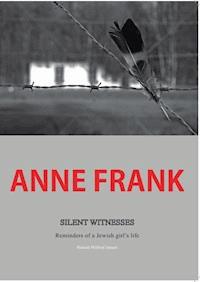
Ronald Wilfred Jansen visited Anne Frank's home addresses in Frankfurt am Main, Aachen and Amsterdam; her hiding place the Secret Annex; and the Westerbork, Auschwitz-Birkenau and Bergen-Belsen concentration camps where Anne Frank was imprisoned. His book describes her history and the objects that today still remind us of the environment in which she lived. His motivation for writing this book is that it was one of the last opportunities he would have to contact the people who knew Anne; these people revealed some new facts about her and her world. Other contemporaries of Anne Frank also contributed fascinating information about her surroundings. By tracing her footsteps, he gained a more complete picture of Anne Frank and her environment.
Sie lesen das E-Book in den Legimi-Apps auf:
Seitenzahl: 421
Veröffentlichungsjahr: 2015
Das E-Book (TTS) können Sie hören im Abo „Legimi Premium” in Legimi-Apps auf:
Ähnliche

















ANNE FRANK
RonaldWilfredJansen
Anne Frank
Reminders of a Jewish girl’s life
RWJ-PUBLISHING
‘IWANTTO GOONLIVINGEVENAFTERMYDEATH!’
(AnneFrank)
CONTENTS
PROLOGUE
Annelies Marie ‘Anne’ Frank (hereafter referred to as Anne) has come to symbolise the Holocaust, and her diary has conquered the world. A plethora of biographies and books containing historical photos have been published on her life. The travelling exhibition Anne Frank—A History for Today1 is the most visited Dutch exhibition outside of the Netherlands. The exhibition Anne Frank: Her Life in Letters (2006) 2 depicts her life in hiding with an impressive, panoramic video presentation of excerpts from her diary. Less well known to the public is the physical trail of Silent Witnesses, which serves to remind us of Anne in the (urban) landscape.
My interest in the persecution of Jews in general and of Anne in particular came about gradually. From 1994 to 1996, I participated in international voluntary projects through the Dutch volunteer foundation SIW—projects in the former concentration camps Sachsenhausen and Dachau 3 located in Germany. I wanted to enter into a dialogue with young adults from different countries. I was edging towards the second half of my thirties, whilst most of the others were in their early-twenties. Fortunately, one is never too old to learn.
We discussed Nazism and the dangers of neo-Nazism, with all of us horrified by the stories told by former camp prisoners and members of the resistance. A number of historians led discussions in the presence of local residents. Fortunately, some of them had the courage to face up to this black page in German history. Many (elderly) Germans, however, remain unwilling to face their past. We also participated in excavations and other activities; such activities were intended to foster mutual understanding, but with the secondary aim of facilitating fun together.
What struck me during these activities was the contrast between the current silence in the former concentration camps, combined with the hardships of the prisoners, on the one hand, and the harsh shouts of the camp guards during the war, on the other. I was struck by the cruelty of the Nazi regime. Especially shocking were the lampshades made of human skin. Some of the younger participants were unable to deal with the horrors of the Nazi regime. American army videos displayed shocking images of the corpses of former prisoners in Buchenwald and other camps.
I visited the Achterhuis (the Secret Annex) for the first time in 2001. Visitors tend to be deeply impressed when they visit the Secret Annex, and I was no exception. I could feel the tension of the people in hiding, and I quickly realised Anne had become caught in the Nazi web: she had been snatched away from her usual environment. Anne had a keen interest in culture, religion, science and social matters, and was always concerned with the welfare of others. As a German refugee, she felt at home in Amsterdam and was eager to reach maturity. Her murder just because she was Jewish leaves a very bitter taste in my mouth. Her life was nipped in the bud.
I felt the urge to record Anne's life, not by means of a biography or a book containing old photographs—after all, so many of those have already been published—but in a different manner.
In 2008 and 2009, I went on a memorial tour, visiting Anne’s various places of residence (hereafter referred to as main locations): her addresses in Frankfurt am Main and Aachen, the Merwedeplein in Amsterdam, the Secret Annex in Amsterdam where she went into hiding, and the Westerbork, Auschwitz-Birkenau and Bergen-Belsen concentration camps where she was imprisoned. 4 I converted this historical journey into a (photo) book. 5 The publication of the photo book proceeded with difficulty. The Anne Frank Fonds in Basel only permitted the use of five of Anne’s quotes. 6 I wanted to publish the photo book in 2009, the year Anne would have celebrated her 80 th birthday. Since I was unable to find a regular publisher for the book, I decided to publish it myself. I quickly made a selection of photographs and edited them with the use of Photoshop; I purchased historical photographs from a stock agency; I did the layout myself and published the book in 2009 through a POD 7 publisher. For the English version of the book, I had to pay Random House 8 a (modest) amount of money because I had used a few quotations from Anne’s diaries. Unfortunately, however, my attempts at obtaining subsidies were fruitless.
Nevertheless, I was not put off. I positioned several historical photographs next to current ones taken from the same perspective, which painfully revealed the void left behind by Anne. Many people thought this approach was challenging, and consequently wanted to bring my photo book to the attention of the general public. 9 Hanna ‘Hanneli’ Elisabeth Goslar (born in 1928, hereafter referred to as Hanneli) was a friend of Anne’s and liked my photo book.
The Anne Frank Stichting (The Anne Frank House) noted my original approach 10, and the Anne Frank Fonds in Basel remarked that my photographs bridge the gap between past and present. 11 In spite of this, however, neither organisation was prepared to publish my book 12, which was a great pity. I decided, however, that I would not be deterred by any of this, and would add a final sequel to the photo book and booklet.
This book will be my last work on Anne, and it will be a supplement to the existing historiography of Anne. I wrote this book as a result of getting to know more about the main locations and the surrounding environment of Anne’s residences, her hiding place, and various locations she liked to visit.
Another reason for writing this book is that time is running out for people who knew Anne to tell their story. In a similar vein, the book pays specific attention to the reasons behind why the places that remind us of Anne are disappearing.
The major monuments erected after the war, which commemorate Anne, the war and the persecution of the Jews, are mentioned in this book but not elaborated upon since its central theme is Anne’s residential environment. These monuments serve to illustrate how Anne, along with other war victims, is being commemorated.
Various sources were consulted during the course of writing this book. Since the book is being financed by private funds, it does not include any photographs of Anne purchased from stock agencies or elsewhere. 13 Ad Tiggeler 14 allowed me to use his collection of old postcards to illustrate this book. It contains excellent images, some 1 less well-known, including photographs of De Wolkenkrabber (‘The Skyscraper’, a block of flats looking out on Merwedeplein, Amsterdam). My gratitude also goes out to Jos Wiersema, who allowed me to use historical photographs from his collection 15; images that go beyond the usual pictures.
Some materials from the photo book have been reused in this publication, supplemented by current photos of a number of places Anne visited, which I learnt of in 2010 and 2011 and had overlooked when making the photo book.
Anne maintained a scrapbook with photographs. Some of the places depicted in these photographs have not been identified exactly, even if they show Anne in front of a clearly recognisable background. Following the war, so much attention went to publishing The Diaries that not all old pictures were researched adequately with regard to their origin. The bitter fruits of this are now being harvested: the location of some of the buildings can no longer be established with certainty. Fortunately, however, I was able to recognise some of the places in these photographs when I was physically tracing Anne’s footsteps.
For other photographs, however, I have not been able to establish location. One black-and-white photograph 16 shows an informal yet slightly uneasy gathering of three teenagers looking into the camera. Both boys are wearing neat suits that are in sharp contrast with their decrepit environment of bare vegetable gardens and unpainted sheds.
The youngest boy is wearing clogs. A girl in a light dress gives the photographer a rather surly look whilst pulling one of the cords on her cardigan. This girl is Anne. The two boys standing next to Anne are Herbert Wilp (1928-2002, hereafter referred to as Herbert) and Hermann Wilp (1925-1945, hereafter referred to as Hermann), who came from Neuwied near Koblenz. Following the Kristallnacht 17, Herbert and Hermann fled to Amsterdam. It is unknown where this picture was taken or what relationship existed between Anne and these boys.
Prior to travelling across Anne’s locations, I studied the relevant literature in order to garner insight into what has been written about 1 Anne and where she stayed. Many books have been written about Anne. Melissa Müller’s biography is well-structured and contains a wealth of background information on Anne. 18 The level of other writings differs greatly 19, with practically all writers elaborating on others’ themes.
The biography by Carol Ann Lee (hereafter referred to as Carol) contains several mistakes. 20 A meticulous description of Amsterdam locations reminiscent of Anne may be found in Bob Polak’s book Naar buiten, lucht en lachen! Een literaire wandeling door het Amsterdam van Anne Frank [Outside: fresh air and laughter! A literary walk through Anne Frank’s Amsterdam] (Amsterdam, 2006). His book was of great use to me. My book also contains information published before, supplemented by new facts about Anne’s places of residence and presented from a new perspective.
The Letters21 and The Diaries22 Anne wrote are the main primary sources for reconstructing Anne’s day-to-day environment, and are influenced by the opinions and interpretations of Anne, who, in turn, was influenced by her upbringing, environment and the spirit of her time. There is no information on how the others experienced the hiding: with the exception of Otto Frank (1889-1980, hereafter referred to as Otto), none survived the extermination camps. In spite of the chaotic circumstances in the Secret Annex during the fatal raid on August 4, 1944, excerpts of Anne’s diaries remained intact. Many of the letters Anne wrote whilst living at Merwedeplein have undoubtedly been lost.
Margot kept a diary in the Annex 23 that most probably also has been lost, or perhaps Margot’s diary is still hidden somewhere under the floorboards of the building at 263 Prinsengracht, in an old forgotten attic or orphaned in an archive that has escaped inventory. Who knows? New information about Anne still occasionally crops up from hidden places. In 2008, one of Anne’s postcards turned up in a gift shop in Naarden, the Netherlands 24, along with a picture of a former admirer. 25 The YIVO Institute for Jewish Research 26 discovered some 1 letters by Otto, revealing that he wanted to flee the Netherlands with his family.
The period from December 6, 1942 up to December 22, 1943 27 is absent from the A version of The Diaries. The A version is the first version of The Diaries; the B version is the version rewritten by Anne herself, which she planned to publish in the form of a novel after the end of the war. The B version was never completed, probably because Anne was arrested, and ends on March 29, 1944. I prefer to take the A version, written by Anne between June 12, 1942 and August 1, 1944 as a point of reference because it is the uncensored version in which Anne wrote down her thoughts unreservedly and without consideration of her audience. In some places, the B version contains information that is lacking in the A version.
Otto contributed to a C version of The Diaries: The 1947 Dutch edition of Het Achterhuis [The Secret Annex], published by Contact, from which certain sensitive passages were removed by Otto 28. The academic publication of The Diaries29, meant to scientifically refute the accusations by far-right extremists who claim The Diaries to be a forgery 30, contains sensitive extracts written by Anne, which Otto had systematically kept out of previous publications.
A booklet containing difficult words that Anne wrote down 31 and the card catalogue of books 32 kept by Anne and Margot have not been found. An accounts book in which Anne noted down texts that appealed to her whilst she was in hiding has been preserved: the Mooie Zinnenboek , her Book of Beautiful Sentences (Amsterdam, 2004). (Please refer to the Bibliography section, Translator’s Note, for more information on English editions and translations of titles in the). Some separate notes from the Secret Annex by Anne were preserved, and she also wrote stories, and in 1944 worked on a novel whilst hiding in the Annex. These were published in Dutch as Verhaaltjes, en gebeurtenissen uit het Achterhuis. Met de roman in wording Cady’s leven (Amsterdam, 2005), and in English as Tales from the Secret Annex. Including her Unfinished Novel Cady’s Live (Halban Publishers, 2010). The stories this book contains are partly anecdotes from the Annex, partly made-up fairytales and partly derived from 1 memories of the Jewish grammar school she attended, the Joods Lyceum. Both her stories and her prospective novel contain autobiographical elements: ‘It isn’t sentimental nonsense for it’s modelled on the story of Daddy’s life.’ 33 Anne does not elaborately describe her residential environment in her writings, presumably because it was a given to her—just like it is a given for us that we are free to walk down the street. One only notices that something is missing when it is gone. It was the same for Anne. During her period in hiding, she became more aware of the value of nature, fresh air and having some elbow room, and she described the chestnut tree, the birds and the sky above Amsterdam. Comparably, Anne did not write about her residential environments in Aachen and Frankfurt in any detail; she lived there only very briefly, and may not have remembered much about those places of her early childhood. During her hiding period, Anne mainly felt Dutch and probably did not feel any need to be reminded of her native country.
I was unable to obtain permission to consult the Frank family archives. I am unsure as to whether this would have proven useful; the exhibition Anne Frank—Her Life in Letters in the Amsterdam Museum in 2006 34 did not lead to new insights into Anne and her places of residence. Moreover, some other authors have already conducted extensive research in the Anne Frank Stichting archives.
I was unable to find specific sources, such as postcards or letters, Anne may have written in one of the concentration camps. She may have been prevented from writing—or perhaps she came to lack the strength. Many of the materials from the camps in which Anne stayed have been lost to posterity, meaning that her life in the camps can only reconstructed through the eyewitness accounts of others.
I sought contact with people who (superficially) knew Anne and who were able to tell me about locations she had visited but did not mention in her writings. Whilst travelling along Anne’s locations generally went fine, the contact with her former friends and acquaintances was more difficult. At times, their memory failed them, and they would make contradictory statements. Asking additional question occasionally led to irritations.
Even today, some people continue to argue about who was or was not a friend of Anne’s. 35 Some people who knew Anne and Margot are tired of the war and the attention that goes out to Anne. 36 Some do not like to be reminded of the loss of their family.
Some who were born during or shortly after the war are too young to remember anything concrete about that time. For many survivors, a visit to their old neighbourhood, the Rivierenbuurt, is very difficult. Hilde Goldberg-Jacobsthal (born in 1925, hereafter referred to as Hilde) had not been to her neighbourhood since 1943. 37 Sometimes a person’s health prevented me from having any contact; they understandably wanted to be left alone. Unfortunately, I had not been able to contact Hermine ‘Miep’ Santruschitz (1909- 2010) before she passed away. Miep was the last surviving helper of the people in the Annex.
In 2010, I had a telephone conversation with Anne’s friend Hanneli. This led to some new information on Anne’s places of residence in Amsterdam. I am grateful to her and to the many others who helped me, such as Bernard ‘Buddy’ Elias (born in 1925, hereafter referred to as Buddy), all of whom are mentioned in the ‘Special thanks to…’ section of this book.
Various websites offered me the opportunity to publish a general request for information about Anne and her residential environment. 38 Through the ‘Zuidelijke Wandelweg’ 39 and ‘Anne in de buurt’ 40 community projects, I was able to reach people who did not belong to Anne’s direct circle of friends but who did have important information on her previously unknown places of residence. ‘Zuidelijke Wandelweg’ and some other websites contain valuable information on the Rivierenbuurt, where Anne spent many years of her life.
Several German papers 41 only wanted to publish my request for sharing information about Anne if I paid them for it, which I declined because Anne is not a commercial product to me. What she left us is public cultural heritage.
Persons who have (in)direct experience of the war in Amsterdam provided me with a large amount of useful information about the war. 42 Karel N. L. Grazell (born in 1928, hereafter referred to as 1 Karel), who became one of Amsterdam’s municipal poets, and Max C. van der Glas (born in 1938, hereafter referred to as Max) 43, who is a writer and Holocaust survivor, did not know Anne in person, but they do know Amsterdam and its history extremely well. 44 I reached people through the internet whom I would not have been able to reach through any organisation. I would gather information on the architecture of buildings and neighbourhoods in Amsterdam mainly from websites of the Nederlands Architectuurinstituut (NAI, the Netherlands Institute of Architecture) 45, Gemeente Amsterdam Bureau Monumenten & Archeologie (BMA, the Amsterdam municipal agency for monuments and archaeology) 46 and Joods Amsterdam (Jewish Amsterdam). 47 Some elements that have disappeared from our landscape for good can be reconstructed virtually. I was fortunate enough to see Anne’s chestnut tree ‘live’ from the Annex before it was blown down in 2010, but it can also still be admired in The Secret Annex Online. 48 The Secret Annex Online also served as a reminder during my reconstructions, and I would highly recommend it to anyone who has difficulty walking and would otherwise not be able to visit it.
I did not find any local papers that the Franks may have read during the war. Presumably, local papers were not distributed during WWII because paper was scarce and the strict German censorship suppressed their publication. Anne does not mention the Amstelodamum magazine that appeared during the war. However, an entrepreneurs’ magazine dated January 11, 1940 states that Anne solved their puzzle and could collect her prize. 49 However, consulting archives, reading, interviewing people or looking up information on the internet did not suffice for the purposes of this book. Travelling deepened my connection with Anne’s environment, the distance between her places of residence, the size of her living space, and the elements reminiscent of her in the (urban) landscape. I could only experience the void Anne left behind by perceiving the world from her point of view.
I visited Amsterdam and Aachen again in 2010 and 2011 for the purpose of gathering additional information. The persons and 1 organisations involved provided permission to visit and record the locations inside and out, and I am very grateful to them.
Hopefully, the reader will be inspired to visit Anne’s places of residence and share their experiences with others so that more people will take up an interest in Anne’s cultural heritage, which extends beyond the Secret Annex, her diaries, and old photographs.
This book will hopefully contribute to the inventory and the preservation of the monuments that remind us of Anne. Private individuals, cultural institutions, research institutes and the government can contribute to this. A great deal of information about Anne is scattered, and there are things we still do not know.
It is important that the study of Anne’s cultural heritage stimulates research into the physical traces left behind by other war victims so that they all get the attention they deserve 50; after all, Anne is just one of millions of Holocaust victims.
1http://www.annefrank.org/en/Education/Travelling-exhibition/Introduction-international-exhibition/ .
2http://www.ymere.nl/ymere/index.asp?id=125 (Dutch only).
3 I published a small report on my journey in the Dachau Newsletter by the Foundation for Friends of Former Dachau Prisoners: Nieuwsbrief Dachau (Stichting Vriendenkring van Oud- Dachauers. Nr. 9 – December 1994) pp. 8-9. (Dutch only). The local media also covered the Jugendbegegnungszeltlager (youth gathering) in which I participated (Süddeutsche Zeitung, 10 August 1994), p. 7 (German only).
4 Reports of my journey were published on http://joodsactueel.be/2011/01/03/in-de-voetsporen-van-anne-frank-1929-1945/ and in a heritage magazine: Jansen, Ronald Wilfred. Stille Getuigen. Sporen van Anne Frank in het (stedelijke) landschap [Silent Witnesses. Reminders of Anne in the (Urban) Landscape], in: Monumenten. Hét tijdschrift voor cultureel erfgoed [Monuments. The Cultural Heritage Magazine] (Volume 32, issue 5, May 2011) (both Dutch only).
5 My English photo book: Jansen, Ronald Wilfred, Anne Frank. A Memorial Tour in Current Images (2009) and its Dutch original are listed in the catalogue of the German National Library ( http://d-nb.info/998592757 ). The English version is part of the United States Holocaust Memorial Museum library collection. ( http://catalog.ushmm.org/vwebv/search?searchCode=GKEY%5E&searchType=0&searchArg=memorial+tour+in+current+images ). ‘ In his photo book, Ronald Jansen reveals how our physical landscape contains reminders of Anne’s arrival and departure, presence and absence. Jansen tours Anne Frank’s home addresses, her hiding place and the concentrations camps where she was imprisoned, i.e. Westerbork, Auschwitz-Birkenau and Bergen-Belsen. In his report of this project, which he himself describes as a memorial tour or historical journey, Jansen takes old photos from the archives and puts them next to the pictures he has recently taken from the same perspective. One of the photographs, taken in the summer of 1932, shows three-year-old Anne playing with water in her garden. The photo taken decades later portrays the stones that were once a part of this scene. The building and the courtyard [Ganghoferstrasse 24, Frankfurt am Main, Frank family residence] are still there, but there are no children playing. In this way, Jansen captures the void Anne left behind.’ (Borgman, Erik and Liesbeth Hoeven, Sporen van afwezigheid. Gedenken in stemmen, stenen en stilte [Traces of Absence: Commemorating in Voices, Stones and Silence] (Zoetermeer, 2011), p. 55. The residence stated in the books published by Unibook—which have been withdrawn from the market—is incorrect: Anne did not reside at 5 Liebfrauenstrasse in Eschweiler at this time but at 5 Elsa-Brändström-Strasse in Aachen. I am grateful to the Anne Frank Stichting for pointing this out to me (email dated 14 August 2009). The paperback edition available through CreateSpace does state the correct address and also contains a current photo of the building. This English edition is available in full colour (ISBN 9781466281936) or in black and white (ISBN 9781463714345). Since 2011, my photo book has been available in the Netherlands and Belgium through POD publisher www.mijnbestseller.nl (ISBN 9789491080555 (English version) and ISBN 9789491080432 (Dutch version)). In 2011, I also published a black and white paperback booklet on Anne Frank at Mijnbestseller: In de voetsporen van Anne Frank (Following the footsteps of Anne Frank, ISBN 9789081423847).
6 Email from the Anne Frank Fonds, 16 February 2009.
7 POD stands for ‘Print on Demand’. In POD, the author generally provides the text and lay- out. Most POD publishers in the Netherlands will provide registration at the central distribution centers in the Netherlands and Belgium (Centraal Boekhuis and Libris respectively). More information can be found on https://portal.boekhuis.nl/cbonline/ . The POD publisher will often take care of sales and distribution. Seeking publicity is usually the author’s task. Hoogeveen.nu (2 July 2009), Reformatorisch Dagblad (11 November 2009), Weekblad Meppel (25 August 2009), Auschwitz-Bulletin (53, no. 3, September 2009), the Krant van Midden Drenthe (19 August 2009), De Echo (‘Zuid’ edition, 3 February 2010), The Frankfurter Rundschau (13 June 2011) and the NIW (31) wrote about my publications. The Hoogeveensche Courant (26 June 2009 and 14 August 2009) wrote an elaborate article on my photo project. The Krant van Hoogeveen (25 August 2009), Dagblad van het Noorden (01 July 2009), Meppeler Courant (2 July 2009) and various other local (internet) media ( www.deloodsboot.nl ) and websites (http://anne-frank.startpagina.nl/ ,http://concentratiekampen.loggy.nl/ ,http://www.goethe.de/ins/nl/ams/nlindex.htm?wt_sc=nederland ,http://www.stiwot.nl/ ) covered my publications on the internet. My gratitude goes out to all of them for their interest—especially the Hoogeveensche Courant .
8 ‘Random House is the exclusive licence holder for all Anne Frank texts in English within the US and Canada. They paid us a lot of money in order to acquire those rights, which is the reason they can decide whether or not to grant publishing rights of English Anne Frank texts and whether or not they want to charge money for it. This is normal procedure in international publishing.’ (Email from the Anne Frank Fonds, 1 September 2009).
9 Verenigingsblad Waffel (June 2010, no. 44).
10 ‘This book contains beautiful photographs. It is an excellent idea to take pictures of the places Anne has been to.’ (Translation of a Dutch email from the Anne Frank Stichting, 14 August 2009).
11 ‘So far two members of the board are each holding a copy of your book and they are both very impressed with the book and like it very much.’ (Email from the Anne Frank Fonds, 17 August 2008).
12 Email from the Anne Frank Stichting, 17 February 2009. The Anne Frank Stichting was of the opinion that my book did not fit their objectives. I do not really understand their point, but of course I respect their decision. The Anne Frank Stichting employs its own writers who publish books on Anne and sell them in their shop.
13http://www.gettyimages.nl/ .
14http://members.casema.nl/a.tiggeler/ .
15http://www.amsterdamsetrams.nl/ .
16http://www.gettyimages.nl/detail/3229104/Premium-Archive .
17 The Kristallnacht was a pogrom organised by the Nazis against Jewish people in Germany (9-10 November, 1938).
18 Melissa Müller does a great job of separating main topics from side ones, structures her book well without losing sight of the chronological order of events and manages to place Anne in a broader context. Dutch edition: Anne Frank. De biografie (Amsterdam, 1998) English edition: Anne Frank: The Biography (Macmillan 2013).
19 Even now, new books about Anne are being published, some of which provide a new perspective. An example is Francine Prose’s work Anne Frank. Leven en werk van een schrijfster (Amsterdam, 2009) which emphasises Anne’s artistic talents. English editon: Anne Frank: The Book, The Life, The Afterlife (Harper Collins Books, 2009). Anne’s life is also 19" available as a graphic novel (Jacobsen S. and E. Colón, Anne Frank. The Anne Frank House Authorized Graphic Biography (Anne Frank House, 2010)).
20 Carol Ann Lee states that Hanneli and her family emigrated to the US in 1940 (Lee, Carol Ann, Pluk rozen op aarde en vergeet mij niet. Anne Frank 1929-1945 (Amsterdam, 1998) p. 82). English editon: Roses from the Earth: The Biography of Anne Frank (Penguin Books, 2000). In fact, Hanneli was deported to Bergen-Belsen. On page 83, Carol writes that Otto’s office was located at Singelgracht, but his office was at Singel (no. 400, Amsterdam). (Lee, Carol Ann, Pluk rozen op aarde en vergeet mij niet. Anne Frank 1929-1945 (Amsterdam, 1998) p. 68).
21 Anne Frank Stichting, Anne Frank. Haar leven in brieven [Her Life in Letters] (Amsterdam, 2006).
22 Official English title of The Diaries : The Diary of Anne Frank: The Revised Critical Edition. The Netherlands Institute for War Documentation (New York, 2003). Original Dutch title: De Dagboeken van Anne Frank. Rijksinstituut voor Oorlogsdocumentatie (Amsterdam, 1990/2001).
23 The Diaries, 28 September 1942.
24http://www.geheugenvanplanzuid.nl/tijdtijn/kaartAnneFrank.htm .
25 De Telegraaf, 26 February 2008.
26http://www.yivoinstitute.org/
27 In The Diaries (20 May 1944) Anne describes how a toppled vase ruins some of her work. This may have included entries from her diary.
28 Otto had recently lost his family, so it is quite understandable that he left out Anne’s curses directed at her mother.
29De Dagboeken van Anne Frank , Rijksinstituut voor Oorlogsdocumentatie (Amsterdam, 2001).
30http://www.stormfront.org/forum/t215308/ .
31 ‘I learnt same more new words today, ‘bordeel’ [brothel] and ‘cocotte’ [floozie], I bought a separate booklet for those.’ ( The Diaries , 28 October 1942).
32 ‘Father made Margot and me a filing box with cards that are blanc on one side. This will become our card catalogue of books; we will both write down what books we have read, by whom they were written and the date.’ ( The Diaries , 27 February 1943).
33The Diaries , 11 May 1944.
34http://www.ymere.nl/ymere/index.asp?id=125 .
35 Eva Schloss’ book ( Herinneringen van een joods meisje [Memories of a Jewish Girl] (Breda, 2005)) states that she became Anne’s friend. Eva lived at Merwedeplein during the same period as Anne. Anne does not mention her in her diary.
36 ‘I NEVER read Anne’s diary, in spite of the fact that my daughter left it in our house for over a year. And probably I never will. My opinion on all those publications is the subject is being milked out (...) I think history has become too much focused on Anne, while so many other things were going on in the neighourhood [Francien lived near the Franks].’ (translation of a Dutch email from Francien Bachra, 21 December 2010).
37http://www.geschiedenis24.nl/andere-tijden/afleveringen/2002-2003/Hilde-Goldberg.html
38 http://www.bijbelaantekeningen.nl/blog/2011/01/19/oproep-informatie-over-anne-frank-gezocht/ , De Weekkrant Amsterdam 11 January 2011 p. 4, http://www.dichtbij.nl/amsterdam-zuid/regionaal-nieuws/artikel/1882689/gezocht-getuigen-anne-frank.aspx ,www.echo.nl 28 December 2010, http://hetverhalenarchief.nl/user-stories , Nieuw Israelietisch Weekblad ( NIW ) 17 14 January 2011 p.37, http://rivierenbuurt.weblog.nl/2008/05/08/profielschets-stadsdeelvoorzitter/ ,http://www.seniorennet.nl/forum/viewtopic.php?t=71829&sid=432713e3d58f49e9b534626b863b51a5 . , http://www.deweekkrant.nl/pages.php?page=1528934 , Weekblad De Echo Editie 20" Amsterdam Oud-Zuid 2 February 2011, http://www.joodswelzijn.nl/de-Benjamin-Joodse-agenda/Oproepjes-activiteiten-ingezonden-door-lezers.aspx . The Centraal Joods Overleg (CJO, the Netherlands Central Jewish Consulting Body) does not have a magazine and only places content on their website that is directly related to the CJO. Some organisations, such as Gedenkstätte Bergen-Belsen and the Stadtbibliothek Aachen, do not have a newsletter. The Westerbork Camp Memorial Centre (Herinneringscentrum Kamp Westerbork) and the Anne Frank Stichting in Amsterdam did not reply when I asked for permission to publish a request for information about Anne.
39http://www.zuidelijkewandelweg.nl/ .
40http://www.anne-in-de-buurt.nl/ .
41Frankfurter Allgemeine Zeitung( www.faz.de ), http://www.zeitungsverlag-aachen.de/ ,http://www.az-web.de .
42 Max C. van der Glas.
43http://www.geheugenvanplanzuid.nl/ingezonden/113.htm .
44 This also applies to some of Anne’s other former neighbours who may have seen Anne without knowing. ‘I am afraid I cannot help you because I never met Anne. Still, our paths must have crossed regularly since we lived in Niersstraat across the school that Anne attended for a few years. By coincidence, I worked at Sporthuis Centrum in 1961, and there I became acquainted with a girl from Rotterdam who would travel up and down between Amsterdam and Rotterdam. She later found a room with the Vergnes family at 15 Merwedeplein . This means we know the roof terrace very well, although it was quite a feat to climb up there because it had no regular exit. Incidentally, I married that girl, and that will be 48 years ago this January [2011].’ (Translation of email from John Hendriks, 22 December 2010).
45http://www.nai.nl/bezoek/info .
46http://www.bma.amsterdam.nl/ .
47http://www.joodsamsterdam.nl/ .
48http://www.annefrank.org/en/Subsites/Home/ .
49 The periodical’s title is The Consumer [De consument. Officieel orgaan op verkoopgebied verspreid door winkeliers aangesloten bij de Vakvereniging E.M.M] dated 11 January 1940. Page 7 lists the winners of puzzle 77 and 78. Anne Frank, 37 Merwedeplein won a photo album in group B (to be collected from shopkeeper J. v. Zalingen). In addition to a childrens’ page, the periodical contains recipes, a serial and advertisements. Mrs. S. L. L. Fransen presented the periodical as a gift to the Anne Frank Stichting in 1996. (Email from the Anne Frank Stichting, 15 December 2011).
50 ‘Some are able to appreciate that [i.e. memories of Anne]. But we are her contemporaries and we lived in the same neighbourhood. We have seen so many houses being raided and none of those received the same attention. If I had had a say in it, the Merwedeplein residence would just have been rented out or sold.’ (Translation of a Dutch email from Francien Bachra, 8 January 2011) Her lively memories of the Rivierenbuurt can be read on: http://www.zuidelijkewandelweg.nl/ingezonden/francienvanderveenbachra.htm .
FRANKFURT AM MAIN
Anne’s Jewish ancestors in Germany were confronted with anti- Semitism and economic hardship as far back as the 17 th century. Anti- Semitism—hostility against Jews—is as old as the hills.
In 1806, emperor Napoleon I (1804-1815) established equal rights for Jews in Germany. Germany consisted of independent principalities at the time, with Prussia and Austria as its leading states. During the German Empire (1871-1918), Jews could participate in public, economic and social life like all other citizens.
During the course of the 19 th century, the German Empire industrialised rapidly; however, not everybody profited equally from these developments, and anti-Semitism rose amongst national- socialists, communists and conservatives. Many anti-Semitists were less successful in (banking) business and science than the Jews, and the government protected the Jewish community because they contributed considerable funds to the treasury.
Industrialisation, capitalism, fierce competition and theories centred on the survival of the fittest became prominent in economic practices. Many European countries sought to expand their territory and were engaged in a fierce battle for colonies and natural resources, which accelerated the rise of nationalism and racial classification theories.
During the German Empire, anti-Semitism was generally not expressed openly. Around 1900, however, the Bahnhofhotel Kölner Hof manager came to hate Jews to the extent that he prohibited them from entering his premises. The beer barrels were inscribed with degrading slogans about Jews, such as: Der Jude ist nicht ein Teutscher sondern ein Täuscher (Jews are not Germanic; they are cheaters), Nicht ein Bürger, sondern ein Würger (Not citizens but stranglers), Das Judentum […] verdient […] Ausrottung (Judaism deserves to be exterminated) and Kauft nicht bei Juden (Do not purchase from Jews) 1. In spite of the open hostility against the Jewish, however, many Jews remained loyal to their native country.
Anne’s (great) grandparents adopted German customs and habits, working their way up into the well-to-do, educated upper class of Jewish entrepreneurs in Frankfurt am Main.
Because of its strategic location at the river Main, Frankfurt am Main grew into a major trade centre over the course of the centuries.
Otto Frank did not attend a Jewish school. Instead, he attended advanced secondary education at the public Lessing Gymnasium. Following his graduation in 1908, Otto enrolled in a postgraduate course on economics at the Heidelberg University. However, he quit his studies after a few months, choosing to take up a position with a bank; subsequently, through a fellow student, he was offered the chance to gain work experience at Macy’s department store in New York. Otto left for the United States in September 1909. Unfortunately, he had to return shortly afterwards because his father passed away on 17 September 1909. Following a brief return, Otto went back to the US. This time, he stayed for two years. He spent his first year working at Macy’s department store before taking up a position at a bank. He returned to Germany in the autumn of 1911. Otto started out working for a company in Düsseldorf, which produced window frames. After a while, he joined a company producing horseshoes. 2 The suppressed frustrations and internal tensions came to a head in WWI: ‘Like the majority of Germans, the Jews responded to the August 1914 declarations of war with enthusiastic nationalism’. 3 The Centralverein deutscher Staatsbürger jüdischen Glaubens (Central Committee of German Citizens of the Jewish Faith) sent out an appeal: ‘To the German Jews! In this fateful hour, our native country is calling its sons to arms. It speaks for itself that every German Jew who is called for duty is prepared to sacrifice his life. Fellow believers! We appeal to you to dedicate your strength to your native country and exceed your duty! Take up arms voluntarily! All of you, men and women alike, should serve your country by personal service of any kind and by providing funds and resources! Berlin, 1 August 1914.’4 2 Incidentally, conscription made enlistment in the armed forces compulsory at this time.
Propaganda by the German empire, as well as the prevailing public opinion in Germany that Russia had started WWI, caused the patriotism of German Jews to increase. Because of the pogroms in Russia and the Russian expulsion of Jews, German Jews felt especially militant.
WWI was the first military conflict on an immense scale in which new technologies and poison gas were deployed. Many young soldiers died in the trenches. Over 17 million soldiers and civilians died during this Great War. Eventually, Germany was defeated.
Otto Frank had been an officer in the German army and took Germany’s defeat as a personal failure.
Following WWI, Germany was in an afflicted state. It was suffering from a severe economic crisis and pervasive unemployment. The country had been devastated. The Germans regarded the Treaty of Versailles (1919) as a major defeat. Germany was heavily impacted by its loss of territory, the forced dismantling of its army and the compensatory payments resulting from the Treaty.
During the Weimar Republic (1918-1933), the Jews were formally equal to other citizens; in practice, however, the crisis led to increased nationalism and anti-Semitism. Many blamed the Jews for the military defeat and the resulting hardships.
During this period, the Frank family bank experienced great difficulties as a result of the various restrictions imposed upon the currency trade. Privately, the Franks also experienced major financial losses; their savings had evaporated due to inflation, and their war shares, in which they had invested considerably with a view to German victory, had become void. 5 The pre-WWII patriotic enthusiasm of German Jews can be compared to the current patriotism of Jews in the Netherlands. Most Dutch Jews support the royal family and happily join in singing the national anthem Het Wilhelmus at official gatherings, both domestically and abroad. Notably, however, it was the same in Germany before the onset of WWII. 6 2 Following the German defeat, many German Jews devoted themselves to supporting democracy and socialism, 7 with a great number of them actively involved in interest groups, such as the Reichsbund jüdischer Frontsoldaten (national league of Jewish front soldiers), established in 1919, which looked after the interests of Jewish WWI veterans. Many Jews in Germany also provided support for the Ostjuden, who were subjected to heavy persecutions in Russia. As far as I am aware, the Franks were not (very) active in politics. After WWI, Otto reluctantly took over the bank from his mother and his brother Herbert Frank (1891-1987, hereafter referred to as Herbert). 8 Herbert was not a very talented banker, and his eldest brother, Robert Frank (1886-1953, hereafter referred to as Robert), 9 was not interested in taking over. 10 Otto was not a born banker, either. He had aborted his undergraduate course in economics and, according to Anne, was not particularly good at maths. ‘I flatly refuse to do these foul math problems every day. Daddy Agrees that they’re horrible. I’m almost better at them than he is, though neither of us is much good and we have to fetch Margot all the time,’ Anne wrote whilst in hiding. 11 The family bank in Germany was performing poorly. In 1923, Otto opened M. Frank & Zonen—a Dutch branch of the German family bank—in a stately building on a canal in Amsterdam (604 Keizersgracht). This was risky business: there was a dire scarcity of currencies in Germany and various restrictions were in force pertaining to banks that wanted to trade currencies.
This coincided with the failed coup by Adolf Hitler (1889-1945, hereafter referred to as Hitler) on 9 November 1923, and his consecutive brief detainment during which he wrote Mein Kampf, which was to become the National Socialist bible. It was still relatively quiet in the Netherlands.
On 31 December 1923, Otto registered the bank’s Dutch affiliate with the Amsterdam Chamber of Commerce. Otto appointed Johannes ‘Jo’ Kleiman (1896-1959, hereafter referred to as Johannes) as his main accountant. M. Frank and Zonen did not do well; the bank went into liquidation in 1924.
The premises on 604 Keizersgracht 12 currently host various companies. The old architecture is still visible in many of its details, such as its letterbox and door knobs. There are many beautiful buildings with a rich history on Keizersgracht.
Otto married 25 year old Edith Holländer (1900-1945, hereafter referred to as Edith) on 12 May 1925, his birthday, in the synagogue in Aachen. Photographs show a radiant couple on their honeymoon in Italy. It was a marriage of convenience, and Edith’s capital was of great use to Otto. Edith received a monthly allowance from her mother Rosalie ‘Rosa’ Holländer-Stern (1866-1942, hereafter referred to as Rosa) from Aachen. 13 Otto had been engaged before. 14 ‘(…) I think Father married Mother because he thought she was the best replacement for his fiancée (...) it cannot be easy for a loving wife to know that she will never occupy the first place in her husband’s heart,’ Anne wrote in her diary. 15 After the wedding, the couple took up residence in the home of Otto’s parents at 4 Mertonstrasse in Frankfurt am Main. Otto’s father, Michael Frank (1851-1909, hereafter referred to as Michael), 16 had purchased this semi-detached house in 1901. When his father died, his widow, Alice Betty Frank-Stern (1865-1953, hereafter referred to as Alice), was left in charge. The large, stately urban villa was suitable for the well-to-do upper middle class. It was located in an elegant residential area, and had a separate entrance for servants, 17 three balconies at the front, a dome, a central tower, and a large garden.
Otto and Edith had two daughters. Their first child, Margot Betti Frank (1926-1945, hereafter referred to as Margot), was born on 16 February 1926. Halfway through 1927, when Margot had just started walking, the family rented an apartment in a villa at 307 Marbachweg in the Betramshöhe area on the outskirts of Frankfurt am Main in the Dornbusch district—approximately three miles north-east of Mertonstrasse. 18 The rent was affordable for the Franks. 19 The family lived at 307 Marbachweg, which was a semi-detached home like 4 Mertonstrasse, until late March, 1931. This large residence remains to this day, situated on a crossroads in a Frankfurt 2 am Main suburb. It was built by its former landlord with the support of the Frankfurt am Main Teachers’ Association.
The Franks inhabited the left side of the complex. The house actually comprised two separate living spaces, one on the first floor and one on the second, which were connected by a staircase. The family’s living room, dining room and library were downstairs. Otto and Edith were not intellectuals, but they did read widely. I suspect Otto was not very interested in Jewish history. In 1922, the Museum Jüdischer Altertümer20 opened in Frankfurt am Main (the Museum of Jewish Antiquities at 14/15 Untermainkai). I do not know whether the Franks visited this museum (with any interest).
In addition, the Franks’ residence contained a kitchen, bathroom, and a room for Edith. The small room was furnished with Edith’s elegant writing desk, which she had brought from Aachen, and a bookcase in which she kept her Hebrew prayer books. Otto was not interested in Jewish customs or the Torah. Edith’s family celebrated Jewish holidays, ate kosher foods 21 and were prominent members of the Jewish community in Aachen. I cannot tell whether Otto’s and Edith’s parent would have gotten along well.
Otto and Edith’s bedroom, Margot’s bedroom, Edith’s study and the maid’s room were upstairs. The guest room at the back of the house had a balcony with potted flowers. Edith loved flowers. At the back of the Marbachweg residence there was an entrance leading to the basement and a play area.
Edith’s parents and her brothers, Julius Holländer (1894-1967, hereafter referred to as Julius) and Walter Holländer (1897-1968, hereafter referred to as Walter), often came to visit from Aachen. Anne and Margot’s uncles would regularly take them by car to their grandmother in Aachen.
The landlord resided on the ground floor of number 305; the first floor was inhabited by the Stab family. Their neighbours at number 303 were the Naumanns.
On 12 June 1929, when Margot had just turned three, Anne was born in the Klinik des Vaterländischen Frauenvereins in der 2 Eschenheimer Anlage22 in Frankfurt am Main—a joyful family occasion.
In summer, the family liked to sit on the balcony at the back of the house, which overlooked a small garden and the street. The children would swing or play in the Stabs’ sandpit. The Marbachweg area was a green area with plenty of space for children to play.
In October 1929, the year of Anne’s birth, share prices at Wall Street crashed, which initiated a worldwide economic crisis that would last for many years. Tens of millions of people suffered because of unemployment and poverty—not only in America but also in Europe. Germany was afflicted the most by the crisis because of the burdensome WWI compensatory payments. The global crisis also severely affected the family bank.
The bank had to move to less costly premises on the edge of the city centre, at 20 Bockenheimer Anlage. In her diary, Anne refers to her parents’ financial situation as follows: ‘Daddy was born in Frankfurt am Main, his parents were immensely rich, Michael Frank owned a bank and became a millionaire and Alice Stern had very rich and distinguished parents. Michael Frank had not been at rich when he was young, but he duly worked his way up. In his youth Daddy had a real little rich boy’s upbringing: parties every week, balls, festivities, beautiful girls, waltzing, dinners, a large home, etc., etc. After Grandpa’s death [in 1909] all the money was lost and after the World War [WWI] and the inflation nothing was left at all.’23 The crisis and the inability of governments to turn the tide provided fertile ground for fascism in Europe. Hitler’s national- socialists were rapidly gaining ground in Frankfurt am Main and throughout Germany and, as usual, blamed the Jews for the crisis and ensuing unemployment. Since Frankfurt am Main was an important financial centre and the Jews had always been very influential there, the national-socialists regarded Frankfurt am Main as the place from which the Jews wanted to establish their worldwide rule.
Jews were increasingly confronted with harassment. Otto’s parents were members of the B’nai B’rith association. 24 This support 2 group, run for and by Jews, had been established in Amsterdam in 1924. Although Otto was not very interested in Jewish traditions, he was very concerned for the fate of the Jewish people.
According to author Melissa Müller, one-fifth of the population of Westend—a district in Frankfurt am Main—was Jewish, but not many Jews lived in the Marbachweg area. 25 Jewish buildings, however, indicate that a Jewish community was active around Marbachweg. On 8 September 1929, the Jewish cemetery at Eschersheimer Landstraße was founded—not even half a mile from 307 Marbachweg. The synagogues taught Hebrew and organised readings. Der Freisinnige Verein für jüdisches Gemeindeleben26 (the Liberal Society for Jewish Community Life) provided education at the Westend Synagogue.
According to Melissa Müller, there was no synagogue close to Marbachweg. 27 The main synagogue was located two and a half miles from Marbachweg, in the inner city. Melissa Müller indicates that the Franks did not attend the main (liberal) synagogue, but rather the Westend one. 28 The Westend synagogue had been in use since 1910, and was designed by the architect Franz Roeckle (1879-1953). It was located at 30 Freiherr-vom-Stein-Strasse, and was the first synagogue in Frankfurt am Main outside the ancient city walls. There was another synagogue at 21-23 Unterlindau, the Synagoge der Israelitischen Gemeinde (synagogue of the Israelite community)—approximately two miles from Marbachweg.
Both men and women could attend the Westend Synagogue. The inner space and balcony comprised a total of 1,600 seats. Amongst the attendants of this synagogue were descendants of the Jews who had lived in Judengasse—a ghetto. Aside from the orthodox synagogue at Friedberger Anlage, this was the largest synagogue in Frankfurt.
Hitler’s popularity grew as a result of the crisis; he continued hammering away at how the Jews were the main cause of the crisis, and in his book, Mein Kampf, the dictator revealed his plan to exterminate all Jews. Unemployed working class people, side-tracked 2 military men and industrialists thought they could capitalise on the war industry.
The environment grew increasingly hostile of Jews. Otto decided to move to 24 Ganghoferstrasse when he discovered that his landlord felt sympathetic towards the Nazis. This must have been very painful for Otto: he had fought for his country in WWI and afterwards was discarded by the Germans as a Jew. Otto must have felt betrayed.
From 1930 onwards, Hitler’s propaganda blaming the German government for not having eradicated the Jews before WWI became increasingly prominent.
People sometimes say that children were not aware of the danger at hand. 29 Margot and Anne were still very young; nevertheless, they must have sensed Otto and Edith’s tensions. Parents did their utmost to keep their children aloof from the Nazi danger.
Another reason why Otto moved to 24 Ganghoferstrasse was the decline of his banking business, which forced him to look for a cheaper apartment. His sister Helene Frank (1893-1986, hereafter referred to as Helene) 30 had moved to Switzerland in 1930 because it provided new job opportunities for her husband Erich Elias (1890- 1984, hereafter referred to as Erich). His brother Herbert left the family bank and moved to Paris in 1932. During the move, Anne temporarily stayed with her neighbours and their daughter, Gertrud Naumann (1917-2002), 31 at 303 Marbachweg.




