


13,99 €
Mehr erfahren.
- Herausgeber: The History Press
- Kategorie: Sachliteratur, Reportagen, Biografien
- Sprache: Englisch
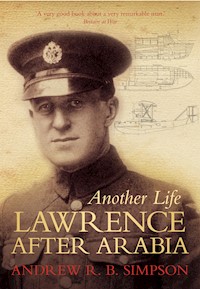
T.E. Lawrence found global recognition for his leadership of the Arab Revolt during World War I, preparing the ground for the final Allied offensive in 1918. He was hailed as a hero, but little is known about this mysterious and charismatic man after those events. Here is Lawrence's life after Arabia, his service in the RAF and the Tank Corps as a mere ranker, and how he became an expert in the technology of the new RAF. The book examines the work he did for the 1929 Schneider Trophy Race, the development of the new RAF 200 seaplane tender, and the development of its armour plated offspring, the Armoured Target Boat. It also investigates his literary endeavours and his tragically early death, a sad end to a Renaissance man of all talents, an academic, a talented engineer and a soldier sans pareil. T.E. was offered exalted diplomatic positions by Churchill, implored by Nancy Astor to re-enter the fray as the Nazi threat grew, socialised with the Cliveden set, argued with the Archbishop of Canterbury. He made lasting friendships with humble squaddies. His self-loathing was expressed physically. Consulting primary sources and also having interviewed some of those who knew Lawrence after Arabia the author portrays the last years of one of the most astonishing figures of the 20th century.
Das E-Book können Sie in Legimi-Apps oder einer beliebigen App lesen, die das folgende Format unterstützen:
Veröffentlichungsjahr: 2011
Ähnliche



















Dedication
In memory of my father
Wing Commander L.J. Simpson, R.A.A.F., R.Aux. A.F., D.F.C. (1918-2007)
Loved and remembered by many
Epigraph
One day I said to Lawrence:
‘… The greatest employments are open to you if you are to pursue your new career in the Colonial Service.’
He smiled his bland, beaming, cryptic smile and said: ‘In a very few months my work here will be finished. The job is done, and it will last.’
‘But what about you?’
‘All you will see of me is a small cloud of dust on the horizon.’
Winston Churchill to T.E. Lawrence on leaving the Colonial Office, January 1922. (From Great Contemporaries, W.S. Churchill, Thornton Butterworth, 1938)
Contents
Dedication
Epigraph
List of Maps and Diagrams
Abbreviations
Acknowledgements
Preface: the Patroclus of the Piece
Introduction
Part One: A Voyage all out of Reckoning
1Motivation: Colonial Office to A/C2
2The First RAF Period: The Mint
The Publication of The Mint in America
3Bovington
Clouds Hill
4The Abridgements of Seven Pillars of Wisdom
The War in the Desert Abridgement
The Subscribers’ Edition Abridgement
The Revolt in the Desert Abridgement
The Anonymous Education Fund
Part Two: In the Racing Stable
5Cranwell, India and beginning the Odyssey
To India
6Problems of a Translator; and mired in the Great Game
Miranshah
7The Book XXI Controversy
8Mount Batten
Scott-Paine
9The Schneider Trophy Races, Hythe and the Blackburn Iris Crash
Major Nathan’s Moth
Henry Field
Bertram Thomas and the Empty Quarter
The Blackburn Iris Crash
10Power Boats: The RAF 200
First Trial: RAF 200 with two Brooke Engines, Stokes Bay
Second Trial: RAF 200 with two Brooke Engines, Plymouth
Third Trial: Experimental Open Hull with One Meadows Engine, Hythe
Fourth Trial: RAF 200 with Two Meadows Engines, Hythe
Towed Target Trials, Plymouth
The Power-Hyland System
A Trip to Scotland
11Power Boats: The Armoured Target Boat
Human Target
Letters to Weblin
The Fall-out with Graves
‘Putting the RAF Fleet on New Lines’
The Marine Aircraft Experimental Establishment, Felixstowe
Admiral Boyle and the Meeting at Devonport
An Impersonation
Corporal Bradbury
The Marine Craft Unit, Bridlington
Part Three: Tragedy at Clouds Hill
12Out of the Service
Clouds Hill Friends
13Monday 13 May 1935
The Return to Clouds Hill
14The Inquest and After
Tuesday 21 May
A Possible Solution
A Final Gesture?
Could Lawrence have Survived?
Suicide
15Conspiracy Theory – 1
The Fascists?
The Zionists?
Rodney Legg’s Theories
16Conspiracy Theory – 2
The Round Table
The Cliveden Set
17Conclusions
Part Four: The Commentators
18John Bruce and the Sunday Times
Bruce’s Unpublished Accounts
19Edward Robinson: A Bogus Biographer
20Postscript
Colin Wilson
If T.E. had Lived?
Bibliography
Sources and Abbreviations
Appendices
Appendix One: Clouds Hill
Appendix Two: Arthur Russell’s Recollections of Lawrence and Arabia
Appendix Three: Edward Spurr: a co-Designer?
Appendix Four: The Brough Superior ‘George VII’ after the Crash
Appendix Five: The Middle East Diary Hoax
Appendix Six: Henry Williamson’s Letters to Lawrence: Winged Victory
Appendix Seven: E.S. Palmer’s and A.E. Chambers’ Letters to Lawrence 1933–34
Appendix Eight: A Visit to Polstead Road, Oxford
By the same author
Copyright
List of Maps and Diagrams
1)Lawrence’s dental chart, 1923
2)Lawrence’s sketch for his dismissal of the Butcher and Laing Theory of the Axe Trial
3)Lawrence’s sketch of the double-bladed Mycenean axe
4)The Scythian bow
5)Lawrence’s dental chart, 1929
6)The Schneider Trophy Course, 1929
7)General arrangement drawing of the Blackburn Iris III
8)General arrangment drawing of the RAF 200 Seaplane
9)Diagram of the ‘hard chine’ on a 63ft Scott-Paine boat
10)Diagram of an 18ft Bomb Carrying Dinghy
11)Comparison of a modern aerial photograph of the Clouds Hill road and a map of the Tank Park Road in 1935
12)Sketch map of the location of the 1935 Tank Park Road and the crash site in 2005
13)Illustration of Brough GW2275 rolling on impact
14)Lawrence’s diagram of the location of the Vulcan Ram Pump
15)Empire Day 1: plan of hull underside, front and rear elevations and side elevation of planing surfaces
16)Empire Day 2: side elevation and plan of hull top
Abbreviations used in the Text
AEC
Associated Engineering Company
AID
Air Inspection Department
Air Min
Air Ministry
ATB
Armoured Target Boat
AV-M
Air Vice-Marshal
AW or AWL
Arnold Walther Lawrence
B-G
W.E.G. Beauforte-Greenwood
BPBCo
British Power Boat Company
CAS
Chief of the Air Staff
CB
Confined to Barracks or ‘ Jankers’
CO
Commanding Officer
CSM
Company Sergeant Major
DH
de Havilland Aircraft Company
DOSD
Directorate of Service Duties
DPP
Director of Public prosecutions
E.6
Air Ministry’s Marine Craft Service or Boat Section
Flg Off
Flying Officer
Flt Lt
Flight Lieutenant
GBS
George Bernard Shaw
GW2275
Lawrence’s Brough Superior ‘George VII’
HSF
RAF’s Schneider Trophy High Speed Flight
JIC
Joint Intelligence Committee
MAEE
Marine Aircraft Experimental Establishment (Originally the Marine and Armaments Experimental Establishment)
MBC
Motor Boat Crew
MCS
Marine Craft Service
MCU
Marine Craft Unit
MI5
Military Intelligence Department 5 (Internal)
MIS
Military Intelligence Department 6 (Foreign/External)
MTB
Motor Torpedo Boat
QMSI
Quarter Master Sergeant Instructor
RAC
Royal Aeronautical Club, also Royal Automobile Club
RAF
Royal Air Force
RAMC
Royal Army Medical Corps
RAOC
Royal Army Ordnance Corps
RASC
Royal Army Service Corps
RFC
Royal Flying Corps
RSM
Regimental Sergeant Major
RTC
Royal Tank Corps
SBAC
Society of British Aircraft Constructors
S-P
Hubert Scott-Paine
TE
T.E. Lawrence
TEL
T.E. Lawrence
TES
T.E. Shaw
Tes
Sydney Smiths’ nickname for Lawrence
US
Unserviceable
W
H.B. Walters, who vetted Lawrence’s translation of the Odyssey
WIG
Wing in Ground Effect
Wing Cdr
Wing Commander
W/T
Wireless Telegraphy
Acknowledgements
Thanks to the late Arthur Russell, Colin Bradley of the Western Morning News, the late Frank Gordon, R. James Hargreave (for information on his grandfather Alec Dixon), Vera M. Hewitt, Ingrid Keith, Mrs. Betty Kent (for the reminiscences of Leslie Edward Gates), Philip Knightley (for permission to quote from the Knightley and Simpson files in the IWM), Terence Phillips (owner of 2, Polstead Road), Godfrey Runyard; Jeremy Whitehorn, Heartland Old Books, Tiverton (for proof reading ); Phyliss Whowell (for permission to use the material from T.E. Lives magazine); all those who replied to my advertisements., the staff of the Modern Papers Room, the Bodleian Library, Oxford; the staff of the Imperial War Museum Reading Room; Mike O’Hara (curator of Wareham Museum, Dorset), the Trustees of the Seven Pillars of Wisdom Trust (for copyright permission to quote from the letters of A.W. and T.E. Lawrence in the Bogus Biographers and An Impersonation sections); the staff of Wareham Reference Library, Dorset; the staff of Dorset County Museum, Dorchester; the staff of the Dorset Record Office, Dorchester and Exeter University Oriental Studies Library, and the staff of the RAC Tank Museum Archives Library, Bovington, Dorset.
Thanks also to the British Library Newspaper Archive, Colindale; Gerald Wasley (for proof reading and help on Mount Batten); Pieter Shipster (for proof reading and help on the Schneider Cup); the technical staff of the Solent Sky Museum, Southampton; Exeter University Library; the Roger Friedman Rare Book Studio, US (for the original Bruce Rogers’ roundel from the Odyssey); the staff of the Imperial War Museum Reading Room; Stuart Haddaway and the staff of the RAF Museum Reading Room; the Fleet Air Arm Museum, Yoevilton; the late Dennis McDonnell; Brian Riddle, the Royal Aeronautical Society; the National Maritime Museum; Alistair Arnott, Southampton Maritime Museum Special Collections; the Military Power Boat Association, Hythe; the National Archives, Kew; the staff of Plymouth City Reference Library; the staff of 3, Elliot Terrace, Plymouth; Colin Harris and the staff of the Bodleian Library Modern Papers Room, Oxford; Alan Thomas, the Air Historical Branch (RAF) Ministry of Defence; Susan Walker, Antiquities Curator, the Ashmolean Museum, Oxford; Jeremy Whitehorn.
Special thanks to Richard M. Bennett, Nick Birnie, Colin Bradley, Mike Chapman, Tony Cripps, Joe Fletcher, Ray Gurven (for proof reading), Ian Handoll, Philip Knightley, Rodney Legg, Alex May, Nigel Neville-Jones, Mike O’Hara, Andrew Perrin (for information on GW2275), Godfrey Runyard, Colin Simpson, Geoff Titman (for photographs of the 1962 film’s Chobham crash site), the Trustees of the Seven Pillars of Wisdom Trust (for permission to quote the two letters of Captain Lettman-Johnson), Jeremy Whitehorn, Anne Williamson (for information on her father-in-law Henry Williamson), Colin Wilson, Jeremy Wilson and the T.E. Lawrence Society, and Saga magazine.
Many thanks to the following, who replied to my letter in Saga magazine in March 2005: Mrs. Julia Anderson, Mr. Philip Bailey, Mrs. Anne I. Baker, Mr. Cyril Blackshaw, Mr. Colin Bristow, Mr. Gordon Brooks, Mr. Barry Burgess, Dr. Julia Burton-Brown, Mrs. E. Bush, Mr. Norman Dawkins, Mr. Nicholas Dewey, Mrs. Margaret Emerton, Mr. Vernon Fewtrell, Mrs. Rosemary Gaston-Grubb, Mr. Peter F. Goodwin, Mr. Roger Hallett, Mrs. Vera M. Hewitt, Mrs. Diane M. Horner, Mr. Ralph Hyde, Mrs. Pat Jilkes, Mrs. Betty Kent, Mrs. M.A. King, Mrs. Y.J.T. Kingdom, Mr. Dave Linguard, Professor James S. Malpas, Mr. Dave Micholly, Mrs. Tessa Morrish, Mr. D.W. Noakes, Mrs. Greta Parker, Mr. R.E. Poole, Mr. John Powell, Mr. Ian Ralph, Mr. E. Reynolds, Rev. L.S. Rivett, Mrs. W.M. Robertson, Mrs. E. Rowbottom, Mr. Godfrey Runyard, Mrs. Jillian A. Shepherd, Mrs. J. Simpkins, Mrs. Margaret Simpson, Mrs. Valery Thompson, Mrs. D.H. Thompson, Mrs. D.H. Thorne, Mrs. Nora Thornton, Mr. H.B. Webster, Mrs. Nora Wise. Of the original interviewees, Arthur Russell, Frank Gordon, Roland Hammersley, Margaret Montague, Joyce Knowles, Joan Hughes, and Bob Hunt have now sadly passed away.
Although a number of members of the T.E. Lawrence Society kindly assisted in the research for this book the Society does not officially support it. I would particularly like to thank Society Committee member Pieter Shipster, Gerald Wasley, and Jeremy Whitehorn, whose large collection of books was a great help.
Photographs
The Archive Library, R.A.C. Museum, Bovington for the photograph of E.S. ‘Posh’ Palmer and other general photographs of Bovington Camp.
The National Archives Photographic Department for the photographs of RAF 200 on trial at Mount Batten.
The Special Collections Department, Southampton Maritime Museum for a selection of photographs from the Scott-Paine Archive.
As far as possible T.E. Lawrence has been referred to by only two names throughout: ‘Lawrence’ and the more informal ‘T.E.’, although Lawrence changed his name by deed poll to Thomas Edward Shaw in the 1920s.
Preface: The Patroclus of the Piece
This book originated with an interview I conducted with Arthur Russell at his home in Coventry in 1985. Russell had served as a private in the Tank Corps with Lawrence from 1923 to 1924 and had been, in his own words, his ‘constant companion’. One day, when they were in the cottage at Clouds Hill, the poet Siegfried Sassoon came to visit. In the course of the conversation, as they were sitting in the music room, Sassoon suddenly exclaimed ‘Little Russell, the Patroclus of the Piece.’ (Patroclus was of course the constant companion of Achilles.) ‘So that’s how he dubbed me,’ said Russell, ‘as his constant companion.’ One would have thought that spending time with someone who had known T.E. that well would have brought one closer to the man, but I did not feel that. After an hour or so of conversation, in which Mr Russell kindly answered many of my questions, T.E. Lawrence remained an enigma.
Arthur Russell at his home in Coventry, December 1985. Brought up in the city Russell ended up in the same barrack block as Lawrence in March 1923 and became his constant companion during his initial period at Bovington. Mr Russell died in 1991 aged 87. (Author)
Russell had married in 1939, settled in Coventry and had a daughter and two grandsons. In April 1995 he was confined to the Aavon Grange Old People’s Home. Although many people went to see him subsequently, gradually, as the years passed, the intensity of his recollections faded. He had taken the well known photograph of Lawrence reading The Times outside the Quartermaster’s Stores at Bovington in 1923, and also donated a bench, carved with his name, to the cemetery at Moreton. Lawrence had changed his life and been an inspiration, as he had for many people. Transferred to Warwick Hospital, Arthur Russell died there on 7 November 1997, a very charming old man, who outlived the friend he was devoted to by 62 years.
I had been given Russell’s details by Ingrid Keith. Ingrid was a teacher in Wareham at the time and all her life she had a fascination for Lawrence, such that in 1985 she decided to form her own T.E. Lawrence Society. It had humble beginnings, starting off with a small meeting in Wareham Museum where the founder members included Ronald Knight, Roland Hammersley and John Weekly. This tiny seed grew to proportions that many would have never believed possible. There are now thousands of members worldwide, with splinter groups in the US and even one in Japan. This book, therefore, was born out of the enthusiasm of others and the frustration of an inconclusive interview. I hope the reader senses the former and not the latter within these pages.
Andrew R.B. Simpson
Introduction
Thomas Edward Lawrence was born in 1888 at Tremadoc, North Wales, the second son of an Irish landowner who fled Ireland after a bigamous relationship with his housekeeper, who bore him five sons. From Wales they travelled to Scotland, France, Guernsey, the New Forest, eventually settling in Oxford. All five boys were educated at Oxford High School, eventually matriculating to the university. Although not the oldest, T.E. was the natural leader of the group, being a stronger character than the others. T.E.’s elder brother submitted to the dominant character of his mother Sarah Junner, whose, according to some judges, hypocritical religious beliefs filtered into his character. He became bound to her and served as her companion and fellow missionary for the rest of his life. The other Lawrences were strong enough to assert themselves against Sarah, and to escape on different paths.
Educated at Jesus College, Oxford, Lawrence made a walking survey of all the important Crusader castles in Syria for his degree thesis, which was awarded a First. In 1910 he was invited by D.G. Hogarth of the Ashmolean Museum, Oxford, to assist at a Hittite excavation at Carchemish in Syria and gradually his knowledge of the Arab peoples began to accumulate and was applied when he went to work for British Intelligence in Cairo in 1914. The tribes in Arabia were preparing a revolt and needed a charismatic leader and Lawrence was sent to find one, in the hope it would revitalize the Allies’ failing fortunes in that theatre. Not only did he do this but, by a series of brilliant moves, long distant rides, tactical attacks and strategic campaigns, manage to harass the Turks from Medina to Damascus, delaying them from transferring their troops northward and preparing the ground for the final Allied offensive in 1918.
Lawrence’s leadership ability, charisma, and genius for guerrilla warfare meant that by 1918 he was leading a united Arab irregular force. The responsibility and the stresses he experienced deeply affected him so that the end of the campaign he was physically and emotionally exhausted. Those experiences would never leave him. He was not yet thirty.
After the War he was employed as an adviser to the Arab forces at the Paris Peace Conference. He failed to get the concessions he had promised to his Arab friends. This was partially, but only temporarily, righted by Churchill’s mandates defined at the Cairo Conference in 1921, held to settle the Middle East question. The rivalries amongst Britain, the Arabs, and France, particularly over the question of Syria and Trans-Jordan, had to be settled. But Lawrence felt betrayed, he had failed his Arab followers. By this time he had become a celebrated international figure, owing to the films made of him in Arabia by the American Lowell Thomas, which were shown in cinemas worldwide. These made him one of the most glamorous figures of the First World War, in a war with little glamour. Lawrence had craved celebrity all is life but when he got it, he despised it.
In Arabia he had realised air warfare would be the overriding factor in any future conflict and, in 1922 joined the RAF under a pseudonym, deciding, much to the consternation of his sophisticated friends, to disappear into the obscurity of the ranks.
This book is about Lawrence’s life after Arabia, his service in the RAF and the Tank Corps and details, hopefully as no other book before has done, how he became an expert in the technology of the new RAF. It examines the work he did for the 1929 Schneider Trophy Race, the development of the new RAF 200 seaplane tender, and the development of its armour-plated offspring, the Armoured Target Boat. During this period he was involved in a number of literary projects. As well as Seven Pillars of Wisdom he created an important study of the early days of the RAF, The Mint. This was ground breaking in its realism, so much so that its ‘ home truths’ were hidden from public view until 1950. His other important literary work, a prose translation of Homer’s Odyssey, took four years to finish and proved almost as arduous a task as Seven Pillars.
What is remarkable about these projects is that, for most of the time they were being written, he was working as an ordinary serviceman where, particularly at Bovington, he lived amongst company that was anything but intellectual. He spent his days doing hard physical work that might have left him little energy for more cerebral pursuits; the fact that he was able to produce such remarkable work in such circumstances, and, in his latter period in the Air Force was able to undertake other important and useful practical work is a testimony to his character. Although the likes of Robert Graves commented on his working man’s accent, gold teeth, roughness of hands and fading literary output, Lawrence took great pride in the fact that he could strip an engine down and rebuild it to running condition. This seemed to be a part of his struggle to escape the ‘Lawrence of Arabia’ image. Where other men from such a position would have risen effortlessly in the diplomatic world, he chose to redirect his abilities to smaller, more mundane matters that, in the long term, were of almost equal importance. It was this progression ‘ from ink to oil’ that was the key to Lawrence’s life in the 1920s and ’30s. It was not something forced upon him, but work that came about through a series of tragic circumstances, creating a product that gave him great joy.
T.E. Lawrence was one of the most mystifying and charismatic figures of the twentieth century. The dashing desert warrior clad in flowing Arab clothes and headdress bears little resemblance to the truth. This was partly set right in 1962 – though there was still plenty of dash – in David Lean’s film, Lawrence of Arabia, which gave a more accurate insight into his psychological conflicts as they were understood at the time; but this still was not the Lawrence known by those close to him. His achievements in World War One were remarkable, and understood by fellow officers who encountered him, and it was this that gave birth to the legend, more so than the books that were written about him, for a legend cannot persist for 70 years without some truth behind it.
Ever since Thomas’s biography appeared in 1925 there has been a regular series of biographies that vary from the excellent, such as J.M. Wilson’s, to those that are so full of exaggerations and downright lies that it is difficult to believe they were published at all. But what they all illustrate is that that there has been an increasing fascination with him, or with the myth that he left behind, ever since his death, the circumstances of which only served to reinforce that myth; some say, because that is the way his admirers want it to be. He is especially attractive to a particular type of person. They tend to be loners or in some way social misfits. A.W. Lawrence, his brother, concluded it was a form of religion to them, such that, after T.E.’s death, many tried to make him a St. Paul. However, A.W. declined to lead the new sect.
Liddell Hart, when writing his biography in the 1930s intended to create a record of the Arab Revolt. However, as he researched the subject more deeply he realised that the contribution Lawrence made was much greater and had more effect than he had originally thought. Eventually he concluded that because Lawrence played such an important part, it was incumbent upon him to write a biography of the man himself and not of the movement. A series of personal interviews with him in the late 1920s and ’30s led him to conclude that, despite his quiet subtlety, Lawrence was a man with a greater force of personality than any he had ever known.
PART ONE
A Voyage all out of Reckoning
CHAPTER ONE
Motivation: Colonial Office to AC2
Why did Lawrence return to the ranks? In Chapter 1 of Lawrence’s Seven Pillars of Wisdom, his account of the part he played in the Arab Revolt of 1917, is a famous passage that begins ‘All men dream: but not equally. Those who dream by night in the dusty recesses of their mind wake in the day to find that it was vanity.’ What follows is an explanation of the dream he had to create a new nation and restore a ‘lost influence, to give twenty millions of Semites’ the foundation of their national ‘dream palace’. With typical self-deprecation Lawrence minimized his contribution to the aim, declaring that his was only a ‘mock primacy’. He realised from early on that the British Cabinet had engineered a conspiracy, conspiring to persuade the Arabs to fight on ‘definite promises of self-government’. Only Lawrence’s word would assure them of the truth of this, as they had no use for written promises. This deception continued for two years, during which Lawrence was always aware of the dishonesty of his task: ‘Instead of being proud of what we did together’, he later wrote ‘I was continually and bitterly ashamed’. His planned solution was to make the Arabs politically strong enough to convince the Allies to grant their wishes at the Peace Conference.
Lawrence explains that there were two deceptions he perpetrated in the war. Firstly ‘a pugnacious wish to win the war’ controlled him, but this was impossible without Arab help, so it was better for them to win on a dishonest premise than to lose. Secondly, since he was fighting under a false flag, a deception even his immediate superior was unaware of, he refused to accept any conventional rewards or recognition for his success: to prevent any ‘unpleasantness arising’ he began to falsify his reports, ‘to conceal the true stories of things’,1 the second deception.
In Arabia Lawrence of course encountered a completely different concept of life with entirely different values to those with which he had been brought up. He explained much of his thoughts on Semitic beliefs in the introduction he wrote to C.M. Doughty’s Travels in Arabia Deserta in 1921:
The desert is a place of passing sensation, of cash-payment of opinion. Men do not hold their minds in suspense for days, to arrive at a just and balanced average of thought. They say good at once when it is good, and bad at once when it is bad.
The different perspective led Lawrence to re-evaluate his own values. After the War he abandoned the concept of the progress of mankind. His belief in God, certainly the Christian God, disappeared in Arabia and he gave up the idea of a conventional career. He tried in his life for an absolute value, a standard, but, in his own eyes, fell far short of it: Basil Liddell Hart concluded ‘His peak was so high that few other men could even see it through the mist of life.’2 Churchill once said that Lawrence moved at a different speed and on a different level to the ordinary man. During the war other men began to move at his pace, but after it was over, he was left alone on his own plane once more.
In 1919 the Peace Conference in Paris ended in political decisions that gave the Arabs almost nothing, causing T.E. extreme depression and bitterness. All the promises he had made to his friends had not been met. He had entered the conference with a cry for Arab unity fresh on his lips but soon found that he was surrounded by parties witrh no interest in the Arab Question. The Conference, he found to his disgust, was more concerned with the settlement of the European War than with petty squabblings in Arabia.
Still, he had other dreams, an important one being the conquest of the air. He also had to write the story of the Arab Revolt, a task for which only he was qualified. He signed a contract with the new publisher Jonathan Cape, one condition of which was the writing of a second book of his choice.
Although profoundly changed by the War, that Lawrence’s psychological problems afterwards were caused by his experiences in the War itself is a misconception. He was actually fairly well balanced at the Armistice. The economist J.M. Keynes, who met him in Paris, found a natural aloofness in him, but reckoned him a fit man and later concluded ‘It was the subsequent events that twisted him.’3 Professor John Mack, a biographer of Lawrence, commented that he had turned inward, his mother describing how in the winter of 1919–1920 ‘He would sit for hours in a state of marked despondency without moving or changing his facial expression.’4 John Buchan met him at this time and observed that he was in a trough of depression caused by ‘the failure of his work for the Arabs, which involved for him a breach of honour.’5 It was during this period that he at last learned the truth of his deceased father’s adulterous background, his own illegitimacy (which he had suspected as a youth), and the fact that an inheritance of large estates in Ireland, which otherwise would have been his, had been forfeited. Simultaneously, Lowell Thomas was eulogizing him before thousands, and in a few years his picture shows would be seen by millions worldwide. The high profile was initially encouraged by T.E. in the hope that it would help the Arab cause; but after the Conference it was clear that it would have no effect. So against his will, he became transformed into a national hero, a society demagogue, and a matinee idol.
His psychological problems actually began to beset him whilst writing his account of the Revolt in an attic room of a terraced house at 14 Barton Street,6 London, in the winter of 1921–22. Here he worked day and night on the book, going without food and sleep for long periods in order to focus. His changing mental state is reflected in his letters. In December 1917 his correspondence is, if anything, jaunty, but in those written later in the 1920s there is a pronounced tone of self deprecation, a kind of masochistic desire for punishment. The consequence of his sense of failure with the Arabian affair was a desire not to have any form of responsibility over men or to make any decisions of consequence again. A step towards this, he felt, was to accept the lowest status possible, which in the ranks of the RAF was Aircraftman 2nd Class. Arthur Russell explained:
Because he’d been let down with the Arabs: he had to go down and promise them things. He knew most of it would never come off but he had to carry on and pretend, but he thought most of them wouldn’t. It was due to the French government and the Indian government. And he told me then that – I don’t know why the Indian government got involved – they didn’t want the Indian government to have these concessions. He told me his life was forfeit if he went back to England.7
There were other, more straightforward reasons for enlisting. He had to find something that would put food on the table: by 1922 he was so poor he had to wait outside his friends’ clubs and ask them to buy him lunch. He had been awarded a research fellowship by All Souls College, Oxford, but this was not worth a great deal8 and also he had his Foreign and Colonial Office salary9 that ended in July 1922. So the ranks offered him some kind of living, if only a meagre one. He had enjoyed the fellowship he had shared with ordinary soldiers with the Handley Page and Armoured car crews in Arabia, and imagined the peacetime ranks would recreate this. Joining the RAF, he hoped, would provide him with material for a second book, which he had been contracted by Cape to produce; and the ‘monastic’ environment of the ranks also offered a chance to escape from the attention the Lowell Thomas lectures created.
The memories of the war his writing brought back to him upset him greatly, so much so that when he joined up in August 1922 he was on the verge of a nervous breakdown. He told Robert Graves he hoped that being ‘ordinary in a mob of likes’1 would cure his mental exhaustion. The day before he joined he wrote to George Bernard Shaw:
You see the war was, for us who were in it, an overwrought time, in which we lost our normal footing. I wrote this thing in the war atmosphere, and believe that it is stinking with it. Also there is a good deal of cruelty and some excitement. All these things, in a beginner’s hands, tend to force him over the edge.11
The conclusion must be that his motivations for joining the ranks were disillusionment with the deceitfulness of the Arabian campaign and subsequent shunning of any form of responsibility; his desire for a life of discipline – a military straitjacket, perhaps – that would kerb the wanderings of his will until his body and mind returned to a more normal state; plus the more prosaic need for a regular income and the chance to write a ‘Day Book’ of the RAF.
Notes
1Seven Pillars of Wisdom.
2T.E. Lawrence in Arabia and After. 2nd Edition. B. Liddell Hart. 1934.
3Friends: Keynes contribution.
4Mack.
5Buchan.
6The building still stands to this day.
7Arthur Russell. Interview with author, Coventry, December 1985.
8£300 p.a.
9£1200 p.a.
10B:RG.
11Letter to G.B. Shaw, 27 August 1922. MB.
CHAPTER TWO
The First RAF Period: The Mint
I am convinced that some quality departed from Lawrence before he became the RAF recruit. Lawrence of Arabia had died.
(Charles Findlay, Adjutant, RAF Farnborough, 1922)
Lawrence joined the Air Force as John Hume Ross on Monday 28 August 1922. There had been rain generally the night before. Around Westminster and the RAF’s Henrietta Street Recruiting Office that morning it was suitably cloudy. His entry to the RAF was not as straightforward as he assumed it would be, his first application being refused because he had no documentation. When he returned with the forms they were judged to be forgeries. By this time the recruiting officer – W.E. Johns, the creator of ‘Biggles’– had contacted Somerset House and discovered that no John Hume Ross had ever been born on the date specified. Lawrence returned to the Air Ministry to retrieve a minute, probably from Trenchard, the Chief of the Air Staff, to Air Vice-Marshal Swann (of the Air Council), that ordered his enlistment. Despite this he still had to get through the medical examination: his physical condition was so poor through malnutrition and stress that he was failed the first time, and the second. The whip lash scars on his body aroused suspicion and even after his identity had been revealed the doctors still refused to admit him. Only after an outside doctor was called in were the admittance forms signed.
Lawrence came from the educated middle classes, a more privileged background, of course, than his colleagues. It was unheard of for high ranking officers to enter the ranks. But the Air Force was a new body utilising new technology, and this affected the relationship between the officers and the men. Now the fitter could know a great deal more about his specialization than his officer. Consequently the social hierarchy in the RAF in the 1920s was something different and the technician had a much higher standing than his earlier military or naval counterparts; there was far more team work.
Lawrence started making notes for The Mint in August 1922, shortly after his arrival at Uxbridge. He was given the service number 352087 and was an Aircraftman 2nd Class. The book would not be released to the public until 1955, fulfilling a promise Lawrence had made to Trenchard, and ensuring that any of the staff mentioned in the text would be dead or retired when it came out. He did however lend segments of the notes to friends. This caused serious trouble in 1931when portions of it appeared in a service journal. Fortunately, the section came from a later part of the work, which was not as critical as the earlier text. There was an official publication in 1935 in the United States however, precipitated by a fear of a pirated edition. To ensure the American copyright, a limited edition had to be published. Lawrence had encountered a similar problem in 1920 when his introduction to an edition of Doughty’s Arabia Deserta was pirated by an American firm.
The Mint was constructed in three parts, the first dealing with the basic training of the ‘raw material’ at Uxbridge in 1922. The second part, ‘In the Mill’, covered N.C.O.’s, school instruction, stock-taking and guard room duties etc. Part Three was different and much mellower in tone than the earlier chapters. The Uxbridge chapters depicted the harsh discipline and brutality of barrack-room life. At the Depot he had been miserable and the toughness of the basic training shocked him. When other recruits had no option but to stick it out, he could have left of his own accord and it required great will power on his part not to do so. The comradeship he had enjoyed during the war with the crews of Armoured Cars and Handley Page aircraft did not exist at Uxbridge and he rapidly became disillusioned:
Out hut is a fair microcosm of unemployed England: not of unemployable England, for the strict RAF standards refuse the last levels of the social structure. Yet a man’s enlisting is his acknowledgement of a defeat by life. Amongst a hundred serving men you will not find one whole or happy. Each has a lesion, a hurt open or concealed, in his late history.1
This was the first time he had bunked with enlisted men and, although the conditions were extreme, they paled in comparison to what he was later to suffer at Bovington. One veteran who was in the same hut at Uxbridge was Aircraftman A.G. Turner. Turner was also quiet and short – 5’ 6” (about the same height as T.E.). He swore less than the other men. He and T.E. were placed together on parades. Turner recalled that Lawrence was ‘a very quiet sort, did not smoke, drink, swear or express much about things going on in camp. He was a loner, did not make friends easily, always went out of camp after duty hours by himself, mostly to London.’2
Turner was 70 years old when he recalled these memories in 1973. He conducted a lengthy correspondence, from August 1973 until March 1974, with Group Captain P.E. Raymond of Uxbridge and the Ministry of Defence, representing the Air Historical Branch. Turner wrote a series of letters elaborating on his experience of ‘Ross’. He found the person he knew in 1922 did not match the man who wrote The Mint. ‘Ross’ was very thin, often fumbling with his weapon on parades. The Drill Sergeant would take it from him telling him ‘he was like an old woman who’d never had it and shewed him how to handle the rifle’.3
Lawrence was then in an extremely weak and neurotic condition, still suffering from the malnutrition and exhaustion that had nearly overwhelmed him at Barton Street. Nobody at the Depot believed such a small, emaciated figure could be the man who led the desert Arabs. This was not an uncommon assessment at the time. The American author Robert McAlmon met him in Paris in 1919, whilst McAlmon was being sculpted by a man named Dobson. Lawrence sat in and discussed excavation work he had done in the Middle East and brought a small statuette, which he gave to Mrs Dobson. Only after he left did McAlmon realise that it was the famous Colonel Lawrence of Arabia. McAlmon found great difficulty in conceiving of him as the ‘bold leader of the desert Bedouins’. The impression he left was not a deep one.4
After the six weeks initial drill at the Uxbridge Depot he became fitter and more settled. Turner found him reluctant to talk about himself. So did other soldiers upon first meeting him. In the Tank Corps his immediate superior in the Quartermaster’s Stores at Bovington found he did not seem to care for anyone at first and was disliked for it initially. He told Turner after some time he had signed on for 7 and 5,5 stating when asked that he was a writer. He then changed the subject immediately to discuss the poor food at the Depot, where the menu was monotonous and unappetizing. But the recruits were so hungry they always ate it. The service pay was three shillings a day, and by Thursday most of the squad were out of money. Lawrence, despite representing himself otherwise, had more cash reserves than the average airman: ‘The fact was, he was about the only airman not short of money on a Wednesday or Thursday; Friday was pay day.’6 It was simply Lawrence’s character that made him adopt a spartan lifestyle.
Turner said of the other men at Uxbridge: ‘We had some pretty tough characters in the squad, costermongers, Merchant Navy men, taxi drivers, farm workers and army officer types. Consequently the language at times was a bit strong, which Ross did not like.’7 A photograph was taken of his squad outside Hut IV, in 1922, by an Army photographer. Lawrence was reluctant to divulge his identity. He can be seen tucked away on the extreme left of the photo, hiding behind the window mullions. Turner could never understand how such a weak man as ‘Ross’ could be passed fit by the stiff RAF medicals. ‘Did someone in the Air Ministry know that he was going to join and so stretch the regulations [?] Every time I see a picture of a thin man it reminds me of Ross at Uxbridge. Life there must have been hell for him.’8 Occasionally Lawrence invited Turner to the Y.M.C.A. for tea and cake: ‘He used at first to go by himself in the evenings but he got pestered so much he started asking me to go with him, seeming to use me as a buffer against other men questioning him. I did not mind, he always paid.’ 9
Turner found Lawrence never seemed to smile, always appearing to be worried about something and noticed he had a peculiar, strained look about his eyes. Only later, when serving in the Middle East, did Turner realize this was caused by the glare of the sun on the desert sand. Lawrence often stayed in the barracks in the evenings. He would sit on his bed writing, his knees drawn up with his back resting against the palliasse and blankets and would do this for about two hours at a time. Turner, only discovered after he had left the Depot that it was material for The Mint.
Lawrence’s squad at the Uxbridge Depot in 1922. Foreground is R.S.M. ‘Taff’ Davis. Second soldier from the right is AC2 E.G. Turner. (via Hyde)
Many of Lawrence’s notes for this were written up much later, but some remain from this period. These are a few pages of the rough notes he made about his experience at Uxbridge. They have been written specifically for an unidentified person, possibly Trenchard or Jonathan Cape.10 Lawrence explained in his introduction his reason for writing them:
I tried to write the monograph on the school as an independent force: but failed, since the whole current of my endeavour at Uxbridge is to see it in general. Consequently all my notes have been of the school in relation to the Depot.
I tried the second time to write up these notes into a coherent form: but my sense of authorship impeded me. It is too soon. So I have chosen some of these in initial m/s & edited them severely. To me now they seem mild: but if they are improper, & if no use for your purpose, I hope that you will destroy them promptly. It is my wish to remain peacefully in the shadow here.11
The spindly handwriting contrasts with a handwritten report Lawrence made at the end of his service in 1935. Both texts are obviously written by the same person, but the later one is significantly more precise and confident. The 1923 unpublished notes appear to be a rough draft of what was later worked up, probably in stages, to be the final draft of The Mint. They are now part of an Air Ministry archive file.12 A number of passages were meticulously rewritten for the final draft.
Hut IV besides being a pack of as-yet unlevelled personalities has (without me) a common character and [illegible] a group opinion, which is usually arrived at by contrarying the too quick judgement of the reactive talkers. We are also developing a group instinct (Lamarck would have loved the order of our growth) and this is gradually enabling us to act together, tautly, as the majority desire.13
In Part Two, Chapter 21 of The Mint we find the final form of this:
Our hut used to arrive at an opinion by discussion, by contradicting the early word that the first fool rushed out. Later this turned into instinct. We have come, unknowing to a corporate life. Today we think, decide, act on parade without a word said. Men are becoming troops when they act like one body. . . 14
The following passage from the original notes also became part of Chapter 21:
It is inevitable that each such place should have a master spirit; and as it has been the lot of Uxbridge to find it in one who does not pretend to be an officer, and who holds perhaps a latent grudge against the professional class of officer. At least he is not reluctant to make clear to them and to us their awkwardness on parade.15
This became:
Every camp needs its dominant: and ours has drawn the lot of Stiffy, who is very masterful. He does not pretend to be an officer: perhaps he harbours a latent grudge against the officer class: he so likes to take them down before us. ‘Mr. Squire, your damned cap isn’t fit for parade’. Indeed he wants to be the sole ruler here and humiliates the Sergeant Major, the sergeants, even the corporals, by public curses.16
According to A.G. Turner, ‘Stiffy’ was ex-Guardsman Flt/Lt Wombwell, so nicknamed because he was a very erect, big, broad man, over six feet tall, who was the officer in charge of drill parades and had a voice like a fog horn. It was said in the camp that his voice was so loud it caused the windows to break in ‘M’ section.17 Michael Yardley and other biographers however identify ‘Stiffy’ as G.F. ‘Stiffy’ Breeze, the Squadron Commander at Uxbridge.18 Turner agreed with Lawrence in identifying the C.O. as Group Captain ‘Pegleg’ Bonham-Carter.19 Lawrence’s original notes stated:
But that is the spirit of technical incompetence in those officers we meet. They are not carefully enough chosen, or careful enough to know their subjects, & that is dangerous with our mixed classes.20 In that 4 are experts on thirty matters, more skilled men than could be plucked from an entire army division. It is good form to conceal this knowledge: but instructors should guard against it. We have been set to learn the handling of aircraft. One expert talked wrongly of the purpose and effect of the dihedral. Another tapped the epicyclic casing and said ‘That’s the Constantinesco gearing by which the propellor is worked up to twice the engine speed.’ One of us was foreman in the C.C. workshop. Two are ex-aerial gunners. One has his certificate. 21
This was rewritten in Chapter 15 as:
Wasted, too, I fancy are the hours devoted to teaching the manhandling of aircraft. Probation-officers take us for that: and they do not put enough effort into it to meet our demand. We have almost a habit of trying hard, now. Some of us have read a little aerodynamics; so we expect the officers to know a great deal. Troops ask everything of their officers. Yet at the first lecture in the gloomy shed through which the wind blew damply upon the carcass of the imprisoned Bristol Fighter, Flying Officer Bayes confused incidence with dihedral . . .
…It was worse later, on October the twenty sixth, when another young officer deputized for Bayes. He tapped the epicyclic gear case with his cane and airily told us, ‘This is the Constantinesco gear. I won’t muddle your heads explaining how it works: but take it from me that it revs up the prop to twice the engine speed.’ Our Allen, a country-bred, has been an air gunner. I saw his legs wilt and his ears redden with the news. 22
The published passages are much more lucid and comprehensive (and more amusing) than the original notes. This contrasts with his rewriting of Seven Pillars to create the 1926 abridged edition, which produced a thinned down, etiolated version of the original Oxford text.
In November 1922 he was transferred to Farnborough. He arrived there one day late for a nine-month photography course and was refused entry. He was told he would have to wait until the first week in January for the next intake. This arranged, he was appointed to the Adjutant’s office as an orderly and his duties were to sweep the office, light the fire and run errands during the day. Charles Findlay the Adjutant saw him as an average recruit, performing his duties efficiently. Although he was heartened by the transfer away from the depot, he was anxious to employ his well honed photographic talents, skills he had been instructed on by his father. He had undertaken work before the war photographing pottery at Carchemish.
Neither Findlay, nor the Station Commander, Guilfoyle, suspected his true identity and it was only after Oliver Swann telephoned to ask why Aircraftman Ross hadn’t started his course that they realised something was afoot; it was most unusual for a high ranking Air Ministry official to telephone a Station. Findlay later commented that ‘Nothing about him ever suggested that here was the most amazing aircraftman ever to join the RAF.’23 Lawrence was called into the Station-Commander’s office, and Guilfoyle noticed something familiar about him as he had once seen him in Cairo in 1914. He informed Findlay that he thought it was Lawrence of Arabia and instructed him to contact the Chief Instructor.
Lawrence enjoyed the course and later found the enlarging and mosaic work, learned in two of the later months, extremely useful. In August 1929 the Committee of the Schneider Trophy would require an aerial mosaic to be made of the course. Farnborough assigned a Flight Sergeant to the task who conducted an aerial photo survey, but the work was considered inadequate and Lawrence was asked to produce a replacement.
In the barrack hut at Farnborough Lawrence met A.E. ‘Jock’ Chambers, the hut orderly, a rugged Scotsman who was later to prove a life-long friend. Chambers didn’t think much of the new arrival at the outset because of his short stature and general air of loneliness. Unaware of who he was, Chambers tried to belittle Lawrence in front of the men and told him to scrub his bed, ‘no tide marks’, addressing him as ‘shortarse’. After half an hour, despite being an officer type, he was accepted by the other men in the hut and he and Chambers soon became close friends. He borrowed two of Lawrence’s books, Also Sprach Zarathustra and The Brothers Karamazov. Although he was not educated Chambers was intelligent and found the books interesting. On one occasion Chambers gave Lawrence a bear hug from behind, pinning his arms behind his back, but sensed immediately that he did not like this and quickly withdrew. Chambers recalls an occasion when the Press was looking for Aircraftman Ross at Farnborough and Lawrence was standing guard duty by the camp gate. ‘Here, you aren’t him are you?’ one of them asked him. The little man replied ‘Now, do I look like a soldier?’24 Some of Chambers’ later comments about the closeness of their friendship were moving, startling even in their depth of feeling: ‘He was my only real friend, the only one I’ve ever had. He was one of the finest men who ever trod the globe, better than Christ or any of them.’25
Lawrence continued making his notes for The Mint at Farnborough. An article by Findlay in The Listener of June 1958 gives an insight into Lawrence at this time: He was keenly interested in photography and felt that, when engaged in any other task, he was misemployed. He told Findlay that service as an officer would have ‘spoiled’ the experience for him. He wanted to see the RAF from the ranks’ point of view and could only do this by sharing life in the barracks. Findlay found he was but a shadow of the man who had led the Arab Revolt. He noted: ‘I am convinced that some quality departed from Lawrence before he became the RAF recruit. Lawrence of Arabia had died.’ 26
Lawrence also befriended another airman at Farnborough named Robert ‘Bob’ Guy. R.A.M. Guy, young, short and fair haired, was particularly handsome – ‘like a Greek God’ Chambers thought – and Lawrence said he represented the best of the Air Force ranks as he pictured them. He was probably attracted to Guy by his good looks, the image somewhat marred by a broad Birmingham accent. Guy transferred stations but still kept in touch and sometimes visited Clouds Hill. He tended to sponge off T.E.
‘Looking like a retired pirate’ was how Malcolm Brown described A.E. ‘Jock’ Chambers when he appeared for the BBC film of Lawrence’s life in 1962. Chambers first met Lawrence at the Cadet College, Cranwell in August 1925. (Tunbridge)
It was not generally known that Lawrence was in the RAF. After the DailyExpress revealed his presence at Farnborough in December 1922, Trenchard told him the only way he could continue in the service was to accept a commission, but he refused. The Air Minister Samuel Hoare was horrified when he heard.27 Lawrence’s enlistment, when concealed, was ‘delicate’ but it became untenable when revealed and he was discharged from the RAF by Air Ministry Order in February 1923.28 From that point until August 1925 his research for The Mint stopped abruptly.
Lawrence did not finish The Mint until 15 March 1928, at Karachi. Between then and 1935 he sent manuscripts29 to his friends G.B. Shaw, E.M. Forster, Siegfried Sassoon, both the Garnetts, and John Buchan, who all praised it for its honesty. ‘It is a document . . . made at a cost of experience and with a literary power that makes it rare and valuable as a record’ said Shaw. Buchan was also full of praise: ‘The kind of document which has never been produced before about any service.’ Buchan, with typical astuteness, also wrote that it was a ‘picture of the impact of this kind of life upon a man of your calibre, who is capable of setting down exactly his impressions and reactions . . . your visualizing and observing powers are perfectly uncanny.’30
E.M. Forster did not think it to be as great a work as the Seven Pillars in ‘colour or form’ but he found it more ‘startling and heartening’ than anything else he had read. The first two parts he found ‘superbly written’, but the third part ‘a little odd’. Edward Garnett described it as ‘first rate stuff’. The style was ‘elastic, sinewy, terse’. The ‘feeling of Hut and Fatigue life’, he thought, ‘swept out of existence all former states of consciousness and riveted one horribly.’31 His son David Garnett’s first impression was that Lawrence was ‘a queerer man’ than he revealed in the Seven Pillars. The Lawrence of The Mint was not ‘intellectual at all’. He found a tendency for Lawrence to ‘regard all sorts of incidents as illuminating and valuable’, when they were neither.32 Siegfried Sassoon saw it as ‘a bit of a shock to the squeamish mind . . . a drama of mind versus body . . . can one achieve mental “perfect fitness”, or whatever it is – in defiance of physical comfort?’33 The book’s descriptions of barrack room life reminded him starkly of ‘the gross brutality of “unprotected” human existence’.34
The Publication ofThe Mintin the US
Shortly after Lawrence’s death in May 1935, Trenchard, then Commissioner of the Metropolitan Police, contacted the Air Ministry to enquire what the position was with regards to the publication of The Mint in the United States. On 15 July the Secretary of the Air Ministry, Sir Christopher Bullock 35 wrote to him:
My dear Trenchard,
In pursuance of our telephone conversation of the other morning, I have been following up the question of ‘The Mint’.
I have spoken both to Jack Salmond and Ellington,36 who saw the book in typescript, and also got young Lawrence37 to come round to see me.
There does appear to be a real danger of a printed version appearing in America, and the only way to bar this seems to be on the lines suggested by Lawrence, viz. that a strictly limited edition should be ‘published’ in the States in order to ensure the copyright position. This entails inter alia the deposit of one or two copies in the Library of Congress and also in our own libraries entitled to copies of all books published, e.g. the University libraries of Oxford and Cambridge.38
Bullock had earlier contacted Sir Stephen Casalec, the Foreign Office Librarian and an expert in such matters, for his opinion. He advised that the Library of Congress was usually very amenable in this type of case, recommending an arrangement be made through diplomatic channels.
Over a year later, in November 1936, the Air Ministry wrote to Sir Stephen reminding him of ‘the question of the protection of Lawrence’s The Mint from general publication in America’.39 A.W. Lawrence, a partner in the firm of Lawrence’s literary agent Raymond Savage Ltd., had contacted the Air Ministry, advising them it would be necessary to take early action to prevent the appearance of a pirated edition. He had realised that, in view of its stark descriptions of RAF life and certain personalities, the book was potentially explosive. Trenchard and Sir John Salmond, each having read a typescript copy, agreed with this emphatically.
The problem arose from an aspect of American copyright law. Bullock: ‘Savage’s secretary added, what is a little obscure to me, that a ruling has recently been given in the States to the effect that when copyright is taken out for any book it is not legally proper to withhold access to it from American citizens generally.’40 An unsigned, undated note remains from this period, officially for the attention of ‘Raymond Savage – publishers’ and ‘A.W. Lawrence’ that resides in the National Archives:
Ruling now given in the States –
copyright cannot prevent publtion
for American Citizens.
Diplom. refuses us to prevent general distribtion .
British
----------------------
Stephen Gaselec.
------------------------
Action by F.O.
(1)Stay publtion. in U.S.A. – pirated.
(2)Tell Embassy we are taking out copyright – here & in U.S.A.
(3)In spite of the recent ruling
can they arrange for the book
to be kept confidential in two or three libraries?41
Gaselec, in an earlier telephone call with an Air Ministry official, agreed that the British Embassy in Washington should contact the American authorities for help. Consequently the Secretary of State for Air requested that he should ask the Americans, firstly that they take any steps required to stay publication of a pirated edition, and secondly that they uphold any confidentiality safeguards in copyright law over copies deposited in the Library of Congress.
Somehow, however, the Air Ministry’s plans failed. When The Mint was published in the US in 1935 the publishers Doubleday, Doran, Incorporated, in order to protect their copyright, offered 10 copies for sale at $500,000. Naturally there were no purchasers.42 But under law two copies had to be sent to the Library of Congress. The editors of America’s Saturday Review of Literature realised that this was a golden opportunity for them to examine it, and sent a man to Washington to watch for the copyright confirmation. He waited a year before it was granted, then, on 13 November 1936, after ensuring legality, the Review editors sent the paper’s critic, Henry Siedel Canby, to review it. Savage’s secretary had been right: under U.S. copyright law anyone could see the books after they were lodged at the Congressional Library.
On 21 November an article by Canby appeared in the Saturday Evening Review, New York:
The Mint, the name a symbol of a man’s desperate mood, may be the last book of Arabian Lawrence, later known as 352087 A/c Ross of the RAF Visitors of the Book Fair have seen one of the twelve printed copies under burglar proof glass with a price of $500,000 on its head . . .
Night by night he wrote these notes in bed, intending to select from them afterward, and presumably to prune the rank abundance of homely Saxon words, which he faithfully copied from his companions indescribably profane and obscene conversation, though he could not use them himself. In this James Farrell, James Joyce, and Ernest Hemingway might well envy his dialogue.43
Canby later wrote a similar, but reworded, review, for a New York paper in December 1936. Examining the Library of Congress books, valued at £200,000, Canby wondered ‘whether one of them was worth half of it’. He realized that it was an incomplete book, since Lawrence was expelled from the Air Force before it was finished. The second part, written after Lawrence’s return of 1925, Canby saw as only a series of notes: ‘It is not a book; it is the foundation porch to a great edifice that was never built; a torso with a sketch of the whole added.’ But Canby concluded it was written with ‘deep psychological insight’ and ‘being a replica of reality it puts art to shame’. It was probably the unexpurgated version, for he refused to describe the language Lawrence’s companions, ‘ordinary, coarse, unheroic men’ used, language he again called ‘indescribably profane and obscene’.
On 14 December 1936 a memorandum was produced by the Air Ministry explaining the Library of Congress’s custody of the book.44 J.M.K. Vyvyan, a British official in Washington, was one of five people, aside from Congressional Library officials, allowed to see the book, after Canby and a Washington Post




