


18,49 €
Mehr erfahren.
- Herausgeber: The History Press
- Kategorie: Sachliteratur, Reportagen, Biografien
- Sprache: Englisch
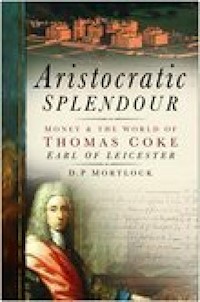
A vivid portrait of 18th century life, through the life and times of Thomas Coke, Earl of Leicester.
Das E-Book Aristocratic Splendour wird angeboten von The History Press und wurde mit folgenden Begriffen kategorisiert:
Das E-Book können Sie in Legimi-Apps oder einer beliebigen App lesen, die das folgende Format unterstützen:
Veröffentlichungsjahr: 2007
Ähnliche



















Aristocratic
Splendour
MONEY & THE WORLD OF
THOMAS COKE
Earl Of Leicester
D. P. MORTLOCK
For Edward Coke, 7th Earl of Leicester, who for nearly a quarter of a century has given me constant support and encouragement. The countless happy hours that I have enjoyed under his eye in one of the finest private libraries in the world have been a blessing beyond compare.
First published in 2007
The History Press The Mill, Brimscombe Port Stroud, Gloucestershire, GL5 2QGwww.thehistorypress.co.uk
This ebook edition first published in 2013
All rights reserved © D.P. Mortlock, 2007, 2013
The right of D.P. Mortlock to be identified as the Author of this work has been asserted in accordance with the Copyrights, Designs and Patents Act 1988.
This ebook is copyright material and must not be copied, reproduced, transferred, distributed, leased, licensed or publicly performed or used in any way except as specifically permitted in writing by the publishers, as allowed under the terms and conditions under which it was purchased or as strictly permitted by applicable copyright law. Any unauthorised distribution or use of this text may be a direct infringement of the author’s and publisher’s rights, and those responsible may be liable in law accordingly.
EPUB ISBN 978 0 7524 9600 9
Original typesetting by The History Press
CONTENTS
Foreword
Acknowledgements
Map
Introduction
1. The Marriage
2. The Great Estate
3. On Home Ground
4. The Town House and its Parish
5. Money Matters
6. The Family
7. The Social Creature
8. The Arts, Culture and Taste
9. Sport
10. Food, Drink and Household Supplies
11. Travel and Stable Matters
12. Servants
13. What of the Future?
Appendices
1. A List of Manors and Properties Purchased by Sir Edward Coke
2. Individual Manors of the Great Estate in the 1720s
3. Advowsons in the Gift of Thomas Coke
4. Household and other Account Books Consulted
Notes
Bibliography
FOREWORD
Over the years the history of Holkham, the estate and the family who have lived in the house has been well documented. However, almost everything written about Holkham has been with a ‘broad sweep of the brush’. Sam Mortlock, the Holkham librarian, has chosen to examine, in fascinating detail, the ten years from Thomas Coke’s return from the Grand Tour in 1718 to his elevation to the peerage in 1728, and thus before the start on building the great house in 1734 that was to be his life’s passion.
Immediately on his return from the Continent, Thomas Coke married an heiress, Margaret Tufton, and it was expected that he would then press on with the house. But it was not to be. Coke rashly invested in South Sea Stock at the very top of the market. The bubble burst in 1720, and he lost the equivalent in present-day money of nearly £3 million. The result was a delay of fourteen years, during which he rebuilt his finances, and that delay has always seemed to me to be a tragedy, as on his death in 1759 the house had still not been completed. The statutory, books, manuscripts, drawings and paintings that still decorate the house were collected by him or at his direction, and it is particularly poignant that he did not live to see it all in situ, or indeed the completed house, the design of which owed so much to his inspiration.
However, Mr Mortlock shows that those years were not wasted. During Coke’s younger years, his estates were competently managed by his trustees, but after his marriage he directed his attention to increasing the return from his land. In the early eighteenth century English farming was still set in the rigid manorial mould that had existed for centuries. Coke set about transforming farming by practices we would recognise today, thus increasing the profits of his tenants and his own rental income. This, combined with the close direction of his non-agricultural properties, produced a 17½ per cent increase in income between 1722 and 1728.
Coke’s energy was prodigious. In 1720 work on a large new kitchen garden was begun; a thorn nursery was established to provide plants for the proposed new hedges. At the same time a huge operation to enhance the landscape to the south of the proposed new house was started. Several thousand tons of soil were removed; thousands of trees were brought in, many semi-mature and some from as far away as Yorkshire. Almost as a diversion, he reclaimed 560 acres of marsh from the sea. In 1725, anticipating the building of his new house, he bought a nearby brickyard. By the time the foundations had been dug in 1734, the prospects of all sides were now far removed from the ‘open and barren’ estate Coke had returned to in 1718.
Mr Mortlock has unearthed fascinating snippets. Coke spent the staggering sum of £5,409 on clothes, jewellery, horses and presents during preparations for his wedding, including £50 on a gold tweezer case for his fiancée. Later, despite the vast gap in their social positions, Coke surprisingly borrowed £60 from Tomley, the hall porter, and £200 from his library, admittedly during the South Sea debacle. Handkerchiefs were bought by the dozen at 4s 6d, which is considerably more, if translated into today’s money, than we pay for handkerchiefs now. In 1728 duty of £1 5s 6d was paid on the importation of 307 drawings, plus half a crown to the Customs Officer to keep him sweet.
Hogarth’s view of the gluttonous Englishman is confirmed when we read in the accounts for February 1727 that everyone in the household was given a daily meat allowance of 2½lb. We are mildly astonished to read of fifty coconuts bought for the kitchen. What were they used for? Total expenditure on food for the household in 1725 was £952, with £526 spent on wine, beer and other alcoholic drinks, perhaps confirming Trevelyan’s observation that ‘Drunkedness is the vice of Englishmen of all classes’. Nothing much has changed!
No doubt, in another 300 years, historians may be as fascinated by life in all its aspects in the Holkham of the early twenty-first century as I have been reading about life in the early eighteenth century. I would not be the least surprised to hear the same names feature in the twenty-fourth century as they do now. We have a Frary, a Futter and a Mallet working here now, as their forebears did in 1720. Perhaps that says something for the stability and continuity of life on at least one of the great estates of England.
Last of all, my very great thanks go to Sam Mortlock for his dedication in producing quite the most informative and enchanting record of perhaps the most interesting decade in the history of Holkham.
Earl of Leicester
ACKNOWLEDGEMENTS
My first thanks are to Lord Leicester and the Trustees of the Holkham Estate, for permission to transcribe and make use of the Holkham archival materials listed in Appendix 4, which form the bedrock of this book. I am grateful also for their permission to reproduce the subjects of Plates 1–5, 7, 10, 11, taken from pictures, Old Master Drawings and books in the house. The text would never have reached its final state had it not been for the guiding hand of Michael Daley MBE, Holkham’s House Administrator, particularly in IT matters. All the photography (with the exception of the aerial view) is his work, and I could ask for no better.
No project spread over twenty years thrives without a generous measure of tea and sympathy, perceptive criticism, doubtful jokes and encouragement when the impulse is to throw everything in the lake and retreat to the pub. Dr Suzanne Reynolds and Michael are in my debt on all counts, and deserve my deep appreciation.
I was fortunate in being able to call upon Raymond Frostick’s knowledge of maps and local surveyors, and he generously provided the reproduction of a section of the eighteenth-century map that appears as Plate 6.
My indebtedness to my publishers is profound. It was commissioning editor Christopher Feeney’s infectious enthusiasm that gave me heart to look more critically at the original text, and sent me on my way with a light heart. Since that happy day, my copy-editor Elizabeth Stone and project editor Hilary Walford have been invaluable in guiding me gently towards the finishing tape. I can only hope that their confidence is justified.
No ancient eccentric has ever been blessed with a more sympathetic wife. Barbara has endured weeks of isolation in Norwich over the years, while I disappeared in search of enlightenment in labyrinthine Holkham and numerous libraries – great fun for me but not for her, and I am deeply grateful.
INTRODUCTION
During the years in which I was preparing a new catalogue of Holkham’s printed books I often had occasion to search the volumes of the household accounts in the archives for information about the house, its contents and the history of the Coke family. As I did so, I came to realise that a mass of fascinating material lay hidden in their pages. Not unnaturally, many before me had made good use of these records. One has only to read any of Dr Hassall’s books and papers, or those of Charles W. James, to find innumerable references to the accounts. Without exception, however, my predecessors had been content to quote individual entries in order to illustrate or validate a point, and I came to believe that only by producing a full transcript could one extract the full measure of the quality of these records. Seeking to keep my enthusiasm within reasonable bounds, I decided that one decade of the eighteenth century should be the limit. The majority of studies so far have focused on the period 1712 to 1718, which covers Thomas Coke’s Grand Tour, and on the great span between 1734, when the house was begun, to its completion after his death in 1759. The gap between invited exploration, lying neatly between Coke’s marriage on his return from the Continent in 1718 and his elevation to the peerage in 1728. As I became more familiar with the material, I realised that it could be used to illuminate a part of his life that not only had been neglected but was of great importance in his development.
My principal source material is the accounts dealing with the years 1718 to 1730, contained in a series of vellum-bound folio volumes in the Holkham archive repository. Not wholly uniform in content or layout, they record the expenses of the household at Holkham and in London, the management of the home farm, details of the economy of the estate lands scattered across England, and income derived from a number of sources. Records of expenditure were kept at three levels if not four, from the hall porter’s notebook up to the land steward’s quarterly and annual summaries. Coverage is not complete, and the scraps of paper that probably formed the lowest level of record have virtually all disappeared, along with nearly all receipted bills.
The volumes contain records kept by land stewards, house stewards and senior servants such as the butler, housekeeper and valet. Supervision and control were exercised at the intermediate level by checking the subordinates and correcting them where necessary before writing up a consolidated version for the house or land steward. Quarterly summaries were then prepared for submission to the master of the house.
In the wider world of the estate, the bailiff of each manor was responsible for preparing accounts of income and expenditure relating to the tenants, to be presented to the land steward or his representative at the manor’s annual court meeting. Finally, the land steward journeyed to London for a meeting with the family’s auditor, where he was joined by the bailiffs from Oxfordshire and Dorset. These definitive audits lasted for ten days or so, in which all the year’s accounts were examined and approved (or amended) for presentation to the owner.
Fifteen account books and three audit books survive from the chosen period, and in most cases the cover title or an internal heading identifies the person who prepared the record (although, confusingly, the phrase ‘this accountant’ is often used in place of the servant’s formal title). In several cases the periods covered overlap, and the same transaction is sometimes noted in more than one place; three of the ledgers contain accounts prepared by more than one person, having been bound up together for convenience of handling. A summary list of these volumes is provided in Appendix 4.
A typical household account book sets out purchases in groups according to the department for which they were made – kitchen, still room, cellar, stables and so on, or by the commodities that were shared requirements, such as fuel. All outgoings were totalled week by numbered week, and at the end of each quarter (Lady Day, Midsummer, Michaelmas and Christmas) the account was submitted for payment. The servants regularly dispensed gratuities on behalf of the master and kept him supplied with spending money, entering the amount ‘for My Master’s Pockett’. Often the hall porter would be sent for a flask of spirits or a paper and then recoup the cost from the house steward at the end of the week. Cash was drawn regularly by the stewards from Peniston Lamb, the family’s attorney and man of business, and a balance was drawn in that respect at the year’s end. Thomas Coke sometimes signed off household accounts, and his signature is paired with his wife’s here and there.
The system of accounting was one that had been used by landowners since the Middle Ages. Its main purpose was not to establish profit or loss but to monitor the probity of the servant involved, and the estate audit books employ a standard format based on this principle. For each year, under the individual manor’s heading, the first section headed ‘The Charge’ records in detail all the sums for which the compiler was responsible and lists rents and casual profits before finishing with a ‘Total Charge’ figure. Then follows ‘The Discharge’, comprising an equally exhaustive list of payments and expenses including quit rents paid, Land Tax payments, expenditure on repairs, allowances for ‘Improvements’ and ‘Neat Money’. Outstanding tenants’ debts are listed before a ‘Total Discharge’ figure is calculated, which allows a balance to be struck. After all the properties are dealt with comes the heading: ‘The Abstract of the foregoing Audit Accompt of the sev.ll Estates for the year 17..’. Under this, the totals of income and expenditure for each manor are tabulated using twelve categories, including ‘Old Arrears’, ‘Deficiencies’ and ‘Arrears Returned’. In conclusion, there is always the written proviso that the accounts are passed subject to the possibility of errors. Overall, this accounting formula made it difficuilt if not impossible to assess relative productivity, but at least it gave the owner a clear picture of who owed what to whom. The absence of realistic forecasts of income – the absence of any apparent concern to determine real income – is a reminder of how remote from today’s practice the accounting procedures of eighteenth-century landowners remained. Even Edward Laurence’s Duty of a Steward to his Lord (London, 1727), which spelled out proper methods for making estate surveys, valuing individual farms and accounting with tenants, nevertheless omitted any mention of how to calculate the real return on the owner’s land.1
Thomas Coke’s role as prime mover in the creation of Holkham Hall has been largely understated: a typical example is John Summerson’s comment on the building in his chapter ‘The Palladian Phase 1710–1750’: ‘Holkham Hall, Norfolk may well owe as much to Burlington as to Kent’, and the relevant plates carry the legend: ‘William Kent, Holkham Hall’.2 However, a phrase of Christopher Hussey’s acts as a useful corrective: ‘It is possible that Kent was then [in 1733] advising on what Lord Lovel called the “pictoresk” and that the actual designing of the house should be assigned to those years preceding the digging of the foundations in 1734’ (emphasis added)3 – in other words my chosen period. In the latest comprehensive overview of the house, its architecture, construction and contents, Prof. Leo Schmidt has this to say: ‘Unique in its combination of magnificent architecture, landscape design and decoration, it forms – along with its priceless collections – a single, complex work of art. Principally the achievement of one man, Thomas Coke, Earl of Leicester.’4 The accounts of the 1720s have a good deal to tell us about the way in which Thomas Coke approached the project that was to become his consuming and lifelong interest, and, while analysing the entries dealing with the preliminary work in advance of building, I was aware that other aspects of his life and times could be explored. Indeed, it seemed unrealistic to consider the preparations for the building in isolation, and I was encouraged by the example provided by Parker’s survey of farming at Holkham.5
In the course of transcribing the audit books in particular I realised (with some surprise) that the old ways and practices of manorial life in English villages were still firmly in place in the early 1700s – a fact often taken for granted by historians and assumed as common knowledge. To me it was a revelation and encouraged a long look at the day-to-day details of village life on the Coke manors. Curiosity fuelled by ignorance must be held responsible for much of the explanatory matter in Chapter 2. Without this information, I could make no sense of what I found, nor succeed in expressing an understanding of what was going on in, say, Hindolveston in 1723. For those with interests in particular village communities, in Appendix 2 I have given brief details of every Coke manor in East Anglia, listing the principal tenants and craftsmen.
Another and more cogent reason for looking in detail at the landed estate during the 1720s is the fact that Thomas Coke’s contribution to the development of agriculture, particularly in Norfolk, has been seriously undervalued. Most commentators have focused on the achievements of his great-nephew Thomas William Coke, known to all as ‘Coke of Norfolk’. The latter’s reputation in his own day was unrivalled, and his fame and patriarchal benevolence, coupled with an aptitude for publicity, have assured his place in history. His admirers established the tradition that he had inherited a sandy waste that he duly transformed. A reading of Arthur Young’s survey published five years before Thomas William assumed control at Holkham is all that is needed by way of correction6 – the crucial changes were effected through the 1st Earl’s management, foresight and determination. The popular image of ‘Coke of Norfolk’ endures, despite one of my predecessors’ efforts to redress the balance:
The yeomen of Norfolk erected no column to commemorate the agricultural efforts of the 1st Earl, as they did in the case of his successor. But had they erected a monument to the man under whose rule the sheepwalks had been changed into a country which gave tenant-farmers £1,300 to £3,000 a year, besides building the house which is one of the stateliest in England, they would have been amply justified in so doing.7
If quality of mind, firmness of purpose and a genius for not only creating the finest Palladian mansion in England but at the same time invigorating a great estate are to be taken into account, then Thomas Coke should stand equal in public esteem with his better-known successor.
In the chapters that follow, I present a picture of life in the Coke household and across his estate under a series of general headings, with the aim of recreating ‘a landscape with figures’. Dame Veronica Wedgwood once wrote that she found the behaviour of men as individuals more interesting than their behaviour as groups or classes,8 and, while agreeing with that sentiment, I have found that in Thomas Coke’s case the behaviour marks a character that is obstinately elusive. Even in his own day he was seen as an odd mixture, combining a fanatical love of field sports with a level of classical learning that commanded respect. His character appears both harsh and compassionate, and the fact that he remains an enigma does not lessen the attraction.
Financial records are sometimes assumed to be dull and mundane, but those I have explored are anything but that. A whole eighteenth-century vocabulary comes into play with dozens of specialised terms for trades, commodities, weights, measures and hundreds of articles in everyday use – lasts of wheat and chaldrons of coal jostle with ankers of brandy and ells of cloth throughout, all priced in pounds, shillings and pence. For those unfamiliar with pre-decimal currency, an aide memoir may be helpful:
There was no pound coin in the eighteenth century, but there were twenty silver shillings in the pound, twelve copper pennies in the shilling, and the pennies were subdivided into two halfpennies and four farthings. Three other silver coins were common: the two-shilling florin (2s), the two-shillings-and-sixpence half a crown (2s 6d), and the crown (5s). After an erratic history, the golden guinea stabilised in the late seventeenth century at twenty-one shillings and was used for professional fees, gambling, at auction and to confuse the multitude until the twentieth century.
These pages illuminate for an instant the individuals among the hundreds of ordinary folk going about their daily lives, whose only other memorials lie unheeded in the parish registers – Tom Manning, whose job it was to ‘fright the crows from the seeds in the Great Wood’; Ann Blinkhorn, the charwoman who found herself transformed into the emergency cook in the London house on a shilling a day and did the job for three months; old Charlie Hodsby, whose mare was seized for a heriot when he died at Portbury; and Henry Carter, who, with his wife and son, spent a week thatching Robert Parker’s barn at Minster Lovell. They come into focus for a moment and then vanish, but together they create a powerful impression of what it was like to ‘live and have one’s living’ (Acts of the Apostles 17: 28) under the hand and eye of Thomas Coke.
In a work such as this there is always a temptation to flesh out the picture in order to make it more attractive. ‘Perhaps’, ‘presumably’ and ‘no doubt’ are seductive, but I have tried to use such terms sparingly and to anchor each statement or statistic on sound evidence found in the archives or in identified secondary sources.
Chapter 1
THE MARRIAGE
On Tuesday 13 May 1718, Thomas Coke landed at Dover with his entourage, having spent ‘near 6 years Travails in France, Italy, Sicily, Germany, Malta, Holland and Flanders’. He was met by Edward Smith, the household’s master of horse, who that day began a new journal in which he recorded all payments made covering his master’s
Expenses in London from that Time to ye 17th of June following which day ye sd. Mr Coke Attain.d to ye Age of 21 Years. And upon Thursday ye 3d of July following was Marryed to ye Rt. Hon.ble ye Lady Margaret Tufton 3d. Daughter to Thomas Earl of Thanet, a Lady of Great Beauty, Singular Virtue & Goodness, being 18 years of Age, 16th of June 1718. These Acct.s also Contain ye Charges of Mr Cokes Equipping himself for ye said Wedding, And for Liveries, Coaches, Horses, Furniture, presents to his said Lady and Gratuities &c.1
It was to be a busy seven weeks and there was much to be done.
It is very unlikely that Thomas had met Lady Margaret before his return, but negotiations concerning a possible alliance had been going on for some time between his guardians and the Earl of Thanet. It would seem that things went forward smoothly and the lawyers for both sides had begun work on drafting the marriage settlement papers. When the young traveller arrived at Dover, his luggage was cleared through the Customs House, a coach and six was hired for the journey to London and arrangements were made for the two berlins* that had been bought abroad to be taken up to town. They probably carried most of the baggage and were guarded during the two overnight stops. On arrival, the whole party went into lodgings with a Mrs Cooley and a Mrs Ireland, and there were tavern bills and bills for wood, candles, washing and sheets. Edward Smith’s father, Humphrey, the land steward, joined him, and, together with three footmen, a coachman, two grooms, a postilion, a stable boy and two helpers, they were all on board wages for eight weeks.
Thomas Coke’s coming of age on 17 June was the signal for the details of the marriage settlement to be finalised, and copies of the documents involved are collected in one volume entitled Copys of the Deed to Lead the Use of the Recoveries, of the Marriage Settlement, and of the Settlement of the house in London made by Sir Thomas Coke.2 The first seven pages are taken up with a detailed list and description of all the properties that comprised the Coke estate in Norfolk and elsewhere, and, after every possible legal synonym, alternative usage and eventuality had been exhausted, it was agreed between the parties (Thomas himself, Sir Edward Coke and John Coke, two of his guardians) that everything was to be ‘to the use and behoof of the said Thomas Coke, his heirs and assigns for ever’. The next indenture was drawn up between Coke and a long list of other parties headed by Thomas, Earl of Thanet and the Lady Margaret Tufton, recording that ‘a marriage is intended shortly to be had and solempnized [sic] between the said Thomas Coke and Lady Margaret Tufton’. It stipulated that £5,000 be passed to Coke immediately as part of Lady Margaret’s marriage portion, the remaining £10,000 to be paid later by agreement. There followed the jointure provisions that were to be available for Lady Margaret’s maintenance should she outlive her husband. A dozen Norfolk manors were selected that yielded £3,354 a year in rent, thus providing her with a tax-free income of £1,600. Within this seemingly interminable list of property details is embedded the more interesting matter of the young wife-to-be’s ‘pin money’. During the lifetime of Coke’s grandmother, Lady Anne Walpole, Lady Margaret was to have £400 a year in equal quarterly instalments from the income of the estate, rising to £500 on the death of Lady Anne. Four other Norfolk manors, yielding £922 a year, were picked to cover the cost, and the first payment was duly made to her in March 1719, covering the preceding three quarters. As with all ‘settled estates’, the questions of sucession and entail were gone into in great detail, and provision was made for the education of any younger children and the maintenance and dowries of any daughters the couple might have. The final indenture in this collection dealt with the Earl of Thanet’s house in Bloomsbury, the freehold of which was owned by Lady Russell. It specified that, ‘in consideration of the intended marriage and of the summe of two thousand pounds . . . to be paid to him the said Thomas Earl of Thanet by the said Thomas Coke’, the residue of the lease of Thanet House would pass to Coke, including the stables, coach houses and other accommodation in Blue Boar Yard. Moreover, the entire contents of the property were similarly assigned. Almost as an afterthought, below the signatures and seals of the various parties there is a separate memorandum that records an agreement that the Earl of Thanet should enjoy the use of an apartment of his choice in the house for the rest of his life.
On the young man’s arrival in London, one of the first requirements was transport, and the following were bought in short order – eight coach horses, four saddle horses for servants, a grey gelding, a ‘managed cropped’ gelding, and a pad* for Lady Margaret, costing £440 in all. Stable, shoeing, bitting and feed expenses followed as a matter of course and amounted to over £70 for the first seven weeks. By then, Coke had moved into Thanet House, confirmed by the cost of feeding the four dogs there being entered in the accounts for the first time. Having made his first exploratory journey down to Hothfield Place, the Earl of Thanet’s house near Ashford in Kent, he made a second visit towards the end of June, accompanied by his guardians and this time using his new custom-built ‘chariot’ lined with fine scarlet cloth drawn by his new team of horses in the hands of Francis Riggs, the coachman. He had spent £50 on a gold tweezer case for his fiancée, and this may have been his opportunity of presenting it to her.
There is no doubt that for all concerned this dynastic wedding was of supreme importance, and no effort or expense was to be spared in ensuring that the bridegroom’s contribution matched that of the noble family to which he was to be allied. That first present was but a small part of a great flurry of spending that was packed into a few weeks prior to the wedding. For the man himself, the primary consideration was his clothes, his linen and his accessories. Over fifty yards of fine cloth, five of scarlet drab, paduasoy silk and nearly sixty pounds worth of gold and silver lace from Mr Henry Hicks went into making six suits. They were made up by William Haines the family tailor, and Mrs Mary Gameron earned £87 for embroidering two of them. There were stockings from Mrs Twamlow, shoes from John Verdon and hats with feathers from John Leek. Shirts, handkerchiefs and linen were all made to order, and another £101 went on lace. Two periwigs, six pairs of gloves and a sword belt completed the list of apparel, but there was more to come. Coke then bought a gold watch, chain and swivel from George Graham, as well as an agate snuffbox, a ring and shoe buckles set with diamonds; pearl tassels enlivened by diamonds and rubies were chosen to adorn his new suits. His silver barber’s basin along with six razors, strops and sundry toiletries, all in a shagreen case, completed Coke’s personal inventory, and two new hair trunks were ordered in which to pack the clothes. His 14-year-old brother, Robert, was kitted out with two suits of clothes trimmed with lace to be worn over a brocade waistcoat, plus stockings, boots and shoes, and a new periwig. Because it was probably his first entry into society, the boy required a sword, a seal and a new setting for his diamond ring, plus seven guineas in pocket money. Both brothers took fencing and dancing lessons under a Mr Bostwick.
The servants who were to travel with the party were newly dressed overall, headed by Humphrey Smith, the steward, who was provided with a suit of fine cloth fringed with gold, together with a hat, stockings, boots and shoes. His son Edward, the gentleman of the horse, had the slightly superior gold lace on his suit, as did Edward Jarrett, the valet-de-chambre. Ten lower servants all had swords and greatcoats to go with their new liveries trimmed with silver lace, and there were twelve pairs of buckskin breeches and velvet caps for the coachmen and grooms.
All the horses that had been bought were furnished with new trappings. Coke’s own horse had a ‘Rich Red Velvet Embroider’d Saddle Royal with Crimson Cloth & other Matters Compleat’. There was also a slightly less expensive set upholstered in blue Genoa velvet enlivened with gold lace and fringe that had a caparison cloth to go with it, which was probably for Robert Coke. Both saddles were fitted with a case of fine pistols supplied with powder and ball. The gentleman of the horse’s new saddle also came with pistol cases and saddle cloth all embroidered. Yet more saddles were needed for the livery servants and the postilion, and a full set of harness for the team of six carriage horses.
By far the largest outlay in this riot of spending was for jewellery and other presents to give to Lady Margaret. The list was headed by a diamond necklace of forty-eight stones, followed by earrings, stay buckles and tags, a sprig for the hair, a gold watch and chain, and a gold seal, and there were wedding rings for both of them. For her new horse she was to have a side-saddle in green embroidered velvet with gold lace and fringes, together with a set of harness. An intriguing item is the £108 of ‘old gold for an Endowing purse’, which was presumably to be presented to the bride. The totals are noted below:
£sdThomas Coke’s clothing504111Thomas Coke’s jewellery &c. 574150Robert Coke’s clothing105120Servants’ clothing32874Horses44010The chariot & harness17906Saddlery & harness199174Lady Margaret’s presents3,0771545,4091053One further small matter had to be attended to. It was apparently required of the young bridegroom that he produce his birth certificate, and the incumbent of St James’s Piccadilly charged half a guinea for providing evidence of his birth and christening.
Those members of his family who had been invited to attend the wedding were gathering, and Sir Edward Coke travelled from Longford in Derbyshire to Sandway,* where servants met him with fresh horses to bring him up to London. Sir John Newton had already gone ahead to Hothfield, but Mr Newton was fetched by coach from Barr’s Court in Gloucestershire, and John Coke came down from Baggrave in Leicestershire. Lady Anne Walpole, Thomas’s grandmother, was of the party, and used her own coach with five servants, and his principal man of affairs, Peniston Lamb, was invited, bringing with him not only his nephew but a clerk in case there was business to transact (his bill for ‘drawing the wedding writings & other business’ was £493 4s, with a further £25 for one of the Masters in Chancery). Humphrey Smith was naturally in attendance, and Mr Haines, the tailor, sent his foreman down to ensure that final touches to the wedding finery were professionally managed. Wedding favours for Mr Coke’s party were provided by a Mr Cooley for £85, and John Casey, the house steward, entered 13s 6d expenses for taking them down.
The scene moves to Hothfield Place, the seat of the Earls of Thanet, where the Tufton family had resided since the time of Henry VIII. The official receipt books record that Lord Tufton paid £5,000 into the Treasury in 1625 for his peerage, but that would hardly have been a suitable topic on which to dwell in 1718, except, perhaps, as a private reminder that ‘money was embracing money’. Of the house itself very little is known, and, although no illustration of it has been traced, it is shown symbolically on John Seller’s map of Kent ‘newly corrected and amended’ of 1710. It was demolished in the 1790s and replaced by a severe stone mansion by James Wyatt, which in its turn was torn down when the estate passed into other hands. All that remains, apart from a fine view to the south across the extensive park, are the original stables and long stretches of mellow red brick walls. The church of St Margaret stands close by, with its substantial shingled spike above a sturdy early fourteenth-century tower. The nave was devasted by a lightning strike in 1598, but restored by Sir John Tufton in 1603. The simple three-bay arcade has exceptionally wide arches leading to a short chancel, which was rebuilt in the late eighteenth century; the rood screen and other medieval woodwork no doubt perished in the fire. The one thing that must have caught the eye of the wedding party still stands just to the left of the chancel entrance. It is the magnificent tomb of the Sir John who restored St Margaret’s, which is quite the best of its period in the county. The recumbent alabaster figures of Sir John and his second wife, Christian, are in pristine condition, with their many children kneeling as weepers below, and the splendid array of heraldic shields in full colour is in remarkable condition. Apart from the evidence of the parish register, which is now in the care of the Kent County Archive Service, nothing can be discovered about the ceremony itself save that it took place on Thursday 3 July 1718, and the chances are that the day was fine. The bride’s father was Thomas Tufton, Baron Clifford and 6th Earl of Thanet. He had been born at the London house in 1644, and, having married Lady Catherine, daughter of the Earl of Newcastle, he was for ten years Member of Parliament for Appleby and, briefly, Lord Lieutenant of Westmorland and Cumberland. He had been a Privy Councillor between 1702 and 1707, but his Tory allegiance lost him his place on the accession of George I in 1714.
As soon as Coke arrived, there had been duty vails (or gratuities) to be handed out to the house staff. Mrs Baker, Lady Margaret’s woman, was given ten guineas, Mrs Price, the housekeeper, five guineas, and a further fifteen guineas were distributed to the rest of the servants. That was but a foretaste of what they received on the day of the wedding, when Mrs Baker received a further twenty guineas, Mrs Price and Mr Drut, the house steward, ten guineas each, and so on down through a total of over thirty servants to a couple of guineas for the ‘helpers in ye House’. Then there were vails for all the relatives’ servants, nineteen guineas for the quintet of musicians who provided the house entertainment, and brother Robert’s obligations to fourteen of Lord Thanet’s servants amounted to another eleven guineas. At the church, as was customary, the parson, his clerk, the doorkeeper and the ringers were all rewarded, and the heart warms to Thomas for giving five guineas to a poor man ‘to keep him out of Goal [sic]’. The sum total of this charitable giving lightened his pocket by £249 18s, and adds substance to the contemporary complaints by the well-to-do that they were being held to ransom by servants everywhere.
After the wedding, most of the family returned to London, but on 25 July Thomas took a trip in his smart new chariot to Tunbridge Wells. Guided by the old Hothfield huntsman and served by Humphrey Smith, his valet, coachman, postilion and a helper, he stopped overnight at Goudhurst, where the ringers got half a guinea for their welcome and the poor gained half-a-crown. He went shopping in Tunbridge for ‘golden toys’ and managed to lose five guineas at basset, a card game rather like faro. Shortly after, he made a trip to Maidstone with the same entourage, but there is no mention of Lady Margaret on either occasion. However, another family wedding was imminent. On 16 August, Lady Margaret’s sister, Lady Catherine, married Lord Sondes, son and heir of the Earl of Rockingham, and the Cokes were naturally invited to stay. Just before that occasion they had called on Lady Fairfax and Sir Robert Furnish, and by 18 August they were on the road back to London, staying overnight at the Bull at Rochester. The chariot was used to transport the maids, while the rest of the party continued the journey by hired coach. Carriers moved over a ton of goods up from Kent to Mr Gibson’s yard, and it took four cart-loads to transfer everything to Thanet House. Meanwhile, the young couple’s arrival in Bloomsbury was greeted by the drummers of the three foot regiments, augmented by six trumpeters, a kettle drummer, the Grenadiers’ trumpeter and the odd hautbois player. Such was possible because, unlike today’s concentration of troops in barracks, at that time the 1st Guards with its two battalions had nine companies spread about Holborn, two in Clerkenwell, two in St Giles’s Cripplegate and eight elsewhere about the city.4 The (unspecified) ‘parish music’ joined in, and St Giles’s ringers added to the welcome. Before the end of the month Thomas Coke had been invited to dine with George I at Hampton Court: it must have seemed that good fortune was his indeed.
* A four-wheeled covered carriage with a seat behind fitted with a hood.
* A docile, easy-paced horse suitable as a mount for ladies and the inexperienced.
* Probably Sandy in Bedfordshire.
Chapter 2
THE GREAT ESTATE
Sir Edward Coke, like many of his generation of thrusting middle-class Elizabethans, had been eager for land. It was his wish to establish a patrimony based on solid foundations, and on the lordship of manors in particular. A Holkham manuscript familiarly known as ‘The Great Book of Conveyances’ gives details of seventy-seven manors.1 The list is headed by Tittleshall Austens, bought for £5 from yeoman Robert Austen in 1576, soon after Coke’s admission to Clifford’s Inn and the Inner Temple. Adjacent Godwick, the house that was to be his family home in Norfolk, came four years later, from the Drewry family, purchased at the much higher price of £3,600. In 1580 Thorington Hall, the first of Coke’s Suffolk manors, was bought from Edward Moulton, a relative of Coke’s wife-to-be, Bridget Paston. In 1596 the net was spread wider to include a manor in Buckinghamshire, and, before the century was out, Stoke Poges, the house in which he was to spend his final years, was bought from the Countess of Huntingdon for £4,000. Properties in Oxfordshire, Dorset, Cambridgeshire, Somerset, Derbyshire, Essex, Staffordshire and London followed. Perhaps sentiment was involved in the purchase of Paston House in Norwich, just across the street from the church of St Peter Parmentergate, where his parents had been married, although it might have been a reminder to his wife’s family of his growing power and influence. His last acquisition was Cookley in Suffolk, which must have given him considerable satisfaction – remembering that he and Bridget had been married there in the church of St Michael thirty-six years before. In all, Sir Edward laid out well over £100,000 between 1570 and 1618.2
These properties formed the foundation for the fortune that the Chief Justice bequeathed to his descendants, and there were very few changes in the land holdings by the time that Thomas Coke’s guardians took over the responsibilities of the estate, when total acreage stood at 40,499.3 The guardians’ principal concern was to maintain the situation until the reins could be handed over to the new owner, but some purchases were made, principally in the Holkham manor in order to bring more of it under direct control. The holding known as Withersby’s was bought from John Thatcher, and various parcels of land that made up the small farm known thereafter as ‘Mansor’s’ were bought from Robert Mansor’s heirs in 1717. The first decade of Thomas Coke’s rule was to be one of transition in the countryside from the known and accepted ways based firmly on manorial precedent and custom, to new and sometimes speculative practices that were inherent in a capitalistic approach to property management.
As a generalisation, throughout southern, midland and eastern counties in the eighteenth century, the land, other than wastes and forests, was ploughland and in very large fields, with a concentration of the population in villages, and little or no evidence of farmhouses and steadings built upon the land outside them. In these areas ‘the ancient system of land tenure based on communal cultivation obtained’.4 The village supported itself by cultivating large open fields in which the people held small strips of land, which were allocated evenly according to their quality. Because each man’s strips were scattered, all had to conform to a common cropping pattern. This worked well for over a thousand years, but, when new crops and improved techniques made farming for profit a reality, the common field system could not hold out against the benefits of enclosure.5 Farms that had been given names such as ‘Hall farm’, ‘Grange farm’ and so on had in the main been consolidated and enclosed from an early date, but it is notable that a detailed map of the Holkham manor based on a 1720s survey shows the ‘East Field’ clearly marked and unenclosed. A gathering momentum in the process of enclosing land is noticeable in the seventeenth century, and by the early years of the eighteenth century it was focused on the common arable fields, but it was not until the late 1700s, when the majority had been dealt with, that ‘the growth of population and the great technical improvements in agriculture caused men to turn their attention more and more to the possibilities of improvement in the technical efficiency of farming’.6 Thomas Coke was one of the first great landowners to promote this particular form of development, followed at the turn of the century by his successor, Thomas William Coke, whose personality and skill in promoting agricultural experiment have enhanced his reputation in this respect and diverted attention from the innovative activities of his great-uncle.
Almost all the information contained in this chapter has been gleaned from the series of audit account books.7 The arrangement is standardised throughout, set out quarter by quarter through the year, with a section for each manor or separate property. There are two divisions, ‘The Charge’, which details all items of income, and the ‘Discharge’, which lists outgoings. On the charge side there are subdivisions for outstanding debts, rents and casual profits (the latter covering non-recurring items such as Leet Court fines and sales of materials); on the discharge side the subdivisions cover taxes, repairs, allowances, deficiencies (that is, allowed variations in charges and payments) and debts outstanding at the end of the period. With the exception of Kingsdown, Kent, where there was a minor variation, the estate paid all national and local taxes, and met the cost of all repairs to premises, whether carried out by the landlord or the tenant. The term ‘repairs’ was applied quite loosely – as at Knightley, Staffordshire, where the tenant of the Park farm was allowed £9 7s 9d under that head to ‘enlarge his dairy and make a new parlour over it’; similarly, at Panworth Hall, Norfolk, the conversion of one end of the hall into a brewhouse and malthouse for £166 was treated as a repair, and, as the amount was too high to allow the manor’s accounts to be balanced, it was entered under the land steward’s general ‘Accompt Current’ for that year. Under ‘Allowances’ payments are listed for improvements made by tenants, of which more will be said later. The typical cottage in Norfolk and Suffolk was built of clay lump, roughly plastered, with a roof thatched with straw, and a typical ‘deficiency’ was entered when one of these at Massingham collapsed (as they often did). In that case the entry ran: ‘To be allowed, a defalcation in Mr Carr’s farm by the fall of a cottage.’ Each year’s entries are rounded off by an abstract of the manorial accounts and an ‘Accompt Current’ in which the land steward set out all his accounts, covering not only the properties but also the house budgets, staff costs, finance arrangements and so on.
A decisive change in the administration and control of the estate was confirmed by the appointment of a new land steward. Humphrey Smith had held that position for some considerable time, and it was to be expected that his son Edward, the ‘Gentleman of the Horse’, would take over when his father retired. Over the years, Smith had established something of a cosy relationship with the guardians, judging by an extract from his letter to Sir John Newton in 1710: ‘My wife has by ye same waggon sent my Good Lady Newton a harvest Goose and a Turkey which she beggs may be accepted of with her humble duty, and thanks for ye Noble present my Lady was pleased to make her.’8 Things had been left very much in Smith’s hands, but one of the guardians at least had begun to have reservations. In June 1711 Sir Edward Coke voiced his opinion: ‘I think it would doe well to be out of Debt & to have a Command of money, & to put these Norfolk repairs under some restriction, & not to leave them so absolutely to the pleasure of the Steward.’ He suggested paying ‘some person who understands building & countrey affairs’ to survey and report back.9
Change was in the air, and a new man was brought in from outside, possibly from Longford in Derbyshire, the home of Thomas’s guardian Sir Edward Coke. George Appleyard’s name first appears as land steward in the audit accounts for 1722 on a salary of £200 a year. Smith had been paid £30, the same rate as his son and the house steward, John Casey, so the introduction of a replacement as the senior servant of the estate on a salary that equalled the income of many a minor gentleman must have come as a distinct shock, not only to the household but to the county at large. Appleyard’s first annual accounts disclose that his predecessor was in debt to the estate. Until Michaelmas 1722, Humphrey Smith was still renting Hill Hall farm, Wellands farm, various marshes in Holkham, lands in Tittleshall and Godwick, and one of the Huntingfield manors in Suffolk. He was living in Hill Hall house on a lease that required him to keep it in repair, for which he was allowed £26 5s in 1717, the year when he finally got round to rebuilding the 15ft-high garden wall that had been blown down by the ‘great wind’ three years previously. By the end of 1722 he was £337 15s 8d in arrears, and by 1725 the debt had grown to £1,298 0s 11d, as more and more deficiencies were uncovered that had to be laid at his door. A number of these concerned the West Country properties, where, for example, from Donyatt in Somerset, Smith had collected £610 8s 9¾ d in fines but had omitted to enter them. By 1728 his indebtedness had dropped to £1,098 0s 11d – ‘part being forgiven and the other part secured to be paid’, with no clue as to what was allowed and what had been secured. Coke’s informed interest in the estate from the moment he assumed control may well have made him aware of Smith’s lack of ability, but the need to recruit a land steward of higher calibre overrode his undoubted respect for an old family servant.
Once he had taken over the running of the estate, Coke set out to farm on the best known principles, growing wheat, clover, turnips and lucerne, fertilised with marl in the approved fashion, in common with his Walpole and Townshend neighbours. From this time forward, leases bound tenants to a course of cropping that included turnips and a clover ley of two years or longer; tenants were encouraged to marl, either at their expense or with financial assistance from the landlord.10 Enclosure and the four-shift rotation bore down on the open-field foldcourses, making the close-folding of sheep in north-west Norfolk anachronistic. In this situation, the keynote of animal husbandry in our period was the beef trade. Because in-wintering was the essence of the new system, the muck cart became as important as the marl cart. The accounts refer to stock bought after the harvest, fatted and sold the following year, and it was possible to make a gross profit of £100 on some fifty bullocks, but feed costs at about eight shillings a beast over six months meant that no great fortunes were to be made that way.11
To some extent, Coke and his new steward were fortunate, at least in Norfolk, in the quality of their labour force. At the end of the century William Marshall had this to say:
In respect of day labourers, two remarkable circumstances are united; namely, hard work and low wages. A Norfolk farm labourer will do as much work for one shilling, as some two men, in many other places, will do for eighteenpence each. There is an honesty, I had almost said an honour, about them, when working by the day, which I have not been able to discover in the day labourers of any other country.
On working practices he commented:
The Norfolk practice of going what are called two journeys a day, with the plow teams starting at 6 or 7 am., the men reach home by dinner time, and having refreshed themselves and their horses, are ready to start again at 1 or 2 o’clock for the afternoon journey until 6 or 7 pm. They employ five-horse teams, with one horse at rest, two used in the morning and two used after dinner. Whether on the road or on the farm, the common practice is to trot with empty carriages [thus improving the turn-round time significantly].12




