


Erhalten Sie Zugang zu diesem und mehr als 300000 Büchern ab EUR 5,99 monatlich.
- Herausgeber: The History Press
- Kategorie: Sachliteratur, Reportagen, Biografien
- Sprache: Englisch
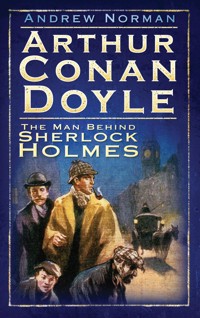
In the year 1900, Sir Arthur Conan Doyle was at the height of his success as a doctor, a sportsman, a writer of historical novels, a champion of the oppressed and, most notably, the creator of that honourable, brave and eminently sensible master detective, Sherlock Holmes. Every new Holmes story was greeted with great anticipation and confidence in the knowledge that, however complex the crime, the supremely intelligent and logical detective would solve it. But in 1916, Conan Doyle suprised his readers by declaring that he believed in spiritualism. And, when, in 1922, he published a book in which he professed to believe in fairies, his devotees were distinctly unimpressed. How could the man who invented ultra-rational Holmes claim to believe in something as bizarre and unproven as the paranormal? Andrew Norman delves into both Doyle's medical records and his writings to unravel the mystery of his beliefs, and to provide an unusual perspective on the life of the man behind Sherlock Holmes.
Sie lesen das E-Book in den Legimi-Apps auf:
Seitenzahl: 265
Veröffentlichungsjahr: 2010
Das E-Book (TTS) können Sie hören im Abo „Legimi Premium” in Legimi-Apps auf:
Ähnliche
















To my dear wife, Rachel
Contents
Acknowledgements
Preface
1 Formative Years and Influences
2 From Doctor to Writer: Sherlock Holmes
3 Doyle Sets the Scene
4 Doyle and Holmes: Analogous Lives
5 Holmes Eclipses his Creator!
6 Doyle on a Treadmill
7 Literary Allusions, Imagery, Music
8 Dr John H. Watson
9 The Demise of Holmes
10 A Quest for Meaning: The Paranormal
11 Holmes is Reborn
12 Justice and Fair Play
13 War, Spiritualism
14 Fairies
15 Harry Houdini: Further Psychic Experiences
16 The Paranormal: The Present Position
17 Charles Doyle: Like Father, Like Son?
18 Charles Revealed through his Son’s Writings?
19 Charles Doyle and the Possible Use of Stimulants
20 The Montrose Royal Asylum
21 Charles Doyle’s Diary
22 From Montrose to Edinburgh and Dumfries
23 Charles Doyle: Towards a Diagnosis
24 Doyle’s Delusions: An Inherited Disease?
25 Epilogue
Bibliography
List of Illustrations
Plates
Copyright
Acknowledgements
Office of the Chief Herald, Dublin, Ireland; Dundee University Archives, Dundee, Scotland; Dumfries and Galloway Health Board Archives, Dumfries, Scotland; Lothian Health Service Archive, Edinburgh University Library, Edinburgh, Scotland; Northern Health Services Archive, Woolmanhill, Aberdeen, Scotland; Central Library, Guildhall Square, Portsmouth, England; Poole Central Library, Poole, Dorset, England; British Medical Association, Records and Archives, Tavistock Square, London; Cumbria Record Office, Kendal, Cumbria; Local Studies Archive, Oldmeldrum, Aberdeenshire; Aberdeen & North-East Scotland Family History Society; Aberdeenshire Library and Information Service; Royal Commission on the Ancient and Historical Monuments of Scotland.
Dr Allan Beveridge; Geraint Bowen; Nellie Carr; James and Carol Ince; Joyce Irvine; Judith Legg; Donald McCaskill; Rosie McLure; Steven Powrie; Peter Tewksbury; Fiona R. Watson; Morag Williams; Louise Yeoman; Dr Mary Young; Daniel Parker; Alice Grayson; Kristina Watson.
I wish, most sincerely, to thank Scirard R. Lancelyn Green for the use of photographs from the collection of the late Richard Lancelyn Green. This collection has been donated to Portsmouth City Council, where an exhibition of it may be seen at the City Museum and Records Office. As regards photographs credited to Paddington Press, despite strenuous efforts it has not been possible to trace this publishing house, which appears to be defunct.
I am especially grateful to my dear wife Rachel, for her help and encouragement.
Preface
It is the year 1900 and Arthur Conan Doyle, now aged forty-one, is at the height of his powers. A qualified doctor who has travelled widely; a keen and able sportsman who once bowled out the legendary Dr W.G. Grace in a cricket match (a favour which the great cricketer was quick to return!); a chronicler of the South African War (which he witnessed at first hand); a writer of historical novels and patriotic pamphlets, and a champion of the oppressed and the underdog. Most of all, however, he is known for being the creator of that honourable, brave, scientific, and eminently sensible master detective Sherlock Holmes.
Every new Holmes story is greeted with great anticipation and confidence in the knowledge that however complex the crime, the eminently intelligent and logical Holmes will solve it. It therefore comes as a great surprise to his readers, when in the year 1916, the author, now Sir Arthur (he was knighted in 1902), declares that he believes in spiritualism. How can the creator of the inexorably logical Sherlock Holmes behave like this? It simply does not add up. And when, in 1922, Doyle publishes a book in which he professes to believe in fairies, the vast majority of his devotees are, frankly, nonplussed. For many, this was too much. Suddenly the iconic figure of Doyle instead becomes a figure of fun; a subject of ridicule, mirth, and derision.
Having an enquiring mind like Doyle, I was prompted to ask what he was seeking when he renounced his former Roman Catholic religion and became a spiritualist. Was there something lacking in his life which led him into an investigation of the paranormal? As for believing in fairies, this seemed altogether too bizarre. So how could one account for it?
As I commenced my research my first instinct was to empathise with Doyle, not for his strange beliefs, but for the reason that like him I am a former medical practitioner who became a writer (in my case, following a spinal injury). What if he had walked into my former surgery in Poole, Dorset (his being in Southsea, Hampshire) one day as a patient, and told me his story? Perhaps, the first thing I should have asked him, discreetly of course, would have been if there were any other members of the Doyle family who had had similar experiences? Unfortunately, for obvious reasons, it is impossible for me to question Doyle himself.
Nonetheless, when I came to investigate Doyle’s psyche using his own writings (both factual and fictional) as my predominant source, I found the journey just as exciting as any of the cases embarked upon by the great Sherlock Holmes, and all the more extraordinary because this was real life! Like Holmes, I was now looking for clues which I largely found subtly concealed in Doyle’s own writings.
The trail led to Scotland, to the remote hamlet of Blairerno near the east coast; to Montrose; to Edinburgh; and to Dumfries. In all of these places Doyle’s father, Charles Altamont, had been forcibly incarcerated in various institutions for both his own safety and for that of others. Could it be that Charles held the key to the unanswered questions about his son?
My investigations led me to conclude that Doyle’s father had suffered not only from alcoholism and epilepsy, as has previously been described, but more importantly from a serious mental illness. Not only that, but this illness was itself a hereditable disease, in other words, one which Charles may have handed down to his son via the genes. Suddenly I realised that I now had an opportunity to solve what I consider to be the ultimate mystery, that of the bizarre and extraordinary nature of Sir Arthur Conan Doyle himself!
1
Formative Years and Influences
Arthur Ignatius Conan Doyle (hereafter called Doyle) was born on 22 May 1859 at 11 Picardy Place, Edinburgh, of Irish Catholic parents. He was the third of nine children, and the eldest son.
Doyle’s son Adrian states that on his father’s side, Doyle was descended from, ‘a line of Irish country squires’ who were Catholics and landed gentry.1 However, life for them would not be easy when, as Doyle states, with the coming of the Reformation (the rejection of the authority of the Roman Catholic Church), ‘My forebears, like most old Irish families in the south [of Ireland] kept to the old faith [i.e. Roman Catholicism] … and fell victim to the penal laws [which were designed to prevent Catholics from achieving wealth and power] in consequence.’2 The outcome was that, in 1668, Doyle’s great-great-great-great-grandfather John Doyle:
…was dispossessed of almost all his Irish land in favour of the Duke of York; only the small estate of Barracurra was left him, and his grandson Richard was forced to leave even this in 1762. After being uprooted from his home, Richard went to Dublin and set up as a silk merchant. His son James Doyle had two sons, of whom the elder John [grandfather of Doyle], was born in 1797.3
Doyle’s grandfather John showed an early talent for painting and drawing – his favourite subject being horses – for which he received many commissions. In 1820 he married Marianna Conan, whose father was a Dublin tailor, like her husband’s father. Marianna is described as, ‘… the surviving cadet of the Conan family [from whom Doyle derives his middle name], the ancient ducal House of Brittany,’ who fled to Ireland following the religious persecution of her forebears.4
In 1821 or 1822, John and Marianna, who by now had a baby daughter Ann Martha (‘Annette’), moved to London. Here John continued in his career as a painter, exhibiting regularly at the Royal Academy between 1825 and 1850. He later became a political satirist and cartoonist. Next came James Edmund William (b.1822); Richard (b.1824); Henry Edward (b.1827); Francis (b.1829, ‘Frank’, who died aged fifteen); Adelaide (b.1831, who died of tuberculosis in 1844); and finally, Charles Altamont (b.1832). In 1833 the Doyle family took up residence at 17 Cambridge Terrace in the fashionable district to the north of Hyde Park.
James became an illustrator of books, an antiquary and the author of TheHistorical Baronage of England and A Chronicle of England (which he illustrated in colour). Richard became an illustrator and watercolour painter with a fascination for fairy tales and legends. He also worked for seven years for the satirical magazine Punch. Henry became director of the National Gallery of Ireland, founder of the National Historical and Portrait Gallery and designer of religious murals. As for Charles Altamont, his story is as follows.
A vacancy arose at the Scottish Office of Works in 1849 and Charles moved to Edinburgh to become one of the assistants to Robert Matheson, Chief Surveyor for Scotland. Here in the Scottish capital, Charles eventually came to lodge with Katherine (née Pack), widow of Dr William Foley of Trinity College, Dublin, and a descendant of the Percy family of Northumberland. In July 1855, Charles married his landlady’s elder daughter Mary Josephine Foley in Edinburgh’s Roman Catholic Cathedral of St Mary.
The couple went on to have nine children: Anne Mary Frances Conan (b.1856, known as ‘Annette’); Catherine Amelia Angela (b.1858, but died in the same year of hydrocephalus). On 22 May 1859, arrived Arthur Ignatius Conan, the principal subject of this narrative, who derived his second name from the fact that his parents were married on 31 July, the Feast of St Ignatius; Mary Helena Monica Henrietta (b.1861, died of laryngitis aged two years;5 Caroline Mary Burton (1866, ‘Lottie’); Constance Amelia Monica (b.1868, ‘Connie’); John Francis Innes Hay (b.1873, ‘Innes’); Jane Adelaide Rose (b.1875, ‘Ida’); Bryan Mary Julia Josephine (b.1877, ‘Dodo’).
To supplement his income and provide for the growing family, Charles devoted his spare time to producing the illustrations for fourteen books, including John Bunyan’s allegory Pilgrim’s Progress and Daniel Defoe’s The Life and Surprising Adventures of Robinson Crusoe. Magazines which he illustrated included Diogenes, The Illustrated Times, Good Words, London Society, and The Graphic. He also painted: favourite subjects being landscapes of Scotland, humorous cartoons and fairies. He also worked as a sketch artist in criminal trials. In 1876, Charles was promoted in the Scottish Office of Works to become second assistant surveyor out of three.
* * *
In 1868, when he was aged nine years, Doyle was sent away to boarding school for his education: first to Hodder Preparatory School in Lancashire and then on to the adjacent Roman Catholic public school of Stonyhurst. The fees were paid, not by his impecunious father, but by his more prosperous uncles. Now, ‘save for six weeks each summer, one never left the school,’ said Doyle.6 Allegedly, this was to keep him away from his father Charles who had become heavily dependent on alcohol.
In 1874, the fifteen year old Doyle travelled to London for the first time where he visited his uncle Richard Doyle, the illustrator and watercolour painter. Four years previously, Richard had published his most famous book In Fairyland. He and Doyle now
became firm friends, and Dick [Richard] entertained his nephew by showing him his studio, full of paintings and drawings of goblins and fairies, elves and ghosts, dragons and witches. He also told young Arthur [Doyle] some of his favourite stories of fairies and ghosts and legends, thoroughly indoctrinating him into the ‘other world’ which also captivated Arthur’s father.7
Forty-six years later, the subject of fairies would again impinge on Doyle’s life, and this time in a most dramatic way.
* * *
Charles’s alcoholism would have immense implications for the family in the years to come. At that time, the view of the medical profession was epitomised by Professor John Glaister in his work A Text-Book of MedicalJurisprudence and Toxicology first published in the year 1921. Glaister acknowledged that ‘… insanity – perhaps of a temporary kind – may be induced by the direct effects of alcohol.’
Glaister also stated that, ‘… alcoholism is one of the more indirect causes of the insane condition ….’8 However, had Charles been examined by a present day psychiatrist, the question asked might well have been, could the reverse of this proposition by Glaister have been the case i.e. did Charles have a pre-existing mental condition which predisposed him to alcoholism? This will be discussed in more detail later.
As for Doyle, his final year of schooling was spent at a Jesuit school in Austria. It was during his schooldays that he renounced his belief in Roman Catholicism.
Notes
1. Doyle, Adrian Conan, The True Conan Doyle, p.6.
2. Doyle, Sir Arthur Conan, Memories and Adventures, p.2.
3. Nordon, Pierre, Conan Doyle, p.4.
4. Doyle, Adrian Conan, op.cit., p.6.
5. Doyle, Georgina, Out of the Shadows, pp.32,34,35.
6. Doyle, Sir Arthur Conan, Memories and Adventures, p.8.
7. Roden, Barbara, www.ash-tree.bc.ca/acdsfairies.htm 29/03/2006.
8. Glaister, John, A Text-Book of Medical Jurisprudence and Toxicology, p.607
2
From Doctor to Writer: Sherlock Holmes
Perhaps it was at the suggestion of Bryan Charles Waller, who came to lodge with Charles Doyle and his family in about 1875 and became their benefactor, that Doyle decided to become a doctor. Waller himself had arrived in Edinburgh in 1871 to take up the study of medicine. In any event, Doyle entered Edinburgh University’s medical school in 1876 where he met the thirty-nine year old Dr Joseph Bell, author of A Manual of theOperations of Surgery. It was ironic that although Bell was Doyle’s medical mentor, it was he who would set the latter on the road to becoming a writer, as will shortly be seen.
In his autobiography, Doyle described how Dr Bell (who paid Doyle the compliment of making him his out-patient clerk), ‘…often learned more of the patient by a few quick glances than I had done by my questions.1 If he [Bell] were a detective, he would surely reduce this fascinating but unorganised business to something nearer to an exact science. I would try if I could get this effect. It was surely possible in real life, so why should I not make it plausible in fiction?’2
Whilst still a medical student Doyle worked for a while as assistant to Dr Richardson of Sheffield, Dr Elliott of Shropshire and to Dr Hoare of Birmingham where his duties included the making up of prescriptions. It was then, he said, ‘that I first learned that shillings might be earned in other ways than by filling phials. Some friend remarked to me that my letters were very vivid and surely I could write some things to sell.’3
Also during his time as a medical student Doyle sent his story TheHaunted Grange of Goresthorpe, described by him as ‘a true ghost story’, to Blackwood’s Edinburgh Magazine. They declined to publish it. Undeterred, he sent The Mystery of the Sasassa Valley, a story set in South Africa and involving a treasure-hunt, to Edinburgh’s Chambers’s Journal which published it on 6 September 1879. In the same month, an academic article by him entitled Gelseminum as a Poison appeared in the British MedicalJournal. (He had first-hand knowledge of Gelseminum which is derived from the root of jasmine, having used it to treat himself for an attack of neuralgia).
Meanwhile, back at home Mary Doyle was undergoing what Doyle described as ‘the long, sordid strain’ of having to cope with her husband Charles,4 who was forced to retire from the Scottish Office of Works in 1876. He now found himself having to live on a pension that was inadequate to support his family.5 Nevertheless, he appears to have continued his work as a book illustrator. No less than sixty of his illustrations appeared in Jean Jambon’s Our Trip to Blunderland (a parody of Lewis Carroll’s Alice’sAdventures in Wonderland, published in 1877 by William Blackwood & Sons, of which 15,000 copies were printed in the first two years).
Finally, the problem of Charles’s continued heavy drinking coupled with his increasing ‘bouts of melancholia and depression’6 proved too great for the family to bear and in 1879, at the age of forty-seven7 he was admitted to Blairerno House, a home for intemperates (those given to excessive indulgence in alcohol), situated seventy miles from his home town of Edinburgh and near the village of Drumlithie in Aberdeenshire (then Kincardineshire), north-east Scotland. Charles would now spend the remainder of his days in one institution or another. As for his wife Mary and their children – including Doyle (Arthur), now aged twenty, it is doubtful whether they ever saw him again.
* * *
Doyle’s world was not confined to that of writing and medicine. In 1880, for example, the year before he qualified, he served ‘in the capacity of surgeon’ for seven months on the 200 ton whaling vessel Hope of Peterhead, in the ‘Arctic Seas’.8 From October 1881, he served for three months as surgeon on the 400 ton steamer Mayumba to West Africa: experiences which resulted in him including seafaring tales amongst the short stories which he was now writing. During these varied experiences and others which followed later, Doyle was furnishing his mind with material which would find its way into his writings both fictional and non-fictional. For example, a visit to Liberia had given him an insight into the brutality of the slave trade which had existed there; his indignation being reflected in The Crime of the Congo, published in 1909, which described in graphic detail the oppression by the Belgian colonists of the native Congolese. Doyle’s seafaring trips also provided inspiration for J.Habakuk Jephson’s Statement (1883), in which a possible solution to the mystery of the Marie Celeste (an American brigantine found abandoned with sails set between Portugal and The Azores in 1872) is offered.
In August 1881, Doyle graduated from Edinburgh as Bachelor of Medicine and Master of Surgery.9 Having qualified, he worked as a general practitioner in Plymouth and then from June 1882 in Southsea, Portsmouth. At this latter place he decided that producing novels would be more financially remunerative than short stories and to this end he commenced TheNarrative of John Smith, described by him as being ‘of a personal-social-political complexion’ and ‘perilously near the libellous’.10 Unfortunately, his only copy of the manuscript of this work was lost en route to the publisher. He then commenced writing another story (this time semi-autobiographical and featuring Edinburgh University) which would finally be entitled The Firm of Girdlestone (1890).
In November 1883, Doyle became a member of the Portsmouth Literary and Scientific Society, which brought him into contact with General Alfred Drayson, whom he described as ‘a very distinguished thinker and a pioneer of psychic knowledge …’.11 It was Drayson who introduced him to theosophy (a theosophist being one who claims to receive divine illumination or inspiration, and to have abnormal control over natural forces). Drayson told Doyle that the fundamental truth was ‘that every spirit in the flesh passes over to the next world exactly as it is, with no change whatsoever.’12 These words made a great impression on Doyle, now aged twenty-four, to the extent that he adopted this tenet of Drayson’s for himself as one, and perhaps the most important, of his core beliefs. Doyle also played football, keeping goal for a team which later became Portsmouth City Football Club.
In late 1883, Mary Doyle, together with children Connie, Ida, Dodo, and Innes, moved to Masongill in North Yorkshire to a cottage on the estate belonging to the family of Bryan Waller, Mary’s former lodger.13 Waller had retired to Masongill the previous year (having inherited the estate on the death of his father in 1877), and had now given up his medical career. Waller was aware of Mary’s plight, and had helped the family financially. It was probably as a result of his benevolence that Mary gave her youngest daughter the somewhat inappropriate first name of Bryan.
In 1885, Doyle obtained his doctorate, also from Edinburgh, on aspects of the venereal disease syphilis. In that year, a widow Mrs Emily Hawkins, her son John and her daughter Louise became Doyle’s patients, having arrived in Southsea from Gloucester. When Jack, aged twenty-five, contracted meningitis Doyle took him into his own lodgings to care for him. The attempt, however, was unsuccessful and the boy died. Doyle subsequently developed a friendship with Louise, whom he married on 6 August of that year. He was aged twenty-six and she twenty-eight. To supplement his income Doyle continued with his short story writing for which he was paid, ‘£4 on average’.14
On 26 May 1885, shortly before Doyle’s wedding, his father Charles managed to acquire some liquor; became violent and attempted to leave Blairerno House by breaking a window. This, apparently, was not the first time he had attempted to break free from there.15 In consequence, he was transferred to the Montrose Royal Asylum (‘Sunnyside’ wing). Here he was held under a detention order as a lunatic, this being defined as
… any mad or furious or fatuous [vacant, silly, purposeless, or idiotic] person, or person so diseased or affected in mind as to render him unfit in the opinion of competent medical persons to be at large, either as regards his own personal safety and conduct, or the safety of the persons and property of others or of the public.16
How distressing it must have been for Doyle and his family to hear Charles described in this way.
* * *
Meanwhile, a breakthrough for Doyle came in 1887 with A Study in Scarlet where Sherlock Holmes and Dr Watson appear for the first time. This story, illustrated by Doyle’s father Charles who depicted Sherlock Holmes uniquely sporting a beard, was published in Beeton’s Christmas Annual of that year. Others to take Doyle’s work included the Pall Mall Gazette, TheCornhill, and Lippincott’sMagazine.
The plot for The Mystery of Cloomber (1888) arose out of Doyle’s meeting in Southsea with the spiritualist General A.W. Drayson. In this story, Doyle (in contrast to Sherlock Holmes) presents a sceptical view of science: an indication that he had become disillusioned with the subject:
…history has shown that it [science] is slow to accept a truth. Science sneered at Newton for twenty years. Science proved mathematically that an iron ship could not swim, and science declared that a steam ship could not cross the Atlantic.17
In January 1889, Doyle and his wife Louise’s first child was born, a daughter Mary Louise. Now came two historical novels: Micah Clarke set during the time of the Monmouth Rebellion of 1685, which was published that year and The White Company, a story of English mercenary soldiers operating in France and Spain in the fourteenth century and published in 1890. That year began with the tragic death in Portugal from influenza of Doyle’s sister Annette.
Doyle’s work as a family doctor, together with his writing, did not prevent him from taking a lively interest in the medical topic of the day – even to the extent of becoming personally involved. In August 1890, Robert Koch, German physician and discoverer of the tubercle bacillus which causes tuberculosis, announced to the International Medical Congress of Berlin that a drug which he had produced, tuberculin, was a cure for tuberculosis. Doyle, was not so sure however, it being his view that ‘the whole thing was experimental and premature’.18 Doyle was proved right. Tuberculin, although useful in diagnosis of tuberculosis, was ineffective as a cure. There was a sad irony in the fact of Doyle’s especial interest in tuberculosis, bearing in mind the fate that was to befall his wife Louise, as will shortly be demonstrated.
In March 1891, the family moved to London where Doyle hoped to become an eye specialist. Here they rented rooms, first at 23 Montague Place, Bloomsbury and subsequently from June, at 12 Tennison Road, South Norwood on the fringes of Greater London.
In July 1891, short stories involving detective Sherlock Holmes and his associate Dr John Watson, began to appear regularly in The Strand Magazine which caused the newly founded publication’s circulation to almost double. Doyle was now commissioned to write a further six stories following the first series, and then a further twelve. He soon found himself in a position to embark on a career of full-time writing, during the course of which he would write several historical novels. For example, A Straggler of ‘15 (1891) describes the final days of a veteran of Waterloo. It was subsequently performed as the one-act play Waterloo (1895), starring the legendary actor Henry Irving. However, although he would not have wished it, it is for Sherlock Holmes that Doyle is best remembered, for it was his legendary detective who would set him on the path to fame and fortune.
In the preface to Sherlock Holmes: The Long Stories, Doyle states that, ‘Having endured a severe course of training in medical diagnosis, I felt that if the same austere methods of observation and reasoning were applied to the problems of crime some more scientific system could be constructed.’ Doyle would later give credit where it was due by dedicating his story TheAdventures of Sherlock Holmes ‘To my old teacher Joseph Bell, MD &c. of 2 Melville Crescent, Edinburgh.’ As for Holmes, he become not only a household name, but in the eyes of the public a very real person! Doyle himself acknowledged this, saying in later years
Well, the curious thing is, how many people there are in the world who are perfectly convinced that he is a living human being. I get letters addressed to him. I get letters asking for his autograph. I get letters addressed to his rather stupid friend Watson. I’ve even had ladies writing to say that they would be very glad to act as his housekeeper.19
* * *
In the summer of 1892, the Doyles, together with Doyle’s sister Connie, visited Norway in company with author Jerome K. Jerome. In November that year, the couple had a son Arthur Alleyne Kingsley (known as Kingsley). Meanwhile, The Great Shadow (1892), describes the crisis leading to the Battle of Waterloo through the eyes of a Scottish boy.
Notes
1. Doyle, Sir Arthur Conan, Memories and Adventures, p.20.
2. Ibid, p.69.
3. Ibid, p.24.
4. Ibid, p.11.
5. Doyle, Georgina, Out of the Shadows, p.41.
6. Engen, Rodney, Richard Doyle, p.168.
7. Doyle, Sir Arthur Conan, op.cit., p.20.
8. Ibid, p.34.
9. Ibid, p.47.
10. Booth, Martin, The Doctor, The Detective, and Arthur Conan Doyle, p.103.
11. Doyle, Sir Arthur Conan, op.cit, p.79.
12. Stashower, Daniel, Teller of Tales: The Life of Arthur Conan Doyle, p.95.
13. Doyle, Georgina, op.cit., p.44.
14. Doyle, Sir Arthur Conan, op.cit., p.72.
15. Doyle, Georgina, op.cit., p.43.
16. Glaister, John, A Text-Book of Medical Jurisprudence and Toxicology, pp.540
17. Stashower, op.cit., p.86.
18. Doyle, Sir Arthur Conan, Memories and Adventures, p.90.
19. Television Documentary. Arthur Conan Doyle: For the Defence. 2005. Produced and directed by Richard Downes. BBC Scotland. C. BBC.
3
Doyle Sets the Scene
The address 221B Baker Street is situated in a fashionable district of London to the south of Regent’s Park, and this is the place where so many of the Sherlock Holmes stories begin, and end. It is morning. Dr John H. Watson is reading the newspaper; Holmes is puffing on his tobacco pipe and occasionally evoking a few discordant sounds from his violin. He sometimes looks wistfully out of the window at urchins playing in the street below and at horse drawn carriages clattering by as he wonders what the day will bring. And of course, there is always Mrs Hudson to provide a meal or a tray of tea: something which Watson always appreciates, although Holmes views eating as more of a necessity than a pleasure. Holmes is intensely motivated by the desire for mental stimulation, and this is reflected in the following words to his chronicler and colleague Dr Watson:
I know, my dear Watson, that you share my love of all that is bizarre and outside the conventions and humdrum routine of everyday life. You have shown your relish for it by the enthusiasm which has prompted you to chronicle, and, if you will excuse my saying so, somewhat to embellish so many of my own little adventures. (The Red-headed League)
From this, Doyle’s readers are immediately aware that before very long Holmes’ passionate thirst for excitement and adventure – along with their own – will soon be requited! Doyle whets the appetite of his readers further by having Holmes declare that ‘For strange effects and extraordinary combinations, we must go to life itself, which is always far more daring than any effort of the imagination,’ (The Red-headed League).
So how do Holmes’ clients come to arrive at 221B Baker Street? The answer is, in a variety of ways. Their first approach may be made by letter, often unsigned and unaddressed; or they may appear on the doorstep either by prior appointment or sometimes unannounced – much to housekeeper Mrs Hudson’s consternation – at the apartment. Or, it may be that Watson draws Holmes’ attention to a particularly intriguing case, reports of which he has read in the newspapers. One or other of them may even observe a confrontation, a crime or some unusual event in the street. Or, as is often the case, some police inspector who knows of Holmes’ reputation arrives, anxious to enlist his support in the solving of a particularly baffling crime.
For his part, Holmes is always careful to understate his desire to become involved in a new case but if remotely tempted, he offers encouragement by employing one of his favourite sayings; ‘The case has certainly some points of interest.’ This is another device by which Doyle keeps his readers on tenterhooks: will the great detective accept the challenge or will he not?
Having come face to face with a potential client Holmes has a habit of demurring that person’s first request, however illustrious he or she may be. Is this case sufficiently intriguing to merit his attention, he asks himself and is it likely that he will be adequately rewarded for his pains? For yes, money to Holmes is certainly a consideration. Of course, if the client declares the affair to be of national importance and appeals to his sense of patriotism then it is likely that he will be persuaded to take on the case. For example, in The Adventure of the Second Stain Watson describes an occasion when
… we found two visitors of European fame within the walls of our humble room in Baker Street. The one, austere, high-nosed, eagle-eyed, and dominant, was none other than the illustrious Lord Bellinger, twice Premier of Britain. The other, dark, clear-cut, and elegant, hardly yet of middle-age, and endowed with every beauty of body and of mind, was the Right Honourable Trelawney Hope, Secretary for European Affairs, and the most rising statesman in the country.




