


5,99 €
Mehr erfahren.
- Herausgeber: David De Angelis
- Kategorie: Sachliteratur, Reportagen, Biografien
- Sprache: Englisch
The purpose of this book is to give, through a diligent selection of Einstein's writings, a concise, but clear and unified representation of his scientific doctrines and philosophical conceptions. His writings are not many: short memoirs, a few fairly succinct essays, lectures and interviews, are all that can be drawn upon to form a concrete picture of his philosophy and his attitude toward life. In order to allow the non-specialized reader to understand the essence and value of the theories of relativity, we have reproduced in their original text some of Einstein's writings and speeches intended for an audience of non-mathematicians and which briefly expose the genesis and character of those theories. Written in a concise and clear language, without references, with rare exceptions, to symbols and formulas of high mathematics, they will give to every reader of average preparation a clear vision of Einstein's theories and of the logical evolution of the thought that conceived and conducted them.
Das E-Book können Sie in Legimi-Apps oder einer beliebigen App lesen, die das folgende Format unterstützen:
Veröffentlichungsjahr: 2021
Ähnliche



















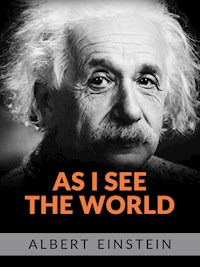
ALBERT EINSTEIN
AS I SEE
THE WORLD
Translation and 2021 edition by ©David De Angelis
All rights reserved
INDEX
PREFACE
ETERNAL SCIENCE AND SCIENCE OF MEN
SOCIETY AND PERSONALITY
Spiritual freedom of individuals and social unity
Decay of human dignity
The economic system hinders free evolution
Social value of wealth
Can you imagine Moses, Jesus or Gandhi armed with Carnegie's bag?
Limits of our freedom
Well-being and happiness
A horse that pulls itself
Everyone must be respected
War
RELIGION AND SCIENCE
Meaning of life
Cosmic Religiousness
The human basis of morality
Ids of human form
Cosmic religiosity knows no dogma
Democritus Francis of Assisi and Spinoza stand close together
Antagonism between religion of terror and science
Wonderful agreement between cosmic religiosity and science
Elevate the men
Peace
The International of Science
SCIENTIFIC RESEARCH
Scientific truth and no
Research Fundamentals
Planck's quanta
THE QUESTION OF METHOD
EVOLUTION OF PHYSICS: KEPLER AND NEWTON
EVOLUTION OF THE CONCEPT OF PHYSICAL REALITY
CHARACTERS OF THE THEORY OF RELATIVITY
WHAT IS THE THEORY OF RELATIVITY?
THE SPACE, THE ETHER AND THE FIELD
ORIGIN OF THE THEORY OF GENERALIZED RELATIVITY
PREFACE
I seem to have been only like a child on the seashore, amusing myself by finding now and then a smoother pebble or a more graceful shell than usual, while the great ocean of truth was still unexplored before me.
ISAAC NEWTON, "Brewster's Memoirs"...
The purpose of this book is to give, through a diligent selection of Einstein's writings, a concise, but clear and unified representation of his scientific doctrines and philosophical conceptions. His writings are not many: short memoirs, a few fairly succinct essays, lectures and interviews, are all that can be drawn upon to form a concrete picture of his philosophy and his attitude toward life.
In order to enable the non-specialist reader to understand the essence and value of the theories of relativity, we have reproduced in their original text some of Einstein's writings and speeches intended for an audience of non-mathematicians and which briefly expound the genesis and character of those theories. Written in a concise and clear language, without references, with rare exceptions, to symbols and formulas of high mathematics, they will give to every reader of average preparation a clear vision of Einstein's theories and of the logical evolution of the thought that conceived and conducted them.
Since this book has an eminently popular character, we have omitted those works that Einstein dedicated to specialists: the analysis of the concepts that make up these writings touches the highest peaks of mathematics and the reader would encounter insuperable difficulties.
Concerned not to alter in the least the genuine formulation of the ideas of the great physicist, we have purposely maintained certain harshness of language and form, necessarily dry and unadorned in the scientific part. The result is a faithful translation, but perhaps ungrateful to the musical needs of the Latin mentality. However, even the form of his prose, which is here filled with high thought, helps to highlight one of Einstein's fundamental traits: great simplicity and the absolute absence of external formalisms. His whole life is an example of simplicity and modesty.
Albert Einstein was born in Ulm (Wüttemberg) on March 14, 1879. In his childhood there were no signs of extraordinary faculties: in vain would one look for the premonitory signs of that genius which then burst forth, powerful and vigorous, in his youth. He made his first studies in Munich at Liutpold's gymnasium and received his first mathematical education from an uncle who was an engineer. Although he manifested a marked aptitude for the exact sciences, in which he far surpassed his classmates, he did not distinguish himself by singular merits. "He seems to have excellent qualities, but he is not very inclined to study," was the judgment of one of his professors.
In 1894, following a reversal of fortune, the Einstein family left Germany and moved to Italy where his father worked as an electrotechnician in Milan, Pavia, Isola della Scala and other locations in the Veneto region. Young Albert wandered as far as Genoa from where he emigrated to Switzerland and, amidst considerable financial difficulties, enrolled at the cantonal school of Aarau where he obtained a certificate of admission to the famous polytechnic school in Zurich. Here he had among his teachers Herman Minkowski who was later one of the most tenacious and authoritative supporters of those theories of relativity of which Einstein's powerful thought had laid the foundations. In 1910 he obtained a degree and qualified to teach mathematics and physics. In 1911 he obtained Swiss citizenship and worked as a technical expert in the Federal Patent Office in Bern.
The years from 1902 to 1909 represent the period of his most intense scientific production. The discovery of the foundations of the special theory of relativity (relativity in the strict sense or of uniform and rectilinear motions) earned him an appointment as full professor of higher mathematics at the Zurich Polytechnic in 1912. In November 1913, he was given a chair in physics at the Prussian Academy of Sciences in Berlin and in the spring of 1914, succeeding Enrico Van't Hoff, he was called to direct the Kaiser-Wilhelm-Institut for physics.
In 1933 political and racial persecution by the Nazis led Einstein to leave Europe. He emigrated to the United States of America and joined the Institute for Advanced Studies at Princeton, where he remains today.
Albert Einstein contributed to modern physics an ingenious creation that will remain in future centuries as one of the milestones in the history of human thought. In 1905, with his memoir Zur Elektrodynamik bewegter Körfer, he laid the foundation for the special theory of relativity based on the constancy of the speed of light in a vacuum. By re-examining the concepts of space and time and that of the simultaneity of two events occurring at distant points, he succeeded in establishing, through an extremely subtle logic, the inertia of energy and the geometrical interpretation of the forces of gravitation.
One of the results that Einstein had deduced from this theory, namely that mass and energy are equivalent, was to have a terrifying confirmation forty years later, with a force of destruction never known: the explosion of the first atomic bomb. Few people know that Einstein played a fundamental part in this event. It was due to his direct intervention that President Roosevelt made available the colossal capital needed for the research that was to lead to the Hiroshima bomb and, implicitly, to the end of the war. In 1939 the physicists Fermi and Szilard had achieved important results in the field of atomic physics, in particular in the disintegration of uranium, and had foreseen the tremendous possibilities deriving from the use of atomic energy for war purposes. However, they knew that they would not be heard unless the matter was directly presented to a high world figure, Fermi and Szilard conferred with Einstein. Einstein did not wish to meddle in military matters, nor did he wish to encourage the construction of the most terrible weapon ever made by man. However, he knew that if Germany was the first to possess atomic energy, it would not hesitate to use it as an instrument of world domination. A few days later Einstein wrote to President Roosevelt: "Some recent work by E. Fermi and L. Szilard, which was presented to me in manuscript form, convinces me that the element uranium can be used as a new and important source of energy in the near future.... A single bomb of this type... exploding in a port... could very easily destroy the entire port together with the surrounding territory". What consequences this letter had, everyone knows.
Leaving aside the works, moreover noteworthy, that he made on the theory of Brownian motions, on the statistical theory of gravitational fields, and the powerful contribution made to the quantum theory (we owe to Einstein the introduction in science of the photon, corroborated by successive discoveries of these last years), we cannot neglect, for its immense importance, the by now classical memoir appeared in 1916 Die Grundlagen der allgemeinen Relativitästheorie. It includes a new and ingenious theory of gravitation with its most brilliant consequences and predictions: explanation of the secular acceleration in the perihelia of the planets; deflection of light rays in a gravitational field; shifting of the lines of the spectrum toward the red, etc. This theory was to have in 1919 a resounding confirmation by facts. And here is how.
In his theory Einstein predicted the shifting of star images during a total solar eclipse (deflection of light rays in a gravitational field). On March 29, 1919 a total solar eclipse would occur which could provide favorable conditions for the verification of Einstein's theory. The Royal Society and the Royal Astronomie Society of London charged a committee chaired by the distinguished physicist Sir Arthur Eddington to make preparations for an expedition to the area where the sun would appear totally obscured. Two expeditions were sent to two very distant points within the zone of total eclipse: one to Sobral, northern Brazil, the other to the Principe Islands, Gulf of Guinea. On November 6, 1919, the Royal Society and the Royal Astronomic Society announced that the light rays are indeed deflected in the gravitational field of the sun and precisely by the amount predicted by Einstein's new theory. A. N. Whitehead, a distinguished contemporary philosopher and mathematician, present at that session, says among other things: "I was fortunate to be present at the meeting of the Royal Society in London when the Astronomer Royal announced that the photographic plates of the famous eclipse, measured by his colleagues at Greenwich Observatory, had confirmed Einstein's prediction that the rays are deflected as they pass near the sun. There was an atmosphere of Greek drama. We were the chorus commenting on the decrees of destiny, revealed by the unfolding of exceptional events... in the background was the portrait of Newton, reminding us that the greatest scientific generalization was now, after more than two centuries, about to receive its first modification... A great adventure of thought had at last come safely to the shore. The dramatic essence of tragedy is not misfortune: it lies in the inexorable progress of things... this inexorability is what pervades scientific thought. The laws of physics are the decrees of fate."
At that time Sir J. Thomson, the famous physicist, was President of the Royal Society. In opening the session he called Einstein's theory "one of the greatest achievements in the history of human thought". He added: "It is not the discovery of an out-of-the-way island, but of a whole continent of new scientific ideas." The scientists of the Royal Society now had to acknowledge that direct observation of nature had confirmed the theory of the curvature of space and the invalidity of Euclidean geometry in the gravitational field.
Einstein's work continues: a few months ago he announced that he had come to formulate a "Generalized Theory of Gravitation" which tends to bind in a single relationship the two theories of relativity and quantum, which means all known physical phenomena. It will take perhaps many years to experimentally verify this theory. In giving the announcement, the supreme physicist has textually said: "Because of mathematical difficulties I have not yet found the practical way to check the results of my theory with an experimental demonstration".
At the conclusion of these brief considerations, we would like to quote the opinion on Einstein's work of a great French physicist, Louis de Broglie, to whom we owe, among other things, the new ideas at the basis of wave mechanics: "To all learned men, whether or not they are devoted to some branch of Science, the name of Albert Einstein evokes the ingenious intellectual effort, which by overturning the most traditional data of physics, succeeded in establishing the relativity of the notions of space and time, the inertia of energy and the somewhat purely geometrical interpretation of the forces of gravitation. This is in fact an admirable work, comparable to the greatest works encountered in the history of science, for example that of Newton; in itself, it would suffice to assure its author an imperishable glory".
Remo Values




