


11,49 €
Mehr erfahren.
- Herausgeber: Atlantic Books
- Kategorie: Sachliteratur, Reportagen, Biografien
- Sprache: Englisch
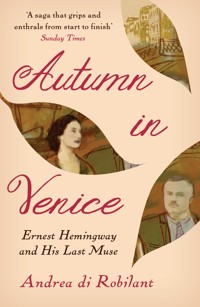
National Geographic Traveller's the best books on European cities, 2019 In the autumn of 1948 Hemingway was approaching fifty and hadn't published a novel in nearly a decade. He travelled for the first time to Venice and there, at a duck shoot in the lagoon he met and fell in love with Adriana Ivancich, a striking young Venetian woman just out of finishing school. What followed was a platonic love affair; he continued to visit her in Venice; she in turn came to Cuba while he wrote The Old Man and the Sea. This is the illuminating story of a writer and a muse that intimately examines both the cost to Adriana and the fractured heart and changing art of Hemingway in his fifties. 'Hemingway [is] an enduringly fascinating character, one whom di Robilant, with his easy-paced style, has sympathetically brought to life.' Literary Review 'Effortlessly and expertly explores the secret desires, successes, and depressive obstacles that shrouded Ernest Hemingway's final productive years.' New York Journal of Books
Das E-Book können Sie in Legimi-Apps oder einer beliebigen App lesen, die das folgende Format unterstützen:
Veröffentlichungsjahr: 2018
Ähnliche


















AUTUMN IN VENICE
ALSO BY ANDREA DI ROBILANT
Chasing the Rose
Irresistible North
Lucia: A Venetian Life in the Age of Napoleon
A Venetian Affair
Published by arrangement with Alfred A. Knopf, a division of Penguin Random House LLC.
First published in Great Britain in 2018 by Atlantic Books, an imprint of Atlantic Books Ltd.
Copyright © Andrea di Robilant, 2018
The moral right of Andrea di Robilant to be identified as the author of this work has been asserted by him in accordance with the Copyright, Designs and Patents Act of 1988.
All rights reserved. No part of this publication may be reproduced, stored in a retrieval system, or transmitted in any form or by any means, electronic, mechanical, photocopying, recording, or otherwise, without the prior permission of both the copyright owner and the above publisher of this book.
1 2 3 4 5 6 7 8 9
A CIP catalogue record for this book is available from the British Library.
Hardback ISBN: 978-1-78239-938-4E-book ISBN: 978-1-78239-939-1Paperback ISBN: 978-1-78239-940-7
Permissions and credits can be found following the index, constituting an extension of this copyright page.
Designed by Iris Weinstein
Printed in Great Britain
Atlantic BooksAn Imprint of Atlantic Books LtdOrmond House26–27 Boswell StreetLondonWC1N 3JZ
www.atlantic-books.co.uk
In memory of Alex Ullmann
CONTENTS
Prologue
CHAPTER ONE · Coming into the Country
CHAPTER TWO · The Road to Cortina
CHAPTER THREE · Venice
CHAPTER FOUR · Villa Aprile
CHAPTER FIVE · Finca Vigía
CHAPTER SIX · Paris—Venice—Paris
CHAPTER SEVEN · Crouching Beast
CHAPTER EIGHT · Let’s Dance
CHAPTER NINE · Idyll of the Sea
CHAPTER TEN · Safari
CHAPTER ELEVEN · La Enfermedad
Epilogue
Postscript
Acknowledgments
Notes
Select Bibliography
Index
PROLOGUE
In the autumn of 1948, Ernest Hemingway and his fourth wife, Mary Welsh, traveled to northern Italy and visited Venice for the first time. They had not planned it that way: their initial intention, when they had sailed from Cuba, was to disembark in the south of France, drive across Provence, and head on to Paris. But a mechanical failure forced the ship to dock in the port of Genoa. Hemingway had known the city well in his youth: it was from Genoa that he had sailed home on the Giuseppe Verdi after World War I, and it was to Genoa that he had returned several times in the twenties, both on assignment as a young reporter and on holiday with his first wife, Hadley Richardson.
As Hemingway set foot on Italian soil, old memories resurfaced, and a longing to see the country took over. He and Mary set off on a serendipitous journey that took them to the lake region in Lombardy, then on to the Dolomites, and finally down into the Veneto, and to Fossalta di Piave, the little town huddled on the southern bank of the Piave River, where Hemingway had stared death in the face on the night of July 8, 1918—a brash kid from Oak Park, Illinois, two weeks away from his nineteenth birthday.
Fossalta is no more than fifteen miles from Venice as the crow flies. Young Hemingway never had a chance to visit the city—he was injured only days after reaching the front line. He finally managed to see it, thirty years later, arriving with Mary on a clear, moonlit evening. Venice was all he had hoped for and more—“absolutely god-damned wonderful.”
Hemingway was less than a year shy of his fiftieth birthday. He hadn’t published a novel in nearly a decade and was struggling with a rambling manuscript. Critics considered him an author of the past; the new young writers coming out of World War II were getting all the attention. His marriage offered few pleasures. Indeed, the trip to Europe was at least in part an attempt to revive a languishing union.
On this score, the first few weeks in Italy looked promising: Hemingway was in excellent form, and Mary had rarely seen her husband in such a pleasant mood. But in early December, things took an unexpected turn. At a duck shoot in the lagoon, Hemingway met and fell in love with Adriana Ivancich, a striking eighteen-year-old just out of finishing school. Hemingway later wrote that when he saw Adriana the first time he felt as if “lightning had struck”—a hackneyed expression he probably would never have used except perhaps in the original, mythological sense, as a way to underscore his helplessness in the face of the gods’ capricious deed.
Lovely, seductive, mischievous Adriana became Hemingway’s muse in the most classical sense. She brought joy to his life, inspired him, made him feel young again—sometimes as young as a child, judging by his playful antics. Most important, her presence helped to fill the dried-up well of his creative juices, leading to a remarkable literary flowering in the late season of his life. Out of Hemingway’s first Venetian journey, in 1948–49, came Across the River and into the Trees, a mysterious and deeply autobiographical novel. Then came The Old Man and the Sea, a perfectly formed novella he wrote in a state of grace while Adriana was staying with him in Cuba. During the time Hemingway was under her spell, he also wrote a good portion of A Moveable Feast and made great strides on two novels that had been languishing for years and were published posthumously, Islands in the Stream and The Garden of Eden. In loving Adriana, Hemingway found the creative release that had been eluding him for years and which Mary, for all her dedication to her complicated husband, could not always provide.
Much has been said and written about whether Hemingway and Adriana were lovers. To be sure, the relationship was fraught with sexual tension from the beginning—their letters attest to that. And there were moments of great intimacy between them—in Venice, in Paris, in Cuba—when the line may have been crossed. But I believe, as Adriana always claimed, that the relationship remained essentially platonic. Hemingway himself saw it as an idyllic union that was separate and removed from earthly life. He sometimes referred to it in Spanish as una cosa sagrada—a sacred thing, which everyone, including his wife, should respect and protect. Of course, to invoke the sacredness of his love for Adriana was another way to deflect the pressure of responsibility. But it did not change the fundamentals: he was a married man in his fifties, looking the worse for wear, hopelessly in love with a girl who was less than half his age.
Hemingway openly discussed with Adriana his desire to leave Mary in order to marry her. Adriana always dismissed the possibility as a puerile fantasy—she came from a conservative Catholic background in a country where divorce was not even contemplated. Hemingway knew it was never a real possibility, but it gave him pleasure to fantasize about it.
Meanwhile, gossip sheets and magazines talked. Scandal hung over Adriana from the start and got more poisonous with time. Hemingway was acutely aware of the damage he was inflicting on her reputation (perhaps less so of the long-term psychological consequences). But his remorse was never strong enough for him to put an end to their ambiguous attachment—even if it meant possibly damaging the life of the young woman he loved.
I have a faded memory of Adriana. When I was growing up, she and her second husband, Rudolf Graf von Rex, lived with their two young children in a country house in southern Tuscany not far from where my family lived. I saw them occasionally at social gatherings—cocktail parties around Christmastime, that sort of thing. I remember an attractive woman in her forties, subdued, vaguely distant, standing in a corner of a crowded room, holding on to a glass of whiskey and a cigarette. I doubt we ever exchanged more than a few words, yet to this day I remember her melancholic gaze.
As a young adult—I was then living in New York—I learned that Adriana had taken her life after struggling with depression. She was buried in the small cemetery down the road from our house. The tombstone was a nicely carved slab of peperino, a dark-gray stone typical of the region; the lettering was in German Gothic: Adriana Grafin von Rex. Whenever I passed by the cemetery, I noticed the plot was well tended, with Mediterranean evergreens neatly clipped.
I was vaguely aware of Adriana’s association with Hemingway, but it was not until years later, when I moved to Venice with my family during a sabbatical year, that I learned more about their relationship. In fact, it was hard to avoid the topic: seventy years later, Venetians still talk about it as if it were the gossip of the season. One day, I went to see Adriana’s older brother, Gianfranco—he had been like a younger brother to Hemingway and had lived with him in Cuba for many years. Gianfranco was in his early nineties and not in very good shape. But I was intrigued to learn that he had recently sold the last batch of Hemingway’s letters to him to the JFK Library in Boston, where the Hemingway Collection is housed.
Months later, I happened to be in Boston and I went over to the library to check out the letters. They had already been filed in a much larger collection, which included most of the correspondence between Hemingway and Adriana from 1948 until 1956. I sat down to read the letters and became utterly absorbed by them.
They covered a period of eight years, starting with a cheeky postcard Adriana sent in December 1948—her girlish scrawl read, “Dear Mister Papa—How are you? Working very hard?”—and terminating with the dramatic letter that ended their correspondence. It was fascinating to see Adriana grow from the innocent young girl who had just graduated from the Catholic school of the Sisters of Nevers into a worldly young woman handling a complicated relationship with a famous man.
The context in which that relationship blossomed was equally interesting to me. My family has strong ties to Venice and the region of the Veneto. I am familiar with the places Hemingway and Adriana went to and the people they knew at the time. My great-uncle Carlo di Robilant and his wife, Caroline, have small roles in the story. “The Faithful Bull,” a fable Hemingway wrote in Cortina, was dedicated to my aunt Olghina.
Hemingway liked to say he was “a Veneto boy.” I think he was genuinely happy there—as happy as he had been fishing the Gulf Stream, hunting in Africa, and studying bulls and toreadors in Spain. At the end of his first, eight-month-long visit, Lillian Ross, the reporter for The New Yorker, asked him how it had been. “Italy was so damned wonderful,” he said. “It was sort of like having died and gone to Heaven, a place you’d figured never to see.”
AUTUMN IN VENICE
Hemingway’s royal blue Buick convertible in Cortina
CHAPTER ONE
Coming into the Country
It was late spring in Cuba, the time of year when Ernest and Mary Hemingway planned their annual migration out to the American West. Come September, hurricane season would be moving in on the island, and they liked to be on the road by then, heading across the country for a few months of bird shooting in Idaho. But this year Hemingway could not get excited about the trip. He complained the place had changed and was all cluttered up with Hollywood people. Leafing through a book on French Impressionist painters one day, he began to feel nostalgic about Provence.
Why not “cruise Cézanne country” in the fall? he suggested.
Mary liked the idea very much. It had not been easy to adapt to a life in the tropics as the new Mrs. Hemingway. A trip to Europe would be good for them. They could take their royal blue Buick roadster over to France and hire a chauffeur to drive them around.
Down at Havana’s harbor, Mary fell for the Jagiello, a sturdy German-built ship awarded to Poland after the war and based in Genoa. On board she found Polish officers and an Italian crew. “It is clean, airy, cheerful, apparently solid and good in any sea,” she reported. The ship was on its way to Europe but would be back at the end of the summer. The timing was perfect. Captain Jan Godecki, a friendly chap with a smooth round face and a sharp nose like Pinocchio’s, agreed to haul the big Buick onto the foredeck, and the deal was sealed.
On September 6, 1948, the Hemingways bade farewell to the staff at Finca Vigía, their rambling stucco house in the village of San Francisco de Paula, and drove down to the port of Havana with thirty-some pieces of luggage. Their closest Cuban friends and a few diplomats from the U.S. Embassy joined them at a small farewell party aboard the ship. John Dos Passos was also there. He and Hemingway had had a falling out at the time of the Spanish Civil War—Hemingway accusing his old friend of betraying the Loyalist cause out of political naïveté. They hadn’t seen each other in years when Dos called out of the blue to say he was in Miami and could he come over to visit. It was really not a good time. The boat was leaving in three days, and the Hemingways were packing and making last-minute arrangements. But Dos came over anyway, and he and Hemingway had a long talk over drinks at the Finca. Though it didn’t really fix things between them, they shared memories of the good times they had spent together in the twenties in Paris, Pamplona, Gstaad, and the south of France, where the Hemingways were now headed.
After a final round of abrazos, the guests disembarked and the Jagiello was finally off. Horns blew in the harbor, and paper streamers flapped and fluttered in the breeze. At the bow, tightly fastened to the deck, the blue Buick gleamed like a captive mermaid.
The weather was fine during the two-week crossing, and the sea was calm. The Hemingways eased into a boozy routine. Ben, the Italian bartender, prepared delicious martinis. At the buffet lunch they drank dry Orvieto. In the evenings they dined at the captain’s table, where Hemingway and Godecki exchanged old fishing stories. After dinner, Ernest and Mary usually made their way back to the bar and drank champagne until after midnight.
They slept like logs. The only complaint was the defective toilet in their cabin, a “shit-spitting dragon” that was best left unflushed.
To keep herself busy, Mary edited the ship’s daily news bulletin and read it out over the loudspeaker. Ernest liked to gather a little crowd of passengers and crew on the upper deck to give his wife a round of applause at the end of her newscast. He was in a good mood and very gregarious; he enjoyed being Chief Entertainer on board.
The Hemingways had plenty of time to study and read. Mary, ever the disciplined traveler, brushed up her French. Ernest plowed through Isabel and the Sea, an account by his friend George Millar, a former British officer turned farmer, about his boat trip down the canals of France. He found the book a little tiresome, but Millar’s descriptions of la France profonde were vivid enough to bring back pleasant memories of his time in France.
The Hemingways hadn’t planned an itinerary. They would take it day by day, driving through Provence and slowly making their way north to their final destination: the Ritz in Paris, where they had fallen in love four years earlier, during the last stages of the war.
Hemingway had met Mary in London in 1944, when he was covering the young bomber pilots flying out of RAF stations for Collier’s. His third wife, Martha Gellhorn, was also a correspondent for Collier’s and a celebrity in her own right. They had drifted apart during the war, both of them absorbed by their own work, and Hemingway had been very lonesome in London before meeting Mary Welsh, a perky reporter in the London office of Time/Life. Mary was married to Noel Monks, an elusive Australian journalist with the London Daily Express who was away covering the war.
Hemingway was very insistent from the start. He told Mary he wanted to marry her the same day her former beau, Irwin Shaw, introduced him to her at the White Tower, a fashionable London restaurant. “Don’t be silly,” she replied. “We are both married and we don’t even know each other.” But he continued to press his case, first in London and later in Paris, where they spent happy, exhilarating times at the Ritz. Mary fell in love with him and eventually moved into his room—Chambre 86. Her husband, conveniently enough, was in Southeast Asia, reporting on the Allied counteroffensive against the Japanese.
At the end of the war, Hemingway went back to Cuba and asked Mary to join him. She went for a clean break: gave up her career, divorced Mr. Monks, and sailed to Havana. It was a startling decision for such an independent woman, and she knew from the beginning that she would have to devote herself entirely to her husband to make the marriage work. But it was what she wanted.
They were married in Havana as soon as their respective divorce papers came through. Mary did her best to settle in at the Finca, which Hemingway had bought in the late thirties at Gellhorn’s urging, and which was still full of her things. But adjusting all at once to Hemingway’s house, his friends, his life had been harder than expected. She missed her smart, sophisticated friends in London and Paris. Drinking rum with her husband’s local pals and shooting pigeons at the Club de Cazadores down the road was not her idea of fun—especially when they ran out of pigeons and started shooting oyster shells and crabs.
There was also the question of children. Hemingway already had three sons. John, the eldest, was by his first wife, Hadley Richardson; he was twenty-five and a young career officer in the U.S. Army. Patrick and Gregory, seventeen and fourteen, were by his second wife, Pauline Pfeiffer, who lived with the boys in the family house in Key West. Mary was thirty-seven when she moved to Cuba, and eager to have a child of her own.
Hemingway was not enthusiastic about becoming a father again, but when Mary became pregnant a year into the marriage, he warmed to the idea of having another child, especially a little girl. In their late-night conversations, they agreed to call her Bridget.
In late August 1946 they took the car over to Florida and drove to Idaho for the winter season. On the way out, in a motel room in Casper, Wyoming, one of Mary’s fallopian tubes ruptured—it turned out she had an ectopic pregnancy. She lost the child, suffering atrocious pain, and came very close to losing her own life on the operating table of the small-town hospital.
In the spring of 1947, Mary had barely recovered from the physical and emotional trauma of her miscarriage when life at the Finca was again thrown into turmoil. Young Patrick, who was staying with them while he studied for the college boards to gain admission to Harvard, went over to Key West to be with his younger brother during Gregory’s spring break. Gregory, who had a reckless streak, crashed the car; he was under age and driving without a license. Patrick was with him. He hit his head and suffered a severe concussion. But it was only once he was back at the Finca that the effects of his head injury manifested themselves. He drifted into a state of increasing confusion and eventually had a complete breakdown. Bedridden for weeks, he moved in and out of consciousness. Hemingway kept vigil at his son’s bedside, sleeping on a mattress; Pauline flew over from Key West.
Mary, meanwhile, traveled to Chicago to assist her father, stricken by prostate cancer.
“Longing for the day when we can get back to our own fine life,” she wrote to her husband. But after more than a year of marriage it sometimes seemed to Mary that her life with Hemingway hadn’t properly started.
Patrick recovered over the summer, took his exams, and was accepted at Harvard. Life gradually returned to normal. To celebrate the end of the ordeal, Hemingway bought the Buick, with its fine red leather seats, and drove it out to Sun Valley in the autumn. Mary joined him, and they spent the winter in a rented cabin in Ketchum. While Hemingway worked every morning, Mary took her first skiing lessons on Dollar Mountain and embraced the sport with enthusiasm.
At the end of the winter, they returned to Cuba. They were seldom alone. Guests were always passing through. Meals were often crowded. There were also fine fishing trips along the coast of Cuba on the Pilar, Hemingway’s beloved boat. And Mary was excited about the new lookout tower they were building next to the main house. But managing the household while at the same time making sure all her husband’s needs were tended to was a tiring occupation that afforded little gratification. “With so many friends to entertain and amuse,” Mary later observed, “he simply didn’t see me in the landscape. I did not like it but I could not invent a situation which would correct it.”
Hemingway’s frustration with his writing made it even harder for Mary to get along with him. This was an especially challenging time in his career: not yet fifty, he was already having to stare back at his long-established canon, which included his three classic novels—The Sun Also Rises, A Farewell to Arms, and For Whom the Bell Tolls—and of course the short stories. Soon after his return from the European theater of war, he had embarked on an ambitious project: a monumental trilogy about the war by air, sea, and land. By the early summer of 1948, he had over nine hundred pages in longhand. But he was struggling to give the book a proper shape, and the writing did not satisfy him. He knew what the critics in New York were saying: he was a writer of the past, and his best stuff was behind him. So he was determined to write a really big book. Big enough and good enough to beat back the young writers who had come out of the war. In May of that year, Norman Mailer, the twenty-five-year-old wunderkind of the American literary scene, had published his war novel, The Naked and the Dead. It had rocketed up to the number-one spot on the New York Times Best Seller List. And there was talk of another big war novel soon to be out: The Young Lions, by none other than Mary’s ex, Irwin Shaw.
Back in the spring of 1944, Hemingway had just walked away from their table at the White Tower when Shaw had turned to Mary and said, “Well, it’s been nice knowing you.”
“You off somewhere?”
“A monopoly has just been born, you dummy.”
“You’re off your rocker.”
But Shaw had been right. There she was, four years later, living in Cuba and still struggling to find her proper place in the Hemingway “monopoly.” So, when her husband came up with the idea of a trip to France, she did not let the opportunity slip by.
In the middle of the Atlantic, with no domestic worries, the Hemingways could finally relax. Their good humor brought on a new tenderness between them. “We made lovely gay full bodied love this afternoon,” Mary recorded with satisfaction after a few days, “then slept like thistle-down until dinner. Papa’s prickly heat—& rash on my neck still bad.”
There was only one incident during the entire crossing, a drama that quickly turned into a delightful farce.
One evening, the Hemingways were having drinks at the bar when the Polish engineer, who was drunk, sidled up to Mary. “What are you?—What ARE you?” he snarled. Hemingway quickly moved in to defuse the tension. “How are the engines?” he inquired. Would the engineer be kind enough to take them on a tour? Passengers were not allowed down in the engine room, the drunken Pole muttered, pressing Hemingway in the chest. Hemingway did not flinch. He wrote down his own name on a slip of paper and handed it over to the engineer as if serving him notice. “I have never killed a chief engineer but now I would like to very much,” he said. “And if you do that again, I will surely kill you in the morning.” The engineer replied that Hemingway was “a bourgeois pig.” What right did he have to own such a big motorcar?
Hemingway, who was also pretty tight, challenged the Pole to a duel the next morning at seven o’clock. He chose the Italian purser, Vittorio Maresca, to be his second and dispatched him to find guns and ammunition. Next morning, he and Maresca waited around on the upper deck. The engineer didn’t show up. They found him snoring in his cabin. Hemingway joined Mary for breakfast, and Maresca went back to work.
Later, the engineer came up to apologize, begging that the matter go no further. Hemingway reassured him. But he now had to appease the crew, especially the Italians, who claimed, only half in jest, that if he didn’t shoot the Pole they would happily throw him overboard. In the end, Hemingway and the Italians sat down and composed a tirade against the drunken engineer. It all ended in good fun.
On September 18, the Jagiello reached the island of Madeira, and Hemingway disembarked to stretch his legs and wander through the fish market with Mary. Two days later, in Lisbon, they read the newspapers for the first time in two weeks and had an apéritif at a café in the busy harbor. The next day, they sailed past Gibraltar, into the Mediterranean; on September 23, they were in sight of the French Riviera.
The plan was to get off at Cannes, but the hydraulic pump connected to the rudder broke, and the captain decided it was too risky to maneuver near the small wharf. So the Jagiello limped on to Genoa, its next and last port of call. It was due back in Cannes in a few days; by that time the rudder would be repaired and the Hemingways would be able to unload their Buick and get on with their road trip.
Hemingway remembered well the old port city of Genoa, with its busy shipyards and smokestacks, and the tangle of ancient streets set against the steep mountains in the background. It was in Genoa that he had hobbled onto the Giuseppe Verdi, still recuperating from his war wounds, to sail home in early January 1919. He was back in 1922, a twenty-two-year-old reporter for The Toronto Daily Star, covering the International Economic Conference. During a break from the gathering, he had joined Lincoln Steffens, the legendary muckraker, and a few other old hands on a day trip to nearby Rapallo, the seaside resort down the coast. He liked it so much that the following winter he had returned with his first wife, Hadley, to visit his friend Ezra Pound. “Cat in the Rain,” a doleful sketch about a married couple holed up in their hotel room in Rapallo during a downpour, had come out of that trip.
Hemingway had passed through Genoa one more time, in March 1927, after his friend Guy Hickok had persuaded him to accompany him on a tour of Fascist Italy. He and Hadley still lived in Paris at the time. But Hemingway was leaving Hadley and starting a new life with Pauline and feeling all the strain of the transition. He’d hoped the trip would take his mind off his domestic troubles, but the guilt about leaving Hadley was sometimes so overpowering that he would burst into tears right there in the car, with Hickok at the wheel trying to console him. Still, their tour in Liguria, Tuscany, and Emilia-Romagna gave Hemingway a small measure of distraction—enough for him to write a series of sketches of Mussolini’s Italy for The New Republic.
Twenty years later, Hemingway, now an international celebrity, was unexpectedly back. In a country that was still struggling to recover from the ravages of the war, he appeared to embody the power and vibrancy of America. A crowd of Italian reporters and photographers, alerted to the change of itinerary, was waiting at the main dock as the Jagiello sailed into the harbor in Genoa. When Hemingway descended the gangplank, with tiny Mary at his side, the journalists were stunned by the sheer size of the man. “The massive bulk of Ernest Hemingway has landed in Genoa,” wrote the enthralled reporter of Il Secolo XIX, the main city paper. “This giant, with shoulders proportionally broad, is nearly two meters tall.” The headline was even more emphatic: “AUTHOR OF FOR WHOM THE BELL TOLLS IS A TWO-METER-TALL GIANT.”
Hemingway was tall but not that tall: he was a little over six feet, or 1.85 meters. But to the Italian reporters who were seeing him for the first time he seemed, quite literally, larger than life.
While the Buick was lowered onto the wharf and taken into customs, the Hemingways headed to the swanky Hotel Columbia. A group of reporters followed them all the way into the hotel lobby and then clamored until Hemingway allowed them up to his suite for an interview. While Mary got settled in, he paced back and forth, sipping whiskey and rambling on about his earlier trips to Genoa and how Italy was the country he loved most after America. He loved it so much, he said, that he was of a mind to spend a couple of months a year in Italy, maybe in Cortina, up in the Dolomites, or perhaps somewhere on the Riviera. He loved Portofino, Santa Margherita, Rapallo, he said, sketching out vague plans as he went on.
Was he a communist? the reporters wanted to know. No, he replied, he was not a communist; he didn’t belong to any party. He only fought for freedom. He was a republican “in the manner of Giuseppe Garibaldi.” The reporters asked about his new book, but he didn’t want to talk about his work. Then he turned the tables on them: what did they think of the picture version of For Whom the Bell Tolls? It had yet to be released in Italy, they said. Well, he replied, they shouldn’t bother to see it, because it was no good. “Except for Gary Cooper and Ingrid Bergman; they [are] very good.”
Hemingway was “very humane and affable, . . . even a little shy,” Il Secolo XIX reported the next day. “There is nothing about him of the literary ‘divinity’ and he doesn’t strike the pose of a maestro.”
Mary saw plainly that her husband was in no rush to get to France. With resigned bewilderment, she had heard him say during his impromptu press conference in their hotel room that he planned to make a “sentimental journey” to Stresa, the resort on Lake Maggiore where he had spent a week recuperating from his war wounds in 1918. “The friendly sing-song language and cheerful welcomes so beguiled my friend,” Mary noted wryly, “. . . [he’s] decided we must go on in Italy.”
Hemingway’s idea was to drive out to Lake Maggiore, spend two or three days in the luxury of the Grand Hotel des Îles Borromées at Stresa, return to Genoa, and sail back to Cannes aboard the Jagiello. Mary grumbled that it was “a lot of fuss and bother to unload the car” for only three days. But she wasn’t going to get in her husband’s way. Provence, after all, could wait a few days.
She hired a local chauffeur, Riccardo Girardengo. Hemingway was tickled to discover that Riccardo was the cousin of Costante Girardengo, the champion cyclist whose feats he had followed in the Italian papers in the twenties.
On their last night in Genoa, the Hemingways gave a farewell dinner for some of the Jagiello crew at a smart restaurant on the terrace of the Torre Piacentini, supposedly the tallest building in Italy: a thirty-one-floor tower designed by Fascist architect Marcello Piacentini that had miraculously survived Allied bombings during the war. It was a fine end-of-summer evening, and the view of the bay was beautiful. Everyone drank heavily after dinner, mixing whiskey, gin, wine, and champagne. The Hemingways staggered back to the Hotel Columbia very late.
The following day, they drove up the steep rise behind Genoa, crossed the Apennines, and made their way down to the Po Valley. “Lovely weather, lovely country,” Mary noted, even though she ached with a hangover. They cruised through peach-and-cherry country, vineyards, and mulberry groves and were soon in sight of Lombardy’s tall, shimmering poplars. Along the road, barefoot women were returning from the rice fields. “Che bella macchina!” they cried out, waving and clapping under their wide-brimmed hats as the Buick swished by.
They reached Stresa just as the sun was setting on Lake Maggiore. Exactly thirty years had passed since a rainy day in September 1918 when Hemingway, age nineteen, had arrived at the Grand Hotel on crutches for a weeklong convalescence. The concierge came rushing out. “Welcome back, Mr. Hemingway,” he repeated solicitously. The scene seemed so rehearsed that Mary was sure Riccardo, the chauffeur, had called ahead to arrange it. Still, her husband was very moved.
The Hemingways looked forward to a quiet meal and an early night after the long drive from Genoa. But it turned out the Miss Italy pageant was being held that very night at the hotel next door. Mary bowed out and retired to their suite; Hemingway went over to take a peek and was immediately surrounded by reporters.
The Regina Palace was in the throes of total pandemonium. Young contenders in long white dresses were running about in a frenzy, followed by mothers, fathers, brothers, sisters, boyfriends, publicists, and all manner of hangers-on. The contest was soon down to two girls: Fulvia, a big dark-haired seventeen-year-old from Trieste, and Ornella, an eighteen-year-old blonde from Bologna. The atmosphere was electric, with both sides yelling and screaming. Hemingway liked Ornella. He told the reporters he was putting his money on the girl from Bologna and bade everyone a good night.
The next morning, Hemingway came down for breakfast looking rested in his light-brown tweed jacket and baggy flannels. The reporters rushed over to tell him his girl had lost. It had been a wild night, they said. At one point it seemed that Fulvia, the girl from Trieste, was to be disqualified because she was not eighteen. But her supporters had caused such a row that she was allowed back into the competition. Shortly before dawn, Fulvia was elected Miss Italy 1948.
“The judges made a mistake,” Hemingway assured the press. “The girl from Bologna was best. That is the truth.”
He’d been in Italy less than three days and he was already stirring things up.
The Grand Hotel des Îles Borromées, with its great halls and manicured garden, hadn’t changed much at all since Hemingway had last been there thirty years before. The old palatial building stood proudly on the shore, facing the placid waters of the lake that shimmered northward into the mountains, all the way to Switzerland. As he walked the old grounds, Hemingway’s memories of his convalescence must have come back to him, mixed with the fictional situations he had described a decade later in A Farewell to Arms, his novel about an American deserter on the Italian front during World War I.
In the early summer of 1918, Hemingway had joined the American Red Cross and was sent over to Italy as an ambulance driver. Eager to get closer to the action, he had managed to get sent to the front line as a runner. On July 8, after only a few days on the job, he was severely wounded when a shell hit an advanced listening post near Fossalta, a little town on the shores of the Piave, on the Venetian mainland.
Biographers have described many times the circumstances in which young Hemingway was wounded. He was handing out cigarettes and chocolate bars to a few soldiers who were manning the post when the Austrians on the other side of the river lobbed a mortar shell that hit them in full. Hemingway suffered multiple wounds all over his body caused by the flying shrapnel, and his left leg and foot were badly hit. The explosion was so powerful, the wreckage so devastating, that he was lucky to survive the blast. In the chaos that followed, and despite his injuries, Hemingway managed to drag one blood-drenched soldier to a protected area; in the process, he was hit in the leg by machine-gun fire. The Italian government later awarded him a silver medal for bravery. After receiving emergency treatment at a nearby camp hospital, he was transferred to the American Red Cross Hospital in Milan, where he underwent an operation for his knee and foot.
During his convalescence, Hemingway famously fell in love with Agnes von Kurowsky, the American nurse whom he later used as a model for Catherine Barkley, the nurse in A Farewell to Arms. Agnes was seven years older than he, but she had strong feelings for her young patient—at least while he was under her care in Milan. At the end of the summer, Hemingway was given a weeklong rest pass to Stresa. He hoped to go there with Agnes. It didn’t work out—she was sent to Florence on assignment. So he went with Johnny Miller, a fellow ambulance driver from Minnesota. At first Hemingway and Miller felt a little stranded in the huge, empty hotel. But the Bellias, a nice family from Turin who were vacationing in Stresa, soon adopted the two young Americans. The Bellias had three daughters, and they all had crushes on Hemingway. He later visited them in Turin, and he corresponded with the family after he returned to America.
When Hemingway was not flirting with the Bellia sisters at Stresa, he was spending his time in the company of Count Giuseppe Greppi, a charming ninety-nine-year-old senator—allegedly the oldest living diplomat in Europe. Count Greppi taught Hemingway and Miller a thing or two about history and politics while they played billiards and sipped champagne. He made such a strong impression on Hemingway that ten years later a fictionalized version of the count found its way into A Farewell to Arms. He called him Count Greffi in the novel because he felt it would not be right to use his real name.
There is a memorable scene in which the hero, Frederic Henry, who, like Hemingway, had convalesced in Stresa, returns to the hotel with his pregnant lover, the nurse Catherine Barkley, and the barman tells him that the old man is waiting for him:
“Count Greffi was asking for you,” [the barman] said.
“Who?”
“Count Greffi. You remember the old man who was here when you were here before.”
“Is he here?”
“Yes, he’s here with his niece. I told him you were here. He wants you to play billiards.”
Frederic joins Count Greffi for a game of billiards. They talk about the war and drink champagne. Despite his brittleness, the old count plays an impeccable game and gives Frederic a drubbing.
After breakfast, Hemingway drove Mary over to Pallanza, the picturesque little town on the other side of the bay where, crutches and all, he had wanted to go with Agnes von Kurowsky in the early autumn of 1918. “But [he] never managed,” Mary wrote in her diary, adding with a note of triumph, “About noon today we got in the Buick, top down, and whirred around there in less than an hour.”
He and Mary had a long, lazy lunch by the water in the pleasant September sunshine, and returned to Stresa in the late afternoon. The Miss Italy circus had moved on, and a new batch of reporters, mostly from the literary pages of newspapers and magazines, had now pitched their tents in the foyer of the hotel. Mary went out on the lake with the boatman while the reporters surrounded Hemingway at the bar. “Standing [there] waiting for the barman to serve him a very iced martini,” one of them wrote, “Hemingway seemed a character in one of his stories, a fellow we might have met before in The Sun Also Rises or in Green Hills of Africa.”
The journalists wanted to know who Hemingway’s favorite writers were. Was he familiar with Italian novelists? And what did he think about existentialism, the new philosophy of Jean-Paul Sartre? “Sartre is a friend,” Hemingway answered in his loud staccato, “. . . when I see him in Paris I never ask him to explain existentialism to me. . . . But since we are among friends here I can say it: it’s a load of crap.”
Hemingway enjoyed such friendly joshing. He offered the reporters a round of martinis as he thumped his heart. “I have to be careful about this one,” he said in bad Italian. And then, feeling his liver: “I have many stones here. I must be disciplined but I am disciplined now in everything I do.”
The martinis soon had their effect on the reporters. One of them, an aspiring young writer who had recently read A Farewell to Arms, leaned over toward Hemingway, paraphrasing the barman in the novel:
“Count Greppi would like to see you.”
Hemingway looked confused. “Who?”
“Count Greppi, don’t you remember? The old man . . .”
After a while, Hemingway caught on. He smiled and inquired after Count Greppi. The reporter told him he had died long ago. Hemingway smiled again and continued to speak to the journalists in his rusty Italian. “My Italian is like an engine that doesn’t work anymore,” he complained. “And it was a good engine.”
Hemingway looked around to see where Mary had gone and was told she was still out on the lake.
The idea of driving all the way back to Genoa, hauling the car back onto the Jagiello, and then sailing to Cannes didn’t make much sense. It was simpler to drive over to France in the Buick. Most of the luggage, however, was in storage at the hotel in Genoa. So, when Mary returned from her boat excursion, Hemingway issued new marching orders: she was to return to Genoa with Riccardo, spend a couple of days resting and shopping, and drive back with all their trunks and suitcases. Meanwhile, he would stay in Stresa. Arnoldo Mondadori, one of his Italian publishers, happened to own a villa on Lake Maggiore and was eager to have him over for lunch. Hemingway had gladly accepted the invitation. His publishing affairs in Italy had fallen into such a state of confusion that he was eager to straighten things out.
CHAPTER TWO
The Road to Cortina
Hemingway was a special target of censorship in the twenties and thirties, during Mussolini’s regime. His books were banned, even as the works of other American writers, such as Sinclair Lewis, William Faulkner, John Steinbeck, and John Dos Passos, were translated and published with success. The blacklisting started as early as 1923, when Hemingway, still a young reporter for the Toronto Star, described Mussolini as “the biggest bluff in Europe” in his dispatch from the Peace Conference in Lausanne, only weeks after the dictator had seized power.* In 1927, he wrote a few sardonic sketches on Fascist Italy for The New Republic after the ten-day road trip he took with his friend Guy Hickok. But it was the publication of A Farewell to Arms (1929), with its anti-militarism and its powerful description of the rout of the Italian Army after Caporetto, that finally made him persona non grata with the regime. His later support for the Republican cause in the Spanish Civil War sealed his reputation as an enemy of Fascist Italy.
When the Mussolini regime fell in 1943, publishers scrambled to translate Hemingway’s novels. The first Italian edition of The Sun Also Rises was published by a little-known company, Jandi Sapi, in the early summer of 1944, only weeks after General Mark Clark’s troops liberated Rome (but seventeen years after it had first come out in the United States and the United Kingdom). A Farewell to Arms, For Whom the Bell Tolls, and To Have and Have Not came out in quick succession the following year, after the liberation of northern Italy. But the translations were hurried and the first editions sloppy. Also, it wasn’t clear which houses owned rights to which novels.
Shortly after returning to Cuba in 1945, Hemingway received a long and rather unctuous letter from Arnoldo Mondadori, in which the founder of the eponymous publishing house had expressed, in uncertain English, his desire to become his “sole publisher” in Italy:
Dear Mr Hemingway, it is of particular joy I address you this letter for I wished since a long time to come in direct touch with you and was prevented to do it first by the draconian fascist prohibitions and then by the tragical events after the 8th of September 1943.* But this didn’t prevent me from asking—during my hard exile in Switzerland, through my NY agent Homer Edmiston—your agent Mr Speiser the rights for all your works for I intended to characterize by them my publishing revival as soon as Italy was liberated from the nazi-fascist occupation. I intended to diffuse your name, almost unknown to the Italian public, as largely as possible, because I know the moral and cultural advantage our readers would have had by coming in touch with your poetic world. . . . But while you were among the fighting forces in France disdaining every danger with the spirit your most attentive readers already know to be yours—your agent did not grant my repeated requests to be your sole Italian publisher. I was sorry for it, for my house, by myself founded in 1907, has been always honored by the greatest authors of the world.
Hemingway was understandably reluctant to grant Mondadori such a request in the fall of 1945, so soon after the end of the war. Mondadori had been the prototype of the self-made man in Fascist Italy, rising from a humble family—his father was a cobbler from a small town near Mantua—to build Italy’s largest publishing house in the 1920s and 1930s. He had proved a visionary and brilliant entrepreneur. But his connections to Mussolini’s regime—he became a card-carrying member of the Fascist Party in 1924—certainly facilitated his success.
In 1943, after the fall of Mussolini and the Nazi invasion of Italy, Mondadori had fled with his wife and children to Switzerland, where he had kept in touch with literary agents in Europe and the United States. Once the war was over, he had returned to Milan to rebuild the firm, arriving on the scene late, when the rush to publish Hemingway—the big prize in postwar publishing—was already well under way. Hence his unorthodox decision to appeal to Hemingway directly, bypassing his tough New York agent and lawyer, Maurice Speiser, and offering to buy the rights to all his books. It was a bold move on his part, considering he had yet to get his publishing house back on its feet. Besides, Speiser and Hemingway’s agents in Europe had already made several book deals with Einaudi, a younger, left-leaning, more literary house based in Turin, which in many ways seemed a better fit than Mondadori.
However, after a series of court rulings in his favor, Mondadori managed to secure Italian rights for the two biggest books—A Farewell to Arms and For Whom the Bell Tolls. The house published a translation of A Farewell to Arms in 1946, with illustrations by Renato Guttuso, a rising star of the Roman art scene. It was an expensive edition, but it went into four printings and quickly sold out. For Whom the Bell Tolls came out in 1947, and there were eight printings the first year alone. “[The] success would have been even greater had we had more paper to print on,” Mondadori assured Speiser. Hemingway’s royalties, meanwhile, were piling up in a bank account in Milan, because restrictive laws on the export of capital in postwar Italy made it very difficult to transfer funds to the United States.
Although Mondadori had snatched Hemingway’s two most famous novels, Einaudi had the rights to The Sun Also Rises, The Fifth Column and the First Forty-Nine Stories, Green Hills of Africa, Death in the Afternoon, and To Have and Have Not. It had no intention of ceding those rights. In the battle for Hemingway, Mondadori and Einaudi remained bitter rivals. So when the rumor spread in the fall of 1947 that Hemingway was finishing a new novel, Mondadori immediately offered a one-thousand-dollar advance. Speiser had to tell him that even though Hemingway was hard at work, there was no book yet. A year later, the same rumor intensified: Hemingway, it was said, was putting the final touches to the big new novel about the war. Mondadori became frantic and raised the offer to twenty-five hundred—the largest advance ever put forward by an Italian publisher for any book. Speiser once again insisted there was nothing yet to bid on. Nevertheless, Mondadori remained extremely agitated: if the new book went to Einaudi, his project of becoming Hemingway’s “sole publisher” in Italy would fall apart.
So Mondadori was thrilled to learn from the papers that Hemingway had unexpectedly arrived in Italy and was now in Stresa, a mere half-hour away from his villa in the small town of Meina, on Lake Maggiore. He sent a car to fetch his most celebrated author.
Much had changed in the three years since Hemingway had received the initial letter from Mondadori. The Iron Curtain had fallen across Europe, and the world had entered the Cold War. The misgivings Hemingway had shown in 1945 about forging a strong alliance with Mondadori had faded in the face of a new political climate. The new Mondadori house, politically aligned with the West, was becoming more attractive to Hemingway than Einaudi, with its ties to the Communist Party.
He was keen to meet Mondadori and talk about the future. He also wanted to know how much money he had in the bank.
Mondadori, a stocky, energetic sixty-year-old with a big nose, goggle eyes, and wide-framed spectacles, gave Hemingway a festive welcome at the family villa, where Thomas Mann, Sinclair Lewis, and many others had been fêted before. As he proudly showed Hemingway the grounds, he told him over and over that “everybody” was reading his books. Mondadori had summoned the immediate clan for the occasion—his two sons and two daughters and their respective families—as well as a few Italian writers who were closely associated with the house. Eugenio Montale, the poet and future Nobel Prize recipient, was among them and shyly introduced himself.




