


10,99 €
Mehr erfahren.
- Herausgeber: Parkstone International
- Kategorie: Geisteswissenschaft
- Sprache: Englisch
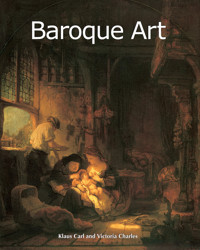
The Baroque period lasted from the beginning of the seventeenth century to the middle of the eighteenth century. Baroque art was artists’ response to the Catholic Church’s demand for solemn grandeur following the Council of Trent, and through its monumentality and grandiloquence it seduced the great European courts. Amongst the Baroque arts, architecture has, without doubt, left the greatest mark in Europe: the continent is dotted with magnificent Baroque churches and palaces, commissioned by patrons at the height of their power. The works of Gian Lorenzo Bernini of the Southern School and Peter Paul Rubens of the Northern School alone show the importance of this artistic period. Rich in images encompassing the arts of painting, sculpture and architecture, this work offers a complete insight into this passionate period in the history of art.
Das E-Book können Sie in Legimi-Apps oder einer beliebigen App lesen, die das folgende Format unterstützen:
Seitenzahl: 147
Veröffentlichungsjahr: 2023
Ähnliche
Text: Klaus H. Carl and Victoria Charles
Translation: Gunther Roth
© 2023, Parkstone Press International, New York, USA
© 2023, Confidential Concepts, worldwide, USA
All rights reserved
No part of this publication may be reproduced or adapted without the permission of the copyright holder, throughout the world. Unless otherwise specified, copyrights on the works reproduced lie with the respective photographers. Despite intensive research, it has not always been possible to establish copyright ownership. Where this is the case we would appreciate notification.
Klaus H. Carl & Victoria Charles
Contents
Introduction
1. Baroque in Italy
Architecture and Sculpture
Gian Lorenzo Bernini
The Fountains of Rome
Turin and Venice
Painting
The Carraccis and their Pupils
Caravaggio
Florence and Venice
2. Baroque in France
Architecture
Painting
Sculpture
3. Baroque in the Netherlands
Architecture
Painting
Frans Hals and his Time
Frans Hals’ Pupils
Rembrandt and his Time
Rembrandt’s Pupils
The Genre, Landscape, Animal and Still-Life Painting
Genre Painting
Gerrit Dou
Gerrit Dou’s Pupils
Johannes Vermeer
Landscape Painting
Van de Velde
Jan van Goyen
Salomon and Jacob van Ruisdael
Other Landscape Painters
The Specialists under the Painters
Art in the Southern Netherlands
Peter Paul Rubens and His School
Anthony van Dyck
The Flemish Genre and Landscape Painters: The Bruegels
David Teniers the Younger and Adriaen Brouwer
4. Baroque in Spain
Painting
El Greco
Diego Velázquez
Bartolomé Esteban Murillo
Francisco Goya
5. Baroque in Germany, England and Austria
Germany
The Builders and Buildings
Painting
Daniel Nikolaus Chodowiecki
England
The Builders and Buildings
Painting
William Hogarth
Austria and the Czechs
The Master Builders and Sculptors
The Charles Bridge
1. Gian Lorenzo Bernini, Baldachin,
ordered in 1624 by Urban VIII.
St. Peter’s Basilica, Vatican.
Introduction
Baroque art (derived from the Portuguese word ‘Barrocco’ meaning rough or imperfect pearl) originated in Italy and a few other countries as an imperceptible passage from the late Renaissance which ended about 1600. It was occasionally seen as a variation and brutalization of the Renaissance style and sometimes conversely as a higher form of its development, and remained dominant until approximately the middle of the eighteenth century. Conventionally, the Baroque style is not emphasized in the global history of art, because the time period when it flourished — between 1550 and 1750 — is correctly viewed as an enclosed time period in which various directions of style were expressed.
For some specialists, the Baroque style, because it adapted to the strict forms of the Renaissance, was strictly nothing other than a branch or a variant of the Renaissance art from which it arose. This is how it was for all changes of style in the history of art: each new direction built on the foundations of the previous one. The Gothic style followed from the Romantic which adapted from the Old Christian, and so on. Since the time when Hellenic art ruled the world, it served as a measure and foundation for the subsequent style developments, which only more or less distance themselves from it or else imitate it.
However, the Baroque style distanced itself from the strict principles and theories of the Antique so much that the Antique fundamentals were hardly recognizable. It is difficult to draw a distinctive line between the Renaissance and the Baroque, as both schools merge into each other. However, the Baroque cannot simply be limited to a specific timeline or location. Moreover, one can only strictly speak of a proper Baroque style in the fields of architecture and perhaps sculpture.
The Baroque period occurred during an era of deep religious, cultural and social unrest. Wars, the Reformation and other confusions resulted in a new political order and complicated spiritual and cultural development. The medieval system of government slowly dissolved between 1520 and 1530, and the Reformation had its indelible effect on the people as the imperial princes became more and more powerful.
2. Pietro Berrettini, also known as Pietro da Cortona,Allegory of Divine Providence,
1633-1639. Fresco. Palazzo Barberini, Rome.
3. Niccolò Salvi (finished by Niccolò Pannini),Trevi Fountain,
1732-1762.Marble.Piazza di Trevi, Rome.
The German imperial crown hardly played a legal role; it only possessed a more or less representative function gladly carried out by the House of Habsburg. In Austria the Habsburgs had occupied the area of Krain (current Slovenia), Kärnten (Carinthia) and Tyrol and, after long internal strife from the end of the fifteenth century into the 1690s, combined them into a single state to withstand the onslaught of the Ottomans. It was only the famous Prince Eugene of Savoy who succeeded in defeating the “Turks” at the battle of Zenta in 1697. This victory was memorialized by Ferdinand Freiligrath in a poem later set to music by Johann Gottfried Loewe: “Prinz Eugen, der edle Ritter, / hei das klingt wie Ungewitter / Weit ins Türkenlager hin. …”
From a historical point of view, the seventeenth century began with the end of the glorious reign of the English Queen Elizabeth I and the civil wars in France by Henry IV. In Italian art, Caravaggio created a new style; in Spain, Miguel de Cervantes wrote Don Quixote; and in England, Shakespeare became world-famous with his dramas.
The Thirty Years’ War raged in the Holy Roman Empire of the German Nation and laid waste to half of Europe. Among the decisive personalities in this war were the Swedish King Gustav II, who fell during the war, and the most important army leader, Albrecht von Wallenstein, who was murdered in 1694 in Eger. Cardinal Richelieu, under Louis XIII, secured the supremacy of France in Europe, and Oliver Cromwell ruled the Republic in England. In Flanders, Rubens and Rembrandt were making their marks on the art world, in France Molière wrote his comedies, and in Italy Bernini defined new paths in sculpture and architecture. It was a very eventful and turbulent century.
4. Giovanni Lanfranco, Paradise, 1641-1643.
Fresco. Cappella San Gennaro,
Cattedrale di Napoli, Naples.
5. Louis Le Vau and Jules Hardouin-Mansart,Versailles Palace,
façade with view of the gardens,1661-1690. Versailles.
6. Georges de La Tour, Magdalene of the Night Light,
c. 1640-1645.
Oil on canvas, 128x94cm.Musée du Louvre, Paris.
7. Johannes Vermeer, Woman with a Pearl Necklace,
c. 1664. Oil on canvas, 55x45cm.
Gemäldegalerie, Staatliche Museen zu Berlin, Berlin.
The very influential classes of society, with their special political rights, lost their influence and privileges during the war. Only the princes governed their respective areas with unlimited power. The situation of the arts and culture in their lands changed according to the personalities, the wisdom and the farsightedness of the respective princes.
From the founding of the Kingdom of Prussia in January 1701, the emphasis of artistic, political and economic life moved from Southern to Northern Germany. The wars and unrest resulted in the impoverishment of the masses, the middle classes and even the nobles. In addition, the wars brutalized customs to such an extent that there was no place for the arts. Only the princes still living in its pomp and splendour could afford objects of art. Their example was the French Court; the residence cities of the princes envied the French and their opulently magnificent buildings with beautiful artistic treasures.
In the later years of this epoch, the influence of the North with its cooler, more thoughtful style became clear, while in the South a more imaginative and possibly also warm-hearted expression ruled. Protestantism was of inestimable importance for the development of this art. Whereas the protestant churches were rather modest and undecorated, the Catholic Church attempted to convince its mostly poorer believers of its power by means of rich decoration and great displays of pomp in its churches.
Developments in Italy followed almost the same scheme. With the exception of Venice, the city republics became principalities which set the pace for the arts. Also in Italy the princes were the only ones who, after the impoverishment of the country due to the loss of leadership in world trade, could still afford a display of luxury in architecture and the decoration of buildings.
In France the situation was completely different. While a devastating war reigned in Germany, depopulating whole swathes of land, the French King was able to tighten his hold, enlarge his country with new lands and take over the leading role in Europe. France was spared the of religious wars due to the application of state power. In Catholic France, the Edict of Nantes (1598) assured the Calvinistic Protestants, the Huguenots, religious tolerance and full citizen rights but fixed Catholicism as the state religion. The unity of the French people and the centralized power gave France a leading position on the continent and influenced the development of the arts. The whole of Europe now emulated the French court and French tastes were decisive for all European Courts.
Spain with its rich colonies had already risen to a world power in the sixteenth century and, due to its wealth, was able to erect magnificent buildings filled with valuable works of art. Later, in the eighteenth century, a branch of the French royal house ruled in Spain and with it French artistic tastes took root, even if, once again, they did not spread among the population. Despite its wealth, Spain lost its dominance of the oceans after the defeat at Cadiz in 1607, and thus also lost its leading position in world trade.
Eighteenth century England, despite internal political problems resulting in the weakening of the monarchy and the development of a parliament with representation by the population, became the leading trading power and, as the leading world power, the wealthiest country in the world. This wealth supported the production of many works of art, and an independent national style emerged from the French-dominated artistic style.
8. Francisco de Zurbarán, St. Francis in Meditation,
c. 1635-1640. Oil on canvas, 152x99cm.
The National Gallery, London.
9. Gian Lorenzo Bernini,Ecstasy of St. Teresa,
1647-1652.Marble, h: 350cm.
Cappella Cornaro, Santa Maria della Vittoria, Rome.
1. Baroque in Italy
Architecture and Sculpture
The Italian Baroque style developed consistently in the architectural and sculptural arts beginning in the high Renaissance period. It followed the spiritual streams of the period and enhanced all decorative and structural details. It was marked by an accumulation of building elements, an arbitrary change of classical building forms and a tendency towards the pictorial, which led to the rejection of all straight lines. Everything that was previously horizontal was curved, canted or chamfered; even the column, the original form of the support, was altered by Giovanni Lorenzo Bernini, the grand master of baroque architecture, to become sinuous and twisted, a style that had already appeared occasionally in late Roman architecture.
Rome was the epicentre of church and palace architecture in the Baroque style. It was also seen in Naples and Palermo, which can trace their architectural physiognomy only to the seventeenth century. The basis of all Baroque churches is the design of the Jesuit Church by the architect Giacomo Vignola, the successor to Michelangelo, and by Giacomo della Porta with the basic motifs applied there for the first time. It is marked by the linking of the nave and the choir with the greatest possible amount of space, ignoring the side naves; regarding the façade, further development occur with canted contours and the decoration of the cupola in its interior vaulting with frescoes. This church, with the altar of St. Ignatius of Loyola, the founder of the Jesuit Order, along with its striking architecture, sculpture and painting, embodies the height of the Italian Baroque style. This dwarfed everything that had been produced in almost two centuries in Italy and Germany. The creator of this altar, the Trento-born Jesuit lay brother, painter, architect and sculptor Andrea del Pozzo (who also painted the Jesuit church in Frascati) was one of the greatest artists of the Baroque style.
10. Carlo Maderno, St. Peter’s Basilica,
façade, 1607-1614. Vatican.
11. Gian Lorenzo Bernini andFrancesco Borromini, Palazzo Barberini,
façade,1629-1644.Rome.
Gian Lorenzo Bernini
Bernini was a master in the creation of magnificent spaces with a skilled eye for perspective effects. This is displayed primarily in the square in front of St Peter’s with its surrounding columned halls, or the Scala Regia of the Vatican. After Maderno’s death, Bernini completed the façade and front hall and created the famous bronze baldachin over the high altar for the inside.
The speed of the change of mind in which the admiration for the antique waned, is illustrated by the fact that the contemporaries of this tabernacle placed it as the high point of an independent artistic style. Bernini is also to be praised for the Palazzo Barberini with its masterful staircase, and for several smaller churches. The importance of the piazza design of this time period can be seen by the positioning of the two small cupola churches Santa Maria di Monte Santo and Santa Maria dei Miracoli at the north entrance of the Corso that were designed by Carlo Rainaldi and executed by Bernini and his student Carlo Fontana. It was they who helped bring the Piazza del Popolo to its completion.
12. Francesco Borromini, Sant’Ivo alla Sapienza,
façade,1643-1660.Rome.
13. Alessandro Specchi andFrancesco de Sanctis, Spanish Steps,
1723-1726. Rome.
14. Gian Lorenzo Bernini, David, 1623-1624.
Marble, h: 170cm. Galleria Borghese, Rome.
St. Peter’s also contains Bernini’s most well-known works in the field of religious sculpture: the statue of the St. Longinus and the tombs of Popes Urban VIII and Alexander VII, both particular patrons of the arts and sciences. Bernini was most skilled in decorative sculpture and here, with his Triton fountain on the Piazza Barberini and the main fountain on the Piazza Navona, he created an imperishable memorial. With this fountain and the gods it features, Bernini reached back into the Antiquities, which were already the fundamentals in the three main works of his youth, Aeneas and Anchises, the stone-throwing David and Apollo and Daphne in the Galleria Borghese in Rome which he created as a 17-year-old.
The Fountains of Rome
As a whole, the fountains of Rome belong to the most brilliant and imaginative creations of Italian Baroque art. Bernini’s model for his fountains was the Fontana delle Tartarughe, the Tortoise Fountain, created between 1581 and 1584 by Giacomo della Porto, whose bronze figures were inspired by the Florentine Taddeo Landini. About the same time, under Pope Sixtus V, who saw to law and order in the streets of Rome, Domenico Fontana created the Fontana di Termini.
The masterpiece of all these fountains is certainly the 20-metre wide and 26-metre high Trevi Fountain by Niccolo Salvi, ordered by Pope Clement XII and integrated on the south side of the Palazzo Poli, which is based on an old Roman triumphal arch and was built between 1732 and 1762. It is the most prominent and remains the most visited fountain in the world, especially since Federico Fellini’s film La dolce Vita with its famous bathing scene of the Swedish actress Anita Ekberg. Pietro Bracci created the proud 580-centimetre high marble statue of Neptune on a sea-shell cart drawn by two sea horses in the central curved niche and a picturesque decoration of rocks over which, in front of the god of the sea, the water crashes down noisily.
The occasional over-exuberance of the Italian Baroque style can be attributed mostly to Francesco Borromini as well as to the aforementioned Andrea del Pozzo, and to Guarino Guarini who was active in Turin as an architect, philosopher, mathematician and Theatine monk. Driven by ambition, Guarini tried to outdo Bernini and often shot way past the mark. But in doing so he initiated a counter-movement that sought to return again to the simpler style and direction of the architectural theoretician Andrea Palladio.
15. Gian Lorenzo Bernini,St. Longinus,
1631-1638. Marble, h: 450cm.
St. Peter’s Basilica, Vatican.
16. Francesco Mochi, St. Veronica, 1635-1639.
Marble, h: 440cm.
St. Peter’s Basilica, Vatican.
At about the same time the Spanish Steps were built with 138 steps leading up from the Spanish square (Piazza di Spagna) to the 1590-completed Trinità dei Monte church and at whose lower end can be found the boat-shaped fountain created by Bernini in 1629.
Turin and Venice
In Turin in the years 1716-1731 Filippo Juvarra, on the wishes of Duke Vittorio Amedeo II, built a Church of the Holy Sepulchre for the princes of Savoy that the latter had designed, the Basilica of Superga




