


8,49 €
Mehr erfahren.
- Herausgeber: The History Press
- Kategorie: Sachliteratur, Reportagen, Biografien
- Sprache: Englisch
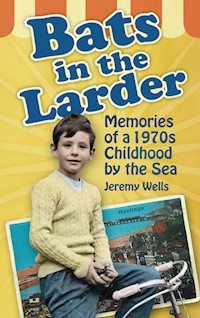
When 11-year-old Jeremy Wells moved home with his family from a bustling London suburb to the Sussex Coast, he was scarcely prepared for the weird and wonderful world he would encounter. Here was a place in which goats used public transport, buses waited for people, trains didn't fit the stations and seeing a film was the last reason for going to the cinema. And the neighbours were even stranger... In this affectionate and hilarious recollection of forty years ago, the author recalls the culture-shock of a family moving to an ancient town by the sea which was just two hours – and two decades – away from the capital.
Das E-Book können Sie in Legimi-Apps oder einer beliebigen App lesen, die das folgende Format unterstützen:
Veröffentlichungsjahr: 2011
Ähnliche



















This book was largely created by the indefatigable nagging of two extraordinary women. It was my mum who got behind the idea of writing it; it was my girlfriend who kicked my behind until I did write it. So, Peggy Wells and Ginny James, what follows is your fault. It’s also dedicated to you both with much love and respect.
First published in 2010
The History Press The Mill, Brimscombe Port Stroud, Gloucestershire, GL5 2QGwww.thehistorypress.co.uk
This ebook edition first published in 2011
All rights reserved © Jeremy Wells, 2010, 2011
The right of Jeremy Wells, to be identified as the Author of this work has been asserted in accordance with the Copyrights, Designs and Patents Act 1988.
This ebook is copyright material and must not be copied, reproduced, transferred, distributed, leased, licensed or publicly performed or used in any way except as specifically permitted in writing by the publishers, as allowed under the terms and conditions under which it was purchased or as strictly permitted by applicable copyright law. Any unauthorised distribution or use of this text may be a direct infringement of the author’s and publisher’s rights, and those responsible may be liable in law accordingly.
EPUB ISBN 978 0 7524 7214 0MOBI ISBN 978 0 7524 7213 3
Original typesetting by The History Press
Contents
Author’s Note
Preface
Prologue: Departures and Arrivals
1 The House That Had Been Hit On The Head
2 Settling In
3 Invitations Go Out
4 Ghosts In Our Machines
5 Next-Door Neighbours And Other Eccentrics
6 Restless Natives
7 The Wild Side Of Life
8 Old School, New School
9 The Sea! The Sea!
10 Whipped Cream On The Sausages
Epilogue
Author’s Note
Although the towns of Hastings and St Leonard’s-on-Sea comprise a number of separate locales, I have, in general, used the terms ‘Hastings’ and ‘the town’ to mean the overall borough of Hastings and St Leonard’s.
In addition, I should warn readers of a gentler disposition that they will find some mild profanity and general vulgarity in the pages that follow. What has been included is not wilfully gratuitous and is there either because it constitutes a direct quote or because I have attempted to represent not just the context of a particular thought or image but its emphasis, too.
Preface
This is a book of memories. Had I become a superstar in any chosen field, were I rich and famous today, they would be called memoirs. But I didn’t . . . and I’m not . . . so they aren’t. Thus, what follow are simply humble memories but, and this is the important bit, they are my memories.
There may be some irony in the fact that their genesis came of an exodus: when my mother was diagnosed with terminal cancer in early 2002 there seemed little point in talking about the future so, on my daily visits to her at St Michael’s Hospice and, latterly, in St Augustine’s Nursing Home, we reminisced about the early days of our ‘new life’ in St Leonard’s; all those incidents and accidents we’d experienced, the people we’d met and the neighbours alongside whom we had lived.
We laughed – how we laughed! – and, given the circumstances, that laughter was worth more than gold. It was mum who suggested I write down all the anecdotes and, as each recollection by the one of us triggered another from the other, we realised that life had, all things considered, been pretty good to us after we made the move to the fading seaside resort which we came to love for its quirky individuality and the personality it had revealed to us as we lived our ordinary lives by the sea.
Mum had found the friends that were as necessary to her as the air she breathed, particularly after dad died in 1975, and my sister and I grew up safely and in an ordinary way. Convention and routine reassured us while fleeting moments of excitement, drama, humour and tragedy flecked the predictability of life with that very unpredictability which gives us all pause both to think and to examine ourselves and our living environments.
I’m not quite sure at what point in life the word nostalgia becomes significant to us as individuals and I’ve also wondered how to define the difference between nostalgia and memory. The answer to the first question is that there is no precise answer. For some people, I think, nostalgia is borne of seeing their own children passing through those phases of life that gave them, in years past, the moments of mental and emotional extreme that constitute growing up and leaving behind the comforts, safeties and protections on which we all rely unconditionally as children; for others it is, perhaps, the dawning knowledge that there is less time on the planet ahead than they’ve hitherto enjoyed at that particular point in time. And there are those who find themselves unexpectedly relocated to a new dimension, to a new perspective of things past by something as innocuous as a sight, a sound or a scent. As to a definition: well, the word nostalgia has come to us from ancient Greek via modern Latin and originated as nostos which means ‘going home’. For me, then, while memory is of the mind, nostalgia is of the mind and of the heart – a Gordian knot of selective recollections of the past intertwined with powerful emotions of the present – sadness, happiness, comfort, shame, triumph, warmth, anger . . . you name it. In any event, memories are personal possessions and, for me, now a middle-aged man who has known both the aces and the deuces that the Great Dealer in the Sky can place before one, they are grown to surprisingly precious things.
Now, I’m quite sure that astute readers of this book (should I be lucky enough to have any readers at all) will pause at certain passages and say things such as: ‘Wait a minute, that building was on the other side of the road . . .’ or: ‘Actually, I’m sure that happened in 1973 not 1974 . . .’ And they’ll probably be right. If they are, more power to their mental elbows – but I don’t really want to know; for what I have tried to encapsulate in these pages is as much the spirit of our story as its dry chronology.
Bats in the Larder is neither sociology nor local history but the simple tale of a family who relocated to a town which seemed, in many ways, just a couple of decades behind the booming London suburb from which that family arrived. If it is peppered with a few unreconstructed opinions on life as it is today, I apologise in advance; but I am what I am.
So, having said that, if anything that follows brings you, the reader, the warmth of nostalgia or the comfort of comradeship: if any of the anecdotes brings a smile to your lips or, better still, a laugh to your throat, then I venture to suggest that you will not have wasted your time in the reading and I will not have wasted my time in the writing.
Jeremy Wells, St Leonard’s-on-Sea, New Year’s Day, 2010
Prologue: Departures and Arrivals
The journey of a thousand miles begins with a single step, say the philosophical Chinese. My journey was 64 miles and it began with a sausage roll on New Year’s Eve, 1970.
For me, just turned eleven years old, that was a highly promising start; but for my parents, embarking on the last day of a dramatic relocation from the London suburbs to a retirement bungalow by the sea, that sausage roll was the physical manifestation of a disaster – and an ominous one at that.
After all, this was their first house move in twenty-five years and, as far as they were concerned, it was going to be their last. My father’s teaching post had become redundant when the preparatory school at which he taught English and History had closed at the end of the summer term of 1970. He had, for some years, fought the long defeat against arthritis and had, earlier that year, decided that enough was enough. He was 62 years old and he was retiring.
The proceeds of the sale of our three-bedroomed semi-detached in Denziloe Avenue, Hillingdon, had bought a bungalow in St Leonard’s outright and, with care and some possible part-time work on the part of my mother supplementing the domestic economy, looked set to allow the family to live in basic comfort henceforth. Of their three children, my brother had long since flown the nest; I, as a pupil at the same school at which my father had taught, the highly regarded Rutland House, on Hillingdon Hill, was bound to find a new school for obvious reasons and my sister, it was hoped, would slot into whichever seaside primary school was closest to us – her confidence bolstered by the presence of ‘big bruv’ who was still the best part of a year away from needing a secondary school place.
The Hillingdon home had been stripped bare and the contents sent forth in an impressive Pickford’s lorry. The residue of those contents, the Wells family itself, should have been similarly sent forth by courtesy of a British Rail service from Charing Cross to Hastings on a bitingly cold last day-of-the-year. Unfortunately, the train had the appalling effrontery to depart exactly on time and the luggage-laden Family Wells bumped to a halt at the platform entrance to see its smug rear-end disappearing from the station, diesel engines booming as it rumbled over the Hungerford Bridge, across the black glitter of the Thames and into the darkness of the South-East London suburbs. So much for dad’s theory that ‘trains never arrived on time because they never left on time.’ Thus, we found ourselves an hour behind schedule before even leaving the capital and were forced to wait in the overheated, over-priced Formica forest of the Charing Cross buffet for the next – indeed the last – service to Hastings.
But a sausage roll . . . well, that was a treat, indeed! I began to have reinvigorated hopes for the whole adventure as I munched away oblivious to the fact that it was in my possession only to shut me up so my parents could bicker and blame each other for the travel cock-up without whingeing children interrupting their flow.
And it was an adventure. Eleven-year-olds are not afflicted with the curse of nostalgia. Yes, I was leaving familiar faces and familiar places but the promise of what was to come was infinitely more enticing that what I was leaving behind. After all, how many of us have had wonderful holidays and wished with all our hearts that we could actually move to live in that holiday heaven? We were doing just that; about to turn our annual two weeks by the sea into fifty-two weeks by the sea. In my mind, life was about to become one long holiday – the more so as dad was retiring and what was retirement other than one unending holiday?
While I enjoyed my sausage roll, dreamed of a seaside Arcadia and revelled in the excitement of a main line station’s hustle and bustle, mum was queueing for a pay-phone to let our host for that night, an old friend in St Leonard’s called Joyce McIntyre, know that we had missed our train. By coincidence and very conveniently, Joyce lived just a couple of hundred yards from the bungalow that awaited us and it could even be seen from her windows.
We finally boarded, lodged the suitcases and found seats, even mum and dad finally infected by the excitement of the children chorusing: ‘Goodbye, dirty old London . . . Bye-bye River Thames . . . Good riddance noise and smoke and dog poo . . .’ and so forth. The train weaved, creaked, squeaked and clanked through the nineteenth-century junctions, squeezing its way through the grime and soot-encrusted warehouses of Borough Market and New Cross to Lewisham and beyond where the light-stippled high-rise blocks gave way to the ordered ranks of sodium-orange street lamps and the hump-backed terraces of suburbia. All the while, the distinctive thump-thump of the train’s diesel engine seemed to beat a tattoo of advance as we headed to our new life. Indeed, the train itself seemed part of that new life, as it was one of the unique Hastings Diesels built specifically for that journey, partly because the line after the Tonbridge junction was not at that time electrified and partly because BR’s existing rolling stock was too wide to use the tunnels between Tunbridge Wells and Hastings. I felt like we’d even been given our own special train for the journey.
Unfortunately, British Rail had one last trick to play on us and it came from the very nature of our dedicated train – a six-carriage multiple unit which, when coupled to one of its brothers, formed a twelve-car train which was just one carriage too long to fit neatly between the tunnel mouths at either end of St Leonard’s Warrior Square station. This resulted in the last carriage remaining in Bo-Peep Tunnel while the eleven others were cheerfully discharging their weary passengers onto the platform of journey’s end.
Guess who’d found seats in that twelfth carriage?
It was gone ten o’clock and we knew our journey was nearly done but when the train squealed to a halt we assumed it was waiting for a signal that would allow it into the station. Then the engine started to thump again and my parents wearily began to gather coats and cases into the gangway. Our carriage emerged into the all-but-deserted station, disconcertingly gathering speed rather than slowing down. As we sped along the platform we spotted the muffled figure of Aunty Joyce searching each window for a sign of her guests, clearly resigned to the fact that we’d missed yet another train. She spotted us at last and made frantic gestures which, although they seemed meaningless to me, were correctly identified by my parents as: ‘Get off at Hastings and come back one stop.’ Fortunately, an understanding guard at Hastings spotted the bewildered ‘Grockles’ with their suitcases and bickering children and held up his London-bound train long enough for us to cross the platform and join it. We were lucky, for it was the last of the night. By this time we were all dog-tired, hungry and, in my father’s case, deeply depressed at his lack of transport management skills. Matters weren’t helped by the guard on our saviour-train finding the whole business highly amusing and repeatedly telling us that: ‘All you trippers get caught out like that.’ Checking our tickets, he leaned forward conspiratorially and, as though revealing one of the secrets of the universe, said: ‘Train’s too long for the platform, see. Oughtn’t to have sat right up the arse-end, see! Happy Noo Year, to you . . .’
Aunty Joyce was waiting for us at Warrior Square and, fortunately, she dispensed all the sympathy that we required, although for me, that sympathy was promptly curtailed when it became clear that we could not all fit into her car – an aged Mini Estate that looked like it had probably come off the production line at about the same time as the Kaiser abdicated – the more so as she’d brought one of her strapping teenage sons, Paul, with her to help with the luggage. To my pouting outrage, it was decided that I should walk to Joyce’s flat with Paul – and carry my own bag – from the deserted station. The tail-lights of the car disappeared down Western Road and fourteen-year-old Paul manfully picked up my case. ‘Come on, it’s not far,’ he said.
It wasn’t; but it was all uphill as Joyce’s flat was in Helena Court, that highly imposing (or monstrous – depending on your architectural preferences) redbrick edifice that dominates the skyline at the top of Pevensey Road. I forgot my ire at being excluded from the car by the nature of that walk up the long, curving hill from London Road. The temperature must have been well below freezing and the sky was studded with stars, the brilliance of which astonished me. I’d never seen them in such profusion or pin-point clarity and that fact, coupled with the deep silence that seemed to have settled over a darkened St Leonard’s, was faintly unnerving. This wasn’t like being in London. Hillingdon was never really dark and it was certainly never silent. Here, it seemed, dark was dark; the stars were stars and silence was just that – silent; awesomely silent.
Within fifteen minutes, Paul and I arrived at his home, my overnight accommodation. There was no lift in Helena Court and I had to trudge up seemingly endless flights of dimly lit and creaking stairs to Joyce’s top-floor flat. The darkness suddenly ended at a golden threshold and, as I stumbled into light and warmth, I saw mum and dad turn towards me with smiling faces and I promptly burst into tears. It was all a bit too much. Those stars, that searingly cold air, that deep silence over the town; all new, all strange because now this was our town. For the first time, a sharp sense of no-going-back had come over me. This was it; I was part scared, part excited but, above all, completely exhausted. That exhaustion, and the excitement of the day, finally had its way with me. I was falling asleep on my feet and my sister had long since drifted into slumber.
I was dimly aware of being taken to Paul’s attic bedroom amid numerous hushed ‘Happy New Years’ and the muted chink of glasses. There, a camp-bed had been made up for me in one corner under the eaves. I recollect a hot water bottle passed to me wrapped in my pyjamas and I remember looking out of the window to see the sweep of a lighthouse beam far over the sea. I also recall being strangely comforted by its rhythmic repetition. Then mum was shooing me into my little bed with its crisp, clean sheets. The light in the room was turned off and silence settled; but that lighthouse continued to pierce the darkness and paint the faintest glow on the walls of the room. I asked Paul where it was and listened drowsily as he told me that it wasn’t a lighthouse but the old Royal Sovereign lightship moored some 15 miles out on the treacherous Royal Sovereign shoals. It was there as a serious warning to all mariners, of course, but it was a strangely welcoming first anchor for me. A new town, a new life; but somehow, somewhere, someone was wakeful and watchful, bringing safety and security to the empty hours of the night. I fell asleep to dream vividly that I was alone on a dark and rolling sea with only a pin-point of golden light to draw and welcome me into a port that I had never visited before. Mum told me later that she had popped her head round the door fearing that I would be troubled in my sleep by the strangeness of it all. Apparently, she found me lost to the world with a happy, peaceful smile on my face.
The next morning I stood shivering and bare-footed at the tiny eaves window of Joyce’s landing seeking my first glimpse of our new home. It was Friday, a monochrome New Year’s Day – everything seemingly black and white because of the light fall of snow in the small hours that lay undisturbed on footway, roof and road. It seemed as though a deep, fur-lined silence had wrapped the world. As it was a Bank Holiday we could not expect the removal men with all our worldly goods until the next day. However, we were all eager to take possession – symbolically, at least – and I was bursting to explore the house so I pulled on my clothes and clattered down the narrow stairs just as mum appeared.
‘Come on,’ she called, packing two thermos flasks into a shopping basket. ‘Grab one of these bags down here and look sharp! We can have breakfast in our new home!’
We set out through the freezing air, our breath steaming in clouds about us as we talked rapidly and loudly about what we would find within the house and how we intended to make our marks upon it; but any illusions I’d had that moving home was simply transferring one’s creature comforts from one set of bricks and mortar to another were about to be rudely challenged.
1
The House That Had Been Hit On The Head
Now, it’s a strange fact to relate but, on that cold first morning of 1971, as we stood in front of our new home, it was the very first time that three of the four family members had so much as set eyes on the place.
For the choice of 17 Boscobel Road North had been mum’s alone. Having voted to quit the capital for good, my parents quickly agreed they wanted to be by the sea. That decided, the list of possibilities was swiftly whittled down to two – Sussex or the West Country and, in the case of the latter, it was, specifically, Devon or Cornwall. The Sussex option stemmed from mum’s friendship with Joyce McIntyre, a friendship which had brought her to St Leonard’s on numerous occasions over the years. Devon and Cornwall made the cut because mum had a sentimental attachment to the peninsula. She’d had an aunt who bequeathed her tiny, two-bedroomed chalet – it wasn’t substantial enough to be classed a cottage – to mum. To her enduring regret, mum had been forced to sell the chalet for needed cash following the birth of my sister. There had been a number of happy holidays in that chalet, perched on a cliffside at Downderry, when my brother was a child and I was a baby and mum had always loved the idea of relocating there permanently. But the choice of Sussex was made with me and my sister in the forefront of my parents’ minds. Dad warned mum: ‘If they end up at college or in London and we’re more than 90 minutes away on a train they won’t come home and we’ll never see them.’
Wouldn’t we? Wouldn’t they? Who can say? However, the argument was clearly a sufficiently cogent one for mum and she bought into it. Even so, Devon and Cornwall weren’t ruled out entirely and mum and dad spent our two-week summer holiday of 1970 in split house-hunting. He went to Devon and based himself in Newton Abbot while she brought my sister and me to St Leonard’s. We had a wonderful time entertained by Aunty Joyce while mum ran her proverbial arse ragged viewing the short-listed properties which had been sent up to London by estate agents positively salivating at the prospect of a cash sale. Consequently, it was mum who inspected the bungalow and it was on her recommendation that the couple made their decision, put in their offer and signed the contract. It was an extraordinary act of faith on the part of my father – in all respects the archetypal husband and head of the house – and the more so as he had quite made up his mind that this new location would be the one from which his two younger children were launched into the wider world.
‘Well . . .?’ said mum encouragingly as we stood on the grass verge in front of the house.
‘It looks like it’s been hit on the head, doesn’t it, dad?’ said my sister. Funnily enough, that’s just what it did look like. A square 1930s bungalow with an apex roof, a centred bay window under eaves – clearly one of the bigger living rooms – and a steep, stepped path down to the front door – which was actually set in one side of the house.
Dad chuckled; mum smiled in relief and we raced down the path to be first inside, clamouring at the door while the house keys, still attached to the paper luggage label, were produced. The door was duly opened – a door to a new home and a new life.
Familiar only with the two-up, two-down semis and terraces of the London sprawl, my sister and I were puzzled and intrigued by the curious geography and the illogical configuration of just about every aspect of this new-fangled ‘bungalow’ thing. One element in which we took an inordinate pride was the fact that no. 17 had two entrance gates, one on either side of the front garden. The one on the left, as you faced the house, sported the house number and led to the front door which was actually set in the side of the house. The other gate led to the door into the house which was diametrically opposite the front door. This was, then, we logically deduced, the back door (although the actual back of the house didn’t have any doors at all). Thus, the gate that led to the back door had to be the back gate although it was clearly at the front. It made sense in a curious way and was something dad dubbed ‘Hastings Logic’ – a way of thinking and perceiving things that we found rather different from that to which we were accustomed. Hastings Logic was fun, though, because even the most everyday conventions and utilities tended to provide their own unique twists. We loved having a back gate at the front of the house – and if proof were needed that it was indeed the back gate, it was provided by a small embossed metal sign saying ‘Tradesmen’ – and everyone knew that tradesmen had to use your back door. We’d seen it on Upstairs, Downstairs a thousand times. It was The Law.
Mum was partly delighted and partly embarrassed to find herself chatelaine of a house with a bespoke tradesmen’s entrance and we were soon to discover that there were quite a few tradesmen to use it, too. Back then, one could have just about anything brought to your door – as long as it was the back door, of course! Coal was delivered, the rubbish taken away; there was a milkman, naturally; a fishmonger and a delivering baker. There was even a grubby individual with hands permanently decorated with sticking plaster who offered to sharpen our knives, shears and lawnmowers. Dad reckoned he couldn’t be doing very well out of the business because of the amount of time he must have been spending in hospital having blood transfusions. By arrangement, meat, fruit and vegetables could be summoned to your house and there were those hardy perennials: the football pools collector; the Avon Lady; the insurance man – the legendary Man from the Pru’ – and, of course, the postman. Our postman was quickly dubbed the ‘Whistling Postie’ (for reasons I’m sure I don’t need to explain). We’d hear him when he was still a considerable way off, his friendly, avuncular form whistling sinister ditties like the theme tune from The Good, The Bad and The Ugly or the latest James Bond film. Like the buses, as we were to discover, the postal service in the town seemed to operate at its own untrammelled pace, Royal Mail’s finest more than happy to accommodate those of his customers disposed to chat with the melodic mail-maestro as he made his relaxed way along the road.
He’d dump his bag on our garden wall and come sauntering down the path, smiling in all weathers, and calling out: ‘Mornin’ Mrs Wells. Just a bank statement and a letter from your son in London. He’s sent you some photies!’
We half expected him to tell us what the photographs showed and how much money we had in the current account. Dad rather disapproved of this informality, as he saw it, and thought that anyone compelled to go to work in a peaked cap should conduct himself in the manner of a Coldstream Guardsman on Household duty. Mum, on the other hand, thoroughly enjoyed it. On top of the intrinsic flirting (and I’ve never met a woman immune to that pastime – within reason, naturally), I think it created in her mind that sense of close community that she associated with her dream existence of the ‘small holding-small village’ in which people lived close-knit and everyone knew each other – and each other’s business.
There were more opportunities to play at small-holdings in no. 17 – or rather, outside no. 17 – in the form of the back garden. Mum fell in love with it on that first exploratory day, principally because it had grass – a proper lawn – as well as apple trees, a rose bed and flower borders. On top of that, the garden backed on to the Marina Estates Allotments which created the impression that the garden, beyond its ancient boundary fence, stretched into the distance offering a pleasing prospect of hazel, hawthorn and hedgerow. That view was further enhanced by the fact that the land sloped away so that no ultimate border was visible, the lie of the land offering a countrified aspect sitting below the distant beaches at Bulverhythe and Glyne Gap with Eastbourne and the Beachy Head promontory on the horizon.
But my admiration for the view would have to wait: I had spotted something much more interesting and much closer to home – quite literally. We had sheds! Not a shed but sheds plural. There were two of them and the male members of the family were thrilled.
Now, here we encounter one of those curious but universal bifurcations of the sexes: for the average woman, a shed is a purely functional edifice used for storing lawnmowers and sundry garden tools. Sheds are to be avoided if possible because they are dirty, dusty and almost certainly have splinters. Worse, they have spiders and moths – if not rats and mice. They are also viewed with deep suspicion because they provide a ready-made bolt-hole and an escape route through which husbands can swiftly go AWOL when unexpected visitors turn up or wives start chatting casually about redecorating. For men, a shed is something else . . . much more. Maybe it’s the old caveman thing – the territorial domain; it’s the frontiersman’s cabin; the commando’s operational base; the outlaw’s hideout. The shed is a masculine preserve where tobacco can be smoked, world conquest can be planned and a free-born Englishman can belch, fart and scratch his knackers without fear of reprimand or sanction.
So while mum was examining the flower beds and mentally planting-out, envisioning the quiet riots of colour that would burst forth in this sunny, sheltered corner, dad and I were exploring the larger of the two sheds at the bottom of the garden. It had a sturdy workbench running along the windowed side and was clearly water-tight and in a good state of repair. Dad stood looking around him and nodding in approval, muttering: ‘Armchair over there . . . radio to hang on the wall there . . . few shelves . . . can use the workbench as a desk . . .’ He came out looking pleased with himself.
‘What’s it like in there?’ asked mum.
‘Loads of spiders,’ said dad.
‘And very big moths,’ I chipped in and, in a moment of male-bonded inspiration, added, ‘Lots of mouse poo, too.’
Dad looked down at me gravely: ‘Those mice might be rats, son. Probably best if we take care of that shed. The one up the top there will do for the bikes and the tools.’
‘Hmmm,’ said mum. She scanned our faces dubiously while we returned her interrogation with innocent sincerity.
Our excitement at our new back garden was not so surprising when you bear in mind that the one we’d had in Hillingdon was basic in the extreme. There, a narrow path from the back door was bordered on one side by a row of rickety outhouses which functioned as coal-holes and, on the other, by a small piece of muddy grass about the size of a Subbuteo football pitch. There was an area of crazy paving beyond that which dad had laid himself; it wasn’t so much crazy as utterly demented. The garden ended in a dilapidated garage which was still filled with the rotting timber off-cuts which were there when my parents took possession of the house. It was a north-facing garden, too, and so not conducive to verdant growth. Mum tried runner beans the year they moved in but the shoots stuck their heads out of the stony London soil, took one look at their dank, chilly surroundings, took one sniff of the sooty reek and promptly keeled over and died on the spot. Its one redeeming feature was an old and abundant plum tree. Apart from us children playing out there, that garden was seldom visited except for the occasional bonfire and the memorable occasion on which dad lent his assistance to the midwife for the birth of my sister.
She was born during the first week of April 1963. It was the worst winter since the famous freeze of 1948 and, in many towns up and down the country – including Hastings and St Leonard’s – 1962/3 remains the coldest winter since records began. In Hillingdon, snow and ice blocked most of the suburban streets and when the baby decided to come it was clear that no ambulance would be able to make it to our house. Fortunately, the local midwife was made of sterner stuff and trudged her way through the snow to deliver my sister in the traditional way – freezing back bedroom, lots of towels and bewildered father running up and down stairs with gallons of hot water. When Miranda had been successfully brought into the world, the midwife came down stairs and informed dad in that brisk, business-like way of the medical professional. She then handed him a parcel wrapped in a copy of Titbits. Dad looked blank and the midwife told him: ‘It’s the baby’s luggage, Mr Wells.’
Dad continued to look blank. The midwife sighed and whispered to him: ‘It’s the placenta, Mr Wells, the afterbirth. Now then, hygiene is paramount with a new baby just arrived. Please take the parcel and burn it immediately . . . and not in here!’ she added quickly, seeing dad’s gaze drift to the fireplace.
Mum told me years later that the midwife then rejoined her and my baby sister in the bedroom and went straightaway to the window overlooking the back garden. She promptly dissolved into laughter. In driving wind and swirling snow dad was out on the crazy paving, the newspaper-wrapped afterbirth on the ground in front of him. He was lighting match after hopeless match, trying, at arm’s length, to set fire to the parcel as if it was some biological firework likely to explode in his face.
So much for the gardens of our new seaside domain. Just as initially perplexing as the exterior of this curiously smitten home was the inside. The solid wooden front door opened onto a small vestibule where coats could be hung. Another door, almost equally substantial but this time set with panels of frosted glass from top to bottom, opened onto the hallway proper. This double-doored entrance was dubbed ‘The Airlock’ on that first day and we called it that for the next twenty years. The house comprised nine rooms in all, each of them featuring dark wooden beams, approximately four inches square, running across the ceilings. Dad’s investigations proved that they were not load-bearing so were there only for decoration; but they were a striking feature and mum loved them because they were another nod to the idea of the country cottage. Because all the rooms opened off a double L-shaped hallway, there were, by definition, no windows between the hall and the external walls. Consequently, with the front door shut and all the doors to the internal rooms closed the hallway was in complete darkness. From day one, that front door was hooked open when the first member of the household was up and abroad and not closed until the last person retired for the night. For years, our home was secured by nothing more substantial than the sprung ball-and-socket catch on ‘The Airlock’. Anyone could have walked into our home: no one ever did and it never occurred to us that anyone ever would.
At least that glass-panelled door provided some natural light – and the place needed it. What was it with our grandparents and great-grandparents and their ideas on interior decor? No. 17, like so many other houses occupied by that generation, was overwhelmingly brown. The doors were painted dark brown, the floors were covered with brown linoleum and all the internal walls treated to an earth-coloured distemper. Even the light switches and power points were in mahogany Bakelite. (Incidentally, Bakelite – a forerunner of modern plastic – has the technical name of Polyoxybenzylmethylenglycolanhydride. It’s not the sort of thing one needs to know in an everyday context, I appreciate, but if you’re playing Scrabble it will absolutely slaughter the opposition!). I often wonder how the estate agents of a century ago attempted to sell such gloominess:
We feel that we shall in no way distract the discerning viewer’s earnest appreciation of the fabric of this fine residential edifice by drawing his respected attention to the splendid interior décor. Walls are washed in a delicate shade of Burnt Sienna while doors are cloaked in the ever-distinguished Vandyke Brown. Subtle contrast is offered by the Burnt Umber of the wainscoting and picture rails, the whole completed by the visually restful ochre shade offered by that miracle floor material of the future, Linoleum.
But brown is brown. ‘It’ll be like living in a hollowed out turd,’ dad muttered to himself. Then, addressing the family, he opined that this was precisely the sort of environment he was anticipating when he was six feet under and that he had no intention of living in a world of loam before that time came. A gallon of white emulsion was the first thing to go down on the ‘things to buy’ list.
Even with the aid of the limited natural light, it was still some days before we had mastered the internal geography of the place. I’d never dreamed that a simple square could prove so complex. That front room with the bay window was earmarked as ‘the dining room’, in effect the family’s living room. A space for dad’s throne-like armchair was reserved, its location decided by the preferred siting of that single most critical item of furniture, the TV. That was to prove an entertainment in its own right – but more on that later. Mum and dad ummed-and-ahhed in the gloomy dust and echoes of the bare-boarded room, allocating floor space to the other components of our second-best, three-piece suite, the dining room table – an ugly and knee-knocking example of Second World War utility furniture (highly collectable now – detested as a relic of times better forgotten, then) and the equally ugly and junk-cluttered sideboard that contained the best china and a superb canteen of wedding-gift cutlery. Mum point-blank refused to use either, too terrified that some component part would somehow be damaged, scalded, chipped, stained, broken, marred or lost. A royal visit might conceivably have swayed her, but I wouldn’t have bet my half-crown pocket money on it.
If there were items in the dining room that weren’t to be touched, there was a whole room that was out of bounds to the whole family other than on very special occasions. In our new home it would be, confusingly, the ‘Front Room’; I say ‘confusingly’ because it was actually at the back of the house. It was called the Front Room because it was, as far as possible, a facsimile of the front room at Hillingdon (there, it was at the front of the house). I mention this front room specifically because it was a curiosity of my parents’ class and time. Front rooms were the best rooms in a house; they had the best carpets, the best furniture, the cabinets containing such valuable antique silverware and china as were possessed and the best curtains and pictures. They stayed ‘best’, too, because no-one ever got to see them, touch them, walk on them or generally come into close proximity to them.
The front room, lounge, best room – different families had different terms for it – stayed as a weird and utterly useless inner sanctum; a reception room that received nothing and no one for 99 per cent of the time and was used only when guests – and guests of some substance – were to be entertained. I say ‘weird’ because one might have thought that such a room, pristine, immaculate and showing off the best the Wells family had gathered over the years, might just reflect something of the family’s history and tradition; at the very least clues as to my parents’ collective past. But it didn’t. For some 360 days of the year it remained a sterile chamber like a business boardroom, always ready for use, but rarely pressed into service.
Mum and dad both came from houses which had, in their turn, featured front rooms. As a child, my dad set foot over the threshold of his family’s seasonal sepulchre only on Christmas Day. Mum’s parents were more relaxed. She and her siblings were allowed into their front room on Sundays but only to peruse the educational books collected therein – principally the Bible and her father’s prized possession, a copy of Foxe’s Book of Martyrs presented to him as a school prize when he was thirteen. Mum recalled how she and her brother would leaf through that mighty tome – for 200 years the officially sanctioned record of the Catholic persecution of the pioneers of Protestantism – their sides aching with silent mirth. They tried not to catch one another’s eyes while trying to fix their faces into studies of grave compassion as they examined the artists’ impressions of gruesome executions at Smithfield and Jews being burned in chains at Northampton. ‘We only laughed because we were expected to be so serious,’ mum recalled to me once. ‘What use is a book like that to nine-year-olds – all church language and tiny print? We didn’t realise the artist had drawn those poor old Jews writhing in torment. We thought they were dancing. If they weren’t dancing, why were all the people in the background clapping and cheering?’ Unfailingly, one or the other of them would lose control of their features and they would be expelled from the room with stinging slaps to arms and legs.
By my time, the front room had become less of a chilly chamber of high manners and low usage but it was still a room reserved for special occasions and one which we were not even allowed to enter without permission. It was a shame, too, for that front room at the back of the house, south-facing, had the best view of all and, after redecoration, with walls emulsioned a pale creamy orange, the skirting boards and picture rails a brilliant gloss white and with a green three-piece suite, the room seemed to be filled with a permanent glowing sunset. Even the print of Millais’ Boyhood of Raleigh, with its maritime theme and sited discreetly to one side of the chimney-breast, seemed to fit perfectly with the view from the windows – low-tide sands at Bulverhythe, Glyne Gap and the whale-backed promontory that was Eastbourne, Beachy Head and the southernmost reaches of the Downs.
Things were to change, though, and sooner than we might have expected. But as we installed ourselves in no. 17, allocating a room to be the front room was high on the agenda. To this day, I know families who have maintained that same tradition; now, of course, the untouchable icons of style and success are HD TVs with surround-sound audio, £5,000 Chesterfields and hand-styled Art Deco table-lamps which cost more than the 1930s originals from which their designs have been shamelessly stolen.




