


Erhalten Sie Zugang zu diesem und mehr als 300000 Büchern ab EUR 5,99 monatlich.
- Herausgeber: The History Press
- Kategorie: Sachliteratur, Reportagen, Biografien
- Sprache: Englisch
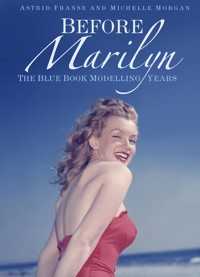
Before Marilyn tells the story of Marilyn Monroe's modelling career, during which time she was signed to the famous Blue Book Agency in Hollywood. The head of the agency, Miss Emmeline Snively, saw potential in the young woman and kept detailed records and correspondence throughout their professional relationship and beyond. On the day of Monroe's funeral, Snively gave an interview from her office, talking about the girl she had discovered, before announcing, rather dramatically, that she was closing the lid on her Marilyn Monroe archive that day – to 'lock it away forever'. This archive was purchased by Astrid Franse, and together with bestselling Marilyn Monroe biographer Michelle Morgan they draw on this collection of never-before-seen documents, letters and much, much more. Before Marilyn explores an aspect of Monroe's life that has never been fully revealed – by charting every modelling job she did, and illustrating the text with rare and unpublished photographs of the young model and her mentor.
Sie lesen das E-Book in den Legimi-Apps auf:
Seitenzahl: 231
Veröffentlichungsjahr: 2015
Das E-Book (TTS) können Sie hören im Abo „Legimi Premium” in Legimi-Apps auf:
Ähnliche



















For Marilyn Monroe and Emmeline Snively, with muchlove and thanks.
Astrid: For my mother, Miep van Anrooy-Biesthorst, andmy family.
Michelle: For Suzie Kennedy. You will always be ‘Blanche’to me. xx
Authors’ Note
Miss Snively always referred to her former pupil as Norma Jean Dougherty and later Marilyn Monroe. However, records show that the official spelling of her name was actually Jeane with an ‘e’. In order to be factual, the authors have written her name in the official way.
On a similar note, because the agency boss often wrote her notes and letters with business partner Joyce Ryan, she sometimes refers to herself in the third person. Where she did this in the archive, we have – for the most part – kept it that way in the text of the book. The only thing we have changed is where Miss Snively occasionally gets a date incorrect in her notes. These have been corrected to correspond with historical accuracy.
ACKNOWLEDGEMENTS
The authors would like to thank the following people:
Memory Monroe and Marco van der Munnik, who introduced us and planted the seed for this remarkable project. We would also like to thank Marco for providing some photographs from his collection.
Those wonderful people who provided photographs, interviews, information or support for the project, including: Suzanne Van Leendert, Christopher Ryan, Frank Van Osch, Chuck Murphy/One West Publishing, David Conover Junior, Margaret Miller/Richard C. Miller Estate, Roland and Chris Hueth, Kim Goodwin, Greg Schreiner, Melinda Mason, Dionne Abraham, Eric Patry, Michael Reynard, Eduardo Caballero, Livia Vidicki, Debra Holden, Annabelle Stanford, Steve Hayes, Bill Pursel, Maria Musikka, The Estate of Joseph Jasgur, Joyce Black, Beverly La Belle, Paul Jordan, Noreen Nash, Paula Knotter, Darren Julien of Julien’s Auctions, Matt Butson, Irvin Gelb, Mamie Van Doren, Claartje van Dijk, Fiona Maynard, Eric Woodard, Christina Rice, Tara Hanks, Marijane Gray, Fraser Penny, April VeVea, David Wills, Polly Haas, Laura Wagg, Beth Watson, Christine Mas, Scott Fortner and Andrew Hansford.
Also the Marilyn fans who have supported us, and specifically those who have joined the Blue Book Project Facebook page over the past year and helped us identify and find rare photographs. There are too many members to thank each and every one personally, but you all know who you are!
We would also like to thank our agent, Robert Smith, and publisher, The History Press, for believing in this project and giving us the opportunity to tell Marilyn’s Blue Book story.
Finally we would like to say a huge thank you to Emmeline Snively. If she had not kept her files for all those years, this project would never have come to fruition. We are both extremely grateful to her.
Michelle would like to thank:
My family, especially Richard, Daisy, Mum, Dad, Paul, Wendy and Angelina. My friends Claire, Helen and Mandy, and my readers, who have always been so supportive. I can’t thank you enough; you all mean the world to me.
Astrid would like to thank:
My mother Miep van Anrooy-Biesthorst, who raised me by herself and died, aged 47. My husband Ben Franse. My sons Sargon Franse and Maroen Franse, and their families. Noor Johnson. My business colleagues at Bennies Fifties, who assisted me: Richard Westdijk, Anais Constandse, Rana Stuivenberg, Jack van der Meulen and Julie Schulting (www.benniesfifties.com/www.fiftiesstore.com).
The front and back cover images have been supplied courtesy of Kim Goodwin.
Every effort has been made to trace copyright holders and to obtain their permission for the use of copyrighted material. The authors apologise for any errors or omissions and will be happy to correct future reprints or new editions.
CONTENTS
Title
Dedication
Author’s Note
Acknowledgements
Foreword by Greg Schreiner
Introduction
one Speculation, Unassigned
two No. 37, Casino Floor
three Fame Has a Way
four Cross My Heart I Did
five Who is the Girl on
Laff
?
six Mmmmarilyn Mmmmonroe
seven There’s No Business Like Show Business
eight And So It Was
Bibliography
Plates
Copyright
FOREWORD
M arilyn Monroe is probably the most written about movie celebrity of all time. Countless biographies have delved into her life with varying accuracy. Her difficult childhood, early film success and her eventual stardom are chronicled through endless tomes. But one critical area has been only superficially covered – her years early in her career with the Blue Book Modelling Agency. When Norma Jeane walked through their doors on that fateful day on 2 August 1945 her life would forever change.
So much of what Marilyn learned from the Blue Book Modelling Agency would carry her through her entire life, and literally opened many doors for her that allowed access to a film career. Her blonde hair, unique, quivering smile and famous walk were attributes directly related to her education with the agency and its director Emmeline Snively. Adding to all this was a growing confidence in herself and her abilities to function as a model and eventually an actress. Marilyn was obviously destined for greatness, but this could have been all lost to the world if she had not had this turning point in her life. Miss Snively took her under her wing and nurtured and guided her and believed in her abilities. She also may have been responsible for getting Marilyn her first screen test at Twentieth Century Fox Studios.
The most ironic part is that all of this history might have been lost if not for the concern of Miss Snively to save all of the photos, papers and other articles relating to this time. The eventual loss and recovery of these files provides a fascinating story in itself.
The authors, Astrid Franse and Michelle Morgan, have done extensive and exhaustive research into this relatively unknown area of Marilyn’s life, and given us tremendous insight into how Marilyn transformed herself from a simple hometown girl into the world’s greatest movie star. The book is loaded with unseen photos of Marilyn from this period, as well as other documents and letters. This is certainly a must-have book for Marilyn fans; at last the complete history of this so important part of Marilyn’s life will be filled in. But this is also a book to give hope to anyone who dreams big and strives to achieve a better life. Be prepared to fall in love with this glamorous, sensitive, adorable woman.
Greg Schreiner
President, Marilyn Remembered
www.marilynremembered.org
INTRODUCTION
T wenty years ago, Astrid and Ben Franse were in a vintage store in Los Angeles, buying items for their shop, Bennies Fifties. As they spoke to the shopkeeper, a man walked in with a box in his hands and mumbled something about finding it in a locker. Nobody seemed aware of the exact contents contained inside, but, despite that, the store owner bought the item to sell in his shop. Astrid and Ben overheard the conversation and took an immediate interest in the mysterious contents of the box. They negotiated a deal with the owner and then took the box back home to Europe.
The couple were convinced that what they had just bought was a box of pictures, old newspapers and press clippings mentioning Marilyn Monroe. Thinking the items had probably been collected by a fan, they stored the box under a desk and temporarily forgot about it. In the years ahead Astrid thought often that she should take a good look through to see exactly what was in there, but one year led to another, and before she knew it, two decades had passed and the box remained untouched.
In 2012 – fifty years since the death of Marilyn Monroe – a dealer telephoned from the United States on behalf of a collector, who was interested in buying one of the couple’s jukeboxes (a rare 1943 prototype of the Wurlitzer 1000). During the course of the conversation, he happened to mention that his client was a huge Marilyn Monroe fan, who had previously tried to buy the dress the actress had worn when singing ‘Happy Birthday’ to President John F. Kennedy. It was at this point that Ben remembered the box under his desk. He told the dealer, and then received a call later that night to say that the Marilyn collector was definitely interested in buying the box.
This information prompted the couple to look at the contents for the very first time. When they lifted the lid, they were absolutely stunned. While Ben and Astrid had always believed the crate held just a series of clippings and memorabilia, they were proved to be wrong. The box actually contained the archives from Miss Emmeline Snively, owner of the Blue Book Modelling Agency, who had signed Marilyn (or Norma Jeane Dougherty as she was then) in 1945.
There were folders containing negatives, letters (one from Marilyn herself), telegrams, agency books, business cards, photos, envelopes, worksheets and much more. There was even a play that had been written by Miss Snively and Joyce Ryan, her secretary, who had once been a Blue Book model. The archive was a monumental discovery and revealed that long after Marilyn’s death the agency boss tried to make her memories into a book or documentary, compiling notes and sorting photos along the way. Her efforts went unpublished, however, and eventually she decided to lock her archive away forever.
When news of the discovery hit the newspapers, it caused a sensation. No longer was Astrid the owner of a box of memorabilia; suddenly she was the keeper of a very important piece of history. She decided that, instead of selling the files, she should bring the information to the masses in the form of a documentary and book. As a result, Astrid was inundated with requests from authors, all asking if they could be the one to tell the story of Marilyn’s discovery by Emmeline Snively. Their interest was appreciated, but Astrid was determined that she needed to work with someone who understood and respected Marilyn and who would want to fulfil the dreams of Miss Snively just as much as she did herself.
After reading the 2012 biography Marilyn Monroe: Private and Undisclosed, Astrid believed that author Michelle Morgan was the best person to write the story. After a successful meeting and many emails back and forth, the two women decided to work together. Their aim? To bring the story of Marilyn’s time at the Blue Book Agency to life in a way that only they could: by fusing together the agency archives, Astrid’s prodigious research into its contents and Michelle’s rich knowledge of the actress’s life. It was a perfect fit.
Miss Snively’s letter to an editor explaining that the story of Marilyn’s modelling career has never been told. (From the archive of Ben and Astrid Franse)
From the very beginning, the authors have been adamant that this project should be an extension of what Miss Snively had begun all those years ago. Therefore, this book is not a biography but a unique look into Marilyn’s early career in the 1940s and her continuing relationship with the Blue Book Agency. It has also become a tribute not only to Marilyn but to Miss Snively herself, telling the fascinating story of how she played a part in creating a legend. ‘If Miss Snively had not been around, there would not have been a Marilyn,’ says Astrid. ‘She discovered her, she saw her potential.’
Astrid is correct of course. While Marilyn had tentatively begun a modelling career in 1944, her life was to change forever on that fateful day a year later when she walked through the beautiful lobby of the Ambassador Hotel and into the reception of the Blue Book Agency. Emmeline Snively took the young woman under her wing and encouraged her to dye her hair blonde and make several other corrections and adjustments – ultimately helping to launch one of the most successful film careers the world has ever seen.
This book is a tribute to the hard work of both Marilyn Monroe and Emmeline Snively, bringing alive the archives of the agency and reliving a vital part of history: Marilyn Monroe’s Blue Book years.
ONE
SPECULATION, UNASSIGNED
N orma Jeane Baker never intended to be a model. Instead she had dreamt of one day becoming an actress, so that she could receive the love so desperately lacking in her childhood. Raised as an orphan, even though both parents were still alive, she was in and out of foster homes and an orphanage until she met a young man called James Dougherty. He was good-looking, sporty and thought of himself as something of a knight in shining armour. She was 15, pretty, scared and desperately looking for a way to avoid another stint in an orphanage. After prompting by her foster mother and future mother-in-law, Norma Jeane reluctantly agreed to marry Dougherty, just weeks after her 16th birthday, and became a teenage housewife.
By 1944 Dougherty had joined the Merchant Marines and Norma Jeane moved in with her in-laws. She found a job at a local defence plant, where she worked first in the typing pool and then on the factory floor, spraying parachutes. The mixture that went into the spray played havoc with the young girl’s hair, and she went home each day completely exhausted. She hated the job; she disliked living with her in-laws, but it was wartime and she saw no means of escape. In the end, however, escape found her.
Working for the US government, photographer David Conover found himself visiting the factory to take photos of women working during the war. Spotting Norma Jeane working feverishly at her post, he asked where in the hell she had been hiding, and after explaining that she had just returned from visiting her foster parents, Conover asked if he could take her picture. She whole-heartedly agreed. At that point it seems as though Norma Jeane had been moved from spraying parachutes onto a slightly less dirty job, and the photos taken of her in those next few minutes surely must go down in history as some of the most important.
Wearing a green shirt, grey slacks and her wedding ring, along with a name card firmly attached to her waist band, Norma Jeane posed for Conover, with a broad smile firmly on her face. When she later wrote to her foster aunt Grace, she told her that some of the photographers at the factory that day had also taken moving pictures of her and asked for dates. The girl who had otherwise lived a humdrum, and at times loveless, life must surely have been thrilled by the attention, but she turned down the requests to go out with the photographers. Instead, Norma Jeane concentrated on Conover’s professional interest and changed into a red sweater before posing for several more photographs, this time outside the factory environment. Whilst snapping her picture, he asked if she had ever considered modelling. Norma Jeane laughed and assured him that she had not.
David Conover was so impressed with the young factory worker that he returned to her workplace several times to take more shots. Then one morning he called to say that the photos had been developed and had turned out very successfully. Apparently workers at the Eastman Kodak Company asked him, ‘Who’s your model for goodness sake?’ This news pleased Norma Jeane, who remembered the story over ten years later during an interview for the Bombay Screen magazine:
I began to think that maybe he wasn’t kidding about how I ought to be a model. Then I found that a girl could make five dollars an hour modelling which was different from working ten hours a day for the kind of money I’d been making at the plane plant.
Conover asked if Norma Jeane would like to travel around Southern California with him; the idea being that she could pose for photographs and learn the correct way to hold herself in front of a camera. She told him she would be happy to go, and after her husband had finished a home visit and returned to the forces, Norma Jeane and Conover put their plans to work. For the next two weeks he snapped her wearing various outfits, including white hot pants teamed with a striped T-shirt, a sweater and a blouse.
‘Norma Jeane loved the cameraand it loved her right back’
While this was the first proper photographic session she had ever taken part in, Norma Jeane was actually no stranger to being in front of a camera and had posed for family and friends on several occasions in the years leading up to the Conover sessions. Her family and friends snapped her standing in front of cars, lying in the grass outside her home and hanging out with teenage pals. She had even been caught on moving camera, strutting confidently on the front lawn while wearing a relative’s new fur coat. There was no doubt that from a very early age, Norma Jeane loved the camera and it loved her right back. The time spent on these amateur modelling sessions seem to have put her in good stead, and the Conover photos taken during the first half of 1945 show a young woman poised, professional and, most of all, happy.
David Conover enjoyed working with Norma Jeane and told his friend Potter Hueth all about her. According to Miss Snively, the former introduced Norma Jeane to the latter with the following words, ‘Here’s a cute girl who photographs very well. Maybe you can get some work for her.’ Hueth liked what he saw, and before long Norma Jeane had posed for him wearing a distinctive striped bikini, which she would also wear later whilst modelling for several photographers, including Joseph Jasgur and Bruno Bernard. Hueth photographed her sitting on a hay bale, which almost landed her in trouble with her husband, who was home at the time. The story goes that while sitting in the barn that day, the young model was asked to remove her wedding ring so that it didn’t appear on any of the photos. She did, and accidentally put it down in the hay. By the time the end of the shoot came, the ring was nowhere to be found, and Norma Jeane was forced to search through the barn for it. She did not find it at first but luckily discovered it during a second look the next morning.
Norma Jeane’s ‘girl-next-door’ image shines through in this photograph taken at her home in Los Angeles during the 1940s. (From the collection of Michelle Morgan)
Norma Jeane poses outside a house believed to be that of her foster mother Ana Lower, unknown photographer. (From the collection of Michelle Morgan)
Through her association with Hueth and Conover, Norma Jeane came into contact with several other photographers, such as Bob Farr and Paul Parry. Both men liked her girl-next-door look but had trouble selling her photographs to magazine editors, who believed she was ‘too natural’. Parry later told reporter Jim Henaghan about his first memory of Norma Jeane:
I was sitting in my office chinning with a couple of other fellows one day, when this girl came in and asked if I thought she could be a model. I’ll never forget it because she was wearing a pink sweater – and the other two fellows just fell right off their chairs. Could she!
One of Parry’s photographs eventually led to a calendar advertising Mission Orange Drink, which was published in 1952, after Norma Jeane had become a star. One that appeared much sooner, however, came when she teamed up with William Carroll, a photographer looking for a young model to appear on counter displays to advertise his Ansco Color film processing shop. Norma Jeane liked the idea and headed to the beach with Carroll, where a variety of colour shots were taken.
‘Although James Dougherty initially approved of the modelling work … he made it especially clear that he would only tolerate it until he returned from war’
Back at home, the young woman continued to resent being married at such an early age and most certainly did not like having to live under the scrutiny of her husband’s family while he was away. Although James Dougherty said initially that he approved of the modelling work – thinking it far easier than working in the factory – he also made it especially clear that he would only tolerate it until he returned from war. After that he was determined that the two would settle down to a normal life with a house and children like every other ‘normal’ couple. His parents were of the opinion that this should happen too, but they could also see that this was not something on Norma Jeane’s mind. As a result, they quickly became worried for their son’s future.
At this point, it would seem that she was being faithful to Dougherty, and remained so for some time after becoming a model. Sister-in-law Elyda Nelson later recalled that while Norma Jeane was aware that other wives dated while their men were away, she never commented or gossiped about such things and instead just ignored the activity and got on with her own life. Norma Jeane later backed this up when talking about her own experience of dealing with unwanted male attention:
I didn’t have much trouble brushing them off. I found that if I just looked sort of stupid, or pretended I didn’t know what they were talking about, they soon gave up in disgust. Some wolves are sinister, others are just good time Charlies trying to get something for nothing. Others make a game of it. The last type is most interesting.
Enjoying a company day out at the Radioplane picnic, unknown photographer. (From the archive of Ben and Astrid Franse)
Norma Jeane and her colleagues have fun at the Radioplane picnic. Unkown photographer. (From the collection of Michelle Morgan)
Her attitude towards the wolves of Hollywood was also demonstrated when William Carroll initially rang to introduce himself before their photograph session. She refused to have anything to do with him, until he assured her that he was a professional, known to Conover and Hueth, and interested in taking her photo, nothing else. Bill Burnside, who met her in 1946, had the same kind of experience: ‘Physically she was wary of men and was wary of me for the first months of our knowing each other.’
Despite this, Norma Jeane’s in-laws continued to worry about her future as a married woman. While she had worked at the munitions factory the family had trusted her completely, possibly because mother-in-law Ethel worked there too and could keep an eye on her, but also because the men there were considered ‘ordinary Joes’ who could be brushed off without a moment’s thought. Everyone recognised how beautiful she was, however, and at one point, Norma Jeane was even crowned ‘Queen of the Radio Plane Picnic’ during a company outing. The family had been happy with the achievement, but now everything had changed and her in-laws were more than a little concerned.
In hindsight, it is easy to understand why the family were concerned about Norma Jeane’s new-found interest, especially when it came to going around town with various photographers that were not known to the family. Most of those who worked in Hollywood were gentlemen, as confirmed by fellow starlet and model Annabelle Stanford. She insists that no matter what she was modelling – whether it be negligees, swimming costumes or underwear – there were never any passes made towards her and everyone conducted themselves in a professional, decent manner. However, there were certainly several photographers who were known in the industry as being less than perfect or discreet, and the models saw to it that they were always on guard in their presence. One such man was known to some of the women as ‘a pig’ because of his uncouth behaviour, and he often became so aroused by the bikini-clad girls in his presence that his physical excitement could not be disguised.
In 1940’s Hollywood there was also the issue of the casting couch, which could become a big problem for any girl wishing to turn their modelling careers into acting ones. This is apparent with the story of one model, who arrived at a film studio only to find herself being shuttled towards a bed, discreetly kept in a room joined to the casting director’s office. Calling her ‘Cutie Pie’, the man tried to convince the young woman that if she slept with him, he would ensure she got acting jobs every single day of her career. She was married and told him very firmly that if he forced her into doing such a thing, she would detest him forever and never be anything but an enemy to him. Astonishingly, the director became very embarrassed by her response. ‘I have never been told off so politely,’ he told her, and vowed never to try it on with her again. Surprisingly, he cast her in a movie anyway, and he kept his promise of keeping his hands to himself.
Hollywood as it looked in 1945, when Norma Jeane signed with the Blue Book Agency. (From the collection of Michelle Morgan)
Norma Jeane leaning against an open-top car, unknown photographer. (From the collection of Debra Holden)
‘She would hold up her key ring, jingle it and say cutely, “I’ve got my own transportation”’
Although she was still new to the modelling game, Norma Jeane quickly became aware of what went on behind closed doors in some of the studios – both photographic and movie. She was so determined not to get herself into a sticky situation that she would often drive herself to and from modelling appointments in her husband’s car. That way she would not fall into the trap of a photographer insisting on giving her a lift home after the shoot and taking his chances in a quiet, deserted lane. ‘She would hold up her key ring, jingle it and say cutely, “I’ve got my own transportation”,’ Miss Snively later wrote.
Beautiful early portrait of Norma Jeane, complete with a mass of brunette curls. Unknown photographer. (From the collection of Eduardo Caballero)
This still didn’t please her in-laws, however, and things came to a head one evening when Norma Jeane was driving home from a modelling job and, by her own admission, was ‘dreaming again’. Before she knew it, a car appeared in front of her and she was unable to stop, crashing head-on into the vehicle and writing off Jim’s car in the process. ‘All I have is a small bump on the head,’ she told her sister-in-law, ‘But you should see our poor car, it’s completely demolished.’
‘Here was a child who had rarely felt loved before, though the camera seemed to adore her’
It would seem that the car incident was the beginning of the end between Norma Jeane and the Dougherty family because, not long after, she decided enough was enough and moved into the home of former foster parent ‘Aunt’ Ana Lower. This was a huge step. Not only did she now have some kind of independence, but she knew that by distancing herself from her in-laws the gap between herself and James Dougherty would be widened too. The long-distance marriage would struggle on for another year, but the end was most certainly looming.
While modelling might have caused problems between Norma Jeane and her husband’s family, she was still determined that it would be her key to a better future for herself. Here was a child who had rarely felt loved before, though the camera seemed to adore her. The happiness is clear to imagine, even though there were many times when Norma Jeane had to work initially for free. The reason for this was that if the photographer could not sell his work, then he would not be paid, and in turn she wouldn’t be either.




