


Erhalten Sie Zugang zu diesem und mehr als 300000 Büchern ab EUR 5,99 monatlich.
- Herausgeber: The O'Brien Press
- Kategorie: Sachliteratur, Reportagen, Biografien
- Sprache: Englisch
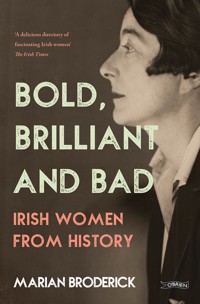
From every county in Ireland Bold, Brilliant & Bad draws together the stories of over 120 amazing Irish women. Marian Broderick is back to explore the histories of remarkable Irish Women in history. From creative craftswomen to singing sensations, poets to sporting champions. From Lilian Bland to Maeve Binchy and from Anne O'Brien to Professor Sheila Tinney, these women paved the way for the future and made massive changes in their various fields. Meet the women from history who went against the grain and challenged the expectations of the world. There were and are a force to be reckoned with.
Sie lesen das E-Book in den Legimi-Apps auf:
Seitenzahl: 267
Veröffentlichungsjahr: 2018
Das E-Book (TTS) können Sie hören im Abo „Legimi Premium” in Legimi-Apps auf:
Ähnliche

















Reviews
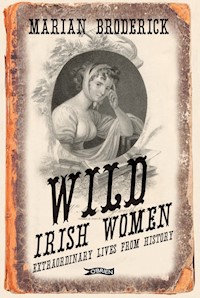
Reviews of WILD IRISH WOMEN
‘A rollicking read’Books Ireland
‘After reading this book, one can never again ignore the role of Irishwomen’Dublin Historical Record
‘Broderick’s prose is simple and accessible, and her fascination with her two favourite subjects – Irish history and women’s studies – jumps out from every page’Sunday Business Post
Dedication
To women across the world, who make their voices heard, and especially Mary Clement Harkin Broderick, the boldest of them all.
‘She is a girl and would not be afraid to walk the whole world with herself.’
Lady Augusta Gregory,
Visions and Beliefs in the West of Ireland (1920)
Acknowledgements
Thanks to all my lovely family and friends, particularly Alfredo Cristiano and Conall Broderick Cristiano, Anne Conaghan, Helen Broderick, Tim Collins, Aidan Byrne, Clare Byrne, staff at the London Irish Centre Library in Camden, Colm O’Rourke, Tony Murray, Joanne O’Brien, Sinéad McCoole, Seán Ua Súilleabháin, Tony Kearns, Treasa Harkin of ITMA, staff at the British Library, staff at the National Museum of Ireland, staff at the Royal College of Surgeons in Ireland, Francis Clarke of the National Library of Ireland, John Dunne and all the volunteers at the London Irish Centre Library in Camden Town, Katie Giles of Kingston University Archives, Jacquelyn Borgeson Zimmer and Conrad Froehlich of the Martin and Osa Johnson Safari Museum, Sarah Frandsen of the AELTC, Stephen Weir of the National Museums of Northern Ireland, Rob Gallagher of Sportsfile, Robert O’Connor and Anne O’Neill of An Post, Yvonne Davis and Brendan McGowen of Galway City Museum, Peter Beirne of Clare County Library, Irene Stevenson of The Irish Times, Audrey Drohan of UCD, Claire Ní Dhubhcháin of Cnuasach Bhéaloideas Éireann/National Folklore Collection, Legends of America, Jason Flahardy of the University of Kentucky Archives, Sam Cunnington of the Banner of Truth Trust.
Finally thanks to Michael and Ivan O’Brien and all at The O’Brien Press, particularly my hard-working editor Susan Houlden and designer Emma Byrne.
Contents
Did You Knows
Introduction
Nearly twenty years ago when I wrote Wild Irish Women, I walked into a major Irish bookshop and found that no Irish women from the past were represented on its shelves – with the honourable exception of Constance Markievicz.
Fast forward to 2016’s Easter Rising commemorations, and I found stories and image of Markievicz and her comrades everywhere, including on buses going down O’Connell Street. Fast forward again to the commemoration of female suffrage in 2018, and there were myriad websites, books, history journals and art projects devoted to giving voice to many women whom history had rendered silent. This is a truly pleasing development – long may it continue into every nook of under-researched Irish history.
In this collection, I aim to continue what I started all those years ago. There are fascinating stories out there about Irish women who are not nationally, let alone internationally, known. Yet they should be household names, tripping off the tongue of every schoolchild and pub-quizzer. First woman in the world to build and fly her own aircraft? Lilian Bland of Co Antrim. Ireland’s very own Wild West heroine? Nellie Cashman of Co Cork. Ireland’s first international singing star? Catherine Hayes of Limerick … the list goes on.
The stories in this book cover subjects from mountaineering to murder, and poetry to philanthropy. These are women in all their multiplicity of layers: political rebels who are also schoolteachers, top sportspeople who are also devoted carers, frontier-busting scientists who are also gifted musicians.
My stories about them are short and snappy; they are intended as an introduction, a tantalizing signpost on the road to finding out more about these women and the times in which they lived. At the end of each section, there is a page of Did You Knows – how many of these women had you heard about?
I have included women from every county in Ireland – and beyond. Emigration has been a cultural phenomenon all too familiar to the Irish, and it features a lot in these pages. Some of my women were second-generation Irish, born of Irish parents in slum conditions abroad. Some were born in Ireland, surrounded by luxury, and could choose whether to stay or go. Many faced the starker choice of leaving or starving, which, as we know, is no choice at all. But nearly all of them travelled and made their mark wherever they went, be it Europe, Asia, Africa or America.
Some of our women were brilliant and some were bad – but they were all bold in their way. I hope the stories avoid the neatly packaged forms of womanhood ‘allowed’ by society, and show the real women of Ireland’s history doing what they did best – living their own lives.
World Firsts …
‘I proved wrong the many people who had said that no woman could build an aeroplane.’
Lilian Bland
Lizzie on the summit of a Norwegian mountain, c.1900.
Lizzie Le Blond
1860–1934
Pioneer of mountaineering photography and film
‘For several years it did not occur to me that I could do without a maid … I owe a supreme debt of gratitude to the mountains for knocking from me the shackles of conventionality.’
Lizzie Le Blond, Day In, Day Out (1928)
Elizabeth Hawkins-Whitshed, or Lizzie as she was known, was born in Dublin, the only child in a titled, military family. She inherited her father’s estate, Killincarrick House in Greystones, on his death, when she was just eleven years old, but it was held in trust for her until she came of age at twenty-one. She seemed destined for a life of horse and hounds, leisure and laziness – but this was not at all what Lizzie had in mind.
Like all rich Victorians girls, Lizzie did not go to school but was educated at home by a governess and claimed it was ‘to my ever present regret I learned absolutely nothing’. She had a London season, as was usual for one of her social class, and was engaged by the end of it, as was the purpose. The wedding gifts included those from ‘my Irish tenantry’ as well as one from the Prince of Wales.
With her trustees’ consent but not approval, at the age of eighteen, Lizzie married the first of her three husbands, Colonel Fred Burnaby, dubbed ‘the bravest man in England’. Colonel Fred was an adventurer, a practical joker, a daredevil – and doubtless rather hard to live with. After the birth of her son, Harry, Lizzie was advised by doctors to travel abroad to a better climate for her health. ‘Travel abroad’ was often nineteenth-century code in smart circles for marital separation, and Lizzie and Colonel Fred did not live together again, though she remained on fond terms with her only child’s father, and devoted a whole chapter of her autobiography to his many exploits as a soldier.
In Switzerland in 1881, Lizzie became obsessed with mountains. One afternoon she went out with a lady friend, both of them wearing highheeled boots, and the two somehow managed to make it halfway up Mont Blanc. The experience left Lizzie dazzled. The next time she attempted Mont Blanc, she achieved the summit, and her life course was set.
Taking up climbing, even while wearing a modest, good-quality skirt, horrified relatives in high society. In her autobiography Day In, Day Out, Lizzie remembers how ‘grand-aunt Lady Bentinck sent out a frantic SOS: “Stop her climbing mountains! She is scandalizing all of London!”’
While she was exploring the Swiss Alps, Lizzie developed another selftaught passion: photography.
It was trying work setting up a camera with half-frozen hands, hiding one’s head under a focusing cloth which kept blowing away, and adjusting innumerable screws in a temperature well below freezing-point. But one learnt one’s job very thoroughly.
Lizzie published her pictures in five mountaineering books between 1883 and 1900. Thus she became the world’s first mountain photographer. From here, it was a short step to ‘animated photography’, that is, short films. Her favourite subjects included snow sports, such as tobogganing and skating.
Lizzie published her first book, The High Alps in Winter, in 1883 and was self-deprecating about ‘the crudest publication of a travel nature ever offered to a kindly public’. However, they were well received by critics.
A different sort of ‘book-making’ came in 1907 when she discovered eighteenth-century letters between her titled family and European royalty in an old bureau and decided to edit and publish them. She visited German relatives for research, took her own photos of their paintings and jewellery, and edited the manuscript in the same room in which Kaiser Wilhelm was to sign his abdication.
Colonel Fred was killed in action in Sudan in 1885. Lizzie, a fairly merry widow, did not return to any of her homes in London or Ireland but stayed in St Moritz, lavishly funded by the tenantry of her estate in Wicklow.
She took up other sports, such as skating and cycling. Overhearing a man criticising her skating ability one day, she wrote, ‘I suppose I have more than my fair share of cussedness, because as soon as that happened I applied myself and became the first woman to pass the highest St Moritz Skating Test.’
She must have had the most astonishing stamina, because she also pushed herself to the limit on cycling, describing how she ‘rode from St Moritz most of the way to Rome with my luggage on my machine, carrying my bicycle up over portions of the path along the Lake of Como …’ The advent of the motor car put a stop to this hobby, for obvious safety reasons, which she lamented.
Lizzie made a second, unfortunate marriage in 1886; this time, it was the husband, John Frederick Main, who, after only a year of marriage, went travelling and never came back. Cushioned by her wealth, it seemed to make little difference to her life; she supported him until his death, which, conveniently for her, occurred in 1892.
Her third marriage to Francis Aubrey Le Blond in 1900, when she was forty and he was thirty-one, was the one that lasted the rest of her life. Her husband admired her boundless energy. In 1907 she became foundation president of the Ladies’ Alpine Club formed to promote women’s climbing. Lizzie and Francis became attracted to Norway because of the previously unconquered mountains and eventually moved there. The two were inveterate travellers, ranging widely from Scandanavia to East Asia and everywhere in between. In 1912 they made a tour of China and Japan returning by the Trans-Siberian Railway. In 1913 it was St Petersburg and Moscow where she experienced a cash-flow problem for possibly the first time in her life: ‘The Moscow Bank excelled all others I ever entered in its incompetence,’ she wrote acidly.
Despite being Irish, Lizzie saw herself as a woman of the British Empire, as did many of her class. During World War I, she went to France to work as a hospital volunteer in Dieppe, and she raised funds for ambulances. Just after the war she travelled with her camera around what she called the ‘tortured trenches’ and raised money to restore the damaged medieval Reims Cathedral.
Lizzie’s final decade was spent involved in the post-war relationship between France and Britain, and writing her witty, name-dropping autobiography, Day In, Day Out, complete with frontispiece of her looking resplendent in tiara and feathers, and with a foreword by EF Benson of Mapp and Lucia fame.
Shortly before she died, Lizzie was awarded the Légion d’honneur in France for her efforts in getting a statue of the Allied Commander-in-Chief, Marshall Foch, erected in London’s Belgravia, where it still stands. She died in Wales after an operation, aged seventy-two, and is buried in Brompton Cemetery, London.
Lizzie, wearing full skirts, climbing in the Swiss Alps.
Lilian Bland
1878–1971
First woman in the world to design, build and fly an aircraft
‘I had proved wrong the many people who had said that no woman could build an aeroplane, and that gave me great satisfaction …’
Lilian Bland, Western Morning News (1966)
Initiative, guts and determination, Lilian had all the qualities to make a great design engineer in the early 1900s. All, that is, except one: she wasn’t born a man.
Lilian was born in Kent but came from a long line of Anglo-Irish gentry, and, when her mother died, her family moved back to their roots in Carnmoney, Co Antrim. Lilian experienced this move as liberating and she made the most of it, indulging her love of hunting, shooting, and fishing.
She was attracted to the world of photography, and became an excellent photographer, doing all her own chemical processing and fixing. She also avidly followed one of the biggest stories in the papers at the time: the progress of the Wright brothers of America and of Louis Blériot of France, who had finally managed powered, controlled flight, and patented their own aircrafts. Lilian devoured the stories and, by 1908, she had become obsessed with flying.
Lilian at the controls of Mayfly, which she designed, built and flew in 1910.
Having read everything she could lay her hands on, Lilian travelled to England to a meeting of amateur aviators. She made detailed observations of all that she saw, from the techniques of the aviators to the dimensions of their aircraft. Back in Antrim, she asked her aunt for access to her uncle’s workshop. And it was here that Lilian started to design her own flying machine.
She used local and imported timber, and recycled materials where she could. After several successful smaller models, which she flew as large kites, Lilian embarked on a full-size glider with a wingspan of over 6 m (20 ft). It was an ambitious project and Lilian had a gallows sense of humour: she named her creation Mayfly – after an insect that lives for one day only.
In early 1910, the day dawned when Lilian was ready to take Mayfly to the top of Carnmoney Hill. The idea was that thermal currents would lift the aircraft from the top of the hill and it would glide down the hillside for some distance. Wisely Lilian persuaded five men to hang off Mayfly as ballast rather than doing it herself. Mayfly’s maiden flight worked like a dream, and the men landed safely, which led Lilian to conclude that if Mayfly could bear the weight of five men, it could bear the weight of an engine.
She brought a two-stroke engine over from England and fitted it in the workshop. By the summer of 1910, after a few adjustments, the new engine-powered Mayfly was ready. This time Lilian wanted to fly it herself.
She moved this final phase of her operation to the Randalstown estate of Baron O’Neill in Co Antrim, because it had a huge field, albeit shared with his lordship’s bull. Lilian mounted and strapped herself in; an assistant was standing by. The plane’s engine roared and kangaroo-hopped across the field, stopping the hearts of Lilian’s father and other spectators. But the Mayfly did become airborne to about thirty feet (nine metres). Lilian had become the first woman in the world to design, build and fly her own aircraft.
From a commercial perspective, Lilian’s planes and gliders were not a success. She knew she needed a bigger engine, but she also knew a bigger engine would wreck the plane. Surprisingly she seems to have taken no further interest in aircraft, but she was able to maintain her interest in engines by turning to the new world of motor vehicles. In due course she worked as an agent for the motor car, the Model T by Henry Ford.
The year after her flying triumph, Lilian married her cousin Charles Loftus Bland and embarked on a completely different life. The couple settled in Quatsino, a remote area of British Columbia, Canada. Lilian gave birth to her only child, Patricia, and the family worked hard to build a life. They had little success, struggling continually with failed ventures and money troubles. Then, when Patricia was only sixteen, she died of a tetanus infection. Lilian’s marriage collapsed after the tragedy and she left Canada for good. She spent the rest of her long life in England, keeping busy with her gardening and horse-racing, and she died aged ninety-two, in Cornwall.
Today there is a park named after Lilian Bland in Glengormley, Newtownabbey, Co Antrim, featuring a full-size sculpture of her plane.
Kay McNulty
1921–2006
Co-inventor of the first general-use digital computer
‘Science and everyday life cannot and should not be separated.’
Rosalind Franklin, c.1940
From a Donegal fishing village to the heart of American wartime intelligence, the trajectory of Kay McNulty’s life journey was an unusual one.
Kathleen, known as Kay, was born in the townland of Feymore, near Creeslough, in the Donegal Gaeltacht, an Irish-speaking part of northwest Ireland. She was the daughter of stone mason and IRA officer, James McNulty. He was arrested and imprisoned for two years when Kay was just a baby. When he was released in 1924, he and his wife Anne and their six children emigrated to Pennsylvania. Kay had to learn English in America before going to school.
Kay was always a maths whizz, graduating at the top of every class throughout school. When the USA got involved in the war in 1941, Kay was still attending Chestnut Hill College for Women. She graduated with a degree in mathematics in 1942 and went straight into helping with the war effort.
She accepted a role at the University of Pennsylvania in Philadelphia, where her job was to improve the range and accuracy of American artillery by making mathematical calculations about current trajectories. Kay and her female colleagues worked on hand-operated calculators and they themselves were known as ‘computers’.
Kay McNulty, c.1942.
Wartime speeds up technology, and soon Kay was shown an enormous, brand-new, top-secret invention named ENIAC (Electronic Numerical Integrator and Computer), which had been co-created by her future husband and physicist John Mauchly. This was the world’s first electronic digital computer and, along with five other women, Kay got the job of writing the programme for it. This was before the advent of any such thing as computer science, so essentially Kay and her colleagues taught themselves how to do programming. Her programme slashed the human time of making the trajectory calculations from thirty or forty hours to up to four calculations per minute.
Kay married John Mauchly in 1948 and became stepmother to his two children, as well as going on to have five children of her own. She continued to work as a software designer for her husband’s inventions. In later life she also wrote and lectured on software engineering. Unfortunately Kay was widowed in her late fifties; she remarried but was widowed a second time in her seventies.
Kay McNulty (left) and colleagues operating an early computer, University of Pennsylvania, c.1942–1945.
Her achievements in computer science as a young woman having been forgotten, Kay started to receive recognition in later life. In 1986 the Letterkenny Institute of Technology in her home county of Donegal introduced a medal, the Kay McNulty Mauchly Antonelli medal, to be presented annually to a computer science student. She visited the college in 1999. In 1997 she and the other five women who programmed ENIAC were inducted into the Women in Technology International Hall of Fame. In 2017 Dublin City University named a computing facility after her.
Kay died in 2006 in Pennsylvania. She was eighty-five.
DID YOU KNOW?
* * *
The academic Agnes O’Farrelly (1874–1951) from Virginia, Co Cavan, was the first woman to write a series of novels in Irish. She did not speak Irish until she was an adult but, despite this late start, she went on to replace Douglas Hyde as Professor of Modern Irish at University College Dublin (UCD).
* * *
Co Galway woman Alice Perry (1885–1969) was the first female in Europe to graduate with an engineering degree. She worked as a county surveyor in Ireland, then a factory inspector in England. After losing her husband of six months in World War I, she became a Christian Scientist and moved to the USA.
* * *
In 1955, Belfast-born crooner Ruby Murray (1935–1996) was the first person to have five songs simultaneously in the Top Twenty. This record stood for more than fifty years before it was equalled in 2009 by Michael Jackson.
* * *
In 1921 Mary O’Toole (1874–1954) of Carlow became one of the world’s first female judges when she was appointed to the law court in Washington DC, USA. With tongue-in-cheek, she was quoted in The Washington Times of 27 January 1921, saying that women jurors needed breaks to powder their noses because they couldn’t ‘think straight with shiny faces’.
* * *
… And Irish Firsts
‘Being a woman is like being Irish; everyone says you’re important and nice, but you take second place all the time.’
Iris Murdoch
Dr Emily Winifred Dickson
1866–1944
First woman Fellow of the Royal College of Surgeons in Ireland (FRCSI)
‘An epidemic … of Lady Medicals has broken out in a certain hospital in town.’
St Stephen’s: A Record of University Life (1903)
reporting on Richmond Hospital, Dublin, employing three women
Emily Winifred Dickson must have lost count of the times she collided with gender discrimination in an effort simply to do a job she loved and for which she was well suited.
She was born the second-youngest of seven children in Dungannon, Co Tyrone. Emily’s father became a Liberal MP when she was eight, by which time her mother was an invalid. Emily went to boarding school in Belfast and London, and took over her mother’s nursing care after leaving school. Her application to go to Trinity College was vetoed by the theological faculty, which didn’t want to accept women.
In 1887 Emily applied and was accepted to the Royal College of Surgeons in Ireland (RCSI), where she was the only woman student on the roll. By 1891 she had obtained her first-class certificate from here and her licence from the Royal College of Physicians of Ireland (RCPI). She trained in midwifery at Dublin’s Rotunda Hospital. In the 1890s, it wasn’t easy; medicine was a job for the well off because medical students had to gain clinical experience at their own cost – for example, paying Dublin hospitals, such as Sir Patrick Dun’s, to take them on ward visits.
Dr Emily Winifred Dickson on graduation day, 1891.
In 1893 Emily graduated from the Royal University of Ireland and in the same year she was elected a Fellow of the Royal College of Surgeons in Ireland (FRCSI). She was the first woman in Ireland or Britain to achieve this; it was not until 1920 that London appointed a female FRCS.
Emily decided to continue specialising in midwifery and gynaecology – not, one might think a particularly controversial choice for a woman. But when she was awarded a six-month travelling scholarship to continue training in Berlin, she came up against male disapproval and was barred from doing ward rounds with other doctors because she was a woman.
After completing her scholarship, Emily returned to Dublin and set up her practice at 18 Upper Merrion St. Again, she collided with authority when she was refused a licence to practise at the Rotunda on the basis of her gender. However she managed to find employment in other hospitals, including the Coombe.
Through these years Emily not only lectured and published papers on gynaecology, but organised a committee to help women students with accommodation in Dublin. She completed two post-graduate degrees in medicine and obstetrics, becoming a Doctor of Medicine and Master of Obstetrics at the Royal University of Ireland in 1896. Despite this, when she was made an examiner, there was a petition by outraged male students intent on preventing a woman from examining them. The petition failed.
‘Woman,’ she wrote, ‘should not give up the medical profession for the profession of marriage unless she likes the latter profession better.’ Yet Emily did just that. When, aged thirty-three, she married Robert McGregor Martin, she gave up medicine for fifteen years. Emily’s marriage produced five children.
After World War I broke out and Emily’s husband joined up, Emily regarded a return to medicine as her patriotic duty, and unusually, used her maiden name professionally.
With all the children except the youngest at boarding schools, she moved to England. She worked mainly in Lancashire in much less senior roles than she’d had in Ireland.
After the war, life became more difficult for Emily. Her husband returned with severe shellshock. This led Emily to become involved in psychiatry, an area that interested her for the rest of her life. Emily nursed her husband but herself fell victim to the Spanish Influenza epidemic, which swept the world in 1918–19, and is estimated to have killed 25 million people – more people than died during four years of war. Her health never fully recovered. She developed the painful and crippling disease of rheumatoid arthritis, and her ability to work was affected.
Emily spent the inter-war period travelling and working when she could. She returned to Lancashire during World War II, and was still active in psychiatry when she died of cancer, aged seventy-seven years old.
In 2012, papers belonging to Dr Dickson were donated to RCSI by her grandson, Dr Niall Martin. These papers included certificates, testimonials, medals, correspondence and photographs dating from the 1880s–1920s. The papers are now catalogued in the RCSI Library.
In 2016 the RCSI created an award in Emily’s honour. Today the Emily Winifred Dickson award is given to women who have made an outstanding contribution in their field.
Beatrice Hill-Lowe
1868–1951
First Irishwoman to win an Olympic medal
‘The most important thing in the Olympic Games is not winning but taking part; the essential thing in life is not conquering but fighting well.’
Pierre de Coubertin, founder of the modern Olympics
It was a sweltering July day in the White City Stadium, London, and the 1908 Olympic medal ceremony for Women’s Archery was underway. Gold went to Britain, silver went to Britain, and bronze went to Britain – but the recipient of the bronze medal was, in fact, an Irishwoman, forty-year-old Beatrice Hill-Lowe from Ardee, Co Louth, and this historic moment marked the first but not the last time an Irishwoman was to win an Olympic medal.
Beatrice Ruxton was born one of eight children in a substantial mansion named Ardee House on New Year’s Day 1868. Her family had been Anglo-Irish Ascendency since the 1600s and her father was a representative of the Crown in the county. Beatrice grew up in a world firmly entrenched in all the privilege of centuries. She was married in 1891, at the age of twenty-three, to a Commander Hill-Lowe of the Royal Navy, another pillar of the establishment, and considerably older than his wife. They had no children.
Beatrice Hill-Lowe.
Archery was one of the very few sports considered suitable for a woman: it didn’t involve running or other tomboyish movement, it was graceful, and it was played while fully clothed. It was also a well-to-do sport, requiring as it did expensive equipment and a piece of private land to practise on. It is not known how Beatrice took it up but, as a rich young woman, she certainly would already have been able to ride, and probably played tennis and croquet. In fact these sports, along with golf and sailing, had been open to women since the Paris Olympics in 1900. Archery was opened to women participants only in 1904.
Beatrice Hill-Lowe’s Olympic bronze.




