


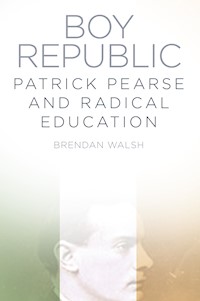
18,49 €
Mehr erfahren.
- Herausgeber: THP Ireland
- Kategorie: Sachliteratur, Reportagen, Biografien
- Sprache: Englisch
Patrick Pearse, teacher, poet, and one of the executed leaders of the 1916 Rising has long been a central figure in Irish history. The book provides a radically new interpretation of Patrick Pearse's work in education, and examines how his work as a teacher became a potent political device in pre-independent Ireland. The book provides a complete account of Pearse's educational work at St. Enda's school, Dublin where a number of insurgents such as William Pearse, Thomas McDonagh and Con Colbert taught. The author draws upon the recollections of past-pupils, employees, descendants of those who worked with Pearse, founders of schools inspired by his work - including the descendants of Thomas McSweeny and Louis Gavan Duffy – and a vast array or primary source material to provide a comprehensive account of life at St. Enda's and the place of education within the 'Irish-Ireland' movement and the struggle for independence.
Das E-Book können Sie in Legimi-Apps oder einer beliebigen App lesen, die das folgende Format unterstützen:
Veröffentlichungsjahr: 2013
Ähnliche

















Contents
Title
Foreword by Declan Kiberd
Introduction
One
Who was Patrick Pearse?
Two
The Evolution of Schooling in Ireland
Three
The Tongue of the Gael
Four
Emmet’s Ghost: The Boy Republic of St Edna’s
Five
The Murder Machine: Schooling as Resistance
Six
Why Pearse Matters
Bibliography
Plates
Copyright
Foreword by Declan Kiberd
Brendan Walsh has given us an open, honest and persuasive portrait of Patrick Pearse as teacher, headmaster and educational theorist.
Pearse left few notes on the preparation of his classes, yet the colonial authorities, whose pedagogic ‘murder machine’ he denounced, pronounced him a fine and effectual teacher. He believed in a child-centred approach and hated the idea of a rigid curriculum imposed on student and teacher alike by the system known as public examinations. He repeatedly argued that teachers and schools should not be assessed and rewarded according to results achieved in these tests. Yet, for all that, he was pragmatic enough to permit boys from his own college, St Enda’s, to take the Intermediate Examination if their parents wished it.
In this book, Walsh demonstrates that administrations in the later nineteenth century took a more child-centred approach than either Pearse or posterity has given them credit for. If that makes some of Pearse’s ideas a little less original than they might have seemed, it also shows that they had their practical, up-to-date side. He believed in teaching business methods as well as science, reflecting the widespread Victorian and Edwardian desire to give students useful skills, but he also insisted that school should be a free zone, a utopian space in which people could be freed of the constraints of the material world.
I had long thought that Pearse was a disciple of Maria Montessori but Walsh has located just one reference, mildly laudatory, in his writings which go on to question her notion of the teacher as servant rather than master. Convinced of the charism which touches all great teachers, he felt that they were entrusted with a priest-like office. Whereas Montessori believed that the teacher should stand back to centralise the activities of free-bonding children, Pearse felt that the true educator brings ‘not a set of ready-made opinions but an inspiration and an example’. This was both his strength and his weakness for, placing such a premium on emotion, Pearse has left a much less developed set of educational theories than did Montessori or Pestalozzi or Froebel.
Walsh demonstrates that he was a consummate liberal, even a libertarian. He saw St Enda’s not just as an answer to Anglicised public schools in which those Gaelic elements, spurned by colonial thinkers might be centralised, but also as a democratic zone in which future citizens could learn the art of self-government. So he devolved a remarkable number of decisions about the running of St Enda’s to a School Council administered by the boys themselves – St Enda’s really was a republic of childhood. We read here that in 1913, when a senior boy named James Rowan proposed that cricket be adopted as a summer sport, there was a spirited debate. Rowan’s nationalist credentials were not in doubt, as he had just published a lament for the slaughtered rebels of 1798 in the school magazine, An Scolaire. However, another boy, D.P. O’Connor, opposed what he called ‘this pernicious proposal’. During the prolonged controversy, tennis was suggested as a possible compromise before the majority finally voted for hurling. It is an interesting moment – one can hardly imagine the boys of Clongowes Wood or Blackrock College in 1913 being encouraged to debate a similar proposition to replace, say, rugby with hurling.
Far from being a recruiting camp for physical-force nationalism, St Enda’s emerges in the following pages as an early version of such alternative, democratic schools as Summerhill, Dartington Hall or Beacon Hill. As few as twelve past pupils took part in the Easter Rising. Four of these were sworn-in members of the Irish Republican Brotherhood well before Pearse himself had joined, which suggests that they were more likely influenced by family tradition or some other factor. The appeal of St Enda’s reached well beyond nationalist insurgents – Jim Larkin sent his son there, as did Eoin MacNeill. The list of monthly guest-speakers in the college is a roll-call of the Irish revival – Yeats, Hyde, Casement, Markievicz, and Gonne to name but a few. Its teachers included the witty and gifted Thomas MacDonagh, who became a lecturer at University College Dublin. If Cúchulainn was, in the words of Desmond Ryan, ‘An important if invisible member of staff’, he was there not just as Celtic warrior but as English public schoolboy in drag; one whose example appealed to a combination of athleticism and aestheticism, of muscular Christian self-sacrifice, such as would have been espoused at Thomas Arnold’s Rugby. Pearse and MacDonagh might have opposed colonial theory but they were genuine admirers of the English tradition of lyric poetry, from Thomas Campion to William Wordsworth.
In a period when corporal punishment was still widely used – and would be for another fifty years – Pearse saw little need for it. Accepting that boys, if trusted, would tell the truth, he adopted the Fiannaiocht code of ‘glaineinargcroi, neartinarlamh, is beart de reirarmbriathar’, and it generally worked – so much for the fang-toothed martinet of revisionist lore.
In the end, says Brendan Walsh, there was nothing really new in Pearse’s pedagogy. What was new was his placement of the child-centred tradition within a culture of schooling that was dissenting. Pearse saw education in much the same way as Joyce saw the English language – as a weapon of empire which might nonetheless be captured, remodelled and turned back upon its authors by a dissident intellectual. Brendan Walsh has in this book done full justice to Pearse’s ideas and to his practice, and by admitting the limitations of both he has redoubled our sense of the importance of what Pearse achieved.
Declan Kiberd, Dublin
January 2013
Introduction
This book is about Patrick Pearse’s work as the founder of two schools, the work he did as a headmaster and teacher, and how he foreshadowed modern ideas about the use of schools for ideological ends – how learning should happen in them and why what happens in the classroom is politically important. For many it will come as a surprise to learn that Pearse dedicated his adult life to education, and to some it will appear far less interesting than the glamour of his final few years as member of the Irish Republican Brotherhood and executed rebel. However, the two cannot be separated and this book demonstrates that Pearse’s work at St Enda’s and St Ita’s was deeply political in nature. Pedagogically it was forward-looking but not innovative, rather that its importance lay in the creation of a model of schooling that was a direct challenge to the type prevailing at the time: intensely competitive and examination driven, the content of which was very much influenced by English culture. The extent to which Dublin was an ‘English city’ in early twentieth-century Ireland is easily forgotten (see Chapter Five). C.S. Andrews recalled in 1979 that, before he was enrolled as a pupil at St Enda’s, he had ‘never heard of Fionn or Cúchulainn’, something which would strike any Irish schoolchild today as extraordinary.
It was this omission that Pearse sought to address, in a way that was as emphatic as it was dismissive. Writing in 1906 he stated the case simply: the British had no right to interfere in schooling in Ireland because they were British, not Irish. They were, therefore, ‘no more entitled to dictate what should be taught to children in Connemara than they were to dictate what should be taught to children in Yokohama’ (see Chapter Three).
Pearse’s dedication to Irish nationalism is well know and widely documented. But much less is known about his educational work, which represents a gap in our historical knowledge. By his own admission, Pearse dedicated his adult life to schooling, but until now no book has appeared that deals exclusively with that work. Given that 104 years have elapsed since he founded St Enda’s, the silence is remarkable. In the Dublin of the early twentieth century Pearse was known as a headmaster, and this is how W.B. Yeats defined him for all time – the man who ‘kept a school’ – and this is how Pearse would like to have been remembered. He wrote in The Murder Machine that he had ‘dedicated the greater part of [his] life’ to education (see Chapter Five), and this book reveals how many of his friends and associates remembered him, primarily, as a teacher.
The lives of teachers is seldom the subject of history, although a growing body of international and American work has started to preserve the narratives of school teachers, finding in them stories that intersect with feminist and labour histories in particular. In the case of Pearse and St Enda’s, this is particularly so. Four staff members were executed for their part in the Easter Rising, others were imprisoned. Frank Burke, its last headmaster, was in Croke Park on Bloody Sunday, when the Black and Tans shot fourteen civilians during an inter-county football match. The great luminaries of Irish Ireland visited the school, addressed the pupils, helped fund it and sent their children to be educated there. For a brief period it was the brightest and most lauded adventure of the cultural nationalist movement and, as we see in Chapter Six, it spawned a number of imitators. Like any school it had good and bad teachers, pupils who liked and disliked it, its everyday routine was humdrum in the way schooldays usually are but, in several fundamental ways, it was very different. St Enda’s was to be a training ground for boys, not in republican militancy as so often thought (see Chapter Four), but in democratic nationalism. It was, as such, an experiment, and like so many similar experiments it ultimately failed and closed in 1935. Yet, as this book demonstrates, what Pearse achieved there predated, by many decades, the work of better-known radical educationalists whose theories now inform much of the western world’s educational practice. This book seeks to address this omission and in doing so to accord to Pearse the place he deserves as one of Ireland’s foremost radical educational thinkers. It was Pearse who first articulated the now widely understood use of schooling as a colonial tool and he was among the very first, in turn, to use education as a means of undermining that colonial dominance.
Brendan Walsh, Dublin City University
January 2013
One
Who was Patrick Pearse?
AT HOME AND AT SCHOOL
Patrick Pearse was the first son of James Pearse (1839–1900) and Margaret Brady (1887–1932). They had four children, Margaret (1878–1968), Patrick (1879–1916), William (1881–1916), and Mary Brigid (1884–1947). Patrick Pearse began attending Westland Row Christian Brothers School in 1891, and between 1893 and 1896 sat four Intermediate Examinations. He enjoyed school and remembered that he ‘learned quickly’ having ‘no recollection of any effort.’1 According to his mother he was ‘exceedingly fond of study’, and upon leaving school his ‘whole ambition was to teach boys.’2 Mary Brigid remembered him as ‘exceedingly studious’ and, even in his teens, possessing ‘every attribute of the perfect teacher’3, while Eamonn O’Neill, who attended Westland Row along with Pearse, remembered him as a ‘great reader.’4
He was influenced by the political radicalism of his father, James, who held strong non-conformist sympathies. James’s small library reflected liberal and independent-minded views and included essays of radical thinkers and colonial history.5 The adolescent Pearse was an avid reader and undoubtedly took an interest in his father’s books. Pearse’s grandfather had been politically liberal and his mother, Margaret, was a Unitarian.6 Radicalism and free-thinking, therefore, were characteristic of Pearse’s paternal lineage, while his mother’s ancestry was characterised by a spirit of separatist nationalism.
Much of what we know about Pearse’s youth comes from an unfinished autobiographical sketch and the memories of his family, in Mary Brigid’s The Home Life of Pádraig Pearse, published in 1934. To a contemporary reader, these recollections bear the stamp of an adoring family and are little more than hagiography, written at a time when the public was willing to accept such memories at face value. For the historian they are useful, but must be approached with the usual critical stance necessary when reading biography. This is even more important when the authors are family and the subject a national hero, executed for his part in his country’s fight for freedom. The cautions of historical methodologies aside, we cannot expect a critical, detached account of Pearse from his sister and mother. We certainly cannot expect it in the Ireland of 1934, when the fallen leaders of the 1916 Easter Rising were held in almost religious awe and former insurgents filled the front and back benches of Dáil Eireann. Mary Brigid’s book, and its contributors, pre-date the post-modern uncertainties of our times and it is unfair to look to it for anything beyond what it supplies; an affectionate, uncritical account of some aspects of Pearse’s life. Yet, the book contains accounts by those who knew Pearse well and cannot, therefore, be ignored by those wishing to write about its subject.
Indeed, the home life of Pearse throws much light on his adult personality. His sculptor father evidently associated with artists, some of whom made nude drawings of the young Pearse. On these occasions he would lie ‘without [his] clothes in the warmth of the fire’, composing stories for himself: ‘Some of the longest stories I ever made up … where made up while a man was making a picture of me stretched on my face with my chin resting on my hands.’7 This was not uncharacteristic of the late Victorian and Edwardian view of pre-pubescent children as being unsullied and symbolic of an unworldly purity.8 The artistic, but not bohemian, influence of Pearse’s father was countered by his mother, whose great-grandfather had fought in the 1798 Rebellion and whose brother was hanged for treason. His great-aunt Margaret would tell him stories of Robert Emmet and Wolfe Tome and ‘had herself known the Fenians’.9 Undoubtedly, this old woman had a profound influence upon the young Pearse and he prized her tales of the Fianna and patriots above all others. But Pearse’s convert father was a nationalist in the tradition of Parnell, fair-minded and reasonable; what Edwards called ‘the best kind of decent Englishman’.10 He was a stolid Edwardian, devoting his energies to a successful monumental carving business, with modest investments in shares and an interest in liberal thought. In this last aspect he was the opposite of his wife, and it was her influence that dominated Pearse’s youth. James died when Patrick was twenty-one, and throughout his extensive writings there is barely a mention of him, although the theme of motherhood appears repeatedly.
Pearse believed that the combination of the ‘widely remote traditions’ of his parents made him the ‘strange thing I am’. Only on one other occasion does he make reference to the complexity of his personality.11 Indeed, what is most striking when one begins to write about Pearse is how different he was from the very earnest figure of the popular imagination. His family, for example, repeatedly refer to his sense of humour and largeness of personality. Although the historian treats these recollections with caution, others too remembered him as cheerful and genial, albeit occasionally withdrawn and introspective. As a child he was possessed with a vivid imagination and would fill his days playing at being a Shakespearian hero, military general or priest. Willie and Brigid enjoyed his antics and Edwards’ claim that ‘to a child as romantic as Patrick, family life must have been suffocatingly dull …’ is simply not supported by family recollections and certainly never hinted at by Pearse.12 Mary Bulfin attended St Ita’s and recalled that one afternoon Pearse regaled the girls with stories about his own schooldays, and while he himself did not laugh aloud he had ‘a queer little secret smile that made one feel he was having a great chuckle away down inside in himself.’13
His mother and sister Brigid remember him bustling about the house, late for appointments, his reluctance to get out of bed in the morning, his brief flirtation with vegetarianism and his passion for opera. According to Brigid, in later years he attended ‘every opera that came to Dublin, Wagner’s heavy works being his particular favourites.’14 He was energetic, playful and somewhat pompous, but outside of the family could be shy and serious. Eamonn O’Neill, who was at school with Pearse, described him as ‘extremely reserved at school’, and although Patrick’s cousin Alfred McGloughlin described him as unathletic, he joined both the school boxing and football teams. He was also prominent in the school debating society – an aspect of school life he encouraged at St Enda’s. Pearse worked hard at school and quickly gained a reputation as a fine orator and, according to O’Neill, his peers ‘liked and respected him’.15 He was, in short, a diligent, earnest and perhaps over-serious schoolboy. He appears to have been self-conscious but, at the age of sixteen, to have quickly developed a confident grasp of public speaking, when he and others formed the New Ireland Literary Society – a forum for discussing aspects of Irish literature. Unlike others who write of their schooldays, Pearse fails to mention friends and one is left with the impression that his maintained a certain distance from his peers and revealed his true self at home, rather than socially. Certainly, his brother Willie was his closest confidant and friend throughout his life.
As a young man, Pearse was a cultural nationalist. Irish historian Mary Hayden remembers that, when she first knew him, he had little interest in politics, and despite the attempts of later generations to associate him with a particular and narrow type of Catholicism, she remarks that he ‘seldom spoke’ of religion. Indeed, regarding schooling, Pearse was frequently critical of the Catholic hierarchy, religious-run schools, and the Christian Brothers in particular. In an Ireland where Religious Orders had a monopoly over secondary schooling, Pearse’s school was managed and operated by lay persons.
Upon leaving secondary school, Pearse acted as a monitor – a type of junior assistant teacher – at Westland Row Christian Brothers’ School. Perhaps it was this experience as a monitor that helped form his earliest thoughts on the individualistic and competitive secondary school system. Westland Row was made up of middle-and working-class boys. Pearse’s father’s occupation as a monumental sculptor meant that he was ‘trade’, but being self-employed and an artisan he belonged to the lower middle-class. The Christian Brothers were renowned for no-nonsense, examination-driven teaching and their schools often provided a direct route into white-collar employment; the Civil Service in particular. Since the mid-nineteenth century their schools have been held in high esteem and while Pearse set out to create a distinctly middle-class school in Rathfarnham, Brothers schools throughout Ireland catered for those less fortunate than the St Enda’s boys. Nonetheless, for the young, sensitive bibliophile, the cramming and competition must have been anathema and, given his later criticism of the Brothers’ methods, must have earned his silent disapproval. The regime in Westland Row, as in other secondary schools, was one of grinding preparation for the Intermediate Examinations. The final examination was a high-stake affair; schools published their successes in the daily newspapers and vied with one another in the hope of attracting enrolments. Prior to the Intermediate Education Act 1878, schools did not benefit from direct funding (see Chapter Two). In order to sidestep the unpalatable prospect of funding denominational schools in Ireland, the Act allowed schools to secure funding through the awarding of cash prizes for examination success. As a result, the Intermediate Examination – the ancestor of the present high-stake Leaving Certificate – became an annual ordeal for schools and a spectator sport for the public. When first held, in the summer of 1879 – the year of Pearse’s birth – TheIrish Times described the contest as an ‘intellectual tilt and tournament’, with 5,000 pupils entering ‘the lists’.16 It was this element of competition, the hot-housing of individuals that many schools, particularly the Christian Brothers’, excelled at. But the schools cannot be blamed. They were the victims of a terminal examination system in which the public had ‘an almost superstitious reverence’ and which parents understood as the best chance of securing a fighting chance for their children in the labour market.17 This was the system that Pearse baulked at, but at which, as a pupil, he was highly successful.
While in no way exceptional, he operated well within the system and gained the required marks to allow him to enter the Royal University of Ireland two years later.18 He studied English, French and Celtic (Irish) and was considered an excellent student.19 Eamonn O’Neill who also attended Westland Row remembered him as ‘a grave, sweet, silent boy’, who never joined in ‘the ordinary games at playtime’ but ‘often climbed up on the high window-ledge of the schoolroom and sat there reading.’20 Edwards makes the point that, at Westland Row, he would not have developed any ability to read critically; the requirements of the intermediate rendering any such luxury superfluous. But one suspects that Pearse’s romantic imagination also prevented much analysis. During his mid and late teens he read, almost exclusively, Irish myths and legends – printed versions of what his great-aunt Margaret had told him in childhood. On winning a book-prize at the Senior Grade Intermediate in 1896 he chose Thomas Flannery’s For the Tongue of the Gael, a book of essays on contemporaneous Irish writing – a choice that would appear to undermine the view that he was disinterested in critical aspects of Irish literature. However, his later writings indicate that he was unaware of the analytical work being done by scholars, such as Kuno Meyer, for example. Edwards is correct when she notes that as Pearse grew older, he read the tales with a ‘childish wonder’ that would have ‘shaken the sophisticated and subtle Douglas Hyde’.21
The grinding contestation Pearse endured at school was shared by thousands of boys and girls, but few founded a school that offered a strident alternative. As we shall see later, Pearse set out to establish a school that would challenge the entire Intermediate System. This was Pearse’s way; he was a man of action. Not content as a teenager with the lack of highbrow literary discussion in Dublin he was a founder member of the New Ireland Literary Society. Edwards calls the title and the circular announcing its establishment ‘pretentious’ – a forgivable trait in earnest young literary men.22 The sixteen-year-old Pearse, president of the society, demonstrated an ignorance of European and contemporary Irish literature that was not uncharacteristic of most boys of his age. Drilled in the intermediate texts he had little capacity for discernment, and his addresses were not unlike those that appeared as essays in school annuals of the period: enthusiastic rather than insightful. But this is not to underestimate his commitment to starting something new. Regardless of its juvenile nature, the society was, at least, an attempt to address what Pearse considered the absence of literary and debating societies in Dublin. This spirit manifested itself again in a wholly different and less conventional matter two years later, when, aged eighteen, he publicly noted the ‘poor support’ which the Irish clergy had extended to the Irish language revival.
The schoolboy Pearse was, then, hardworking, earnest, reserved, successful in examinations and an avid, if unadventurous, reader. His success at school is demonstrated in the Brothers asking him to act as a monitor at Westland Row upon leaving school. Although, given Pearse’s dislike of their method and later trenchant criticisms of the Intermediate Examination, one wonders at their doing so. He must, as a teenager, have given the impression that were he to become a teacher, he would fit the mould perfectly. At home, Pearse was outgoing, fun-loving and busy. It would be tempting to conclude that this indicated a type of split personality but what it in fact reflects is that Pearse was, in all respects, a not untypical, socially shy teenage boy; a fact he attested to himself in later life. After his father’s death he became responsible for the family and there is no doubt that the affection of his family had prepared him for this transition. But Pearse’s schooling tells us nothing about him other than the rather uninteresting fact that he was, in all respects, a rather ordinary schoolboy.
However, Pearse was an extraordinary adult and the object of this book is to tell the story of his adult life in teaching rather than to provide a general biography. He was, first and foremost, a teacher and a school principal. Pearse did not join the Irish Republican Brotherhood (IRB) until 1914, but since 1908 he had operated St Enda’s School. It is not surprising, but it is a scholarly injustice, that a full-scale study of his educational work has not previously appeared. However, historians have written about aspects of this work and before we consider Pearse and St Enda’s in detail, we will look at these valuable contributions and what they add to our knowledge of Patrick Pearse.
READING ABOUT PEARSE
Traditionally, Pearse’s educational work has been regarded as forward-looking and enlightened, given the period in which he worked as a teacher. However, the view that he was ‘at his peak as a theoretical educationalist’ cannot be simply taken for granted.23 Again, given his trenchant criticism of schooling in Ireland under British rule, his work must be examined within the context of education at the period, which, it turns out, was far less restrictive than Pearse claimed. Pearse was also less than generous in recognising innovations in the school curriculum that closely resembled those he weekly advocated in the pages of An Claimeadh Soluis – the journal of the Gaelic League.
Again, Pearse’s criticisms cannot be properly understood without reference to primary and intermediate schooling in the late nineteenth and early twentieth centuries and the contemporary reports of school inspectors, along with official and commissioned reports, provide a wonderfully detailed context against which his criticisms can be understood and examined. Pearse’s work on the teaching of Irish is much neglected but gave rise to the development of sensible teaching approaches, which reveal a firm grasp of sound methodology. His emphasis upon the language as a spoken medium in many ways foreshadows modern understandings of language acquisition and this book details his work on behalf of the language in schools and as a compulsory subject for matriculation to the National University of Ireland.
Our main focus, however, is Pearse’s work at St Enda’s and St Ita’s, although little is known about the latter. Gertrude Bloomer, who acted as headmistress at the school, did not keep thorough records and the school’s short existence means that first-hand accounts are rare. However, a strong relationship existed between the staff and pupils of both schools, helping to disperse the myth of Pearse’s shyness in the company of women and shed light upon his understanding of the nature and purpose of schooling.24 Yet this understanding, while often progressive, was motivated by political rather than pedagogical concerns, and within it nestle ambiguities. For example, St Enda’s was similar to the model of English boarding schools typified by Rugby in England, or Clongowes Wood and Castleknock College in Ireland. Indeed, Pearse consciously imitated these to promote St Enda’s and simply inverted, or substituted, the ethos to create a ‘gaelic’ school. This is fairly typical of school founders, but the dissenting nature of Pearse’s work is not immediately apparent until examined within the broader field of educational history. In other words, Pearse set out to undo the system of the time and replace it with a new model of schooling – quite a radical project. His intention was to create a school that would be stridently defiant of the type operating at the time and to offer an alternative, modelled upon an eclectic mix of Irish Ireland/Gaelic League aspirations; the notion of fosterage; elements of the public school ethos; and influenced by the heroic models of Cúchulainn and Robert Emmet. In short, a very personal, if not idiosyncratic, project but absolutely typical of school founders whose undertakings are informed by strongly held beliefs. Pearse’s work was complex; while harking back to the past it was also modern and radical and it is not surprising that it finds echoes in the work of founders, such as Rabindranath Tagore (1861–1941) and Bertrand Russell (1872–1970), and in the work of radical theorists, such as Paulo Freire (1921–1997) and Henry Giroux (b. 1943).25
In viewing Pearse’s educational work as a precursor to the more intensely felt enthusiasm of political activism, rather than a meaningful, separate and inherently important undertaking, historians have done him a great disservice. A copious body of educational writing, coupled with Pearse’s role as headmaster and schoolteacher for eight years, deserves exclusive attention. He considered himself a teacher before all else, describing its rewards as ‘richer than ever rewarded to any voyagers among treasure-islands in tropic seas.’26 Eavan Boland’s observation that Pearse’s educational achievements had, by 1966, become the casualty of the ‘well-bred distaste’, with which the efforts of his generation were viewed fifty years after the insurrection, remains uncomfortably true.27 Before the 1966 anniversary of the Easter Rising commentators were almost always enthusiastic about Pearse. He had become an iconic and untouchable figure, representing Catholic nationalist Ireland. In that year, Eamonn De Valera accepted the keys of St Enda’s School from Margaret Pearse on behalf of the Irish state. Yet it is difficult to imagine a time when Pearse did not provoke controversy. Damned by some as reactionary and elitist, he is praised by others as being in possession of a deeply democratic and egalitarian instinct. For modern sensibilities he is a profoundly ambiguous figure, the intensity of his sombre personality, celibacy and commitment to the notion of sacrifice are strikingly at odds with the timbre of contemporary life. Pearse haunts modern Ireland’s image of itself – his portrait hangs in the office of the An Taoiseach – yet, as a society, we are not sure if we subscribe to the values his generation represent. In particular, we are troubled by the thought that, somehow, the later purveyors of republican violence could, seemingly, justify their actions by reference to him. That he provided the intellectual template for later republican atrocities has proven the single most pressing concern in studies of Pearse and has resulted in an almost total disregard for his educational work.
The way in which Pearse was popularly perceived underwent a significant change in the years following the fiftieth anniversary of the Easter Rising. To some extent this has been the result of the so–called revisionist school of historical enquiry, which not only challenged traditional narratives in Irish history but also led to simplified and iconoclastic representations of Pearse. Hence, for those of us who first encountered him after the 1970s, he was parochial, reactionary, motivated by a desire to die young, and the principle apologist for the atrocities occurring on an almost daily basis in Northern Ireland – obviously a very significant sea-change had taken place in how Pearse was understood.
This change began in earnest in 1972, with the publication of Father Francis Shaw’s essay ‘The Canon of Irish History – A Challenge’. The article expressed misgivings concerning Pearse’s use of Catholic vocabulary and imagery to espouse militant nationalism.28 Shaw argued that Pearse and other insurgents had misappropriated the vocabulary of sacrifice and applied it to the realm of political action. In effect, it could be argued (although Shaw does not make the connection) that Pearse had identified a relationship between the vocabulary of theology and the political resistance and liberation in a manner that was becoming increasingly popular among Latin American theologians in the 1970s. Shaw raised important questions about Pearse’s legacy and his essay was important because it forced a reappraisal of Pearse at a time when sectarian tensions festered in Northern Ireland, while challenging the benign figure of Pearse that had been become an accepted part of Ireland’s culture. Shaw’s essay therefore prompted historians to look more sceptically at Pearse and his age.
Pearse lived at a time of considerable social and political change. Many of Pearse’s generation committed themselves to radical political and cultural activism. The period witnessed the initial growth of Irish trade unionism, the founding of the National University of Ireland, the language revival and the development of an increasingly politicised articulate and radical middle-class, many of whom took part in the Easter Rising. Pearse was ambitious and committed. His complex personality has led commentators to analyse his relationships closely. An essay by Joe Nugent in 1996 attempted to explain the apparent complexity in terms of an Oedipean complex, in which Pearse’s life was informed by an attempt to prize apart his mother (Irishness) and his father (Englishness).29 Nugent suggests that this conflict later manifested itself in his involvement in the Rising, representing the attack upon the father figure as epitomised by England. This interesting proposition undervalues the influence of the Gaelic Revival, interest in the Irish language, Pearse’s political beliefs and the wider cultural milieu in which he operated. Indeed, it has become commonplace for commentators to ignore or be unaware of Pearse’s own profound insight into this marriage of nationalities, leading him to ponder whether it was this mixture that made him the ‘strange thing’ he became in adult life30.
It is worth noting that those who worked closely with Pearse did not consider him a complicated personality. Usually, their recollections are very positive and most praise his vision and commitment. Desmond Ryan, who attended St Enda’s as a boy and later taught there, described the school as ‘the soundest and most determined attempt to reform Irish education.’31 Certainly, the accounts of Pearse’s educational work written between 1916 and the 1970s tend to lack critical distance, and one is left with the impression that it is the man, rather than the work, that is being praised. And it is for this reason that his work at St Enda’s has so often been overlooked and taken for granted. It has been assumed that St Enda’s was noble and in some way provided a model for schooling in post-independent Ireland. As late as 1973, for example, commentators were writing blithely of St Enda’s as a ‘startling success’, despite its debts and dramatically falling enrolments from 1914 onward.32
While significant works on Pearse have appeared, none claim to present a critique of his educational work.33 Usually St Enda’s is not presented as significant. The claim, by Ruth Dudley Edwards, for example, that St Enda’s was simply another of Pearse’s enthusiasms is unjustified given his personal and financial commitment to the project. The supposed problematic issue of Pearse’s political influence upon his pupils is touched upon by Edwards who describes him as sitting, ‘Every night on the bed of one or another of the boarders, chatting to him and getting to know him as an individual whose mind he might influence.’34 However, there is no record of such a custom or instance. Indeed, Pearse was usually a sombre character, lively when among his pupils but otherwise reserved. He was aware of this and on at least one occasion makes reference to it.35 The contention that he failed ‘through his arrogance’ to maintain St Enda’s is contradicted by Ryan, whom Edwards describes as Pearse’s ‘best biographer’.36 Yet Edwards’s biography provided the first incisive and critical portrait of Pearse, and remains the essential reading for those interested in the subject.
But Edwards is not alone in underestimating Pearse’s commitment to his schools. In Patrick Pearse and the Politics of Redemption (1994), Seán Farrell Moran argues that in opening St Enda’s Pearse was indulging in escapism – Moran’s valuable study almost completely ignores Pearse’s educational work. This is regrettable because Pearse’s financial investment in St Enda’s brought him to the edge of personal bankruptcy and swallowed up his share of his late father’s business.37 It was not, in other words, a work of escapism.
Séamas O’Buachalla’s Letters of P.H. Pearse (1980)38 is an important collection and provides information of Pearse’s correspondents, although the author concedes the incomplete nature of the collection – some thirty letters are absent.39 These have not been previously employed by scholars and had not become available when O’Buachalla published Letters.40 Finally, O’Buachalla’s An Piarsach Sa Bheilg (P.H. Pearse in Belgium/P.H. Pearse in Belgie) (1998) provides a trilingual collection of the articles written by Pearse that appeared in An Claidheamh Soluis, under the title ‘Belgium and its Schools’, between 1905 and 1907. The editor provides an introduction to the articles, placing them in the context of Pearse’s developing interest in bilingualism.41 O’Buachalla’s collections remain significant points of departure for those interested in Pearse and schooling, and he correctly places Pearse within the tradition of child-centeredness.
Elaine Sisson’s Pearse’s Patriots, St Enda’s and the Cult of Boyhood (2004) provides an analysis of the relationship between life at St Enda’s and conceptualisations of masculinity in early twentieth-century Ireland, arguing that from the ‘standpoint of cultural history’, St Enda’s provided a ‘training ground for the teasing out of a new definition of Irish masculinity’. This view is examined within the context of ideas concerning the ‘perceived relationship between manhood and patriotism’, which was ‘under constant revision in the early years of the twentieth century’.42 Sisson’s innovative study once again focuses upon evolving definitions of masculinity rather than Pearse as an educator. Drawing upon visual expressions of boyhood at St Enda’s, she argues that the theatrical costumes worn by pupils in the school dramas were visual articulations of Pearse’s desire to create a reinvigorated Ireland based upon an archaic gaelic model. This interesting avenue is undermined by the author’s claim that there is an ‘almost total absence of detailed accounts of what it was like to be a St Enda’s boy’.43 Yet a very considerable amount of such material exists and is employed extensively in later chapters of this book. Other observations are equally unhelpful. It is suggested, for example, that Desmond Ryan recalled how ‘The boys joked that the pervasive presence of the Hound of Ulster [Cúchulainn] made him an “important if invisible member” of staff.’44 The boys did not ‘joke’ about this; rather, it was treated with gravitas. Ryan wrote, ‘Mr Pearse begins … to tell us of the Cúchulainn saga which he subsequently continues every day … until the “dark, sad boy” has become an important if invisible member of the staff.’45 The brief reference to the students from St Ita’s, who were involved in dramatic productions at St Enda’s, as ‘the six women’ who had ‘been borrowed from St Ita’s for the day’ greatly diminishes the importance of the regular and close links between the schools (see Chapter Five).46
Sisson’s reflection that ‘the subject of Pearse remains so contentious that to admit to writing on [him] presupposes that the idea is either to debunk the myths of martyrdom or to reinforce him as an icon of the past’ is certainly true and captures the challenge facing those wishing to unravel the subject of Pearse.47 The author correctly identifies Pearse as among the first to draw the attention to the vulnerability of the Gaeltacht way of life, and writes eloquently on the issue of his sexuality.48 Her view that the fledgling Irish state reduced Pearse’s ‘ideas on pedagogy to a narrowly focused religious and nationalist orthodoxy’ is certainly true.49 Perhaps Sisson’s most striking contribution is her analysis of the type of personality or disposition Pearse wished to cultivate in the boys of St Enda’s – a combination of the virtues of pagan heroes, such as Cúchulainn and the early Irish saints. This was done through a combination of visual references in the school, such as paintings and the use of dress, especially for theatrical productions. Undoubtedly the symbolism of dress and the visual culture developed at any institution reflect, and perhaps foster, particular dispositions, but wider socio-political factors are also at work. The emphasis upon visual representations of the boys as early Irish saints or heroes belongs within the wider context of cultural revivalism which resulted in a reawakened sense of national identity and also in trifling eccentricities, such as the wearing of kilts.50 Again, given Pearse’s proclamation that St Enda’s was founded to challenge the entire educational system, it is unsurprising that he was sensitive to the quality of its visual representation, both in terms of the reputation of the school and in attracting publicity.
While these works have contributed in greater and lesser degrees to our understanding of Pearse, no single volume offers a comprehensive survey of his educational work and practice. The value of his contribution to the history of Irish education remains undecided and the intellectual rigour underpinning his work at St Enda’s remains uncertain and unexamined. Yet these issues continue to provoke animated public debate.51 The continued effort to promote the Irish language and raise awareness of national identity through heritage and culture, articulated by recent policy documents and initiatives, point to the continued potency of values that Pearse sought to place at the heart of education in Ireland.52
READING PEARSE: POLEMICS AND POLITICS
Writing about Pearse involves reading his journalistic, literary and political output; however, the tone of Pearse’s writing was incessantly persuasive. The ever-present need to initiate and perpetuate publicity as editor of An Claidheamh Soluis, meant that his editorials were usually pugnacious. He quickly developed an editor’s instinct for controversy and succeeded in transforming often unpromising material into provocative journalism. Pearse’s aim was to persuade, and his writings in An Claidheamh Soluis must be read in that context.
His ability to write and deliver provocative journalism was not lost on the veteran Fenian Tom Clarke, who suggested that Pearse deliver the graveside oration at the funeral of O’Donovan Rossa in August 1915.53 His tracts frequently resonate with religious sentiment. He wrote of ‘Struggle, self-sacrifice, self-discipline, for by these only does the soul rise to perfection’54, of teaching as a ‘priest-like’ task55 and employed the analogy of ‘the disciple and the master’ to describe the pupil-teacher relationship.56 Declan Kiberd has noted that it will never be fully clear whether the resort to religious rhetoric ‘is sincere or tactical’57, although it is possible that, in Pearse, the two were closely linked. While personally moved by notions of sacrifice and struggle, Pearse drew upon the vocabulary and imagery of Catholic piety, recognising in it a deep historic and cultural quality that would immediately resonate with his readers. He and his audience were immersed in the language of Catholicism; historically laden with notions of persecution, sacrifice, resurrection and triumph, and its shared imagery, vocabulary and ritual were a potent element of Irish identity – being Catholic meant not being English. Therefore, when Pearse writes about schooling in Ireland as a ‘murder machine’ it has a duel meaning; on the one hand referring to pedagogical poverty and on the other to its use as an agent of colonialism.
Pearse’s writings about education are usually informed by concerns that extend beyond teaching and learning, and he cannot, therefore, be examined in the same manner as educational commentators such as Dewey, Montessori or Gardner, for example.58 He does not write, foremost, as an educational thinker but as a commentator, standing just outside the traditional discourse of that discipline. This perhaps explains his seeming lack of familiarity with nineteenth and early twentieth-century educational writing, but also with what appears to be only a passing familiarity with thinkers such as Pestalozzi or Froebel, whose work his so closely resembles. The likeness he bears to other thinkers is accidental and he seems unaware, for example, that he is immersed in the late nineteenth-century culture of child-centeredness. But this is not unusual; school founders often appear from the outside (Maria Montessori’s initial interest in children, for example, was medical rather than pedagogical). These thinkers often act as agents of change and are motivated by ideas of social transformation, rather than learning, and often place practice before theory, enabling school to become the laboratory for untested ideas.
Notes:
1 See Patrick Pearse, ‘My Childhood and Youth,’ in Mary Brigid Pearse, The Home Life of PádraigPearse, p. 27. Pearse was awarded an exhibition in 1894 at Intermediate Certificate, Junior Grade. He obtained honours grades in Latin, English, French, Celtic, arithmetic, algebra, natural philosophy and chemistry. See MS 21096 (2) Intermediate Education Board for Ireland Certificate, Junior Grade, 1894, Pearse Papers, NLI.
2 Margaret Pearse, ‘A Mother’s Golden Memories’, in Mary Brigid Pearse, The Home Life of PádraigPearse, p. 34.
3 Brigid Pearse, ‘My Brothers’ Love of Books – His First Attempts at Authorship’ in Mary Brigid Pearse, The Home Life of PádraigPearse, p. 62 & p. 64.
4 Eamonn O’Neill, ‘Some Notes on the School and Post–School Life of Pádraig Pearse’ in Mary Brigid Pearse, The Home Life of PádraigPearse, p. 103.
5 The following are examples: Geo. Catlin, North American Indians (1841); Albert G. Mackey, A Lexicon of Freemasonry (1883); George W.E. Russell, Collections and Recollections (1903); Thomas Archer, Gladstone and his Contemporaries: Fifty Years of Progress (n.d.); Edmund Ollier, Illustrated History of the Russo Turkish War (n.d.) Library Collection, Pearse Museum.
6 See Ruth Dudley Edwards, Patrick Pearse, the Triumph of Failure, pp. 1–10.
7 Patrick Pearse, ‘Myself – My Father – My Mother and Her People’, in Mary Brigid Pearse, The Home Life of PádraigPearse, p. 7.
8 See, Catherine Robson, Men in Wonderland: The Lost Girlhood of the Victorian Gentleman, passim.
9 Patrick Pearse, ‘First Lessons and Schooldays’ (sic) in Mary Brigid Pearse, The Home Life of PádraigPearse, p. 7.
10 Ruth Dudley Edwards, Patrick Pearse, the Triumph of Failure, p. 10.
11 See Chapter Five, ‘Pupils’ Views of Pearse’.
12 Ruth Dudley Edwards, Patrick Pearse, the Triumph of Failure, p. 7.
13 Mary Bulfin, ‘Pádraig Pearse Among His Pupils’, in Mary Brigid Pearse, The Home Life of PádraigPearse, p. 118.
14Ibid., ‘A Social Evening and Other Diversions’.
15 Eamonn O’Neill, ‘Some Notes on the School and Post-School Life of Pádraig Pearse’.
16TheIrish Times, 5 July 1879.
17 D.V. Kelleher, James Dominic Burke, p. 100.
18 Pearse was sixteen upon leaving school and therefore too young to enter university. He sat the Matriculation examination for Royal University of Ireland in 1898.
19 MS 21050, Letter of Commendation concerning Mr Patrick H. Pearse, from Revd J. Darlington, MA, FRUI, Dean of Studies, University College, Dublin, 25 September 1905. Pearse Papers, NLI.
20 Eamonn O’Neill cited in Ruth Dudley Edwards, Patrick Pearse, the Triumph of Failure, p. 14.
21 Ruth Dudley Edwards, Patrick Pearse, the Triumph of Failure. p. 15.
22Ibid., p. 16.
23Ibid., p. 205.
24 See book review of Unstoppable Brilliance by M. Fitzgerald and Antionette Walker in Sunday Independent, 9 April 2006. It has been popularly assumed that Pearse ‘turned his face’ against marriage but a letter from Mary Hayden reveals that he had discussed the matter generally with her and may have intended to marry later in life. Hayden writes that she hopes finally to find him ‘settled as a paterfamilias with children not adopted’. MS 21054, Mary Hayden to Patrick Pearse, Pearse Papers, NLI, (n.d.).
25 See, B. Walsh, The Pedagogy of Protest, passim.
26TheMurder Machine, ‘Back to the Sagas’.
27 Eavan Boland, ‘Aspects of Pearse’, The Dublin Magazine, Vol. 5, Spring 1966 (n.p.). The Dublin Insurrection of April (Easter) 1916.
28 See Francis Shaw, ‘The Canon of Irish History – A Challenge’, Studies, LXI (1972).
29 ‘Patrick Pearse and Homosexual Panic’, TheMcNair Scholars’ Journal, Vol. 4.
30 P.H. Pearse, ‘My Childhood and Youth’, in Mary Brigid Pearse, The Home Life of Pádraig Pearse, p. 11
31 Desmond Ryan, ‘The Man Called Pearse’, St Enda’s and its Founder, the Complete Works of P.H. Pearse, p. 209. Pearse’s ‘Story of a Success’ and Ryan’s ‘The Man Called Pearse’ were published in Ryan’s work StEnda’s and its Founder, a volume of The Complete Works of P.H. Pearse, edited by Ryan.
32 Raymond J. Porter, P.H. Pearse, Preface. Pearse’s educational writings are accorded four pages in a text of 140 pages.
33Patrick Pearse, the Triumph of Failure was awarded the National University of Ireland Prize for Historical Research, 1978.
34 Ruth Dudley Edwards, Patrick Pearse, the Triumph of Failure, p. 130.
35 See Chapter Five.
36 Ruth Dudley Edwards, Patrick Pearse, the Triumph of Failure, p. 114. Ryan recalled that during the occupation of the GPO during Easter Rising Pearse asked him ‘if it were the right thing to do’, adding that this ‘was the last question I ever expected to hear from him.’ While this does not necessarily reveal Pearse as an arrogant personality it perhaps points to his being unaccustomed to questioning his own actions. See Desmond Ryan, ‘The Man Called Pearse’, St Enda’s and its Founder, the Complete Works of Patrick Pearse, p. 188.
37See Chapter Five.
38 Séamas O’Buachalla (ed.), The Letters of P.H. Pearse.
39Ibid., xxii. Letters to the following parents/correspondents, written in the 1910–11 school year, do not appear in O’Buachalla. The name of the relevant son/pupil appears in brackets. Three letters were written to Mrs Delaney and two to Mrs Andrews. Mr Fogarty (Fredrick); Mrs Murphy (Richard); Mrs Colahan (William); Mrs Peterson (Conrad); Mr Mac Dermot (John and Stephen); Mrs Gallina (Richard); Father McHugh (O’Reilly – unidentified); Father Molloy (Frank – unidentified); Mr Carleton (Tadgh); Mr Boyle (Edward); Mr Holden (unidentified); Mrs Reddin (Kenneth); Mrs Delaney (Edward); Mrs Rooney (Joseph); Mrs McGrath (Eoin); Mrs Gaynor (Alfred); Mr O’Seadh (?) (Fergus); Mrs Andrews (C.S. Andrews); Mrs Donnellan (Patrick); Mr Jennings (Horace and Antony); Mr Delaney (Patrick); Mrs Cleary (Kevin); Mr Carney (Desmond); Mr Delaney (Edward); Mrs Rowan (Joseph and James); Mrs Powell (Gilbert); Mrs O’Connor (Daniel) and Fanny (at St Ita’s school). MS 21086, Pearse Papers, NLI.
40 The Pearse Museum, Rathfarnham is located at The Hermitage, formerly St Enda’s School. The museum houses a collection of school ephemera. Pearse had gone to American in 1914 to raise funds for St Enda’s. Eugene Cronin returned with him to board at the school in May 1914 and spent the summer with an uncle in Bandon, Co. Cork. The collection of letters from Eugene to relatives in America and those of Pearse to his father Michael Cronin, originally stored at the Pearse Museum in Rathfarnham, were being re-located to the Kilmainham Goal Archive (KGA) at the time of writing.
41 For the Introduction in English see pp. 105–116. The articles that comprise this volume were reproduced in the author’s earlier The Educational Writings of P.H. Pearse (1980).
42 Elaine Sisson, Pearse’s Patriots, St Enda’s and the Cult of Boyhood, p. 9.
43Ibid., p. 239.
44Ibid., p. 80.
45 Desmond Ryan, ‘A Retrospect’, St Enda’s and its Founder, the Complete Works of P.H. Pearse, p. 90.
46 Elaine Sisson, Pearse’s Patriots St Enda’s and the Cult of Boyhood, p. 94.
47Ibid., p. 2.
48Ibid., p. 2, p. 61. & p. 152.
49Ibid., p. 160.
50Ibid., p. 151.
51 See for example The Sunday Times ‘Culture’ 8 April2001; Irish Independent ‘Review’, 14 April 2001; Sunday Business Post, 15 April 2001; The Irish Times: ‘Ceist Staire’, Tuarascáil, 2 October 2002; ‘An Irishman’s Diary’, 17 April 2004; ‘Letters to the Editor’, 27 April 2004 & ‘Book Reviews’, 3 July 2004.
52Programme for Action in Education 1984–1987 stated that the ‘development of our linguistic and cultural heritage should be at the core of our educational system.’ The Green Paper on Education, Education for a Changing World (1992) stated that the aims of the primary curriculum are ‘to enable students to: Communicate with clarity and confidence through speech, reading and writing in their first language. Acquire a mastery of a second language (English in Gaeltacht areas, Gaeilge in Galltacht areas)’. Charting our Education Future, White Paper on Education, 1995, noted that ‘The Higher Education Authority will have a statutory responsibility for the preservation, promotion and use of the Irish language in the higher education sector …’ See also Para. 31, ‘Teaching through Irish’, Education Act (1998).
53 O’Donovan Rossa, a veteran Fenian was resident in the United States. Upon his death his remains were brought to Ireland for burial. Clarke ‘noticed young Padraig Pearse whose oratory was already inspired and inspiring. At Clarke’s suggestion Pearse was asked to deliver the oration at Glasnevin Cemetery … Clarke determined that this new voice should announce the tidings of the country’s deliverance.’ Donagh MacDonagh, P.H. Pearse, p. 2. (n.d. n.p.) MS 33694/G, NLI. Thomas Clarke (1857–1916) veteran nationalist, publisher of Irish Freedom, member of IRB, participant in Easter Rising, executed May 1916. On Pearse as a political writer see J.J. Lee, ‘In Search of Patrick Pearse’, in Revising the Rising.
54 See Patrick Pearse, ‘The Story of a Success’, St Enda’s and its Founder, Desmond Ryan (ed.), The Complete Works of P.H. Pearse.
55The Murder Machine, ‘Back to the Sagas’.
56Ibid., ‘Master and Disciples.’ Declan Kiberd has noted that such use of religious language was not new: ‘if there is any substantive difference between the English revolutionaries of 1640 and the Irish insurgents of 1916, it is merely this: the English relied mainly on the Old Testament … and the Irish on the New.’ Declan Kiberd, Inventing Ireland: The Literature of Modern Ireland, p. 211. See also Evan Boland, ‘Aspects of Pearse’, The Dublin Magazine, Spring 1966 and Séamas Deane, ‘Pearse: Writing and Chivalry’, in CelticRevivals.
57 Declan Kiberd, Inventing Ireland: The Literature of Modern Ireland, p. 211
58 John Dewey (1859–1952), Maria Montessori (1870–1952), John Gardner (b. 1943).
Two
The Evolution of Schooling in Ireland
THE HISTORICAL BACKGROUND
For centuries schooling played a crucial part in the process of cultural and religious assimilation in Ireland, and Pearse’s attempts to undermine the system of the early twentieth century had historic antecedents that reached back at least to the hedge-schools of the eighteenth century.1 The defiant nature and political resonance of his work is more readily understood when studied against the often inglorious narrative of education in Ireland under English rule.
Educational provision in Ireland, from the Tudor period until the advent of the 1831 National Education (Ireland) Act, under which the National School System came into being, was characterised by State involvement, either directly or indirectly through the support of proselytising bodies. In a speech given at Dublin’s Mansion House in December 1911, Pearse remarked that the English never committed a ‘useless crime’2 and the notion of the education system as a crime enforced upon the children of Ireland remained central to his thinking. He believed that the aim of successive British administrations was the creation of an unquestioning and submissive population in Ireland, and that they began this process in the classroom was testament to their rigour. Central to the success of this project was the spread of the English language and throughout his life Pearse asserted that attempts to make the Irish language redundant were an open attack on an integral characteristic of a people. Henry Tudor (1509–1547) issued an edict in 1537 in an attempt to protect the linguistic identity of the Anglo–Irish Pale, prompted by the prevalence of Irish language and customs amongst its settlers.3 The Act stated that ‘The King’s true subjects inhabiting this land of Ireland … shall use and speake commonly the English tongue and language’, and endorsed a measure designed to encourage the founding of parish schools.4
Further efforts to establish schools were undertaken during the reign of Elizabeth I (1558–1603). Known as diocesan schools – imitations of the English grammar schools – their development was slow and arduous. The Act demanded that the archbishops of Armagh, Dublin, and the bishops of Meath and Kildare nominate schoolmasters within their respective dioceses and that the Lord Deputy appoint schoolmasters for all other dioceses. Each parish was to raise sufficient monies to build a schoolhouse and raise one third of the salary of the schoolmaster. The imposition of such expenditure upon the parishes was as offensive to Catholic sensibilities as it was poor political thinking. Having ordained the founding of the diocesan schools, the administration had to find a way of making them become a reality and at the same time prevent Irish Catholics from entering colleges and seminaries in France and Spain.5 Relations between these two countries and post-Reformation England had suffered considerable strain over the previous five decades and Parliament feared the influence the colleges would have upon Irish students. The few diocesan schools built during Elizabeth’s reign were concentrated within the Pale area and therefore, like the parish schools, presented little threat to the prevalence of Irish.6 It should be noted, however, that even at this early stage the notion of schooling as a mechanism for assimilation and social control was understood and acted upon.
The accession of James I (1603–1625) saw the emphasis shift to the new plantation in Ulster, and, echoing the Elizabethan model, newly established free schools would be placed in the hands of the local bishops who would support them by income from rented land. As post-Reformation persecution became more virulent, Catholics of means increasingly sent their sons to foundations abroad, and it is in this period that the first official prohibitions were created to prevent Catholic families from sending children overseas.7 It was hoped that the developing network of schools would facilitate the spread of English, the absence of which among the Irish was impeding the work of proselytism. In May 1620, King James wrote to the Lord Deputy, instructing him to place a number of Irish speakers in Trinity College so that, having been instructed in the Protestant faith, they might act as interpreters for ministers among the Irish peasantry.8




