


Erhalten Sie Zugang zu diesem und mehr als 300000 Büchern ab EUR 5,99 monatlich.
- Herausgeber: The History Press
- Kategorie: Sachliteratur, Reportagen, Biografien
- Sprache: Englisch
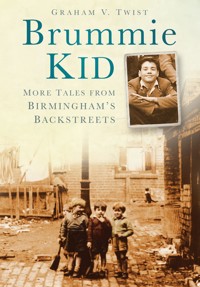
Brummie Kid is a fascinating recollection of the experience of growing up in the slums of Nechells and Aston. All the harshness of daily life is remembered here by local author Graham Twist. Despite hard living conditions and a distinct lack of money, a strong community spirit prevailed and families and neighbourhoods were close-knit. In these tough times you hoped nobody noticed you going to the 'pop shop' to pawn precious valuables, siphoning petrol from cars under the nose of the local bobby, or sneaking into the flicks without paying – though everyone was more or less in the same boat. Here are more funny, heart-warming stories from the backstreets of Birmingham which are sure to rekindle old memories.
Sie lesen das E-Book in den Legimi-Apps auf:
Seitenzahl: 177
Veröffentlichungsjahr: 2010
Das E-Book (TTS) können Sie hören im Abo „Legimi Premium” in Legimi-Apps auf:
Ähnliche


















Brummie
KID
MORE TALESFROM BIRMINGHAM’S BACKSTREETS
GRAHAM V. TWIST
First published 2010
Reprinted 2011, 2012
The History Press
The Mill, Brimscombe Port
Stroud, Gloucestershire, GL5 2QG
www.thehistorypress.co.uk
This ebook edition first published in 2013
All rights reserved
© Graham V. Twist, 2010, 2013
The right of Graham Twist to be identified as the Author of this work has been asserted in accordance with the Copyright, Designs and Patents Act 1988.
This ebook is copyright material and must not be copied, reproduced, transferred, distributed, leased, licensed or publicly performed or used in any way except as specifically permitted in writing by the publishers, as allowed under the terms and conditions under which it was purchased or as strictly permitted by applicable copyright law. Any unauthorised distribution or use of this text may be a direct infringement of the author’s and publisher’s rights, and those responsible may be liable in law accordingly.
EPUB ISBN 978 0 7509 5650 5
Original typesetting by The History Press
Contents
Dedication
1.
Setting the Scene
2.
Food for Thought – Fought for Food
3.
Happy Days
4.
A New Stamping Ground
5.
A New School
6.
Life in ‘the Lane’
7.
For Richer, For Poorer
8.
Off the Rails
9.
Back on Track
Acknowledgements
Dedication
This book is dedicated to the people who have shaped and moulded me as if I were clay. These people wrote this book as if they were doing the typing themselves: my family, my friends, my wife Sheila, fellow Summer Laners, the teachers and pupils in Cowper Street School and neighbours from Cowper Street itself, and all the good people who proudly call themselves Brummies.
Everybody I knew, looking back now into the past, had it so hard. Second-hand clothes, free school dinners, Daily Mail boots, fleas, nits, scabies, TB, overcoats on beds, crock hot water bottles in the cold, clammy bed (or in the case of many a family, a brick heated in the hob on the black-leaded grate and wrapped up in a cloth), the bucket on the stairs, cold lino on the floors, gas lights with mantles, huddling round the fire on freezing nights, no central heating, no hot water.
My memories of childhood are still vivid today: the chapped hands of the caring mothers slaving over the dolly and the mangle to get their kids’ threadbare clothes at least clean, the pride in having her front doorstep so clean that you hardly wanted to tread on it, the spud peelings and slack thrown up the back of the little fireplace, the crooked little finger as you drank your tea out of an old enamel mug, the tea pot on the hob stewing away till the tea was almost black, the hand-made rugs, the distempered walls of the toilet that was always locked while your front door was always open, making tuppenny bundles of firewood, trying to make a few bob by hammering the oily hinges together on the only table in the room, milk poured straight out of the bottle, salmon sandwiches as a treat on a Sunday afternoon and the rabbit stew that was kept going for days. There were visits to the ‘pop shop’, two penny all the way round trips on the no. 8 inner-circle bus, the visits to the Lickeys, tooth-breaking toffee apples, Spanish root, Woodbines, Park Drive cigarettes sold one at a time by Vi who owned the corner shop, queueing for sweets in long lines on the one day in the year when you could get sweets without ration books, day-old bright yellow chicks from the rag and bone man. We had 5-mile walks to Perry Barr Park and then back, walks along the cut watching the barges silently pulled by the sturdy horses . . . I could go on forever but suffice to say, nobody had anything, so we were generous to a fault. If you went into a house, the first thing you were offered was a cup of tea. If you needed a hand, your neighbours would always be there. If you were sent to borrow a cup of sugar you always came back with one, and the glue that held us all together was poverty and need. Being treated worse than animals by some bosses, and ignored by most in authority – everybody was poor in their own way but they were all the richer because of it.
This book is dedicated to all those people who’ll share my treasured memories and say ‘Yes, that’s how it was.’ My fellow Brummies.
Graham V. Twist, 2010
CHAPTER ONE
Setting the Scene
It was nearly midnight, and on a cold, dark moonless night in 1958, me and my mate were crouching by a car. The car was parked on a bombed peck which was full of various different vehicles, and this bombed peck was at the bottom of Brass Street and Newtown Row in Aston. The reason we were there was because we were siphoning out the petrol from the car’s tank, and why we needed that petrol was to get to work roof tiling the next day. It was almost pitch black, the only light coming from a distant streetlight in Newtown Row. We crouched there listening to the petrol dribble through the rubber tube into the 5-gallon tank. Suddenly my mate stiffened, grabbed my arm, and said, ‘Sshh.’ He had heard a noise – and then I heard it too, it was the ticking sound that the gears of a bicycle make when the bike is being pushed, and it was coming down Brass Street out of the blackness of the night, and more importantly, it was coming towards us. We immediately did two things: first we dropped down on the rough ground and slid under two adjacent cars, and secondly, we froze like statues. In the darkness and cold, our scared, panting breath started to condense into give-away clouds. We could hear both the ticking of the bike gears and the tinkling of the petrol which, with the combination of adrenalin and fear, was beginning to sound more and more like Niagara Falls. We lay there silently.
The bottom halves of the bike’s wheels slowly came into view as did the lower legs of the pushing owner. The legs were clad in black trousers which were above black hobnailed boots and each ankle had a bike clip holding the trousers tight to those ankles. The trousers and hobnailed boots immediately told us that these were the legs of a copper, and so we lay there trying to shrink into the ground and desperately trying not to breathe. I watched the ticking wheels and police-issue boots advance towards us and the completely exposed tinkling petrol can. I thought to myself there could be no way that the policeman was going to miss seeing the can and, with a possible three years locked up in an Approved School looming, I gestured to my mate to get ready to do a runner. The half-wheels and the boots made their way past the van and suddenly and quietly the copper parked his bike up against an adjacent car. Thinking ‘this is it’, I shuffled to the other side of the vehicle ready for the mad race that was surely about to start. The legs sidled behind a car and stopped; there was no sound at all now – the petrol tank had obviously been drained and the can had filled up. The arcing stream of steaming piss when it hit the floor was as much a relief to us as it was to the copper, and I hit my head on the underside of the car trying not to laugh. We lay there waiting for the flood to stop, which it finally did with a satisfying ‘Ahh’ from the copper. He grabbed his bike, swung his piss-free leg over the crossbar and jauntily rode off into the night.
Free from the long arm of the law, we grabbed the can and were off in a flash up Ormond Street where we had digs in the attic of my sister’s place. We put the can in the brewhouse up the yard where we kept our Dawes Double Blue bikes and then, still shaking with both relief and laughter, went off to bed.
Nicking the petrol when it was only 2s 3d a gallon may have seemed petty, but we were seventeen years old and couldn’t have cared less. We worked for ourselves sub-contracting at tiling roofs for the Marley Tile Company which was based near Burton upon Trent and the world was our oyster. When we got a cheque for our work it would be cashed and spent on the necessities of life, like days off, fags, snooker, booze, the flicks, clothes and other important items. Hence the reason for pinching the petrol.
Me and my mate had been friends since about 1950. He had lived at the bottom end of Cowper Street in Aston and I lived up the other end of the street over the chemist’s shop in Summer Lane. We had become mates because he blacked one of my eyes after some older lads had goaded us on to fight each other one day by Blews Street Park, just off Newtown Row. After the fight, which incidentally he won, he cried, I cried, and we both walked home with our arms around each other’s shoulders swearing we would be mates for life, and that was how it was. His mom was a nice little woman who was always making jumpers and cardigans for him so that sometimes he looked like a little mommy’s boy. Nothing could have been further from the truth. I think I must have thought of him as a bit posh because he never had anything second-hand, like shoes or clothes, whereas I was dressed up in hand-me-downs or clobber and used footwear bought from the Salvation Army place up by Gosta Green. He didn’t seem to hold that against me and we got on a treat and in no time at all were inseparable – we would gee each other up to do things and seemed to be forever in some trouble or other, but none of it really bad stuff.
♦ ♦ ♦
Although I didn’t know it at the time, my eldest brother’s future wife, Lorraine Turton, lived at no. 3 Park Grove with her mom and dad, Evelyn and Ted. Lorraine’s mom and dad had a classic wartime romance; Ted was part of an all enlisted squad that looked after the barrage balloon that was flying over Blews Street Park in the early days of the war. He and his fellow members of the squad had been billeted at no. 4 Park Grove. He obviously took a shine to Evelyn and would take her courting on their ‘monkey run’ down Newtown Row. As Evelyn remembers it, they would turn left out of Park Grove into Ashford Street to the corner and left again into St Stevens Street, up to Newtown Row facing Ormond Street with Asbury’s the flower shop on the corner. Keeping on the left-hand side of the horse road they would pass the big café, some little houses and then Spilsburys clothes shop on the corner of Cowper Street, where all the local moms would have their Christmas clubs to save up and spend on their kids’ ‘best Sunday clothes’. Crossing Cowper Street, there were some terraced houses where my friend used to live, and there was a little sweet shop which was next to Bob and Agnes Jones’ tobacconists and paper shop. Then there was another shop before O’Neal’s second-hand shop, whose front window display would be visited by me and my mate in the future.
Evelyn and Ted would then cross Milton Street with Barclays bank on the corner and Mr Burbridge’s barber shop next door, before passing the flat-windowed Stork pub and the little garage with two pumps, followed by Albert Lowe’s fruit and veg market store before the Little Market, butcher’s shop and the post office on Asylum Road. They’d saunter past the boozer on the corner and the Co-op with its grocery and butcher’s, the gentlemen’s outfitters, the Maypole grocery shop, a ladies’ clothes shop selling dresses and coats and a hardware shop just this side of Inkerman Street. Then they’d pass Gould’s tailors, Perk’s grocery shop, Smiths the butcher’s, Griffin’s fruit and veg, Blacks clothes shop, Averill’s cooked meats and then, past the alleyway, a tobacconist’s, bike shop, a small chemist’s, another sweet shop and a small jeweller’s before reaching Wrensons on the corner of New Street, opposite the salubrious, no-frills-attached Globe Cinema.
Corporal Harold Turton outside the gates and fencing surrounding Aston’s ‘Disney World’ of its day, Blews Steet Park.
Harold ‘Ted’ Turton sitting among the rubble of back-to-back houses in Park Grove, Aston, blown up by German bombers during the Second World War.
Lorraine Turton’s family lived in Frankfort off Summer Lane in 1929. From left to right are Emily Spencer, Alfred Spencer, Evelyn (Lorraine’s mom), Eliza and Elizabeth.
Sometimes they would walk on the right-hand side of Newtown Row from St Stevens Street, past the huge Leopold Lazarus factory, three or four houses, a small fancy goods shop, a little grocer’s, Whites the laundry shop and past the end of Aston Brook Street with Richardson’s butcher’s on the corner. Then they’d pass a photographic studio, Hunts the cake shop, Johnson’s sweet shop, Pawsons the jewellers, the entry to the ‘Pop Shop’, the Dog and Duck, Coopers the butcher’s, Timpson’s shoe shop, the ‘House that Jack Built’, Wimbush’s cake shop, the Home & Colonial grocers, and onwards, past the pub on the corner of Webster Street and Newtown Row. They’d cross Burlington Street, go past Woolworth’s, an opticians, the ‘Elbowroom Club’, ‘Blacks’, ‘The Aston Hip’ and then go up Potters Hill with the Barton’s Arms on the left.
Ted came from Derby but, having fallen for the charms of his Brummie sweetheart (whose family had always lived in the Aston area), he married Evelyn and stayed in Brum thereafter.
One day in 1952 we were mooching about in Porchester Street when we noticed one of the factory’s little cast-iron framed windows was broken. Looking through we could see lots of big lampshades hanging down and underneath each one was a big, fat bulb. This was just too good an opportunity to resist, and so I nipped home and got my Diana air pistol. This was a gun that when fired, the barrel would extend and you would have to push it back in to be able to fire again. We took it in turns taking pot shots at the blameless bulbs, but because of the way the gun would jump when you fired it, I don’t think we even managed one hit. It was my turn at the window and I was just taking careful aim in preparation to fire when suddenly I found myself up in the air in the grip of a big bloke wearing a trilby hat and an overcoat. I swivelled around in his hands and saw my mate was being held just the same as me by my captor’s mate. He too was dressed in an overcoat and a trilby. Overcoats and trilbies only meant one thing down ‘The Lane’ in those days, and that was coppers.
‘What do you think you are doing?’ he snarled at me.
‘Nothing mister.’ I replied.
‘Did you break this window?’
‘No mister!’
‘Right, come with me up to Bridge Street police station.’
Me and my mate traipsed dejectedly up the road and I prayed our moms or anyone else from our families wouldn’t see us. I began to worry again whether we would have to go to court or even worse we would be sent to an Approved School. On the way to the cop shop I had been dropping the lead pellets for the gun out of my pocket so that when we got there I had got none left.
They split us up, me in one room, my mate in another.
‘Whose gun is it?’ asked the cop playing with the offending article.
‘It’s my older brother’s,’ I said contritely, allowing tears to form in my eyes and slide gently down my cheek in what I hoped was a picture of abject misery and fear. The cop was having none of it – he must have seen it all working in this area of Aston, one of the roughest parts of Brum going. He came round the desk menacingly.
‘How many pellets have you got?’ he said, putting out his big, beefy hand.
‘I only had one,’ was the reply.
‘Lying little bleeder,’ he said and gave me a head-rattling slap around the face. He felt my pockets but obviously didn’t find any more of the offending slugs. He opened the door to the passage just as my mate went flying past holding his arse where the beefy copper’s mate had just planted his boot. They took us in front of the uniformed sergeant who gave us a right bollocking. He handed me back the air pistol.
‘Take that back to your brother and tell your mom and dad we will be watching your house to see if it is taken out by you again.’
He knew that I would get a right whaling off my mom when I told her, and he wasn’t wrong.
‘Now sod off the pair of you,’ he yelled, and as we made good our escape through the swing doors I heard one of them say, ‘only one pellet?’ followed by gales of laughter from the other coppers.
♦ ♦ ♦
Being poor when you were a kid wasn’t something to really worry about – everybody was virtually in the same boat. Obviously there were degrees of poverty, as with everything in life, but even those at the top of the relative ladder of affluence living in the little terraced houses all over Brum were probably only just above the poverty line. It seems to me that it was only when we were told we were poor that we began to really think about our situation and began to react to it. So, as a consequence, money or goods of any description were eagerly sought after, and it was a well-known fact that in certain pubs around the Aston area (and no doubt all around the city), things that had fallen ‘off the back of a wagon’ could be purchased at a fraction of their real cost. Indeed if you were in the know you could arrange for items that were desired to fall off these obviously unsafe vehicles. For instance, there was a driver at the oven factory down the Lichfield Road who would sell anyone a brand new cooker, and he obtained these cookers by the simple expedient of loading on an extra one onto his vehicle on the given day. The really big no-no about ‘borrowing gear’ from anyone was never to steal off your fellow neighbours; companies or factories or well-to-do people were all fair game, but you never ever stole from your own kind. Just as much as you never squealed on your mates if you were the only one who got nicked by the cops during some nefarious deed or other. Anyone who broke this unwritten rule would be ostracised by everybody in the community and in some cases could end up putting a postcard advertisement in the local shop or asking the council for an exchange, which meant you swapped your little palace for another little palace somewhere else that suited both families.
There were ways of making money on the side and there was many a house in Cowper Street, Summer Lane and the surrounding streets that resounded to the hammering together of thousands of brass hinges. The hinges would be put on newspaper on the kitchen table and knocked together with little hammers on pieces of wood to protect the table surface. The whole family would be roped into this money-making venture and there would be no going out to play until the required amount for that day had been made. Working on putting these hinges together would leave a black stain on the fingers which in the days of carbolic soap could be hard to remove. The kids who didn’t have these stains would sometimes taunt the tainted ones along the lines of ‘we don’t have to do “out work” like you lot,’ and would therefore somehow feel superior.
Bonfire nights would find us kids desperately ripping the backs off any old settees or chairs that had been donated for the blaze – the reason being that if you were lucky, you would find a few pence down the back that had fallen out of someone’s pocket.
Most streets would have a lady or two who would ‘lay out’ the dead. They would come in and clean up the body, put a penny over each eyelid to keep them closed, put the teeth in if need be, tie the jaws up to stop the mouth gaping open, tidy the hair and dress the corpse in their ‘Sunday best’. They would sometimes do such a good job that the bereaved relatives would occasionally be heard to remark ‘that’s the best I’ve seen him look in ages.’ These ladies never asked for any money but wouldn’t refuse it if it were offered. Generally these same women acted as midwives in the absence of doctors or nurses, and could be relied upon in most medical emergencies.




