


Erhalten Sie Zugang zu diesem und mehr als 300000 Büchern ab EUR 5,99 monatlich.
- Herausgeber: The History Press
- Kategorie: Sachliteratur, Reportagen, Biografien
- Sprache: Englisch
In a BBC poll in 2002, Isambard Kingdom Brunel was voted the second-greatest Briton of all time, only eclipsed by Winston Churchill. In the soaring ambitions of the Victorian age, nobody thought bigger than Brunel; indeed, it's often claimed that that, through his ships, bridges, tunnels and railways, he played a critical role in creating the modern world. Never tied to a dusty office, he crammed enough work, adventure and danger into a single year to last a lesser person a lifetime. He was also a brilliant showman, a flamboyant personality and a charmer. Brunel's influence is seen all over the landscape of England and in the practices of modern civil engineering. He may have made plenty of mistakes, but he also designed and built several structures which are still with us to this day. In this concise yet informative biography, learn about the man famously described to be 'in love with the impossible'.
Sie lesen das E-Book in den Legimi-Apps auf:
Seitenzahl: 121
Veröffentlichungsjahr: 2014
Das E-Book (TTS) können Sie hören im Abo „Legimi Premium” in Legimi-Apps auf:
Ähnliche


















Contents
Title page
Acknowledgements
Map
Introduction:
The Second-Greatest Briton of all Time?
1 Marc Isambard Brunel
2 Marc Brunel’s Greatest Achievement
3 Isambard’s Early Career
4 The Great Western Railway
5 Marriage and Family Life
6 The First Two Ships
7 Railway Triumphs, Railway Failures
8 The Later Years
9 Legacies
Notes
Timeline
Further Reading
Web Links
Copyright
Acknowledgements
Thanks are due to lots of people, but especially Lauren, Monique (but not Jamie), Andrew and Melanie Kelly, Brunel’s SS Great Britain, Adrian Andrews and the Brunel Institute.
Introduction
The Second-Greatest Briton of all Time?
‘Brunel built the world.’
Isambard Kingdom Brunel was born in Portsmouth and lived in London almost all his life. Yet it is Bristol, a city where he never had any permanent residence, which jealously regards him as its own. Brunel gave the city its trademark Clifton Suspension Bridge and built its peerless rail link to London. In Bristol’s harbour, his mighty iron steamship, SS Great Britain, arguably the forerunner of all modern ships, is a leading heritage attraction.
It was not always like this. Many of his Bristolian contemporaries took a rather dim view of him. To John Latimer, Bristol’s great Victorian journalist and historian, Brunel was ‘an inexperienced theorist, enamoured of novelty, prone to seek for difficulties rather than to evade them, and utterly indifferent as to the outlay which his recklessness entailed upon his employers’.1 Too often, said Latimer, Brunel was allowed to ‘indulge his passion for experiments and novelties’2 when what was needed was hard-headed common sense. Brunel, he went on, had done nothing to prevent Bristol’s relative commercial decline as a port, and may even have hastened it. When a new railway station was built at Temple Meads, it was to replace Brunel’s original building, which was widely derided by Bristolians.
In 1930, a painting by Ernest Board entitled Some Who Have Made Bristol Famous was presented to Bristol’s museum and art gallery. This is a fanciful group portrait of figures from different eras in the city’s past. It requires an expert knowledge to name even a few of the thirty-nine local worthies in this immense daub, and hardly any will be known to a visitor from elsewhere. Several members of the Wills tobacco dynasty merit inclusion, but of Brunel there is no trace. By 1930 he had been written out of Bristol’s history and, by and large, out of the nation’s too.
It is very different nowadays. The opening ceremony of the 2012 London Olympics featured Sir Kenneth Branagh as Brunel, choreographing and conducting the Industrial Revolution. Brunel, we were given to understand, was not just a key figure in British history, but one of Britain’s greatest gifts to the world.
Brunel’s rehabilitation took many years, but had been complete ten years or more before the Olympiad. In a series of programmes in 2002, the BBC asked the public to vote on who they thought were the greatest Britons of all time, with a succession of celebrities, historians and media pundits advocating their own favourites. The case for Brunel was made forcefully by Top Gear presenter Jeremy Clarkson: ‘Brunel built modern Britain and Britain built the world, which means Brunel built the world.’3
In the national poll, Brunel came second, to Winston Churchill, with 350,000 votes.
Brunel had always been known to railway buffs and to aficionados of the heroic Victorian era of British engineering. Indeed, by the 1960s there was a whole university with a strong bias towards technology and engineering named after him. In the consciousness of the wider public, however, he has gone from historical footnote to national icon.
Until recent decades, British schoolchildren were taught that George Stephenson and Richard Trevithick were the real inventors of steam railways. And these men were joined by several others in the pantheon of heroes of the Industrial Revolution. Brunel, if he was mentioned at all, was used as an example of the scale on which Victorians dared to think, usually in the context of his gargantuan ship Great Eastern.
In his own time, and for long after, Brunel was a divisive figure. He remained in relative obscurity after his death partly because many of his contemporaries could not see past his costly failures to recognise his lasting achievements. It was not until 1957, when Lionel Rolt, one of the greatest historians of Britain’s Industrial Revolution, produced a compelling and entertaining life of Brunel that people started to take notice of him once more. More than fifty years on, and despite the efforts of some historians to take a more balanced and sceptical view, the nation is now madly in love with him.
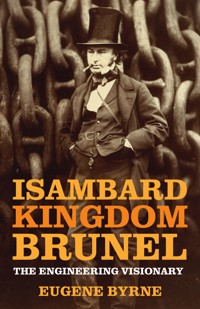
The main reason for this is that he is media friendly. Brunel’s is a colourful story, and it makes for good television. There is the iconic photograph of Brunel, hands in pockets, cigar in mouth and mud on his trousers, taken by photographer Robert Howlett in 1857 at the Millwall dockyards where Great Eastern was being built. There are numerous memorial plaques and statues – in Bristol, London (at Temple Meads and Paddington stations), Brunel University, Saltash and Portsmouth, while one at Neyland in Pembrokeshire was stolen in 2010.
Many of the statues have him wearing that hat. Brunel always wore the silk hat, even when travelling in his carriage. He claimed that it was both warm and airy at the same time, and that it would afford his head some protection in the event of any objects falling on him. The suspicion must also remain that, at 5ft 4in, he also wore it because it made him look taller.
Then there are the yarns; the cold facts of Brunel’s career are remarkable in themselves, but there are numerous legends too. Some are true or half true, but many are complete fictions which nonetheless illustrate some broader point about the man. Here is a good one:
He once insisted on building a bridge on a principle which was condemned by competent critics. The bridge, which had cost ten thousand pounds, collapsed and the directors remonstrated with their engineer on the waste of money involved. Brunel was equal to the occasion. He triumphantly retorted that he had saved the company hundreds of thousands of pounds, for he argued if the structure had not collapsed he would have built all the bridges on the system the same way.4
Brunel’s status, then, is not just about the things he built. It’s about the whole story of the man, of innovation and of perseverance in the face of adversity and opposition, all leading to great triumphs, and to some equally great disasters. The backstories to most of these projects involve Brunel’s brilliance as a showman, a flamboyant and persuasive personality who time and again succeeded in convincing investors to finance his schemes. Then there’s the restlessness, the driving ambition which crammed a decade of work, adventure and danger into every year – not forgetting all the accidents and near misses he had as a result of his astonishing physical courage.
But as every scriptwriter and novelist knows, you have to make your good guys a little bit bad – and Brunel had plenty of bad. He was what would now be described as a ‘control freak’ who found it hard to delegate even small tasks. His supreme self-confidence was actually quite brittle; it could spill over into arrogance and a fear of being challenged by others whose abilities came close to his own. He bullied his staff and contractors and he toadied to authority when his schemes called for it. Throw all the bad into the mix with the good, see how his flaws contributed to his achievements, and there you have your script.
Those who had lost large sums of money on his various projects were possibly not best placed to judge him. From the distance of hindsight, we are in a far better position to evaluate him. Brunel built several structures that are with us to this day, and which still have the power to seduce us with their elegance, their size and how good they look in their settings. Amidst the soaring ambitions of the Victorian age, no engineer thought on a bigger scale than Brunel, and few paid more attention to the quality of what they were building. That he also made ruinously expensive mistakes simply adds to the legend.
Brunel’s style, his sheer charisma and the ambition of the things he made speak to us of a type of hero we don’t have any more. While there are a handful of, say, architects, who are global celebrities, they are famous simply for being architects. The big engineering projects of today are built by faceless consortia of companies with teams of project managers, architects, financiers, consultants, engineers, lawyers and PR people. Brunel performed most of these roles himself – Lionel Rolt called him the last of Europe’s Renaissance men. Brunel was an individualist who dazzled people in his own lifetime and continues to do so today.
What really confers ‘giant’ status on Brunel is the fact that his greatest works were at the cutting edge of technical possibility. He was not primarily an inventor, but again and again he took the newest technologies and ideas, not just to build bigger or faster, but to do things that more mundane intellects said simply could not be done. Commercial failures at the time were almost always technical triumphs that future generations used and built on.
In his television series Civilisation, art historian Kenneth Clark put it best. Brunel, he said, was a born romantic: ‘Although the son of a distinguished engineer, brought up in a business that depended on sound calculations, he remained, all his life in love with the impossible.’5
1
Marc Isambard Brunel
‘Come on, Citizen!’
On 17 January 1793, France’s revolutionary regime condemned King Louis XVI to death.
That day, a young French naval officer was sitting with his dog in a cafe in Paris. On hearing the news, he spoke a little too loudly about his feelings and found himself in an angry exchange with some republicans. As he stood up to leave, he summoned his dog ironically: ‘Come on, Citizen!’
People were being executed in ever greater numbers for alleged or actual crimes against the revolution. The toll extracted by the guillotine – the ‘national razor’ as they were starting to call it – would soon peak over a ten-month period known as ‘The Terror’. Marc Brunel decided to flee the cafe, flee his lodgings in Paris and, eventually, flee the country.
Marc Isambard Brunel was born in Hacqueville in Normandy in 1769. His family were prosperous farmers, and he was proud of his roots. In a courtroom in England he was once asked if he was a foreigner. ‘Yes,’ he replied. ‘I am a Norman, and it is from Normandy that your oldest nobility derive their titles.’6
Isambard was a very uncommon name. It is thought to have derived from the German surname ‘Eisenbarth’, which may originally have meant ‘iron beard’ or ‘shining iron’, which seems appropriate. It may have arrived among the Brunel family of Normandy via some Flemish variation like ‘Ysenbaert’.
Marc had an elder brother who would in due course inherit the family landholdings and, as was often the way with second sons of such families, Marc was therefore destined to enter the Church. But by the time he had completed his elementary education it was clear that his talents lay in other areas: his aptitude was for drawing and mechanics. The college principal decided that the boy had no religious calling and helped him transfer to study under François Carpentier, a retired sea captain, for training in hydrography and draughtsmanship. Carpentier was married to one of Marc’s cousins and, although French, was also the American consul in Rouen.
At 17 Marc Brunel became a junior officer in the French navy. He served for six years, mostly in the West Indies, aboard the corvette Le Maréchal de Castries. By the time he returned, France was in revolutionary ferment. The old order – the Ancien Régime – had been overthrown, or so it seemed, and Marc, in that Parisian cafe, was on the wrong side of the new order. He made his way from Paris to his parents’ home in Hacqueville. From there he went to Rouen and the house of his mentor, Monsieur Carpentier.
There he met Sophia Kingdom, an English girl about 17 years old. She was the youngest of sixteen children of William Kingdom, a contracting agent for the British army and the Royal Navy. He had died when she was 8 years old, but the family was reasonably well off, and in due course, despite the revolutionary turmoil, she was sent to France to complete her education and improve her French. She also taught English to the children of the local middle classes.
While M. Carpentier was obtaining a passport for Marc to leave for America, the youngsters fell in love. Before he sailed for New York in July 1793, Marc promised he would one day return to her and that they would be married.
Brunel soon found work in America. Working with two other Frenchmen, he carried out a land survey around Lake Ontario. He went on to survey the line of a canal that would eventually link Lake Champlain with the Hudson River. He also submitted a design for a new congress building in Washington; his scheme, modelled on Paris’ Halle aux Grains, won, though it was never built as it was considered too expensive. A modified version was built as the Park Theatre in New York, but was destroyed by fire in 1821.
Marc gave up his earlier hopes of one day being able to re-join the French navy, and at the age of 27 was appointed chief engineer of New York. But for all America’s vast potential, the place for an ambitious engineer was back across the Atlantic. Britain was the seat of the Industrial Revolution, the place where the most exciting new engineering and technology developments were taking place. It was also the home of the largest employer in Europe, an organisation of immense scale and complexity working at the cutting edge of technology: the Royal Navy.
Marc had an idea which he thought would be of use to the navy, and so he set sail for England with a letter of introduction to the First Lord of the Admiralty from a British diplomat in Washington. Equally prominent in his mind – perhaps more so – was the promise he had made to Sophia.




