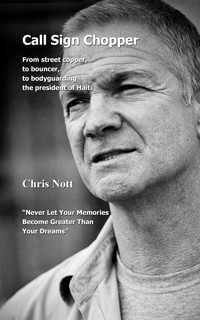
Call Sign Chopper
Chris Nott
Published by StoryUp Media in 2023
Copyright © Chris Nott 2020
First Edition 2020
Second Edition 2023
The author asserts the moral right under the Copyright, Designs and Patents Act 1988 to be identified as the author of this work.
All Rights reserved. No part of this publication may be reproduced, stored in a retrieval system or transmitted, in any form or by any means without the prior consent of the author, nor be otherwise circulated in any form of binding or cover other than that which it is published and without a similar condition being imposed on the subsequent purchaser.
Ebook ISBN: 978-1-916826-02-1
Cover photo courtesy of John Scott Blackwell
www.StoryUpMedia.com
Dedication
To my family, especially to my wife Frances for her love and support;
Graham Cutting (RIP) for his friendship and guidance;
Martyn Jones, friend and fellow adventurer
Readers Note
I have attempted to use authentic Kreyol patois which is based on French with some Spanish flavouring. Interwoven is an influence of American English which pervades in the
Caribbean and which may seem out of context at times.
Before the separation of the Island into Haiti and the
Dominican Republic, it was known as Hispaniola. Therefore speech and place names may not translate exactly.
Additionally, spelling and pronunciation varies regionally much like English dialects the world over. Some words I spelt phonetically.
So, please accept that if what you read makes only partial sense then remember an often quoted expression, ‘this is Haiti’.
The stories are all true. A few names have been changed to protect their privacy. I hope you enjoy.
Table of Contents
1. PROLOGUE
2. BEGINNINGS
3. TIMES THEY ARE A-CHANGIN’
4. MUSCLE
5. GOING SOUTH
6. DREAMS DO COME TRUE
7. ARRIVAL
8. The PPU
9. TRAINING DAYS
10. FLAG DAY
11. SETTLING IN
12. MOTORCADES
13. SHIFT WORK
14. THE ‘JUAN’ INCIDENT
15. TITTIE RUN
16. GEORGE’S PIZZA PARLOUR
17. INCIDENT AT THE COMMISSARIAT
18. ZOMBI
19. PHILOSOPHICAL DIFFERENCES
20. RING OF TYRES
21. COURT APPEARANCE
22. WALKABOUT
23. FREE RICE?
24. DAVE
25. NO FOOL LIKE AN OLD FOOL
26. DICK
27. CANNIBAL ARMY
28. BETTY SUE
29. NIGHT MOVES
30. VULTURES
1. PROLOGUE
As I negotiated the long bend into Rue Pan-Americaine, I could see a plume of black smoke rising into the sky ahead. A low-rise clutter of buildings obscured its source. Perhaps it was a house fire? Car fire? Maybe a mound of roadside garbage had gone up in flames? There was nothing unusual about smoke over PétionVille, so I wasn’t unduly alarmed; nevertheless, my vigilance ratcheted up a gear. I put my Glock between my legs, gripped it with my right hand and rested it on top of my thigh; standard operating procedure under the circumstances. I continued along the route, left hand on the wheel, observing.
Cars were speeding away from the direction of the smoke towards Rue John Brown. One of the drivers gesticulated to me - but why? His rapid, erratic hand signals suggested that something ahead was not good. It was at this point I recognised the distinctly pungent smell of burning rubber and instantly knew what lay ahead, a barricade of burning tyres, the signature of a Haitian manifestation[1].
Rounding the corner, I found myself confronted by cars abandoned at the roadside. Two or three vehicles were desperately trying to make three-point turns in the road to escape a mob of about a hundred people who were busily erecting a barricade. A stack of tyres was burning fiercely, the source of the smoke plume.
Brain racing, I processed the information in front of me. The mob had overtaken one of the cars attempting to turn. Fuck that! I had no intention of being beaten, robbed and seeing my car burnt to the ground! Just at that moment, I spotted an opportunity. To the left of the burning tyres was a gap, the heat must have prevented the rioters from dragging obstacles too close to the flames. I seized on this as my exit route. I had no idea what lay beyond the barricade but going through it looked like my only option. I raised my gun hand and pointed the Glock straight out in front of me, letting out a guttural growl as I stamped hard on the accelerator. The 4×4 lurched forward, scattering people on either side of me.
As I hurtled towards the firewall, I could feel the intense heat and smell the rubber burning. I caught a glimpse of the mob who were dancing jubilantly; their attention focused on the burning tyres. In horror, I realised what they were looking at, a pair of human legs bent at the knee and projecting out at right angles from the top of the tyre stack. A body had been tipped headfirst into the pile. Had he or she been alive when it happened? Were the tyres alight at the time? As I burst through the flames and out onto the other side all I knew for sure was that they had been wearing boots.
Two hundred metres later found me entering the suburbs of Pétion-Ville. All was calm, and there was no sign of an uprising; the manifestation must have been an isolated incident. Mentally ratcheting down from top gear, I checked my breathing, holstered my gun and lowered the windows to inhale what passed for fresh air in Pétion-Ville. The smell of burning rubber and human flesh overpowered the usual stench of open sewers.
The acrid taste in my throat and images in my head needed to be washed away. I drove to Bar St. Pierre and ordered a beer. I drank it and, in quick succession, followed with another. ‘That’s better!’ I sighed to no one in particular. The taste in my mouth was gone; my throat was cleansed, back to normality.
‘Nadine!’ I called out to the waitress. ‘Hamburger, sil vou plait.’
2. BEGINNINGS
I was born on Friday, 13th October 1950. Yes, Friday the thirteenth.
This might explain all sorts of things:
The freak accident which broke my neck and ended my police career
The job guarding a notorious dictator in one of the poorest, most lawless countries in the world
The gunpoint standoffs, riots, car-chases and life-or-death situations in which I found myself as a result
The middle-of-the-night Vodou revenge ceremony, the encounter with a real-life zombie, the cannibal army.
I could go on...
But was any of this actually bad luck?
Let’s go back to the beginning, and you decide.
As a child I seemed destined for an active life. I ran cross-country, played rugby, did boxing and judo, swam in national championships and was always out on the hills surrounding my hometown of Bath, either hiking or cycling. It was a happy childhood until my father deserted us when I was fifteen. He wasn’t very good at paying maintenance and my mother was working day and night to keep us going, so I decided to leave school and get a job to help supplement the family income. O-levels would have to wait.
Having watched Dr No and devoured all the James Bond 007 novels, I knew that Bond was a naval commander, so when the opportunity arose to enter the Ministry of Defence Naval Department as a temporary clerical assistant, I jumped at it. Maybe I could be a spy like James Bond! I reported for my first duty in August 1966, only to discover that my job involved collecting reams of paper signals from Royal Navy ships around the world, cutting them to length and filing them in chronological order. It took me less than thirty minutes to realise that fantasy and reality were a million miles apart: I had made a colossal mistake.
To liven up my dismal job, I applied for anything and everything that was going. I finally reached the pinnacle of my Ministry of Defence career when I was seconded to a naval base in Gourock, Scotland, where my duties consisted of filing, shredding and delivering post! The closest thing to espionage I ever did was working as a courier, delivering restricted mail to the local submarine base by boat.
On returning to Bath, I took to going out on the town. Some of the lads I was mixing with had started to attract the attention of the local constabulary during our booze-fuelled nights out in the city centre. I was a couple of years younger than the rest of them but looked older than I was and had no problem buying rounds in the pubs and dance halls we frequented. Horseplay, scrapping and falling down drunk were standard on our nights out: normal activities for young men, I guess. However, when a couple of my mates got themselves arrested for assault and being drunk and disorderly, I started to think seriously about my future. I could see that things had to change.
One night at my local swimming club I was called aside by Graham Cutting, a star of the club, an amazing swimmer and a copper. He had heard about my exploits and the people I was mixing with and made a grim prediction about where I would end up if I continued on my current path. He asked if I’d ever considered joining the police force. I had but had dismissed it. I was too young, and anyway, I would be seen as a traitor to my mates. Graham persisted and told me about the local police cadets. It sounded like military-style training that you could do without leaving home. I really liked what I was hearing, but there was just one problem - it was the police! Graham reassured me that on completion of cadet service, there was no compulsion to join up; I could be paid for the things I loved doing for the next couple of years and earn five bob a week more than I was getting as a clerical assistant! That clinched it.
It was a sunny September morning when I pitched up at the New Bridewell headquarters in Bristol and nervously asked the duty officer for directions to the cadet office. I couldn’t help noticing his campaign medals. Most officers’ uniforms bore colourful ‘flashes’ of war service, from the Second World War to Korea, Suez, Malaysia, to name but a few. These were the last years of the Swinging Sixties and the police force was one of the last bastions of the old militaristic regime of WWII - as I was about to find out! The constabulary was a tough man’s world with its harsh discipline of drill and physical training and uncompromising standards, so at odds with libertarian 1960s society. I was in my element. Our cadet instructor was a former army commando who bore the Oak Leaf decoration for disarming a gunman. He treated us cadets as army recruits and ‘beasted’ us as if we were training for war.
It was an incredible two years, but all too soon I found my carefree time as a cadet drawing to a close. Having watched my predecessors graduate into the ranks of the constabulary, I knew what to expect when I was called into the sergeant’s office in August 1967.
‘What are your intentions?’ he asked. ‘You haven’t applied to join the force. If you don’t do it now, we’ll have to let you go.’
I didn’t know what to say. I was thinking of applying to the Royal Marines. I was in a serious relationship with my girlfriend. I wasn’t sure what I wanted.
‘We need men like you,’ he said, handing me an application form. And that was that.
After sixteen weeks of training, I became a constable with the Bristol Constabulary with a posting in the north-west of the city. I completed two years’ probation and became a response driver, answering 999 calls and tackling all the usual reports of crime and debauchery. When the opportunity arose to work with the Special Services Squad, a plainclothes unit which acted as a springboard to the CID, I grabbed it. Life in the CID sounded perfect, but after a spell with them I discovered that they operated at a slower pace than the frenetic lifestyle I enjoyed with Special Services and could see that it wasn’t the place for me. I chose to return to uniformed street duty. I was now several years into my police career and beginning to feel just a little disillusioned.
I remember seeing another officer receive a Chief Constable’s commendation for dealing with what I considered to be a relatively minor violent incident. I had never received any recognition for my work so I raised the subject with the inspector at my next appraisal.
‘Can you explain to me why he received a commendation for that incident?’ I asked. His response was like a kick in the teeth:
‘What he did was good work for him. We expect that of you. Do you want a pat on the back every time you have a scrap?’
This was a turning point for me. On reflection, I guess that I was reaching some kind of burnout. I had been in the heat of the St. Paul's riots, the peak years of football hooliganism. A little recognition wouldn’t have gone amiss.
I needed a change. Having continued my sporting activities throughout my career I wanted to see if I could incorporate my physical skills into my police service. I submitted a request to be considered for the next vacancy for a physical training instructor post at the District Training Centre. My supervisors supported my bid and put my name forward. Some weeks later, along with several other prospects from all over the south of England, I lined up at the training centre to take part in a series of physical challenges. I did well, gaining the best score overall, passed the interview and was offered the next available slot. Three months later, having passed the Home Office Physical Training and Self-Defence Instructor course, I was seconded to the District Police Training Centre, Chantmarle in Dorset for two years.
Upon my return to the Avon & Somerset Constabulary I managed to secure a part time role working half-time as a trainer and the other half as a street duty officer, either on the beat or as a response driver. I was happy with this arrangement as it added to my credibility as a trainer that I was also an active officer. However, the flip side of this was that as an active officer, I had a reputation to maintain. I was regularly put to the test and would be sent to all kinds of violent incidents where my skill set could be utilised to best effect; disarming knife-wielding thugs, piling into pub fights, street brawls and affrays. Alongside my martial arts skills, I began to develop a keen sense of verbal jujitsu for those times when no matter how many physical skills I possessed, they wouldn’t have saved me.
I remember one evening in early summer when I was on mobile patrol in a panda car, single-crewed as I preferred to be, at the ‘ass end’ of the Southmead Estate. I was cruising slowly past groups of sneering youths, burnt-out cars and packs of snarling dogs when I saw a large gathering filling the road in front of me. As I crept up towards the edge of the crowd, I was spotted by some of the estate elders who I knew. They surrounded me as soon as I got out of the car.
‘Chris, it’s the Smiths and Jones. They’re gonna have a ‘straightener’. The best thing you can do is get back in yer car and fuck off.’ Being told to ‘fuck off’ is guaranteed to make me not fuck off, so I locked my car, leaving my police cap on the passenger seat. I didn’t want to be worrying about my hat flying off if things all went sideways!
I shouldered my way into the melee where the warring factions were facing each other across a central void. I had arrived right at the beginning of formalities: insults and threats were being fired back and forth accompanied by all the requisite gesticulations. I strode between them and stood with the Smiths on my left and the Joneses on my right. A general hissing and booing arose from the two hundred-strong crowd. They seemed to agree that I should just fuck off. One of the more respected elders moved alongside me having done a quick risk assessment. From what he knew of me and my reluctance to back down combined with the mood of the crowd, he concluded that I was going to come a very poor second! If I took a bad beating, he knew what the police reaction would be: they would flood the area with cops, making it much more difficult for profitable day-to-day criminality to continue. A diplomatic solution was therefore required. I needed to maintain some credibility and the conflict between the two families had to be dealt with; otherwise, serious disorder could break out. An idea formed in my mind, and I quickly relayed it to him.
The elder raised his arms and shouted for quiet. An inquisitive hush rolled over the assembly. All eyes were on us. ‘Listen. If we ‘do’ the copper, you know what’ll happen. They’ll come in mob-handed and stitch us all up. If this all goes mad and turns into a riot, the same’s gonna happen. The copper says that this should be settled the old-fashioned way; the best man from each family step up and he’ll ref it.’ He looked left and got a nod, looked right and received another nod. ‘Alright, let’s get it on!’ he shouted, to tumultuous cheers from the crowd.
I stood in the middle and elders from the community quickly took up positions to keep the baying crowds away. The best fighter from each family stepped forwards, they took off their shirts and started shadow boxing. I called them in.
‘Ok. No holds barred, but no one is gonna die. I will stop the fight if someone’s taking a beating.’ The three of us gave a nod of agreement and the two combatants began circling, probing and testing one another. A flurry of fists flew from Smith. Jones saw an opening and dived in, viciously headbutting his opponent, whose nose exploded on impact. Jones followed up with a series of heavy punches to the face and it was clear that Smith was going down. I moved swiftly between them. By now Jones had a bloodlust, and I had some trouble holding him back from the defenceless Smith, but the elders moved in to contain him and steered him away with the promise of alcohol in the local pub, followed by the rest of their wildly-cheering entourage. The disappointed Smith clan closed in to see how their boy was. It was decided that he should be taken to the local casualty department, but by car, not ambulance.
The crowd had mostly dispersed, and there had been no major incident or mayhem. With any luck it had all been dealt with so quickly that there would be no further fallout. I shook hands with a couple of remaining elders and made my way back to my police car, reflecting on my success in refereeing the ‘Battle of Lydney Road’ in a way that left me without injury to either pride or body. It was only when I unlocked the car door and slid into the driver’s seat that I noticed the broken glass on the front passenger seat, followed by the absence of my police cap! Some creative writing was called for to cover the damage and theft, but such an occurrence was not unusual, and I managed to square it away without difficulty.
Always looking for more excitement, during the period from 1984 to 1997, I served in various military reserve units:
Royal Military Police
Somerset and Cornwall Light Infantry
Royal Air Force
RAF Lyneham Defence Force
RAF Regiment & RAF Aeromedical Evacuation
Squadron
Active service in UK home defence and Cyprus
1991 saw the creation of the Bristol Doorsafe scheme: a police-run training programme for local nightclub bouncers. With my physical training skills, I was a natural choice to join the team. We were expected to maintain a professional distance from the students as the police were under pressure from the local authorities to get a grip on the door staff after a catalogue of alleged wrongdoings; however, I noticed an immediate connection with a man from the ‘other side’.
‘You know Martyn don’t you?’ A colleague introduced me to a large, instantly recognisable man. Martyn Jones ran Security Leisure, the biggest door agency in the south west of England. He hadn’t reached that kind of prominence by being a shrinking violet. The folklore surrounding him went back to the East End of London in the 1960s, where he may have had links to notorious characters such as McLean and Shaw and the Kray twins. There were many rumours about the way his business was run, talk of gangsterism, enforcement beatings and shady dealings. I was aware that Martyn had been arrested and convicted of assault, but there was nothing on his record for dishonesty.
‘Yes,’ I replied. We shook hands and locked eyes - for just a moment longer than seemed necessary. It was the beginning of a friendship that would change my life.
RAF Lyneham Defence Force
3. TIMES THEY ARE A-CHANGIN’
After many years in the police, I had finally found my ideal job, a combination of teaching officers public order and the use of force from ‘empty hands’ to firearms tactics.
In the evenings I was running use of force training for door supervisors through the Doorsafe scheme. I was in my element.
One day, about eighteen months in, I was asked to run a training course on the use of the Armament Systems Procedures (ASP) tactical expandable baton at the police station in Yeovil. Whilst looking for a parking space, a sudden impact to the rear of my vehicle jarred my neck. A police car had driven into the back of me. The incident was all captured on CCTV and it was clear that the other copper was at fault. The police authority paid for repairs to my vehicle and, as far as I was concerned, that was the end of that. However, after ten months of being in denial about headaches, stiffness and aches in my neck, I finally booked an appointment to see my doctor. He referred me for an X-ray, which revealed a teardrop fracture in my spine. A sliver of bone had been shed due to the whiplash and had migrated into the ligaments and ossified. I had a broken neck! It sounded serious, but the specialist I saw subsequently advised me that my neck was stable and that I would get used to the discomfort. However, when I returned to the office things took an unexpected turn. I joked about having a broken neck - not realising my mistake. Before I knew it, an appointment was made for me to see the police doctor and I was placed on restricted duties in the office, answering the phone and doing odd bits of admin. A decision was soon made and I was to be retired on medical grounds. The police were not prepared to accept liability for me with this condition.
I left the force just four years short of my thirtieth anniversary, wondering what to do with the rest of my life. I felt both loss and exhilaration. I had to work and, in any case, I still felt fit and strong. The only incapacity I suffered was an inability to turn my head far to the right; I could put up with the stiffness and aches and pains.
Fortunately, I was still able to run the Doorsafe training alongside Martyn. We had become friends and I looked forward to those Tuesday night sessions. I started thinking, if I was going to train door staff then, for the sake of my personal credibility and to have an income, maybe I should become a doorman? I enrolled on one of the courses that I helped to run and, on completion, approached Martyn for a job at Security Leisure. He gave me work on the door of the newly opened Chicago Rock Cafe, a popular venue which was busy seven nights a week.
Friday nights were always the busiest, full of lads’ nights out. You could guarantee anything from some rough and tumble at the lower end of the scale to an all-out mass brawl at the upper end. Justice was instant and, in my experience, dispensed more or less fairly. For example, if a group of lads became too boisterous and were asked to leave the premises, providing that they accepted with good grace and were contrite, then they would be escorted out in a dignified manner. However, if they kicked off or abused staff or patrons then they would be ‘bumped’ out unceremoniously and not invited back. I found the straightforward justice of the door refreshing compared to the official system perpetrated in the courts which seemed to me to have become a playground for lawyers to serve their own ends.
I believe that anyone considering a career in the police or military should work at least six months of weekends on the door of a lively bar or nightclub. Door supervision is a much-maligned occupation, and yet it tests all of the qualities required for such careers: teamwork, resilience, strength of character, raw courage. All this aside, the camaraderie is second to none. I found myself really getting into the culture: it was an adrenaline-filled existence, never knowing what confrontational challenges you were about to face each time you started your shift. The psychology of the work particularly fascinated me. The general perception of a doorman is a big, thick-necked bruiser, dragging his knuckles on the floor. In truth, there were a substantial proportion of those. However physical stature didn’t always equate to being a successful door person. More women were coming into the business, bringing their own innate skills, and I came across any number of students working to pay their way through university: student doctors, nurses, moonlighting military personnel and people from every other job or profession you could think of. However, it was the ‘career bouncers’ who taught me the most; those who had seen it all and done it all.
I particularly remember completing a day’s training in Liverpool and being offered an evening’s work on the door of the world-famous Cavern Club, where the Beatles had first been discovered. It was not the original Cavern Club of the 60s as it turned out, but a rebuilt replica. Still, it was close enough to the real thing for me!
It was a Tuesday night and relatively quiet. The head doorman, Mick, was dressed as per the era, wearing black trousers and standard issue black bomber jacket. Only five foot eight tall and reasonably well-built, he stood with his hands plunged into the side pockets of his jacket and regaled me with tales of derring-do and funny incidents in only the way that Scousers can. After a couple of hours of admitting ‘nice’ people - mainly tourists doing the Beatles trail - I stiffened as a group of track-suited, chanting, drunken youths hove into sight. I adjusted myself subtly into a pre-dynamic stance.
‘We’ll fuck this lot off’, whispered Mick.
As they approached, all swagger and bravado, I was ready; my hands loose at my sides in a modified fighting stance, slightly to the rear of Mick’s right shoulder. In racing terminology, I was ‘on my marks’, balanced and ready to go.
Mick still had his hands deep in his bomber jacket pockets. He had moved his left foot forward and was in balance. The group of six young men stopped just in front of us and crowded around. The smell of beer on their breath assailed my nostrils. I kept quiet. ‘This is going to be interesting,’ I thought. ‘How’s he going to ‘fuck this lot off’ without a fight?’ They were clearly spoiling for one. The body language was up and blustering as they proceeded to test us. The tallest one, seemingly the group leader, leaned forward.
‘Let us in, mate,’ he said, smirking.
‘No trackies,’ was all Mick said as we stood blocking the entrance.
‘Yoos two fucks gonna stop us?’ the tall one responded and started to point at Mick, jabbing his forefinger towards him. ‘Come on, Mick; do something,’ I muttered internally. Mick just stood there, hands in pockets.
‘Fuck off now before it’s too late’, he said in a clear, no-nosense voice.
That was my ‘get-set’.
The tall one took a step forward, puffing his chest out. In an instant, Mick pulled his left hand out of his jacket pocket and thrust it forward, almost into the face of the advancing ‘tall one’. That was my ‘go’. I was just about to draw one off on the nearest tracksuit, when out of my peripheral vision I made out something in Mick’s left hand. His right hand was in a fist and at waist height. I reigned in my right-hander as the whole group focused on a tiny, fluffy teddy bear which Mick clutched in his left hand and was waving in their faces! They were thrown into complete confusion. After a few seconds the tall one said, ‘You’re fuckin’ mad you, let’s fuck off and leave these nutters alone’.
In a second they had turned on their heels and were laughing, gesturing and blowing kisses at us, but walking away. No one was hurt, there was no damage; the situation was resolved without a fight.
‘Mick, that was brilliant! Tell me, where did that come from?’ I enthused.
Mick showed me his secret weapon: a small, fluffy, brown, child’s teddy bear with one eye missing. He explained that in the build up to any set-to on the door, you focus on each other with intense eye contact. The teddy is a distraction from that because it’s so out of context in the situation. Your opponent has to take in and process information which is totally at odds with what’s going on. The usual outcome is what happened that night - he’ll walk away laughing at you. However, if he doesn’t laugh and walk away, his brain has still had to process the information - and this takes time. It may only be a fraction of a second, but in that time you can make a decision. You’ve ‘indexed’ him by measuring the distance to his chin by thrusting Teddy into his face. His jaw invariably goes slack as his brain tries to evaluate what’s in front of him - the ‘duh’ effect! So if required, you can now drop him with a right cross to the jaw.
I was constantly amazed by the gems like this that I learnt along the way; psychology born of experience, not from a book.
However, I never got round to carrying a teddy in my pocket!
In those days, working as a bouncer was something of a cowboy business. There were regular scandals involving door staff dealing drugs as well as gang wars, sawn-off shotgun shootings of doormen in Liverpool and Manchester and all kinds of criminality going on in Essex and London. Fortunately, in Bristol, Martyn was the local ‘godfather of the doors’. As a family man who hated drugs and the people who dealt them with a vengeance, he knew that if you controlled the security at a venue, you also controlled the drugs.
‘If I hear of anyone dealing drugs on any of my doors, they’ll have to answer to me, then the law!’ was his approach. The fact that his company provided security for most of the venues in Bristol helped to prevent a drugs free-for-all in the city.
Alongside my door work, training jobs were picking up too; local authorities all over the country were setting up door schemes and, as Martyn and I had been at the forefront of this kind of training, we started getting more and more contracts. I was asked to run everything from kickboxing classes to self-defence courses to training on how to deal with difficult people: basically, anything to do with conflict. I was soon travelling the length and breadth of the country on weekdays and helping to man the Security Leisure backup van (known as the Battle Bus) at weekends. During my travels around the UK, I started to come across opportunities for other work, including a casual job with Maritime Security aboard US military prepositioning ships based in the Mediterranean. It was quite a coup for a British company to be awarded such a contract. We were involved in liberty launch security, sea watches and any other tasks required by the captain. The best part of the job was that the ships visited some of the nicest ports in the Mediterranean, such as Palma, Barcelona and Ibiza!
On a work trip to Exeter to negotiate a contract with a fellow security firm, Martyn and I encountered Airtight International, an organisation offering courses in ‘executive protection’. There was a tactical firearms element to the training, which took place in Huntington Beach, Los Angeles. Leafing through the glossy brochures, we saw photos of men and women running around in the Californian sunshine, guns in hand. I felt energised just looking at the pictures and sensed that Martyn was too.
‘Fancy that?’ I said.
‘Fucking right I do!’
It turned out that the course was targeted at Royal Marines leaving the service, who received a training grant to help them gain qualifications for civilian employment.
‘How much would a course cost as a civilian?’ I asked Ed, the founder of Airtight International.
‘The same as for service personnel: £2,500. Of course, any civilian would have to satisfy our standards and prove to us that they were up to it.’
I could feel Martyn wince at the price, as did I, but we concealed it well. £2,500 was a lot of cash in those days.
Over the following weeks, California was like a worm in my head, twisting and turning and eating away at my brain. I knew that Martyn felt the same. We started having regular coffee meets away from the office so that we couldn’t be overheard by prying ears. Little did we know that serendipity was at work for us.
4. MUSCLE
One morning over coffee, Martyn told me that he had struck up an acquaintance with a fellow member of the gym where he trained. Roy worked for the BBC in Bristol as a producer of documentary series and was fascinated with the bouncer lifestyle. He had suggested that it might be a good subject for a documentary.
‘What do you think?’ Martyn asked. I thought for a second and gave a throwaway response.
‘Sure, if it gets us to Hollywood!’
Months passed and the dream of being able to afford the Airtight course was slipping away. Our conversations were becoming depressing. We were both getting on in years - I was soon to be fifty and Martyn was six years older - and though both in excellent physical shape, had anyone ever heard of over fifty-year-old bodyguards? We were growing tired of life on the doors and started exploring alternatives. We considered running away to join a mercenary army in Bosnia but didn’t fancy the cold winters. We were too old for the French Foreign Legion…
‘Tell you what, I’ll get hold of Roy and see how far he’s got with this documentary idea,’ Martyn volunteered. It was a long shot, but what did we have to lose?
‘Could you see yourself as a television star?’ asked Martyn, as we sat in the same café exactly one week later.
‘Everyone has to have their 15 minutes of fame,’ I quoted Mr Warhol.
‘Then be here at 1000 hrs tomorrow; we have a meeting with Roy and Dick the director.’
‘Are you serious?’
‘Yes, they think it’s a goer. A six-episode Saturday night prime-time goer!’ grinned Martyn.
So it was that the seeds of the BBC fly-on-the-wall documentary Muscle began to grow. There were numerous meetings with the BBC, photoshoots and interviews before we could proceed. Eventually, it was agreed that a camera crew would follow the exploits of Martyn (The Boss), Chris (The Ex-Cop), Ron (The Enforcer) and Mike (The Christian), the Battle Bus team who responded to help calls from door staff across the city. Everyone was super-enthusiastic.
Martyn and I saw a window of opportunity to resurrect our Californian dream and make it come true, so we showed the Airtight International brochure to Roy.
‘Great!’ he beamed. ‘I can see the two of you now: jaded, sick of the streets, exhausted from a heavy night of pub fights, walking out of a club door and into the sunshine of LA, the track ‘Street Life’ playing in the background. It’s brilliant! Just perfect!’ Caught up in the hype, we mentioned the cost of sending both of us on the course.
‘£5,000?’ spluttered Dick, Roy’s boss. ‘Sorry boys, but what with the cost of the camera crew going with you that would run us way over budget; however, I do like the idea. Can you fund it yourselves?’ We hesitated.
‘It’s such a shame,’ mused Dick. ‘California would have been the climax to the show. I know the BBC aren’t paying you a penny but think of the opportunities that will flow from this? You’ll become celebrities - so maybe it’s an investment? Speculate to accumulate? Just think about it.’ So we did. We contacted Ed at Airtight and arranged a meeting for us all. At the meeting, Roy gave them a similar pitch to the one Dick had used on us.
‘Just imagine what this kind of exposure could do for your business!’ Ed was sold and wanted in on what had already been dubbed ‘the Californian episode’. The only sticking point was the small matter of the money! Martyn, Ed and I had a separate meeting and agreed that this was too good an opportunity for any of us to miss out on.
‘The budget is tight so you can’t go for free,’ said Ed. In the end, we agreed on £2,000 per head. It was still a lot of cash but we thought of the rewards which would follow. It seemed a small price to pay to ‘speculate to accumulate’ - so we dipped into our savings and speculated!
The training in LA was both demanding and exhilarating. Providing close protection is the complete opposite of what you do as a copper and bouncer. In these roles you actively step in to untangle difficult situations. When providing close protection, you take every step to avoid any entanglements as close protection entanglements typically involve a shoot-out! Overall the California trip was everything I hoped it would be - a genuine dream come true - but all too soon I found myself back under the grey skies of Bristol, wondering what the future had in store.
It was in a state of high anticipation that we watched the first episode of Muscle air on national television one Saturday night in January 2000. The programme was groundbreaking for its time and shocked a lot of people. These days you can watch edgy documentaries full of sex, violence and every swear word in common usage, but in Muscle all swearing was fudged out and some of the violence was not used. On reflection, this was possibly just as well! The episode made quite an impact, particularly as the final sequence featured the explosive ‘Battle of King Street’, which was, and still is, legendary in door circles. In it, Martyn was arrested for assault - a charge from which he was later cleared. Our methods were exposed for all to see and the police and local licensing authority weren’t happy with us - however, the BBC were delighted. Real, gritty and raw, it exposed the binge drinking and brawling that was plaguing the towns and cities of Britain at that time and with viewing figures of over six million it looked set to do well. The reviews were all good, apart from one in the local press which claimed that we had besmirched the good name of the city, painting the city centre as a night-time no-go area, ruled over by a gang of bouncers. Local councillors were aghast and up in arms.
We got ourselves an agent and sat back and waited. After a flurry of television, radio and press interviews, nothing much happened. It was suggested to us that no one wanted to handle us as our image was too nasty, however Martyn got himself a minor speaking role in The Bill, a popular, long-running police series. I managed a few non-speaking character roles on television shows such as East Enders (gangster), Casualty (military policeman), Dalziel and Pascoe (copper), The Inspector Lynley Mysteries (another copper). Typecast or what!
5. GOING SOUTH
Despite the success of Muscle, the stardom we had been promised eluded us. California was now a distant memory and the future wasn’t looking quite so bright any more. I could feel depression setting in. To add to my woes, I was called in by the police doctor who explained there was a clause in the conditions of my medical pension that said if I participated in any activity that could exacerbate my medical condition, then the level of payment would be reduced. There was no argument that I had broken my neck in a work-related accident, it was just down to how much they were going to reduce it! I appealed the decision but it was rejected.