


Erhalten Sie Zugang zu diesem und mehr als 300000 Büchern ab EUR 5,99 monatlich.
- Herausgeber: Books on Demand
- Kategorie: Sachliteratur, Reportagen, Biografien
- Sprache: Englisch
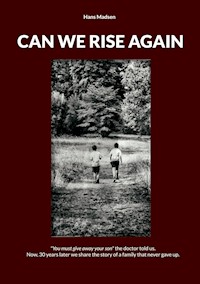
Having a child with severe autism is one of the most transformative things you can ever experience. We love our son and want to give him the best life possible. And with the knowledge there was back then, there was a possibility his condition could improve, perhaps he could even start talking. We gave it everything. But 30 years later we have to acknowledge that he is exactly the same as he was then. He is still autistic with all that entails, he still has no speech. Was our fight in vain? Now looking back on 30 years of living with severe autism, we can share a story of a family that never gave up. We took all the fights that were necessary, and that we believed could help our son to have as good a life as possible, as a child and a youth, but also the hardest of them all, in adulthood. We achieved what was considered impossible, yes unimaginable. Our lives were not isolated from all the things we wanted to achieve together with our children. Autism was not allowed to prevail, that would be our clear goal, our life task. Autism would not be our son, but only a part of him. Behind his eyes, we found a happy, loving, and absolutely wonderful guy, we found our son. But that also came with a price. Were we able to live two such different lives? And what happened when his life wouldn't change? Could we change and give up our hopes and dreams? The story of autism contains so many different angles, and somehow, they all came together in our life. Science moved forward, and many answers were elaborated. It turned out that we had done so many things right. Still, there were so many losses. The story begins on a spring day in 1993. A normal day it may seem, but this Saturday our lives would change forever. The life we had hoped for would now forever be gone. We just didn't know it at the time.
Sie lesen das E-Book in den Legimi-Apps auf:
Seitenzahl: 213
Veröffentlichungsjahr: 2023
Das E-Book (TTS) können Sie hören im Abo „Legimi Premium” in Legimi-Apps auf:
Ähnliche



















Contents:
Prologue
Silence, a horrible silence
- Attitude – but in reality, early signs
- Never!
- Hope?
We didn't defeat autism, but...
- Our first victory
Investigation and diagnosis
- The different organisation of the brain
- Loss
- 6AO2
- Autism in the world
- 2, 3, 4
- Medical assistance
- Sleep – change and break?
- Repetitive stimulation
- Insomnia
- He is a normal autistic
Assistance – the constant worry
- Finally, on assistance
A limit that does not exist
- Imagine
Life Part 2
When words are not enough
- Sensing
Activities
The bouncing ball
Mechanical
The codes of autism
- Sorting the autistic codes
"The pedagogy of the 1000 times"
Unique knowledge
Breakout. Hijacking
Killing feelings
Friends
- Grandfather
Parents
- Rock bottom
"Who is the best" – the best brother in the world
The family with the autistic boy
“You don’t leave me alone with Nico!”
Dad/husband/Me 2:0
Conclusion
Autism - The true story
- ICD: International Statistical Classification of Diseases and Related Health Problems
- Statistic
- Medicine Hux or Flux
How do we sum this up
Prologue
Having an autistic child is one of the most life changing conditions you can ever imagine. That's how it was for us anyway. When our son was born, autism was not a diagnosis that was generally known, not the way it is today. None of us had ever heard the word autism before. But now it was the reality for our little family, at the beginning of our adult lives.
Our own model was also a long way from the “ideal” family with an autistic child. We had lots of love but no routines, instead we were youthfully spontaneous. Decided the days as they came, all according to the weather and what was going on as young ones do, with the friends we had around us. We have always had many friends and liked to be where the action was, in the city, the beach, barbecue evenings or just chilling. Our neighbours used to say that if we weren't away, we had guests, it was always one or the other.
In addition, we were at the beginning of our adult life and started a company that grew, we also wanted to invest in that direction. We had a lot going on that required our focus and attention, things that are completely normal at the beginning of any adult’s life. We also wanted a house, so after a few years we were on track to the future with a house, car and a growing business. The future looked bright in that sense.
Of course, it was challenging, a track and a goal in life that required both time and great effort. If we had an autistic child today, all this would be settled, but not then. Life hadn't made us who we are yet. We were young and still ”on the way”.
Add to that the immaturity, there is no way around when life experience hasn't caught up yet. Yes, a lot in our life happened in those early days that made us both focused and spontaneous, young as we were, curious as we were, poor and hard working as we were.
Many couples go their separate ways when they have an autistic child, but now looking back at more than 30 years of marriage, we can probably say that our son's autism has never been a reason for us to separate. Of course, things have happened over the years that could have been a cause,they happen to any couple – but never this. Our fights, we fought them together with common goals, the time we used, we used together, always together. The joint decision was made right from the start and made us invincible. We and his wonderful big brother along with Nico, were invincible.
Invincible, but vulnerable. Could our life with family, work and recreation really work together with autism? And what happened to us when we couldn't allow our child an independent adult life of his own? What does life become like when the human qualities needed in a relationship do not work, such as learning ability, adaptability, social codes and communication? Could we be the ones who invested everything to give our son the best possible life, not only as a child, but also as a youth and an adult? Is invincibility without end? Or would autism be the invincible? Did we really stand a chance?
We achieved spontaneity together with structure by using our own inexperience. Our life hadn't settled down yet and it would not go on without him, never. Instead, it would be spontaneously structured, an expression that does not exist. We dare to say that our son has had and still has a good life. Our decision to never stop fighting for him, made his life at all stages as good as it could be, with his limitations.
We must also be able to say that it has been a huge struggle, not only in terms of our responsibility as parents, but also our responsibility for an autistic person completely without communication. Also, an eternal struggle against the authorities for his rights, a fight that will apparently never end. Constantly in today's society there is the threat that his opportunities will be drastically changed due to a political decision or for “efficiency” with society's resources. An aspiration that we are constantly reminded of affects the weak ones. But our son has never been weak, he has always had us. Our story should also include this fight—the fight for the voice of a mute human being.
You have probably heard stories of parents when they first suspected that something was wrong with their child, the investigation process, then finally being told that the child was autistic. And then life changes, with intensive training and everyday life constantly adapted to the child's needs. But what happens after that? How did we move forward in life together when autism wanted us to stay in the same place? What we had to change in life, when Nico was diagnosed and really from the time he was born, changed drastically several times during his upbringing. It wasn't just getting started and then everything went on automatically, right on track. Oh no, it was just the opposite. We were on track but many times it felt like the train was coming straight at us.
We started well, paid attention to what we were taught, and pretty quickly we learned the codes of autism. But what we thought was a manual that would work in further life, just as upbringing has a certain developmental manual for a child's different ages, turned out to be something completely different. There were no manuals for his development and needs. They did not follow a natural progression up through the ages. We learned that the hard way, on a path without end.
Over the years, it has also been quite transformative to first have a child, then a youth, then an adult with the same restrictions. Every part of life has been like starting a new chapter, especially the development from youth to adult. Adult autism should almost be a diagnosis of its own, not because it differs from a child's diagnosis, but because the problems become so much bigger with age and so much more difficult to solve. A child can be physically managed and controlled, but you can't do that with an adult individual. What to others may seem like an anxious or difficult child, becomes completely different if you put the same behaviour in an adult body.
A child is given upbringing and guidance in life, which changes continuously with age. The upbringing of an autistic child is something else again, not "only" based on upbringing, but also on strategies and routines. It is also based on other things that have nothing to do with upbringing or feelings at all but must be there for everyday life to work. This is all truer now that Nico has grown up. Everyday life is not governed by ingenuity or a forward moving drift in life that other young people experience, but by routines, routines and routines. Not meaningless routines but things with content, a life of content, a content that we as parents constantly must invent and reinvent and also figure out. Otherwise, it will be just meaningless routines. Yes, in addition to living our own lives, we also had to "live" his life.
Beyond all this, we must never forget that the most important thing for us was love. Not routines or understanding or adaptation to his disability, but that he would feel loved and needed. We showed him very clearly how happy we were for every bit of progress he made. We wanted him to understand how we felt about him, that we loved him deeply. That’s probably what he's been told most in his life: “We love you”.
But all of this comes later. Let me start where it all started, on a Saturday in the month of May 30 years ago. A normal day, it seemed, but this Saturday our lives would change forever. The life we had hoped for would never be. We just didn't know it then.
Silence, a horrible silence
We married young and decided to have children. We wanted at least two, so they had each other growing up. We had two sons and Nico is the second. Our first son was the most wonderful child imaginable, and very pretty. Word spread in the hospital when he was born, so several nurses came from other wards just to see him. He was also so easy to handle, never whined, just a happy kid. Some time later, we were expecting a child again. This pregnancy was different, very different.
He was born in breech. Totally insane, I know now, but young as we were, we believed fully and firmly in the doctors' judgement, which should also have been the best. I've never been so close to passing out as when the doctor was struggling to get the last part out, his head. The room was filling up with people and I was quickly made to feel non-existent, completely unable to be a part of anything. But I stayed calm, I wouldn't abandon anyone at this moment, no one. Once outside, it was just quiet, a horrible silence. Not in the room, but from him.
The doctor quickly cut the umbilical cord and immediately took him out of the room. I ran after the doctor, I didn't want to abandon him, or whatever human expression I can use to describe everything in this chaotic situation. I did not get to be a part of his first moment in life as I had with his big brother, I wasn't even close to him yet. Still, I wanted to be everything to him, my son. In the resuscitation room, they gave him oxygen and cleared his throat so he could get air. He breathed quickly right away, showing all the signs of life. He's a strong boy, my boy, our beloved son.
Attitude – but in reality, early signs
Early on there were clear signs of a need for routines, but we didn't interpret them that way, they were just part of life now. For example, he would always sleep with us, by mom. Nothing else mattered. In the stroller, he would be rocked quickly to sleep. Our friends said it wasn't that strange, someone had had a child where they drove the stroller back and forth across the doorstep. He just had attitude, even then a real boy.
If he fell asleep in the car, we would not wake him up, if we did he became terribly sad, almost impossible to comfort. He slept well in the car, so we used to take a drive around the streets just for his sake and let him sleep. When he could walk he was fascinated by cars, or rather, he would always sit in the cars. Wherever we were and in anyone's car. He could take his chair and wanted to get in other people's cars and just be there all the time. Not with us or others. Just himself, there in the car.
He was completely fearless. We lived in the country and one day when we got home a little late and it was dark outside, I decided to test him. He always used to walk around out there for a while, so we started putting out lights in the house, but he didn't react, even when the whole house got dark. Finally, I turned off the outdoor lights, now it was only the moon's glow that shone. But no, he didn't even look towards the house. He walked around the patio that I had made some distance from the house, unmoved by the darkness of insecurity. He just looked towards the sky, towards the stars.
Never!
What would then lead to the diagnosis Infantile Autism begins as I guess it does with most children, I guess. We didn't think he could hear very well because he didn't react when we talked to him. The eye contact was also missing. He always looked away, not wanting to seek contact. He did not need social contact with us or other children either, but was always by himself, preferably under the stairs of the house we lived in. He was also fearless, as I mentioned, really fearless!
The investigation itself took a year, with all sorts of tests at the hospital. For example, they tested his hearing by measuring in the brain how he reacted to sounds. After a year we were called in to the doctor and he said that Nico had autism.
Autism. I'd never heard that word before, never. Even during the investigation, I had not heard this word. I was completely baffled. It was a foreign word, completely incomprehensible. The doctor said he had traces of autism. What was it?
My wife's reaction was that this wasn't right... I don't remember any more of that meeting. The next thing I remember is in the car on the way home from the hospital. My wife said "No, that's not right" and cried. I... yes, I just... I don't know. I think I said we'll have to make it work. Somehow.
Well, I actually remember something from the meeting. I remember the doctor saying that life, because of his diagnosis, was going to be difficult, so difficult that we should consider leaving him. We didn't even look at each other or think about it for a second, our answer was clear: we would never do that. Never!
Hope?
The examinations of him continued for a while after the diagnosis, I perceived that the diagnosis was not so well known at the time, not even to the doctors. That made it interesting to test and check him medically, and that was also in our interest. Among other things, they scanned the brain and took a spinal cord sample. The spinal cord test was so difficult to determine. We imagined how much it would hurt? But the doctors assured that he would be completely unconscious, and it would be done at the same time as the brain scan. It was probably the hardest decision for us to make, but of course we wanted to discover every opportunity to help him. We said yes.
I had Nico in my arms, dressed in his hospital clothes. The doctor and nurses stood around us, waiting to start the examinations, waiting for us to give the clear signal. There was an intense feeling in the room. I walked around with him in my arms, couldn't look at my wife. I gave him a kiss, a long one with my eyes closed and nodded. The doctor gave him the shot and in the same second, he fell unconscious into my arms, completely lifeless. The little boy, usually tense in body with a concerned face, hung in my arms. His head fell backwards, but I leaned it against my chest and kissed him. Sorry, my son, sorry.
I didn't let go for a while, I wasn't mentally prepared for this, not at all. We couldn't talk at that time. It was a mental shock, and who can deal with the unreal? Not parents, that’s for sure. We were in shock, but we still had hope.
The brain scan showed nothing. The spinal cord sample showed nothing. Was there hope?!
We didn't defeat autism, but...
Hope? Hope for what? We must have realised early on that he would never be free of his handicap, even if at the time we didn't understand the extent of his limitations at the time. I guess we had already abandoned that hope, but still, with your child – hope will always be there.
Hope that he would have a good life anyway, that hope we have always had and always lived by. However, we soon understood that changes in our lifestyle were required for it to work. Yes, even big changes.
As I said, we were at the beginning of our adult lives with all that it entailed, also with a large group of friends. We understood that this spontaneous, "chasing around" lifestyle was a strain for Nico, a stress factor, but at the same time we wanted to have that life and have him in that life with us as well. He wouldn't miss out on anything. How should we harmonise those two, so conflicting views of life?
Our first victory
After a while we came to the conclusion that Nico should feel safe and secure because he was with us. Instead of him being bound by routines – we would be his routine.
It may sound simple, but was far from it. In fact, it was impossible to achieve, it's the opposite of autism. A toy has no emotions, no touchable feelings or eyes that see you or speak to you. A routine is likewise without emotion or contact with life's challenges. We would find a compromise where the toy and the routine would be allowed to be there with us. If that toy and routine became as important to us as for him, we became a part of his life, someone who protected his world. We had to be a part of it to be a part of him. We would become the routine that protected his world, something we could then use to open up to another world for him, beyond his limitations.
It may sound simple for an ordinary family, where children depend on their parents and feel a need for their security naturally. But for a child who doesn't have these needs at all, to feel the same way required quite a lot from us, both in childhood and later in life. For example, a child naturally seeks a parent's hands to hold on to, it gives a natural feeling of security. But Nico didn't want to hold our hands, did not have the natural need to feel secure and safe, to hide behind a parent's legs like a normal child. Instead, he wanted to get away from us, into his own world where he felt safe on his own.
I thought at some point of putting him in a harness, but that’s what you do with animals. No, we didn't want that. We didn't want to solve his difficulties by making him different. We had always searched for a normal life for him. The solutions should be found in the normal world. His autism should adapt to us, not the other way around.
To always be extremely attentive to him and to have physical contact when we were outside was an absolute must! In a second, he could be gone. It's happened a couple of times unfortunately, but it's always worked out. Any parents can put themselves in that stressful place. The problem was mainly that when you called him, he didn't respond or make noises. One time he disappeared when I was cutting the grass and was inattentive for a second. We called on him, but he didn't react to our calls at all, we didn't get an answer. Had he gone out on the road? If so, in which direction? Or was he in the forest, the house, basement or in the garage, at the neighbour's house or in their storage? Of course, we ran out onto the road first, in each direction, and found him walking in the middle of the road some distance away from the house, in his own little world. Luckily there weren’t any cars on the road just then. After that incident, some friends and I put industrial fences around the entire plot, 1.80 metres tall. Not so pretty, but effective, and yes, in our case even a protection for Nico's life.
The attention, the physical contact we had, the tickles he got and our effort to give him fun and encouragement, I truly believe had a big impact on him in his emotional life. It must have had, otherwise we would never have been able to do all the things we did in life.
But that didn't mean everything worked out, as I said, not at all. But that was our goal, and it went to some extent. We didn't want to make a distinction between him and his brother. If we were in a restaurant, of course he should also be there with us as a family. He would have all the things we had too. Fun with friends, many days and evenings together with them, barbecuing, swimming in the lakes, playing ball etc. Yes, everything that belonged to our young years as young parents, and as young ones do.
Also, the things we wanted to do for our first-born son. All the recreation parks where we stayed, amusement parks and travels. It was for them both, that's how we wanted it. Of course, it just went to a certain limit and on his terms, we understand that now more than then, when we were in the middle of it all. For example, we went to Tivoli one day, just when they opened. At that time there weren't many people, so we were running at full speed to do all the attractions they wanted to try until people started coming in, and queues were starting to build up. Nico doesn't understand the concept of queues and gets stressed when he is not allowed to just go on the attraction when he wants to, so I took him to other fun stuff like the magic mirrors, and mom took our other son to the attraction he wanted to ride the rest of the day. Even if we weren't together physically, it still felt like we were there together as a family.
So, the things around us as a family became his routine, of course to the extent possible. It didn't work 100%, or sometimes not at all, but I'd still like to say we succeeded, we made it. He felt safe with us as protectors of his routines. We found opportunities that we now in retrospect cannot believe we had the energy for. But back then it was our life situation, we had no desire or thoughts of any other life. It was who we were, our situation, our opportunities in life.
Setting that standard for our life, also made us better equipped for what was to come later, Nico's life as a youth and adult. Had we foreseen that reality, and the strength or energy required of us…no, it would have been beyond what we could imagine.
We didn't defeat autism, but it didn't defeat us either. Yet.
Investigation and diagnosis
The different organisation of the brain
Before I continue my story, I want to include some facts about autism and our path into the diagnosis. It seems most natural to continue with that subject since autistics are precisely factual people. Understanding this basis makes it easier to see the pattern in an autistic's life, the manual that is driving them, there beyond the emotions.
The real-life "Rain Man," Kim Peek, is a useful example (although he wasn't autistic, the film's character is based on that diagnosis). About one in ten autistic people have the same savant or "fault" as Kim Peek – they have special abilities. These often fall into the following categories: calendar count, music, head count, art, mechanical ability, sensory ability, precise time perception, and memory intelligence. However, although these people are particularly talented, they, like others diagnosed with autism, lack to varying degrees the ability to understand humour, sarcasm, illustrations, hyperboles and things that are not factual but demands a certain level of imagination. These are not fact, but fiction, based on imagination, beyond order and structure.
It is also said that autistics perceive words quite literally. If someone says, "can you give me a hand?" then the factual mind cannot discern it as an everyday expression of need for help. Viewing autists as fact-people can help us to better understand their impressions of what is happening in and around them.




