


Erhalten Sie Zugang zu diesem und mehr als 300000 Büchern ab EUR 5,99 monatlich.
- Herausgeber: Mercier Press
- Kategorie: Sachliteratur, Reportagen, Biografien
- Sprache: Englisch
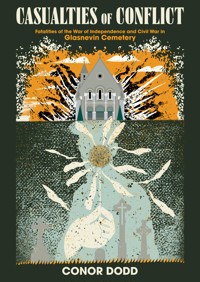
From the ordinary to the extraordinary, Casualties of Conflict explores the lives and deaths of over 300 individuals laid to rest in Dublin's iconic burial ground. These men, women and children who perished during the tumultuous years of the War of Independence and Civil War have their stories woven together for the first time in this captivating book. Through meticulous research and first-hand accounts from witnesses and participants, Conor Dodd unearths a treasure trove of tales hidden within the cemetery's burial records. From daring ambushes and covert assassinations to clandestine spies and shocking executions, the book reveals the profound impact of these historical events on the lives of ordinary citizens. This unique exploration of Glasnevin Cemetery sheds light on the extraordinary stories of revolution that lie beneath the headstones, offering a fascinating glimpse into Ireland's revolutionary past
Sie lesen das E-Book in den Legimi-Apps auf:
Seitenzahl: 684
Veröffentlichungsjahr: 2023
Das E-Book (TTS) können Sie hören im Abo „Legimi Premium” in Legimi-Apps auf:
Ähnliche


















Dedication
Do Shane – imithe romhainn ró-luath ach ní imithe uainn
MERCIER PRESS
3B Oak House, Bessboro Rd
Blackrock, Cork, Ireland.
www.mercierpress.ie
www.twitter.com/MercierBooks
www.facebook.com/mercier.press
© Conor Dodd/Dublin Cemeteries Trust
ISBN: 978-1-78117-728-0
eBook: 978-1-78117-729-7
Cover design: Craig Carry
A CIP record for this title is available from the British Library
This eBook is copyright material and must not be copied, reproduced, transferred, distributed, leased, licensed or publicly performed or used in any way except as specifically permitted in writing by the publishers, as allowed under the terms and conditions under which it was purchased or as strictly permitted by applicable copyright law. Any unauthorised distribution or use of this text may be a direct infringement of the author’s and publisher’s rights and those responsible may be liable in law accordingly.
Acknowledgements
Producing a book is a solitary task but one that is impossible without the support and contribution of many people. I have been very fortunate with the help I have received and kindness shown to me during the process by those I know and those I have never met. I would like to thank all those who I have been in contact with during the period of research and writing, I am very grateful to everyone.
The process of writing this book has, like many similar endeavours in the past few years, been made possible by the work of those in repositories and institutions in making source material available online. I am indebted to the staff of the libraries and archives listed in the bibliography for their hard and often thankless work. Particular thanks go to Brenda Malone and Clare McNamara of the National Museum of Ireland, Berni Metcalfe and the National Library of Ireland, Michael Foley, Cian Murphy and the GAA Museum, Derek Jones, Georgina Laragy, Ciaran O’Neill, Peter Power-Hynes, George Fonsie Mealy, Georgina Kelly, Peadar Breslin, Donal King, May Moran, Joe Baldwin of Southampton Archives and Local Studies, Ray McManus of Sportsfile, Natalie Jones of Reach Licensing, Mary Feehan of Mercier Press, the staff of the Military Archives and also the relatives of those included within this book that have contacted me or who I was able to contact. I would also like to thank all the staff of Glasnevin and Dublin Cemeteries Trust, past and present, who I have worked with and who not only share an interest in the cemetery but also know how special a place it is. I am particularly grateful to the CEO, Aoife Watters and Chair, David Bunworth, as well as George McCullough and John Green. Their support has made this project possible.
Finally I would like to acknowledge Liam and Mairéad who have consistently and constantly supported me. Without doubt, my greatest debt is owed to Katie, who has made everything possible. While Meadhbh and Aoibhín, whom I love dearly, have given me perspective on many things, not least the important things in life.
Go raibh maith agaibh go léir.
Introduction
Glasnevin Cemetery in Dublin is Ireland’s largest cemetery with over one million burials. Its interments represent and reflect the multifaceted history of the city and Ireland but it is also steeped in political meaning and significance. Its foundation in 1832 was, in its own right, a form of political activism by Daniel O’Connell, the Catholic Association and its supporters, in the midst of the Penal Laws and restrictions in relation to Catholic burial rights. Its initial association with O’Connell provided a basis from which it developed into a cemetery that not only holds many famous interments but is also an important space of identity and meaning. In this context the national and international conflicts of the period between 1914 and 1923 had what is arguably the most significant impact on Glasnevin.
Amongst the visible legacies of this tumultuous period are the Republican and the National Army plots, as well as the subsequent burials of well-known political figures of the revolutionary period in the areas that immediately surround those plots. However, the casualties interred within that area of the cemetery tell a small part of the wider picture in relation to the legacy of the War of Independence and Civil War in Glasnevin. Naturally the focus often falls on a small number of well-known interments. These are individuals who made significant political or other contributions during the period and remain, and are likely to remain, a deserving source of interest and study. However, even a cursory examination of the names included here show that these figures make up a small proportion of the overall numbers buried in the cemetery who died as a result of these conflicts. It is also worth noting that although parts of the cemetery, such as the Republican, Royal Irish Constabulary or National Army plots, can be described as being curated spaces of political or institutional importance, the majority of those included in this book were interred in Glasnevin due to its practical function as a burial place. Beyond this, familial links to the cemetery are also in evidence through family burial plots or relations previously buried in the cemetery. It is therefore important to emphasise, that although Glasnevin has a reputation of revolutionary importance, for most of those who died in the two conflicts examined here, the cemetery was chosen due to practical or personal reasons rather than political.
In focusing simply on biographies and the circumstances of death of those killed this book has a necessarily narrow view of the revolutionary period in Ireland. As a result the significant political, social, administrative and other change of the period is somewhat obscured but glimpses are visible through the lives of those included. The use of a chronology of deaths also assists in using these biographies to track the progression and the ebb and flow of the conflicts.
Through them, we can see the expansion of urban warfare in Dublin, executions, assassinations, the Connaught Rangers mutiny in India, rural ambushes, Bloody Sunday, the Battle of Dublin, seaborne landings, the Kerry offensive, extra-judicial shootings and official executions of the Civil War and much more. The connections between events, personalities and deaths is also clear throughout, showing the, at times, parochial nature of the conflicts with their chains of events, actions and reactions. Juxtaposed with this is the representation in the book of those who were born in twenty-three different counties as well as Wales, England, Scotland, Canada and the United States of America. Likewise, although many of the fatal incidents recounted occurred in Dublin, there is also a much wider geographic representation and sense of the conflicts beyond that county. Perhaps most important are the examples that give a sense of the grief, loss and impact on individual family members left behind and, in certain cases, who also witnessed the death of their loved one.
Where possible, I have tried to include first hand accounts of the circumstances of fatalities, however, like all witness statements these can be influenced by different factors and varying accounts of the same incidents exist in many cases. The available evidence will be debated, contested and interpreted in many different ways but I have attempted to give a balanced representation of all incidents. This includes the determination of affiliation attached to every individual. This is not intended as a definitive judgment of the status of an individual, or indeed representative of their own political activities or other beliefs, which as the biographies demonstrate can be complicated. However, I have attempted to categorise all those listed. The criteria for the biographies included are those who met their deaths because of political violence or in carrying out political activities or protest. A very small number of individuals who died through apparent armed robberies or in homicides that appear to have no clear political motivation or connection have been excluded.
A visitor to Glasnevin in the nineteenth century, utilising a quotation from As You Like It, described that there were ‘sermons in stones’ within the walls of the cemetery. His description might have been more apt than he had imagined given that Glasnevin was formed as part of the garden cemetery movement earlier that century. This ethos, which had a direct impression on the early formation of the cemetery, advocated for the positioning of burial grounds as institutions of culture and heritage, an experiential and educational space that had the potential to inform visitors of the current generation and future generations. In recent years, the cemetery has returned to this function, albeit in a very different way, through its educational activities, tours and visitor centre. The ultimate aspiration of this book is to provide a basis for exploring the War of Independence and Civil War through the prism of Glasnevin. It is hoped that it will not just act as a guide for those who might visit the cemetery but also demonstrate the possibilities of using cemeteries and burial places for educational purposes and to shine a little light on personalities, incidents and events of the past.
Conor Dodd
Patrick Smyth (centre, with moustache) with other Dublin Metropolitan Police detectives outside the Dublin City Morgue following an inquest in March 1919. Courtesy of Mercier Archives.
1919
8 September 1919 Dublin Metropolitan Police
Patrick Smyth DH 225½, St Bridget’s
Patrick Smyth, a detective with G Division, Dublin Metropolitan Police, was shot on the evening of 30 July 1919, his wounds proving fatal. His shooting was the first assassination attempt authorised by IRA General Headquarters and would be a precursor to the types of operations carried out later in the War of Independence by the Squad.
Born in Co. Longford, Patrick Smyth joined the DMP in 1893 aged twenty-five becoming a member of G Division four years later. Having settled in Dublin he married Annie Bourke in 1901 and lived at 51 Millmount Avenue in Drumcondra. In the aftermath of the 1916 Rising, and early stages of the War of Independence, Smyth became well-known as an active and efficient detective, working in combating and harassing the activities of republicans. His activities had made him a source of great irritation for many leading figures in the independence movement, including Michael Collins. In March 1919, he was involved in the arrest of Piaras Béaslaí, who was found to be carrying documents of a military nature. Despite being approached, and warned not to forward evidence to the trial of Béaslaí, Smyth did so, resulting in a guilty verdict and two year jail sentence for Béaslaí. As Smyth continued in his work plans were being put in place for his assassination. James Slattery was one of four men tasked with shooting Smyth. He later recalled the events leading to the evening of 30 July 1919:
Mick McDonnell told us that Detective Officer Smith [Sic]was living in Millmount Avenue and he was to be shot as he was becoming too active working against Volunteer interests. Mick McDonnell instructed me to go to Drumcondra Bridge and take with me Tom Keogh, Tom Ennis and Mick Kennedy, who knew Smith by sight. Mick McDonnell told us that Smith usually came home by tram, alighted at Botanic Avenue, and walked across the bridge. We were to wait at the bridge and shoot Smith when opportunity offered. We waited at Drumcondra bridge for about five nights. Finally we saw a man approaching across the bridge and Kennedy said, ‘I think this is Smith’. I told him to make sure, but Kennedy said he could not be sure, although he thought it was Smith. I said ‘If this man turns into Millmount Avenue we will shoot him’, because I knew Smith was living there and between Kennedy being nearly sure of his identity and the fact that he turned into Millmount Avenue would leave very little doubt about him. Kennedy was still undecided, but instead of turning into the Avenue, the man walked across, passed the Avenue and turned down a lane going along the back of the Avenue. After he passed us and crossed over I nearly dropped on my knees thinking I had nearly shot an innocent man, but when he turned down at the back of the houses we knew it was Smith. By this time he had gone out of range and we knew we had missed him. There was a bit of an argument then, ‘I told you so’ and so on ... We came back again to the bridge and after about a week we shot Smith. We had .38 guns and they were too small. I thought that the minute we would fire at him he would fall, but after we hit him he ran. The four of us fired at him. Keogh and myself ran after him right to his own door and I think he fell at the door, but he got into the house. He lived for about a fortnight afterwards. I met Mick McDonnell the following morning and he said that we had made a right mess of the job the night before, but I can assure you that I was more worried until Smith died than Mick was. We never used .38 guns again, we used .45 guns after that lesson.
It was reported that Smyth was making good progress in his recovery in the Mater Hospital despite being shot five times. He even had the opportunity to give an account of his shooting to another member of the DMP:
I was going home soon after 11 o’clock. When I got off the tram at the end of my own avenue, I saw 4 or 5 men standing against the dead wall and a bicycle resting against the kerbstone. Just as I turned the corner I was shot in the back. I turned round and said to them ‘You cowards’ and 3 of them fired again with revolvers at me and one bullet entered my leg. I then ran away and they pursued me to within about 15 yards of my own door and kept firing at me all the time. In all, about 10 or 12 shots were fired at me. I shouted for assistance but no one came to me except my own son. I had no revolver myself and I am glad now I had not one, as I might have shot some of them when I turned round after the first shot, and I would not like now to have done that. About a week ago, when going home one night, I noticed a similar number of men at the same place with two bicycles. As I suspected them, I did not go into my own avenue but went along as far as Millbourne Avenue, where I turned up to my own house. I cannot describe any of the men nor can I identify any of them.
Despite his initial progress, Patrick Smyth died of his wounds on 8 September 1919. Three days later, following requiem mass at Mount Argus, his remains were removed to Glasnevin for burial in what was described as a semi-private and ‘simple funeral’ with family, friends and some colleagues attending.1
1920
22 March 1920 Civilian
Ellen Hendrick DD 71, St Paul’s
Ellen Hendrick, who was born in the Coombe Hospital on 28 September 1901, was the daughter of William Hendrick, a baker and Ellen McCann who resided at 5 Kelly’s Cottages. She was killed after members of the British army, who were attempting to disperse a crowd, fired shots. 22 March 1920, the day of Ellen Hendrick’s death, marked the anniversary of the Battle of Tofrek, fought between the British army and Mahdist forces in Sudan in 1885. The 1st Battalion of the Berkshire Regiment was present and because of their involvement was granted the Royal title, becoming the Royal Berkshire Regiment and marked the day annually. On this occasion its members, who were stationed in Portobello Barracks, were given 150 tickets to a performance in the Theatre Royal on Hawkins Street.
In the House of Commons, the chief secretary of Ireland, Ian MacPhearson, outlined the official account of events that occurred that evening after T. P. O’Connor, the Home Rule MP, raised the issue with him:
The 22nd of March is the anniversary day of the Royal Berkshire Regiment, and 150 were given free tickets by the battalion for the performance at the Royal Theatre. At the end of the performance the men sang the National Anthem. No disturbance occurred. The men then proceeded home in groups, singing. A crowd collected and followed, and on reaching Kelly’s Corner, at about 9 p.m., the crowd commenced to throw stones at the troops. The troops were unarmed, but defended themselves, gradually moving up South Richmond Street. On reaching Lennox Street, the troops were fired on by the crowd, who used revolvers; one soldier was shot in the chest. At 9.45 p.m. information reached Royal Berks headquarters at Portobello Barracks concerning the disturbance. A cyclist patrol, under an officer, was ordered to proceed to the scene of the disturbance, and to assist the men who had been attending the theatre to return. The patrol reached the scene at about 10 p.m., and was supported by a piquet on foot. On reaching Portobello Bridge, fire was opened on patrol from direction of Portobello House, and stones were thrown by the crowd. The officer in charge of patrol, considering that his command was in danger, cautioned the crowd, and ordered them to disperse. The crowd refused to do so. The officer then ordered ten rounds to be fired, and charged the crowd, which withdrew to Fade Street. The patrol followed up the crowd as far as Kelly’s Corner, where it was again fired on by civilians. A position was taken up at Kelly’s Corner, and civilians in the vicinity were searched for arms. A further reinforcement was sent to the patrol from Portobello Barracks, but nothing further transpired.
It was disputed whether the soldiers had been fired on but some witnesses noted that the gathered crowd threw stones and other objects at them. The actions of the soldiers while returning to their barracks from the Theatre Royal did little to endear them to the local onlookers and exacerbated an already tense situation. One newspaper stated that the evidence of civilian witnesses showed:
... their conduct was characterised by disorder and by shouting such as to cause irritation and annoyance throughout the whole of their march to South Richmond Street.
The initial melee had little risk of fatalities, as the members of the Berkshire Regiment engaged in it were unarmed. However, when armed reinforcements arrived, commanded by twenty-two year-old Lieut Thomas G.L. Dawson, the situation became much more dangerous. In his report to the adjutant, Dawson stated that:
On the night of 22nd March 1920, I was detailed to proceed down to Dublin town and deal with a hostile mob (and rescue the theatre party) which had shot some of our men. On reaching Portobello Bridge I came in contact with the crowd who booed at us, threw bricks and fired shots. I cautioned them and they continued to fire and throw stones. I gave the order to fire and we charged the mob who dispersed towards Kelly’s Corner and down the side streets. We then followed them down the main road and were fired at again at Kelly’s Corner. We had no casualties in my command but three civilians were hit. We searched every pedestrian whom we met in the street but found no arms.
One of those hit was Ellen Hendrick. She was not part of the crowd that had gathered but was making her way towards the centre of the city from Rathmines. John Nolan, a civilian from Albert Place, witnessed the soldiers fire shots from Portobello Bridge and Ellen fall. As she did so, she screamed that she had been shot. The bullet had entered her chest and exited through her back severing a number of blood vessels. She was removed to the Meath Hospital but was dead on arrival. A girl, with whom she worked as a servant, originally identified her as Margaret Dowling, as she knew her by that name so there was a delay before her mother correctly identified her. Her funeral took place on 25 March from St Nicholas’ church to Glasnevin. At the time, the incident drew many comparisons with the shootings at Bachelor’s Walk in 1914 and the army were denounced at the coroner’s inquest that took place following it.
Ellen was the first to be buried in a family grave in the St Paul’s section of the cemetery. In 1944, her brother William Hendrick was buried in the same grave. William had served throughout the First World War as a member of British army with the Army Service Corps. He was one of the first to arrive in France with the British Expeditionary Force and left the army just under a year before his sister was killed. He returned to serve during the Second World War and died while still a member of the Army Catering Corps. Their grave is marked in memory of Ellen and also bears a formal marker in memory of her brother, William.
Thomas G.L. Dawson, who commanded the detachment that opened fire on 22 March 1920, served for a long period with the Berkshire Regiment and throughout the Second World War. He died in Wales in 1988 aged ninety.1
9 May 1920 Irish Republican Army
Francis Gleeson RD 35, South New Chapel
Francis Aiden (Frank) Gleeson died on 9 May 1920 in the Mater Hospital in Dublin. Born in Liverpool in 1895 to Irish parents Gleeson was a trainee teacher and a member of the Irish Volunteers when he travelled to Ireland in 1915 in order to avoid the possibility of being conscripted into the British army. His brother later described that his decision to leave England was ‘because he did not want to dishonour his soul’. Gleeson initially joined with the Irish Volunteers in Belfast before he moved to Dublin in 1919. There he lived at 34 Cadogan Road with the Holohan family. Hugh Holohan was a fellow member of Dublin Brigade, IRA and early on the morning of 19 February 1920 the house on Cadogan Road was raided by members of the British army acting on information received from the DMP. During the raid revolvers, ammunition, a bullet-making machine, notebooks and orders were found. Hugh Holohan, Francis Gleeson and two other men were arrested. The men were initially brought to Ship Street Barracks and later transferred to Mountjoy. They were briefly released but promptly arrested once again and placed on trial for possession of revolvers and ammunition. Gleeson refused to give any information to the authorities on his entry to Mountjoy and was processed under his alias, Aiden Redmond. The four men were sentenced to two months hard labour with a further month on probation. On Easter Monday 1920 Gleeson and over sixty other IRA prisoners went on hunger strike. The numbers participating in the strike grew to over 100 and after ten days on strike Gleeson was one of a number of prisoners who were released. However within this time his health had deteriorated significantly and he was taken straight to the Mater Hospital. He remained in hospital until 3 May when he was discharged but two days later was taken back by ambulance. Suffering with acute appendicitis he was operated on but died the following day. An inquest returned a verdict that he died of ‘toxaemia following nephritis and acute appendicitis accelerated by hunger strike’.2
28 May 1920 Royal Irish Constabulary
Thomas Kane JF 233½, Garden
Born in Co. Meath, Thomas Kane joined the Royal Irish Constabulary in 1891, aged nineteen, and became a member of its Mounted Force the following year. His first period with the police force lasted until 1901, when he temporarily resigned from the RIC and joined the newly raised 131st (Irish Horse) Company of the Imperial Yeomanry to serve in South Africa during the Anglo-Boer War. Following his return to Ireland at the end of 1902, he was reappointed to his position and continued to serve on horseback with the police. As time progressed, the Mounted Force of the RIC became outmoded and by 1920 it only had thirteen members including Thomas Kane, who was one of its three sergeants. It was disbanded that year and Kane was due to be appointed to a new position in Co. Limerick. On 26 May 1920, he was temporarily sent to Kilmallock where two days later a group, consisting of some 100 IRA volunteers, participated in and supported the attack on the fortified barracks there. Here the RIC detachment with Tobias O’Sullivan (see 20 January 1921) defended the barracks against a long and sustained attack. One of the members of the IRA who took part in the attack that night later recalled the events that led to the death of Thomas Kane:
By the spring of 1920, the campaign against RIC barracks was well under way and successfully fulfilling its two-fold purpose of loosening the enemy’s hold on the country and augmenting the arms of the Volunteers. It was decided to attack and capture Kilmallock RIC barracks. It was discovered that the normal strength of the barracks consisted of two sergeants and eighteen men. The building was a very substantial one and all the windows were steel shuttered and slotted to enable rifle to be fired through them. In addition to a plentiful supply of ammunition, the garrison was well provided with rifle, grenade and Mills bombs. In short the police were in the position of an exceptionally strong military force with every prospect of holding out for days against even overwhelming numbers. The barrack however, had one drawback, of which great advantage could be taken by daring attackers. Situated in the main street of the village, it was a rather low, squat structure strongly built, but overlooked by higher buildings adjacent to it. This gave the attackers, provided they could occupy these buildings successfully, a dominant position over those barracks ... It was too much to hope that so strong a barrack could be carried by a short, sharp attack. It would obviously have to be besieged. This constituted the greatest part of our task, because a protracted fight would certainly lead to the possibility of reinforcements coming to the relief of the garrison. Our force was too small for the risk to be lightly regarded. All available help in the entire district was accordingly mobilised at 9 o’clock on the night of the attack and all the main roads, by-roads and railway tracks for a radius of about fifteen miles around Kilmallock were rendered impassable for any form of traffic. A prodigious amount of labour went into this work, but it was cheerfully and effectively done, and it was well indeed that it was so, for the barrack proved a far tougher proposition than we had counted upon.
About thirty men, each of whom was recommended by his local commander, were now specially selected, armed with the best of rifles, given a plentiful supply of ammunition and detailed for the direct attack on the barracks. The remaining men, to the number of about forty, armed with shot-guns and all sorts of miniature weapons were detailed to guard minor entrances and exits ... About six paces from the gable-end of the barracks, facing south-west, another building towered above it. From the roof of the building our leader was to give three flashes of a lamp which was the signal to begin the attack. All eyes were now straining towards this point. There was no sign of life or activity from the barrack and we seemed to have made our occupation of the surrounding houses without arousing suspicions. Suddenly from the roof top three flashes of light winked out into the night and were instantly answered by the roar of thirty rifles. At the same moment our leader cast a fifty-six pound weight crashing though the slates of the barrack roof. Two other fifty-six pound weights followed in quick succession, their crashing noise passing almost unnoticed in the din of rifles and bursting bombs. This unique method of breaking a fort was very effective, causing a large gaping hole in the roof. Into this opening our leader, from the roof hurled bottle after bottle of petrol. The bottles broke and saturated the roof with petrol. Then our leader hurled bombs into the breach. Each bomb burst with terrific force causing considerable damage but completely failing to set the roof on fire. Meanwhile the fight was raging fiercely all round the barrack. The large garrison had manned every loop-hole and were returning hot fire to our attack... By means of a hose paraffin was now poured into the breach in the roof, for the best part of an hour. Then another Mills bomb hurled into the breach had the desired effect and the roof burst into a blaze... The battle for possession of the barracks raged without intermission from midnight to 2 a.m.. At that hour our leader flashed out the ‘cease fire’ signal from his perch on the house top. It was almost instantly obeyed by the attackers and the only sound was from the intermittent fire of the defenders. It was a weird night and one which the participants are never likely to forget, the smoke of burst bombs and the burning roof billowing around the building, the sudden comparative quiet after the fierce noise of the conflict, the red, hungry flame shooting skyward out of the doomed building.
The garrison was called on to surrender but the reply was ‘No surrender’ followed by a volley of rifle and grenade fire. Instantly the three flashes of light for the ‘open fire’ winked out from the house-top and the battle was again in full swing. For upwards of three more hours the building, the fire of which was increasing every moment, was subjected to a continuous attack. During all this time the defenders, who showed remarkable courage and pertinacity, directed their main efforts against Clery’s Hotel. They endeavoured to make this position untenable by a continuous attack ... The fight had been waged for over five hours and the entire barrack was little better than a roaring furnace. The position of the defenders was hopeless as it was quite impossible to remain any longer in the building. Once more the ‘cease fire’ signal flashed out. Silence again took the place of conflict. The garrison, for the last time, were called upon to ‘surrender’. Their answer was ‘never’ followed by a few shots. The fight then recommenced and was continued up to about a quarter to six. About that hour the entire roof fell in, amidst frantic cheering from the attackers. Flames, sparks and clouds of smoke now shot skyward, giving a weird red tinge to the whole scene. The defenders had by this time made a dash to a small building in the yard of the barrack. This building like the barracks, was fortified... From this small building they put up a stubborn resistance. They fought the fight of heroes and although we were engaged in a life and death struggle with them, we readily acknowledged the magnificent stand they made in the face of an utterly hopeless situation... With daylight full across the country, our supplies of ammunition exhausted and the danger of being trapped by heavy reinforcements, our leader was forced to sound the ‘Retire’. We retired in good order leaving the barracks a smouldering ruin.
Sgt Thomas Kane had been killed in the main barrack building. An inquest was unable to convene because the full jury summoned did not attend. His death was recorded as being due to ‘shock from burns’, however, contemporary reports described Kane as being killed by one of the bombs that was thrown into the barracks at the height of the battle. He was posthumously awarded the Constabulary Medal for his gallantry in the defence of the barracks.
His funeral came to Glasnevin on 1 June 1920 with his coffin draped in the Union flag and led by the bands of the 15th Hussars, Royal Irish Constabulary and Dublin Metropolitan Police. His wife, Teresa, whom he had married in 1905, and their children followed the hearse. Amongst those in attendance were the chief commissioner of the Dublin Metropolitan Police Lieut Col Walter Edgeworth-Johnstone and Lieut Gen Henry Hugh Tudor. His widow, who remarried a former member of the Royal Irish Constabulary in 1922, died in 1952 and is buried with him.3
Courtesy of Reach plc (Daily Mirror)
The funeral of Thomas Kane in Glasnevin. Courtesy of Reach/Daily Mirror.
1 July 1920 Connaught Rangers
Peter Sears SD 28, South New Chapel
Peter Sears from Ballyshingadaun, the Neale, Ballinrobe, Co. Mayo enlisted in the Connaught Rangers at Claremorris in November 1914, following the outbreak of the First World War aged eighteen. A member of the newly formed 6th Battalion Connaught Rangers, part of the 16th (Irish) Division, he was sent to the Western Front, arriving in France in December 1915. Whilst serving with the Connaught Rangers he was temporarily attached to the Royal Engineers and specifically to one of their tunnelling companies. In the midst of the stagnation of trench warfare in France and Belgium these units of tunnellers were often given the responsibly of digging from their own trenches underneath no-man’s land and beneath their enemies defensive positions where large quantities of explosives were placed and detonated. The job was not just difficult physically but also dangerous and nerve-racking as both sides mined and counter-mined. They also listened to each other’s movements in the anticipation of detonating explosives to blow one another up. Sometimes they even broke through into enemy tunnels with subsequent hand-to-hand fighting in the dark with knives and bayonets. The chalky soil of northern France lent itself well to this type of tunnelling but for Peter Sears the dust it produced resulted in significant health issues and he eventually began suffering with defective eyesight. Despite this he continued to serve during the war and in July 1918, he was transferred to the Labour Corps where he was involved in overseeing German prisoners of war who were used to carry out a variety of different labour tasks in groups known as Prisoner of War Companies. Peter Sears remained in France until February 1919 when he was discharged. However, he soon re-enlisted in the Connaught Rangers, this time the 1st Battalion of the regiment, which was stationed on garrison duty in India.
It was here on 28 June 1920 that a chain of events began leading to the deaths of Peter Sears and Patrick Smythe (seebelow). On that day, a mutiny began amongst members of the Connaught Rangers stationed in northern India. Amongst the mutineers’ concerns was the situation in Ireland and the actions of British authorities in the War of Independence in their home country. The mutiny began peacefully in Jalandhar through a refusal to carry out their duties in protest and soon spread to another garrison at nearby Solon. Here events came to a violent climax when some members of the Connaughts attempted to rush the garrison armoury to capture weapons they had earlier given up. During this struggle, both Peter Sears and Smythe were fatally wounded. The mutiny of the Connaughts was quickly quashed and the participants placed under arrest and marched away to face courts martial. There was some understandable confusion during the attempted storming of armoury at Solon and differing accounts of the wounding of Sears and Smythe exist. Joseph Hawes, the de facto leader of the mutiny in Jalandhar, gave details of the events at Solon that were recounted to him by the leader there, James Joseph Daly, who was later executed by firing squad:
On the day of our mutiny at Jallander the officers in Solon must have been notified of the occurrence. Rumours started to circulate amongst the men at Solon, probably through the indiscretion of some officer, but none of the men knew what was wrong at Jallander but that something had happened there. Kelly and Keenan arrived at Solon barracks and were immediately put under arrest but as they were being led away they shouted an incomplete message of the happenings at Jallander. Private James Joseph Daly who chanced to be one of those on the scene overheard what Kelly and Keenan said even though the message was incomplete Jim Daly figured out the rest for himself and took action. He immediately spread the word of the Jallander mutiny and what had caused it, about 40 of his comrades joined him and they occupied a bungalow over which in a short time flew the tricolour. This was only about one third of the total force at Solon. Like the Jallander men the Solon mutineers were also armed. Father Baker, an Irishman and an army chaplain, advised Daly and his comrades to hand up their arms as they were only a small party and not as strong as the Jallander mutineers. They took his advice to fight a passive resistance and their arms were handed over and put in the magazine. A heavy guard was then put over the magazine by the authorities. This magazine was built on rising ground.
That night a rumour spread in the barracks that British troops were coming in the morning to arrest the rebels. At a discussion in the canteen some of the hotter mutineers suggested taking back their arms and fighting the British. Daly who was a teetotaller himself said ‘I have given my word to Fr. Baker and I won’t break it’. Somebody said ‘Are you afraid?’ This grieved Daly who said ‘fall in outside and follow me and I will show you I am no coward.’ The mutineers obeyed and fell in behind Daly and advanced up the hill towards the magazine. When they reached between 20 or 30 yards of the magazine which was still on a ledge over them a sentries voice rang out ‘Halt who goes there’. The men halted and Daly stepped forward a pace and said ‘I’m James Joseph Daly of Tyrrell’s Pass, Mullingar, Westmeath, Ireland and I demand ye are to lay down your arms and surrender in the name of the Irish Republic’. Immediately Lieutenants Walsh and McSweeney (Sic) who were in charge of the guard opened fire with their service revolvers at Daly. They missed Daly but mortally wounded Private Sears who though wounded rushed the rising ground and fell dying at the feet of the two officers. Private John Egan was shot through the chest but survived to later stand trial and be sentenced to death. Private Smith (Sic), who was not a mutineer and not of the party which approached the magazine, going to his bungalow further down the hill was shot through the head and died on the spot. Father Baker on hearing the shooting rushed to the scene and implored all concerned to take back the dead and wounded to the camp hospital. At the hospital Egan’s wound was attended to and it was seen that nothing could be done for the other two men.
Lieut Desmond Thomas McWeeney, from Dublin, was one of the officers in charge of the armoury on the night of the attempted capture of the weapons. At the court of inquiry into the events of the night, he described how Lieut C.J. Walsh called for assistance and his response:
... about 22.00 hours, I was sitting in the veranda of the officers’ mess. I heard a whistle blown, which I knew to be the alarm signal, from the direction of the magazine. I immediately ran to the magazine followed by the Guard, where I met Lieut Walsh, who told me that four mutineers had tried to rush the Sentry, and, on being cautioned by him, withdrew. I then took up a position close to Lieut Walsh, and on the south side from the mens’ bungalows. A few minutes after an attack was made on the Magazine by the Mutineers armed with naked bayonets. The attackers were challenged at least three or four times, but refused to stop. As a further warning, I fired two revolver shots into the air, but the attackers took no notice but came on. I then fired into the attackers, who, thereupon, withdrew. I shortly afterwards saw three men being carried on stretchers to the station Hospital, two of whom, I heard, were dead and one wounded.
Both Peter Sears and Patrick Smythe were buried in Solon and remained there until 1970 when they were exhumed and returned to Ireland for burial in Glasnevin. Both men were interred together, a short distance from the Connaught Rangers mutiny memorial in the cemetery, which had been erected and unveiled in June 1949 in a ceremony attended by some of the surviving mutineers, 1916 Rising veterans, former members of Cumann na mBan and relatives.4
1 July 1920 Connaught Rangers
Patrick Smythe SD 28, South New Chapel
Patrick Smythe died from wounds received during the Connaught Rangers mutiny at Solon in India (seeabove). Smythe and Peter Sears were the only two men to be killed during the mutiny and both are buried together in Glasnevin. Patrick Smythe, from Drogheda, was a regular soldier and member of the Connaught Rangers before the outbreak of the First World War having enlisted in December 1910 in Cavan. Having served at home for just over a year, he was sent to India where he remained with his regiment from 1912 to 1914 when, along with his battalion, he was recalled to Europe to take part in the war there. Smythe spent the war with his battalion, serving firstly in the fighting around the town of Ypres in Belgium in the autumn of 1914 and he was wounded in the left arm in November 1914 during the First Battle of Ypres. In December 1915, he left France arriving in Mesopotamia where he took part in the campaign there for two years, fighting against the Ottoman Empire. After a brief period back in India, Smythe and his battalion moved to Palestine joining with the Egyptian Expeditionary Force in campaigns in Transjordan and Syria where they remained until the end of the war. He re-enlisted for further service with his regiment following the Armistice and was sent to India in October 1919 where he was present in Solon during the mutiny and was fatally wounded. At least two of his comrades noted that Smythe was not an active participant in the mutiny and was an unlucky bystander. A letter to his mother Bridget on 17 July 1920 confirmed to her the death of her son:
I regret having to inform you that a report has been received from India to the effect that your son, No. 10079 Lance Corporal Patrick Smyth [Sic], 1st Battalion, The Connaught Rangers, died on the 1st July 1920 from gunshot wound. No further particulars have been received in this office.5
9 August 1920 Civilian
Thomas Farrelly VC 77, St Paul’s
Thomas Farrelly, from Mary’s Lane in Dublin, was shot dead by members of the Lancashire Fusiliers who opened fire on him, and a group of other men, gathered at the junction of Greek Street, Mary’s Lane and Beresford Street, to the rear of the Four Courts, following curfew on the night of 9/10 August 1920.
Born in Dublin in 1900 Thomas was the son of Patrick and Mary Farrelly. On the night of his death, a bonfire had been lit, and a crowd had gathered, in support of the Irish-born Catholic archbishop of Melbourne, Daniel Mannix. The archbishop had been prevented from visiting Ireland by the British govern- ment due to his outspoken support for the republican movement. While the group gathered around the dying embers of a fire, they sang songs. As they sang ‘The West’s Awake’, a routine military patrol of fifteen men of the Lancashire Fusiliers, under the command of Lieut J.A. Smith, arrived at the location. Smith later stated that he saw the group of people moving around by the light of the fire and decided to split his party into two sections. The first under his command approached via Mary’s Lane and the other, under the command of Sgt Burgess, approached by Greek Street. As they advanced the latter party opened fire and the group of civilians ran. As Thomas Farrelly was approaching his nearby family home, he was struck by a number of bullets. His mother remembered being woken by the shots followed by her son shouting out ‘Mother, Mother’. The fatally wounded Farrelly was taken into his home where Lieut Smith arrived shortly afterwards telling Mary Farrelly ‘My God, I gave no order to fire’. In the civil inquest that followed, his death a finding was produced that stated:
We find that Thomas Farrelly died on August 10 from shock and haemorrhage caused by bullets fired from the guns of the military on 10th inst. without justification. We strongly condemn the action of the military in empowering youths to endanger the lives of citizens and we desire to place on the record our deepest sympathy with the relatives of the deceased.
The funeral of Thomas Farrelly to Glasnevin on 13 August was a huge event and a significant political funeral. It began with a service at St Michan’s before removal to the cemetery just after 14.00. His coffin was draped in a Tricolour, which had been made by Thomas in the days before his death, and was embroidered with the words ‘Welcome to Dr Mannix’. Large crowds lined the route of the funeral with members of the Volunteer movement acting as marshals. Two bands led the procession with a Tricolour marked with a black cross and a horse drawn bier was used to transport floral tributes. Amongst the mourners were members of Dáil Éireann, including W.T. Cosgrave and Richard Mulcahy, Dublin Corporation and a significant representation of clergy. He was buried in the St Paul’s section of the cemetery.6
Thomas Farrelly (inset) and his funeral on arrival at Glasnevin. Courtesy of Reach/Daily Mirror.
3 September 1920 Irish Republican Army
Neill Kerr SD 38, South New Chapel
Neill Kerr, an IRA volunteer, was killed in an accident during an operation involving the shipment of weapons in Liverpool, England. Born near Loughgall in Co. Armagh in 1896, he was the son of Neill and Sarah Ann Kerr. The family moved to England and lived at Florida Street in Bootle. Neill junior participated in the 1916 Rising and was a member of the garrison at Jacob’s Biscuit Factory, being interned in Frongoch following the surrender. Neill, his father and many other members of his family were also active participants in the War of Independence. On 3 September 1920 Kerr, along with his father, brother, and other Liverpool IRA members were awaiting a shipment of arms and ammunition from Scotland to be sent to Dublin. While the group was waiting in the basement of a Sinn Féin Club, at 93 Scotland Road in Liverpool, Kerr was fatally wounded. Stephen Lanigan, in support of an application by Neill Kerr senior for a military pension, stated that while waiting for the consignment of arms in Scotland Road the tension increased over many hours and a gun was accidentally discharged resulting in the death of Neill Kerr. He further stated that Neill’s brother, Tom, fired the fatal shot. Patrick Daly, a member of the Irish Volunteers and IRB in Liverpool, who was present when Kerr died, gave a similar account of the incident to the Bureau of Military History, albeit with one significant difference:
On one of these few occasions on which a lorry or car was expected I remember a tragedy occurring affecting one of our members. We were waiting in a cellar for this lorry to come from Glasgow and, as the time of arrival was very uncertain, actually after waiting all day it did not come at all. But during the course of the day a member of the I.R.A., a son of Kerr, put as he thought, an empty parabellum to his head and shot himself dead.
The remains of Neill Kerr were brought from Liverpool to Dublin on the steamer Killineyaccompanied by his father, step-mother, sister and brother. After mass at the church on City Quay, the coffin was brought, covered in the Tricolour, to Glasnevin where he was interred in the Republican Plot.7
30 September 1920 Royal Irish Constabulary
James Joseph Brady TE 7, South New Chapel
James Joseph Brady in the uniform of the Irish Guards. Courtesy of Peter Power Hynes.
James Joseph Mary Brady was born on 9 October 1898 in 17 Corrig Avenue, Kingstown (Dún Laoghaire), Dublin. The son of Louis Brady and Anne Corless his father worked on a number of merchant navy and other vessels operating from the town. In the early 1900s Louis became one of the crew of the Commissioners of Irish Lights vessel SS Tearaght,later rising to become captain of another of the lighthouse service’s vessels the SSIerne. In January 1916, James joined the Inns of Court Officer Training Corps, giving a fake date of birth on his enlistment and the following April was enrolled as a cadet in the Dublin University Officer Training Corps in Trinity College, Dublin. Following his training, he was commissioned as a second lieutenant in the Irish Guards and sent to the Western Front for service. Following the war he joined the Royal Irish Constabulary as a cadet in February 1920 and was made a district inspector in June, being posted to Ballymena in Antrim. Soon afterwards, he wrote a letter to Dublin Castle requesting to be posted elsewhere stating that:
I have a good station and should be sorry to lose it but I am only 22 years old and fit and I do not see why I should be up here in safety and not in the firing line where I might relieve some older man who may be nerve-wrecked and feeling the strain.
As a result, after just three months in Ballymena, he was transferred to Tubbercurry in Sligo on 11 September 1920 where the district inspector had reported sick. There he was killed before the end of that month in an ambush. John P. Brennan, a member of Sligo Brigade IRA, described the engagement:
After the brigade had received a consignment of arms from GHQ it was decided to carry out an ambush in the battalion area of Chaffpool. In order to cause enemy activity and get enemy patrols on to the roads we raided a mail car in the early morning of the 1st September. Frank Carty took charge of the men who took up position at Chaffpool. The number of men in Carty’s party, including himself, was 10. All were armed with service rifles. After waiting the whole day in position, towards evening a Crossley tender approached containing a load of police. The police officer in charge of the Crossley was District Inspector Brady who had been in the area only a short time and whose advent in Tubbercurry initiated British activities against the IRA. Brady was sitting with the driver of the car and the rest of the police were in the body of the lorry. As the lorry came opposite the position occupied by our men fire was opened on them. D.I. Brady received five bullet wounds which proved fatal a few hours later. Head Constable O’Hara was severely wounded and a Constable Browne was also wounded. The driver of the tender was able to get the tender through and reach Tubbercurry safely. None of Carty’s men was injured by the exchange of fire from the police in the lorry.
Following the ambush and the death of Brady reprisals took place in Tubbercurry with homes and businesses being burned. The burnings resulted in approximately £125,000 of damage and, significantly, the loss of two creameries in the area, affecting over 1,000 dairy farmers. The funeral of James Joseph Brady came to Glasnevin on 4 October. Following mass at Aughrim Street his coffin was placed on a gun carriage and the cortege proceeded to the cemetery with a police and military guard of honour including members of the Irish Guards who had travelled from London for the occasion. Members of the RIC and DMP lined the pathways of the cemetery to the grave where the Last Post was sounded. His parents and his uncle, P.J. Brady, a former Irish Parliamentary Party MP for Dublin St Stephen’s Green, led the mourners. He was buried in the grave of his grandfather who died in 1879.
Upon hearing of the reprisals following the death of his son, Louis Brady decided to write to the parish priest in Tubbercurry, Canon Gunning. His letter was read to the parishioners the week of his son’s funeral:
Very Rev and Dear Sir,
As regards the death of my beloved son, writing on his mother’s behalf and my own, I want to tell you that neither of us entertains the least feeling of ill-will towards anyone in connection with the tragedy. God’s holy will be done. It was his way of bringing Jim to heaven. We forgive from our hearts whoever was responsible for this deed, wherever they came from. My wife and I were deeply grieved to learn of the reprisals that have taken place in your parish. No useful purpose is served by such conduct, and if anything could now make my poor boy unhappy it would be to know that he was the innocent cause of injury to anyone. Availing for your prayers and those of your congregation for my boy and his heartbroken mother and father.
Believe me yours sincerely,
Louis Brady.8
The funeral of James Joseph Brady on its way to Glasnevin. Courtesy of the National Library of Ireland.
The parents of James Joseph Brady arrive at the cemetery during his funeral. Courtesy of the National Library of Ireland.
14 October 1920 Civilian
Patrick Carroll XJ 300½, St Patrick’s
Patrick Carroll, a sixteen-year-old messenger boy, from Royal Canal Terrace was shot and killed during a firefight on Talbot Street in Dublin. The fight also resulted in the death of Seán Treacy, one of those responsible for the Soloheadbeg Ambush, regarded as the first military engagement of the War of Independence, and one of the most wanted IRA men in Ireland. Following the escape of Dan Breen and Seán Treacy from the house of John Carolan in Drumcondra (see 26 October 1920)Breen was treated for his wounds in the Mater Hospital under an alias while Treacy remained in Dublin. Two days later in the early evening of 14 October 1920, a British raiding party outside the Republican Outfitters on Talbot Street found Treacy. Following a struggle and firefight Treacy and a British intelligence officer, Gilbert Price, were killed. Two civilians Patrick Carroll and Joseph Corringham were also hit by gunfire and died.
Patrick Carroll was the son of Patrick Carroll and Eliza Duffy and was born in 11 North King Street in December 1903. Moving first to Dorset Street and then to Royal Canal Terrace in Phibsborough, Patrick worked as a messenger boy for Gilbey’s wine stores in the city. On the evening of his death, he was reported to be passing by J. Speidel’s butchers, at 98 Talbot Street, walking towards O’Connell Street, when he was fatally wounded and died almost instantly. He was buried in a family grave in the St Bridget’s section of the cemetery on 19 October. He was one of four Carroll siblings buried in the same grave to die aged sixteen and under.9
Seán Treacy’s body [right] on the path outside Speidel’s Butchers in the aftermath of the fight on Talbot Street that resulted in the death of Patrick Carroll. Courtesy of Mercier Archives.
[Below] Bodies being removed from Talbot Street following the gun fight. Courtesy of Mercier Archives.
Talbot Street following the fight that resulted in the death of Patrick Carroll and Seán Treacy. Courtesy of Mercier Archives.
16 October 1920 Civilian
Peter O’Carroll MH 193½, St Bridget’s
In the early hours of 16 October 1920 Peter O’Carroll, a butcher aged sixty-three, was shot dead at his home 92 Manor Street, Dublin. Born in Dublin in 1858 Peter O’Carroll was an old member of the Irish Republican Brotherhood. Two of his sons, Liam and Peter, were members of Dublin Brigade, IRA, and his daughter Mary was a member of Cumann na mBan.. Although he could not take an active part in the conflict due to his age and health Peter O’Carroll bought arms and equipment from British soldiers stationed at the nearby Royal Barracks, which he passed to the Irish Volunteers and later IRA. His home and business on Manor Street had been raided a number of times and on the morning of 16 October 1920, when a knock was heard on their door, Peter and his wife Annie assumed that another raid was about to take place. Peter went down the stairs and as he opened the door he was forced backwards into the shop and shot in the head. His assailants then quickly and quietly made their escape.
Peter O’Carroll’s daughter gave an account of his shooting shortly after the incident:
At about 1.40 this morning a knock came to our door and having been often raided, particularly within the last three or four weeks, we believed they were about to search the place once more. My mother also got out of bed and looked through the window. She noticed the forms of two or three men at the door. The night was densely dark. My father turned on the electric light in the kitchen and shop and then opened the door. After this all appeared absolutely quiet except for a slight movement of persons walking in the shop floor. There was a slight thud and then stillness. The light in the shop was put out and the door from the kitchen closed and the shop door was also pulled to on the spring lock. My mother hearing no noise suspected the raiders had gone to the back accompanied by her husband. She came down stairs and seeing the shop in darkness and quietness still prevailing, returned to her room again. After being about 10 minutes there she became uneasy and returned to the kitchen turned on the shop light and opened the door leading to the shop and there the most terrible spectacle met her eyes, her aged husband lying a lifeless corpse in a huge pool of blood. She went upstairs again and screamed from the window at the top of her voice: Murder! Murder! And kept on screaming until coming on to 3 o’clock when people in the locality heard her cries and rushed to the house.
Fr George Turley from Aughrim Street arrived to administer the last rites but O’Carroll was dead. He had been shot through the left temple at close range and died almost instantly. There had been no struggle, no noise and no loud gunshot. It was reported in the EveningHeraldin the aftermath of the shooting that following an earlier raid on the property, during which his sons were not present, Peter O’Carroll was told ‘... we will come back again soon and if they are not here it will be worse for you’.
David Neligan stated that within the IRA it was believed that Jocelyn Lee Hardy had carried out the shooting. Hardy, a British intelligence officer, had served with the Connaught Rangers during the First World War. Having been captured in 1914 he spent much of the war as a prisoner before, after many attempts, he escaped to England via the Netherlands. He was sent back to the Western Front in 1918 where he won a Military Cross for gallantry and was wounded multiple times in October 1918, necessitating the amputation of his leg and gained the nickname ‘Hoppy’ as a result. During his time in Ireland he became a well-known and much feared operative. Neligan later claimed that:
The same British officer figured in another murder, a fact I knew from a description of him given to Volunteers by the Carroll family, and from clues at the time. An old man named Carroll kept a locksmith’s shop in Stoneybatter, a working class quarter of the city. He had two sons, active Volunteers. Carroll had a visit from a British Army officer who warned him that if his sons did not surrender at the Castle before a given date he would be shot. Carroll was found shot dead in his shop later. On his body was pinned a card: ‘Spies beware, I.R.A.’ Tobin brought me a slip of paper and on it was written in Collins’ writing: ‘Concentrate on Hardy’. That was the name of the killer. MacNamara and myself knew this man well. He was an Orangeman, with an artificial leg, on the Castle garrison and was an Intelligence Officer in the Auxiliaries and a very hostile killer.
In the aftermath of




