


6,99 €
Mehr erfahren.
- Herausgeber: Parkstone International
- Kategorie: Geisteswissenschaft
- Sprache: Englisch
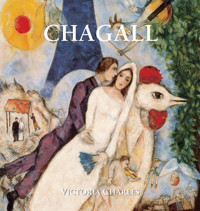
Marc Chagall was born into a strict Jewish family for whom the ban on representations of the human figure had the weight of dogma. A failure in the entrance examination for the Stieglitz School did not stop Chagall from later joining that famous school founded by the Imperial Society for the Encouragement of the Arts and directed by Nicholas Roerich. Chagall moved to Paris in 1910. The city was his “second Vitebsk”. At first, isolated in the little room on the Impasse du Maine at La Ruche, Chagall soon found numerous compatriots also attracted by the prestige of Paris: Lipchitz, Zadkine, Archipenko and Soutine, all of whom were to maintain the “smell” of his native land. From his very arrival Chagall wanted to “discover everything”. And to his dazzled eyes painting did indeed reveal itself. Even the most attentive and partial observer is at times unable to distinguish the “Parisian”, Chagall from the “Vitebskian”. The artist was not full of contradictions, nor was he a split personality, but he always remained different; he looked around and within himself and at the surrounding world, and he used his present thoughts and recollections. He had an utterly poetical mode of thought that enabled him to pursue such a complex course. Chagall was endowed with a sort of stylistic immunity: he enriched himself without destroying anything of his own inner structure. Admiring the works of others he studied them ingenuously, ridding himself of his youthful awkwardness, yet never losing his authenticity for a moment. At times Chagall seemed to look at the world through magic crystal – overloaded with artistic experimentation – of the Ecole de Paris. In such cases he would embark on a subtle and serious play with the various discoveries of the turn of the century and turned his prophetic gaze like that of a biblical youth, to look at himself ironically and thoughtfully in the mirror. Naturally, it totally and uneclectically reflected the painterly discoveries of Cézanne, the delicate inspiration of Modigliani, and the complex surface rhythms recalling the experiments of the early Cubists (See-Portrait at the Easel, 1914). Despite the analyses which nowadays illuminate the painter’s Judaeo-Russian sources, inherited or borrowed but always sublime, and his formal relationships, there is always some share of mystery in Chagall’s art. The mystery perhaps lies in the very nature of his art, in which he uses his experiences and memories. Painting truly is life, and perhaps life is painting.
Das E-Book können Sie in Legimi-Apps oder einer beliebigen App lesen, die das folgende Format unterstützen:
Seitenzahl: 43
Veröffentlichungsjahr: 2011
Ähnliche
Author: Victoria Charles
Text: Mikhaïl Guerman, Sylvie Forestier
Layout: Baseline Co. Ltd.
61-63A Vo Van Tan
4thFloor
District 3, Ho Chi Minh City,
Vietnam.
© Confidential Concepts, worldwide, USA
© Parkstone Press International, New York, USA
© Marc Chagall, Artists Rights Society (ARS), New York,
USA / ADAGP, Paris
All rights reserved
No part of this publication may be reproduced or adapted without the permission of the copyright holder, throughout the world. Unless otherwise specified, copyright on the works reproduced lies with the respective photographers. Despite intensive research, it has not always been possible to establish copyright ownership. Where this is the case, we would appreciate notification.
ISBN: 978-1-78160-587-5
Victoria Charles
LIST OF ILLUSTRATIONS
1.Kermis (VillageFair) (1908).
2.Self-Portrait(1909).
3.The Artist’s Sister (Mania) (1909).
4.My Fiancée in Black Gloves (1909).
5.Sabbath (1910).
6.Dedicated to myFiancée(1911).
7.The Wedding (1910).
8.From the Moon (TheRussianVillage).
9.TheViolonist(1911).
10.Self-Portrait with Seven Fingers (1911).
11.The Poet (HalfPast Three) (1911).
12.I andtheVillage (1911).
13.Birth of a Child (1911).
14.Hommage à Apollinaire (1912).
15.To Russia, Asses and Others (1911-1912).
16.The Drunk (The Drinker) (1911-1912).
17.Golgotha(1912).
18.The CattleDealer(1912).
19.TheSoldierDrinks (1912).
20.Soldiers (1912).
21.The Violonist (1912-1913).
22.Maternity (PregnantWoman) (1913).
23.Self-PortraitwithWhite Collar (1914).
24.Paris through the Window (1913).
25.Portrait of the Artist’s Sister, Maryasinka (1914).
26.Father (1914).
27.The NewspaperVendor(1914).
28.The Barbershop (1914).
29.Chemist’s Shop in Vitebsk (1914).
30.Over Vitebsk (1914).
31.Feast Day or Rabbi with a Lemon (1914).
32.Jew inGreen(1914).
33.TheClock(1914).
34.Lovers in Pink.
35.Lovers in Blue (1914).
36.Lovers in Green (After 1914).
37.Soldiers with Bread (1914-1915).
38.Over the Town (1914-1918).
39.The Mirror (1915).
40.Jew in Red (1915).
41.The Green Violonist (1915).
42.Birthday (1915-1923).
43.Lilies of the Valley (1916).
44.Lovers in Grey (1916).
45.Bella with a WhiteCollar(1917).
46.Double Portrait with aWineglass(1917).
47.The Promenade (1917).
48.The Cemetery Gates (1917).
49.The Blue House (1917-1920).
50.Time is a River without Banks (1930-1939).
51.Self-Portrait with Muse (The Apparition) (1917-1918).
52.Praying Jew (1923).
53.The Revolution (1937).
54.The Couple of the Eiffel Tower (1938-1939).
55.Blue Concert (1945).
56.The Apparition of the Artist’s Family (1947).
57.Wall-Clock with a Blue Wing (1949).
58.Champ deMars(1954-1955).
59.The Artistat His Easel (1955).
60.The Triumph of the Music (1967).
61.The Dream (1978).
62.The Painter (1976).
1.Kermis (Village Fair) (1908).
Oil on canvas, 68 x 95 cm,
Collection Wright Judington, Santa Barbara, California.
Marc Chagall was born into a strict Jewish family for whom the ban on representations of the human figure had the weight of dogma. If one is unaware of the nature of traditional Jewish education one can hardly imagine the transgressive force, the fever of being which propelled the young Chagall when he flung himself on the journalNiva(Field) to copy from it a portrait of the composer Rubinstein. This education was based on the historic law of Divine Election and covered the religious side of life only. The transmission to the very core of the Jewish hearth was essentially effected through oral means. Each Jewish house is a place made holy by the liturgy of the word. The Chagall family belonged to the Hassidic tradition: we should emphasize here that this form of piety -Hassidmeans devout - gives preference to direct contact between the individual and God. The dialogue which is thus set up between the faithful and Yahweh exists without the mediation of rabbinical pomp and display. It is born directly from everyday ritual and is expressed in the exercise of personal liberty. Hassidism lies outside the scholarly Talmudic culture, the institutional commentary of the synagogue. It was historically found in rural Russian and Polish communities, communities based on the original fundamental nucleus of Jewish society which is, of course, the family.
Chagall’s father, Zakhar, was a pickler at a herring merchant’s. Sensitive, secretive, taciturn, the figure of Zakhar seems to have had the tragic dimension inherent in the destiny of the Jewish people.“Everything in my father seemed to me to be enigma and sadness. An inaccessible image”, Chagall wrote inMy Life. On the other hand, his mother, Feyga-Ita, the eldest daughter of a butcher from Liozno, radiated vital energy. The psychological antithesis of their characters can be seen in Chagall’s very first sketches and in his series of etchings produced for Paul Cassirer in Berlin in 1923 which were intended to illustrateMy Life. This antithesis, so strongly felt by Chagall, embodies the age-old experience of the whole of Jewish existence: his father and mother, in the artist’




