


13,99 €
Mehr erfahren.
- Herausgeber: The History Press
- Kategorie: Sachliteratur, Reportagen, Biografien
- Sprache: Englisch
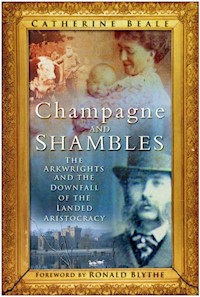
In January 1870, Johnny Arkwright was the largest landowner in Herefordshire. From the processions and balls which celebrated his coming of age, to facing financial ruin at his own sons birthday and the eventual sale of the estate, this book shows, through the example of a prominent family, the downfall of the landed classes.
Das E-Book können Sie in Legimi-Apps oder einer beliebigen App lesen, die das folgende Format unterstützen:
Veröffentlichungsjahr: 2009
Ähnliche



















CHAMPAGNE & SHAMBLES
THE ARKWRIGHTS & THE COUNTRY HOUSE IN CRISIS
CATHERINE BEALE
FOREWORD BY RONALD BLYTHE
In memory of my motherSybil Jane Owens (née Price, of Abercray, Trecastle, Brecon) 1943–89
Front cover: Hampton Court (Courtesy of Hampton Court)
First published 2006
This edition first published in 2009
The History Press
The Mill, Brimscombe Port
Stroud, Gloucestershire, GL5 2QG
www.thehistorypress.co.uk
This ebook edition first published in 2013
All rights reserved
© Catherine Beale, 2006, 2009, 2013
The right of Catherine Beale to be identified as the Author of this work has been asserted in accordance with the Copyright, Designs and Patents Act 1988.
This ebook is copyright material and must not be copied, reproduced, transferred, distributed, leased, licensed or publicly performed or used in any way except as specifically permitted in writing by the publishers, as allowed under the terms and conditions under which it was purchased or as strictly permitted by applicable copyright law. Any unauthorised distribution or use of this text may be a direct infringement of the author’s and publisher’s rights, and those responsible may be liable in law accordingly.
EPUB ISBN 978 0 7509 5140 1
Original typesetting by The History Press
Contents
Foreword
Arkwright Family Tree
Map of Herefordshire
Introduction
One
The Heir to the Seat
Two
The Season and its Harvest
Three
Master of the Estate
Four
Mastering the Family
Five
Foxley Hunting
Six
Sons and Mothers
Seven
Hodge Finds his Voice
Eight
Down Corn, Up Horn
Nine
Algiers to Aberystwyth
Ten
Sized up, Seized up and Silenced
Eleven
Arkwrights Act
Twelve
Parasites and Mousetraps
Thirteen
Land Loss at Home, Victory Abroad
Fourteen
Lord Looted
Fifteen
Letting and Going
Epilogue
Notes
Sources and Bibliography
Acknowledgements
Foreword
This is a fascinating story, unique in my experience of rural social history. It gives the facts and figures of what was popularly called the ‘coming-down time’, that protracted collapse of nineteenth-century land values which continues to shape village life to this day. And not only our countryside, but our politics too. Weather also had a hand in it, years of rain which washed away the late Victorian harvests and were felt to be by some as a divine indictment of agriculture itself. This steady draining of profits from what had immemorially been the basis of real wealth – the fields and forests – and which had for centuries successfully ordered country dwellers into aristocrats, yeomen and peasants, was, as this marvellously documented book reveals, seen at first as an impossibility. Just as the biblical promise of seed-time and harvest never ceasing was believed, so was land ownership seen, even when it was slipping away, as the sure foundation of British society.
Throughout the ‘coming-down time’ historians, great novelists, and worried diarists all described this dramatic breaking-down of what for generations had been the only true source of wealth and position, the land itself. Its owners had covered it with magnificent parks and palace-like houses. The farmhouses and their work buildings looked profitable and were often beautiful, and at the time when the fissures began to threaten this classic scene many landowners started to care in a new fashion for the labourers and their families, building schools and estate cottages. All this has been much written about by the social historian.
Yet the overall accounts of the ‘coming-down time’ rarely reveal what was actually occurring at the top as prices fell, farmers struggled and men fled. As Catherine Beale shows, nothing was happening at the top. Taking the Arkwrights of Hampton Court, Herefordshire as a typical landowning Victorian family, she exposes not only their dwindling fortune but their unchanging attitudes. Moreover, she makes us like them, not romantically as we nowadays stare up at the portraits in some country house open to the public, or watch its old life in a film, but as individuals. Johnny Arkwright, a rich young man descended from the famous Sir Richard Arkwright, who invented a spinning machine which brought him a fortune, did not as some might think go on living beyond his means as his landed interests foundered, as it were. He simply went on living the only life he understood. Champagne and Shambles might suggest a picture of high living and the devil take tomorrow, but it is devoid of that recklessness which became a cliché in the fiction of the times. Rather we are shown a landowning family which, like so many others, was strangely ignorant of the swift disappearance of its universe – and this in spite of the fact that between the 1870s and 1890s prices had fallen from £54 to £19 an acre. Entire villages were abandoned by the labourers and just before the First World War farms in East Anglia were practically given way. The War, and previous imperial wars, slaughtered the inheritors, and another Arkwright, Sir John, mourned the loss with his plaintive hymn, ‘O Valiant Hearts’, still sung in country churches on Remembrance Day.
Catherine Beale’s achievement is to have written an enthralling biographical economy in which a single landowning family is made to tell the full story of agriculture and the social life around it from the early nineteenth century almost up to the present. In it she has avoided all the stereotypical images of the landowning classes and given us vulnerable human beings who are seen as helpless in one of history’s great shake-ups. Alongside this scholarly portrait she sketches our current flirtation with the country house from Brideshead to Gosford Park. It is a sympathetic read and an enlightening one. The many thousands for whom these places are now a reminder of a civilisation should read it – alongside the guidebook. It will alter all their views.
Ronald Blythe
Arkwright Family Tree
(Simplified)
Map of Herefordshire (not to scale).
Introduction
‘I am in an awful state of depression which nothing but champagne can remove’, wrote Johnny Arkwright in January 1870.1 Six months after the death of his mother, Johnny, then 36 years old, was struggling to find £25,000 (over a million pounds today)2 to pay his brothers their inheritance – a sum equivalent to two and a half times his gross annual income. He was privately facing an emotional and financial crisis, but things were about to get a great deal worse.
Johnny’s words could have served as the chorus for his entire social class between 1870 and the First World War – the years of champagne and shambles. In January 1870, John Hungerford Arkwright (1833–1905) was the largest landowner in the most agricultural county in England.3 He was the grandson of ‘the richest commoner in Europe’,4 and had inherited a fairytale fifteenth-century crenellated house and the 10,250-acre estate that surrounded it. As one of England’s top 365 landowners, he was among the élite class of the most powerful nation on earth.
However, revolution was brewing, a quiet revolution such as only the British could mount, a revolution led by due democratic process and supported by the mob of market forces. Britain’s greatest patrician families were about to be engulfed by events beyond their control, by an avalanche of change that would sweep them aside as it – quite literally in 1,200 cases in the twentieth century – demolished their homes.5
The downfall of the landed class in Britain is a subject that has been treated in diverse ways in the past. Lord Tennyson’s 1886 poem ‘Locksley Hall Sixty Years After’ boils with anger at the breakdown already under way. Oscar Wilde made ascerbic but amusing observations on the eradication of those whom he regarded as ‘unspeakable’, in his play The Importance of Being Earnest (1895). Among the most humorous treatments of the subject is Noël Coward’s 1936 song ‘The Stately Homes of England’, and Evelyn Waugh fictionalised the Marchmains’ plight in his elegaic 1945 novel Brideshead Revisited.
In non-fiction, F.M.L. Thompson has undertaken much work on agriculture and landed estates.6 The recollections of some of the villagers in Ronald Blythe’s Akenfield (1969) reach back to rural life during this period of upheaval. The most comprehensive account of this process, however, has been given by David Cannadine in his 1990 work, The Decline and Fall of the British Aristocracy.7 Cannadine identifies the patrician élite and compares its members with their counterparts in Europe. He shows how and why their broad acres lost their value, how the aristocracy’s political power was eroded and how its control in the shires was superseded by professional local government. The aristocracy, Cannadine further illustrates, had ceased to represent the richest class in society by the dawn of the twentieth century, and it had contemporaneously ceased to rule.
Cannadine’s scholarly, comprehensive, and refreshingly irreverent account considers the fall of the landed class as a whole between 1880 and 1930, and dips into a breathtakingly broad range of sources. This book is narrower in breadth, but humanises this social change by plunging more deeply into the predicament of one family over the sixty-year period 1854–1914. In doing so, it attempts to show how the events of their undoing in the second half of the nineteenth century appeared to the landed class at the time; how the balance of power between the bank manager and the patrician client shifted as land values plummeted; how the squire could no longer be sure of getting the right man in at the local parliamentary election; and how the landowner came to be expected to take his seat alongside his tenants in the church hall for Parish Council meetings.
In order to demonstrate this, I have used the extensive collection of private and estate papers preserved by the Arkwright family, and now by Herefordshire Archive Service. ‘Keep all your letters,’ Johnny advised his son Jack, in 1885, while he was at Eton, just as his own father had advised him.8 As a result, the Arkwright Collection consists of dozens of boxes each containing up to a hundred yellowing letters, occasionally with pressed-flower enclosures. These passed between husband and wife, and parents and children, revealing the feelings of their correspondent about contemporary change. The broken-backed leather ledgers of tenants’ rents and labourers’ wages show changing estate management in the attempt to evade ruin. School reports, and elaborate photograph albums lend charm and depth. Close examination of these papers combined with the study of more general works revealed the Arkwrights’ story to be a remarkably accurate illustration of the revolution against which they were struggling. I hope that this account will complement the work of Cannadine and his colleagues.
This is a book, therefore, that takes the historical and makes it personal. As a 24-year-old, Johnny Arkwright of Hampton Court, Herefordshire, seemed to inherit the earth, yet he had to mortgage part of his estate in his seventies. Johnny’s grandfather Richard Arkwright (1755–1843) bought the quadrangular manor house, contents and 6,220 acres in 1810 from the 5th Earl of Essex. To acquire the estate, Richard paid £226,535 (equivalent to approximately £6.2 million today), a sum equivalent to roughly 30 per cent of the total annual investment in the cotton industry at the time.9 Richard was the only son of the industrialist Sir Richard Arkwright (1732–92) who perfected a mechanical method of spinning cotton yarn. His patent for the spinning frame, and that for his later carding machine, made him a fortune.
Sir Richard Arkwright’s most enduring legacy, however, was the factory system.10 In 1771, he erected a spinning mill at Cromford in Derbyshire, and to this was added a carding mill in 1776. To supply his workforce, as Arkwright’s biographer R.S. Fitton noted, he built ‘habitations most comfortable’, a chapel for 300 people, a Sunday school, the Black Greyhound Inn and schools for the children.11 The significance of Cromford was acknowledged in 2001 when the Derwent Valley was designated a World Heritage Site.
Richard Arkwright the younger, the only son, had made a spinning fortune of his own before he inherited his father’s fortune in 1792. Through judicious investment and scrupulous attention to detail, Richard increased his wealth. By the time of his death in 1843, he was worth £3.25 million (almost £181 million today).12 It was estimated in the year 2000 that Richard Arkwright was joint 180th richest man since 1066.13
From 1792, Richard Arkwright began to invest in landed estates, not so much because he wanted to set up his sons (though that was the result) but rather because, during the blockades of the Napoleonic Wars, agriculture was producing a good return. He purchased five major estates for a total of £391,000: Normanton Turville in Leicestershire (in 1792), Hampton Court in Herefordshire (1808–10), Mark Hall in Essex (1819), Sutton Scarsdale in Derbyshire (1824) and Dunstall in Staffordshire (1826).14 Of these, Hampton Court was the largest. On Richard’s death, each of his sons took to the estate on which he was living – Robert inherited Sutton Scarsdale, Peter Willersley, John Hampton Court, Charles Dunstall, and Rev. Joseph Mark Hall and Normanton Turville (to which he had taken after the death of their eldest brother in 1832).
Richard never intended to live at Hampton Court. He sent his Matlock land agent George Nuttall to Herefordshire to apply industrial principles to agriculture; the weir near the bridge over the River Lugg was mended, and the river water powered saw- and stone-mills. Brick kilns and eventually a small railway were built at the estate works near the home farm, and professional book-keeping skills were employed in the estate office.
The fourth of Richard’s six sons, the Eton- and Cambridge-educated John, asked to reside at Hampton Court in 1814. John had by then seen four of his five brothers marry, and being still single but wishing to settle, he confessed to his father that ‘of all the situations I know, there is none which suits my tastes so well as Hampton Court . . . I should like a small farm, grazing or breeding, with liberty to preserve, Shoot and Fish’.15 His wish was granted, and from then until Richard Arkwright’s death in April 1843, John acted as a go-between for his father and the agent at Hampton Court, asking for and having to justify expenditure on the house or estate, and having occasionally to persuade his father to soften some decisions which, being founded on good industrial principles, were not consistent with what was expected of the owner of a landed estate. In the depression that followed the Napoleonic Wars, Richard wanted to cut back on estate expenditure but John had to make him see that it was his responsibility instead to embark on large projects to employ more men. In addition, John persuaded his father to remit up to 33 per cent (in 1823) of the rents in difficult years.16
In 1830, amid a flurry of gossip, John married Sarah (Tally), the daughter of impecunious local baronet Sir Hungerford Hoskyns of Harewood Park near Ross-on-Wye. Tally was twenty-three years younger than John, which some deemed ‘unfortunate; persons who know her say her manners are artificial & that she has a very high spirit . . . but love is blind, they say, & Miss H is young & pretty looking’.17 They produced seven sons and five daughters in the following eighteen years.
By the 1830s, Hampton Court had not housed any children for around 120 years. Tally could no doubt see opportunities for improvements in the domestic arrangements, so, from 1835, John undertook major work on the house to accommodate the family more comfortably. The medieval Great Hall and Great Parlour were reproportioned to produce a dining room and library, and a new drawing room was added at the south-west corner of the house. Nurseries and a schoolroom were also incorporated in the south front.
John’s choice of architect, Charles Hanbury Tracy, seemed promising.18 Hanbury Tracy’s predilection for the Oxford collegiate style, visible at his own home, Toddington in Gloucestershire, appeared well suited to Hampton Court’s original architecture.19 However, disagreements between Hanbury Tracy and Tally over the location of the nurseries resulted in over a decade of alterations and altercations. John grew alarmed at the scale and cost of the work, and Hanbury Tracy was scornful of John’s entertainment of the wishes of his wife.20 John derived infinitely more pleasure from corresponding with, and welcoming on a visit, Joseph Paxton, whom John commissioned to design the new conservatory that was added to the southwest corner in 1845–6.21 In all, the work cost over £30,000, took twelve years, and produced ‘a Herefordshire Windsor’,22 but by the end of his life, John wished that he had never touched a stone.
On his father’s death, in addition to Hampton Court, John inherited £50,000 and an equal share in the residue of his father’s estate, amounting to £263,745 17s (almost £14.7 million today).23 He spent the rest of his life in Herefordshire acquiring farms and enlarging the estate by 65 per cent, sitting as a Justice of the Peace, taking his turn as High Sheriff, patronising local causes like funding schools and rebuilding churches, hosting bow meetings, and helping to identify suitable parliamentary candidates for the nearby Leominster constituency. For this, he became accepted by the landowning class in the county and deservedly popular. John was noted as a liberal host, but was rarely ostentatious with his fortune.
To Johnny, John Arkwright therefore bequeathed a modernised house and an estate of 10,250 acres, but, crucially, only a share of his wealth, which John divided between his dozen children.24 Johnny and his brothers were all educated at Eton and Harrow, and Oxford or Cambridge, and his sisters married well, where they married at all. By the time of Johnny’s inheritance in 1858, he and his siblings had been entirely assimilated into the landed class of his day. They were Herefordshire born and bred, and Johnny had been schooled, had cricketed, shot, fished and hunted with the scions of the other great houses in Herefordshire and the neighbouring counties. They knew their (elevated) place in society, and society knew it too.
Johnny would never be subjected to the cutting observation of one local landowner who had referred to Richard Arkwright as late as 1833 as ‘a tradesman’.25 Despite such persistent snobbery, the combination of his father’s manufactured inheritance and his mother’s landed ancestry makes Johnny a good example of the patrician type, having the money to indulge in patronage of all kinds and the confidence to take an assured place in contemporary society.
Not being titled, Johnny was not strictly a member of the aristocracy, but two of his brothers and one of his sisters married into aristocratic families. He certainly mixed socially with the aristocracy, in the shires, in London, on committees and on the hunting field. Johnny fits, almost exactly, the model of the patrician landowner as identified by Cannadine, and Hampton Court is a microcosm of the situation nationwide. Johnny was Eton and Oxford educated, lived in the country but was often up in town serving on voluntary committees of local and national importance. He did not labour, but was leisured, and took a wife from his own class. He was at once the pinnacle of the county scene and the bedrock of London society, alert to the subtleties of honour, precedence and protocol and with a strong sense of keeping up his position. He was a liberal landlord and host, and had a safe seat in the saddle. Finally, he ‘accepted, implicitly and absolutely, an unequal and hierarchical society, in which [his] place was undisputedly at the top’.26
Johnny Arkwright was the second of three John Arkwrights who lived at Hampton Court, but the only one for whom all the seasons of life turned within the 7-mile compass of the pleasure grounds. His father moved there in his thirties, and his son lived there until his fortieth year. It should be noted that I refer throughout to these three men by the names that the family itself used to differentiate between them: John (John Arkwright, 1785–1858), Johnny (John Hungerford Arkwright, 1833–1905) and Jack (John Stanhope Arkwright, 1872–1954).
The decade of working on the Arkwright collection has been leavened by Johnny’s irrepressible personality. Through his letters he comes vividly alive, with appealingly human frailties. As a rumbustious child he rampaged about the estate on his pony and was noted at Eton for ‘a disposition to noisiness in the House’.27 He was wildly popular at Oxford where he was given to sinking punts. Hopelessly enamoured of his fiancée, Johnny chose to read love letters in church rather than listen to a boring sermon of ‘maudlin verbage’.28 He couldn’t get his bride to their wedding night destination quickly enough, and later said of their propensity to reproduce that ‘rabbits are nothing to it!’29 He frequently confounds the notions of the stern Victorian pater familias, particularly in the delight he took in playing with his children.
Johnny was a quintessential county man, promoting Herefordshire’s interest on the national stage, and encouraging causes locally, from personally rehearsing the church choir to chairing the Executive Committee for Hereford’s Three Choirs Festival. He was a leading agriculturalist, teaching his tenants to graft fruit in his orchards and sitting with the future king on the Council of the Royal Agricultural Society of England. To many he represented ‘the epitome of the English squire’.30 Behind the public front, though, there slunk personal insecurities, producing occasional bouts of the blues. When things began to go seriously wrong for him, Johnny became uncharacteristically bad-tempered and touchy, and even ungracious regarding the wedding of his second daughter.
Johnny Arkwright was therefore no saint, nor was the life that he led one of unbounded ease. The times were not static, and to label the sixty-three years of the Queen’s reign ‘Victorian’ implies a homogeneity that is misleading. The period should not be thought of as all house parties and London seasons. Perhaps the lives of Johnny’s kind more closely resembled that cycle up to 1870, but thereafter, they were fighting for survival. In the years before the First World War, the gloves were off, and the sight of the patricians when they took their last stand over Irish Home Rule, for example, was not an edifying one.
I make these points not in any way to deride the landed class. Rather, I hope to toss a lifeline of realism into the soup of nostalgia in which they risk drowning. Since the Victoria and Albert Museum’s 1974 exhibition ‘The Destruction of the Country House’, the heritage industry has established a strong position in the economy. English Heritage’s annual report of 2003 indicates that domestic tourism generates £61 billion of expenditure and provides employment for 7.4 per cent of people in Britain, frequently in rural areas where it is badly needed.31 The movement has furthermore helped to ensure that no significant houses have been deliberately destroyed since the 1974 exhibition.32
The popularity of visiting country houses has enabled some to remain in private hands – Longleat, Beaulieu, Woburn, Blenheim, Chatsworth, Alnwick and Arundel, for example. It has also no doubt contributed to the current interest in history, and it is difficult to imagine that the success of the National Trust’s 2002 campaign to save Tyntesfield for the nation would have been possible before the heritage movement took hold.
We British and our visitors alike derive immense pleasure from viewing historic houses, though the precise number of visits made annually is hard to ascertain. The National Trust’s 300 or so country properties (some with houses, some just gardens) received 12.6 million visitors in the year to the end of February 2003. The 1,500 privately owned properties that form the Historic Houses Association receive over 14.1 million visitors per year. Visit Britain’s annual survey of houses and castles in 2002 received 605 responses from such properties, whose visitors that year totalled 30.5 million.33
The experience of touring one of these properties can captivate the visitor. The skilful display of tables set for dinner, writing materials on desks and kitchen dressers laden with copper pans can suggest that life was one of a perpetual carefree house party – all croquet and crinolines, port and partridge shooting. Yet if the invitation to nostalgia is declined, it is striking that (usually) the occupants are missing today, and the properties are owned indirectly by the visitors themselves through what has been described as ‘de facto nationalization’.34 Over the period covered by this book, such places were inhabited by real people facing frightening times as their way of life came under threat, then crumbled and finally disintegrated. I cannot be alone in having wondered where exactly life went so wrong for Johnny’s class, and how his generation reacted at having to let such a rich inheritance go. Noël Coward put it succinctly when he asked, ‘What availed the sceptred race’, and whether ‘the playing fields of Eton’ made them ‘frightfully brave’?35
In Johnny Arkwright’s experience, we can find many of the answers. His Hampton Court estate is located in Herefordshire – ‘of all the counties of England . . . the most blessed’.36 The county neighbours Worcestershire to the east, in which Madresfield Court, the house on which Waugh based Brideshead, is located. To the west lies the principality of Wales. Herefordshire is one of those English counties that borders on (or ‘marches with’) Wales, to which are given the collective name of the Welsh Marches. To the north of Herefordshire lies Shropshire, location for P.G. Wodehouse’s Blandings Castle, home of Lord Emsworth, and to the south, Gloucestershire.
Hampton Court should not be confused with its namesake Hampton Court Palace on the River Thames near London. Cardinal Wolsey began his Tudor palace around eighty years after Hampton Court, Herefordshire, was built by Sir Rowland Leinthall, under licence from Henry VI from 1434. The history of the two houses occasionally became entwined, most closely towards the end of the seventeenth century,37 but there is no deliberate connection between the two.
Even without his father’s cash fortune, the extent of Johnny’s estate by the 1870s put him in the top 365 landowners in Britain, above some of his titled superiors. Cannadine identifies three ranks of landowners in the 1870s: approximately 6,000 families who owned 1,000–10,000 acres producing an income of £1,000–10,000 per annum; a second group of around 750 families, of which Johnny’s was one, that had estates ranging from 10,000–30,000 acres whose owners were all ‘economically, great men’; and at the top, 250 territorial magnates who each had more than 30,000 acres.38 By this calculation, at 363rd in the landowning ranking, Johnny was towards the top of the second group. However calculated, he was definitely one of the ‘big people’.39
With such a remarkable inheritance, why did Johnny need to seek a special Act of Parliament in 1887 to enable him to remain at Hampton Court, and why did he have to spend Easter 1900 deciding which farms on the estate to mortgage? The answer was all around him. Land ceased to be the bedrock of wealth and status in British society during the second half of the nineteenth century. Since at least the Dissolution of the Monasteries in 1536 – and arguably since the Norman Conquest of 1066 – land had been inextricably linked with wealth, status and political power. The social and political élite had been territorial, its position underpinned by the acres that it owned. As Anthony Trollope had observed in 1867: ‘land gives so much more than the rent . . . position and influence and political power, to say nothing about the game’.40
The removal of guaranteed prices for grain effected by the Repeal of the Corn Laws in 1846 was bitterly resented by the landowning class. To appease them, special loans were made available from the 1850s, which many took up to drain their land and (after 1864) to improve farm buildings, in order to increase productivity and secure tenants, the landlord’s source of income. With a 25-year repayment period, many landowners still owed large sums when, from the 1870s, they came under assault from a variety of sources. Prolonged periods of appalling weather over the next three decades ruined crops and rotted livestock, and encouraged the import first of cheap grain and then, with the development of refrigerated shipping, cheap meat, which ruined tenant farmers. Rental incomes dried up, leaving landowners unable to meet loan repayments. As farms were sold to try to meet obligations, the value of land began to slide, deepening the crisis by the late 1890s.
As competition from imports implies, the world was shrinking as the global economy was born in the last quarter of the nineteenth century. English magnates, formerly kings of their own county realms, began to be judged in the context of the wealth élite of other countries. Newly made industrial fortunes, particularly those in the United States of America, dwarfed those of many English landowners.
During past agricultural depressions, like that prevailing in the 1820s and 1830s, when landowners had sold their estates, their acres had been bought by wealthy merchants, stock-jobbers and industrialists like the Arkwrights themselves. Now, however, new money was invested not in economically vulnerable land with its attendant responsibilities (and, from 1894, death duties) but in new, more liquid holdings, such as stocks and shares, contributing to the fall from fashion of landownership. The landed were disinherited of their status as the most glamorous social group. As Oscar Wilde quipped in 1895: ‘Land has ceased to be either a profit or a pleasure. It gives one position, and prevents one from keeping it up.’ 41
By the turn of the twentieth century, the Tory Party, traditionally sympathetic to landowners when in government, was no longer able to justify defending the landed interest when the balance of political power had come to reside in urban constituencies as a consequence of electoral reform. With the reallocation of parliamentary seats under successive Reform Acts, the rural voice became the minority in the House of Commons and many landed sons declined the opportunity to sit in an increasingly professional Parliament. Politically, as a class, landowners began to retreat. At the same time, from the 1880s political pressure groups with a specifically anti-landlordist agenda toured the country encouraging dissent in the atmosphere of growing democratic confidence. David Lloyd George, the influential Welsh Member of Parliament, found the courage to question the status quo and squandered no opportunity to lampoon the landed.
It is this process of shifting ground that is illustrated by this book. In just one generation – Johnny’s generation – land turned from being a boon into a burden. He and his contemporaries felt the full force of the avalanche of changes in landowning fortunes in the second half of the nineteenth century. The position, power and prestige that had been theirs by birthright for centuries disappeared west across the Atlantic Ocean. Their pictures, silver, jewels, and occasionally parts of their houses, were not far behind.
Although his times were difficult, Johnny remains a lively companion throughout, appreciating the ridiculous in his own predicament. I have, wherever possible, taken his point of view, and his opinions should not be mistaken for my own. The style that I have adopted is intended to make this a book read for pleasure, although I hope that the inclusion of footnotes will enable others to use the Arkwright Collection. A numbered reference in the notes is, however – because of the way the collection is indexed – that of a box that might contain a hundred letters, so anyone wishing to follow leads will still have much patient digging to do.
Those seeking Johnny Arkwright today will be pleased to note that, with the exception of several of the country houses, many of the places mentioned in the text are not just identifiable, but in many cases have barely changed. Herefordshire was, by the mid-nineteenth century, one of the few counties in England in which industry and manufacturing had not gained a hold – glove-making and carriage manufacture were Hereford’s strengths. Despite intermittent attempts, canals had not developed here, and Hereford had no railway until 1853.42
Today Herefordshire’s economy remains richly agricultural, with 9,603 people employed in agriculture, or around 5.5 per cent of a population that has grown, since 1841, by 53.5 per cent to 174,900.43 Herefordshire’s agricultural workers make up almost 8 per cent of the total number in the United Kingdom. There is still good pasture land for grazing both sheep and the fine beef cattle for which the county is renowned. The strong red soil is well suited to farming potatoes, which has proliferated since Johnny’s day, as has strawberry growing with its attendant, controversial polytunnels.44 Diversity of produce still reigns. Cider apple and perry pear orchards, though fewer, still froth with blossom in the spring, and hop poles strain and stride across the fields. Woodland is still plentiful and oaks grow so freely in the county’s generous soil that they have long been known as ‘the weeds of Herefordshire’.45 The architectural wealth of half-timbered oak-framed black and white houses stands as testament to this fact. Hereford city’s main employers reflect the agricultural tradition – cider-makers Bulmer’s and poultry processors Sun Valley. Herefordshire does, though, feel poised on the cusp of significant change. The years 1991–9 saw a growth in the county’s population of 7,000, or 4.4 per cent, entirely due to net inward migration, mainly from other parts of the West Midlands and the south-east – a rate of growth greater than that experienced by the rest of England and Wales. This has applied pressure on the infrastructure, particularly roads. Hereford city’s need of a bypass is a frequent topic of letters to the Hereford Times. Light pollution is also encroaching on the starlit night skies.
Hampton Court itself remains the picture-postcard castellated house that it was when Johnny lived here. The house has barely altered, and the surrounding landscape has hardly changed. The oaks still lean in the deer park across the road, the skating rink is opposite the gate, and the waters of the Lugg that Johnny fished still roll silently past the south meadows. Sadly, there is no herd of Hereford cattle today in the bull pens at Green Farm, but they are occasionally to be found grazing the surrounding river-meadows.
The contents of the house (some of which had been there since the sixteenth century) were broken up during a three-day sale in 1972. The house and grounds have since changed hands more times than in the previous five and a half centuries put together. After American Robert Van Kampen bought the property in 1994, Hampton Court underwent the most necessary and extensive programme of repairs since John’s alterations. Under the care of the estate’s manager, Edward Waghorn, the soft red sandstone was replaced where it had worn, and the 122-room house was almost entirely reroofed, redecorated and rewired.
Outside, exciting new gardens, sensitive to the location and classically structured, yet vibrant in texture and colour, were created by David Wheeler and Simon Dorrell, and brought to life by local craftspeople. The glasshouses were recommissioned, and a small army of gardeners was once again employed. Hampton Court’s gardens (but not the house) opened to the public in 2000, and are accessible year-round, attracting about 50,000 visitors per annum.
Sadly, Robert Van Kampen died in 1999 and Hampton Court was sold again in 2008. The new owner, Graham Ferguson Lacey, has delighted visitors by opening the ‘Castle’ to the public, so that you can now see the dining room and Coningsby Hall where the Arkwright girls’ marriages were celebrated, or sit in the chapel that was the focal point for the household on so many occasions.
The highly-popular gardens remain open, and there are plans to develop them further. The passage of tens of thousands of feet has, in places, worn the grass, revealing the layout of paths and beds as Johnny knew them. If you are tempted to nostalgia when seeing these spectres of summers past, remember that despite the warm welcome you will receive today, in his time the hoi polloi were allowed in only on high days and holidays. If Johnny is watching from a window, he is no doubt roaring his disapproval, wondering what the world has come to, and reaching for the champagne.
ONE
The Heir to the Seat
William Daggs tapped the barometer in the hallway, and was relieved to note that it rose towards ‘fair’. Change was in the air. ‘A good thing too,’ he might have reflected as he pressed his hat into place and stepped over the threshold into the puddled street beyond. The date of 12 July 1854 was an auspicious day. It marked the coming of age of Johnny Arkwright, the heir to the largest estate in Leominster’s neighbourhood.1 As secretary to the committee organising the estate’s celebrations, Daggs hoped for neither lows nor storms.2
Daggs strode across Corn Square, gripping the Arkwright banner under his arm and raising his hat in acknowledgement of salutations. He turned between the stooping houses of Draper’s Lane, running the day’s schedule through his head, until he emerged before the piebald town hall. He was relieved to note that many of the Arkwright tenants in Leominster had already gathered, giving the town an air of market day rather than a holiday. Some were milling between the oak pillars, while others congregated under the Regency arcade at the end of Draper’s Lane. Carriages filled Broad Street ahead, while well-wishers on foot and on horseback blockaded the road towards the Priory to the right and Burgess Street to the left.
Daggs at once set about checking that the five wagons from the parishes in which Arkwright owned property had arrived, bearing their oxen and bread. The Hope Ox was a magnificent display, bedecked in flowers, evergreens and gold. He next checked that the brass band that would head the procession was comfortably accommodated in its carriage. The Oddfellows had assembled, bristling with flags on staffs. Blue rosettes had been distributed and streamers fluttered in the northerly breeze that was chasing away the clouds. After mounting his horse, Daggs snapped his fob watch shut at nine o’clock precisely and led off the procession of around 2,000 people for what he had predicted would be ‘one of the most happy and joyous gatherings which this county ever produced’.3
Five miles away, at Hampton Court, Johnny Arkwright was feeling uncharacteristically self-conscious as his father rose stiffly to his feet to lead the household in morning service in the chapel. After readings, hymns and prayers with a particular note of thanksgiving, the servants were released to their duties. As soon as he could, Johnny returned to the furtive reworking of the speech that he had begun in his rooms at Christ Church, Oxford. His father had noted his unease, but, while offering reassurance, observed to himself that the occasion might help Johnny to appreciate the responsibilities of his station in life.
The notice for the celebrations in the Hereford Journal had asserted that ‘With the admirable example of such beloved and excellent parents before him, we cannot doubt the future honourable conduct of Mr Arkwright.’ John Arkwright knew, though, that his son was instead likely to write to him in the following less than honourable terms:
You were riding when I departed so I missed the opportunity of telling you a fact in my finances. I borrowed 10£ of my mother because I had no money. And still am owing. The last 100 you gave me went as follows –
40 College bills
20 reading coach
10 lodgings
the rest in cricket boating and club subscriptions and wine bills – I have really but just found out what money is, and how far it goes, and can, I know, for the future keep out of debt if I get out now. Will you advance, till I get an income of my own, as I had rather do that than receive more from you which I have no right to, and of course rob my brothers of . . . PS you might think at this time that I had lost about the Derby, but I had not a single bet.4
At 69 years of age, John knew that the responsibility for the 10,250-acre estate would pull Johnny up soon enough, and his natural inclination was to allow the boy his head while he might; and yet, he needed to instil in him some sound good sense before it was too late. Still, the lad’s twenty-first birthday was not the occasion to do so.
Daggs’s procession stretched for nearly a mile. Once through the toll gate to the south of Leominster, it passed Broadward, crossed over the Arrow river and was in estate territory. All along the route, cottages showed their ‘bit of enthusiasm’ with arches over the paths, or flowers at the door. Every by-road and footpath brought new additions to the party. The cavalcade wound its way past Ford’s new railway station, and got its first glimpse of the River Lugg that would run alongside the cheerful throng to Hampton Court. At Wharton, Daggs was joined by his father-in-law, Edward Hodges, the senior tenant on the estate. From the bold, square house they proceeded over the railway bridge at Marlbrook.
At Hope-under-Dinmore they negotiated the toll-gate and turned on to the England’s Gate road, relieved, no doubt, not to have to climb Dinmore Hill ahead. After crossing the Lugg bridge that John had built in 1826,5 the happy crowd caught sight at last, between the trees, of the crenellated silhouette of Hampton Court. The band played ‘Roast Beef of Old England’ as the procession turned up the drive that led straight to the oak gates beneath the entrance tower, where the family awaited them on a specially constructed dais. At 10 o’clock, with all assembled, Edward Hodges presented to John Arkwright the committee’s address of congratulation on the coming of age of his heir.
Your tenants especially take this opportunity of expressing their gratitude for the unvarying kindness, forbearance, and liberality with which they have been treated. Your noble conduct in this respect, surpassed by no landlord in Herefordshire, has enabled them to bear up against many adverse circumstances, and has endeared your name to all their families.
John responded with thanks. ‘I am exceedingly proud,’ he said, ‘at having become by adoption a Herefordshire man, for my feelings and affections are bound up in the county. [Cheers.] My son has the advantage over me that he was born a Herefordshire man, and I hope he will turn out to be a credit to the soil which gave him birth.’6
The wagons then fanned out over the estate to Bodenham, Pencombe, Hope, Wharton, Stoke Prior and Docklow, distributing bread, beef and money to John’s tenants and labourers. With the formalities over, the well-wishers were free to roam the grounds before dinner. For many, this was a rare opportunity to get beyond the north front of Hampton Court, to walk past the chapel at the east end of the house, round the drawing room on the corner and emerge into the sun of the south front. It was a revelation. From the road, the house wore a gloomy aspect, appearing to lie too close to the foot of Dinmore, the trees on the hill surely rendering the court damp and dark. And yet, as the visitors discovered, between the south walls of the house and the waters of the Lugg that curved around Dinmore, were extensive lawns of perfect seclusion. The sun seemed to be trapped between the hill and the house, a pool of unrelenting light and warmth.
Around 500 people had purchased tickets for the banquet at 3 o’clock in a marquee on Dinmore Hill. Afterwards, Johnny rose nervously to his feet. He thanked the tenantry and especially the organising committee, and assured them that the day would never be erased from his memory. In proposing the toast to the tenantry, ‘he regretted to say he knew so little of them and of the science of agriculture . . . but at some future time, he had no doubt, he should take more interest in eradicating the thistles, docks, and other such enemies of the farmer’.
A quadrille band had been engaged for the evening, when the dancing was opened by John and Mrs Hodges. Johnny’s mother Tally had the pleasure of dancing with Mr Hodges. At the end of the day, Johnny retired with his parents for some private celebrations. Despite the presence of his five sisters, no doubt Johnny’s absent brothers were in their minds. He was certainly in theirs. George, the third son, dined with his tutor Rev. Harbin, at the home of Tally’s sister at Cucklington in Wiltshire. George reported to his father ‘John’s health was drunk by the assembled gentlemen. Harbin’s wish was “good health, double first class and leaving of hunting”. The last two are doubtful.’7
Johnny’s brothers were not to miss out altogether. Further celebrations were planned for early August, when they would be at home. In contrast to 12 July’s festivities, these were to last for three days and involve not just the immediate but the wider family. John Arkwright, though always a liberal host, was rarely ostentatious with his wealth. The August party was an exception, and a monumental three days of celebration were planned between Wednesday 2 and Friday 4 August.
While Johnny worried about his oratorical shortcomings, his mother concerned herself with her eldest daughters. Prior to the birth of an heir, John and Tally had produced two daughters, Caroline in 1831 and Mary the following year. Known as Carey-Mary in family shorthand, these girls expected much of the forthcoming celebrations, and would be on display to the leading county families. Caroline, though not beautiful, was a bonny girl blessed with endless patience sorely tried by her rumbustious younger brothers. In contrast Mary was asthmatic and the weakest of the Arkwrights’ dozen children. Owing to the attention that she had received, Mary was more precious than her older sister. The contrasts between them, though, and their relative isolation as a pair at the head of the four brothers that followed them in age, made them close companions in anticipation and excitement.
It was not only the younger generation who looked forward to the beginning of August. John’s three surviving brothers and their families would be attending, Robert from Sutton Scarsdale in Derbyshire, Peter from the Arkwright family home Willersley, at Cromford in Derbyshire, and Rev. Joseph from Mark Hall in Essex. Robert’s eldest son, George, was one of the present Members of Parliament for Leominster. Peter had seven surviving sons and five daughters; they would be staying over Dinmore Hill at Bodenham, where Peter’s third son, Henry, was vicar of the parish that was in John’s gift. Joseph had five sons and six surviving daughters. His wife Anne wrote excitedly in July to inform John that she, Anne and Charles were to travel to Hampton Court together, while Arthur would make his way separately with Godfrey from Sutton Scarsdale.
Wednesday 2 August finally came round and the guests for the opening ball arrived from 9 p.m. Among them were the Countess of Oxford, Lady Emily Foley of Stoke Edith, Viscount and Lady Hereford of Tregoyd, Hon. and Rev. Lord Saye and Sele, and Sir Joseph Bailey of Glanusk. By 10 p.m., ‘a galaxy of beauty and fashion had assembled. . . . The sight was most imposing – the superb dresses and costly ornaments worn by the fair daughters of Herefordshire, their graceful and beautiful figures moving in a fairy circle.’8 Dancing in the Coningsby Hall began at 10 p.m. and continued until the ball supper was announced at 11.30 p.m. To feed the 200 guests, London caterers Mr Holt of Radley’s Hotel, New Bridge Street in Blackfriars,9 and Mr Jacquet of Clare-Court, were employed alongside Mr Merrett of Hereford. They came with ten male cooks, confectioners and a large number of carvers, waiters and runners. John’s guests dined on patés, galantines de volaille, hams, tongues, gateau royale and compote de fruit. The guests resumed dancing, and ice creams, cakes, tea and coffee, wine, cool drinks and fruits sustained them until daylight.
On Thursday morning, the youngsters amused themselves with archery on the lawns to the south-west of the house where John habitually hosted county bow meetings. Meanwhile, the large marquees of the Leominster and Hereford Horticultural Societies were joined together for luncheon. The scene was captured by J.H. Brown of Gloucester, who had been commissioned to produce ‘a painting of a good size of the Festivities at your beautiful residence – comprising the tents, visitors, trees & mansion’.10
Four hundred guests arrived at around 3 p.m. and, with John in the chair, the meal began shortly after 4 p.m., having been held up by the late arrival, to knowing glances, of the newly-wed Lord and Lady Bateman of Shobdon Court.11 After a sumptuous lunch, the speeches were made.12 Lord Bateman explained ‘our delay in coming amongst you . . . we stayed here very late last night. [Laughter.] That was one thing. And to-day we had at Shobdon . . . such heavy rain, that on our way hither we got a “complete ducking”, and, as we were travelling in an open carriage, were obliged to take refuge under somebody’s haystack.’ Tally’s brother, Chandos Wren Hoskyns recalled speaking twenty-one years earlier at the christening of ‘the young squire’. With nightfall came a spectacular firework display, orchestrated by Henry Mortram, ‘pyrotechnic artist by appointment to her Majesty’s Court Theatricals, Windsor Castle’.13 Another ball then followed from 7 p.m. until daybreak.
On Friday it was the turn of 1,000–1,400 tenants and labourers, ‘strikingly Herculean types of the genus homo’, to enjoy beef, mutton, poultry, vegetables, plum puddings and ale.14 Afterwards, 300 children from the schools on the estate were entertained with plum cake and tea. The supervision of this part of the celebrations fell to Carey-Mary who were known to the children through their assistance at the schools. The Arkwright boys then organised sports before more fireworks were released. For those with the stamina, the whole three days were rounded off with a final ball in the house, led by Cox’s band from Cheltenham.
Once the guests had departed, while John was recovering his strength, he must have reflected with satisfaction that the celebrations had united county society, landlord, tenant farmer and labourer at Hampton Court. He no doubt hoped particularly that the symbolism of the estate’s unity was not lost on either his guests or his heir. Such occasions were designed to help cement and perpetuate the status quo.
With normality resumed, John could enjoy the rest of the summer holidays with his precious wife and dozen children. The £30,280 that he had spent altering Hampton Court in the 1830s and 1840s meant that it accommodated his large family and their visiting cousins and friends with ease.15 John knew of no pleasure to equal that of sitting on his grey with his whole brood on horseback in the courtyard, starting for a gallop in the park and hearing the hooves clop on the wooden setts and re-echo under the entrance tower.
To the children, the gardens and estate offered boundless possibilities for amusement, with fishing in the Lugg, waterfalls on the Humber brook, cricket, archery and croquet on the lawns, and riding or sketching on Dinmore. The freedom that the youngsters enjoyed was punctuated by the call to meals of the bell on the drawing-room gable. The balance between freedom and a strict timetable fostered independence of spirit but promoted self-discipline and consideration for others, not least the staff who toiled to support the household. John’s brother-in-law Sir James Wigram observed after his sons had stayed with the Arkwrights, that ‘the mere spectacle of a family ordered as is yours, is more practically instructive than a whole volume of sermons’.16
All the children were avid gardeners. From their early years in the schoolroom they had given the cedars pet names (the favourite being Julius), chased butterflies around the Black Boy Arbour, and acquired the rudiments of cultivation from the long-suffering Head Gardener, Mr Gadd. During term-time, the girls sent their brothers garden news. In February 1850, Mary had added to Johnny and George’s Eton hamper ‘a little pkt of mignionette seeds which I hope you will sow in a box outside your window, & 8 nosegays to sweeten your rooms’.17 The following year, there had been a plot afoot to ‘drive Gadd & his potatoes from the territories they claim in the pink garden’.18 As a result, Johnny developed a lifelong passion for the rose; Richard (Dick) and to some extent Henry contracted ‘a mania for ferns’,19 so that a fernery was dug west of the kitchen gardens; George was dubbed the ‘knight of the scarlet geraniums’,20 and Arthur enjoyed layering carnations. On wet days, they could pursue their horticultural loves in the conservatory that Joseph Paxton had designed for John in 1845.21
Before Johnny returned to Oxford and Dick to Trinity, Cambridge in the autumn of 1854, they visited their Derbyshire cousins at Willersley and at Sutton Scarsdale. Robert Arkwright’s late wife, Fanny, had been a great favourite of the ‘Bachelor’ Duke of Devonshire.22 It is little surprise therefore that Johnny reported: ‘We picniced at Chatsworth on Thursday and were enchanted with the grounds and more especially the tropical houses for trees and shrubs . . . including gigantic cacti and the exuberant foliage of the prodigious what d’you call-it’.23
In these high spirits Johnny returned to Christ Church where he was ‘the most popular man’,24 while at Hampton Court lessons were resumed in the schoolroom. The rhythm of the household, though, was thrown in November, when John opened a letter which revealed the fruits of the summer’s festivities. The hand he knew well to be that of Berkeley Scudamore Stanhope, son of John’s friend, Sir Edwyn Scudamore Stanhope of Holme Lacy, one of the most ancient houses in Herefordshire. Berkeley had shared county business with John and they had corresponded, for example, on school board meetings. However, Berkeley’s letter to John of 16 November 1854 was on a subject entirely new:
Through your & Mrs Arkwright’s unvarying kindness in asking me from time to time to stay at Hampton Court . . . I have not failed to observe and admire the character & high principle of one, who brought up under the guidance of the kindest and best of parents, could scarcely fail to reflect at least in some degree, their many merits . . . Those excellent qualities & deep religious feeling such as a parent may well delight to see in a child, & which shine preeminently from your eldest daughter Caroline, have fully convinced me, that should you & Mrs Arkwright not consider me an unworthy aspirant, & I should hereafter be fortunate to gain her affections, I might indeed consider myself highly favoured . . . I determined on making you & Mrs Arkwright acquainted with my feelings before I had conveyed them to her, whom . . . it would be my pride & pleasure to win.25
If Berkeley’s self-conscious unease made John smile and remember his own endeavours to win Tally, the letter’s implications made him sit back in his chair, remove his pince-nez, and reflect. However much, as an older father, he wanted to perpetuate the pleasures that he had belatedly discovered in family life, he could not ignore the fact that the rest of the world considered it time that it drew to a close. John, though, was not ready to let Carey go. He discussed the matter with Tally before composing a reply of sensitive clarity:
Mrs A & I wish to express our sense of the compliment paid to us and our family by one for whom we have always entertained the greatest regard. It is my wish & intention to be equally candid with yourself. And at once to state that Mrs A & myself have every reason to believe that she does not at present feel the least preference for anyone out of her own family & that if the proposal were at this time to be made to her come from what quarter it may, she would at once reject it . . . I know nothing as to how far you have considered the question of means should her decision (some time hence I selfishly hope) be in your favour.26
Berkeley was temporarily stalled until he had further advanced in his career in the Church. Although there would have been the utmost discretion outside the family, it seems that Berkeley’s feelings were already common knowledge among them. The Valentine’s Day postal delivery three months later caused consternation as Henry wrote to his father: ‘I did not send Carey-Mary any “Valentines”. Please to tell them that they cannot persuade me that they do not know who sent them. Hem!!!’27
The year 1855 was an important one for George who was due to forsake the protection of Harbin’s vicarage and go up to Oxford. He had fancied that he might follow a career in the Army, but had been persuaded that the Church was his vocation, a decision that arguably saved his life.28 George might otherwise have been about to embark for the Crimea. John, though, was concerned that the reunion of George with the Etonians among whom he had been highly popular might undo the good that Harbin had wrought in his third son. Johnny pleaded the opposite case:
An Eton man must meet with old friends in every college . . . I cannot help thinking that my being up especially in his first terms would be of advantage inasmuch as my experience and I must own it extravagance will put me in a position to prevent his falling into the same. Experientia docet. Now I know that the bills of the first terms residence are enormous, owing to ignorance. Furniture pictures and swell things for ones rooms run up frightful bills, before a man knows what he has done . . . my things will be transferred to his rooms and so save him all that . . . [I] can promise to be of far greater use to him in that way than I have ever been to myself – You have asked to know my money matters and so I have calculated that I have £129 in Smiths bank, 100 in the Oxford bank, 50 at Leominster, and owe 400.29
John derived rather more comfort from the knowledge that at Oxford George would be near his uncle, John Leigh Hoskyns, Tally’s younger brother, who was vicar of Aston Tyrrold,30 a fellow of Magdalen and canon of Christ Church. When George started at Oriel in 1855, Leigh promised to look him up. ‘I do trust he will take to working hard,’ Leigh wrote, adding, with characteristic simplicity of soul, ‘he has chosen the happiest calling on earth.’31
George took heartily to Oxford life with rather less simplicity. He offered a timeless observation about study. ‘Reading I find much harder work than I expected . . . it is one thing to sit over one’s book, and another thing to derive any advantage from so doing.’32 John, totting up his expenditure on George at the end of 1855, came to a total (despite Johnny’s reassurances), including two bills of £150 for Harbin, of £820 17s. For a man who had lent over £40,000 to the Marquess of Normanby and over £35,000 to the Duke of Buckingham with stern penalties for default, John showed surprising incompetence over his children and their pocket money, turning to his brothers for advice.33




