


Erhalten Sie Zugang zu diesem und mehr als 300000 Büchern ab EUR 5,99 monatlich.
- Herausgeber: Spellmount
- Kategorie: Sachliteratur, Reportagen, Biografien
- Sprache: Englisch
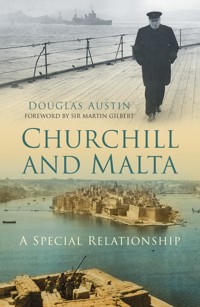
This is the compelling story of the special relationship between Winston Churchill and the people of Malta. During six visits over a period of forty years he came to understand and support the aspirations of the Maltese people and in the Second World War the bonds linking them were tempered in fire and destruction. In those dark days Churchill's determination to defend the island and his faith in the courage of the Maltese people never wavered.
Sie lesen das E-Book in den Legimi-Apps auf:
Seitenzahl: 429
Veröffentlichungsjahr: 2014
Das E-Book (TTS) können Sie hören im Abo „Legimi Premium” in Legimi-Apps auf:
Ähnliche



















Malta is a little island with a great history. The record of the Maltese people throughout that long history is a record of constancy and fortitude. It is with those qualities, matchlessly displayed, that they are now confronting the dark power of the Axis.
The Right Hon. Winston S. Churchill, C.H., M.P.
Foreword to The Epic of Malta, 1942
Acknowledgements
My thanks are due first to Sir Martin Gilbert who has kindly written the foreword to this book. The footnotes within will make clear how much I owe to his remarkable scholarship. I also wish to thank Professor David French for his continued support and encouragment. For their help in providing information about the gift to Sir Winston Churchill of the Malta Shield, which still hangs in his study in Chartwell, I am indebted to my good friends Fr. George Aquilina, O.F.M., Mr Michael Refalo, and to Mr Antoine Attard who is the grandson of Antonio Attard who made the Shield. I am also grateful for the help given me by Mr Neil Walters, the National Trust House Manager at Chartwell, not least for making arrangements for me to include a new photograph of the Malta Shield.
Throughout this study numerous quotations have been made from official British government records now lodged at the National Archives at Kew. These documents and the map entitled ‘Malta: Showing airfields in April 1942’ (plate section no. 22), which is taken from the Official History, ‘The Mediterranean and Middle East, Vol. III’, are Crown Copyright and are reproduced with the permission of the Controller of HMSO and Queen’s Printer for Scotland.
Numerous quotations have also been included from books, memoranda and letters written by Sir Winston Churchill, some of which form part of the Churchill Papers, which are now held at Churchill College Cambridge. The copyright holder is Winston S. Churchill, administered by Curtis Brown Ltd, and permission to quote from these documents is hereby gratefully acknowledged.
The copyright holders of the photographs included in this volume are as follows and the author is pleased to acknowledge their consent for their use in this volume. Imperial War Museum, London: picture numbers 4, 12-19, 21, 23, 25, 27, 29; Richard Ellis Ltd, Valletta, Malta: 2, 6, 8, 9, 11; Churchill Archive Centre, Broadwater Collection, © Winston S. Churchill, administered by Curtis Brown Ltd: 3, 5; Library of Congress: 1, 7, 20, 26, 32; The Times, Malta: 31, 34; National Trust: 30; author: 10, 33, 35-38.
Finally, I wish to acknowledge and pay tribute to the staff and volunteers at Chartwell for the high regard in which they hold the memory of Sir Winston Churchill and the warm welcome they give to the many visitors to Sir Winston and Lady Churchill’s home.
The author records with great sadness the deaths of Michael A. Refalo in June 2011, and of Fr George Aquilina OFM in Spetember 2012.
Contents
Title
Quote
Acknowledgements
Preface
Foreword by Sir Martin Gilbert
Introduction
I First Visit to Malta, October 1907
II The Malta Conference, May 1912, and its Consequences
III The Approach of the Great War
IV The Pursuit of the
Goeben
V Colonial Secretary and a New Malta Constitution
VI The 1927 Visit and a Meeting with Mussolini
VII The 1930s and the Abyssinian Crisis
VIII Return to the Admiralty 1939
IX The Italian Attack on Malta, June 1940
X The First German Blitz, 1941
XI Malta Fights Back, Autumn 1941
XII The Second Great Siege of Malta, Spring and Summer 1942
XIII Change of Governor and the Relief of Malta
XIV Malta’s Contribution to Allied Victory in North Africa
XV 1943. A Year of Attack and Churchill’s Fifth Visit to Malta
XVI Churchill’s Sixth Visit to Malta, January 1945
XVII The Post-War Years
Bibliography
Plates
Copyright
Preface
In September 1922 Winston Churchill purchased Chartwell Manor, a house with medieval origins surrounded by 80 acres of land on the greensand hills of Kent near Westerham. It continued to be his principal residence until his death in January 1965, and it was there that he and Mrs. Churchill raised their family. It then reverted by the terms of a previous arrangement to the National Trust and it is now open to the public between April and October each year. On display in the house are many of the thousands of gifts that Sir Winston received during his long life. Among these there hangs in his Study an elaborate silver shield mounted on a black oval base. It is described in the Chartwell Guide Book as ‘A shield bearing the arms of Malta, given by the people of the island.’ This statement is incorrect in several respects and the author has with the help of Mr. Michael Refalo, Mr. Antoine Attard and Fr. George Aquilina, O.F.M. in Malta, and papers held in the Churchill Archives held at Churchill College Cambridge, pieced together the story of this gift.
In July 1945 the Rt. Hon. Winston Churchill lost the General Election called at the end of the war and became leader of His Majesty’s Opposition. In May of the following year he received a letter from Lt.-Col. Agius, Trade Commissioner at the Malta Government Office in London, asking if he would be prepared to accept a gift from a Maltese citizen. Lt.-Col. Agius wrote that Mr. Edward Ceravolo wished to present a piece of Maltese silver to Mr. Churchill ‘whom he considers the saviour of the world from slavery and paganism.’ Churchill said he would be ‘greatly honoured’ by such a gift.
Edward Ceravolo had lived in Valletta throughout the bombing of 1940-43 and he owned and managed the ‘Splendid’ bar in Valletta. Although the building is no longer a bar the colourful sign of the ‘Splendid Lounge Bar’ still hangs on the corner of 34 Archbishop Street. During the Second World War this bar was the haunt of many British and Commonwealth servicemen and Edward Ceravolo named a number of his special drinks after wartime battles. Early in the war he bought two fine examples of Maltese silver that had been made by Antonio Attard, a well-known and highly accomplished silversmith who had had a workshop on St. Paul’s Street in Valletta. One was a model of Kingsgate, the old entrance to Valletta. The other was a shield depicting an elaborate and finely crafted array of medieval weapons surrounding a coat of arms. These are not the arms of Malta but rather those of Grand Master Jean Parisot de la Valette. It was he who at the age of 71 had led the resistance of the Knights of St. John and the people of Malta against the Turkish armies of Suleiman the Magnificent in the Great Siege of 1565. Edward Ceravolo had initially thought of presenting the Kingsgate model to Churchill but later decided that the shield would be more appropriate in view of Churchill’s role during Malta’s second Great Siege of 1940-43.
Edward Ceravolo came to England several months later and on Wednesday 24 July 1946 he called on Churchill at his room in the House of Commons, accompanied by Lt.-Col. Agius and Mr. H. A. Bonavia from the Malta Government Office. Edward Ceravolo presented the shield to Churchill saying that it was a ‘token of his admiration of Mr. Churchill’s leadership of the British nation during the war’. He also gave Churchill for Mrs. Churchill, who was not able to be present, a bouquet of red and white roses—Malta’s colours. After examining the shield Churchill responded by saying: ‘It is really lovely. I shall keep this in my home and treasure it as a memorial to Malta’s great heroism.’
Churchill then made arrangements for a signed photograph of himself to be framed in walnut at Aspreys, the London jewellers, and on 4 November he sent this to Edward Ceravolo together with a box of his special ‘Churchill’ Havana cigars. His covering letter, written at Chartwell, read as follows:
Dear Mr. Ceravolo
I am sending you herewith a photograph which I have signed, and some cigars, as a small measure of recognition of your kindness in presenting me with the beautiful Maltese shield. This, which now hangs in my study here, is a continual source of pleasure to me, and the care and craftsmanship which produced it have my warm admiration. It will also be a perpetual reminder of Malta’s gallantry during the war.
Yrs sincerely,
Winston S. Churchill
The shield still hangs today in a place of honour in Churchill’s Study at Chartwell where he placed it in 1946. The signed photograph, in its walnut frame, that Churchill sent to Edward Ceravolo in November 1946 is now in the care of Fr. Aquilina, O.F.M., Archivist of the Franciscan Order in Valletta to which it was bequeathed by Mr. Ceravolo’s nephew. The many thousands of visitors who each year pass through Chartwell thus have this valuable and historic reminder of the close ties forged between Winston Churchill and the people of Malta, particularly in the stern days of the Second World War.
Foreword by Sir Martin Gilbert
In the vast panorama of Churchill’s life, his relationship with Malta is a bright light, as bright as the paintings that he did of Valetta harbour. Douglas Austin has traced this relationship from Churchill’s first visit in 1907 to his sixth visit in 1945 and beyond. At the centre of the story is Churchill’s understanding of what he called ‘Malta’s gallantry during the war’, which had so impressed him.
Even before his first visit, Churchill had glimpsed Malta on the sea voyage to India, at the age of twenty one. His first, 1907, visit has intrigued me since, forty years ago, I was working my way through the 1907 files of the Churchill papers. Douglas Austin’s pages about that visit have finally satisfied my curiosity.
Like everything Churchill set his mind to, there is a wealth of gems: personal, historical and constitutional, in this 1907 visit alone, the brightest being Churchill’s ‘Malta memorandum’, uncovered by the author in the files of the old Colonial Office, and examined fully here for the first time.
The first wartime assault on Malta came with Mussolini’s bombers in 1940. As Douglas Austin shows in fascinating detail, it was from that moment that Churchill made every effort to protect and defend the island, as it took its part in the long, hard and often harsh struggle with Italy and Germany in the Mediterranean.
Churchill’s part in that struggle is finely presented in these pages, from which one can see clearly why Malta was awarded the George Cross, a remarkable and unique honour for a place. Churchill understood, as he telegraphed in early 1941 to the Governor, the scale and nature of the ‘magnificent and ever-memorable’ defence of Malta by the ‘heroic garrison and citizens’.
That heroic defence of Malta, and the extraordinary story of the Malta convoys and their escorts, of courageous sailors and intrepid airmen, is an integral part of Britain’s war story. ‘We are absolutely bound to save Malta in one way or another’, Churchill informed his Deputy Prime Minister, the Labour leader Clement Attlee. The terse six words: ‘The Navy will never abandon Malta’, are among Churchill’s greatest wartime instructions; and they were carried out.
This book is a tribute, not only to Churchill’s concerns and achievements across the Maltese scene, but also to its defenders, and to its civilian citizens, each of whom was, by the very nature of the war, a combatant. The research is copious and impeccable; the result is a book that is both true history and high drama.
Introduction
Sir Winston Churchill visited the island of Malta on six occasions. He first sailed in to the Grand Harbour of Valletta on the evening of 2 October 1907 when at the age of 33 he was Under-Secretary of State at the Colonial Office. His last visit took place in January 1945 when, as Prime Minister, aged 70 and on his way to the Yalta Conference, he arrived at dawn on his special Skymaster aircraft. During the inter-war years, too, his eyes were on several occasions drawn to the island by the march of events. But it was during the Second World War that Malta most urgently claimed his attention. This was particularly the case when a few weeks after he had become Prime Minister in May 1940 Mussolini declared war on Britain and launched his bombers against Malta. From that moment as the war in the Mediterranean began with the crash of bombs and guns on the crowded civilian communities around the historic Grand Harbour Churchill was determined that every effort should be made to defend the island and its people and that Malta should play a full part in the defeat of the Axis powers. By the time he paid his last visit to Malta in the closing months of the war he was able to judge, despite severe human loss and physical damage, how well that part had been played. As he had written in 1942, ‘Malta is a little island with a great history. The record of the Maltese people throughout that long history is a record of constancy and fortitude. It is with those qualities, matchlessly displayed, that they are now confronting the dark powers of the Axis.’1
In the following pages the author has drawn together out of the long life of one of the busiest men of the early twentieth century the story of Winston Churchill’s involvement with the people of Malta. Because in his long career he held so many Cabinet positions and always devoted himself with great energy to the task at hand he was able to look at the affairs of the Maltese people from two points of view. At the Colonial Office in 1906 and again in 1921 his concern was for the civil administration of the island and its political, social and economic development. Although he was throughout his life a firm believer in the British Empire and Commonwealth he was also convinced that people would rather govern themselves poorly than suffer the ‘better’ rule of others. This was undoubtedly his view as early as 1906 and it was reflected in the undertaking during the Second World War that Malta would receive a new Constitution as soon as the war was won.
Malta’s other role as a unique imperial fortress in the Mediterranean commanded his attention when on two widely separated occasions he held the office of First Lord of the Admiralty. It was this strategic role that inevitably dominated his thoughts and decisions when he became Prime Minister during the Second World War. Before 1940 it would not be correct to suggest that Malta engaged his attention for long. It was otherwise after he had become Prime Minister and Mussolini had made his cowardly decision, in what Churchill later denounced as ‘the rush for the spoils’, to begin the bombing of a crowded, inadequately defended island. From that moment the plight of the Maltese people and of its military garrison was never long out of his thoughts. Moreover, official Government records and his own voluminous personal files on Malta, from which many papers have been quoted in this study, make clear that many of the key decisions relating to the defence of the island and its development as a powerful offensive base can be attributed to him. Without his forceful insistence that Malta, despite the savage bombing which its people and defenders were compelled to endure, had a unique role to play in the fight against the Axis powers in the Mediterranean it is possible that the island might have been forced to surrender.
As far as possible the story presented here is unfolded in Sir Winston’s own words, official and private, as they were spoken or written at the time. This is especially important for the war time years since Churchill’s own memoirs of the Second World War were, as has often been observed, written under considerable constraint, not least because he was unable to reveal the secret intelligence which guided or determined many decisions. In the latter chapters of this study, therefore, the author has based his account largely upon official government records, particularly those of the Prime Minister’s Office, the War Cabinet and of the Chiefs of Staff Committee. Throughout this study much use has been made of Churchill’s own letters, memoranda and contemporary documents, extracts from many of which are printed in the official biography of Churchill and the associated Companion volumes. The author, like all recent writers about Churchill, owes an enormous debt to Sir Martin Gilbert for this magisterial work. No one can write about Churchill with any hope of accuracy without constant reference to these volumes. Several members of Churchill’s family and many of his friends, colleagues and personal staff have also recorded their personal memories of him. Where appropriate, extracts from these works have been quoted to show how they remembered him. The attached bibliography indicates the main sources that have been consulted in this study.
The narrative set out in the following pages spans a period of half a century. During these years despite dangers and hardship the Maltese people moved steadily towards self-government, independence and, more recently, membership of the European Union. Although the last miles of this long journey have been travelled after Winston Churchill’s death he would surely have applauded as Malta took her place in the community of nations. That the Maltese people should choose to remain within the Commonwealth and to carry upon their national flag the representation of the George Cross awarded to Malta by King George VI in April 1942 would undoubtedly have given him particular pleasure.
Note
1 Foreword to The Epic of Malta (Odhams Press, London, n.d., c. October 1942).
CHAPTER I
First Visit to Malta, October 1907
He should see the hot stones of Malta, baking and glistening on a steel-blue Mediterranean.
Winston Churchill, My African Journey, p. 1
In September 1896 Winston Churchill, a twenty-one year old subaltern in the 4th Hussars, passed within sight of Malta on his first voyage to India but his troopship, the SS Britannia, did not call at Valletta on that passage. While at sea, ‘Between Malta and Alexandria’, Churchill sent his mother, Lady Randolph Churchill who had given her son a new telescope, a detailed description of the voyage.
The monotony of the voyage and of the view is relieved by frequent glimpses of land—at one time off Cape Finisterre—Cape St. Vincent or the lights of Lisbon—at another of Malta or the African coastline. We pass many ships & my telescope is in great demand and constant use. It is a very powerful glass and will be very valuable in India.1
It was not until eleven years later that, in the evening of 2 October 1907, he set foot on Malta for the first time. He was on his way to a private hunting expedition in East Africa, which subsequently became the subject of his book, My African Journey, but his visit to Malta was undertaken in his official capacity as Under-Secretary of State for the Colonies. He had been appointed to this, his first ministerial position, by Sir Henry Campbell-Bannerman in the Liberal administration which the latter had formed in December 1905. As Churchill crossed the Malta channel on the SS Carola between Syracuse and Valletta on that autumn evening he had every right to feel pleased with his achievements in the previous eighteen months.
The Liberal Party had been out of office since 1895 but when in December 1905 Arthur Balfour, the Conservative Prime Minister, resigned King Edward VII invited the Liberal leader, Sir Henry Campbell-Bannerman, to form a government. The new Prime Minister at once offered Churchill, who had moved from the Conservative to the Liberal benches in 1904, the Financial Secretaryship of the Treasury. However, Churchill sought and was, after some delay, granted the less important position of Under-Secretary of State for the Colonies. As he wrote to his friend, Lord Hugh Cecil, at the time, ‘I had some difficulty in securing my wish as it involved considerable alteration in other minor offices.’2 In his biography of his father Randolph Churchill has suggested that Churchill’s preference for the Colonial Office was due, at least in part, to the fact that the new Secretary of State, Lord Elgin, was in the House of Lords. It would consequently fall to Churchill to represent the department in the House of Commons. As Financial Secretary, on the other hand, he would have served under the Chancellor of the Exchequer, Herbert Asquith.3 In the general election that followed in January 1906 the Liberal Party won 377 seats and the Conservatives only 157. Churchill himself, standing for the first time as a Liberal, captured North-West Manchester from the Tories.
With this overwhelming majority the new administration could do much as it liked although, particularly in the field of foreign policy, it acknowledged some obligation to maintain a bi-partisan approach in the interests of continuity. Ministers, however, felt less bound to abide by this principle in matters of colonial policy where they believed that the Tories had eroded the spirit of justice and fair play. Churchill fully shared these views. As early as 1904 he had lectured Joseph Chamberlain, a former Colonial Secretary, that if the empire held together it would be ‘because it is based upon the assent of free peoples, united with each other by noble and progressive principles; because it is animated by respect for right and justice … an agent of human progress and of international peace.’4 Upon taking office Campbell-Bannerman’s government had put principle into practice by securing the grant of self-government to the former Boer republics of Transvaal in 1906 and to the Orange River Colony in the following year. The detailed work on the transition of these territories from Crown Colony status to full self-government had fallen to Lord Elgin and to Churchill, his Under-Secretary. It would be difficult to imagine a greater contrast than between these two men whose only common characteristic seemed to be their membership of the Edwardian ruling class. The white-bearded, Oxford-educated, 9th Earl of Elgin was then 58 years old. His grandfather had been responsible for removing the ‘Elgin marbles’ from the Parthenon, and his father had achieved great distinction as Governor of Jamaica, Governor-General of Canada, and Viceroy of India. He in turn had been Viceroy, 1894-99. He was, however, unusually shy and rarely spoke in Cabinet and then only on his departmental responsibilities. When he was initially recommended to Queen Victoria for the Viceroyalty she observed that ‘he is very shy and most painfully silent … He would not command the respect which is necessary in that office.’5
Churchill could never have been accused of being shy or silent. Although then only 31 years old, he had already gained wide publicity—self-publicity, many said—as a soldier, journalist, biographer, and rising politician. Reticence and modesty were not part of his personality and he attracted admiration and loathing in almost equal measure. Alexander MacCallum Scott, a fellow Liberal MP, had already in 1905 published the first of many biographies of Churchill and in this he observed that his subject was ‘probably the best-hated man in England after Joe Chamberlain.’6 This judgement owed much, but not everything, to Churchill’s defection to the Liberal Party in 1904. MacCallum Scott added, however, that Churchill was ‘confidently spoken of by his admirers as a future prime minister.’ John Morley, at that time Secretary of State for India, and a close political ally, thought that, after Joseph Chamberlain, Churchill was:
… the most alive politician I have ever come across—only he has not got Chamberlain’s breadth nor his sincerity of conviction. But for ceaseless energy and concentration of mind within the political and party field, they are a good match. They make other folk seem like mere amateurs.7
Churchill had already met Elgin in India in January 1898. He was at that time a mere 2nd Lieutenant in the 4th Hussars, while Elgin was Viceroy, but he had stayed with the Elgins for several days at Government House in Calcutta. Churchill had recently been attached to the Malakand Field Force on the North West Frontier of India, and had been ‘Mentioned in Despatches’ for his involvement in the fighting there. These experiences became the subject of his first published book, The Story of the Malakand Field Force. Churchill, exhilarated by this experience, had hurried to Calcutta hoping to be attached in some capacity to the Tirah Expeditionary Force.8 In this he was unsuccessful and he must have thought it most unlikely that eight years later he would be working with Elgin at the Colonial Office.
Inevitably, Elgin had some initial misgivings about his junior colleague but resolved to make the relationship work by taking Churchill fully into his confidence. The latter in his first ministerial appointment plunged into the work with tireless energy and enthusiasm, often writing memorable minutes on the many papers that crossed his desk. He and Elgin frequently disagreed. On one of Churchill’s memoranda that concluded with a resounding, ‘These are my views’, Elgin quietly minuted, ‘But not mine’.9 Once each had taken the measure of the other a constructive, if never close, working relationship developed. Edward Marsh, Churchill’s Private Secretary, later described this relationship as one of ‘qualified esteem’.10 After Elgin had left office in April 1908 he told his successor, Lord Crewe:
When I accepted Churchill as my Under Secy I knew I had no easy task. I resolved to give him access to all business—but to keep control (& my temper). I think I may say I succeeded. Certainly we have had no quarrel during the 2½ years, on the contrary he has again and again thanked me for what he has learned and for our pleasant personal relations. I have taken a keen interest in his ability and in many ways attractive personality.11
This oddly paired couple despite their temperamental differences successfully steered the Government’s proposals for the new Transvaal constitution through Parliament in the summer and autumn of 1906. As noted above, one of the political advantages of Churchill’s position was that, since Elgin was in the House of Lords, it fell to him to present and argue the Government’s plans in the Commons. However, even he could hardly have expected to present the Cabinet’s Transvaal proposals at the end of July 1906. He later told Violet Bonham-Carter, Asquith’s brilliant daughter and a life-long friend, ‘how astonished and overjoyed he had been when he was sent for by the Prime Minister and asked, quite unexpectedly and at a fortnight’s notice, to undertake it.’12 The speech Churchill made in the House of Commons on 31 July, meticulously prepared, as were all his speeches then and later, was warmly received at least on the Liberal benches. His concluding, but fruitless, appeal to the Opposition that ‘we can only make it the gift of a party; they can make it the gift of England’, was an early example of Churchill’s gift for finding the apt and long-remembered phrase.13 Shortly before he left London in October 1907 he received a letter from the Prime Minister. Referring to Churchill’s contribution to the new constitutions in South Africa, Campbell-Bannerman wrote ‘a large part of the credit of it must be always attributed to you.’14
At the end of the Parliamentary session in the summer of 1907 Elgin welcomed Churchill’s plans to spend the autumn months on a hunting expedition in East Africa since this would give him the opportunity to study various problems at first hand. Nevertheless, Elgin had not expected Churchill to have time to send back to London so many letters and memoranda and he later wondered how ‘a purely sporting and private expedition … drifted into so essentially an official progress.’15 After leaving London Churchill had attended the French army manoeuvres and then, accompanied by his cousin, the Duke of Marlborough, had spent some time hunting on Baron de Forest’s estates in Moravia. They had then parted and Churchill made his way south to Syracuse where he boarded the SS Carola. He landed at Valletta on the evening of 2 October. There he was joined by Edward Marsh whom two years earlier he had appointed as his Private Secretary. Marsh later recounted in his memoirs that when Churchill had offered him the position he had some misgivings which he expressed to Lady Lytton. She, as Pamela Plowden, had once been unofficially engaged to Churchill and after listening to Marsh she told him: ‘The first time you meet Winston you see all his faults, and the rest of your life you spend in discovering his virtues.’16
Two years older than Churchill, Edward Marsh was the great-grandson of Spencer Perceval, the only British Prime Minister to have been assassinated, and his upbringing and education were financed by what he called the ‘murder money’ that Parliament had voted after Perceval’s death for the benefit of his children and descendants. Following a fine academic career at Cambridge ‘Eddie’ Marsh entered the Colonial Office and was a First Class Clerk in charge of the Africa Department before being appointed as Churchill’s Private Secretary. During the following thirty years until his retirement in 1937, Sir Edward Marsh, as he later became, served as Private Secretary whenever Churchill held office. He became a close friend of Churchill’s family and was godfather to Churchill’s second daughter, Sarah. For his part Churchill quickly formed a strong attachment to Eddie Marsh and in August 1908 wrote to him that ‘Few people have been so lucky as me to find in the dull and grimy recesses of the Colonial Office a friend who I shall cherish and hold to all my life.’17
Upon his arrival at Valletta Churchill was, as he wrote to his younger brother, Jack, ‘installed in much state in this wonderful old Palace of the Grand Master of the Knights of Malta’.18 During a characteristically busy week he inspected the dockyard, the military positions, the schools and hospitals, but, as he wrote to Lord Elgin before leaving Malta, the ‘pièce de résistance’ of his week there was his meeting with the elected Members of the Council of Government on 4 October.19 Churchill was fully aware that he was stepping into a political and constitutional hornets’ nest when he undertook this visit. The full story of this complex situation properly belongs to Maltese constitutional and political history. Suffice here to say that in 1903 the Malta Constitution of 1887 was revoked after a long dispute about the degree of autonomy to be granted to the elected Maltese Members of the Council of Government in respect of purely local matters. Imperialists in London, such as Joseph Chamberlain, were apt to quote in defence of their position a saying attributed to the Duke of Wellington that ‘you might as well give a constitution to a man-of-war as give it to Malta.’20 The naval importance of Malta at that time is more fully explored in the next chapter.
On the day after Churchill’s arrival in Valletta the Daily Malta Chronicle printed a lengthy address by Augusto Bartolo, the son of the newspaper’s Anglophile editor, arguing for greater Maltese control of local affairs. ‘Malta Lacks a Constitution’, he insisted. Shrewdly he also drew attention to the disparity between the British Government’s treatment of Malta and the Boer republics.
Can anyone believe that that same England which … has given an autonomous government to conquered South Africa, should obstinately refuse to grant the management of its domestic affairs to our Malta … which entered the British Empire of its own free will, relying on the honour and good faith of the British Nation?21
Churchill hardly needed this reminder of his part in securing the grant of self-government to Transvaal and the Orange River Colony. He might also have recalled that in his speech to the House of Commons on 31 July 1906 he had said, ‘No one can contend that it is right to grant the forms of free institutions, and yet to preserve by some device the means of control.’22 Many Maltese political leaders would no doubt have argued that this was an accurate description of the situation in Malta.
Churchill met the elected Members and representatives of the nobility, the Malta Bar and the Chamber of Commerce at the Palace on the morning of Friday 4 October. Most of the Members offered their views and proposals, after listening to which Churchill made a lengthy reply that was printed in the local press. He began by saying that he was there to listen, and could not give any promises or pledges. He then made reference to the arrangements that had been made after the withdrawal of the Constitution in 1903. He told his listeners: ‘I do not feel any astonishment that you do not like them; indeed, if I were in your place, I should not like them, but Lord Elgin must be confronted with clear evidence that a new situation has arisen before he can be induced to reconsider the present state of affairs.’ He welcomed the earlier decision of the elected Members to resume their seats in the Council of Government and continued: ‘I shall be glad if it be possible to make some arrangements which would be more in accordance with your wishes and secure to you a more effective voice in purely local affairs.’ He concluded by declaring that ‘the door is not closed on the constitutional question.’23
Later the same day, while the details and the apparently cordial atmosphere of the meeting were still fresh in his mind, Churchill wrote a lengthy letter to Elgin. After describing his activities, he wrote:
I am bound to say that their complaint—viz that they were never conquered by England, but that now we spend their money without allowing the Maltese any sort of control—is a vy real & to me at least a vy painful one… . My line was that ‘the last word has not been spoken’ & that it rested with them by frank cooperation with the Government to establish a case for the reconsideration of the question.24
Several days later Churchill and his party boarded the cruiser, HMS Venus, which the Admiralty had put at his disposal, and sailed for Cyprus. He then prepared a longer memorandum setting out the proposals he had promised Lord Elgin and this was duly despatched to the Colonial Office.
In many of the numerous biographies of Churchill the reaction of the Colonial Office officials to this memorandum has attracted much attention, its contents almost none. Sir Francis Hopwood, the Permanent Under-Secretary, wrote to Churchill that ‘I am nursing up the Malta Memorandum until your return, as it must be dealt with with considerable circumspection.’25 A month later, however, Hopwood, having received from Africa a steady stream of letters and memoranda, sent a letter to Lord Elgin which was highly critical of Churchill.26 ‘He is most tiresome to deal with & will I fear give trouble—as his father [Lord Randolph Churchill] did—in any position to which he may be called. The restless energy, uncontrollable desire for notoriety & the lack of moral perception make him an anxiety indeed.’ He went on to write:
Churchill should have reserved his points until he returned home—anybody else would have done so both out of caution or at the dictation of personal convenience—Marsh gives a vivid description of 14 hours work in one day upon these memoranda in the heat & discomfort of the Red Sea.
Elgin, too, was critical of the numerous memoranda that Churchill sent home, writing to Lord Crewe, ‘I believe most of them hopelessly to be unpracticable at least as they stand.’27
Churchill’s Malta memorandum, carrying the pencilled date ‘January 1908’, is to be found in the Colonial Office files at the National Archives at Kew.28 Churchill began by referring to his discussions in Valletta. He noted that the views of the elected Members, often given little weight by the Governor’s official staff, had been ‘quite unexpectedly endorsed’ by the representatives of the old Maltese nobility, the Bar, and the Chamber of Commerce whom he had also met. These special interest groups expressed in even stronger terms than the elected Members did their indignation at the constitutional position. They were, they declared, ‘strangers in their own island’. Churchill rejected the ‘fortress Malta’ argument employed by Chamberlain, characterising this as an ‘extremely inadequate argument upon which to dismiss the claims to any measure of self-government even in respect of their own purely local affairs’. He felt unable to recommend a return to the 1887 Constitution, but went on to suggest a revision to the proceedings of the Council designed to put the Maltese elected Members in a majority whenever the issue in question was a purely local Maltese matter. It would be for the Governor to determine whether an issue for consideration was local or imperial, and Churchill recognised that this might lead to controversy. Nevertheless, he expressed the hope that goodwill on both sides would prevail, and reinforced this by proposing that in every case where the Governor ruled that a question was an imperial one a report should be made to London to ascertain the views of the Secretary of State. Clearly, this proposal did not fully square the circle but Churchill argued that it was worth a trial; it would, he felt, ‘mitigate a very real grievance and actual injustice’.
Churchill’s scheme reflected a genuine sympathy for the Maltese position with regard to local issues, without conceding overall London control on matters of imperial concern. However, as he recognised, its practicability required goodwill on all sides, and he may have been encouraged by his visit to believe that this might be forthcoming. In urging co-operation he had reminded the elected Members that ‘If everybody in England was to strain his privileges and rights to the utmost letter of the law, the British Constitution would become unworkable in a week.’
Churchill’s absence in East Africa which kept him out of England until mid-January 1908 meant that formal consideration of the proposals set out in his memorandum did not begin until his return. By then, however, political changes were imminent and on 10 April Churchill left the Colonial Office to take up his first Cabinet appointment as President of the Board of Trade. At the same time the Earl of Crewe succeeded Elgin as Colonial Secretary. With Churchill’s departure from the Colonial Office the impetus for any change in Malta’s governance slowly evaporated. A full two years later, after numerous memoranda and minutes, all recorded in the Colonial Office files, the only change was an amendment to the Constitution providing for two of the Maltese Members of the Council of Government to be appointed to the Governor’s Executive Council. The elected Members found this unsatisfactory and resigned their seats.
Long before then, as we have seen, Churchill had left the Colonial Office. It was not until 17 January 1908 that he returned to London from his African expedition having already been made aware that the Prime Minister’s health was failing and that his resignation could not be long delayed. In the event Campbell-Bannerman resigned on 3 April and several days later Asquith succeeded him. On 8 April he offered Churchill the position of the Presidency of the Board of Trade, with a seat in the Cabinet, and Churchill, after some initial hesitation, accepted. It was this promotion that, for the time being, brought to an end his direct involvement with the affairs of Malta.
There remains, however, an intriguing possibility that deserves attention. When Asquith, even before Campbell-Bannerman’s resignation, was beginning to think about appointments in his new administration he had a meeting with Churchill on 12 March 1908. Two days later Churchill sent him a letter with his thoughts on the three possible appointments that they had discussed, viz. the Colonial Office, the Admiralty and the Local Government Board. In his letter Churchill made quite clear his aversion to the Local Government Board and the difficulty he felt about considering the Admiralty caused by the fact that his uncle, Lord Tweedmouth, was the incumbent First Lord. With regard to his present appointment he wrote:
I know the Colonial Office. It is a post of immense importance, but largely disconnected detail: & I have special experience of several kinds which helps. During the last two years practically all the constructive action & all the Parliamentary exposition has been mine. I have many threads in hand and many plans in movement.29
He went on to add that, compared with a move to the Local Government Board, ‘I would rather continue to serve under Lord Elgin at the Colonial Office without a seat in the Cabinet’. He, nevertheless, concluded by saying that he would serve ‘where you wish’ and on 10 April accepted Asquith’s offer of the Presidency of the Board of Trade.
One is inevitably left to wonder what the effect on Malta’s constitutional development might have been had Churchill remained at the Colonial Office, especially had he, rather than Lord Crewe, succeeded Lord Elgin as Secretary of State. Despite the misgivings of some officials in London and Malta, it seems likely that he could have persuaded Asquith and the Cabinet that the proposals set out in his memorandum should be given a trial. Moreover, his evident sympathy for Maltese grievances might well have ensured that his overall supervision of the Governor’s discretion to regard an issue as an imperial one was exercised in such a manner as to meet the Maltese demand for control over purely local matters. Evidence of Churchill’s views about British colonial rule can be found in many of the Colonial Office papers. In a letter to the King describing the new Transvaal constitution he wrote: ‘Any intelligent community will much rather govern itself ill, than be well governed by some other community.’30 At the end of his thoughtful study of Churchill’s early years at the Colonial Office Ronald Hyam offered this assessment of Churchill:
He had a generous and sensitive, if highly paternalistic, sympathy for subject peoples, and a determination to see that justice was done to humble individuals throughout the empire. He had this sympathy to a degree which was rare among British administrators, and even politicians, at this time.31
It is more difficult to judge how the elected Members might have responded to Churchill’s proposal had it been implemented. But it seems at least possible that the mutual goodwill, which appears to have been created during the Valletta discussions, might have persuaded them that the proposed new voting procedure was a meaningful step forward and well worth a trial. What is, nevertheless, clear is that, after Churchill’s promotion to the Board of Trade in April 1908, lethargy replaced ‘tireless energy’ in the corridors of the Colonial Office. Nothing, therefore, came of Churchill’s initiative and by 1911 the constitutional impasse in Malta was as firmly established as it was before his visit to the island.
This first experience of Malta and his meetings and discussions with leading men in the island thus gave Churchill a direct view of the realities and complexities of British colonial rule in the early years of the twentieth century. Although he expressed no doubts about the need to retain overall British control for imperial and military reasons he saw no justification for denying the Maltese people an acceptable constitution and the right to decide their own local affairs. His inclination, not then widely shared in the Colonial Office, was to broaden the sphere in which the Maltese might govern themselves through leaders of their own choice. At this time, however, this basic inclination did not prevail. Nevertheless, the fact that Churchill’s first direct experience of Maltese affairs was related to civil and political issues rather than to military considerations gave him an early insight into Maltese political conditions and aspirations. This would influence the future decisions he took when he held positions related to imperial defence. Such a perspective was required when, five years later, he next visited the island.
Notes
1 Randolph S. Churchill, Winston S. Churchill: Companion Volume I, Part 2 1896-1900 (Heinemann, London, 1967), WSC to Lady Randolph Churchill, 18 September 1896, p. 679.
2 Randolph S. Churchill, Winston S. Churchill: Volume II, Young Statesman 1901-1914 (Heinemann, London, 1967), pp. 106-7. [Note: The volumes of the official biography of Winston Churchill, of which the first two were written by his son, Randolph, and the other six by Martin Gilbert, are henceforward referred to as Churchill. The accompanying Companion volumes of related documents are referred to as Companion with the relevant volume and part number.]
3Churchill, Vol. II, pp. 106-7.
4 R. Hyam, Elgin and Churchill at the Colonial Office (Macmillan, London, 1968), p. 50, footnote 3.
5 Ibid., pp. 17-18.
6 A. MacCallum Scott, Winston Spencer Churchill (Methuen, London, 1905), p. 241.
7 Quoted in Hyam, Elgin, p. 502.
8Churchill, Vol. I , p. 368.
9 Hyam, Elgin, p. 494.
10 C. Hassall, Edward Marsh: Patron of the Arts (Longmans, London, 1959), p. 122.
11Companion, Vol. II, Part 2, Elgin to Crewe, [?] May 1908, p. 797.
12 V. Bonham-Carter, Winston Churchill As I Knew Him (Eyre & Spottiswoode and Collins, London, 1965), p. 137.
13 D. Cannadine (ed.), The Speeches of Winston Churchill (Penguin Books, London, 1990), p. 30.
14Companion, Vol. II, Part 1, Campbell-Bannerman to WSC, 9 September 1907, p. 667.
15Companion, Vol. II, Part 2, Elgin to Crewe, [?] May 1908, p. 797.
16Churchill, Vol. II, p. 111.
17Companion, Vol. II, Part 2, WSC to Marsh, 20 August 1908, p. 836.
18Companion, Vol. II, Part 2, WSC to Jack Churchill, 3 October 1907, p. 684.
19Companion, Vol. II, Part 2, WSC to Elgin, 4 October 1907, pp. 684-7.
20 Quoted in H. Frendo, Party Politics in a Fortress Colony: The Maltese Experience (Midsea Publications, Valletta, 1991), p. 5.
21Daily Malta Chronicle, 3 October 1907.
22 Cannadine, Speeches, p. 30.
23Daily Malta Chronicle, 7 October 1907.
24Companion, Vol. II, Part 2, WSC to Elgin, 4 October 1907, p. 686.
25Companion, Vol. II, Part 2, Hopwood to WSC, 15 November 1907, p. 698.
26Churchill, Vol. II, Hopwood to Elgin, 27 December 1907, p. 228.
27Companion, Vol. II, Part 2, Elgin to Crewe, [?] May 1908, p. 797.
28 NA CO 158/360/3351, WSC to Elgin, January 1908.
29Companion, Vol. II, Part 2, WSC to Asquith, 14 March 1908, pp. 754-6.
30Companion, Vol. II, Part 1, WSC to King Edward VII, 15 August 1906, p. 559.
31 Hyam, Elgin, p. 503
CHAPTER II
The Malta Conference, May 1912,and Its Consequences
We cannot possibly hold the Mediterranean or guarantee any of our interests there until we have obtained a decision in the North Sea.
Churchill letter to Lord Haldane, 6 May 1912
Winston Churchill’s second arrival at Valletta was markedly different from the first. In 1907 he had disembarked late at night from the Syracuse ferry. Five years later in the morning light of Wednesday 29 May 1912 he sailed into the Grand Harbour as First Lord of the Admiralty standing on the bridge of the gleaming 3,500-ton Admiralty yacht, HMS Enchantress. Alongside him stood, among others, the Prime Minister, Herbert Asquith, and his daughter, Violet. In her book, Winston Churchill As I Knew Him, Violet Bonham-Carter has described being summoned on deck by Churchill as the Enchantress approached Malta.
The Island we were approaching looked like one vast fortress, a great heap of battlemented stone built between sky and sea. We sailed into the most wonderful harbour I could have imagined or dreamt of. —‘harbour of harbours’—strongholds and fortresses piled up on every side, Men of War hoisting their colours with bugle calls from every deck. Grandees of all sorts began to arrive in pinnaces—all the Admirals in the first, followed by their Flag-Lieutenants, then Ian Hamilton with a military contingent and finally Lord Kitchener looking quite splendid, treble life-size—but alas! dressed as a civilian in a Homburg hat.1
Much had happened in Churchill’s official and private life since his previous visit to Malta but, by his own account, by far the most important event was his marriage on 12 September 1908 to Clementine Hozier. Her father, Sir Henry Hozier, who had died a year earlier, had been Secretary of Lloyds and in that capacity was well known to the commercial and shipping community in Malta. As a result Mr. Giovanni Messina, President of the Malta Chamber of Commerce, wrote to Churchill on 31 August 1908:
As a token of the Chamber’s respectful homage and hearty greetings, I beg, on my behalf and that of my colleagues, you would condescend to present for its acceptance to Miss Clementine Hozier a reproduction of a Gozo sailing boat … wishing you and Miss Hozier a happy and prosperous life.2
Clementine stood beside her husband as Enchantress steamed into the Grand Harbour on that May morning.
In the years since joining the Cabinet as President of the Board of Trade Churchill had become Home Secretary in February 1910, and then, in October 1911, had been appointed by Asquith as First Lord of the Admiralty exchanging positions with Reginald McKenna. In the first volume of The World Crisis, his subsequent history of the First World War, Churchill described his visit to Asquith’s Scottish residence, and his joy at being offered the Admiralty.
The fading light of evening disclosed in the far distance the silhouettes of two battleships slowly steaming out of the Firth of Forth. They seemed invested with a new significance to me.
‘I was to endeavour’ he added, ‘to discharge this responsibility for the four most memorable years of my life.’3 His joy was not shared by the many supporters of the Navy. This was due in large part to his vehement support of Lloyd George in 1909 when the latter, as Chancellor, had opposed McKenna’s plans to build six new dreadnought battleships. To support McKenna Admiral Sir John Fisher, the First Sea Lord, orchestrated a campaign in the press with the slogan, ‘We want eight, we won’t wait!’ Churchill himself attracted widespread criticism. Lord Knollys, the King’s Secretary, wrote to Lord Esher on 10 February 1909:
What are Winston’s reasons for acting as he does in this matter? Of course it cannot be from conviction or principle. The very idea of his having either is enough to make anyone laugh.4
A fierce struggle within the Cabinet ensued before agreement was reached that only four would be laid down in 1909-10 but with the understanding that four more might be ordered later if circumstances warranted. The subsequent news that both Italy and Austria had announced their intention to build new dreadnought battleships then triggered the construction of the additional four British ships. As Churchill later wrote: ‘The Admiralty had demanded six ships: the economists offered four: and we finally compromised on eight.’5




