


Erhalten Sie Zugang zu diesem und mehr als 300000 Büchern ab EUR 5,99 monatlich.
- Herausgeber: Phillimore & Co Ltd
- Kategorie: Sachliteratur, Reportagen, Biografien
- Sprache: Englisch
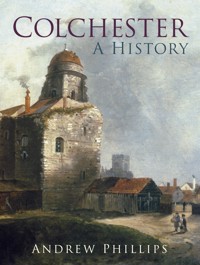
Colchester boasts 2,000 years of history. Few towns in Britain can equal that. Yet this new book, by a local author, is the first full and concise history of Colchester to be published for over half a century, during which time our knowledge of the town's past has grown immeasurably. The Iron-Age capital of King Cunobelin (Shakespeare's Cymbeline), Colchester was the target of the Roman invasion in AD 43. Where the Emperor Claudius received its submission, the Romans built a legionary fortress, the framework of which still forms the centre of Colchester. As capital of Roman Britain, Colchester was overrun and burnt by the warrior queen Boudica (aka Boadicea), then rebuilt and ringed by its famous walls. After Rome fell and the Saxon incursions began, the Saxon King Edward the Elder made it the leading town in Essex. The Normans raised its profile higher, when an Abbey, a Priory and a great castle gave it the strategic defence of Eastern England. It was besieged only once, when King John was in conflict with his barons over Magna Carta. For 400 years Colchester's cloth industry placed it among the top fifteen towns in the kingdom. It saw Protestants burnt at the stake, withstood a Civil War siege, was ravaged by plague and stood in the front line against invasion, first by Napoleon, then by the Kaiser, then by Hitler. An important engineering town since Victorian times, it is today a regional shopping centre, a major garrison town and a popular tourist attraction. This authoritative, readable and well illustrated work, from a professional historian, will doubtless become the standard work on this ancient town for at least the next half-century.
Sie lesen das E-Book in den Legimi-Apps auf:
Seitenzahl: 256
Veröffentlichungsjahr: 2017
Das E-Book (TTS) können Sie hören im Abo „Legimi Premium” in Legimi-Apps auf:
Ähnliche



















COLCHESTER
A HISTORY
John Sell Cotman’s view of the ruined west front of St Botolph’s Abbey church captures the theme of ancient grandeur which has sustained Colchester’s public identity for 200 years. Cotman’s drawing sold in some numbers in 1836 to help fund the building of the present St Botolph’s Church (see pages 27–8).
COLCHESTER
A HISTORY
ANDREW PHILLIPS
First published 2004 by Phillimore & Co. Ltd
This revised and updated edition 2017
The History Press
The Mill, Brimscombe Port
Stroud, Gloucestershire, GL5 2QG
www.thehistorypress.co.uk
© Andrew Phillips, 2004, 2017
The right of Andrew Phillips to be identified as the Author of this work has been asserted in accordance with the Copyright, Designs and Patents Act 1988.
All rights reserved. No part of this book may be reprinted or reproduced or utilised in any form or by any electronic, mechanical or other means, now known or hereafter invented, including photocopying and recording, or in any information storage or retrieval system, without the permission in writing from the Publishers.
British Library Cataloguing in Publication Data.
A catalogue record for this book is available from the British Library.
ISBN 978 0 7509 8750 9
Typesetting and origination by The History Press
Printed and bound by CPI Group (UK) Ltd, Croydon, CR0 4YY
eBook converted by Geethik Technologies
CONTENTS
About the Author
List of Illustrations
Introduction and Acknowledgements
1. Camulodunum 50 B.C.-A.D. 60
2. The Roman Town A.D.60-450
3. From Saxons to Normans 450-1200
4. The Medieval Town 1200-1525
5. The Godly Town 1525-1640
6. From Civil War to Commercial Crisis 1640-1720
7. The Long Decline 1720-1830
8. Pride and Progress 1830-1914
9. War, Depression, War 1914-45
10. As Far as the Eye can See 1945-2000
Concise Bibliography
ABOUT THE AUTHOR
ANDREW PHILLIPS is a Fellow of the Department of History at the University of Essex, having previously been Lecturer in History and Head of Humanities at the Colchester Institute. For many years responsible for training Blue Badge tourist guides for the town, in 1988 he founded the Colchester Recalled Oral History Group and, soon afterwards, became chairman of the Friends of Colchester Museum. He was honorary librarian and a former president of the Essex Society for Archaeology and History.
Since 1981 he has contributed a regular local history feature to the Essex County Standard and Gazette and given frequent talks and lectures on local history around Essex. He has written nine previously published books about Colchester, most recently Colchester in the Great War in addition to many articles about Colchester and Essex. With this latest book on Colchester he has brought together over forty years’ study of the town.
LIST OF ILLUSTRATIONS
Frontispiece: St Botolph’s Priory
1. Roman Britain in c.A.D. 60
2. Four gold coins
3. The dyke and river system, Camulodunum
4. Gryme’s Dyke
5. Artist’s reconstruction of the original tomb beneath the Lexden Tumulus
6. Two crucial finds in the Lexden Tumulus
7. Archaeological plan of the Roman Colonia
8. A model of the Temple of Claudius
9. Temple foundations, Colchester Castle
10. A bronze head of the Emperor Claudius
11. Logo of the Essex County Standard
12. How Colchester’s Roman wall was built
13. Southern bastion of the Balkerne Gate
14. The Ermine Street Guard
15. Painting of the theatre built at Gosbeck’s
16. Gosbeck’s temple and theatre
17. Bronze statuette of Mercury
18. Artist’s impression of chariot racing
19. Roman tombstone
20. Roman tombstone
21. The so-called Colchester Vase
22. High status Samian ware
23. Mosaic floors uncovered in Colchester
24. Decorated military buckle
25. Grave collection
26. Roman glassware, Butt Road cemetery
27. Skull and thigh bone of an elderly woman
28. A brooch, comb and a coin, c.720
29. Reconstruction: 7th-century Saxon hut
30. A replica Viking ship
31. The tower of Holy Trinity Church
32. Sketch of Colchester Castle, 1610
33. The church of St John’s Abbey, 1463
34. Eudo the Dapifer, his statue on Colchester Town Hall
35. Colchester borough seal, c.1200
36. St Helena’s Chapel
37. Map showing the sites of the Mary Magdalen Hospital
38. Inside a Norman stone house
39. Artistic impression of Colchester Castle
40. Carvings on the walls inside the Castle
41. Aaron of Colchester
42. Illuminated list of charters
43. Norman and Saxon fish weirs
44. List of wills enrolled in Colchester
45. John Ball, preaching on horseback
46. Bastions in modern Priory Street
47. Reconstruction of the Red Lion Inn
48. Medieval East Street
49. A restored building, West Stockwell Street
50. The borough’s coat of arms
51. 1523 pardon issued by John Driver
52. The burning of the Colchester Lollards
53. Thomas Audley
54. Richard Rich
55. The gate to St John’s Abbey
56. The burning of John Laurence
57. Colchester Protestants being led in chains to London
58-9. Placards placed round offenders’ necks
60. Colchester in 1588 seen from the east
61. Speed’s map of 1610
62. Lead seal showing Colchester Castle
63. Dr William Gilberd
64. Dr John Bastwick
65. The arrival of Marie de Medici, 1638
66. 1642 assault on Sir John Lucas’s house
67. Sir Harbottle Grimston, M.P
68. Sir Charles Lucas
69. Sir Thomas Fairfax
70. Map: Parliamentary batteries encircling Colchester
71. The siege of Colchester
72. Pamphlet: The siege of Colchester
73. Pamphlet: the executed Lucas and Lisle
74. The Great Plague of 1665-6
75. Colchester from the north, 1697
76. Witchfinder General Matthew Hopkins
77-8. Carvings of a Bluecoat boy and girl
79. Bay tokens produced as small coinage
80. Traditional silk-weaving loom
81. Outer Colchester when still rural
82. Sir Isaac Rebow
83. The castle from the north, 1725
84. A High Street grocery shop
85. A tallow candle factory
86. A Colchester-made clock, >c.1750
87. Colchester High Street in 1858
88. Middle Mill
89. Hythe from Clingo Hill, 1741
90. The former Custom’s House, Hythe Hill
91. Colchester bank note
92. ‘The Tea Room at a Colchester Ball’
93. Lion Walk Church
94. Uniform of the Colchester Loyal Volunteers
95. Colchester’s medieval North Gate
96. View from the rebuilt St Nicholas Church spire
97. Colchester’s silk throwing mill
98. Colchester High Street from the east, 1834
99. High Street from the west, 1862
100. Plan of the Colchester Parliamentary constituency
101. Late Victorian Hythe
102. A train at Colchester North Station, 1846
103. The new livestock market, Middleborough
104. William Bruce’s coachworks
105. Lent Watts’s Castle Steam Stone Works
106. Colchester’s new garrison
107. John Kavanagh, with his workforce
108. Inside Mumford’s main erecting shop
109. Women using gas irons
110. The Oyster Feast of 1902
111. The new town hall under construction
112. Earnest nonconformists, Headgate Chapel
113. Colchester Town Football Club
114. High Street, 1905
115. Kitchener recruits
116. A wounded soldier
117. Queuing for potatoes, 1917
118. Schoolteachers writing out ration cards
119. Peace celebrations, 1919
120. Colchester High Street in the 1920s
121. East Bridge being widened, 1927
122. The new Colchester Bypass
123. Britain’s first two-hinged arch bridge
124. Hyam’s factory workers on an outing
125. A Tyneside collier bringing coal
126. The newly-completed Turner Village, 1935
127. Evacuees at Burton-on-Trent
128. Incendiary blaze at St Botolph’s Corner
129. Women at the Britannia Works, 1944
130. Orlitt houses under construction, 1946
131. The Commons in 1959
132. Demolition of St Nicholas Church spire
133. A footbridge spans Queen Street
134. Market stalls in High Street
135. The ‘hole in the ground’, 1974
136. The ‘magic roundabout’
137. Concrete rafts and towers, Essex University
138. Colchester Tattoo in Castle Park
139. Wood’s new factory complex
140. ‘Post Office tower’, 1969
141. Pickets outside the gates of Ozalid
142. Colchester United versus Leeds United
143. Paxman staff and a Valenta engine
144. View of Balkerne Hill, 1988
INTRODUCTION AND ACKNOWLEDGEMENTS
Few towns in Britain can match Colchester for the depth and drama of its history. In this book I hope ordinary readers will find not just headline-grabbers like Julius Caesar and Boudica, King John and Henry VIII, but the ordinary people of Colchester pursuing their often hazardous lives. I have also given full coverage to the 20th-century history of the town, the bit many readers will actually remember. A history book should always be a bridge to the future and not just a detour from the present.
In writing a concise history there are two challenges. Firstly, there is real difficulty in deciding what to leave out. Complex issues must often be reduced to a simple story. Secondly, I am heavily indebted to other writers who know more about certain periods than I do. In particular, I would like to thank Philip Crummy of the Colchester Archaeological Trust and author of City of Victory, for help with the early chapters and the use of illustrations from his books, Janet Cooper, editor of the outstanding Victoria County History of Essex, Volume 9, about Colchester, and Ian McMeekan, of the Colchester Tourist Guides, who have read individual chapters. Paul Sealey introduced me to ‘British G’ coins. I have suggested, in the Bibliography, books where an interested reader might find more detailed information.
Reconstruction by the artist Peter Froste of Roman Colchester in c. A.D. 250, showing the major landmarks discovered by archaeologists.
Keith Mirams drew the cloth trade illustrations and Brian Light the map of Roman Britain, while the incomparable Peter Froste has kindly permitted me to include several of his historical paintings. The Colchester Museum Service were helpful in supplying a great many images. Marcel Glover digitalised other images. In addition, I would like to thank the following individuals, institutions and publications for the use of photographs and illustrations, for which they hold the copyright: Barracuda Books, Colchester Archaeological Trust, Colchester Evening Gazette, Colchester Museum Service, Essex County Council Archaeological Unit, Essex Society for Archaeology & History, John Byford, Tony London, Martin Simmons, David Stephenson, Jenny Stevens, Daphne Woodward.
Andrew PhillipsMarch 2004
One
CAMULODUNUM50 B.C.–A.D. 60
Colchester boasts 2,000 years of history. Even in England this is remarkable. Hence the tourist slogan that Colchester is ‘Britain’s Oldest Recorded Town.’ Is this correct? In part that depends on what is meant by a ‘town’. To see why, we must turn to the eye-witness account of these islands and their inhabitants provided by Julius Caesar. We can also learn from archaeology, whose evidence is frequently dramatic.
Although there had been settlements in what is now Essex for centuries before his arrival, Julius Caesar’s assault across the Channel in 55 B.C. provides our first documented history. By his own account Caesar was invading on the pretext that one British king had murdered another and his son, Mandubracius, had fled to Caesar for protection. Mandubracius was a prince of the Trinovantes, a tribe inhabiting most of modern Essex and South Suffolk. The Trinovantes were, Caesar wrote, ‘about the strongest [tribe] in south-east Britain’.
Caesar’s 55 B.C. invasion came close to total disaster. Hence his return in 54 B.C. with a larger army and an enormous navy. This time the Britons united under the leadership of Cassivellaunus, whose stronghold Caesar eventually attacked and overran. The evidence suggests that Cassivellaunus was king of the Catuvellauni, a tribe based on modern Hertfordshire, the next-door neighbours of the Trinovantes and the alleged murderers of the father of Mandubracius. The Trinovantes now appealed to Caesar to install Mandubracius as their king and to protect him from Cassivellaunus. These two tribes, the Catuvellauni and the Trinovantes, apparently hold the key to the origin of Colchester.
1 Roman Britain in c.A.D. 60, showing tribal divisions.
2 Four gold coins (staters) produced under Cunobelin bearing CAMU for Camulodunum and CUNO for Cunobelin.
Though Caesar had conquered no territory, he had, during his invasion, established direct links with several British tribes. Over the next 100 years, from its close trading contacts with Rome, the south-east became the power centre of Britain. This was a two-way process; not only did British grain, hides, metals and slaves reach the Roman world, but Roman luxuries were traded to the British aristocracy, spectacular evidence of which has been found in a series of royal or aristocratic graves, many near Colchester. The distribution of a coin called ‘British G’, current around 50-25 B.C., suggests that Colchester was already an important centre. Significantly, very few ‘British G’ coins have been found to the west in Catuvellauni territory.
3 The dyke and river system which defended Camulodunum, showing the Iron-Age farm at Abbotstone, the burial site at Stanway and the Roman town which forms the core of modern Colchester.
4 Gryme’s Dyke, today the western boundary of Colchester, still shows some of its rampart defences, despite 2,000 years of erosion.
British kings now began to issue coins carrying their own names, often tied to a specific mint. In the absence of any written British language, the coins carry Latin script, further evidence of Roman influences. The first king to name a mint was Tasciovanus, king of the Catuvellauni, and presumably a descendant of Cassivellaunus. His mint was at Verulamium (now St Albans), the tribal ‘capital’, but early in his reign he also issued coins from Camulodunum (now Colchester), presumably in Trinovantian territory.
From about A.D. 5 Cunobelin, described as the ‘son of Tasciovanus’ (Shakespeare calls him Cymbeline), also began to issue coins from Camulodunum – and only Camulodunum – and issued them in great numbers for over thirty years: perhaps a million gold coins according to a recent estimate. We must conclude that the Catuvellauni royal family, or Cunobelin at least, had made Camulodunum their new power base. It is easy to see why the port access this provided to the Roman world might be preferable to land-locked Verulamium. How far this entailed conquering the Trinovantes we do not know.
Camulodunum was very large – about ten square miles – and well defended, flanked to the north and east by the River Colne, to the south by the Roman River. To the west a whole series of dykes was built (earthen ramps and ditches), clearly meant to be defensive against the chariot warfare at which the British were so adept. Added together the dykes stretched perhaps 12 miles, an enormous investment in labour, though it should be pointed out that a good deal of the system was built or extended after the Roman Conquest. The Romanised name of Cunobelin’s stronghold – Camulodunum – is also significant. It means the fortress (dunum) of Camulos, the British war god. But was it a ‘town’?
5 Artist’s reconstruction of the original tomb of a British king, beneath the Lexden Tumulus, showing its rich assemblage of grave goods, most of which were later ritually ‘killed’.
The Romans did not think so and described the larger British settlements as ‘oppida’ (strongholds), not ‘urbes’ (cities). This would be reinforced by Camulodunum’s appearance. On present evidence much of it was rural, given over to fields and livestock, particularly cattle, and scattered settlements. Two areas of importance have been identified. At Sheepen, where shallow boats could be brought up the tidal River Colne, a manufacturing and commercial area existed. In particular, coin moulds have been found for Cunobelin’s formidable output of currency.
Perhaps more interesting is the second area at Gosbecks, much of it now set aside as the Gosbecks Archaeological Park. This appears to have been based on a large farmhouse complex surrounded by a ditch, cattle trackways and fields. A ‘sacred’ area nearby was later to house a temple. It has been interpreted as a royal centre, presumably of Cunobelin himself. From here during his extraordinarily long reign, Cunobelin’s trading network extended over much of southern England, where he held the status of a paramount king, termed by one Roman writer the ‘king of the Britons’. Indeed, it was tribal conflicts following his death, in which his sons appear to have been aggressors, that provided the pretext for the Roman conquest of Britain, 98 years after Julius Caesar’s first cross-Channel raid.
One other sign of Camulodunum’s importance must be mentioned: the contents of several remarkable graves. The most significant is the Lexden Tumulus, a large burial mound (today in someone’s back garden), datable to 15 to 10 B.C. and found to contain the richest collection of grave goods known for that date in Britain: at least 17 Roman amphora (wine flagons), rich garments, chain mail armour, a collection of figurines and vessels of copper. As part of the burial ritual most of these objects had been deliberately broken up. There may therefore have been more objects than we now have. The entire burial was probably placed within a large wooden chamber. Quite the most important find was a silver medallion of the Emperor Augustus, arguably presented to the buried man. On date evidence this could be Addedomarus, whose issue of Camulodunum coins ends about this time.
There are other burials. At Stanway several important chambered graves in ditched enclosures have been excavated, containing high status tableware, drinking vessels and other symbols of wealth, ritually broken up. Most significantly, as we shall see, most of these burials actually date from after the Roman Conquest.
The Roman Invasion
It had probably been Rome’s intention to control Britain since the days of Julius Caesar. An invasion was finally launched in A.D. 43 by the Emperor Claudius. Significantly, a large Roman army made straight for Camulodunum. Landing in modern Kent, several bloody battles were fought, probably at the River Medway and near a crossing of the Thames. Here one of Cunobelin’s sons, Togodumnus, was killed. Another son, Caratacus, lived to fight on and subsequently became an inspirational guerrilla fighter against the Roman advance, continuing the struggle in the Welsh hills.
6 Two crucial finds in the Lexden Tumulus: (i) delicate silverwork of ears of corn, which recall the grain on the coinage (ii) a silver medallion of the Emperor Augustus, perhaps a personal gift from the Emperor.
Meanwhile, north of the Thames, the invading army halted until they were joined by the Emperor Claudius himself, bringing, a Roman historian tells us, additional equipment and war elephants. Such a long journey from Rome, the only one the Emperor ever took, in order to lead his troops against the British stronghold, tells us volumes about the importance of Camulodunum, even if the whole event was carefully stage-managed. In a stay of just 16 days, Claudius took Camulodunum and received the submission of a number of native kings. Back in Rome his achievement was considered sufficiently real for him to have two triumphal arches built, a ‘triumph’ parade held in Rome and the title Britannicus granted to his son.
With Camulodunum subdued, the Roman army continued its advance north and west. Within four years most of south-east Britain, so long in contact with the Roman world, was subdued. This was not solely the result of battle: Rome had long known how to divide and rule. The invasion itself owed much to the friendly support of the Atrebates (in modern Sussex), who were now restructured as a client kingdom. Likewise the tribe to the north of the Trinovantes, the Iceni (modern Norfolk and part of Suffolk), were allowed to retain their autonomy under Prasutagus, a pro-Roman member of their royal family. It is a matter of some interest as to how the Trinovantes themselves were now treated.
7 An archaeological plan of the Roman Colonia, showing the street grid, the known excavated buildings, and the ditch of the earlier fortress marked with a dotted line.
In Caesar’s day they had been pro-Roman, seeking his help against their neighbours the Catuvellauni. Yet those neighbours had established their ‘capital’ in Trinovantian territory. The great Cunobelin was a Catuvellauni king ruling from Camulodunum. His sons led the fight against the Roman invasion. That was why the Emperor came to receive the surrender of Camulodunum. On whose side were the Trinovantes? We must assume they had accepted the rule of Cunobelin and his sons. Otherwise they deserved better from the Romans than what followed.
The XXth Legion, almost 5,000 strong, were to be housed in a permanent fortress built on a gravel ridge above the River Colne, a high point where today the town centre of Colchester stands. It commanded the heights above the Sheepen industrial area and stood uphill from the furthest point of tidal navigation. Built according to Roman military design, it was roughly four-square, 510 metres long, 445 metres wide, running west-east along the ridge, enclosing in all an area of some fifty acres, surrounded by a deep ditch and earth rampart. Inside were some sixty barrack blocks, the commander’s headquarters, stores and other buildings. Nothing on this scale had been seen in Britain before, and the manpower, logistics and assembly of material that it called for would vividly demonstrate Rome’s formidable administrative resources. Modern Colchester was thus Rome’s first command and control base in Britain.
The conquest of Britain meanwhile made slow progress. Tribes resident in what is now Wales were harrying the Roman forces, assisted by the second son of Cunobelin, Caratacus, who became a legend for his exploits against the Romans. The new governor of Britain resolved to move the XXth Legion from Camulodunum to the vicinity of Gloucester. As they left, the new legionary fortress was re-designated a colony, the foremost type of Roman city. Manned by retired Roman soldiers, it would have had its own Imperial charter, public services and a city council, serving as an example of Roman civilisation to the native population. It was also, for the present, the capital of Britannia, the new province. On this basis Colchester can claim to be Britain’s first town.
It was very much a planned town, its grid of intersecting streets varying only slightly from the layout of the legionary fortress. But the new colony did not consist solely of streets and buildings. It would have had its own ‘territorium’, land surrounding the town, divided into plots and farmed by the Roman citizens of the colony. Given a likely population for the built-up area of 2,000, the ‘territorium’ would have extended for several miles around. Such land may have been taken from estates owned by the Catuvellani royal family, but it seems also to have included Trinovantian territory.
8 A museum model, with figures for scale, of the Temple of Claudius, based on the known style and proportions of such a building.
This did not endear the Romans to them. Nor did the town’s largest public building: a majestic classical temple dedicated to the Emperor Claudius, now declared a god, following his sudden death in A.D. 54. This, the largest classical temple known from Roman Britain, promoted the imperial cult of Emperor worship and of the goddess Roma. Financed by heavy taxation of the local population, there could be no clearer statement of Roman economic and cultural imperialism. There was also, according to the Roman historian Tacitus, a large statue dedicated to Victory, with the name of the new town reinforcing this message: Colonia Victricensis – Colony of the Victorious.
Remarkably, we can still see the base of the Temple of Claudius. One thousand years later a Norman castle was built on its foundations. Mortar poured by the Romans onto shuttered mounds of sand (since removed) now forms ‘vaults’ under that castle. The Temple was set in a large courtyard, apart from the rest of the town. Archaeology has shown that many of the buildings in the legionary fortress were adapted for re-use in the new town; indeed, with a slight realignment and an extended grid of streets, the Colonia was essentially an eastward extension of the fortress. This eastern end housed a number of public buildings, of which the Temple and a theatre soon existed. It is also possible that coins issued at this date from a mint in north-west Europe bearing the head of Claudius were minted here. Many have been found in the town.
9 The temple foundations, once filled with sand, now form vaults under Colchester Castle.
Colonia Victricensis was, then, a distinct creation within the wider confines of Camulodunum: it had not become Camulodunum, and the old tribal capital was itself transformed. The Sheepen site extended its manufacturing capabilities, undertaking leather and metal working which probably involved the maintenance of Roman military equipment. The Gosbecks complex, the former royal farmstead two miles from Colonia Victricensis, with its sacred temple site, also appears to have remained British, but was overseen by the new rulers. The dyke system protecting the exposed western approach to Camulodunum was considerably strengthened and extended; some of this may have related to whatever military activity accompanied the Claudian conquest. A Roman road also linked the area with the new town, and a military fort, capable of housing 500 men, was built just inside the dykes which flanked the Gosbecks area.
If Gosbecks suggests some accommodation with continued British cultural traditions, an even more tantalising suggestion lies just outside its protective dykes in five enclosured graves excavated in recent years at Stanway, the earliest pre-dating A.D. 5. These enclosures contained chambered tombs with grave goods ritually broken up, such as we noted in the Lexden Tumulus. In some enclosures subsidiary graves appeared to house lesser members of the British aristocracy. One contained a doctor’s surgical instruments, similar to the most advanced in the Roman world; another contained an inkwell, suggesting literacy; another contained a spear and a shield, implying the right to bear arms. Had the occupant perhaps served with the Roman army? These graves date to after the Conquest. Yet Cassius Dio, a Roman historian, clearly states that all the tribes who surrendered to Claudius were disarmed. Here, surely, we have evidence of a British regime continuing in some client relationship to the Romans, permitted to exercise a degree of their former power and traditions in return for keeping the system going, keeping the British quiet and the taxes rolling in. If so, such pro-Roman leaders were soon to face the fury of their fellow Britons.
Hate was fanned into revolt in A.D. 60 by the Roman treatment of the Iceni. Prasutagus, the client king, died, having made the new Emperor, Nero, co-heir with his own two daughters. Roman officials on the spot, however, plundered the kingdom, seized Iceni land, made its leaders slaves and, in what was clearly an act of calculated insult, flogged Boudica, the late king’s widow, and raped the two daughters. Boudica now raised an army said to number 120,000. As a client (not a conquered) tribe, the Iceni had retained their arms and, we must presume, their war chariots. Moving south they were joined by other disaffected natives, notably the Trinovantes. They made for the hated Colonia Victricensis, where the Temple of Claudius was a particular object of British loathing.
10 A large bronze head of the Emperor Claudius, apparently wrenched from an equestrian statue, found in the River Alde in Suffolk, could have been taken by Boudica’s followers and ritually drowned in the aftermath of the destruction of the Roman colony.
The main Roman army was currently campaigning on the Isle of Anglesey and a small force sent to the Colonia from London was of little help. The Britons destroyed the Colonia, killing everyone they found, systematically burning the place to the ground. Dramatic evidence of this has been demonstrated by archaeology. The ‘Boudican destruction layer’ is found everywhere. So fierce was the fire that clay walls and foundations have been baked solid. Charred textiles, burnt couches and incinerated floorboards have been uncovered, and the hastily buried gold and silver ‘Fenwick’ jewellery. Sometimes the layer is 30 cm. deep. Charred grain, flax, coriander, fennel, beans, lentils, grapes and figs have been found. A bag of 23 dates, the only ones known in Britain, had been completely carbonised. On what is still Colchester High Street a hardware shop was full of imported stock. Glass vessels, doubtless from the Rhineland, stacked on the upper shelves, had melted and run down over nests of samian bowls, imported from Gaul, sealing them all together. Nearby a possible warehouse was stocked with 80 flagons and 30 grinding bowls. Yet in all this destruction virtually no bodies have been found. Some residents must have escaped; others were perhaps led away. Tacitus tells us that those Romans still present fled to the Temple of Claudius as a last refuge, but this too was finally torched and those inside were slaughtered.
11 Boudica rides on: as the logo of the Essex County Standard, Colchester’s weekly newspaper.
Boudica’s army now descended on the new port of Londinium (London) recently founded on the Thames to accommodate the vast flow of goods to and from the continent. We must assume that Camulodonum’s River Colne was inadequate for the task. With London also destroyed, the Britons moved to Verulamium, the old tribal capital, now also a Roman town, and destroyed that too. There were atrocities. Roman power in Britain stood on the brink. The governor, Suetonius Paulinus, rushed south, gathered an army and defeated the British in a great and bloody set-piece battle. According to Tacitus, Boudica committed suicide. Prolonged and severe reprisals followed. Roman writers hint at famine: standing crops may have been destroyed; new seeds had not been sown, the Britons having hoped to seize the Roman military granaries. The whole episode may have cost hundreds of thousands of lives. Roman advance in Britain was set back a decade.
Colonia Victricensis was, of course, rebuilt. The Gosbecks complex also survived. Indeed, as yet there is no archaeological evidence of destruction there. But no more prestige British burials are found at Stanway. Cooperation with the local British aristocracy was clearly a thing of the past.
The Boudican Revolt may have accelerated a process that was perhaps inevitable: the transfer of the capital of the new province from Colchester to London. Its far superior port facilities were central to its future; the road network radiating from it one of the long-term legacies of Roman rule. The site of Camulodunum had been chosen by Cunobelin and his predecessors as a compromise between a land route to their tribal heartland and a river route to the continent. Cunobelin thereby ensured that when the Emperor Claudius arrived, the new Colony of the Victorious, a city standing on a hill, would be built there too. Today, Colchester’s High Street and Head Street follow lines set down by a legionary fortress 1,960 years ago, but it was not going to remain the capital of Britain.
Cunobelin, Claudius and Boudica: Colchester was never going to be so important again.
Two
THE ROMAN TOWNA.D. 60-450
Roman Colchester lasted in some form for over 350 years. Enormous changes took place over this time, yet, after the dramatic events of Boudica’s Revolt, Colchester scarcely appears in contemporary accounts of Britain, far less in the wider history of the Roman Empire. We are almost entirely dependent on archaeology and inferences drawn from events elsewhere. Archaeology has done wonderfully well, but the gaps are still enormous. Above all, few individuals rise to our view, no datable historic event is known.




