


7,00 €
Mehr erfahren.
- Herausgeber: The Lilliput Press
- Kategorie: Sachliteratur, Reportagen, Biografien
- Sprache: Englisch
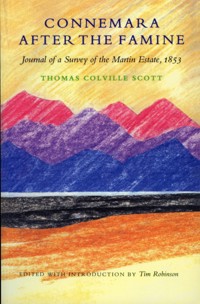
In the aftermath of the Great Famine of 1845-52, the Martin Estate in the West of Ireland, 200,000-acres of bog and mountain, was put up for sale. Its mortgagees, the London Law Life Insurance Society, evicted many of the tenants, and in February 1853 sent Thomas Colville Scott to conduct a survey of their property. This is his journal, recently discovered at an auction-house in England. Colville Scott records many an extraordinary encounter with individual survivors of the famine, some traumatized into idiocy, others mysteriously bettering themselves on well-nigh invisible means. The descriptions of squalid hostelries, rent-evading tenants, thieving beggars and the works of 'Papistry' are those of a cocksure Scots metropolitan – and his account of a meeting of the Clifden Workhouse Guardians is as brutally comic as Thackeray – but his dealings with human flotsam such as the tiny chimneysweep running naked through the snow shows a warm-heartedness that makes this journal as moving as it is richly informative. Drawings by the author and sketches from contemporary guidebooks illustrate the text. Tim Robinson's introductory essay locates Colville Scott's responses within the frame of Connemara history and the nineteenth century. His annotations and map detailing the Martin Estate enable the reader to follow, day by day, the young surveyor on his exploration of 'this inhabited desolation, Connemara after the Famine'.
Das E-Book können Sie in Legimi-Apps oder einer beliebigen App lesen, die das folgende Format unterstützen:
Veröffentlichungsjahr: 1996
Ähnliche
















Connemara after the Famine
JOURNAL OF A SURVEY OF THE MARTIN ESTATE BY THOMAS COLVILLE SCOTT, 1853
Edited & Introduced by Tim Robinson
Contents
Title Page
INTRODUCTIONby Tim Robinson
JOURNAL
NOTES
MAP
Copyright
INTRODUCTION by TimRobinson
In August of 1849, at the Mart in London, a huge property was put up for auction: the Martin estate in the west of Ireland. The vendors were at a loss for words to describe its attractions:
Any description which can be written would fall short of the advantages which would present themselves to the eye of an intelligent person, in his survey of this truly wonderful district. It is impossible for the mind of man to conceive anything necessary but capital, and a judicious application of it, for rendering this vast Property fertile beyond a parallel that this Estate does not contain within itself; facilities for Draining, the formation of Roads, inland Navigation, abundance of lime, sea-weed for manure, valuable kelp shores, innumerable beautiful sites for Buildings, and the soil generally might be designated, to use a homely phrase, as one vast dung-heap…*
The estate, of 196,540 acres, comprised most of the territory stretching westwards from the town of Galway and known as Connemara. The detailed description of it in the sales prospectus was in terms of about two hundred of the basic land-divisions known as townlands, and this was to be read in the light of the following special inducement to buy:
The number of Tenants on each Townland, and the amounts of their Rents, have been taken from a Survey, and ascertained Rental in the year 1847, but many changes advantageous to a Purchaser have since taken place, and the same Tenants by name, and in number, will not now be found on the Lands.
That year of 1847 had been the worst of several consecutive years of famine, and it was to be understood that those missing tenants had abandoned their holdings to crowd into the workhouses or the emigrant ships to the New World, or they were dead; in any case they no longer infested the ground, which was left as a blank canvas on which Capital could paint a fair and profitable landscape.
Topographically Connemara appears as a natural refuge, or as a trap. The twenty-four-mile length of Lough Corrib fences it off on the east, and the Atlantic provides the rest of its bounds: a low and labyrinthine shoreline along the south, westward-thrusting reefs and promontories, and across the north, a sea inlet almost comparable with a Norwegian fiord, Killary Harbour. Steep mountains rising to over two thousand feet occupy most of the northern half of this isolated region, much of the south is a sea-level plain intricately interrupted by some two hundred lakes, and both highlands and lowlands are blanketed with bog, up to ten or fifteen feet deep in places and fed by a copiously oceanic sky. In early historic times (but history only made brief and tentative incursions here until much later) most of this territory was held by a people known as the Conmaicne Mara, the Conmaicne of the Sea; they counted their descent from a Celtic hero, Conmac the son of Maeve and Fergus, but they played no great role in memorable matters, and the name ‘Connemara’ is almost the only trace of their former presence. In the early thirteenth century they were eclipsed by the O’Flahertys, who had been masters of the fertile plain stretching eastwards from Lough Corrib, until they were driven across the lough by the Normans. Thereafter, for three hundred years, the O’Flahertys ruled and feuded in their obscure hinterlands according to the old Gaelic customs, while Galway, controlling the isthmus between Lough Corrib and the bay, grew into a walled city, sea-linked to Renaissance ways and ruled by an oligarchy of merchant and banking families of Norman origin, among whom the Martins were prominent. The disaffected and rebellious O’Flahertys were the natural enemies of the Galway merchants, who, it is said, had the legend ‘From the ferocious O’Flahertys, O Lord deliver us’ inscribed over the west gate of their loyal and industrious little polity. But the Martins learned to deal with the O’Flahertys, and bought some land near town from them, and later obliged them with mortgages on other bits of land further out, which in due course were forfeited and became part of the Martin holdings. Deep in Connemara one of the O’Flaherty strongholds was Baile na hlnse, ‘the settlement of the island’, so called because it was centred on a lake-island castle. When Queen Elizabeth’s statesmen succeeded in partially netting the O’Flahertys in the web of feudal duties and prerogatives radiating from the English throne, the western half of Connemara became the Barony of Ballynahinch, by anglicization of the Irish name of this settlement. Ballynahinch was to become the heart of the Martin estate in later times.
The remorseless rending of Europe between two faiths eventually brought the Galway townfolk and the O’Flahertys into alliance in the 1640s. Both supported the Catholic Confederation in the Irish rebellion that budded off from the Civil War in England; both suffered for it when Protestant Parliament overthrew Catholic King, and Cromwell’s army savaged Ireland. One O’Flaherty chief was hanged and the rest expropriated, and their countless acres of wasteland were distributed to Cromwell’s financial backers and to Catholic landowners dispossessed of better lands now reserved for Protestants. The Martins lost some Galway property and were given large tracts of Connemara, and soon added to them some holdings the Cromwellian grantees were happy to sell off. Not for nothing was the head of the Martin family a lawyer known as Nimble Dick; by adroit self-representation as a friend to both sides, he was restored to some of his old holdings, and later had his ownership of the new ones confirmed by King William. Thus the Martins bobbed to the surface, after fifty years of religious strife, as the largest landowners in either Britain or Ireland.
The next generation of Martins built a mansion on the lakeshore near the ruined O’Flaherty castle of Ballynahinch. Richard Martin, Nimble Dick’s grandson, was the first of the family to be educated (at Harrow and Oxford) as a Protestant; he became Member for Galway in the Irish Parliament and, after the Act of Union in 1800, at Westminster. Nicknamed Humanity Dick by his friend the Prince Regent for his legislation on animal welfare, and known as Hairtrigger Dick for his notorious duels, when quizzed on this contradiction between his attitudes to animal and human life he replied, ‘Sir, an Ox cannot hold a pistol!’ Richard Martin was in all senses an extravagant figure in London society, and Ballynahinch was his necessary refuge from controversy and bailiffs. It seems that the Martins were less oppressive than several neighbouring landlords, and folklore remembers them more kindly; Richard Martin is said to have used the old O’Flaherty island-castle as a prison for peasants who mistreated their animals, but his relationship to his tenantry was more that of a patriarch than of an evicting and rackrenting absentee. The outside world, lifting its eyes from the pages of Sir Walter Scott, found the idea of the Martin kingdom immensely appealing, with its high-spirited defiance of civil law, the devotion of its wild clansmen to their master, its fabled hospitality floated no doubt on a sea of smuggled brandy, and its backdrop of trackless wastes and stormy skies. Charles Lever used Ballynahinch as the setting of a novel, while Maria Edgeworth and Thackeray were among those who visited Richard’s son Thomas Martin in the days when he was called the King of Connemara and his daughter Mary its Princess.
This veil of romance was torn away by the Great Famine, revealing a death’s-head landscape. Reports from Connemara were as terrible as those from anywhere in Ireland. The Martins, bankrupted by generations of high living and the general collapse of agricultural profits that followed the end of the Napoleonic Wars, could do no more for their starving people than the worst of the evicting landlords. Thomas went to visit his former tenants in the workhouse, caught the famine fever, and died; Mary inherited only debts, and fled to Belgium with her newly married husband. The estate had been mortgaged to the Law Life Insurance Society of London, who soon had it put up for sale, with the vulturish commendations I have quoted above, and when there were virtually no bidders, bought it in very cheaply. To make it a saleable property they set about clearing the land by evictions, and, being as well versed in Scott as any, added battlements to the Martin’s plain house. However it was not until 1872 that a London brewer, Richard Berridge, took the bulk of Connemara, plus a few small Mayo estates, off their hands for £230,000—nearly a quarter of a million acres at just under a pound an acre.
I have summarized this history in terms of a few prominent names; but who were these historically anonymous folk who, for their betters, appeared as a mere natural feature of the landscape, to be cleared like scrub when no longer a source of profit? Many of their surnames recalled days that had become glamorous in retrospect: the O’Flahertys were still numerous, and the O’Malleys who looked back to a comparable glory in west Mayo; an even more aboriginal name was that of the O’Queelys, one-time chiefs of the Conmaicne Mara. The O’Hallorans and O’Duans had been stewards to the O’Flahertys, and the O’Lees their hereditary doctors. The Joyces were originally Norman-Welsh and had settled in the north-east of the area under the protection of the O’Flahertys. But all these, together with a few families that had followed their transplanted masters into Connemara in Cromwellian times, were long reduced to a common level. They were Catholic, visited holy wells, revered saints no one outside of Connemara would have heard of. They sang, prayed, mourned and cursed in Irish, and they had their famous story-tellers and poets. They lived in clusters of little one-or two-roomed cabins, under thatch; they farmed on the ancient system known as rundale, each household having a scattering of little stone-walled plots and pastures intermingled with those of their neighbours on the improved land near the village, and the right to graze a certain number of sheep or cattle on the huge commonage areas of bog and mountainside further away. They fished from hide-covered canoes or small wooden sail-boats, cut turf from the bogs and ferried it to the Aran Islands and Galway city for sale as fuel, and gathered seaweed for kelp-burning on the shore. Since their work called for many hands, and extra plots to feed them could always be won from the margins of the limitless bogs, early marriage and lots of children were advantageous, and the population, especially in the coastal areas, grew astoundingly, until it was a puzzle to visitors what they could all be living on.
From the landlords’ point of view these folk were primarily a potato-fed, rent-producing stock. The potato, most years, produced a filling if monotonous food-supply out of small patches of earth well manured with seaweed, so that every other product of the hills, the bogs, the sea and the shore could be sold to pay the rent. As a Roundstone man observed to a visitor in 1844:
Three hundred and sixty-five days a year we have the potato. The blackguard of a Raleigh who brought ‘em here entailed a curse upon the labourer that has broke his heart. Because the landholder sees we can live and work hard on ‘em, he grinds us down in our wages, and then despises us because we are ignorant and ragged.’*
And when the potato failed, as it did periodically because of drought or excessive wet or disease, these ragged ones starved, or emigrated; occasionally there were government road-and harbour-building schemes on which the able-bodied could earn a pittance, and scraps of charity to be begged from the upper classes.
Whereas their neighbours the D’Arcys had developed a town and a port complete with warehouses on their land at Clifden, the Martins had left their estate largely unimproved. The only settlement on it that was more than an agglomeration of cabins was at Roundstone, where the engineer Alexander Nimmo had leased land around a harbour he had built there for the Fishery Board in 1822, and then sublet plots along the new road he had laid out, and so brought into existence a neat village, which had flourished for a few years with the herring fishery, and then had fallen into decline. In general the teeming population of Connemara lived from hand to mouth, unable to lay anything aside against bad times, while most of the Martins’ rent income was wasted in profligate living abroad or sunk in ill-advised mining ventures at home.
Thus when the potato blight struck in four successive seasons from 1845, there was nothing the smallholders, the landless labourers and the fisherfolk could do but plead for a job breaking stones on the Government works, and when those were shut down, sell everything they had, including spades, nets, boats, and even their clothes, to buy food, and then abandon everything to face the horrors of the emigrant ships from Galway or the fever-ridden workhouse at Clifden. Connemara’s agony was of course shared by most of Ireland. Sir Robert Peel’s Tory government and its civil servants reacted energetically to the emergency at first, but, given the general underdevelopment of the country and the ignorance of science as to the nature of the potato blight, their best efforts could not have averted the disaster. The shameful record of the Whigs under Lord John Russell, after the fall of Peel in 1846, cannot be expunged by historical revision; here was a ruling class of immense wealth and power letting its humanity be overruled by the idea that laws of economics were laws of Nature and therefore laws of God—always an attractive belief to those in whose favour the so-calledlaws are working. In 1847 the new government transfered the cost of famine relief onto the Poor Law rates. The result in Connemara was typical: since the rates were levied locally on property owners who themselves were being bankrupted by the loss of their rents, the workhouse had to close, and its desperate inmates were sent out into an utterly destitute world. By the time of the Law Life sale in 1849, another total failure of the potato crop, and the spread of typhus, relapsing fever and dysentry, had seen to it that, indeed, ‘the same Tenants by name, and in number,’ would not be ‘found on the Lands’.
*
Human life sheds evidences of itself in chaotic drifts; History salvages a handful of leaves from the rainstorms and bonfires of that perpetual autumn, and tries to imagine the forest. Here, in this present publication is a leaf that has preserved some sap and colour. It is a journal, the manuscript of which surfaced at an auction in England in 1994, and it covers a few weeks in the life of a young Scottish surveyor, one Thomas Colville Scott. The background sketch I have offered above will make its opening entry quite explicit:
London Thursday, Feby 3rd 1853: Left London this afternoon, by the 5 p.m. Express Train, for the County of Galway, Ireland, to execute my first important Commission, namely, to survey, value, and report on, the ‘Martin Estate’, Connemara, in conjunction with Mr. E.P. Squarry of Salisbury, and Mr. Hitchins, mineral Engineer, London; for a group of gentlemen represented by Mr. ‘Coverdale, Solicitor, Bedford Row,’ and who propose to purchase the entire Estate, containing nearly 200,000 acres, from the ‘Law Life Insurance Company’.
One senses immediately the energetic, factual, commercial temper of Victorian England working like pistons in that 5 p.m. Express Train out of London. But the efficiency of the railway system, recently extended to Galway, only delivers the young surveyor all the more promptly into a land stunned by misfortune. When, five weeks later, back by his own fireside in ‘the great Metropolis’, ColvilleScott tries to arrive at general conclusions, his mood is very different:
If, now, I take a retrospective glance at the scenes and the people I have just left, how puzzling the theme, how vague the thoughts, how indefinite the resolution!
And although he goes on to assure himself that the ‘state of Ireland’ cannot just be a mystery, that it must arise from known historical circumstances, his attempts to explain the horrors he has seen fall back on the colonialist presumptions of his times: the benightedness of the Roman Church, and ‘Paddy’s’ fecklessness; and he concludes a conventional analysis with a stirring appeal to Ireland to emulate his own country, Scotland, in throwing off the trammels of a creed inimical to self-reliance and progress. This historical, political and economic summation is worth reading as an example of ideology at its largely unconscious work of justifying exploitation, and it is salutary to see the benightedness and fecklessness of capitalist thought so exposed. But much more valuable are his day-by-day notes, his unsentimental and spontaneous descriptions of the people he meets as he probes into every corner of the wreckage of the Martin estate, individuals who, whether they are traumatized to the point of imbecility, or are bettering themselves on almost invisible means, are at least spared the final ignominy usual to famine victims, that of burial in statistics.




