


6,99 €
Mehr erfahren.
- Herausgeber: Parkstone International
- Kategorie: Geisteswissenschaft
- Sprache: Englisch
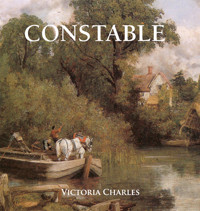
John Constable was the first English landscape painter to take no lessons from the Dutch. He is rather indebted to the landscapes of Rubens, but his real model was Gainsborough, whose landscapes, with great trees planted in well-balanced masses on land sloping upwards towards the frame, have a rhythm often found in Rubens. Constable’s originality does not lie in his choice of subjects, which frequently repeated themes beloved by Gainsborough. Nevertheless, Constable seems to belong to a new century; he ushered in a new era. The difference in his approach results both from technique and feeling. Excepting the French, Constable was the first landscape painter to consider as a primary and essential task the sketch made direct from nature at a single sitting; an idea which contains in essence the destinies of modern landscape, and perhaps of most modern painting. It is this momentary impression of all things which will be the soul of the future work. Working at leisure upon the large canvas, an artist’s aim is to enrich and complete the sketch while retaining its pristine freshness. These are the two processes to which Constable devoted himself, while discovering the exuberant abundance of life in the simplest of country places. He had the palette of a creative colourist and a technique of vivid hatchings heralding that of the French impressionists. He audaciously and frankly introduced green into painting, the green of lush meadows, the green of summer foliage, all the greens which, until then, painters had refused to see except through bluish, yellow, or more often brown spectacles. Of the great landscape painters who occupied so important a place in nineteenth-century art, Corot was probably the only one to escape the influence of Constable. All the others are more or less direct descendants of the master of East Bergholt.
Das E-Book können Sie in Legimi-Apps oder einer beliebigen App lesen, die das folgende Format unterstützen:
Seitenzahl: 50
Veröffentlichungsjahr: 2011
Ähnliche
Author: Victoria Charles
© Confidential Concepts, worldwide, USA
© Parkstone Press International, New York, USA
ISBN978-1-78160-607-0
All rights reserved. No part of this book may be reproduced or adapted without the permission of the copyright holder, throughout the world.
Victoria Charles
Table of content
1. Daniel Maclise, Constable painting, c.1831
2. Riverside; ship against the sunset, c. 1800
3. Incised Outline of a Windmill, fragment of the windmill on East Bergholt Heath, 1792
1. Daniel Maclise, Constable painting, c.1831.
Pencil sketch, 15 x 11.5 cm,
National Portrait Gallery, London.
John Constable is arguably the best-loved English artist. His fame and popularity are rivalled only by those of his great contemporary, J. M. W. Turner. But like Turner, his reputation rests on a handful of very well-known paintings, normally Suffolk scenes such asFlatford Mill(p. 35)or theHay-Wain(p. 48). The latter in particular is so famous that it sometimes overshadows the rest of his work, whereas we know from Constable’s writings that he set greater store by hisStratford Mill, and once declared that it wasSalisbury Cathedral, from the Meadows(p. 71) rather than theHay-Wainwhich best embodied‘the full compass’of his art. For all its fame, even theHay-Wainitself is misunderstood. It isso familiar that it is hard for a modern spectator to grasp the enormous impact it had upon some of the greatest French painters of the day. In order fully to appreciate Constable’s achievement, one must first attempt to clear away some of the many misconceptions surrounding his work.
He was, for example, a more versatile artist than most of his modern admirers realise. It is true that he was deeply and sentimentally attached to the scenery of Suffolk, and unlike many of his colleagues he did not normally tour in search of material; but his friendships and family life forced him to travel, and so there is diversity in his subject matter, embracing the Lake District, Hampstead, Kent, Dorset, Sussex and Salisbury. Many of the magisterial productions of his last years, includingHadleigh CastleandThe Opening of Waterloo Bridge(p. 74)are a far cry from the Suffolk scenes, whilst his accomplishments within the difficult and competitive genre of marine painting have been consistently undervalued.
A persistent error surrounding Constable’s work is that it is somehow‘artless’and untouched by theory–that he simply‘painted what he saw’in response to the beauty of the English countryside. On the contrary, he was a sophisticated, reflective artist whose naturalism was hard-won, based on an incessant study of nature, the Old Masters and wide reading. Far from disdaining theory, Constable’s library is known to have contained an enormous body of theoretical texts, ranging from classic writings by Cennino Cennini, Leonardo da Vinci, Roger de Piles and Gerard de Lairesse, to the more recent works of Sir Joshua Reynolds and Henry Fuseli. Where landscape was concerned, there were few important books that escaped his notice, and he had a thorough mastery of the aesthetic debates which preoccupied his contemporaries. Late in life he even lectured on the subject himself. He was also well versed in science, poetry, history and divinity, and like Turner, he put this fund of self-acquired knowledge to use in his paintings. In short, the breadth of his intelligence and the clarity of his ideas are seriously at odds with the view of Constable as a naïve realist.
2. Riverside; ship against the sunset, c. 1800.
Pen, ink and grey wash drawing, 20.1 x 25.2 cm,
Victoria and Albert Museum, London.
3. Incised Outline of a Windmill, fragment of the windmill on East Bergholt Heath, 1792.
Incised in wood, 29.5 x 39.5 cm, The Minories, Colchester.
It is also tempting to forget that Constable was a professional painter, and that the kind of success and reputation he desired could only be achieved in London within the orbit of the Royal Academy. He could have earned a living in Suffolk, just as his contemporary, John Crome, was able to do in Norwich; but Crome relied for a steady income upon his work as a drawing master whereas Constable looked for a professional status that would match his family’s social position.
Constable had a very high-minded view of landscape and was single-minded in pursuing his own course, but he also craved recognition and tried various strategies to secure it:he increased the scale of his pictures, occasionally varied his subjects and sometimes tailored his paintings to meet the expectations of the Royal Academy. He had an independent income, but it was not enough to support his family, and he was therefore sometimes compelled to sell duplicates of his most successful scenes and to accept uncongenial commissions. These conflicts between his declared intentions, professional ambitions and family responsibilities are fundamental to an understanding of Constable’s career.
John Constable was born in East Bergholt, Suffolk, on June 11, 1776, the fourth child and second son of Ann and Golding Constable. His father was a prosperous local corn merchant. His family’s business interests provided Constable with the allowance which supplemented his meagre income as a painter, and, equally important, with arepertoire of familiar subjects.‘Constable Country’, as it is now known, comprises only about twelve square miles of the Stour Valley on the Suffolk-Essex border. Around 1833, in a text intended to accompany an engraving of the house in which he was born, Constable described East Bergholt as“




