


Erhalten Sie Zugang zu diesem und mehr als 300000 Büchern ab EUR 5,99 monatlich.
- Herausgeber: The History Press
- Kategorie: Sachliteratur, Reportagen, Biografien
- Sprache: Englisch
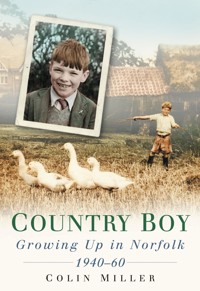
Colin Miller chronicles developments of the 1940s and '50s through the eyes of a Norfolk schoolboy and teenager.
Das E-Book Country Boy wird angeboten von The History Press und wurde mit folgenden Begriffen kategorisiert:
Sie lesen das E-Book in den Legimi-Apps auf:
Seitenzahl: 400
Veröffentlichungsjahr: 2005
Das E-Book (TTS) können Sie hören im Abo „Legimi Premium” in Legimi-Apps auf:
Ähnliche



















COUNTRY BOY
A studio portrait of mother and me, 1945. This photograph was intended to be a gift for my father who was serving with the armed forces in Italy. Mother was particularly fond of her RAF commemorative brooch. We were both good advertisements for a wartime diet. (Regent Photographics)
COUNTRY BOY
Growing Up in Norfolk
1940–60
COLIN MILLER
First published in 2005 by Sutton Publishing
Reprinted 2007
Reprinted in 2010 by
The History Press
The Mill, Brimscombe Port
Stroud, Gloucestershire, GL5 2QG
www.thehistorypress.co.uk
Reprinted 2011
This ebook edition first published in 2013
All rights reserved
© Colin Miller, 2011, 2013
The right of Colin Miller to be identified as the Author of this work has been asserted in accordance with the Copyright, Designs and Patents Act 1988.
This ebook is copyright material and must not be copied, reproduced, transferred, distributed, leased, licensed or publicly performed or used in any way except as specifically permitted in writing by the publishers, as allowed under the terms and conditions under which it was purchased or as strictly permitted by applicable copyright law. Any unauthorised distribution or use of this text may be a direct infringement of the author’s and publisher’s rights, and those responsible may be liable in law accordingly.
EPUB ISBN 978 0 7509 5319 1
Original typesetting by The History Press
Contents
Acknowledgements
Introduction
1
Rollesby 1940–59
2
A Working Family
3
Our House
4
Village Services
5
School Days
6
Health & Fitness
7
Home Entertainment
8
Sport & Leisure
9
Manners, Beliefs & Teenage Culture
Acknowledgements
Writing this book has given me immense pleasure but it would not have been possible without the encouragement and help I received from many individuals and organisations. I wish to thank my dear wife, Dr Celia Miller, for her patience, encouragement and practical assistance; my mother-in-law Edna Bushell, my cousin Stephanie Gallant and my friend Richard Tacon for reading and evaluating the manuscript. I am most grateful for the help given during my research by the staff of the Great Yarmouth Central Library and the Norfolk and Norwich Millennium Library. I must thank my editor, Simon Fletcher, at Sutton Publishing for his valuable assistance and advice. My thanks go also to the individuals and organisations that have permitted me to reproduce photographs and illustrations from their collections. Where possible, I have made every effort to identify and trace all current copyright owners for their permission to reproduce these photographs and illustrations. If I have failed or omitted any person or organisation from the following list, I apologise and suggest that they contact me immediately. My thanks go to Mrs S. Gallant, Mr Cecil Miller, Mr R. Tacon, Mrs G. Tooke, Mrs Sheila Allen, Mr and Mrs J. White, Mr Eddie Bates, Mr M. Teun; Regent Photographics on behalf of D.R. Nobbs & Son of Great Yarmouth; Archant Norfolk Limited for the Great Yarmouth Mercury and Eastern Daily Press, in particular Jenny Sheldrake of Front Office Photosales; Norfolk County Council Libraries and Information Service, especially Aimee Lawrance, Picture Norfolk Administrator; and Mrs E. Ward, local history librarian at the Great Yarmouth Central Library.
Introduction
The following is an account of my early life in Rollesby, a small Broadland village in the county of Norfolk, during the years 1940 to 1959 based mainly on my memories of that time. My recollections cover the period when Britain was at war with Germany, through post-war austerity until, eventually, Harold Macmillan allegedly proclaimed ‘You’ve never had it so good’; through the period of nationalisation, the creation of the National Health Service and growing working-class expectations arising from the 1944 Education Act; through a time when Communism was in its ascendancy and war with Russia was a distinct possibility, and when the British Empire painfully evolved to become a Commonwealth of equals. Not that I was aware of these developments, although some undoubtedly directly or indirectly affected my early years. My memories are simply recollections of life in a small rural community as seen through the eyes of a child. Although I can remember wartime and its immediate aftermath, my clearest memories are of the late 1940s and the 1950s, a period when my mother, father and I lived as a family in a modest, rented semi-detached house on the Martham Road in Rollesby.
In this account I have tried to describe my memories as accurately as possible without recourse to any additional embellishments or fabrications in order to produce a good story. Neither have I attempted to analyse or pass judgement upon my recollections; this I leave to my reader. If possible I have substantiated my memories by referring to friends, relatives and a careful trawl of contemporary local newspapers, particularly the weekly Great Yarmouth Mercury. Where appropriate I have supported my descriptions with extracts from newspaper reports.
During a period of almost twenty years it is inevitable that many changes will have occurred, not only nationally but within a small village community. Nevertheless change was slow in a country recovering from the effects of a World War, much slower than those that have taken place during the last twenty years. Yet change did occur and in my text I have tried to identify those changes that affected family and village life during my childhood. To this end I have organised my memories thematically describing in turn the village, my family and my home, local employment, village facilities, education, health, entertainment and leisure. In the text I have referred to some individuals by name, but have done so only where I am sure that no embarrassment or offence will be incurred by those identified or by their friends and descendants. I also refer to my parents as Mother and Father when, in reality, I addressed them by the more familiar titles of Mum and Dad. Finally I have included a chapter exploring my recollections relating to manners, beliefs and the emergent teenage culture of the late 1950s.
The village of Rollesby, 1940–60.
The result, I believe, gives a glimpse of village and family life in the 1940s and 1950s, of the joys and difficulties of growing up in a rural community and of a way of living that has long disappeared. It was a time when television sets were a rarity and most people relied on public transport rather that the motor car, a time before supermarkets, out-of-town shopping malls, computers, e-mails and cheap continental holidays. Although my memories of childhood are mostly pleasurable, it is not my intention to suggest that these were the ‘good old days’ or to compare them unfavourably with village or family life in the twenty-first century.
1
Rollesby 1940–59
I was born on 5 August 1940 in the village of Rollesby, 8 miles north-west of Great Yarmouth, in the centre of Broadland Norfolk. To be precise, I was born in the back bedroom of an historic thatched house opposite Rollesby Church known locally as Old World Cottage. According to an inscription on its gabled end the cottage was built in 1583 and had clearly seen better days, as during the 1940s it was divided into two small semi-detached residences. The roadside half, where my mother was staying, had been enlarged by the addition of a corrugated iron roofed single storey kitchen extension. Local folklore suggests that, in 1600, the cottage was also the birthplace of Rollesby’s most famous inhabitant, Thomas Goodwin, a puritan clergyman who was at one time both chaplain and friend to Oliver Cromwell.
My mother’s account of my birth acknowledges that it was not any easy one as she insists that her labour began in the evening of 3 August and continued until the early hours of Monday 5 August, a Bank Holiday Monday when the August holiday was taken at the start of the month rather than the end as now. Some of her difficulties were undoubtedly caused by my apparent insistence on arriving feet first and that I needed to be turned many times before eventually acceding to arrive in the conventional manner. The forceps’ scars that can still be seen at the front and back of my head indicate that even then I needed some persuasion to be born. At the time of my birth, England was at war with Germany and the Battle of Britain had yet to be won. My mother often recalled that part of that battle was being conducted overhead as I was being born and that she was praying that a bomb would land on the cottage to put an end to her misery. Ultimately we were both pleased that no bomb fell. When I had been tidied up the midwife, appropriately named Mrs Nurse, announced that ‘In later life this child will be bald’, a prediction that, inevitably, proved to be all too accurate.
Whether or not it was a consequence of my extended arrival, I was destined to be an only child. Not that this was a problem, as I received far more love and attention from my parents, particularly my mother, than I could have expected as a member of a larger family. Nor was I in any way indulged – I did not have many or expensive toys, for times were hard just after the war and money was scarce. However, I did not want for company, although I did learn to enjoy and sometimes crave being on my own. As well as many village friends, I was fortunate in having a large extended family. On my father’s side, my Rollesby grandparents, Walter and Nora Miller, had had six children, four boys and two girls: Dorothy (Dolly), George, Elsie, Cecil, Raymond (my father) and Kenneth. Kenneth unfortunately died of diphtheria in 1924 while still an infant. My maternal grandparents, Arthur and Edith Cole, lived at 12 North Market Road in Great Yarmouth and had also produced a large family consisting of four boys and three girls: Arthur, Stanley, Edith, Edward, Doris, Gertrude (my mother) and Bob. By the 1940s, all my aunts and uncles were married and had children of a similar age to myself. Apart from Grandfather Cole who died when I was two years old, my surviving grandparents and many of my aunts and uncles continued to live locally. Consequently the benefits derived from being a member of two large and close families, and the company and friendship of many young cousins, compensated greatly for the lack of brothers or sisters.
At the time of my birth, my mother was staying at Old World Cottage with two of my aunts, Doris Miller and Elsie Ward. Both uncles, Cecil Miller and Reginald Ward, had already been called up for army service while my father, being a bricklayer and in an exempted occupation, was employed by the RAF as part of a construction gang that travelled around the country building airfields. Before the war my parents had moved to Birmingham in search of work and remained there until the outbreak of hostilities when my father moved back to Rollesby so that my mother could be supported by his family while he did his bit for the Royal Air Force. Soon after my birth, we moved into a rented property on Martham Road in Rollesby which became my home for the next nineteen years. My father continued his travels around the country eventually joining the Royal Engineers in 1942 and seeing action during the Italian campaign. At the end of the war he remained in service with the army for a further two years, attached to the British occupation force in Austria. It was 1947 before he was finally demobilised and we were able to become a whole family once again. My early life in Rollesby continued until Tuesday 6 October 1959, when I loaded my new red trunk, filled with all my possessions, into the goods van of the 9.20 a.m. steam train from Great Yarmouth’s South Town station. Making sure that I was unobserved by any of my contemporaries, I kissed my mother goodbye, shook hands with my father and boarded the train for Leicester, university and the next phase of my life.
THEVILLAGE
The village of Rollesby lies between Ormesby and Repps on the A149, approximately 8 miles north-west of Great Yarmouth and 17 miles north-east of Norwich. Rollesby’s ‘by’ ending suggests that the village was established in the ninth or tenth century during the Danish settlement of East Anglia when Rollesby would have been located on an island, the Isle of Flegg, surrounded by the water and marshland of a great shallow inland estuary situated behind the sandbank on which Great Yarmouth now stands. Although the word Flegg derives from an Old Norse word meaning flat, the Rollesby landscape of the 1940s and 1950s was a gently undulating agricultural patchwork of hedged fields, woods, scattered farms and homesteads. Most of the village population lived either side of a 1 mile stretch of the A149, the Main Road, between the bridge – a narrow humpbacked bridge that crossed a short cut joining the Ormesby Broad to the Rollesby and Filby Broads – and the Horse & Groom crossroads where the A149 was crossed by the B1152 which linked Acle and Fleggburgh, to the south-west, with Martham, Hemsby and the coast to the north-east. Located on one corner of the crossing was the Post Office and Stores belonging to my grandparents, while a mere 50 yards along the B1152 towards Martham, the stretch known appropriately as Martham Road, was the small semi-detached house that became our home. Two other narrow lanes, the Back Road and Court Road, linked the A149 from close by the bridge to the B1152 either side of the Horse & Groom. Further short lanes and tracks led to numerous isolated farmsteads and houses.
The primary form of employment within the village was in agriculture, a combination of mixed farming, market gardening and fruit growing. Rollesby had three large farms of 150 acres or more, together with a number of smaller council owned holdings of 40 to 50 acres. Rollesby did not have an easily identifiable centre. Small groups of farms and houses were scattered throughout the village, each group identified by a place name such as Cowtrot, Old Maid’s Corner or ‘Up the Heath’. Most private housing had been built close to the A149 with two major concentrations at the opposite ends of the village, one between the school and the bridge, and the other around the Horse & Groom crossroads. Most accommodation was rented, either as council housing, privately owned lets, or houses tied to agricultural occupations, the latter mostly associated with the larger farms or with the Rollesby Hall estate. Apart from a few bungalows near to the Horse & Groom, little new housing was built in the village during the 1940s for the most part because of the lack of a mains water supply. In the early 1950s, two small housing developments were built along the Main Road, a private estate of ten houses for rent opposite Belle Vue terrace and, in 1952, a small council estate near to the school appropriately named Coronation Avenue. Little other new building took place until the bungalow boom of the 1960s. Consequently the village population was relatively static and changed little during the years 1940 to 1959. In 1931, the village had a population of 456; in 1951, 524 and in 1961, 533. Until the 1960s newcomers were a rarity and those that did move into the village mostly came from adjoining villages. The dominant accent was Broadland Norfolk. Those few incomers with an accent from outside East Anglia were treated with curiosity and, occasionally, suspicion.
The nearest we had to a community centre was the recreation field, known officially as King George V’s Playing Field. Rollesby had no functional village hall and most communal indoor activities – wedding receptions, whist drives, dances and socials – were held in the school next to the recreation field or at a hall in the adjoining village of Little Ormesby. A ‘Church Room’ donated to the village in 1929 for use as a community hall had been badly damaged by fire during the war and was little used thereafter. From the early 1950s, efforts were made to gain funding for a replacement facility and, as a result, in 1959 a new village hall was erected on a piece of waste ground immediately behind the bowling green of the Horse & Groom public house.
. . . there is the Church room, which Rollesby used to do duty as a parish hall. This caught fire when troops were billeted there during the war and has been untenable ever since. As a result, social activities in the village are on a very reduced scale as there is just nowhere to hold meetings or social gatherings except the unsuitable hut on the playing field – the only King George V Memorial playing field in a village for miles around.
‘Portrait of Rollesby’, Yarmouth Mercury, 7 July 1950
Three of Rollesby’s most historic buildings, Rollesby Hall, the Old Rectory and Rollesby Courthouse, were requisitioned by the government during the war to house troops or evacuees from London and, by the end of hostilities, all were in a state of disrepair and mostly empty. Rollesby Hall, dating from the seventeenth century and owned by Colonel and Mrs Benn, was in such a derelict state that it was never reoccupied and was eventually demolished in 1950 to be replaced by a modern building in a Norwegian style. I visited the old Hall a number of times with my grandfather but can only vaguely remember a decaying building, surrounded by rhododendron bushes, which contained large, dark, damp, empty rooms with wood panelling on the walls. Having ceased to be the residence of Rollesby’s vicars, the Old Rectory with the attached Church Room remained empty until 1950 when it was sold for redevelopment as private housing. Rollesby Courthouse, originally the Union Workhouse and Magistrates Court for East and West Flegg, was also sold to become a private house in 1946.
However important these buildings may have been, they feature very little in my recollections of Rollesby. My memories are related to family, our house on Martham Road, my grandparents at Rollesby post office, the farms and homes of my friends, Rollesby Broad, the church, the primary school and the recreation field, the Horse & Groom and the Eels Foot in Ormesby, the football and cricket clubs. As a young child the village was my world and, along with all the other local children, I was allowed to roam unrestricted anywhere within its bounds. There was not a road, track, farm, field, meadow or wood that I had not explored. Personal safety was not a serious consideration in days when local transport was more likely to be a bicycle than a car, a time when most residents worked in the village and strangers were rare. There were very few places that I could go without my presence being noted by some adult and, occasionally, reported back to my parents. My mother and father frequently seemed to know where I had spent my day even before I had time to tell them. In a quieter world we were able to communicate among ourselves over reasonable distances by means of various finger-assisted whistles or yodels. Many parents were exceptionally skilled at throwing their voices and could call their children home for tea from relatively long distances.
ROLLESBY BROAD
The 600-acre lake formed by the Rollesby, Ormesby and Filby Broads, known collectively as the Trinity Broad, is now acknowledged to be the result of peat digging during the Middle Ages and not, as I was taught, left over puddles from the last Ice Age. Being separate from the larger Broads’ navigation system they were, for the most part, unaffected by the pre- and post-war growth in tourism and, for this reason, they had become a source of drinking water supplying Great Yarmouth and surrounding districts. A large waterworks had been built adjoining Ormesby Broad to extract and purify the murky Broads’ water. As a result, in the 1940s and 1950s, the Trinity Broad was free from the motorboats and yachts associated with the holiday industry and provided a tranquil and picturesque location for fishermen, birdwatchers and local villagers to use and enjoy. At weekends and evenings during the fishing season, the bridge was usually crammed full of small boys dangling fishing rods over its parapets. From time to time a float would disappear under the water and, accompanied by a whoop of delight, a line would be reeled in usually to reveal a small, wriggling, silver fish attached to the end, barely worth the time, effort and enthusiasm expended in catching it. If lucky, the fish would be quickly detached from the line and returned to the water from which it came. If unlucky, it would be taken home as a treat for the household cat. I, too, had a fishing rod and occasionally took my place with the other small boys on the parapets of the bridge. My fishing rod was bought for me by Grandfather Miller and consisted of four varnished bamboo sections with a cork handle all contained in a purpose-made cloth bag. A reel was attached to the rod by two ornamented metal rings. My colourful spare floats, lines, hooks and lead weights were all contained in an old biscuit tin. I was extremely proud of my rod as most of the other boys’ rods only had three sections. I was, however, unaware that the rod was for sea fishing and not particularly suitable for the freshwater Broads. I mostly enjoyed casting the line, taking great pride from landing the float on top of a predetermined point in the water. I frequently practised this art from out of my upstairs bedroom window to the annoyance of my mother. I actually disliked fishing, and I felt very sorry for any fish that finished up on the end of my line. My earnest hope was that I could detach the unfortunate creature from my hook without causing too much damage to its mouth. Regrettably, this was not always possible.
Most adults preferred to fish from small boats that they rowed out into the centre of the Broad well away from the jostle and noise of the shoreline rabble. Boats could be hired from two nearby jetties, one close to the bridge behind a public house called The Sportsman’s Arms, now delicensed and a private house, and the other at the curiously named Eel’s Foot Inn in Little Ormesby. At weekends, particularly during the summer, boats were in great demand by fishermen, families intent on a recreational row around the Broad and young couples seeking a private place in the reeds to do their courting. I was lucky in that Grandfather had his own private landing stage at the bottom of a field adjacent to Rollesby Broad that he hired from the waterworks’ company for use as a market garden. The landing stage consisted of a small channel cut through the reeds together with a fairly rickety wooden jetty constructed from three pairs of upright stakes driven into the soft mud of the water bottom. Each pair of stakes was connected by a horizontal bar a foot or so above the waterline on to which planks were laid to form a walkway. As a small boy, I was never totally confident when walking on to this jetty as it seemed to be most precarious. However, it was extremely unlikely that I would have come to any harm if I had fallen off, as the water was very shallow at that point. Attached to the jetty was Grandfather’s rowing boat – a rather cumbersome and heavy vessel that he insisted had at one time seen service as a lifeboat. Before it could be used it was frequently necessary to bail out all the rainwater that had collected inside since its last trip. Often, after heavy rain, the boat was barely afloat.
Despite my indifference to angling, I regularly accompanied my uncles, Cecil and George Miller, on fishing trips in grandfather’s boat. Once settled on the Broad, my uncles would have a competition to see who caught the most fish, each keeping their catches in nets which they hung from the stern of the boat. In the quiet times between catches they would quaff whisky or brandy from large hip flasks while I would pig out on a pile of jam sandwiches made for me by my mother. We would often sit in silence listening to the calls of moorhens, coots and great crested grebes echoing across the Broad, our eyes glued to the small colourful floats that bobbed continuously on the surface of the water. I quickly learnt to distinguish between the different types of fish that we caught and could easily recognise if they were perch, rudd, roach, bream or some other variety. Eels were common and disliked intensely by all freshwater fishermen as, if caught, they would tangle themselves around the line or in the mesh of the landing nets. It was almost impossible to detach an eel from a fishing line without damaging it or incurring harm to oneself. In the winter, my uncles would fish for pike. Grown large with the easy pickings of a well-stocked Broad, these fishy predators were a prized catch, the largest of which usually ended up stuffed and displayed in a glass case at a local public house. I can remember pike-fishing expeditions on mornings so cold that ice had formed on the surface of the water. On one particularly cold trip we spent all day fishing without any sign of a catch when, to my surprise, as we reeled in our rods for the last time, hooked on to the end of my line was the one and only pike that I ever caught. Perhaps I can understand the pleasure gained from fishing for such game as, with encouragement and advice from my uncles, I battled with the fish for at least fifteen minutes before it was at last landed into the boat and dispatched. After proudly displaying my catch to my family and friends it was given to a local resident who considered pike to be an edible delicacy. None of our family ate pike, considering it to be tasteless and with too many bones.
As small boys we also learnt to swim in the Broad, although this was another activity I did not particularly enjoy. On warm summer days, gangs of boys and girls made their way through the woods behind the allotments on Court Road to a shallow part of the Broad, called Lily Broad, where they could swim and splash about in relative safety. My reluctance to join in undoubtedly resulted from the fact that, being small for my age, I was always the one to be thrown in or ducked. I preferred to swim alone when I would breaststroke at my own pace across a narrow part of Lily Broad, my head held well above the surface of the water. In the harsh winters of the late 1940s and early 1950s the Broads regularly froze and many adults were able to enjoy a period when they could skate on the iced-over water. My father was a keen skater and I well remember accompanying him on to the Broad where I was left standing, cold and rather apprehensive, as he glided and twirled at breakneck speed over the ice. My fear of being on the ice was worsened by his habit of testing its strength by jumping up and down, often causing cracking sounds to rifle across the surface, seemingly for miles, something that he always seemed to ignore.
Skating on Rollesby Broad, 1954. The Trinity Broad regularly froze over during the harsh winters of the 1940s and ’50s. Skaters travelled from near and far to perform on the ice. My father owned a pair of ice skates which he used as often as possible. (Author’s Collection)
Skating on the Broads – Ice 12 inches thick at Rollesby
The Norfolk broads, world famed summer holiday attraction, has since that great freeze became a winter sporting centre. Skaters have been travelling from neighbouring towns and villages during the last two weeks to the Rollesby Filby Ormesby Broads where the ice is 12 inches thick. It is possible to walk from Rollesby to Filby Bridge. Otters have been seen at Eels Foot where there is a small stretch of open water. The stretch, too, is covered by wild fowl seeking food. Many wild birds, particularly water hens, are being found dead.
Yarmouth Mercury, 1 March 1947
THEPLAYINGFIELD
Most outdoor activities within the village, official and unofficial, took place on the playing field. On weekdays during term time the village school used the field for PE and games activities, at weekends it was home to the village football and cricket teams. In summer it hosted the village fete and on 5 November a massive bonfire. In a corner of the field close to the Main Road were three swings, a see-saw and a sandpit. Erected just after the war as a facility for village children, they were a potential source of injury as well as enjoyment as no soft safety surface was provided under the swings and many children were injured, albeit none seriously, through falling on to the ground underneath, which often had been baked as hard as concrete by the sun. My own enthusiasm for swinging was seriously dented after I fell backwards off one of the swings and lay on the ground for some time, stunned and winded. The sandpit became a convenient toilet for every cat within a radius of about a mile.
Fete and Show
Rollesby’s annual fete and horticultural show was held on the playing field on Saturday. The show was opened by Mrs I B H Benn and the children’s new amusement corner was opened by Mr J Gaze, chairman of the King George’s Playing Field trustees. Children’s sports, competitions and side shows were well patronised and Mr H Marsden Smith auctioned the show exhibits on behalf of the Playing Field Fund for which the effort was organised.
Yarmouth Mercury, 2 August 1947
In another corner, at the far end of the field and away from the road, was the men’s toilet. This consisted of a square enclosure, fenced with corrugated iron sheets and surrounded by firs for additional privacy. Men and boys would normally pee against the sheets or into a long strip of guttering conveniently attached to one side of the enclosure. At each end of the gutter was a hole. When in use, the contents of the gutter would empty through these holes on to the ground or, more often than not, over the shoes of some inattentive individual. For a while there was no facility for women; then, to the relief of the ladies, a lavatory for women was sited on the opposite corner of the field consisting of a lockable wooden shed containing a cylindrical chemical toilet. A large, green, wooden hut had been erected adjacent to the school for use as a changing room and for any other purpose as needed by the various playing-field users. These facilities were improved in 1948 when an electricity supply was installed. As far as I remember, the internal fittings of the hut consisted of a sink, one cold tap and one electric socket, a small counter at one end opposite the only door, and six or more collapsible wooden benches and tables. Despite this simplicity, it was a great improvement on what had gone before and provided a location for cricket teas, refreshments for village fetes and sports days, and a meeting place for the Ladies’ Club as well as a room for teams to change in.
New club for women
To fill a long felt want the sports pavilion has been adapted to provide a clubroom for women. It will be officially opened next Tuesday at 2.30 p.m. A whist drive (was held) in aid of the Playing Field Fund on Friday, £10 was raised.
‘Village News: Rollesby’, Yarmouth Mercury, 18 March 1949
A veranda with a long bench seat was eventually attached to one side of the hut, financed from funds collected to celebrate the coronation of Queen Elizabeth, to be used as a shelter from which spectators could watch sporting activities on wet days. However, this veranda became the main meeting place for the young people of the village, particularly Rollesby’s teenagers. At evenings and weekends, in winter as well as summer, the veranda would be full of children and teenagers discussing and doing what children and teenagers discuss and do when they get together, their bicycles littering the grass in front of the hut. On dark winter evenings many teenagers would contrive a convenient excuse to get out of their houses to join the multitude huddled together on the veranda seat. Luckily, I had aunts, uncles and grandparents in the village that I could visit. The visit normally lasted only five minutes, sufficient for a good alibi, before I cycled full pelt to the playing field. On the veranda, the very young made a lot of noise but were usually just onlookers, learning the art of growing up, while the eleven and twelve year olds lit up cigarettes ‘borrowed’ from packets left unattended by their parents. By thirteen the girls were discovering boys, by fourteen the boys caught up. We discovered the strange excitement to be had by sitting close to a girl, holding hands or engaging in nervous silly conversations and, sometimes, pairs ended up cuddling and kissing, always under the careful scrutiny of the very young. Occasionally, a pair would leave the shelter of the veranda to ‘go down to the bottom of the field’, shadowed silently but remorselessly in the dark by the young observers who spied on them from behind tufts of grass or the ladies’ toilet. I never really discovered why others found it so exciting to venture down to the bottom of the field as my trips in that direction were uneventful and never as described to me by others who had gone before.
On Saturday and Sunday mornings, the veranda was usually occupied by numerous boys of all ages waiting for someone to arrive with a football. My arrival was always greeted with enthusiasm as my Grandmother Miller was very generous and had bought me a full-sized leather football. A tennis ball had to suffice if there were no footballs to hand. Once the team captains had been selected, the remaining boys, and occasionally a girl or two, formed a line from which these captains, in turn, selected the members of their team. Usually the youngest or the most inept were picked last. On good days teams could be a dozen or more on each side, one team playing as shirts and the other as pullovers. Mostly we played in our everyday clothes as few children owned a proper football kit. Some, like me, had football boots: stiff, brown, ankle-high leather boots with a hard toecap and tied up by long white laces. Underneath each boot were six cylindrical leather studs, each stud being attached by three small metal pins. Periodically these pins protruded through the bottom of the boots and gouged holes in the soles of our feet while we played. Those without boots played in plimsolls or their ordinary shoes. We were lucky that, for the duration of the football season, the playing field boasted a marked out football pitch with permanent goalposts at each end. For young boys a full sized pitch was often too demanding and, consequently, our second goal was normally located on the halfway line, marked out by two piles of coats. The resulting additional wear and tear to the pitch became evident by the end of the football season when the goal area of the end most used became totally devoid of grass and resembled a mud bath when it rained, and, as a result, goal chances were often missed in the Saturday afternoon adult games when the ball became stuck in the mud. Sometimes, when neither a football nor a tennis ball was available, we cycled mob-handed to the Martham Recreation Field, where a similar game was usually underway, to deliver an inter-village challenge. The resulting match frequently degenerated into a game resembling more a cross between rugby and boxing than classic football.
THE HORSE & GROOM
Dominating the crossroads, the Horse & Groom public house, tied to Lacon’s Brewery of Great Yarmouth and managed by Mr and Mrs ‘Buster’ Curtis, was the centre for many village activities. The solid square building was constructed in dark brick and had a large entrance porch supported by four upright wooden columns framing the main entrance. To the right of the porch, two wooden hatch doors led down to the cellar. A 3-foot tarred border ran around the base of the building and in summer this often bubbled in the sun, becoming subject to frequent prodding by the fingers of inquisitive little boys. From the porch, the front door opened into a poorly lit through passage which gave access to the public bar on the left, and a small narrow lounge on the right. Although I was very familiar with the outside, the interior remained a mystery until I was eighteen as the village policeman from Fleggburgh was so diligent in performing his duty that our area of the Fleggs was frequently commended by the licensing court for the lack of prosecutions for drunkenness. However boys will always find a way to be boys, particularly teenage boys, and to that end we developed an interest in bowls. To the back of the public house was the bowling green, a popular summer venue for teenagers as well as for the serious bowls player, which consisted of a perfectly tended green playing square adjoining the pub garden and enclosed by a high fence made from Broadland reeds. A small summerhouse, also made from reed and containing a wooden bench seat, stood halfway along one side. During opening hours we were able to borrow a set of bowls from Mrs Curtis at the back door of the pub and, in the summer months, we became very proficient bowls players – although that clearly was not the main purpose of the exercise. Whether or not Mrs Curtis was aware of our ages, it was usually possible to obtain a half-pint of Lacon’s bitter, or shandy for the less adventurous, at the same back door. If challenged, we would pretend to be purchasing drinks for an adult playing on an adjacent lane. The location of the green gave adequate time for illegal drinks to be well hidden should the Fleggburgh policeman make a call. Not that we imbibed alcohol to excess as limited funds ensured that we remained relatively sober.
To the front and along one side of the building was the pub car park which also served as a stop for the red number 5 Eastern Counties bus that travelled through the village on its way from Norwich to Great Yarmouth and back. Passengers often made use of the wooden bench seats along the front wall of the pub to rest their feet while waiting for the bus to arrive. On Saturday winter evenings a crowd gathered for the arrival of the 8.30 p.m. service from Norwich which delivered copies of the Pink ’Un, a Saturday only evening newspaper that reported on the major national and local sporting activities of the day, including the football league and, in particular, the fortunes of Norwich City Football Club, then in Division 3 South. Once delivered, the Pink ’Un could be purchased from the Horse & Groom car park and my father regularly sent me there to obtain a copy so that he could recheck his football pools coupon, as he was always concerned that he might have misheard the results declared on the radio at the tea time edition of Sports Report and could, after all, be this week’s winner of the £75,000 Vernon’s Pools’ jackpot. A mobile van selling fish and chips usually arrived just before the bus and did a good trade with the waiting villagers and the customers inside the pub.
The car park was also home to a bright red telephone box that was in almost constant use, as very few people owned a personal telephone. Queues often formed outside as users waited impatiently for their turn. At weekends and on early weekday evenings, it was mainly used by teenagers and single men and women arranging dates with similar teenagers and singles at other boxes in neighbouring villages. Occasionally confrontations occurred between those waiting and those inside the box, particularly if their conversations were overlong, and I can remember one incident when a person using the telephone was locked in the kiosk by some impatient youths who had secured the door with wire. Sometimes personalities arrived at the pub, no doubt hoping for some anonymity and a quiet relaxing drink in the depths of rural Norfolk, well away from the holiday resort of Great Yarmouth. I can clearly recollect my grandfather frantically knocking on our back door to inform us that the popular entertainer George Formby was drinking at the Horse & Groom. Along with most of the other residents from our part of the village, we formed an excited but uninvited audience, adults inside and children outside standing on benches to peer through the window, while, to enthusiastic cheers, a thin-faced man with protruding teeth was persuaded to pick up a ukulele and perform a number of songs accompanied word for word by most of the assembled villagers.
ST GEORGE’S CHURCH
From Fleggburgh the B1152 to Martham meandered into Rollesby, passing the junction with Court Road, Church Farm with its magnificent thatched barns, and on to St George’s church, situated opposite to Old World Cottage where I was born. Built from stone and flint with an octagonal tower on a round Norman base, St George’s church is situated on the top of a small rise and, undoubtedly, identifies the location of the original village centre. However, it is clear that sometime in the past this centre moved as, in the 1940s, only the Rectory, the Grange, Old World Cottage and Church Farm remained in close association with the church.
Although my parents were not regular worshippers, I was encouraged to take part in many church activities. In her younger days my mother had been a Sunday school teacher but, somewhere along the line, had lost her enthusiasm for organised religion – perhaps the experience of war had challenged her beliefs. As a family we rarely discussed heady issues such as religion, so I was surprised when, one summer’s evening, mother suddenly confessed to me that she had difficulty in believing in God or that we went to Heaven after death. ‘If there is a Heaven, it has to be right here on Earth, and if you don’t believe me then look at that,’ she said, pointing to a marvellous Norfolk sunset occurring in front of our eyes. My mother was a lovely lively person who always saw the best in everybody and everything. My father had twin passions: my mother, who we both adored, and sport, particularly football. These two passions, together with his commitments to work and the home, gave him little time for Sunday services. Like many others, my parents only maintained an appearance of religious observance by attending church for christenings, weddings, funerals and other special occasions.
It was my Grandfather Miller, a Church of England enthusiast, who was the prime mover in encouraging me to attend at church. Like his father before him, he was both parish clerk and churchwarden and attended Sunday services on a regular basis. Grandfather enjoyed church and sang the hymns of the day at the top of his voice, providing his own adaptations to both tune and words. To me, Sunday service was an unintelligible ritual and I perceived God as an all-seeing Father Christmas-like figure who would grant wishes as a reward for good behaviour. My occasional bedtime prayers were usually a lengthy list of requests relating to issues of importance to a small boy. ‘Please God, let me not wet the bed tonight’, ‘Please God, let me live forever, or at least until I am one hundred years old’, ‘Please God, let Rollesby win the football match on Saturday’. I enjoyed going to church not for any religious reason but for the activities that took place there. On Sunday afternoons, along with a dozen or more other village children, I attended Sunday school which took place in a side aisle of the church in front of a small altar table and underneath a stained glass window. The window, depicting an old man carrying a lantern and based, no doubt, on Holman Hunt’s Light of the World, strangely fascinated me, particularly in the way that its colours changed and glowed in the sunlight. I happily blanked out the boring bits of Sunday school and the Sunday morning sermon by gazing intently at this amazing window or staring fixedly upwards at the blue ceiling covered in gold stars. At Sunday school we listened to stories from the Bible, learned to say the Lord’s Prayer and sang inharmonious versions of favourite children’s hymns like ‘All Things Bright and Beautiful’. At various times during the year and always at Christmas and Easter, we would perform religious plays in front of invited parents and relatives. In various Christmastime Nativity plays I progressed from a brief appearance as third shepherd to, eventually, the part of Joseph. At the end of Sunday school all the children were given a small pictorial stamp depicting some event from the Bible with an appropriate moralising caption, which I stuck into a scrapbook as a record of my attendance.
Mothering Day Service
A special service for Mothering Sunday was held at Rollesby church last Sunday. Presents taken by the Sunday School children and bunches of violets and primroses were presented to the mothers. The service was conducted by Mr Carpenter of Filby. The children taking part included G. Evans, J. Hewett, G. Gilbert, C. Miller, R. Wymer, T. Tubby, K. Knight and C. Ransome.
‘Village News: Rollesby’, Yarmouth Mercury, 24 March 1950
The Sunday morning service became less of a bore when the vicar, Mr Grundy, invited me to join the choir, which I enjoyed not for the singing but for the dressing up. At best, the choir consisted of no more than five or six persons, normally three adults and three boys, all dressed in red gowns with white surplices. At the beginning of the service, we proudly marched in procession along the central aisle from the tower room to the choir stalls. Leading the procession would be one member of the choir carrying a large brass cross, followed by the rest of the choir in two columns and, bringing up the rear, the vicar in his finery. At the end of the service, we marched back again. For me the singing was a chore, particularly as I didn’t possess a very good singing voice and was incapable of remembering the words to even the most regularly sung hymns. As hymnbooks were frequently unavailable in the choir stalls I did a great deal of humming, which didn’t matter too much as my grandfather’s weekly vocal virtuosity hid many of the shortcomings of the choir.
The most enjoyable task allocated to the choir was to ring the church bells for the half hour prior to morning service. St George’s had three bells which we rang one after the other in sequence, without attempting any complicated variations. For the last five minutes before the service a single bell was rung, usually the largest and loudest, to inform those late for worship that the service was about to start. Choir attendance was variable, particularly in winter or at harvest, and there were times when I was the only member of the choir present. Then I rang the bells by myself. Ringing three bells was possible by standing on one leg with a rope in each hand and the third looped on to the end of my other foot. This often proved too much for a small boy and I was regularly lifted off my feet by the upswing of one of the ropes, upsetting the rhythm of the ring and resulting in a chaotic cacophony from the belfry. Occasionally, a boy from the choir would be asked to pump the bellows that supplied air to the organ. St George’s church organ was situated to the right of the main aisle, just below the pulpit. Next to the organ and reaching almost to the roof was a three-deep bank of pipes, activated by air from the bellows located in a small room behind the organ seat. At a preordained signal, usually a withering glance from the organist, an ancient lady in a hat and long coat who arrived at church on a tricycle, the selected choirboy dived into the cubicle and began energetically pumping, although often too late to avoid the first notes sounding like a badly played bagpipe. My interest in church activities eventually waned at about the age of eleven when a combination of school homework, sport – football in winter and cricket in summer – and, eventually, the pursuit of girls occupied most of my weekend hours.




